
The confluence of events in the last few years have done no wonders for the economic performance of any country, but the longer-term performance of the British economy in the wake of the financial crisis is even more worrying. With the prospect of a sustained fall in real disposable income due to general inflation and, in particular, the severe rise in energy prices, the importance of renewed economic growth is only clearer. Indeed, we need to be clear that economic growth is a moral imperative. A growing economy is essential to the welfare and well-being of the whole nation, enabling all to flourish. Naturally, there will be political debate over the means and extent of the distribution or redistribution of the proceeds of growth, but the case for economic growth in principle needs to be made again and with clarity.
As Sam Ashworth Hayes argues by some measures the average employee earnings in the UK have never recovered since the financial crisis and won’t until at least 2027. One can debate the statistics but the fact that it is even debatable speaks volumes about recent economic performance. Other figures like the historic levels of taxation and the predicted steady rise in government spending in part due to demographic burdens only add to worries about the future.
It is easier to wish than to will, of course, but a clearly articulated vision for growth rather than managed decline or intentional degrowth is at the heart of a moral vision for the economy. With the defenestration of Boris (whose magical thinking applied to both national and personal finances) there are some signs of serious interest in economic growth by all the leadership candidates. Perhaps the most interesting was the now eliminated Kemi Badenoch who in her announcement said some interesting things about governing and economic performance in this context, one of which I reproduce below:
“Lower taxes yes, but to boost growth and productivity, and accompanied by tight spending discipline”.
The part I have italicized is important because it suggests an escape from both the more ideological support of all tax cuts and from bean-counting pessimism; deregulation and tax cuts in support of growth within the bounds of fiscal discipline. Stian Westlake, also in the Spectator, situates the more pessimistic attitude in the unique institution of the Treasury which combines budgetary, financial, and economic policymaking.This is unlike similar institutions in other countries where these roles are split among government agencies. As Westlake writes:
“The accountant mindset goes hand-in-hand with a historic pessimism about the government’s ability to improve the UK’s economic growth. The Treasury’s prior is that tax cuts, deregulation, public investment and other policy changes can do little to increase the UK’s rate of economic growth. Better the bird-in-the-hand of the tax increase or the spending cut today than the two-in-the-bush of higher national income.”
As a result of a similar assessment, Badenoch suggested splitting up the Treasury and creating a new office to focus on improving economic growth to in order to weaken the role of the Chancellor whose incentive for the accountant mindset “creates,” as Westlake writes, “a sort of learned helplessness in the rest of Whitehall that ends up costing the taxpayer more.”
One hopes that candidates for the highest office will reflect seriously on the opportunities for growth rather than simply continuing on with high spending, high tax and middling economic outcomes. Rishi Sunak, in his Mais Lecture suggests interest in reviving economic growth through some policy levers, but as Philip Salter wrote at the time there needs to be more work into the details (a point that applies to all candidates). The former Chancellor recently wrote that, “my ambition is that the UK should become by far the richest country in Europe within the next 15 years” before highlighting three areas of policy divergence with the EU that Brexit allows and that may enable growth.
It is a shame that it took the current situation to revive talk of economic growth, but thankfully arguments for economic growth are becoming more prominent among all plausible major candidates in the next general election (including Keir Starmer who recently said not only that “Labour will fight the next election on economic growth” but that “the first line of the first page of our offer will be about wealth creation”). Strange times, indeed. Of course, there are a great deal of hard-to-solve problems related to economic growth, but it is at least inspiring that there is more consensus about the major issue.
 John Kroencke is a Research Fellow at the Centre for Enterprise, Markets and Ethics. For more information about John please click here.

Much of The Biblical Entrepreneur’s Experience comprises a rather simplistic and selective use of scripture to support a particular world-view, namely a North American free market system. As such, it could almost be categorised as espousing a prosperity gospel, in which correctly following biblical methods will necessarily bring success in business (see Chapter 2 for Davis’s “system”). The examples given in the book, of entrepreneurs such as Sarah Breedlove (Madam C.J. Walker), Strive Masiyiwa and Scott Harrison, tell this story in an often engaging way, but at times verge on a parody, which attempts to represent the complex riches of the Christian faith in an unreflective manner. One example is the song “The Hairdresser’s Ode to Madam C.J. Walker”, to the tune of “Onward, Christian Soldiers”, which the author cites approvingly (pages 72-73). The ‘mission’ of beautifying hair is conflated completely with the great Christian Commission in a manner that I found both disturbing and shallow.
Davis’s central metaphor, akin to a sermon illustration, is that of ‘bees and fleas’, and the author uses the bee/flea imagery to invite the reader into his world-view. BEEs (Biblical Experiential Entrepreneur) are good, and FLEAs (in-Flexible Learnt Entrepreneurial Antagonist) are bad. At the heart of Davis’s analysis is the proposition that “A BEE creates; a FLEA takes” (page 22). The book is peppered with “fun facts”, such as, “The honeybee has a heart!” (page 143), and side-bar notes, for example, “Strive – to devote serious effort or energy; to struggle in opposition” (page 115). Taken together, the above makes the overarching style of the book quite propositional and un-nuanced.
However, at times the book is also informative and every now and again I was pleased to find an interesting comment or statement that, I felt, contributed in a thoughtful way to a theological consideration of the subjects of enterprise and of entrepreneurial behaviour. For example, on the theme of entrepreneurial endeavour, Davis suggests: “It is to prepare the entrepreneur for the next life: a venture more fulfilling than its worldly counterparts” (page 5). This statement sketches out an idea which could be developed into some deep vocational thinking on the kingdom of heaven, and the place for enterprise within God’s enduring purposes. In another intriguing statement Davis comments: ‘…through grace we are given a great opportunity to provide others with a needed product or service to glorify Him – not ourselves” (page 11). Here, the themes of God’s grace, human need (not desire), and divine glory are all connected together under the umbrella of enterprise.
In Chapter 6 biblical examples are used to support the practice of “active listening”, as a way of harnessing God’s messages imparted through others, and Davis interestingly adds some thoughts about the challenges of fear and pride (pages 46-47). This “active listening” to others is to be set alongside the need for regular meditation on scripture (Chapter 15), not mere uncritical proof-texting, which appears elsewhere in the book. Separately, Chapter 10 plays with the “beehive” imagery and the way hexagons fit together perfectly, an illustration of how a project should work, a line of discussion that concludes with this communitarian statement: “…an individual cannot save the world; however a swarm of BEEs in each city can rebuild areas, then blocks of areas, followed quickly throughout a city. Multiple cities make up a country. Multiple countries make up a region. Multiple regions make up the world” (page 104).
A different book might have taken some of these statements and developed them by placing them alongside (and sometimes in tension with) the thinking set out by other authors who have considered the place for enterprise within the Christian world-view. The reader is left to do this work for themself. For example, the rich and in my mind helpful concept of the vocation of the entrepreneur, as proposed by Davis, could have been explored within a more general discussion on vocational calling, and specifically the nature of work within God’s providence.
In a way, the most inspiring section of this book for me was Section 6 (Chapters 16, 17 and 18), which describes empirical research about the distinctiveness of Christian-led and Christian-inspired businesses. Such enterprises typically have greater productivity, staff loyalty, and general outperformance. In this regard, I found the story of Walker Mowers engaging, not least the way in which the owners and directors of this business deliberately attempt to tell the story of the company within the bigger context of the story of salvation history (page 155). An enterprise is thus no longer a means to an end (profit), but is part of an over-arching narrative that embraces God’s purposes. This theme alone could have been developed into a major piece of thinking that I believe would be incredibly timely and helpful for business in today’s world.
In sum, this is a “popular” rather than “scholarly” book. It is, in the main, an easy read with occasional thought-provoking nuggets. With rather less “prosperity gospel” and rather more theological reflection on the important themes that are hinted at, it would have been much improved upon.
“The Biblical Entrepreneur’s Experience” by S Leigh Davis was published in 2021 by River Birch Press (ISBN-13: 9781951561802). 260pp.
 Edward Carter is Vicar of St Peter Mancroft Church in Norwich, having previously been the Canon Theologian at Chelmsford Cathedral, a parish priest in Oxfordshire, a Minor Canon at St George’s Windsor and a curate in Norwich. Prior to ordination he worked for small companies and ran his own business.
He chairs the Church Investors Group, an ecumenical body that represents over £10bn of church money, and which engages with a wide range of publicly listed companies on ethical issues. His research interests include the theology of enterprise and of competition, and his hobbies include board-games, volleyball and film-making. He is married to Sarah and they have two adult sons.
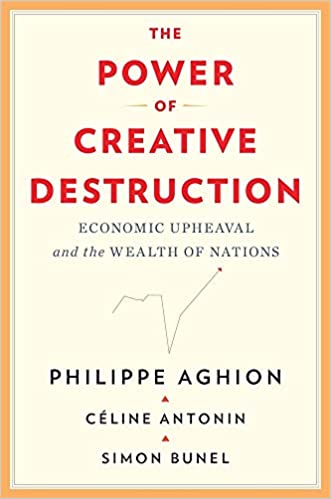
French economist Philippe Aghion has long been associated with the model of growth through creative destruction – the so-called “Schumpeterian Paradigm”. In The Power of Creative Destruction he, together with his two French co-authors, seeks to summarise this paradigm and explain its implications. The authors believe, surely correctly, that “innovation and the diffusion of knowledge are at the heart of the growth process” (page 4) and they thus focus on the causes, impediments and consequences of innovation.
The scope of the book is vast and its pace breath-taking. The authors state that their purpose is to “Penetrate some of the great historical enigmas associated with the process of world growth… Revisit the great debates over innovation and growth in developed nations… [and] Rethink the role of the state and civil society” (page 2). The history of the world’s economy is reviewed in 20 pages and is followed by 13 further chapters dealing with issues as diverse as whether we should fear technological revolutions, whether competition is a good thing, the impact of innovation on inequality, whether developing countries can bypass industrialisation by moving immediately to a service economy, the impact of creative destruction on health and happiness, managing globalisation, the role of the state and the “golden triangle” of markets, state, and civil society. All this in 319 pages!
Inevitably, the result is broad but shallow and the reader’s reaction to it will depend upon what they are looking for. Those seeking insights based on new original research or indepth analysis of issues and carefully argued conclusions should look elsewhere, perhaps to some of Philippe Aghion’s other works; on the other hand, those who wish to think about a broad range of issues and to have some previously unexamined assumptions challenged will find the book stimulating and, probably, an inspiration for further exploration.
It is based on the authors’ lectures at the College de France and it could well serve as a student text. However, the preface strongly suggests that the real target audience is policymakers: it contains much advice, even instructions, for Western Governments, of which perhaps the most stern is that “they must accompany the process of creative destruction, without obstructing it” (page vii).
The book was written between late 2019 and mid 2020 against the background of the Covid pandemic. The authors suggest that the pandemic has acted “as a wake-up call by revealing deeper problems that plague capitalism” (page vii) and they argue that what is required is a reformation of capitalism. So many recent books have adopted this starting point that there is a danger of it being greeted with a yawn and the expectation that what will follow will comprise the standard left-wing prescription of more government intervention and redistributive taxation. However, as the emphasis on creative destruction should suggest, this is not what Philippe Aghion and his colleagues advocate.
They see a role for the state that is larger than that which many free market economists would support. In particular, they see a role for it in financing and generally promoting the development of certain technologies that might otherwise not be developed (particularly those associated with the transition to a low carbon economy). However, they accept that “Objections to industrial policy from the 1950s through to the 1980s are difficult to counter, all the more because later work, such as that of Jean-Jacques Laffont and Jean Tirole, pointed to several sources of inefficiency in state intervention” (page 68). In particular, they recognise that national industrial policy has the effect of limiting or distorting competition, that governments are not great at picking winners and that governments may be receptive to lobbying by large incumbent firms. Consequently, they recognise that we must look primarily to the market rather than to governments to secure economic prosperity.
Some parts of The Power of Creative Destruction are basic, even to the point of distortion. For example, the description of the drivers of the industrial revolution is hopelessly superficial and does not even consider the role of beliefs, ideas and culture (which Deirdre McClosky has analysed so carefully in Bourgeois Equality). There are also some irritating inaccuracies in the book. For example, James Watt did not invent the steam engine (as is stated on page 40), the wheel was not invented in China (as is wrongly stated on page 20) but most likely in Eastern Europe and there was no “year zero” (which is bizarrely referred to on both page 22 and page 26). However, these errors are minor and the book contains a lot that is of real substance. Most readers will, at the very least, find thought provoking material within it.
For example, the authors draw attention to a number of studies that should at least cause pause for thought among those who see greater equality and better social outcomes coming primarily from government action: a comparison among different American states that suggests that innovation increases “both the share of income of the richest 1% (top income in equality) and social mobility” (page 82); other evidence points to a very strong positive correlation between job creation and job destruction (i.e. that the preservation of “zombie” corporations is an obstacle to the creation of new jobs; page 214ff); and evidence from Finland suggests that parental influence remains a decisive factor in whether a child will become an innovator even in a country where the educational system is highly egalitarian and of high quality (page 199ff).
Other parts of the book presents challenges to those who favour less government intervention. For example, the authors present evidence that “strongly suggests that as a firm gains greater market power and moves towards market dominance, it focuses its efforts less and less on innovation and more and more on political connections and lobbying” (page 92). There are also some tantalisingly brief policy suggestions, perhaps the most interesting of which is the idea (originally put forward by Richard Gilbert in Innovation Matters) that antitrust authorities need to change the way that they look at mergers by not using the definition of existing markets as their loadstar and instead evaluating the extent to which a merger could discourage the entry of new innovative firms (page 123).
Much of the evidence supporting these assertions and suggestions is set out in innumerable graphs. These are interesting and informative but a few words of warning need to be sounded: the graphs require careful study and this is rendered more difficult in some cases by the inadequacies of their labelling; furthermore, in a number of cases, it is difficult properly to understand and evaluate the relevant graph without access to the book or paper from which it has been extracted.
More generally readers need to be careful that the readability of the text does not cause them to be swept along by the authors and fail to spot the points at which the evidence presented fails adequately to support the argument being made. This is not to say that the relevant arguments are wrong but merely to warn that, in many cases, the authors have not proved that they are right.
That said, The Power of Creative Destruction is a good read: it avoids overly technical language, does not assume a lot of prior knowledge, has been well translated by Jodie Cohen-Tanugi and clearly presents important ideas.
“The Power of Creative Destruction: Economic Upheaval and the Wealth of Nations” by Philippe Aghion, Céline Antonin and Simon Bunel was published in 2021 by The Belknap Press of Harvard University Press (ISBN-13:9780674971165).319pp

Richard Godden is a Lawyer and has been a Partner with Linklaters for over 25 years during which time he has advised on a wide range of transactions and issues in various parts of the world.
Richard’s experience includes his time as Secretary at the UK Takeover Panel and a secondment to Linklaters’ Hong Kong office. He also served as Global Head of Client Sectors, responsible for Linklaters’ industry sector groups, and was a member of the Global Executive Committee.

On Wednesday 6th July 2022 the Centre for Enterprise, Markets and Ethics (CEME) and the Institute of Economic Affairs (IEA) hosted a joint event to discuss the topical question of whether the UK public has lost faith in free markets, and if so what might be done about it.
CEME’s Director, Revd Dr Richard Turnbull, presented startling polling undertaken by CEME which reveals that the general public and churchgoers views of the market differ dramatically from those of the elites in business or the church and considers what this might signal. Has business lost confidence in business?
The event was chaired by Lord Griffiths of Fforestfach.

The economic headwinds facing Britain seem to be evermore penetrating – recently we have seen:
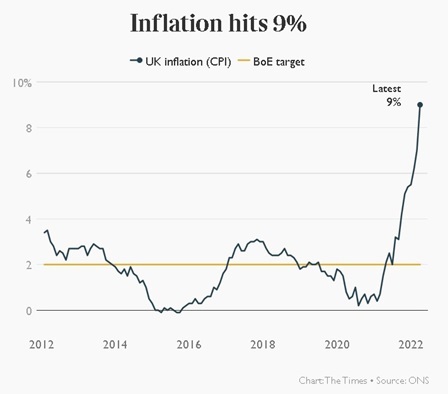
Inflation hit a 40-year high of 9%
Largely driven by the increase in utility prices and the higher energy price cap that came into effect (see chart below). ONS chief economist, Grant Fitzner said that, “Around three quarters of the increase in the annual rate [of inflation] this month came from utility bills.” CEME Chairman Brian Griffiths has written extensively on the issue and has warned on repeated occasions about the threat and ills of inflation. In his first article entitled The Spectre of Inflation written back in August 2020 he wrote that,
“We must take the prospect of inflation seriously. […] To allow inflation to rise would be a failure to learn the lessons of history. […] Controlling inflation is painful. It requires the central bank to raise interest rates. […] Each time interest rates have been raised, inflation has been brought down, but only at the cost of increased unemployment”.
The markets have seen their biggest drop since the pandemic began in March 2020
Two years later and we are very much in this ‘painful’ phase of stemming inflationary prices through (an increasingly) contractionary monetary policy. Yet, we are only at the start of beginning to feel the economic and social consequences of rising interest rates.
The S&P 500 briefly fell into bear market territory dropping more than 20% since its previous record high. £40bn has been wiped off the FTSE 100 intensifying fears that the UK is heading for a recession. The online news outlet and portal ThisIsMoney asks, “Is a recession inevitable as inflation hammers the UK and interest rates are hiked?”
Energy prices of course have reached record highs rising by 54% in April 2022 alone
The average household currently pays just under £2,000 in annual energy bills but modelling conducted by E.ON suggests this could rise to £3,000 by October 2022. Ofgem Chief Executive Jonathan Brearley confirmed that energy prices will likely hit £2,800 this year and that this is a “once in a generation event not seen since the oil crisis in the 1970s”. Lower income households may be faced with spending as much as 40% of their disposable income on energy, leaving millions of people in fuel poverty (as many as 12 million according to Mr Brearley).
What does this mean for savings?
At first glance, rising prices will mean that households and in particular those on low incomes may find themselves having to ‘break the piggy bank’ to make ends meet. That is of course, if they are in the more fortunate position of having a piggy bank in the first place. For many, it will mean sacrificing long-term funds for short-term survival – placing households in the potentially tr situation of having no financial resources at all. Worse yet, some will be forced to take on additional debt that may prove unsustainable, meaning that families and individuals could rather quickly find themselves in a dangerous financial pit.
The most recent Quarterly Outlook (May 22’) of the National Institute of Economic and Social Research (NIESR) found that, “1.5 million households (5% of the population) have food and energy bills greater than their disposable income. For these households, who likely do not have sufficient savings or access to credit cards to help them cope with these prices, we can expect them to either resort to payday loans, or simply not pay their bills by going into arrears and incurring more long-term debt.”
So those with savings are facing a difficult challenge. Inflationary pressures will continue to reduce the value of existing savings over time and rising costs are forcing more and more households to dip into savings for their daily sustenance. The savings ratio has plummeted from the pandemic high of 23.9% in Q2 of 2020 to 6.8% in Q4 of 2021 (ONS) – we can only expect this to drop further.
There are no easy solutions to this complex post-pandemic economic environment. In the short-to-medium term inflation has to be brought down, meaning that the BOE will have to continue to rise interest rates. Yet this may also be an opportune moment for the Treasury to reverse some of the previous National Insurance hikes and offer a tax cut to the working population and business in general (perhaps a reduction in VAT seems appropriate?). This would not only send the right message to the markets, it would also boost confidence and offer many small to medium-sized enterprises a much needed lifeline to counter rapidly spiralling costs.
Supply side fiscal responses proved successful in the Ragan/Thatcher era of the 70s and 80s. The Federal Reserve under Paul Volker brought down US inflation from 13.5% in 1980 to 4.1% in 1988 (interest rates remained relatively high throughout the 80s), whilst ‘Reaganomics’ promoted economic growth. GDP under the Reagan Administration averaged 3.5%; compared to George H.W. Bush at 2.25%; Bill Clinton 3.88%, George W. Bush 2.2% and Barack Obama 1.62%. Similarly, inflation in the UK under Thatcher dropped from almost 18% in 1980 to around 3% in 1987.
Quick and sustained action is needed to bring down inflation. Higher interest rates need to be balanced with supply-side policies. It is unfortunate that the tax burden has reached its highest level in 70 years under a Conservative government, while many are struggling to afford the daily basics. The problem is that the Conservatives risk losing their once-held credibility on economic matters as the former Brexit Secretary David Davies pointed out, “It’s a real risk now that the party is going to lose its reputation for economic competence.” The tide must be turned before it is too late.

Andrei E. Rogobete is Associate Director at the Centre for Enterprise, Markets & Ethics. For more information about Andrei please click here.

UK inflation is at a 40-year high and rising. The consumer price index has hit 9%, the retail price index 11.1%. As the Government’s official target is 2%, the blame game is in full swing, with the main target being Bank of England and its Governor, Andrew Bailey.
The Government’s priorities, outlined in the recent Queen’s Speech, are “strengthening growth and easing the cost of living”. That is something we can all agree with. It means better housing, better public services, making a reality — not simply an aspiration — of levelling up, reducing inflation and helping those squeezed by the rising cost of living.
If these objectives are to be realised, one requirement has to be met.
Inflation must be brought back down to 2%, the Government must endorse 2% as the target going forward and, most importantly, it must be delivered. This cannot happen immediately, but the Bank states in its recent Monetary Policy Report that it can be achieved by 2024.
The rising cost of living is now the number one challenge facing the Government. It is proving painful for most people, but extremely painful for the least well off. We have all heard or read stories of so many families who are desperately trying to help their children and themselves just to bring food to the table. Fuel poverty has already hit 20% of households and is predicted to rise to 40%.
Inflation is clearly painful, but it is more than just a painful economic shock.
Inflation is a corrosive force in our society. It creates suspicion, distrust and social conflict. It produces a blame culture, which undermines trust. People think the local corner shop is just jacking up prices to do them down, just like the large electricity companies. The same applies to Shell and BP who have done nothing special to earn the massive rise in profits. Supermarkets are no different. Why is Waitrose increasing prices much more than Aldi and Lidl? Inflation breeds a culture of blame, resentment and distrust. The threatened strike by RMT, the rail union, later this summer, could well become a landmark for higher wage settlements and a signal that stagflation may not be a temporary phenomenon.
The prospect of a windfall tax on the excess profits, not just of gas and oil producers but electricity generators, including wind farms operators, has needlessly infuriated these companies. This creates uncertainty, hits business confidence and will raise the cost of capital for investors. Multinational companies may well prefer to invest elsewhere.
Tackling inflation is where the Bank of England comes into the picture.
When the Covid pandemic hit the UK at the start of 2020, nearly everyone was supportive of the Bank of England slashing interest rates to 0.1%, increasing monetary growth and supporting businesses with easy credit. The objective was to avoid another Great Depression like that of the 1930s: falling prices, mass unemployment and business failures. I supported the Bank pursuing this objective, not least by increasing money supply growth to finance increased spending on the NHS, the furlough employment scheme and providing more credit at cheap rates for businesses.
However, already by the late summer of 2020 there were signs that the policy was giving a lift to the economy: company sales were rising briskly, corporate profits increasing and prices in assets which were hedges against inflation taking off, such as gold and precious metals, commodities, o bjet s d’arts , even Michael Jordan’s basketball shoes.
Back in August 2020, I wrote an article here , “The spectre of inflation”, which argued that we were in danger of creating too much money for the supply of goods and services available. I followed it up last year with four more articles for TheArticle, criticising the Bank for not raising interest rates and urging action.
Unfortunately, last year the Bank made a serious policy error which consisted of keeping interest rates very low and through Quantitative Easing buying government stock in the market and increasing money growth, while insisting that inflation was “transitory”.
With inflation now at 9%, the Bank of England and the Governor, Andrew Bailey, have taken a hammering from backbench MPs, in the House of Lords debate and from numerous commentators. Frankly, I have been surprised at the ferocity of the attacks in the middle of a debate in the Lords and changed the content of my speech there because I felt that we were beginning to play the man (Bailey) and the institution (the Bank), not the ball.
In the Bank’s defence
To start with I do not believe that the Bank or the Governor were “asleep at the wheel”.
The pandemic was an extraordinary event with a series of new variants of the Covid virus, a series of lockdowns and genuine uncertainty as to how exactly the economy was behaving. The fall in output was the worst recorded in 300 years. The lockdowns were more severe than during any of the wars in our history. Next, there was considerable uncertainty over the extent of the true measure of unemployment, as it was disguised by the furlough scheme. As is clear from the evidence given by members of the Monetary Policy Committee to the Treasury Select Committee (9 May 2022), their so-called “dithering” over whether to raise interest rates in November 2021 was simply their collective caution because the furlough scheme had only come to an end the previous month.
Meanwhile throughout the whole of this 18-month period, other central banks, such as the US Federal Reserve and the European Central Bank, were (like the Bank of England) convinced that the increase in inflation was “transitory” and would of itself come down soon. They were advancing similar arguments to the Bank of England. Some allowance should also be made for the fact that hardly anyone on the Bank’s staff had lived through the inflation of the 1970s.
The one criticism therefore that does not hold any water is that they were “asleep at the wheel”.
In addition, for most of the period up to November 2021 most commentators had not been calling for the Bank to raise interest rates. They were very happy with forecasts which showed a remarkable economic recovery and their major concern was that they did not wish to see it jeopardised by higher interest rates. The outcome they feared most was not inflation but recession.
The Bank’s defence of its policies was weakened by three other factors.
First, there has been a lack of intellectual diversity among members of the Monetary Policy Committee. With rare exceptions they have all accepted the New Keynesian framework in which policy has been conducted. This has resulted in underestimating the genuine uncertainty facing policymakers in the world in which we live. They have highly emphasised the importance of the expectations of inflation held by consumers, businesses and investors, but have misled themselves into believing that by issuing “forward guidance” about what is really taking place in the economy and through the powerful toolkit at their disposal (changing interest rates and buying and selling government stock), they could thereby control inflation.
Second, there has been groupthink among central banks. They meet monthly at the Bank for International Settlements in Basel and in any case can talk to each other at any time. The result has been that all of the leading central banks employ the same intellectual framework.
Third, the Bank of England has as its primary goal the control of inflation. However, it has numerous other secondary objectives: stability of the financial system, support for the government of the day’s economic policy, specifically growth and employment, the soundness of firms, ensuring competitive markets in the financial sector and most recently the resilience of the financial system to reach to net zero. Certain of these objectives clash with each other and so the Bank has to make a judgement on trade-offs. The result is that instead of always looking ahead, it has to look sideways to find out the public’s likely response to such things as higher mortgage rates, a slowing growth rate, rising unemployment, or progress towards net zero.
Neglect of money
The major failure of the Bank, however, is none of these but an intellectual error, namely the neglect of money growth as one key determinant of inflation. Far from being asleep at the wheel, those in the driving seat have 100% focused on the journey, the vehicle has been in fine condition, all the controls have been working well, but they have been using the wrong map and handbook.
The importance of money growth in understanding any sustained bout of inflation is in my judgement beyond dispute. Even those who recognise the importance of money (“monetarists”) recognise its limitations. For example, Milton Friedman wrote:
“The proposition that inflation is a monetary phenomenon is important yet it is only the beginning of an answer to the causes of and cures of inflation… because the deeper question is why excessive monetary growth occurs”. (Milton and Rose Friedman, Free to Choose p. 264, Secker & Warburg 1980, London)
In a similar vein, Friedrich Hayek argued: “I will admit that in its classic form, as now revived by my friend, Milton Friedman, this theory [monetarism] grossly oversimplifies things by making it all an issue of statistical aggregates and averages.” (Commentary, the Times, 28 March 1980)
This is particularly true at present when there is such uncertainty over the likely course of policy making and shortages, sanctions and tight labour markets all of which affect aggregate output.
There is also one further but important conversation.
The Bank of England was established over 300 years ago and has served us well. It has avoided hyper-inflation during times of war, unlike many other European countries and until it was nationalised in 1946 the Bank was entirely independent of government. It was only 25 years ago that it was given back operational independence. It is a venerable institution and one of the pillars of our unwritten constitution. As Lord Fox, the Liberal Democrat peer, said in a recent debate in the House of Lords: “We have to be careful not to undermine — or to set in train a process that undermines [an independent Bank of England]. We… have a duty of care around this issue.” (Hansard Vol 822 No 4, 16 May 2022.)
The current lapse in performance by the Bank is no reason for the Treasury to take back control. It is they, after all, who have appointed members of the Monetary Policy Committee.
When in the 1970s the Bank increased money growth to finance the Barber Boom and facilitate our entry into the European Economic Community, the blame for the inflation lay solely with politicians. The Chancellor was the key person responsible for setting the level of Bank rate and effectively the conduct of monetary policy. Today it is not the politicians who are first in the firing line, but the Governor of the Bank of England and the Bank itself.
While no individual or institution is beyond criticism, because of the Bank’s standing in our unwritten constitution and the status of its staff as unelected public servants who cannot say everything they might wish to, we do have a duty of care.
In my judgement the tone recently has become uncomfortable. Instead, the focus of comment should be on three issues.
1. We should be strengthening the resolve of the Bank to act now to raise interest rates. At present the real rate of interest (i.e. Bank rate adjusted for inflation) stands at negative 8%: this has put us on the road to stagflation along which we are travelling. A rise in rates to whatever level is necessary will change people’s expectations of inflation.
2. Everyone would like to avoid a recession. The best way to limit the impact of a recession is by rising rates now to whatever level is necessary, so that people become convinced that inflation will be brought under control.
3. The fiscal boost to household spending just announced by the Chancellor, coupled with a very tight labour market, is a window of opportunity for the Bank to act.
This article was first published in TheArticle.

Lord Griffiths is the Chairman of CEME. For more information please click here.
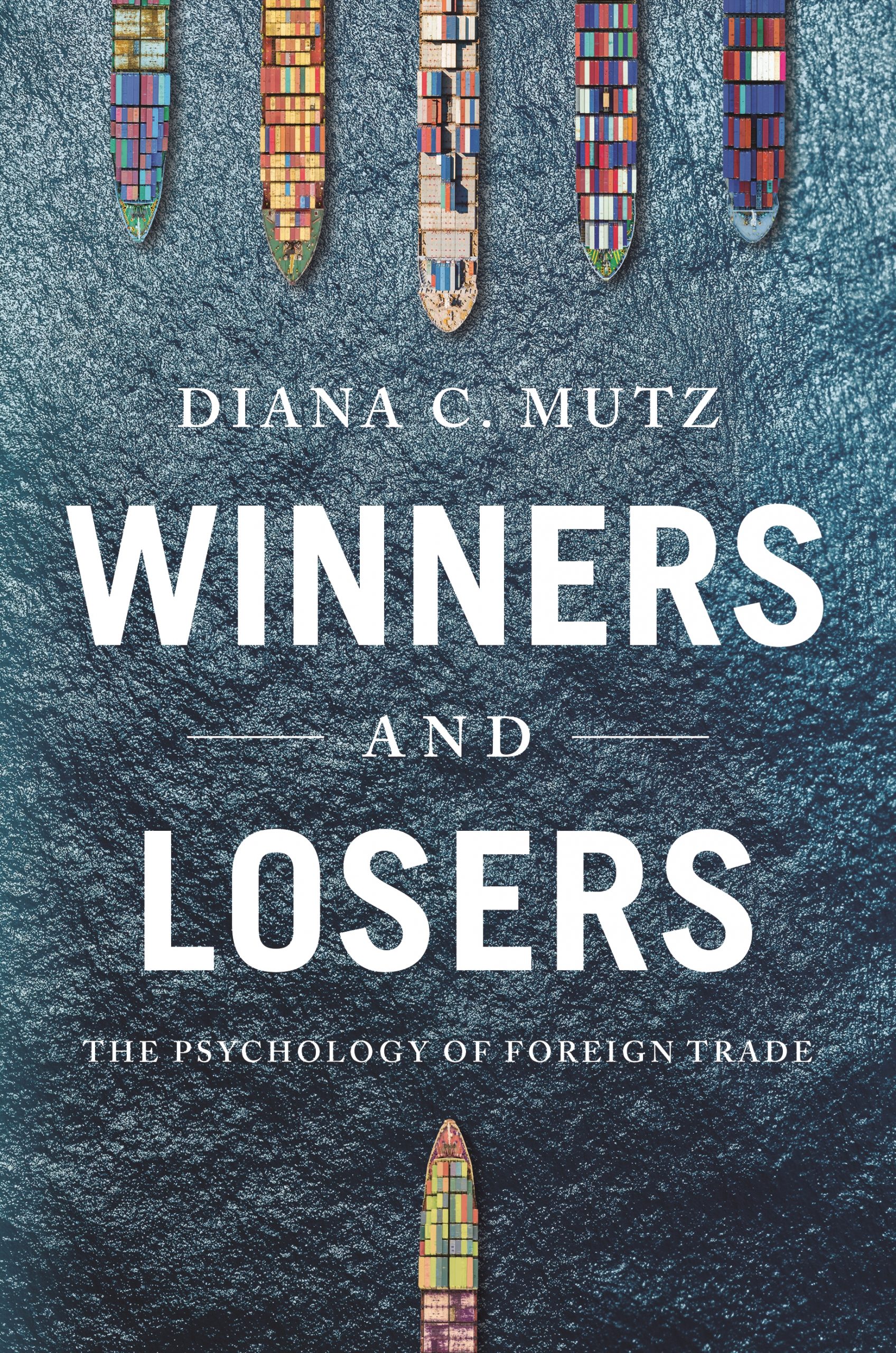
Thomas Macaulay observed that “Free trade, one of the greatest blessings which a government can confer on a people, is in almost every country unpopular.”. There is plenty of evidence to support this assertion but the reason for public hostility is less clear. What is it that impacts public opinion about trade and why is it not better liked?
Diana Mutz, Professor of Political Science and Communications at the University of Pennsylvania, has spent a number of years researching these questions in the United States and, in Winners and Losers: The psychology of foreign trade, she summarises the results of her research, considers the evidence of other researchers, draws conclusions and reflects upon their implications. She says that her “central purpose … is to bridge a gap in our understanding of the causes and consequences of American attitudes toward international trade” (page 15).
The result is both fascinating and important. All those who believe in the merits of free trade and wish to see it widely pursued by democratic countries should read what Mutz has to say.
She begins with three basic propositions, each of which she successfully justifies. First, “for most Americans, globalization is something happening ‘out there’, away from their everyday lives” (page 2). Secondly, unsurprisingly, most Americans are largely unaware of the economic arguments for and against free trade. As Mutz puts it, “few wax poetic about the wonders of the invisible hand, the efficiency of market specialization, or even the lower cost of consumer goods” (page 3). Thirdly, despite their profound ignorance, people do nonetheless hold opinions about international trade, holding “alternative, lay theories about how international trade works” (page 3).
Many economists have asserted that these home-spun theories are based on the self-interest and Milton Friedman asserted that “Complete free trade is not politically feasible … because it is only in the general interest and in no-one’s special interest”. Mutz’s research, however, provides little support for this. Instead, she suggests that public opinion is based upon sociotropic factors or what, more bluntly, might be called unsophisticated nationalism.
Mutz observes that trade is often seen in terms of competition rather than cooperation and American attitudes to trade are determined to a considerable extent by whether or not it is expected that America will be the “winner”. Furthermore, many people perceive trade as a zero sum game in relation to job gains and losses and, when coupled with uncertainty as to whether America will be the “winner”, this perception can produce highly negative attitudes to it.
Mutz suggests that people’s reasoning in relation to trade is similar to their reasoning in relation to human relationships at a personal level: “People trust people who look more like them” (page 101) and people are influenced by things as basic as who they like and who they do not like. Hence, in a survey conducted by Mutz, those who, in answer to a request to name the US’s three largest trading partners forgot Canada were less likely to support international trade than those who remembered Canada, whilst those who forgot China were more likely to support trade than those who remembered it.
Unfortunately, all of the attitudes that lead to a negative view of trade receive regular reinforcement. Mutz’s survey of references to trade in major US newspapers between 2000 and 2018 indicates that the vast majority of such references viewed trade as competition rather than cooperation; her survey of references to job losses in major US newspapers over the same period indicates that trade is frequently blamed for losses, whilst automation is very rarely blamed despite most economists believing that this is the primary cause of US manufacturing job loss; the idea of trade being a zero sum game is reinforced by concepts such as “trade deficits” and even “fair trade” (which sound, to the uninitiated, as though a fixed sized pie is being unevenly divided); and news stories reporting the benefits of free trade generally support their narrative with graphs and other impersonal material whilst those opposing it show pictures of forlorn American workers who have lost their jobs, which naturally have a bigger emotional impact. More fundamentally, Mutz points to the simplicity of the claims made by those who oppose free trade (primarily relating to job losses) in comparison to the complexity of the arguments in favour of free trade.
Mutz provides copious evidence that, overall, supports her theories. However, the book is not without flaw. Some of the numerous graphs and charts are not well labelled and space limitations have resulted in Mutz cross referring to a significant amount of online material. Readers also need to be on their guard since a number of the graphs are not based to zero, which results in differences being exaggerated (the graphs on page 127 relating to racial differences being particularly egregious examples of this). Furthermore, some of the research results, whilst statistically significant, do not suggest huge differences among different categories of people and Mutz may on occasions be guilty of over-interpreting them.
Mutz is clearly highly pro trade and moderately to the left of centre in her political views. She does not disguise her distaste for some of those who take a different view and, unfortunately, this may have distorted some of her conclusions. For example, she appears to believe that those who are pro trade are more rational than those who oppose it but this does not seem consistent with her own evidence. Thus, she comments that “protectionist attitudes in the US are driven largely by non-economic, symbolic beliefs” (page 241) apparently forgetting that the same appears to be true of attitudes that favour free trade. She also appears reluctant to acknowledge that some non-economic arguments relating to trade may be rational and reasonable. For example, no matter how pro free trade one might be, it is hard to disagree that there are downsides in trading with countries governed by authoritarian regimes and thus the apparent implication in Mutz’s comments that logical and reasonable people should favour trade with China as much as they favour trade with Canada is surely misplaced.
Mutz recognises that her findings are limited to the USA and her evidence from Canada suggests that they may not apply elsewhere. Nonetheless, the findings present those who favour free trade with a challenge: what are we to do about this? Mutz makes a number of reasonable suggestions: efforts should be made to make people realise that most job losses are not caused by trade but by automation; we need to make efforts to enable people to understand trade in terms of cooperation and to realise that it is not a zero sum game; and we need to build on the finding that the vast majority of Americans believe that trade is good for relationships with other countries. However, these suggestions are vague and do not relate closely to all of the issues that Mutz identifies.
In particular, she fails to focus adequately on her recognition that many influences on people’s attitude to free trade “pale in comparison to the impact of prospective financial concern” (page 225). The more insecure that people feel, the more they “hunker down” and one suspects that negative attitudes to trade in the USA are to a significant extent a reflection of a loss of national self-confidence and feelings of insecurity. In The Wolf at the Door, Michael Graetz and Ian Shapiro suggest that addressing this is the most important domestic challenge faced by America and it may be that, if it were adequately addressed, support for free trade would materially increase.
That said, Diana Mutz has done a great service to those who favour free trade by clarifying the causes of opposition to it. It is now up to others to work out how best to apply the implications of her research in influencing both politicians and public opinion.
“Winners and Losers” by Diana C. Mutz was published in 2021 by Princeton University Press (ISBN 978-0-691-20302-7). 275pp plus notes and bibliography.
Richard Godden is a Lawyer and has been a Partner with Linklaters for over 25 years during which time he has advised on a wide range of transactions and issues in various parts of the world.
Richard’s experience includes his time as Secretary at the UK Takeover Panel and a secondment to Linklaters’ Hong Kong office. He also served as Global Head of Client Sectors, responsible for Linklaters’ industry sector groups, and was a member of the Global Executive Committee.

It is common amongst politicians and economists to suggest that we should tax bad things and subsidise good things. It is on these grounds that, for example, we have sugar taxes and cigarette taxes. The justification for taxing “bads” becomes stronger if the ill effects are felt more widely through society and not just by the consumers.
Anybody looking at our tax system, with this principle in mind, might well conclude that our political class believes that families with two parents, and those families where one parent works part time or works entirely in the home bringing up children or looking after ageing parents, were a very bad thing. After all, we strongly penalise such arrangements in our tax and welfare systems.
In the United Kingdom, tax rates rise with incomes, but assessment for tax is based on individual and not on household or family income. This penalises families that have an uneven split of incomes between the adults – this will mainly apply where you have mothers undertaking caring responsibilities.
Take, for example, a couple where both adults earn £12,500 per annum. They will pay no income tax – literally, no income tax at all. If the same couple is a single-earner couple with one of the adults earning £25,000, they will pay income tax of £2,500. To have the same net income, the single-earner family would have to earn an extra £3,125. This blow is softened, marginally, by the married couples allowance, but this has little effect and it is quickly withdrawn as incomes rise. When you take account national insurance, things get worse. The dual-earner couple actually pays lower national insurance contributions than the single-earner couple, yet the dual earner couple will earn the right to two pensions rather than just one pension (though, in certain circumstances, the second adult in the single-earner couple can accrue state pension rights).
A sum of £3,125 is a lot of money to a couple with children on a low income. Earning this additional sum at the minimum wage would involve the main earner working an equivalent of eight extra weeks across the year. If this is a family with a stay-at-home mum, the father will hardly see his children.
It gets worse. When one of the earners within a couple reaches £50,000 per annum, child benefit is withdrawn. This policy almost seems to be designed to penalise single-earner families. More generally, the progressive nature of the tax system, together with some additional quirks, means that the tax system penalises single-earner families more and more as earnings rise. A single-earner family with three children earning £70,000 a year would pay £8,000 more in tax than a dual earner family with an even split of earnings. To make up this gap, the single-earner family would have to earn an extra £14,000. There are some circumstances in which the single-earner family would need to earn an extra £30,000 a year.
This situation cannot be justified. Governments measure inequality and poverty by looking at household income and not individual income. It would be absurd to regard an individual as poor if they do no paid work whilst being married to somebody earning £4million a year. So, if it is the resources of the family or household that matter for measuring inequality and poverty, why do we not tax families on the basis of the household income – or at least on the basis of the income of the two main adults, with all the rates and allowances being applied at that level? Two households with the same income should pay approximately the same amount of tax regardless of how that income is split between the couple.
Of course, it is clear in Judaeo-Christian thinking that the family is the basic cell of society. In Genesis 2:24 it is stated that “…a man leaves his father and mother and is united to his wife, and they become one flesh.” But secular philosophers such as F. A. Hayek thought that way too.
The UK tax system can be seen in a worse light if we consider how it interacts with the welfare system. A non-earning mother with a child will be given welfare benefits. If she marries, or even lives with, the father of that child she may lose those benefits if he has a job. And yet, there is no compensation in the tax system for the fact that his, possibly meagre, resources now have to be spread across three persons rather than just one.
Quite simply, our tax system penalises – in a substantial and explicit way – family formation and caring in the home. Families on similar incomes are treated far more harshly, simply by virtue of the fact that one parent might look after a parent or child. It does not have to be like this. The tax systems in Germany and France, treat families fairly. They tax families on the basis of family income. We should do the same.
 Philip Booth is Professor of Finance, Public Policy and Ethics at St. Mary’s University, Twickenham

The P&O debacle has become a touchstone for business ethics.
Few would like to be in the shoes of Peter Hebblethwaite, the Chief Executive, who admitted in oral evidence to a joint sessions of the Transport and the Business, Energy and Industrial Strategy Committees, that he had broken the law on consultation with trade unions. He argued that without this decision there was no future for the company and 3,000 rather than 800 job losses would result. The crews would be replaced with an agency model, with levels of pay above the internationally agreed levels for the model, but considerably below the UK minimum wage provisions. It was, he said, the only decision which could be made and he would do so again.
The basic facts
The facts on the ground are relatively straightforward.
There are some other disputed issues – for example, the requirement to give 30-45 days’ notice to relevant flag state authorities – for which there appears to be an exemption and whether or not the Secretary of State was informed, but there appears to be no disagreement on the main three points above.
The initial responses:
What options were available to P&O?
The company had lost, according to the CEO, an unsustainable amount of money, around £100m in the last year. What then were the options open to P&O?
There may have been other short-term options (property sales, loans) but in essence a company in the situation that faced P&O almost certainly has to reduce its wage bill, one way or another. Perhaps the chief executive was correct when he said that was no other decision he could make?
Nevertheless, if this is the case, why would you not follow the appropriate and required legal processes for achieving these redundancies? Why risk further damage to reputation by failing to do so?
Ethical observations
Ironically, the market may sort out both the economics and the ethics.
My real point is not to defend P&O, but that the rule of law provides remedy.
I am not sure that I like the fact that agency seafarers are paid such low wages. Indeed, for the government to take the lead in reforming the international maritime system would be a point of moral leadership. However, to arbitrarily introduce legislation affecting only British ports could destabilise the competitiveness of British ferry companies to the detriment of all their employees.
There are some signs that the government has accepted that legislation to achieve this is not possible under international agreements; indeed, arrangements agreed with international trades unions. There also appears to be some moves afoot to declare some or all P&O directors unfit with an investigation launched by the Insolvency Service into both criminal and civil liability.
I have no comment on whether the standards are met, but it is right that the company and its directors are held account for their actions. I do not support the manner in which these redundancies were handled at all. I believe workers should be properly and generously treated, their dignity respected and that they should be well-paid. P&O have done themselves serious business damage through the impact on their reputation, for which the directors are responsible.
However, we need far more care in discerning the real issues in this and similar disputes. The rush to judgement helps nobody and usually requires backtracking.
The market has an extraordinary way of filtering out bad business practice. The employees would probably be best advised to seek alternative employment and the unions advised to help them. But I also wonder whether the shareholders want a board of directors in place that causes such unnecessary reputational damage by failing to follow due process? The consequences are entirely commercial.
 Dr Richard Turnbull is the Director of the Centre for Enterprise, Markets & Ethics (CEME). For more information about Richard please click here.
Some of the toughest and most complex challenges faced by businesses and corporations in today’s world involve ethics and morality. This is in part why the study of business ethics has now become central in MBA and other programmes. But the very complexity of these challenges, in an increasingly pluralized as well as globalized world, present a danger that companies lose sight of the big picture – failing to see the wood for the trees.
Lutge and Uhl seek to assist here by providing a comprehensive overview of the essential concepts of business ethics related to the economy as a whole. At the same time, they offer a wide-ranging analysis of the issues and tools that corporations need to be aware of as they consider the ethical and moral dimensions of their activities. So, this book – Business Ethics: An Economically Informed Perspective – is distinctive and helpful in the comprehensiveness of what it offers.
Lutge and Uhl are German-based scholars who evidently have deep knowledge in these very important areas – which cover a wide range of academic disciplines. The quality of their English writing is very good, and the book will be a valuable resource both for companies (especially medium-size and large companies), as well as individuals who have senior-level responsibility.
The authors sometimes refer to their book as a ‘textbook’. However, my impression is that is more of a comprehensive survey than a teaching book as such.
Chapter 1 sets the scene by discussing briefly the phenomenon of globalization. The authors argue that globalization poses a challenge to virtue ethics: “It is an enormous challenge to find some plausible common ground” for a meaningful ethical dialogue “if a common denominator of values does not exist” (pages 13-14). The authors propose that a more helpful approach is offered by order ethics: the focus here is more on rules than on values. “The key idea of order ethics is to look out for strategies on the level of rules that enable win-win solutions for all affected parties” (page 14). The authors return to this emphasis a number of times.
Chapter 2 provides a brief analysis of the relationship between ethics and economics. The authors interpret business ethics as ethics with an economic method. This links to the book’s subtitle: An Economically Informed Approach. Lutge and Uhl argue that, from the point of view of business ethics, “production and distribution should be recognized as interdependent and therefore only discussed simultaneously” (page 26). Similarly, “it is only in the interplay of ethical reflection and economically informed implementation that rules and institutions can be created that are resistant to exploitation and mutually beneficial” (page 31).
Chapter 3 surveys the development of business ethics thinking in the historical context of the distinction between premodern and modern companies. The authors include a brief survey of ethical teaching in the Bible and Christian thought, as well as Hinduism and Islam. They argue that the complexity of the 21st century world means that it is insufficient to have an ethics of behaviour: one must also think about the ‘ethics of conditions’, by which they mean the rules of competition (page 52). This chapter makes a strong case for the benefits of markets and competition. It also argues that business ethics can to some degree be regarded as a form of risk management. “Especially in an information society…it is in the company’s own interest not to ignore the moral dimension of its own actions” (page 37).
Chapter 4 is a more lengthy survey of key models and tools of business ethics and corporate ethics. It consists of three sections: the first looks at philosophical foundations and tools, such as deontology and consequentialism and contractual concepts (e.g., the work of Hobbes, Kant and Rawls). The second section focuses on economic and social-science foundations and tools, such as the rational actor, dilemma structures (e.g., the ‘Prisoners’ Dilemma’) and the concept of utility. These tools are applied to concepts of justice. The third section deals with psychological foundations and tools. Major subjects considered here include the social intuitionist model of moral judgment and the concept of bounded ethicality: a perhaps unfortunate piece of jargon which essentially refers to the study of how and why ethical decision-making can be inconsistent and thus problematic – both on the part of individuals and organizations.
It would be fair to say that the evident breadth and depth of Chapter 4 means that it is not easy reading. But this chapter does illustrate the usefulness of the book as a comprehensive survey, and thus a tool for reference and reflection.
Chapter 5 looks in depth at some of the challenges of the modern globalized world, and seeks to show how these impinge on business ethics. This chapter considers absolute poverty and relative poverty, and then evaluates the extent to which equality is a valid goal, in ethical terms. The authors’ overall approach is reflected in the following words: “It does not make sense to construct a fundamental trade-off between freedom and equality. Rather, there should be a search for win-win opportunities that improve all parts of society so that no group feels systematically left behind” (page 168).
Chapter 6 is the last and most comprehensive chapter in the book, and addresses a number of aspects of corporate ethics. In doing so, it pays due attention to the fact that companies are key players in the globalized world. Again, this book is seen to offer a very important survey of material and perspectives that are vital, especially for larger corporations. A number of case studies are provided (in this and other chapters) which help to highlight the practical nature of the challenges and ethical issues.
Chapter 6 provides a detailed analysis of compliance – as a minimum ethical requirement – including the limits of compliance. It then considers different perspectives on corporate responsibility, including the relationship between profit-maximization and ethical responsibility, and corporate ethics based on the role of ‘the honourable gentleman’ – this latter approach having been recently revived through, for example, the Harvard Business School: “As one of the world’s top management schools, it is providing a prominent stage for individualistic concepts and moral codes” based on honour (page 237). The authors are, however, sceptical and critical of this development: the question arises as to how such an approach “can be implemented in concrete terms in the context of value pluralism. Even if it were possible to agree on certain values – at least within a certain cultural sphere – there would be obvious disparities in the actual evaluation and respective weighting of particular actions” (page 238).
The authors argue, instead, that the complexity of the modern world “requires the implementation of ethical values in the form of rules and institutions” (page 239). However, it would seem that further thought is required here: unless there really is some given moral foundation for behaviour and conduct – such as that provided by the Christian faith – then any “implementation” of ethical values is ultimately lacking in foundation. Even though today’s world evidently exhibits some degree of moral pluralism – and hence relativism – it is still surely possible to draw people together to engage in meaningful conversation about what is right and just.
Chapter 6 concludes with a survey of concepts of corporate social responsibility, including the importance of guarding against reputational risk and loss that can arise if companies fail to act in line with ethical principles. Once again, this illustrates the usefulness of the book as a comprehensive reference, to help guide companies, and those who have senior responsibility, through the complexities that surround business ethics.
“Business Ethics: An Economically Informed Perspective” by Christopher Lutge and Matthias Uhl was published in 2021 by Oxford: Oxford University Press (ISBN 978-0-19-886477-6). 353pp.
 Revd Dr Andy Hartropp is an economist, theologian and church minister. He has two PhDs, one in Economics and one in Christian Ethics. He lectured in financial economics for 5 years at Brunel University, west London. He also worked for a year with the Jubilee Centre in Cambridge, primarily leading a team doing research on families in debt. He trained at Oak Hill College, London, for ordained ministry in the Church of England. His (second) PhD was published as: What is Economic Justice? Biblical and secular perspectives contrasted (Carlisle: Paternoster, 2007). He has spent 13 years in parish ministry. He worked for eight years with the Oxford Centre for Mission Studies, where he was the Sundo Kim Research Tutor in Mission and Economics. In March 2016 he joined Waverley Abbey College as Director of Higher Education. He chairs the Ethics and Social Theology Group of the Tyndale Fellowship. He is married to Claire, and they live in Bicester, near Oxford.

CEME was delighted to co-host, in partnership with St Mary’s University and CCLA Investment Management, an in-person event on The Morality of Government Debt: insights from economics and Christian social thought. One economic consequence of the pandemic has been the accumulation of large amounts of public debt. This has huge ramifications and raises a wide a range of moral as well as economic questions.
Our panel of speakers were: