
The characteristics and consequences of government debt
Growth of government debt often goes unnoticed – the spending decisions that lie behind it are more likely to feature in headlines and comment. In addition, government debt may be related to more hidden costs, such as pensions and health care. This chapter reflects on the way government debt has evolved, the impact of the hidden costs, and the underlying causes and financing of the debt.
1.1 The recent evolution of government debt
Public attention to government debt is often sparked during difficult economic times. This was the case in the early 1980s, when Latin American countries were unable to service their debt and stood on the brink of default. In 2009, the European sovereign debt[1] crisis threatened the future of the eurozone – an episode from which it has not really recovered. Government debt has also been much discussed during the Covid crisis, given the unprecedented public spending on furlough and business support. This has led many to question whether further increases in government debt – the implications of which may have been clouded by low interest rates – are sustainable.
However, during better economic times, problems with government debt do not disappear. In between crises, many countries have failed to reduce debt, so that each new crisis leads to its growing to higher levels. Furthermore, what might be termed ‘implicit debt’, in the form of future pensions and health-care liabilities, accumulates regardless of economic circumstances. Individual countries also go through phases of increasing debt dramatically, but this does not necessarily reach the headlines unless so widespread or serious that there is a crisis. Perhaps in this way, as in others that will become clear, there are similarities with environmental crises.
Table 1 shows historical public debt data in five countries: the United Kingdom, the United States, Japan, Greece and Brazil. As might be expected, debt tends to rise in time of war. Indeed, the history of the UK national debt from 1700 to 2019 can more or less be explained by three wars and a financial crisis: debt increased dramatically after the Napoleonic Wars, the First and Second World Wars and the financial crisis of 2008. In peacetime, government debt levels tended to fall – though not after the financial crisis. For a number of countries, however, debt has either grown in recent years or not been reduced during peacetime.
| United Kingdom | United States | Japan | Greece | Brazil | |
|---|---|---|---|---|---|
| 1800 | 176.8 | 18.1 | – | – | – |
| 1820 | 260.0 | 13.9 | – | – | – |
| 1840 | 154.7 | 0.2 | – | – | – |
| 1860 | 115.5 | 1.4 | – | – | – |
| 1880 | 65.4 | 17.5 | 34.0 | – | 99.0 |
| 1900 | 32.4 | 6.6 | 21.5 | 218.1 | 54.9 |
| 1913 | 27.9 | 3.3 | 53.6 | 64.7 | 37.7 |
| 1920 | 137.8 | 27.9 | 25.6 | – | 36.2** |
| 1939 | 149.7 | 44.0 | 71.2 | 77.8 | 30.8 |
| 1950 | 216.9 | 87.5 | 14.0 | 23.6*** | 10.6 |
| 1970 | 73.2 | 35.7 | 12.0 | 24.7 | – |
| 1990 | 28.8 | 62.0 | 67.0 | 73.2 | 65.7 |
| 2000 | 37.0 | 53.0 | 143.8 | 104.9 | 68.5 |
| 2010 | 75.7 | 94.7 | 215.8 | 146.3 | 63.0 |
| 2020 | 108.0 | 131.2 | 266.2 | 205.2 | 101.4 |
| 2025* | 117.0 | 136.9 | 264.0 | 165.9 | 104.4 |
Sources: 1800–2010: IMF Data Mapper: Historical Public Debt Database; 2020–5: IMF Data Mapper: World Economic Outlook. * projection; ** data for 1923; *** data for 1952.
In considering the level of national debt it is also necessary to take into account defaults and inflation. These are ways of reducing government debt without repaying it ‘honestly’. Default involves countries not paying the obligations demanded by debt contracts. Inflation leads to a country repaying debt in devalued money. In the UK, for example, the price level doubled between 1974 and 1979. Thus the fall in the debt-to-national-income ratio in this period was in many ways illusory: governments were devaluing their debt using the mechanism of inflation, and repaying the holders of government bonds with money that had a lower value. Japan defaulted on its debt following the Second World War and there were other defaults among the countries in Table 1.
Since 2009, Japan has been the first developed modern economy in a peaceful period to sustain a debt level above 200 per cent of GDP. Meanwhile, the Greek situation is probably similar to the regular debt crises seen in South and Central America. Although post-war Greece managed to keep debt below 30 per cent of GDP until the 1980s, debt then rose rapidly, hovering around 100 per cent from 1993 before surging after the financial crisis and crossing the 200 per cent threshold. It is only as a result of bailouts, restructuring and intervention by outside economic agencies that the situation has been stabilised.
In the decade following the financial crisis, government debt did not return to pre-crisis levels – indeed, in many countries it rose further even after the worst had passed. Between 2007 and 2019, government debt as a share of national income doubled in the UK (42–85 per cent), with similar trends displayed in the USA (65–109 per cent), Greece (103–181 per cent), Japan (175–238 per cent) and Brazil (64–90 per cent).[2] Even in the period 2014–19, after the bailouts of banks at the height of the financial crisis, it was only in Germany that government debt fell.
The challenge of government debt is not simply historic. In the UK, the Office for Budget Responsibility (OBR) projects government debt forwards for 50 years in their annual Fiscal Sustainability Report. They assume that tax and spending policies remain the same; that is, for example, that pensions, tax brackets and health-care spending continue to be uprated in line with current policy. This demonstrates what may happen to the national debt as demographics change and there are fewer taxpayers and more elderly people in receipt of pensions and health care. Even before the pandemic, government debt in the UK was forecast to reach 283 per cent of GDP by 2067.[3] When the 2020 Fiscal Sustainability Report was produced as the pandemic was just beginning, that figure was revised to around 400 per cent.[4] To keep the debt under control, there would need to be huge cuts in government spending or increases in taxation over the next generation. Indeed, the OBR projections suggest that, even with large increases in taxation to levels well above those experienced in modern British history or in other developed countries, there would still have to be cuts in government services or transfer payments, including to those to whom promises of pensions or health-care provision had been made. These developments in public finances are a consequence of the creation of social security systems whereby pensions and health-care costs are financed by taxes from the following working generation. The implications of this will be discussed in Chapter 2.
In any given year the total amount of government debt increases if there is a budget deficit; that is, if annual government spending exceeds annual revenues. Italy, for example, has run deficits every year since the Second World War. As discussed below, there are various reasons for running deficits, and it is often argued that they may be reasonable and justified in the short term if followed by periods of budget surplus. However, as Figure 1 shows, over the last 25 years most of the example countries mainly ran budget deficits, with only fleeting periods of surplus (1999–2001 in the UK; 2000 in the USA; 2016–19 in Greece).
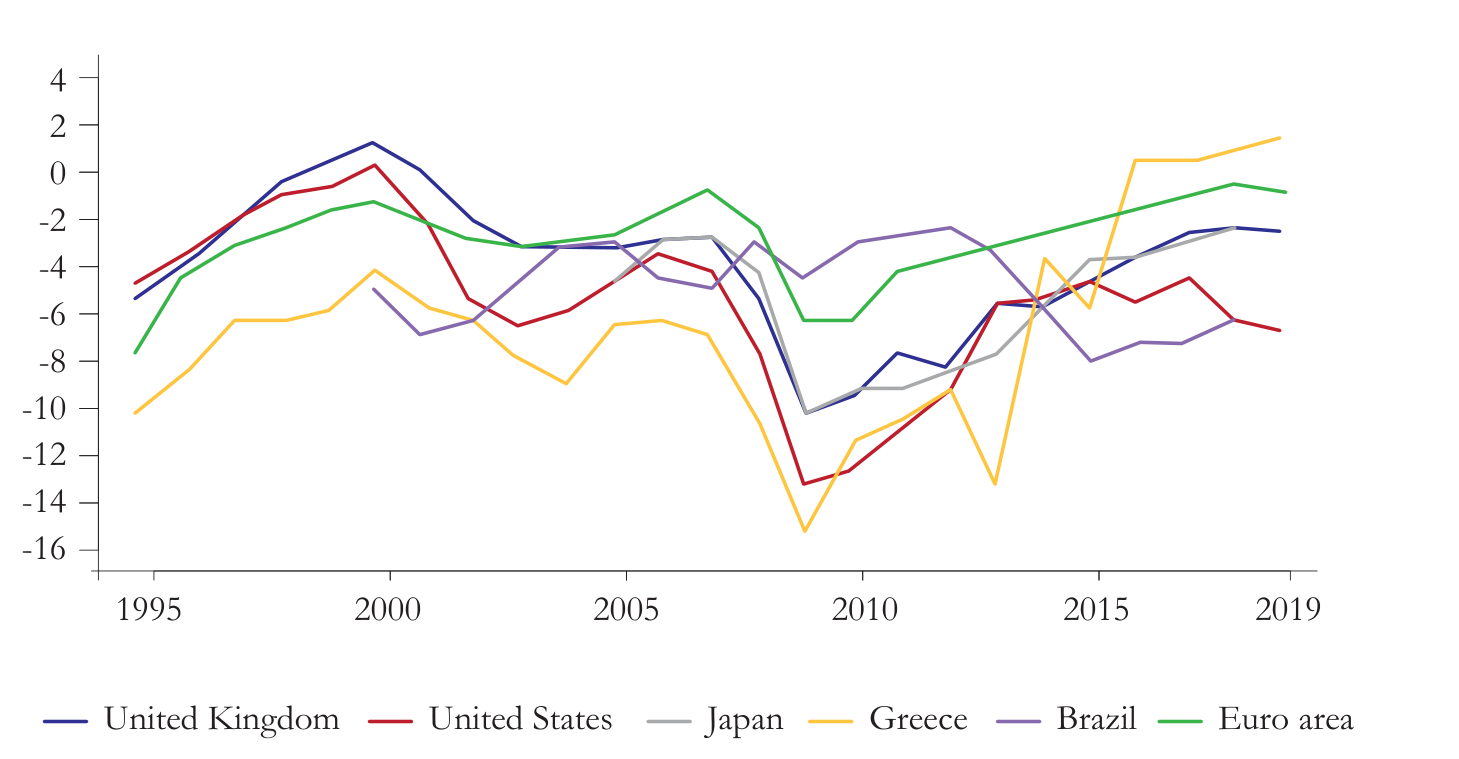

Source: OECD (2021), General Government Debt
Government debt as a percentage of national income is often regarded as a better measure than the absolute size of the debt. This increases if the deficit in any year as a percentage of national income is greater than the growth in national income. This is a low hurdle, but the increase in indebtedness as a proportion of national income in Table 1 shows that most countries have not been clearing it for any sustained period.
When government debt is accumulated, there is a genuine burden – it is not merely a paper transaction. First, interest has to be paid. Second, governments have to reduce spending or increase taxation, all other things being equal, in order for the burden of debt to be brought back down to lower levels. In 2019–20, government-debt interest in the UK amounted to around five times government spending on the environment, roughly the same as spending on defence and about half that on education. The moral question this poses is rarely discussed.
It is often suggested that government debt in developed countries is not a burden because ‘We owe it to ourselves’. This is not correct. First, a substantial proportion – about one-third in the UK – is owed to overseas holders of government debt. Second, even if that were not so, we do not owe it to ourselves: future taxpayers in general owe it to particular people, such as those who expect to receive a pension from a pension fund that has bought government bonds. This is a real burden for future taxpayers, and if governments defaulted or repaid debt with worthless money resulting from inflation, those pensioners in the future would not receive what they expected.
Alongside its concern for government indebtedness among poorer countries, the Catholic Church has also shown interest in sovereign debt in middle-income nations. When Mexico threatened to default in 1982, its debt stood at 48 per cent of national income. This brought the attention of the Catholic Church and numerous non-governmental organisations to the worsening debt situation in Latin American and African countries. By 1986, when the Pontifical Commission for Justice and Peace released the document At the Service of the Human Community: An Ethical Approach to the International Debt Question, Mexico’s debt had risen to 78 per cent of national income. This level is much lower than debt levels in many richer countries today. However, it still sparked a crisis. Even though debt levels in richer countries have not reached levels at which default is being threatened or feared imminent, many of the problems discussed below, such as intergenerational justice, are even more serious in their case. A country does not have to be faced with imminent disaster for its debt to be ethically problematic.
1.2 Future pension and health-care costs
Official government debt is not the only obligation a government has. A feature of Western countries in the post-war period is that they have established social-insurance systems whereby individuals accumulate rights to a pension and health care but, unlike in the private sector, no money is set aside to meet these costs. In other words, the costs are met from current taxation and the benefits not funded as they accrue in the system. Additionally, governments, again unlike the private sector, do not have to account for these obligations. These systems can remain stable if the population structure does not change. However, if the number of young people falls relative to that of older people, these costs can become a serious burden. Some countries – such as Japan, Germany, Italy and most of those of Central and Eastern Europe – are facing rapid population ageing. In such circumstances, the obligations increase but the means to finance them will deplete.
As these pension and health-care obligations remain hidden from public view and scrutiny, they are sometimes termed ‘implicit government debt’. Longer life expectancy and more retirees are, of course, welcome developments, but pose a problem for government finances because no funding has been set aside to pay for future pension and health-care commitments. The nature of this form of debt can easily be illustrated by policy decisions taken in the early 2000s. In countries such as Argentina, Poland and Hungary, individuals had their privately invested pension funds confiscated by the government, which used them to repay debt, thus making it look smaller. Governments then made promises to replace these pensions. In most private-sector contexts, this would be called an ‘off-balance-sheet’ liability and would have to be accounted for.
Implicit debt is hard to quantify, not least because it depends on assumptions regarding future policy decisions. One estimate placed total US debt at 500 per cent of national income in 2014 – about five times the level of explicit debt.[5] Estimates do vary from country to country and depend on the method used to calculate the obligations, but there is some support for this ratio more generally across a range of countries.[6]
It could be argued that governments do not have to honour those obligations, and implicit debt could be reduced by simply changing entitlements. However, this is another moral question disguised beneath sovereign debt, and would be a form of debt default offensive to distributive justice, given the reasonable expectations of those who have made contributions to state pension schemes during their working lives.
It is worth mentioning that the Catholic former Prime Minister of Ireland, John Bruton, explicitly raised the issue of government debt in a lecture he gave in April 2019, noting that: ‘Too often the Church takes the easy route and leaves that particular moral question to politicians … The Church should apply to fiscal policy the same sense of intergenerational justice that it applies to environmental policy.’ He specifically related this to ‘piling up unpayable pension obligations’.[7]
1.3 The causes and financing of government debt
Before moving on, in Chapter 2, to examine the moral implications of government debt, it is necessary to consider why governments accumulate it. This helps to determine its moral salience. Questions of government debt management are discussed in standard public finance textbooks, such as Gruber’s Public Finance and Public Policy,[8] and the issues relating to the incentives of democracies to have a natural bias towards voting for governments that accumulate more debt are examined in Wagner’s Deficits, Debt and Democracy.[9] The arguments can be very technical but the basic principles are as follows.
First, as noted (see section 1.1), debt is often accumulated in wartime. A just war is likely to involve preventing the common good of a country – or an ally – being gravely imperilled. All the resources of a country might be procured to fight the war. Historically, many countries did not maintain standing armies, hence a war required the financing of military equipment, manpower and logistics. As standing armed forces became a feature, these costs became permanent burdens on the exchequer. Additionally, war might involve stopping normal economic activity, the costs of which, including employment and income support as well as potentially direct support of industry, would be met by government. The war itself, including enemy action, might prevent normal economic activity taking place and considerably damage infrastructure. A similar situation to wartime might arise with a major catastrophic event, such as a natural disaster, financial crisis or pandemic.
In all these situations, the government may wish to borrow to provide support so that people can maintain an adequate standard of living – as has happened in many countries during the Covid pandemic. Government tax receipts will be lower and there may also be direct costs to meet – testing and vaccinating people in the case of the pandemic, reconstruction following an earthquake and bank rescue in the case of a financial crisis. In the UK, government-debt peaks have been closely related to wartime and the financial crisis; the next peak is likely to coincide with the pandemic.
A second reason why debt might be accumulated is that a government may simply be unwilling to raise the necessary taxes to finance its spending. In simple terms, electorates in a democracy may demand more government spending than they will pay in taxes. The moral implications might differ somewhat where governments borrow for reasons that will benefit future generations, for example by investing in transport facilities. These investments might be expected to increase economic growth in future years and thereby, perhaps, tax revenues. Issuing ‘green bonds’ to finance environmental investment is another example. The problem is how to assess competing moral claims.
A third reason for borrowing, at least in the short term, arises because economies can go through periods of below- and above-average growth. When growth is below average, unemployment might also increase, profits decrease and businesses go bankrupt. When this happens, tax receipts will tend to fall and government spending on welfare payments may rise. As a result, there may be a deficit. When growth is above average, the opposite may happen. Tax receipts may increase, government spending may fall and a surplus might be generated. Rather as for a household with fluctuating income, it does not make sense for a government to run a balanced budget in each individual year when its revenue and spending commitments are varying. On average, deficits arising from this effect should cancel out surpluses.
Related to this, governments often run deficits to try to ‘stimulate’ the economy when output or employment are below normal levels. This would typically be described as ‘Keynesian’ policy, and its beneficial effect is widely disputed. In theory, governments would run surpluses to ‘cool’ the economy when output or employment are above normal levels.
In developed countries, governments tend to finance their debt by selling bonds. However, government spending can also be paid for through the creation of money or, more commonly (especially since the financial crisis), by the central bank printing money to buy the bonds governments have issued. This can lead to inflation. Indeed, governments printing money to finance spending has been a common cause of hyperinflation in countries such as Zimbabwe and Venezuela. In essence, the increase in the supply of money reduces its value.
It is easy for governments, with the support of electorates, to have a natural bias towards accumulating debt rather than surpluses – to run deficits, say, when unemployment is high but not reduce them when the economy returns to normal. There is a degree of perverse incentive for governments to spend on the current account. It may also be easier to spend on infrastructure projects, even if the return is mediocre, than restrain spending, and so on. Spending without taxing allows some part of the electorate to benefit, at least in the short term, while postponing costs to a future date. The same applies to the accumulation of implicit debt in relation to pensions and health care – it is easier for governments to promise current workforces they will receive these in the future, and not set aside the capital to finance them, than it is to set up a fund. Future generations then bear the cost. Similarly with the issuing of bonds to finance environmental expenditure – the current generation claim credit for future benefits, but without considering the future costs of the debt.
Changing perceptions about their role is a further reason why governments accumulate debt. Significant sectors of health and welfare spending previously undertaken outside government, through intermediate institutions such as religious charities, are now almost exclusively an activity of government. Government borrowing allows politicians to pay for such services without imposing explicit and easily observable tax costs on the electorate.
The reasons why governments accumulate debt do matter when it comes to the moral aspects, especially in relation to distributive justice. The next chapter will discuss those moral questions that are legitimately within the domain of Catholic social thought and teaching.
Notes to Chapter 1
[1] The terms ‘government debt’, ‘national debt’ and ‘sovereign debt’ will be used interchangeably.
[2] IMF, Global Debt Database, General Government Debt as percentage of GDP; https://www.imf.org/external/datamapper/GG_DEBT_GDP@GDD/OEMDC/ADVEC/WEOWORLD/GBR.
[3] OBR, Fiscal Sustainability Report – July 2018 (London: Office for Budget Responsibility, 2018).
[4] OBR, Fiscal Sustainability Report – July 2020 (London: Office for Budget Responsibility, 2020).
[5] Michael D. Tanner, Going for Broke: Deficits, Debt, and the Entitlement Crisis (Washington DC: The Cato Institute, 2015).
[6] For a thorough discussion of this question, see also Jagadeesh Gokhale, The Government Debt Iceberg, Research Monograph 68 (London: Institute of Economic Affairs, 2014).
[7] See https://www.youtube.com/watch?v=JqARepLm888, at approximately 29 minutes.
[8] Jonathan Gruber, Public Finance and Public Policy, 6th edn (New York: Worth, 2019).
[9] Richard E. Wagner, Deficits, Debt and Democracy (Cheltenham: Edward Elgar, 2012).