
CEME was delighted to host an event on the theme of The Great London Estates – Lessons for Housing. The event took place on 18th July 2023 at CCLA Investment Management Limited, One Angel Lane, London, EC4R 3AB.
The meeting was chaired by Nicholas Boys Smith, founding Director of Create Streets which aims to help the housing crisis through researching the links between urban form, well-being, sustainability and prosperity.
The speakers were:
Dr John Kroencke, Senior Research Fellow, Centre for Enterprise, Markets and Ethics, and author of Private Planning and the Great Estates – Lessons from London.
Rt Revd Guli Francis-Dehqani, the Bishop of Chelmsford and the Church of England’s Bishop for Housing.
Dr. Samuel Hughes, Head of Housing, Centre for Policy Studies.
Thomas Macaulay observed that “Free trade, one of the greatest blessings which a government can confer on a people, is in almost every country unpopular.”. There is plenty of evidence to support this assertion but the reason for public hostility is less clear. What is it that impacts public opinion about trade and why is it not better liked?
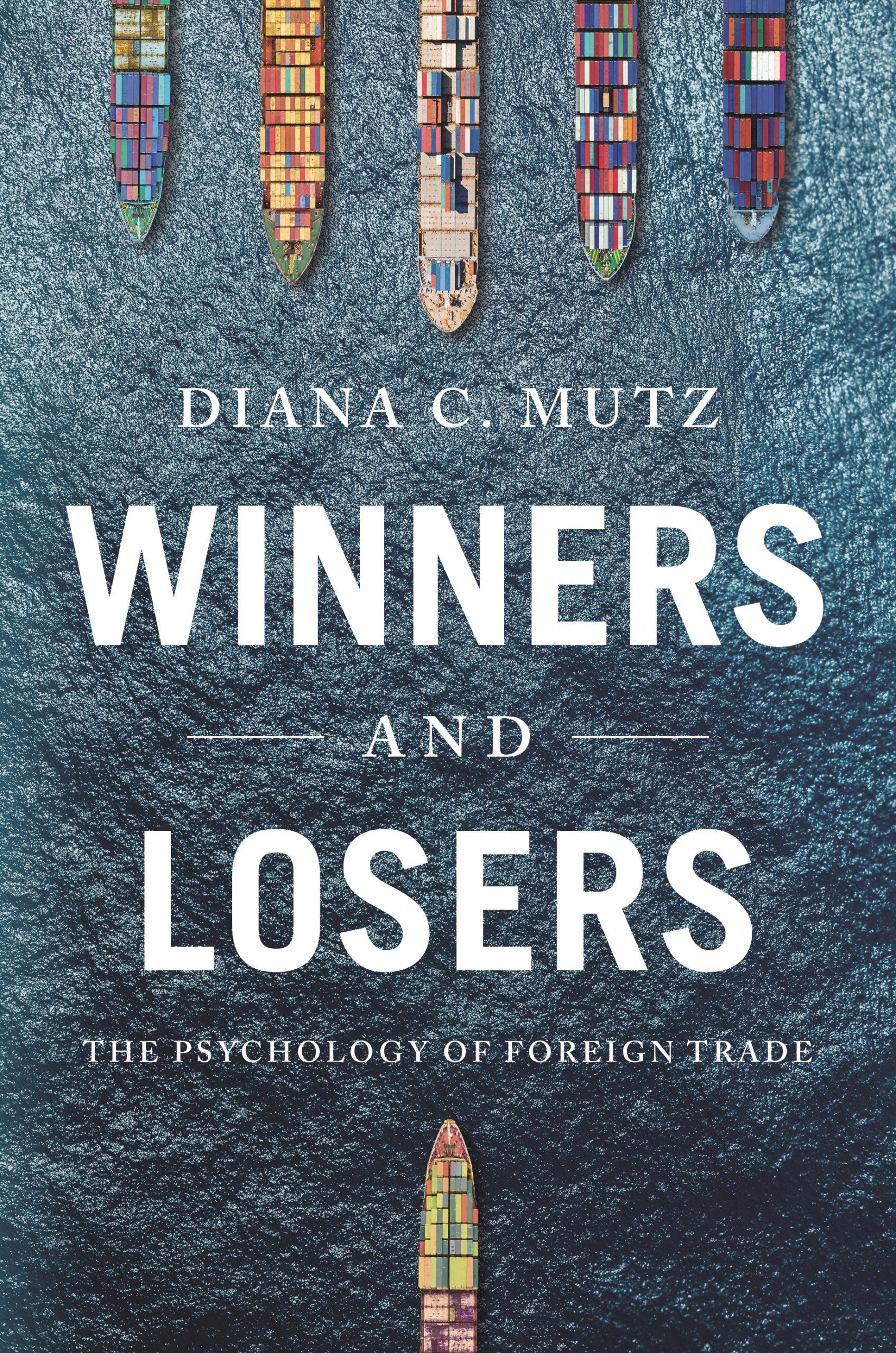
Diana Mutz, Professor of Political Science and Communications at the University of Pennsylvania, has spent a number of years researching these questions in the United States and, in Winners and Losers: The psychology of foreign trade, she summarises the results of her research, considers the evidence of other researchers, draws conclusions and reflects upon their implications. She says that her “central purpose … is to bridge a gap in our understanding of the causes and consequences of American attitudes toward international trade” (page 15).
The result is both fascinating and important. All those who believe in the merits of free trade and wish to see it widely pursued by democratic countries should read what Mutz has to say.
She begins with three basic propositions, each of which she successfully justifies. First, “for most Americans, globalization is something happening ‘out there’, away from their everyday lives” (page 2). Secondly, unsurprisingly, most Americans are largely unaware of the economic arguments for and against free trade. As Mutz puts it, “few wax poetic about the wonders of the invisible hand, the efficiency of market specialization, or even the lower cost of consumer goods” (page 3). Thirdly, despite their profound ignorance, people do nonetheless hold opinions about international trade, holding “alternative, lay theories about how international trade works” (page 3).
Many economists have asserted that these home-spun theories are based on the self-interest and Milton Friedman asserted that “Complete free trade is not politically feasible … because it is only in the general interest and in no-one’s special interest”. Mutz’s research, however, provides little support for this. Instead, she suggests that public opinion is based upon sociotropic factors or what, more bluntly, might be called unsophisticated nationalism.
Mutz observes that trade is often seen in terms of competition rather than cooperation and American attitudes to trade are determined to a considerable extent by whether or not it is expected that America will be the “winner”. Furthermore, many people perceive trade as a zero sum game in relation to job gains and losses and, when coupled with uncertainty as to whether America will be the “winner”, this perception can produce highly negative attitudes to it.
Mutz suggests that people’s reasoning in relation to trade is similar to their reasoning in relation to human relationships at a personal level: “People trust people who look more like them” (page 101) and people are influenced by things as basic as who they like and who they do not like. Hence, in a survey conducted by Mutz, those who, in answer to a request to name the US’s three largest trading partners forgot Canada were less likely to support international trade than those who remembered Canada, whilst those who forgot China were more likely to support trade than those who remembered it.
Unfortunately, all of the attitudes that lead to a negative view of trade receive regular reinforcement. Mutz’s survey of references to trade in major US newspapers between 2000 and 2018 indicates that the vast majority of such references viewed trade as competition rather than cooperation; her survey of references to job losses in major US newspapers over the same period indicates that trade is frequently blamed for losses, whilst automation is very rarely blamed despite most economists believing that this is the primary cause of US manufacturing job loss; the idea of trade being a zero sum game is reinforced by concepts such as “trade deficits” and even “fair trade” (which sound, to the uninitiated, as though a fixed sized pie is being unevenly divided); and news stories reporting the benefits of free trade generally support their narrative with graphs and other impersonal material whilst those opposing it show pictures of forlorn American workers who have lost their jobs, which naturally have a bigger emotional impact. More fundamentally, Mutz points to the simplicity of the claims made by those who oppose free trade (primarily relating to job losses) in comparison to the complexity of the arguments in favour of free trade.
Mutz provides copious evidence that, overall, supports her theories. However, the book is not without flaw. Some of the numerous graphs and charts are not well labelled and space limitations have resulted in Mutz cross referring to a significant amount of online material. Readers also need to be on their guard since a number of the graphs are not based to zero, which results in differences being exaggerated (the graphs on page 127 relating to racial differences being particularly egregious examples of this). Furthermore, some of the research results, whilst statistically significant, do not suggest huge differences among different categories of people and Mutz may on occasions be guilty of over-interpreting them.
Mutz is clearly highly pro trade and moderately to the left of centre in her political views. She does not disguise her distaste for some of those who take a different view and, unfortunately, this may have distorted some of her conclusions. For example, she appears to believe that those who are pro trade are more rational than those who oppose it but this does not seem consistent with her own evidence. Thus, she comments that “protectionist attitudes in the US are driven largely by non-economic, symbolic beliefs” (page 241) apparently forgetting that the same appears to be true of attitudes that favour free trade. She also appears reluctant to acknowledge that some non-economic arguments relating to trade may be rational and reasonable. For example, no matter how pro free trade one might be, it is hard to disagree that there are downsides in trading with countries governed by authoritarian regimes and thus the apparent implication in Mutz’s comments that logical and reasonable people should favour trade with China as much as they favour trade with Canada is surely misplaced.
Mutz recognises that her findings are limited to the USA and her evidence from Canada suggests that they may not apply elsewhere. Nonetheless, the findings present those who favour free trade with a challenge: what are we to do about this? Mutz makes a number of reasonable suggestions: efforts should be made to make people realise that most job losses are not caused by trade but by automation; we need to make efforts to enable people to understand trade in terms of cooperation and to realise that it is not a zero sum game; and we need to build on the finding that the vast majority of Americans believe that trade is good for relationships with other countries. However, these suggestions are vague and do not relate closely to all of the issues that Mutz identifies.
In particular, she fails to focus adequately on her recognition that many influences on people’s attitude to free trade “pale in comparison to the impact of prospective financial concern” (page 225). The more insecure that people feel, the more they “hunker down” and one suspects that negative attitudes to trade in the USA are to a significant extent a reflection of a loss of national self-confidence and feelings of insecurity. In The Wolf at the Door, Michael Graetz and Ian Shapiro suggest that addressing this is the most important domestic challenge faced by America and it may be that, if it were adequately addressed, support for free trade would materially increase.
That said, Diana Mutz has done a great service to those who favour free trade by clarifying the causes of opposition to it. It is now up to others to work out how best to apply the implications of her research in influencing both politicians and public opinion.
“Winners and Losers” by Diana C. Mutz was published in 2021 by Princeton University Press (ISBN 978-0-691-20302-7). 275pp plus notes and bibliography.

Richard Godden is a Lawyer and has been a Partner with Linklaters for over 25 years during which time he has advised on a wide range of transactions and issues in various parts of the world.
Richard’s experience includes his time as Secretary at the UK Takeover Panel and a secondment to Linklaters’ Hong Kong office. He also served as Global Head of Client Sectors, responsible for Linklaters’ industry sector groups, and was a member of the Global Executive Committee.
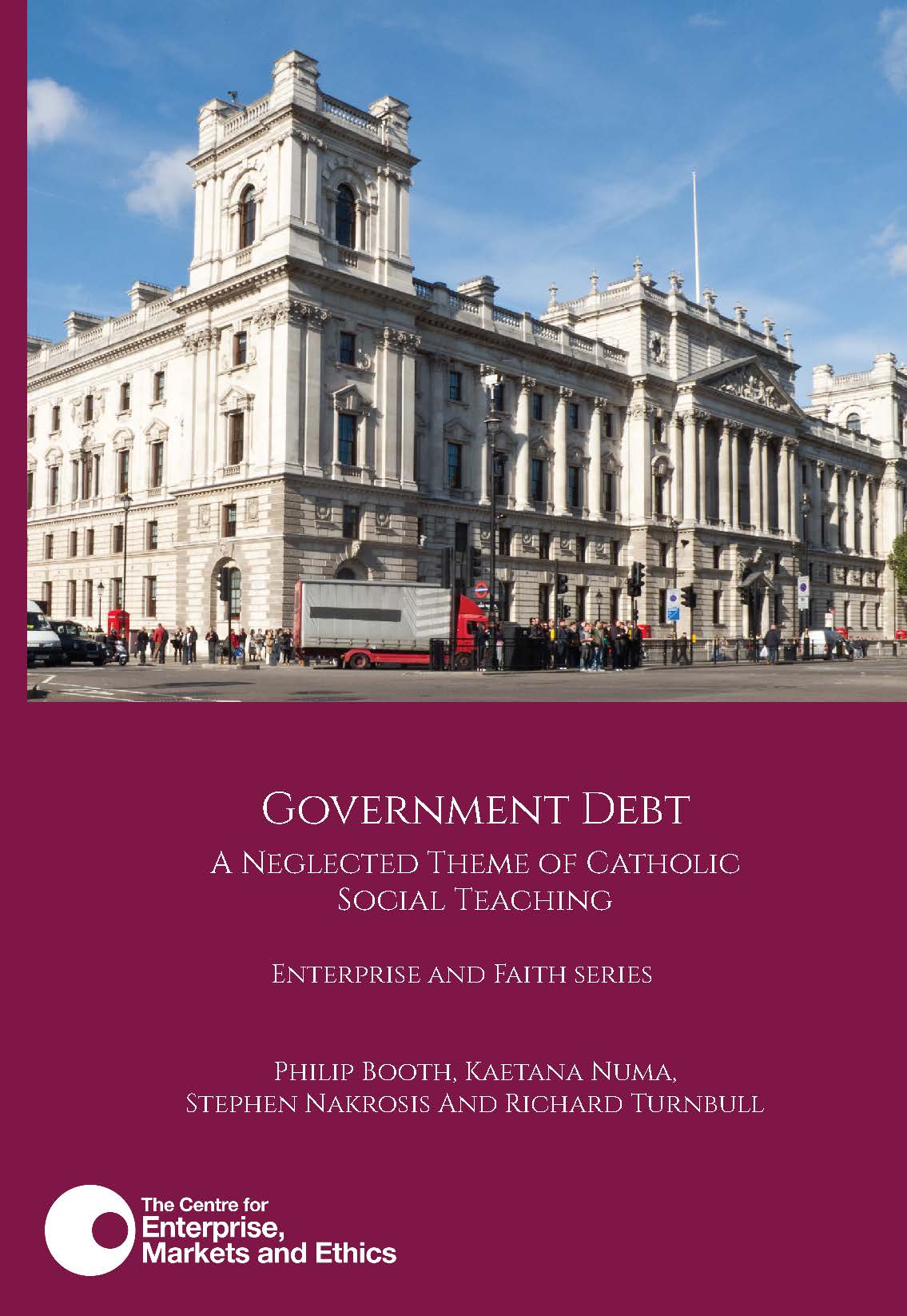
The Centre for Enterprise, Markets and Ethics (CEME) is delighted to announce the publication of Government Debt: A Neglected Theme of Catholic Social Teaching by Philip Booth, Kaetana Numa, Stephen Nakrosis and Richard Turnbull.
Government debt in developed countries has risen sharply in recent decades, yet Catholic social teaching — which has engaged extensively with sovereign debt in the developing world — has paid surprisingly little attention to its moral implications closer to home. This essay seeks to fill that gap.
The authors begin by charting the growth of government debt across several major economies, noting that peacetime reductions have become increasingly rare and that “implicit” liabilities — unfunded pension and healthcare promises — may dwarf the official figures. They examine the various reasons governments accumulate debt, from wartime necessity and counter-cyclical spending to the perverse incentives facing democratic electorates, who may prefer to consume today at the expense of future taxpayers.
The central moral argument turns on intergenerational justice. Drawing on the creation mandates of Genesis, the scriptural emphasis on stewardship and wealth creation, and Catholic principles of distributive justice, the authors contend that systematically burdening future generations with debt — or with unfunded social-insurance obligations — is difficult to reconcile with the dignity owed to all persons across time. They supplement this with perspectives from the wider Protestant tradition, including Calvin, Kuyper and Chalmers, all of whom point towards a limited but purposeful role for the state and a strong presumption against excessive public indebtedness.
Historical case studies — from Bourbon France and nineteenth-century Egypt to interwar Germany, Argentina and the eurozone crisis — illustrate how high debt can impair democratic accountability, provoke inflation and default, deepen poverty and undermine the very functions of government that Catholic social teaching regards as essential. The authors conclude that excessive government debt sits uneasily with Christian teaching and deserves far greater attention within Catholic social thought.
A PDF copy can be found here. A hardcopy of the publication can be ordered by contacting CEME’s offices at office@theceme.org

The Centre for Enterprise, Markets and Ethics (CEME) is pleased to announce the publication of The UK Savings Crisis: Rediscovering the Principle and Practice of Saving by Andrei Rogobete.
A PDF copy can be found here. The publication can also be purchased in paperback by contacting CEME’s offices via email at office@theceme.org
The Future of Capitalism tackles one of the big issues of our time. Its impressive author, Sir Paul Collier, CBE, FBA is a distinguished member of the Blavatnik School of Government at the University of Oxford and a seasoned practitioner in development economics for which he received a knighthood. He is convinced that capitalism is the only economic system which can generate mass prosperity. Regrettably it has also divided societies, created dysfunctional democracies and posed risks to the planet. More than that he claims it is morally bankrupt. The challenge he set himself in this book is how to restore ethics within capitalism to prevent it drifting into either a totalitarian state (China) or populist nationalism (East European countries). In doing so, he eschews ideology claiming that all his policy prescriptions are based on evidence, analysis and pragmatism.
The inspiration for the book was Anthony Crosland’s The Future of Socialism, published in the 1950s, which set an agenda for the social democracy of the post war years in the UK. (To some readers Anthony Crosland might seem a minor figure out of a history book, but in his heyday he was the leading UK intellectual of the centre left and a Cabinet minister in the Wilson and Callaghan Labour Governments attempting to put his ideas into practice). Collier claims that the Crosland agenda worked well between 1945-70, even at one point describing it as the “miracle period”. It failed however because it neglected its roots in the ethical foundations of the nineteenth century cooperative movement.
It was replaced by a combination of Utilitarian technocrats (mainly economists) intent on redistributing income to those below the poverty line (however defined) and lawyers committed to John Rawls philosophy which promoted the rights of disadvantaged groups based on race, gender, sexual preference and so on, which has become the basis for identity politics.
Both of these philosophical approaches emphasise the individual not the collective and differences between groups based on either income or disadvantage rather than the needs of persons and families. Each elevates a single moral prescription, “the greatest happiness of the greatest number” and “laws in a society must be designed for the most disadvantaged groups”. However, they neglect the normal moral instincts and values of people such as loyalty, fairness, obligation and desert which were central to the cooperative movement.
The philosophical foundation which Collier builds on is found in the writings of David Hume and Adam Smith (especially The Theory of Modern Sentiments) and the Pragmatism of nineteenth century American philosophers such as William James and Charles Peirce. After laying this down he devotes four chapters to restoring ethics within the state, firm, family and world. Then, in the final section he presents a plethora of ideas for restoring an inclusive society.
To tackle the geographical divide, he proposes taxing the metropolis and regenerating broken cities and regions through establishing local banks, local universities and business zones. Families can be strengthened by preventing them from falling apart in the first place, supporting children in the early years, from pregnancy to the first day of school, raising standards of teaching in schools, offering improved post-school vocational education and extending home ownership. Tackling the negative effects of globalisation requires redistribution of resources to those areas which have lost out through free trade and technology.
In putting forward all these proposals he is not afraid to be controversial. He is scathing about the greed of investment banks. He argues for taxes on financial transactions and raise taxes on the incomes of highly skilled workers especially in finance and law. He wishes to see a new criminal law comparable to manslaughter which he calls bankslaughter. He backs immigration controls, strengthening traditional two parent families from whom they are genetically descended and having less state intervention through social policy dealing with the needs of children.
Although it is not fundamental to the main theme of the book I question Collier’s judgement that the period 1945-70 was as successful as he claims. It is certainly true that the new social contract devised by Beveridge, Temple and others which produced the post war Welfare State and mixed economy lasted the course. However, by the 1960s inflation was back accompanied by rising unemployment, prices and incomes policy were a failure and the nationalised industries were mired in the red, while by the end of the 50s the social infrastructure began to show signs of fraying through increased violent crime, illegitimacy and addiction. Meanwhile, some of Crosland’s policies were proving destructive; “If it’s the last thing I do, I’m going destroy every fucking grammar school in England. And Wales. And Northern Ireland”. By the time of his early death (58 years old) he became so disillusioned with the crisis of capitalism that he thought the creation of a ‘serious revolutionary socialist party’ was worth thinking about.
One question which needs to be asked is whether he has succeeded in the task he set himself, namely restoring ethics to firms, families and states. In the case of firms he devotes an interesting chapter to the way in which ethical firms of the past which he mentions – Imperial Chemical Industries (ICI), Cadbury, The Halifax Building Society – have given way to the vampire squids of today which are held in contempt as greedy, selfish and corrupt.
In order to achieve change he believes competition is an important discipline on business but increasingly limited because of the power of networks (electricity, water, railways) and the role of technology in creating unregulated natural private monopolies (Facebook, Amazon, Google, eBay and Uber). The conventional responses to these problems are regulation and public ownership, but both have severe limitations. As an alternative he suggests taxing economic rent, which by definition does not discourage productive activity or risk taking; reforming corporate law so that concern for the public interest should be mandatory for all board members, such as Public Interest Companies in the US; and introducing the new criminal offence of bankslaughter.
The problem with all these, which he recognises is that regulations can be got around by talented management, taxes reduced by clever accounting and laws fudged by legal argument. After acknowledging that the cupboard is fairly bare he puts forward the novel suggestion that society needs to build a critical mass of ethical citizens who can judge the behaviour of companies, favourably or not. This is less than a specialised sub-police force and more a form of neighbourhood watch strengthened to have teeth. This may seem fanciful but the achievement of the women’s movement and climate change protests, based on evidence of discrimination or degradation show that great oaks grow from acorns. Post COVID-19 many questions will be asked about the future of our society, so his proposals may not be so fanciful.
To restore ethics to the state he rejects ethnicity, religion and shared values as a way to create shared identity because they are incompatible with modernity, despite the showing of how popular Judeo-Christian based ethics still remain. He plumps for a sense of belonging to place, something which is hard-wired in our psyche, especially the place in which we grew up and which we call home. Unlike Nationalism, Patriotism is an inspiring concept and he claims a good example of it is found in the politics of President Macron. A major raison d’etre of politicians should be to create narratives of shared belonging. To restore the ethical family, he suggests a greater acceptance of mutual obligations by parents in raising children rather than one focused on their own individual, personal success in work.
The one surprising weakness of the book is its treatment of religion. The book contains four references to religion and six to religious fundamentalism. All are wholly negative: religion leads to cultural separation, marriage is tainted by its religious association, it is the basis of a new nationalism, heir to fascism. Religion is almost always qualified by the adjective “extreme”. Jihad pogroms and other cultic, barbaric practices deserve the treatment he delivers and the Christian religion has many shameful episodes in its history. However, if restoring ethical behaviour in business, politics and society requires ethical citizens, ethical politicians and ethical family members, a rejection of self-aggrandisement, ‘freedom is not bound in servitude to the self but in escape from the self’ (p. 108), and strengthening a sense of obligation, surely a religion based on transcendence and true humanism must be a help to the cause.
On the evidence of nineteenth century history in the work of Gertrude Himmelfarb and Christie Davies, the irony is that ICI, Cadbury and The Halifax Building Society were deeply rooted in a late nineteenth century Christian culture, especially non-conformist, which was also an inspiration for the cooperative movement, friendly societies and the social reforms of the period. Non-conformity would also at this time have been a major force in Collier’s beloved Sheffield.
I enjoyed book but at the end it left me with a nagging question. It certainly respects the evidence, applies analysis to good effect and makes a number of interesting practical proposals. However, its conclusion is that religion has no place in the future of capitalism. In its neglect of the positive contribution of the Christian faith on British life and culture I fear it has strayed across the boundary of social science into ideology.
“The Future of Capitalism: Facing the New Anxieties” by Sir Paul Collier was published in 2018 by Harper Collins (ISBN 978-0062748652). 256pp.
The Future of Capitalism tackles one of the big issues of our time. Its impressive author, Sir Paul Collier, CBE, FBA is a distinguished member of the Blavatnik School of Government at the University of Oxford and a seasoned practitioner in development economics for which he received a knighthood. He is convinced that capitalism is the only economic system which can generate mass prosperity. Regrettably it has also divided societies, created dysfunctional democracies and posed risks to the planet. More than that he claims it is morally bankrupt. The challenge he set himself in this book is how to restore ethics within capitalism to prevent it drifting into either a totalitarian state (China) or populist nationalism (East European countries). In doing so, he eschews ideology claiming that all his policy prescriptions are based on evidence, analysis and pragmatism.
The inspiration for the book was Anthony Crosland’s The Future of Socialism, published in the 1950s, which set an agenda for the social democracy of the post war years in the UK. (To some readers Anthony Crosland might seem a minor figure out of a history book, but in his heyday he was the leading UK intellectual of the centre left and a Cabinet minister in the Wilson and Callaghan Labour Governments attempting to put his ideas into practice). Collier claims that the Crosland agenda worked well between 1945-70, even at one point describing it as the “miracle period”. It failed however because it neglected its roots in the ethical foundations of the nineteenth century cooperative movement.
It was replaced by a combination of Utilitarian technocrats (mainly economists) intent on redistributing income to those below the poverty line (however defined) and lawyers committed to John Rawls philosophy which promoted the rights of disadvantaged groups based on race, gender, sexual preference and so on, which has become the basis for identity politics.
Both of these philosophical approaches emphasise the individual not the collective and differences between groups based on either income or disadvantage rather than the needs of persons and families. Each elevates a single moral prescription, “the greatest happiness of the greatest number” and “laws in a society must be designed for the most disadvantaged groups”. However, they neglect the normal moral instincts and values of people such as loyalty, fairness, obligation and desert which were central to the cooperative movement.
The philosophical foundation which Collier builds on is found in the writings of David Hume and Adam Smith (especially The Theory of Modern Sentiments) and the Pragmatism of nineteenth century American philosophers such as William James and Charles Peirce. After laying this down he devotes four chapters to restoring ethics within the state, firm, family and world. Then, in the final section he presents a plethora of ideas for restoring an inclusive society.
To tackle the geographical divide, he proposes taxing the metropolis and regenerating broken cities and regions through establishing local banks, local universities and business zones. Families can be strengthened by preventing them from falling apart in the first place, supporting children in the early years, from pregnancy to the first day of school, raising standards of teaching in schools, offering improved post-school vocational education and extending home ownership. Tackling the negative effects of globalisation requires redistribution of resources to those areas which have lost out through free trade and technology.
In putting forward all these proposals he is not afraid to be controversial. He is scathing about the greed of investment banks. He argues for taxes on financial transactions and raise taxes on the incomes of highly skilled workers especially in finance and law. He wishes to see a new criminal law comparable to manslaughter which he calls bankslaughter. He backs immigration controls, strengthening traditional two parent families from whom they are genetically descended and having less state intervention through social policy dealing with the needs of children.
Although it is not fundamental to the main theme of the book I question Collier’s judgement that the period 1945-70 was as successful as he claims. It is certainly true that the new social contract devised by Beveridge, Temple and others which produced the post war Welfare State and mixed economy lasted the course. However, by the 1960s inflation was back accompanied by rising unemployment, prices and incomes policy were a failure and the nationalised industries were mired in the red, while by the end of the 50s the social infrastructure began to show signs of fraying through increased violent crime, illegitimacy and addiction. Meanwhile, some of Crosland’s policies were proving destructive; “If it’s the last thing I do, I’m going destroy every fucking grammar school in England. And Wales. And Northern Ireland”. By the time of his early death (58 years old) he became so disillusioned with the crisis of capitalism that he thought the creation of a ‘serious revolutionary socialist party’ was worth thinking about.
One question which needs to be asked is whether he has succeeded in the task he set himself, namely restoring ethics to firms, families and states. In the case of firms he devotes an interesting chapter to the way in which ethical firms of the past which he mentions – Imperial Chemical Industries (ICI), Cadbury, The Halifax Building Society – have given way to the vampire squids of today which are held in contempt as greedy, selfish and corrupt.
In order to achieve change he believes competition is an important discipline on business but increasingly limited because of the power of networks (electricity, water, railways) and the role of technology in creating unregulated natural private monopolies (Facebook, Amazon, Google, eBay and Uber). The conventional responses to these problems are regulation and public ownership, but both have severe limitations. As an alternative he suggests taxing economic rent, which by definition does not discourage productive activity or risk taking; reforming corporate law so that concern for the public interest should be mandatory for all board members, such as Public Interest Companies in the US; and introducing the new criminal offence of bankslaughter.
The problem with all these, which he recognises is that regulations can be got around by talented management, taxes reduced by clever accounting and laws fudged by legal argument. After acknowledging that the cupboard is fairly bare he puts forward the novel suggestion that society needs to build a critical mass of ethical citizens who can judge the behaviour of companies, favourably or not. This is less than a specialised sub-police force and more a form of neighbourhood watch strengthened to have teeth. This may seem fanciful but the achievement of the women’s movement and climate change protests, based on evidence of discrimination or degradation show that great oaks grow from acorns. Post COVID-19 many questions will be asked about the future of our society, so his proposals may not be so fanciful.
To restore ethics to the state he rejects ethnicity, religion and shared values as a way to create shared identity because they are incompatible with modernity, despite the showing of how popular Judeo-Christian based ethics still remain. He plumps for a sense of belonging to place, something which is hard-wired in our psyche, especially the place in which we grew up and which we call home. Unlike Nationalism, Patriotism is an inspiring concept and he claims a good example of it is found in the politics of President Macron. A major raison d’etre of politicians should be to create narratives of shared belonging. To restore the ethical family, he suggests a greater acceptance of mutual obligations by parents in raising children rather than one focused on their own individual, personal success in work.
The one surprising weakness of the book is its treatment of religion. The book contains four references to religion and six to religious fundamentalism. All are wholly negative: religion leads to cultural separation, marriage is tainted by its religious association, it is the basis of a new nationalism, heir to fascism. Religion is almost always qualified by the adjective “extreme”. Jihad pogroms and other cultic, barbaric practices deserve the treatment he delivers and the Christian religion has many shameful episodes in its history. However, if restoring ethical behaviour in business, politics and society requires ethical citizens, ethical politicians and ethical family members, a rejection of self-aggrandisement, ‘freedom is not bound in servitude to the self but in escape from the self’ (p. 108), and strengthening a sense of obligation, surely a religion based on transcendence and true humanism must be a help to the cause.
On the evidence of nineteenth century history in the work of Gertrude Himmelfarb and Christie Davies, the irony is that ICI, Cadbury and The Halifax Building Society were deeply rooted in a late nineteenth century Christian culture, especially non-conformist, which was also an inspiration for the cooperative movement, friendly societies and the social reforms of the period. Non-conformity would also at this time have been a major force in Collier’s beloved Sheffield.
I enjoyed book but at the end it left me with a nagging question. It certainly respects the evidence, applies analysis to good effect and makes a number of interesting practical proposals. However, its conclusion is that religion has no place in the future of capitalism. In its neglect of the positive contribution of the Christian faith on British life and culture I fear it has strayed across the boundary of social science into ideology.
“The Future of Capitalism: Facing the New Anxieties” by Sir Paul Collier was published in 2018 by Harper Collins (ISBN 978-0062748652). 256pp.

Lord Griffiths is the Chairman of CEME. For more information please click here.

Thomas Piketty’s Capital in The Twenty-First Century, published in 2013 (English edition, 2014), is the economics equivalent of Stephen Hawking’s A Brief History of Time: it is a technical book that has secured mass sales, over two and a quarter million copies having been sold worldwide. One may wonder how many of the purchasers have read and properly understood it but there is no doubt that it has achieved almost cult status among those on the left of the political spectrum.
Its reception amongst economists has been mixed with divisions along predictable lines. Few, however, deny that its arguments, and the wealth of data underlying them, require critical evaluation and After Piketty, edited by Heather Boushey, J. Bradford DeLong and Marshall Steinbaum, is a significant academic contribution to this process. It focusses on the issue of economic inequality and comprises 21 essays framed by an introduction from the editors and a response to the essays from Piketty himself. Most of the contributors are economists, although some come from other disciplines (e.g. Daina Ramey Berry is Professor of History and African Diaspora Studies at the University of Texas and Gareth Jones is Professor of Urban Geography at the London School of Economics).
It is not a book to be read quickly and non-economists will find some parts heavy going, especially those littered with mathematical formulae. However, most of the book is accessible to any intelligent reader and, since Piketty’s key arguments are clearly set out, a prior knowledge of these arguments is not essential.
Most of the contributors are left-leaning and share significant parts of Piketty’s political outlook and the editors pin their colours to the mast in their introduction: they ask whether Piketty’s arguments are right or, at least, if they are not definitely right, whether his “disturbing scenario” is plausible and state that “the answer strongly appears to us to be: yes” (page 9). However, the book as a whole is by no means uncritical of Piketty. In fact, parts of it attack the foundations of his arguments and leave his edifice tottering.
Some of the essays are poor. In particular, a few descend into tedious left-wing rants (e.g. the section of Suresh Naidu’s essay entitled “Spheres of Wealth-Dictated Injustice”) and a number contain flashes of imprecise polemic, of which the reference to “proto-fascist populism” in the editors’ introduction is the first example (page 4).
Sadly, the essays of two of the editors (Heather Boushey and Marshall Steinbaum) are among the weakest in the book: Heather Boushey’s “A Feminist Interpretation of Patrimonial Capitalism” contains a few important points but ultimately adds little to the debate whilst Marshall Steinbaum’s “Inequality and the Rise of Social Democracy: an Ideological History” comprises a whistle-stop 30 page economic history of the USA, UK, France and Germany which is packed with contentious and unsupported assertions (of which perhaps the most extraordinary is the statement that the American entry into the First World War “had the flavour of a fanciful, elite foreign adventure”, page 448) and simple factual inaccuracies (such as the assertion that the UK government ministers during the Second World War “were for the most part the Labourites who had long advocated for a planned economy”, page 456). Gareth Jones’s essay (subtitled “Inequality, Political Economy, and Space”) is likewise short on careful logic and long on aggressive attacks on standard left-wing targets.
Parts of the book focus on issues that most people would regard as peripheral to its main subject (e.g. the two chapters that focus on historic – not modern – slavery) and there are a number of points that are assumed rather than argued (e.g. the Fabian sounding belief, expressed by several of the authors, that education is a key to overcoming the equality gap, which needs to be examined in the light of the growing evidence of the existence in a number of countries of a significant number of university educated people who are unable to secure anything other than low paid jobs). Furthermore, there are significant omissions. In particular, despite the commendable desire of the editors to integrate economics and other social sciences, there is no discussion of the impact of the conclusions and policy prescriptions on individual freedom, an omission that is most notable in David Singh Grewal’s essay, “The Legal Constitution of Capitalism”, which chillingly attacks the rule of law on the basis that it upholds capitalism.
These failings unquestionably mar the book but it remains well worth reading. It contains a number of high quality essays and much that should be thought provoking for all readers, whatever their political persuasions. The high points include Devesh Raval’s essay critiquing Piketty’s model, Eric Nielsen’s essay on human capital and wealth, Laura Tyson and Michael Spence’s essay on the effects of technology on income and wealth inequality and Mark Zandi’s essay on the macro-economic implications of rising inequality. Christoph Lakner’s essay regarding the global perspective is also an important correction corrective to the unduly western (or US) perspectives of some of the other essays.
Devesh Raval attacks Piketty’s famous assertion that inequality will continue to rise because r > g (the rate of return on capital is greater than the rate of economic growth). He points out that Piketty’s estimates of the elasticity of capital-labour substitution are out of line with the available literature and suggests that, in fact, capital and labour are not substitutable enough to sustain Piketty’s argument. He goes on to put forward two other explanations for the rise in the capital share of the economy: globalisation and labour saving technical change. These themes are then developed in subsequent essays, notably by Tyson and Spence and by Lakner. The conclusion of the former is that, “Inequality in market-based wealth and incomes is likely to increase over the next several decades, not because of features inherent in the capitalist system, but because of the effects of the digital revolution …” (page 203).
Neilsen questions Piketty’s focus on capital as the market value of tradeable goods. He cogently argues that “the omission of human capital is a serious weakness for both the data and the theory presented by Piketty” (page 151). In particular, he points out that inherited endowments include not merely the financial endowments considered by Piketty but also “social networks, cultural attitudes, and much else” (page 165). He rightly suggests that the inclusion in human capital in the mix is likely to result in policy proposals dramatically different from those put forward by Piketty. Indeed, he is bold enough to point out that, “A possible effect of Piketty’s plan … would be the immiseration of everyone to achieve a reduction in inequality”.
Some of the other contributors are likewise willing to draw conclusions that are unlikely to be welcome to many of Piketty’s supporters. In particular, coming from a global perspective, Lakner asserts that “The available evidence suggests that the Gini index of the global distribution of income has fallen for the first time since the Industrial Revolution, a development that is likely to continue” (page 261) and Zandi suggests that the “hand wringing over the prospects of a further erosion in income and wealth inequality the implications for the economy’s performance”, although reasonable, is likely to be misplaced since “prospects are good that inequality has peaked” (pages 406/7).
Such comments and conclusions demonstrate that, taken as a whole, After Piketty is by no means a simple contribution to the left wing scriptures: it is a serious exploration of the issues raised by Piketty. In fact, perhaps its most valuable contribution to the ongoing debate about inequality is the honest admission in a number of the essays that, despite the wealth of data that is now available and despite Piketty’s analysis, there remains much that we don’t know or don’t understand. Zandi points to numerous methodological and modelling problems that limit our understanding and several of the other authors point to deficiencies in the available data. The result is that, as Mariacristina De Nardi, Giulio Fella and Fang Yang point out in their essay, “Macro Economic Models of Wealth Inequality”, the mechanisms that cause both overall wealth inequality and individual outcomes within that distribution of wealth remain uncertain. Zandi thus wisely concludes, “Macro-economists should … not be comfortable that they have a good grip on what inequality means for our economic prospects” (page 411).
“After Piketty”, edited by Heather Boushey, J. Bradford DeLong and Marshall Steinbaum, was published in 2017 by Harvard University Press (ISBN 9780674504776). 565pp, plus notes.
Richard Godden is a Lawyer and has been a Partner with Linklaters for over 25 years during which time he has advised on a wide range of transactions and issues in various parts of the world.
Richard’s experience includes his time as Secretary at the UK Takeover Panel and a secondment to Linklaters’ Hong Kong office. He also served as Global Head of Client Sectors, responsible for Linklaters’ industry sector groups, and was a member of the Global Executive Committee.
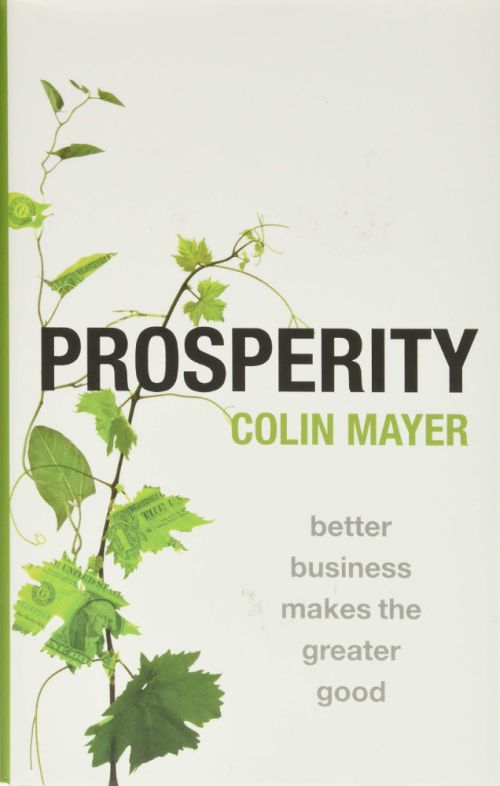
Colin Mayer is a distinguished professor at the University of Oxford, former dean of the Said Business School and a Fellow of the British Academy . Throughout his career one of his fields of interests has been the business corporation and at present he is director of the Academy’s research programme into the Future of the Corporation.
However neither the title nor sub-title of the book do justice to its contents. The book is nothing if not ambitious. In examining the business corporation the claim is that “it will take you across history, around the world, through philosophy and biology to business, law and economics, and finance to arrive at an understanding of where we have gone wrong, why, how we can put it right and what specifically we need to do about it”.
The remarkable fact is that I believe he has achieved his aim. The book is wide in scope, has considerable depth and is not superficial. It is well written, interesting to read and draws on a lifetime of research into different aspects of the business organisation.
The book is first a sustained and vigorous attack on Milton Friedman’s claim that the sole social responsibility of business is to increase its profits, subject however to doing so in open and free competitive markets, without deception or fraud, while conforming to the basic rules of the society embodied in law and custom. For Mayer the public have lost trust in business precisely because business has followed Friedman’s advice and put the interests of shareholders above other stakeholders.
In its place he proposes a total reinvention of the corporation. Corporate law should be changed so that each company is required to state its ultimate purpose over and above profit, redefine the responsibilities of directors to deliver these new objectives, develop new measures by which they can be judged and introduce incentives to deliver them.
In exploring the purpose of business Mayer distinguishes between ‘making good’ (such as manufacturing cars, or electrical products) and ‘doing good’ (treating employees well, cleaning up the environment, enhancing the well-bring of communities). The latter has a social public-service element which goes beyond the private interests of the firm’s customers and investors, and even beyond section 172 of the 2006 UK companies Act, which already imposes duties on directors to take into account the interests of stakeholders other than shareholders. As examples of successful and enlightened corporations he mentions with approval “industrial foundations” companies such as Bertelsmann, Bosch, Carlsberg, Tata and John Lewis which are set up as foundations or trusts.
While I admire his ability to explore different dimensions of the business in one book, I have serious problems with his argument.
First, the pursuit of long term profitability is essential if a company wishes to prosper in the long term. Long term profit is a great discipline. This applies not just to publicly quoted companies; it applies equally to private companies, B-corps, partnerships, foundations and trusts. If companies of any kind make losses, capital will drain away and either they get taken over or go bust. This applies to all companies even those which are foundations and trusts. Not only that but long term profitability is a pre-condition of companies doing good: being able to reward employees well, help communities, develop new products and services for customers and invest to protect the natural environment. In this context it is important to distinguish between long term profitability and short term profitability.
The pursuit of short term profitability is bad business. Just recall the financial derivative products created by banks in the feverish boom years leading up to the 2008 crisis which ultimately led to some banks going bust and others being bailed out by governments. This was bad business. British Home Stores was a classic example of short term profit maximization with inadequate investment in the business itself or the pension fund. Again short termism leading to bad business.
Pursuing long term profitability is not just a matter of management getting numbers right. Before they can do that it requires them to set out a vision which makes the firm “a great place to work”, ensures customers recognize value for money in what they buy, becomes known as an ethical organization by the way they conduct business and admired by shareholders for earning a superior long term return to capital.
A second problem with Mayer’s proposals is the sheer complexity of managing the diverse and frequently opposing interests of stakeholders. It is logically impossible to maximize in more than one dimension. If managers have to manage the interests of all stakeholders they need to be able to make meaningful tradeoffs between competing interests. Profit or change in long-term market value is a way of keeping score in the game of business. Michael Jensen and others have shown that in the long term prospective profit maximization and shareholder maximization amount to the same thing. The use by management of a balance scorecard is no better as it ultimately gives no objective way in which to weigh all of the elements in the scorecard to arrive at a single figure.
A third problem with Mayer’s argument is accountability. “Accountability to everyone means accountability to no one”. The author’s proposal is a revolutionary re-definition of property rights within a modern corporation to make it “trustworthy” but to whom is the board of this new “trustworthy” corporation responsible? And what are the rights of ownership over the funds invested in the business? Already in the US the number of publicly traded companies quoted on exchanges has roughly halved over the past 25 years. One reason is the increasing cost of regulation: another is the availability of private equity finance. If Mayer’s proposals were ever to be implemented they would constitute a major disincentive for companies to raise capital through the public markets and only accelerate the decline in stock market listings.
In Mayer’s proposal shareholders would become providers of capital to business rather than owners of the business. The general public have never had a great trust in business which is why ever since the Industrial Revolution governments have stepped in to control business through laws passed by parliament, regulation, mutualisation, nationalization and state ownership. Mayer’s proposals will downgrade the existing well defined ownership rights which exist in publicly traded companies and replace them with a form of ‘social’ decision making in which the leadership of the company is answerable to trustees but shielded from competition in the market place through take over bids. A sure way to create inefficiency.
In this respect these proposals are a far cry from an exercise in academic research, more a political statement. Far from having no objection to the existence of ‘trustworthy’ corporations as one of many different forms of corporate ownership, I welcome them. In terms of corporate structures let a hundred flowers bloom. If the author was making a case for the idea of ‘Industrial corporation’, fine. However he is doing more than that. He is making the case for eroding private property rights and restricting what companies can do, which is as much a political statement as one based on objective analysis.
“Prosperity: better business makes the greater good” by Colin Mayer was published in 2018 by Oxford University Press (ISBN: 978-0-1988240-08). 288pp.

Lord Griffiths is the Chairman of CEME. For more information please click here.

The Centre for Enterprise, Markets and Ethics (CEME) is pleased to announce the publication of The Challenges of Migration by Andrei Rogobete.
The publication can be downloaded here. Alternatively, paperback copies can be purchased by contacting CEME’s offices via email at: office@theceme.org
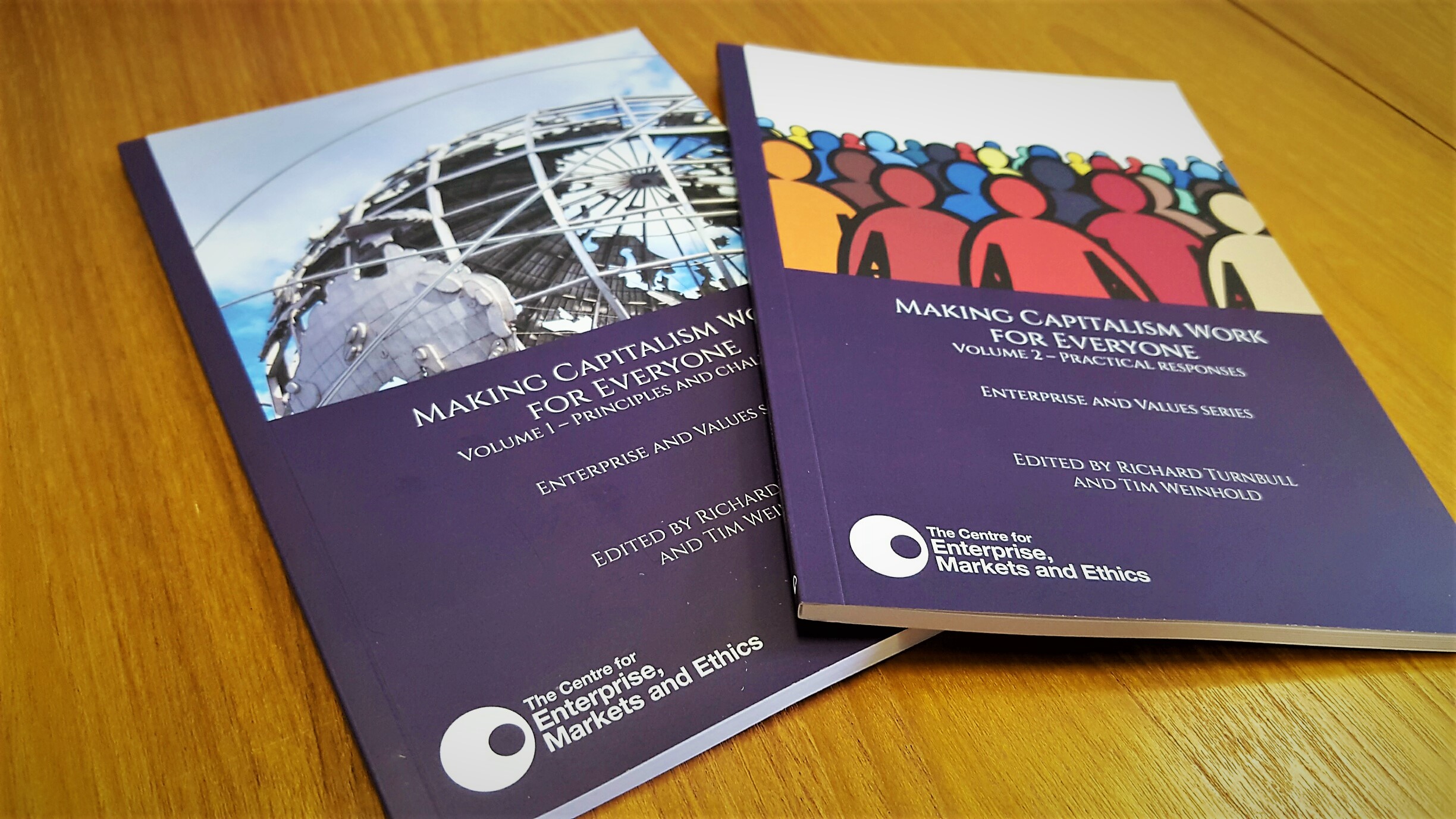
The Centre for Enterprise, Markets and Ethics (CEME) is delighted to announce the publication of Making Capitalism Work for Everyone – Vol. 1 & 2, edited by Richard Turnbull and Tim Weinhold.
Introduction – Richard Turnbull and Tim Weinhold
Chapter 1: Instilling Values in Business – Lord Griffiths of Fforestfach
Chapter 2: Re-imagining Capitalism for the 21st Century – Chris Pinney
Chapter 3: Recovering Moral Purpose in Capitalism – Richard Turnbull
Chapter 4: Capitalism’s Great Divide: The Two Sides of Self-Interest – Tim Weinhold
Chapter 5: The Paradox of Globalisation – Barbara Ridpath
Chapter 1: Creating an Economy of Inclusion – Philip Booth
Chapter 2: Purpose, Practice and Partnership: A Christian Reflection – Jeff Van Duzer
Chapter 3: Benefit Companies – A Pathway to the Future – Rick Alexander and James Perry
Chapter 4: How to Make Finance Serve the Common Good – Cécile Renouard
Richard Turnbull and Tim Weinhold
The global economy affects the everyday lives of millions of people. Through the economic system, goods and services are exchanged, jobs created, businesses founded, taxes levied and government services funded. And lives enriched.
However, too often the system seems fixed, either in favour of big corporations, or governments or individual powerful participants. Greed and exploitation seem to replace mutuality and participation. Consequently, extreme inequalities and injustices arise, structures develop that reinforce aspects of a ‘broken system’ and reward is disconnected from long-term performance. As a result, increasingly large numbers of people experience alienation from the economic system whereby not all share in the fruits and benefits of economic success.
Yet this global economic capitalist system, despite all its flaws, has delivered long-term reductions in levels of poverty through jobs, enterprise and freedom. The progress has been phenomenal in terms of global absolute poverty. We cannot simply set aside the principles of economic growth and trade. Similarly, it is unrealistic to think that some sort of utopian society is possible alongside freedom, individual enterprise and personal responsibility. The question, then, is whether the economic system can be structured in such a way that all may benefit, not necessarily equally but certainly fairly.
What would be the characteristics of such a system? Aspiration, enterprise and reward should certainly be prominent, but alongside responsibility and compassion. Similarly, such a system would encompass a business structure that ensures that good work and quality long-term jobs are seen as responsibilities alongside rewarding the providers of risk capital.
We have gathered together a wide range of authors to explore this question of Making Capitalism Work for Everyone. Our contributors do not share exactly the same perspective on economic or other matters. We do not claim ‘to know’ all the answers. We are critical friends of capitalism. We seek neither utopia nor unrealistic redistributive taxation. We want to encourage wealth creation.
However, we do believe that the only effective way to ensure a prosperous economic future is a system in which all have the opportunity to succeed, all are able to participate on fair terms and all can share in just economic rewards. Similarly, we advocate a global economy in which concepts of justice and fairness shape the system. For some of us the motivations will come from a faith perspective, for others, from human values more widely.
In the first volume our contributors reflect on the principles and challenges faced by capitalism. The second volume explores practical approaches.
We are deeply grateful to the Centre for Enterprise, Markets and Ethics, an Oxford-based think tank dedicated to an ethical enterprise economy for sponsoring and publishing this work.
Your two editors are delighted to have formed a close friendship as well as a professional relationship, and we commend these chapters to you.
Volume 1 can be downloaded here and Volume 2 here. Alternatively, you can order paperback copies via contacting CEME’s offices at: office@theceme.org

Colin Mayer is Professor of Management Studies at the Saïd Business School in Oxford. He believes that “the corporation is failing us” and that dramatic changes in the rights and obligations of those who control corporations are needed. Firm Commitment explains why and makes proposals for change.
Mayer uses the term “corporation” to refer to the kind of limited company that is commonly used by large businesses. He recognises the huge benefits that corporations have brought but he considers them to be seriously flawed. Indeed, he describes his book as “both a tribute to and a condemnation of this remarkable institution that has created more prosperity and misery than could have ever been imagined”. He perceives the main problem to be that corporations are seen as the creatures of their shareholders, rather than as independent entities, and this leads to the pursuit of shareholder value over the interests of stakeholders other than shareholders. In support of this, he cites numerous well-known corporate scandals.
The primary focus of his book is the UK and Mayer appears to believe the position here is worse than elsewhere. However, he is not starry eyed about any currently available option. Notably, he recognises that family and other tightly owned companies may have their own problems and scandals (citing Parmalat) and, in any event, family ownership “is not the resolution to the 21st–century corporation’s problems”. He is also dismissive of the attempts that have been made in recent years to correct problems through regulation (which, he asserts, “promotes immoral conduct”) or through enhanced corporate governance (which, he suggests, may promote increased shareholder control to the further detriment of other stakeholders). He suggests that what we need is “to find mechanisms by which companies can demonstrate a greater degree of responsibility themselves without relying on others to do it for them”. Specifically, he suggests that “we need to establish the means by which corporations can demonstrate more commitment to their stakeholder community”.
Salvation is in what he calls “trust firms”, which would be like existing corporations subject to three adaptations: entrenched within their constitutions would be corporate values (which might reflect the values of their founders, public policy or other things); there would be trustee boards to act as custodians of these values; and the corporation would have “time dependent shares” whereby the voting rights of shareholders would depend upon the extent of their commitment to hold their shares for the longer term (e.g. a share which its holder is committed to hold for a further ten years would have ten times the voting rights of a share which the holder is only committed to hold for one more year).
Mayer does not want any compulsion to be applied in relation to this. He argues that diversity in corporate forms should be permitted. He does, however, suggest that there be tax incentives to encourage the use of trust firms.
There is a lot to applaud in this book. In particular, there is depressingly little evidence that increased regulation or the focus on corporate governance in recent years has materially improved the corporate world and, against this background, Mayer’s stress on the importance of “commitment” as opposed to “control” deserves serious consideration. It links with ideas derived from the work on “relational thinking” that has been undertaken in recent years by, amongst others, the Relationships Foundation and Tomorrow’s Company. Furthermore, the concept of a “trust firm” is an interesting one that could contribute to the development of a broader view of corporate purpose and responsibility.
Unfortunately, however, this is a flawed book. Perhaps Mayer has tried to cram too much into 250 pages. Whatever the reason, almost every page contains contentious statements or statements that require significant qualification. Although there are plenty of footnotes referring to past research, there are also many ex cathedra statements as well as many assertions and assumptions with which specialists will take issue. For example, some of the statements of law are, at best, partial and Mayer seems unaware that much of what he proposes can already be achieved through existing law (as, for example, the entrenchment of editorial independence within the constitution of The Economist Newspaper Ltd illustrates). He also accepts dubious interpretations of past events. In particular, his long description of the Cadbury takeover accepts the views of its former chairman, Sir Roger Carr, without examination. This is a pity because others involved in that takeover (including former Cadbury directors) have different views and consideration of these might have led to Mayer modifying some of his suggestions.
More seriously, Mayer’s analysis of the objective of corporations is unhelpful. He states that “shareholder value is an outcome not an objective” and even quotes former GE CEO Jack Welsh in support of his views. However, his argument only addresses the use of short term share prices as the test of shareholder value and his suggested alternative as a corporate objective is demonstrably inadequate. He asserts that a corporation’s “first and foremost objective is not to its shareholders, or to its stakeholders. It is to make, develop, and deliver things and to service people, communities, and nations”. It is unclear from where he derives this overarching normative assertion and, in any event, it is no more useful than saying that the objective of corporations is “to do things”! It does not help a corporation’s management to decide whether they should remain in heavy engineering or move to IT or whether to be a volume manufacturer or a niche player.
Finally, Mayer’s evident confidence that the trust firm does not suffer from serious flaws and is the solution to the myriad of issues that he has identified is not backed-up by careful analysis. He appears to recognise this since he says that his ideas need to be “subject to careful scrutiny”. They certainly do and, whilst they are undoubtedly worth such scrutiny, it may be seriously doubted whether they are the “cure all” that Mayer appears to believe.
That said, provided that the book is read critically, it is well worth reading.
“Firm Commitment” by Colin Mayer was first published in 2012 by Oxford University Press (ISBN-10: 0199669937).
Richard Godden is a Lawyer and has been a Partner with Linklaters for over 25 years during which time he has advised on a wide range of transactions and issues in various parts of the world.
Richard’s experience includes his time as Secretary at the UK Takeover Panel and a secondment to Linklaters’ Hong Kong office. He also served as Global Head of Client Sectors, responsible for Linklaters’ industry sector groups, and was a member of the Global Executive Committee.