
Case studies are a useful way to evaluate the impact of AI on day-to-day life. The first one below considers the use of biometric recognition in strengthening cross-border security; the second the use of AI in autonomous driving vehicles. The aim is further understanding of where AI features, such as machine learning, might be beneficial and where detrimental.
2.1 Case study A: AI in the use of biometric security
2.1.1 Context and background
A prerequisite of effective governance is an awareness of who is being governed. Historically, the fingerprint represented the de jure form of authentication used by central governments and local authorities. Some of the first records of fingerprinting date back to the late nineteenth century, when William Herschel, a British colonial administrator in India, used basic ink to create impressions of the hands and fingers of awardees of civil contracts and administrative duties.[1] The motivation was essentially prevention of fraud and misidentification. Later, photographic identification, coupled with fingerprinting, increasingly dominated and advanced forensic criminology throughout the twentieth century.
A major breakthrough came in the 1980s, when IBM developed the first optical scanners, which could store scanned fingerprints into a digital database. This new technology extended to barcode scanning, which increasingly enabled categorisation of products and items throughout the late 1970s and 80s.[2] It facilitated the rapid transit and security screening of both goods and people. Digital databases ballooned in size and with them so did the stored information about individuals and products. Yet the more important aspect was speed of accessing data rather than capacity for storing it.
Criminals’ fingerprints could now be screened and the results presented in real time. The implications for border security were, unsurprisingly, vast. By the mid-2000s, biometric passports – also known as epassports – had become commonplace (Malaysia was first to issue them, in 1998). By 2008, around 60 countries had biometric passports; by 2019, over 150.[3] Widespread adoption attests to the popularity and perceived benefits of biometric forms of identification compared to traditional documents.
2.1.2 Key issues
First to note is the role of national – or supranational – borders, namely to allow free passage of legal goods and people and prevent illegal activity. The UK Border Force defines its role as ‘facilitating the legitimate movement of individuals and goods, whilst preventing those that would cause harm from entering the UK’.[4]
The objective of border control therefore fundamentally relies on the distinction between legal and illegal. The problem is that without technology that enables rapid identification, triaging between legal and illegal becomes a laboriously slow and ineffective process. This is particularly acute at high-volume borders, such as airports, seaports or major land border crossings. Guaranteeing safety as well as speed of passage remains a pressing, often conflicting issue. Automation in this case brings multiple benefits to those both seeking and overseeing transit. Biometric travel documents have also led to an increase in the number of automated border control systems, which allow passengers to pass through security merely by scanning their passport and/or face.
2.1.3 Action taken
The first British biometric passport was issued on 6 March 2006.[5] It featured a new design, with an array of supplementary tech-driven security features. A key distinguishing element is an embedded microprocessor chip that includes the holder’s biometric data. The chip has the ability to store facial recognition, fingerprint recognition, iris recognition or any combination of the three. Underlying this technology is a system known as radio frequency identification, which enables the stored data to be encrypted and only read via the embedded radio tag itself. This means that no personal information can be retrieved and copied out of the chip.[6]
One advantage is that digitally stored data can be checked with more accuracy than is possible via visual inspection. Biometric facial data often includes measurements, such as distance between eyes, unique skin marks, size and shape of face. Figure 3 illustrates a facial-recognition mapping model.[7] This approach creates a network of geometric datapoints that can be identified on the surface of the face.
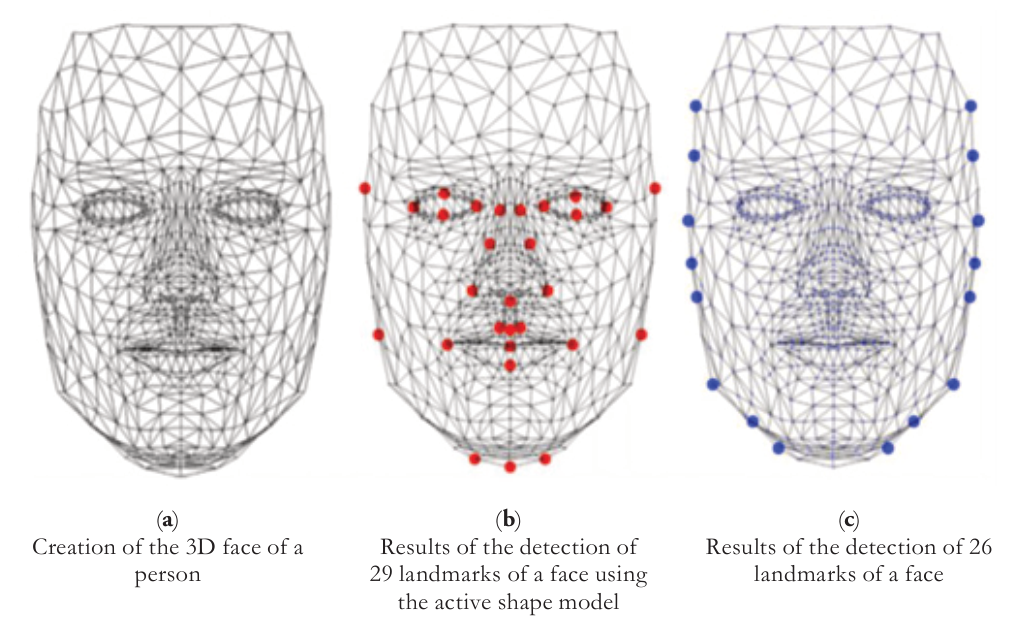
Facial recognition then uses key-points-based techniques to interpret and establish the geometric characteristics of the facial surface.[8] Again, these can include measurements surrounding the inner features of the face (such as nose, lips, eyes), as well as outer features (such as jawline, cheekbone contour, head shape). The facial-recognition process usually involves two steps at which machine learning is involved. The first is key-point detection, where the AI detects the defining physical features of the surface and assigns key points.[9] The second is feature extraction, where data is generated by mapping the key points. The final result is a full-scale digital model of a person’s face, with over 80 key nodal points that can be accurately utilised to confirm identity.
2.1.4 Results and the impact of AI
The move to biometric passports marked a significant turn from traditional travel documents that largely relied on distinctive physical indicators for security and identification. The most obvious result was an increase in the level of border security. Facial recognition benefits from precise measurements as well as the ability to adapt to physical changes, including biological markers such as facial hair, aging or even skin tone. The benefit of having an extensive map of data points is that even if a certain percentage are altered or obstructed (such as by glasses), the remaining visible part of the facial map can be used to authenticate identity. At a micro level, the human face is so unique that the chance of misidentification is estimated to be around 1 in 1,000,000, compared to 1 in 50,000 for fingerprint recognition.[10] Peter Schmallegger of NXP Semiconductors argues that: ‘The use of ePassports makes it harder to present doctored or illegally issued travel documents as the real thing, and helps reduce black-market trade in travel documents.’[11] The data held on the inside chip, compared to embedded security features on traditional passports, makes epassports difficult to duplicate.
Despite officers’ training, visual inspections have their limitations – there will always be cases where the similarities are dominant and can lead to misidentification, such as with twins. Dominik Malčík and Martin Drahanský’s extensive research in this regard found that:
If the facial photo is treated from a biometric point of view (not just as a picture of a person) – the face contains information that is invariant in time and can be measured … for example, the distance between eyes, position of chin, position of nose, and so forth. These factors can affect the recognition process by providing additional information to the officer.[12]
Without the availability of biometric data, officers must rely solely on their own training and intuition.
Moreover, the increase in security has resulted in border-control forces adopting and implementing biometric technologies throughout their operations, with overwhelming support from their chief executives. Accenture conducted a survey of 91 border-agency leaders from Australia, Finland, France, Germany, Japan, Norway, Singapore, the UK and the USA, and found 92 per cent willing to adopt next-generation biometric technologies. Of those surveyed, 68 per cent believed these new technologies can help reduce risk and improve border security, and 54 per cent that they will enhance customer-service delivery.[13]
Another, perhaps more consequential result of biometric passports has been an increase in speed of passage via the adoption of new forms of border automation such as e-gates, or ‘automated border control systems’. E-gates are automated border-control barriers that utilise the data stored in the biometric passport microchip, along with the facial scan or fingerprint taken at point of entry. The system electronically verifies the passport holder’s identity and grants – or denies – passage. If there are issues in the biometric verification process, most scenarios result in the gates remaining closed and an immigration officer taking over. It is important to note that border officers permanently oversee the verification process, usually from a remote desk in proximity to the gates. This enables full control should issues arise.
Biometric identification is a good example of how artificial intelligence and the human component can work harmoniously together. The cohesion of AI, in the form of biometric technology, with the element of human oversight, reinforces speed and security. The two are mutually inclusive, resulting in positive outcomes for both travellers and border staff.
In this sense, e-gates bring additional benefits by reducing the administrative burden on border forces and allowing them to focus on higher-risk individuals. In the future, predicts Michael Petrov of Vision-Box, which has installed over 800 e-gates in more than 60 airports across Europe:
the trend will shift toward the integration of automatic and manual immigration checks. Initial traveler data … would be verified at various stages of the trip. When travellers are securely known throughout their entire journey, the border control mission will be fully realized.[14]
2.1.5 Potential risks and drawbacks
There are arguably two main issues associated with the use of biometric technology in places of transit: system malfunction and privacy. Both are resolvable.
Statistically speaking, the possibility of a systems malfunction is exceptionally low. The latest biometric-recognition technologies have a demonstrated accuracy of 99 per cent, and benefit from an inbuilt error-detection system that instantly alerts overseeing officers to irregularities.[15] In addition, the likelihood of malfunction, attempted illegal passage and officer error all occurring at the same time remains infinitesimally small. This translates to a system with very robust safeguards in place.
With regard to privacy, e-gates collect personal information that usually includes name, gender, date of birth, passport number, travel plan, passport photograph and facial biometric templates. While some might perceive a potential privacy risk, the reality is that, under current legislation, passengers already give up personal details if they wish to travel, whether or not via biometrics. In addition, the data is only handled by authorities sanctioned to do so. It is, however, important to ensure that data is securely stored and not vulnerable to fraudulent attacks or leaks. One e-gate manufacturer pointed out that: ‘We will only use or disclose the personal information for the purpose for which it was collected or as otherwise required or authorised by law.’[16] Privacy in this case is therefore rather a non-issue: passengers always forfeit information if they wish to travel.
2.2 Case study B: the use of AI in autonomous driving
2.2.1 Context and background
In 1939, the American industrial designer Norman Bel Geddes created Futurama, an iconic diorama that depicted what urban transportation might be like in the 1960s. It was no small affair: using scale models, it featured a large metropolis with deep suburbs, 50,000 vehicles, over 500,000 buildings, a million trees, fast-moving highways, sky-high buildings and a 140-ton conveyer system where guests could sit and admire the spectacle.[17] First presented at the New York World Fair for General Motors, Futurama became the exhibition’s ‘number-one hit’,[18] with over 30,000 visitors, fascinated by the possibilities and implications of technological automation.[19]
Inside Futurama, Bel Geddes also presented the first concept model of an autonomous vehicle guided by radio-controlled electromagnetic fields, created by placing metal spikes alongside the roads and highways. General Motors took this concept and made it a reality in 1958 by creating an autonomous vehicle guided entirely by electric pick-up coils. The flow of current could be altered to control the vehicle and move it left or right.[20] It proved unscalable and ultimately infeasible, yet sparked the imagination of both car engineers and the general public as to what advanced automation might bring. There was a common cultural perception by the mid-century that the age of technology was in full swing. In reality, since the 1950s much of the progress has been limited to largely functional vehicle improvements, each decade seeing the target of fully automated vehicles pushed further back as new complexities arise.
2.2.2 Key issues
Since the late 2000s, two corporate giants have been at the forefront of autonomous-driving innovations: Alphabet (Google’s parent company) and Tesla, though others, including GM and Honda, conduct smaller-scale R&D. Thus far all efforts have failed despite the billions invested.[21] Elon Musk admitted in an interview that the problem of self-driving is:
way harder than I thought … what it comes down to at the end of the day is, to solve self-driving … you basically need to recreate what humans do to drive … which is to recreate optical sensors, eyes, and biological neural nets – that is how the entire road system is designed to work.[22]
In similar fashion, Anthony Levandowski, the co-founder of Google’s self-driving car project, Waymo, has said that one would be ‘hard-pressed to find another industry that’s invested so many dollars in R&D and that has delivered so little’.[23]
At present, most vehicles offer some semi-autonomous features more aimed at driver convenience and general safety than autonomous driving per se. Examples include cruise control (more recently radar- and GPS-guided), crash mitigation systems (such as obstacle detection, airbag deployment and assisted braking), as well as other optional improvements (such as auto-dipping headlights, automated windscreen wipers and even a suspension system that adapts its firmness based on real-time GPS scanning of the route ahead, first implemented by Mercedes-Benz in 2013).[24] It is expected that such technologies will continue to improve and gradually feature across a wider range of vehicles.
So with a fully-fledged, road-legal self-driving car yet to be achieved, how far has autonomous driving technology come?
2.2.3 Action taken
The Society of Automotive Engineers currently divides levels of automation into the following categories:
- Level 0 – no automation
- Level 1 – driver assistance (hands on/shared control)
- Level 2 – partial driving automation (hands can be taken off the steering wheel)
- Level 3 – conditional driving automation (does not require continuous eyesight attention)
- Level 4 – high driving automation (does not require continuous mental attention)
- Level 5 – full driving automation (the steering wheel becomes optional)[25]
The most sophisticated road-legal cars today have the technological capacity to reach Level 3. However, safety legislation only permits this for limited periods (usually seconds), after which the driver is required to interact with the steering wheel and demonstrate control of the vehicle.
Some of the main technologies currently used in autonomous driving include audio/visual cameras, GPS, thermographic cameras, radar and lidar (light detection and ranging).[26] Figure 4 illustrates where most of the sensors would usually be placed on a vehicle.
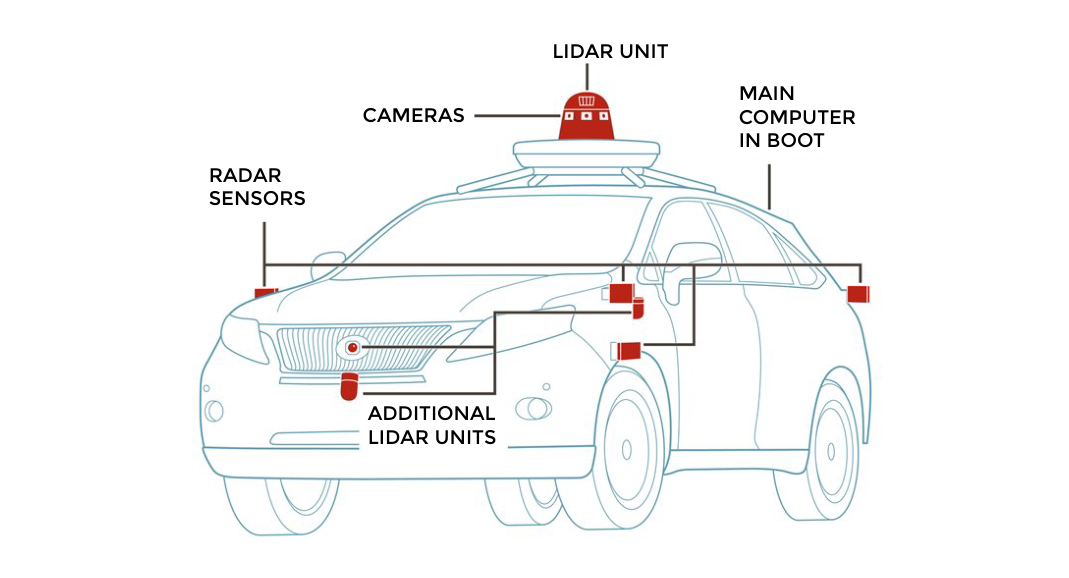
Similar to pattern-recognition technology used in biometric identification, the depth- and object-perception sensors on the car are used to recreate a 3D digital model of the surrounding physical world. Not only does the 3D model have to be accurate, it needs to overcome the additional challenge of continuously adapting in real time.
Figure 5 illustrates what the digital map of the surrounding environment would look like. The challenge is for the systems to identify, interpret and act according to the patterns of objects and people presented while in motion. The AI must accurately label and categorise any familiar forms or shapes, which usually involves pedestrians, road signs, traffic lights, bus lanes, cycle lanes, trucks and other vehicles.
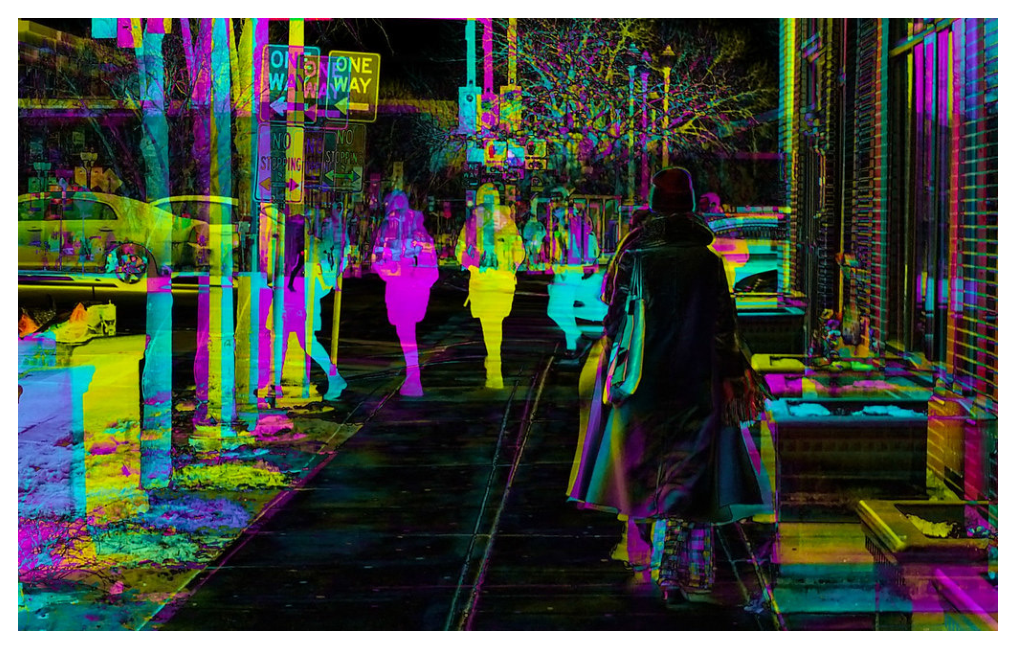
In technical terms, the system used by the sensors is known as Bayesian simultaneous localisation and mapping (SLAM), though it is important to note that not all self-driving vehicles use SLAM. Algorithms in SLAM merge data inputs from the sensors placed throughout the car, which allows generation of a digital map similar to that shown in Figure 5.[27] Some autonomous-vehicle programs use a type of SLAM called DATMO (detection and tracking of other moving objects), which brings the additional advantage of identifying and predicting the position of an object once it has been defined (such as a cyclist, pushchair – or horse).[28]
2.2.4 Results and associated risks
Results and progress on autonomous driving thus far present a mixed picture. On the one hand, in June 2022, Cruise, a subsidiary of GM, received a Driverless Deployment Permit from the State of California – the first private company given permission to offer and charge for driverless rides within a major US city (San Francisco).[29] On the other, while the technology currently has the capability to perform basic driving- and crash-mitigation manoeuvres, it is not yet fit for mass adoption. There are three interconnected areas in which the main outstanding issues arise.
The first concerns when the navigation system encounters the unforeseen, such as a deer jumping in front of the car on a country road, or another vehicle rapidly changing lane without signalling. Information misinterpretation, as well as acute computational load on the system, can result in a temporary malfunction, placing the vehicle at risk of collision.
In March 2018, the death of Elaine Herzberg in Tempe, Arizona, marked the first fatal crash caused by a fully autonomous test vehicle on public roads.[30] Mrs Herzberg was pushing a bicycle across a four-lane carriageway when an Uber test car struck her via lateral collision at an estimated 45 mph (72 km/h).[31] While it became clear that the crossing itself was treacherous, the vehicle’s CAS (collision avoidance systems) failed to activate. The AI’s malfunction pointed to issues in the hardware (the sensors) as well as the software (the programming), which accordingly failed to engage. Jim McPherson, a California attorney and self-driving car expert, pointed out that: ‘Lidar or Radar [systems], each has their shortcomings depending on light, reflectivity … Dark clothing and metal appear to one better than the other.’[32]
The second area concerns when the pattern-recognition AI wrongly identifies or interprets an object on the road (such as a red light or a mobility scooter). This usually occurs when the AI’s recognition algorithms and/or the assortment of cameras and sensors see the data but either malfunction or mislabel it. There is evidence of an incident in 2016, when another Uber autonomous vehicle failed to recognise the correct colour at a traffic light and crossed on red.[33] One investigation suggests that the lasers and cameras used by driverless cars can misinterpret red traffic lights as green up to 30 per cent of the time.[34] Clearly, misinterpreting one colour for another while driving has potentially severe consequences.
The third area concerns when the AI fails to understand the unwritten rules of driving. A major component of driving relies on distinctly human anticipation and intuition. Making eye contact with other drivers, small hand gestures to pedestrians, giving way – or warning of hazards – by flashing headlights all contribute to a driving ecosystem heavily reliant on human perception and instinct. Current AI technology is poor in this area.
There are also issues surrounding the dynamics of object occlusion and object permanence. Human drivers rely on memory and quite intricate spatial awareness. For example, a driver encountering a school bus pulling over may only temporarily see the children disembarking but her short-term memory and intuition instinctively make her slow down in anticipation that some children may suddenly jump from behind the bus to cross the road. The object (in this case children) temporarily appears and then disappears from the driver’s field of view, yet she remains aware that temporary disappearance does not imply absence – the object is merely obscured (in this case by the bus). An AI in such scenarios may be fooled into thinking that since the object is no longer in sight, it is no longer present.
Creating AI driving systems that can reliably mitigate the dangers of such intricate situations is work in progress. Google has invested heavily in R&D here with their ‘behaviour prediction’ technology, which ‘can predict the behaviour of an object on the road based on its classification by inferring data from the training models constructed using millions of miles of driving experience’.[35] While promising, the software is not yet available to the public, and as even Google admit: ‘This is an incredibly difficult problem that is critical for the success of any self-driving car project.’[36]
It is the human component of driving and its unwritten rules that current autonomous technology fails fully to grasp and act on in a manner deemed safe for public use. At present the risks of self-driving cars outweigh the rewards. An article in The National Law Review pointed out that statistically there are 9.1 driverless-car accidents per million miles compared to 4.1 for regular vehicles, making autonomous vehicles more than twice as dangerous.[37] It remains to be seen how the promise of autonomous driving evolves over time, but as of now it is an example of where AI is not yet fit for purpose.
Notes to Chapter 2
[1] Costica Dumbrava, ‘Artificial Intelligence at EU Borders: Overview of Applications and Key Issues’, European Parliamentary Research Service, July 2021, p. 2.
[2] ‘Bar Code Scanner’, Encyclopedia.com, 18 January 2023, https://www.encyclopedia.com/science-and-technology/computers-and-electrical-engineering/electrical-engineering/optical-scanners.
[3] Thales Group, ‘The Electronic Passport in 2021 and Beyond’, 23 February 2023, https://www.thalesgroup.com/en/markets/digital-identity-and-security/government/passport/electronic-passport-trends.
[4] UK Border Force, ‘About Us’, 12 March 2023, https://www.gov.uk/government/organisations/border-force/about.
[5] HM Passport Office, ‘Biometric Passports and Passport Readers’, 22 March 2023, https://www.gov.uk/government/publications/biometric-passports-and-passport-readers/biometric-passports-and-passport-readers.
[6] Dominik Malčík and Martin Drahanský, ‘Anatomy of Biometric Passports’, Journal of Biomedicine and Biotechnology 2012:4, Article ID 490362, 18 July 2012, https://www.ncbi.nlm.nih.gov/pmc/articles/PMC3433183/pdf/JBB2012-490362.pdf.
[7] Yassin Kortli, Jridi Maher, Ayman Al Falou and Mohamed Atri, ‘Face Recognition Systems: A Survey’, Sensors 20:2, 7 January 2020, https://www.mdpi.com/1424-8220/20/2/342/htm.
[8] Kortli et al., ‘Face Recognition Systems’.
[9] Kortli et al., ‘Face Recognition Systems’.
[10] ‘About Face ID Advanced Technology: Find out how Face ID helps protect your Information on your iPhone and iPad Pro’, Apple, 7 April 2023, https://support.apple.com/en-gb/HT208108.
[11] Peter Schmallegger, ‘The Future of ePassports and Border Crossings’, NXP Semiconductors, 5 March 2023, https://www.nxp.com/docs/en/white-paper/the-future-of-epassports-and-border-crossings-whitepaper.pdf.
[12] Malčík and Drahanský, ‘Anatomy of Biometric Passports’.
[13] Jim Canham, ‘Emerging Technologies can Transform Border Management, but Agencies must Prepare’, WCO News, 11 January 2023, https://mag.wcoomd.org/magazine/wco-news-82/emerging-technologies-can-transform-border-management-but-agencies-must-prepare/.
[14] Autumn Cafiero Giusti, ‘E-Gates Ease and Secure International Travel: Kiosks read Passport, use Biometrics to verify Identity’, Secure ID News, 18 December 2016, https://www.secureidnews.com/news-item/e-gates-ease-and-secure-international-travel/2/.
[15] ‘Automated Fingerprint Identification System Market is likely to reach a Valuation of nearly US$ 85 bn by the End of 2032’, Yahoo! Finance, 4 October 2022, https://finance.yahoo.com/news/automated-fingerprint-identification-system-market-143000667.html.
[16] Australian Government, Department of Immigration and Border Protection, ‘Arrivals SmartGate’, 19 January 2023, https://web.archive.org/web/20160103192933/http://www.border.gov.au/Trav/Ente/Goin/Arrival/Smartgateor-ePassport.
[17] ‘What was the Real Futurama?’, YouTube, 13 January 2021, https://www.youtube.com/watch?v=aMSp4d2rOzE.
[18] Roland Marchand, ‘The Designers go to the Fair II: Norman Bel Geddes, the General Motors “Futurama,” and the Visit to the Factory Transformed’, Design Issues 8:2 (1992), pp. 22–40.
[19] P. M. Fotsch, ‘The Building of a Superhighway Future at the New York World’s Fair’, Cultural Critique 48 (Spring 2001), pp. 65–97.
[20] Bonnie Gringer, ‘History of the Autonomous Car’, 12 March 2023, https://www.titlemax.com/resources/history-of-the-autonomous-car.
[21] Rebecca Fannin, ‘Where the Billions spent on Autonomous Vehicles by U.S. and Chinese Giants is heading’, CNBC, 21 May 2022, https://www.cnbc.com/2022/05/21/why-the-first-autonomous-vehicles-winners-wont-be-in-your-driveway.html.
[22] ‘Elon Musk: Self-driving is way harder than I thought’, Lex Fridman Podcast Clips, YouTube, 1 January 2022, https://www.youtube.com/watch?v=MyLUiE-XfQI.
[23] Frank Landymore, ‘Godfather of Self-Driving Cars says the Tech is going Nowhere: “It’s an Illusion”’, Futurism, 10 September 2022, https://futurism.com/self-driving-industry-going-nowhere.
[24] ‘Chassis: The First Suspension System with “Eyes” now sees even Better’, Mercedes-Benz Group Media, 22 October 2022, https://group-media.mercedes-benz.com/marsMediaSite/en/instance/ko/Chassis-The-first-suspension-system-with-eyes-now-sees-even-better.xhtml?oid=22944501.
[25] ‘Taxonomy and Definitions for Terms Related to Driving Automation Systems for On-Road Motor Vehicles’, Society of Automotive Engineers, 28 March 2023, https://www.sae.org/standards/content/j3016_202104/.
[26] Araz Taeihagh and Hazel Si Min Lim, ‘Governing Autonomous Vehicles: Emerging Responses for Safety, Liability, Privacy, Cybersecurity, and Industry Risks’, Transport Reviews 39:1 (2019), pp. 103–28.
[27] Hugh Durrant-Whyte and Tim Bailey, ‘Simultaneous Localization and Mapping: Part 1’, IEEE Robotics and Automation Magazine 13:2 (2006), pp. 99–110.
[28] Talha Takleh Bin Omar Takleh, Nordin Abu Bakar et al., ‘A Brief Survey on SLAM Methods in Autonomous Vehicle’, International Journal of Engineering and Technology (UAE) 7:4 (2018), pp. 38–43.
[29] Lora Kolodny, ‘Cruise gets Green Light for Commercial Robotaxi Service in San Francisco’, CNBC, 2 June 2022, https://www.cnbc.com/2022/06/02/cruise-gets-green-light-for-commercial-robotaxis-in-san-francisco.
[30] ‘Uber Self-Driving Crash: Footage shows Moment before Impact’, BBC News, 22 March 2018, https://www.bbc.co.uk/news/world-us-canada-43497364.
[31] Troy Griggs, ‘How a Self-Driving Uber Killed a Pedestrian in Arizona’, The New York Times, 18 May 2018, https://www.nytimes.com/interactive/2018/03/20/us/self-driving-uber-pedestrian-killed.html.
[32] Ryan Randazzo, ‘What went wrong with Uber’s Volvo in Fatal Crash? Experts shocked by Technology Failure’, AZ Central, 22 March 2018, https://eu.azcentral.com/story/money/business/tech/2018/03/22/what-went-wrong-uber-volvo-fatal-crash-tempe-technology-failure/446407002/.
[33] Mike Isaac and Daisuke Wakabayashi, ‘A Lawsuit against Uber highlights the Rush to conquer Driverless Cars’, The New York Times, 24 February 2017, https://www.nytimes.com/2017/02/24/technology/anthony-levandowski-waymo-uber-google-lawsuit.html.
[34] Matthew Sparkes, ‘Driverless Cars can be Tricked into Seeing Red Traffic Lights as Green’, New Scientist, 14 April 2022, https://www.newscientist.com/article/2315634-driverless-cars-can-be-tricked-into-seeing-red-traffic-lights-as-green/.
[35] Radhika Madhavan, ‘How Self-Driving Cars work: A Simple Overview’, EMERJ, 3 June 2019, https://emerj.com/ai-sector-overviews/how-self-driving-cars-work/.
[36] ‘Join Us – Software Engineer, Evaluation, Behavior Prediction’ [job advertisement], Waymo, 19 January 2023, https://web.archive.org/web/20221007194952/https://waymo.com/intl/es/joinus/4358489/.
[37] Clifford Law Offices, ‘The Dangers of Driverless Cars’, The National Law Review 11:125 (5 May 2021), https://www.natlawreview.com/article/dangers-driverless-cars.