
Skip to content
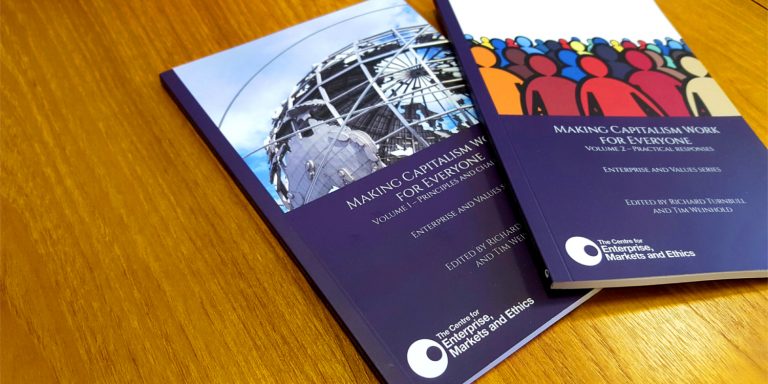
Making Capitalism Work for Everyone

How to Make Finance Serve the Common Good

Chapter 4: How to Make Finance Serve the Common Good   Today, insurance companies and pension funds manage more than 100 trillion dollars of savings. These flows are not directed to long-term investments in low-carbon infrastructure and other sustainable development projects, but are fuelling financial bubbles; shareholders who lack investment (...)

Continue Reading
Making Capitalism Work for Everyone

Benefit Companies – A Pathway to the Future

Chapter 3: Benefit Companies – A Pathway to the Future   The capital markets in the UK and many other countries are dominated by the doctrine of ‘shareholder primacy’. Under this concept, investors – including pension funds – seek to have each company in which they invest ‘maximise value’ by (...)

Continue Reading
Making Capitalism Work for Everyone

Purpose, Practice and Partnership: A Christian Reflection

Chapter 2: Purpose, Practice and Partnership: A Christian Reflection   With apologies to Winston Churchill, it might be said that ‘Capitalism is the worst form of an economic system, except for all the others.’ Or putting it more positively, it seems beyond dispute that capitalism is the most efficient economic (...)

Continue Reading
Making Capitalism Work for Everyone

Creating an Economy of Inclusion

Chapter 1: Creating an Economy of Inclusion Introduction Christian religious leaders are not known for their sympathy towards a market economy. They frequently complain about injustices and inequalities that they argue are caused by markets. Sometimes supporters of a market economy respond by conceding ground; at other times, however, by (...)

Continue Reading
Making Capitalism Work for Everyone

The Paradox of Globalisation

Chapter 5 The Paradox of Globalisation Barbara Ridpath Introduction Globalisation has gone from praised to pilloried. Throughout most of the post-war era, international trade has been seen largely as a ‘good’. The advantage to both parties of trading was based largely on Adam Smith’s description of comparative advantage in the (...)

Continue Reading
Making Capitalism Work for Everyone

Capitalism’s Great Divide: The Two Sides of Self-Interest

Chapter 4 Capitalism’s Great Divide: The Two Sides of Self-Interest Tim Weinhold Adam Smith probably tops history’s list of influential teachers with the most followers who largely misunderstood their teacher’s message. As we all know, Smith is widely viewed as the father of capitalism, based on his 1776 book, The (...)

Continue Reading
Making Capitalism Work for Everyone

Recovering Moral Purpose in Capitalism

Recovering Moral Purpose in Capitalism Richard Turnbull Introduction Capitalism is a complex word, even inadequate. Marxism uses the term in contrast to ‘labour’ (with the assumption that the accumulation of capital can only be at the expense of labour, a zero-sum game). Economic theory holds capital to be one of (...)

Continue Reading
Making Capitalism Work for Everyone

Re-imagining Capitalism for the 21st Century

Re-imagining Capitalism for the 21st Century Chris Pinney Introduction Few would disagree that capitalism is the most powerful economic system humanity has developed. Capitalist societies have experienced unprecedented economic and social progress, creating the highest standard of living the world has ever seen. It is the principles behind capitalism, such (...)

Continue Reading
Making Capitalism Work for Everyone

Instilling Values in Business

By Brian Griffiths

Instilling Values in Business Lord Griffiths of Fforestfach I am a great admirer of Alasdair MacIntyre. He is one of the world’s greatest living philosophers, invariably provocative and controversial but never without interest or depth of thought. A few years ago he gave a lecture with the arresting title ‘The (...)

Continue Reading
Is The Non-executive Director worth saving

Is the Non-Executive Director Worth Saving? (5/5)

Conclusions and Recommendations If these observations are accurate, NEDs face such potentially severe liabilities, and the mismatch of expectations is so great, that there will be problems in recruitment and retention as well as more serious issues. A role may have been undermined that serves business and society with high (...)

Continue Reading
Is The Non-executive Director worth saving

Is the Non-Executive Director Worth Saving (4/5)

What Do We Really Want from a Non-Executive Director? The public narrative around NEDs illustrates a real tension between a proper desire to hold directors to account and a lack of understanding of the nature and complexity of the NED role. Complaints about ‘cosy clubs’, ‘asleep at the wheel’ or (...)

Continue Reading