
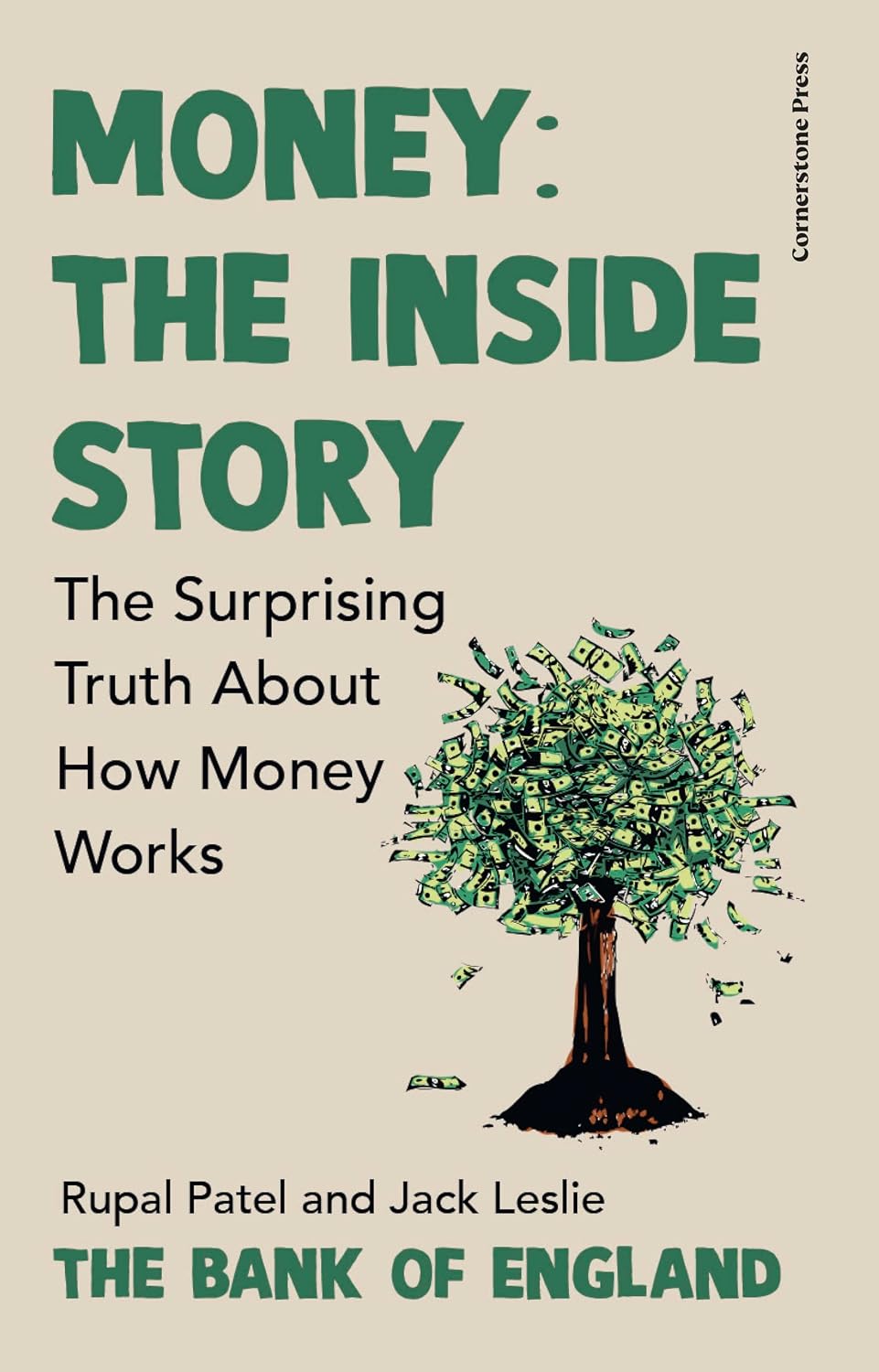
Written by two economists at the Bank of England, this book follows Can’t we Just Print More Money? (also reviewed on this website), as part of The Bank’s efforts to build public understanding of the economy and the Bank’s own role within it. It begins with an observation that in spite of the ubiquity of money and our dependence on it, many of us know little about it. As such, the book aims to examine the system of money in its various forms.
Money and its System
Each chapter addresses a particular facet of money and issues surrounding it, with the book being loosely divided into parts on the themes of the system of money as it actually functions – or is supposed to – when things generally work well, what happens when things go wrong and the future of money. The first chapter considers the key features of money as a medium of exchange, a store of value and a unit of account, and traces the development of money from its commodity forms to its incarnation as notes and coins. In the course of this discussion, the reader is given interesting insights into the Bank of England’s production of banknotes in the present day and the presence of giant banknotes stored on its premises). Moving on from the ‘material’ forms of money to its digital form, the second chapter explores money as bank deposits – essentially numbers in an electronic system – and describes how commercial banks effectively create new money when they issue loans. The importance of central bank deposits as a form of security against the risk of banks running into difficulty as a result of bad loans is made clear. The authors also outline the role of the Bank rate – the rate at which the Bank of England pays interest on the holdings of its depositors – as a means by which the Bank can influence economic activity by varying the price of borrowing and lending. Thus, while commercial banks are not guaranteed to remain stable, central banks can ensure that money works and retains the public’s confidence.
Chapter 3 considers the role of the Bank’s RTGS (Real Time Gross Settlement) system – or black box – in consolidating and settling payments between banks, thus removing a degree of risk from the process of making digital payments. It also traces the development of credit cards (and the emergence of the first ATM) and the digital wallet, such as Paypal as well the importance of such systems in regions where access to banking services is very limited. Even with more futuristic (but real) means of making payment, such as facial recognition, the Bank of England’s black box is involved, so as to ensure confidence and reliability. The fourth chapter looks at the relationship between government and money, both in terms of taxation – which may very well be the reason for the emergence of money in the first place and its acceptance as a means of exchange – and the other means by which governments can gain revenue, whether through seignorage (the profit gained from creating currency, which is effectively the difference between the cost of production and the full face value of the currency itself), selling assets of various kinds or borrowing in the form of selling bonds. It also looks at the various institutions that exist for dealing with governmental cash flow and finances, such as the Debt Management Office and the Office for Budget Responsibility, as well as the role of fiscal rules – changed no fewer than nine times since their implementation in 1997 – in maintaining sound finances.
When Things Go Wrong
From Chapter 5, attention is given to what happens when things go wrong in the system. Banking crises are the subject of the fifth chapter, which gives an interesting case study of Silicon Valley Bank in 2023 and the measures taken by the Bank of England and governments to address such failures. Inflation is addressed in Chapter 6. This is a slightly longer but interesting chapter, which discusses the reasons for which inflation above a certain rate is a problem, the temptations for governments to keep printing money – particularly when heavily indebted – and the various means that have been used in the past (with differing degrees of success) to try to control inflation. It then outlines the mechanisms by which the Bank of England sets interest rates and how these rate changes work to affect the behaviour of businesses and individuals, thus influencing the rate of inflation: ‘… a change in Bank Rate affects how much people save and spend. And how much people spend overall influences how much things cost, i.e. the price of stuff. When interest rates go up, it costs you more to borrow money. You’re likely to spend less and businesses are encouraged to slow down price rises or even cut prices. This reduces the rate of inflation. Conversely, when interest rates fall, it gets cheaper to borrow and so you’re more likely to buy more, which causes prices to rise faster’ (pages 161-2). The chapter closes with accounts of the measures that central banks implemented to address the risk of deflation following the financial crisis of 2008-9, such as the shift (resisted by the Bank) to negative interest rates and the adoption of Quantitative Easing. Overall, the chapter is very engaging and clearly written, presenting an account of monetary phenomena frequently discussed in the media in straightforward terms that can easily be understood.
The seventh chapter considers currencies and the reasons for which different currencies exist, as well as the importance to governments of control over their own currencies, usually for the purpose of influencing international trade and the rate of inflation. There is a brief history of foreign exchange and a discussion of the reasons for which currencies rise and fall, prior to an account of the different methods by which currencies have been valued in the past, whether fixed in relation to a precious metal, such as gold, or pegged to another currency, such as the US dollar – and the advantages and difficulties attendant on each. Britain’s withdrawal from the European Exchange Rate mechanism illustrates the challenges of maintaining a currency’s value against another. The chapter then analyses the monetary union of the Eurozone and the reasons for which it was introduced, considering the advantages as well as the difficulties for governments that come with a loss of monetary sovereignty.
The Future of Money
The eighth chapter begins a discussion of the future of money, focusing on cryptocurrencies such as Bitcoin and stablecoins. The authors explain how they are produced, circulated and exchanged, arguing that Bitcoin is not really money and illustrating the problems faced by stablecoins in their attempts to address the shortcomings of Bitcoin by having their value linked to the US dollar or gold: ‘stablecoins remain distinctly unstable’ (page 224) and fail to hold their pegs. There is also an interesting discussion of central bank digital currencies, the advantages they present and the concerns that surround them. Chapter 9 returns to cash and asks whether, with the decline in cash transactions, we are heading towards a cashless future. It examines the reasons for which cash has declined – essentially because payment technology has improved and become cheaper, approaching much closer to offering the advantages traditionally associated with cash – but reminds the reader of the resilience of cash and the reasons for which it remains the first choice of payment method for a fifth of adults.
The book closes with a short chapter that revisits some of the main themes of the book and provides an interesting account of the authors’ own attempts to buy and spend £15-worth of Bitcoin near their place of work. They assert that money and society continue to shape one another and that what counts as money is a social phenomenon based on acceptance: ‘what constitutes money is a collective decision … Governments and institutions like the Bank of England can have a role in shaping how money develops, but ultimately it is for people to decide what they want to use as money’ (page 269).
The message that pervades the book is that of the importance of trust and confidence in money. For it to retain the same value across its various forms and be accepted in exchanges requires considerable work on the part of central banks throughout the monetary system. Like its predecessor, this volume is very accessible, readable and engaging – and is well illustrated with clear examples and short case studies. The style is such that it can be understood by all readers, including those with no background in economics. It is therefore to be recommended to anyone who seeks a straightforward grounding in money and the complex and fascinating system by which it is created, circulated, maintained and removed from the monetary system.
‘Money: The Inside Story’ by Rupal Patel and Jack Leslie (The Bank of England) was published in 2026 by Cornerstone Press, an imprint of Penguin (ISBN: 978-1-529-93488-5). 320pp.