
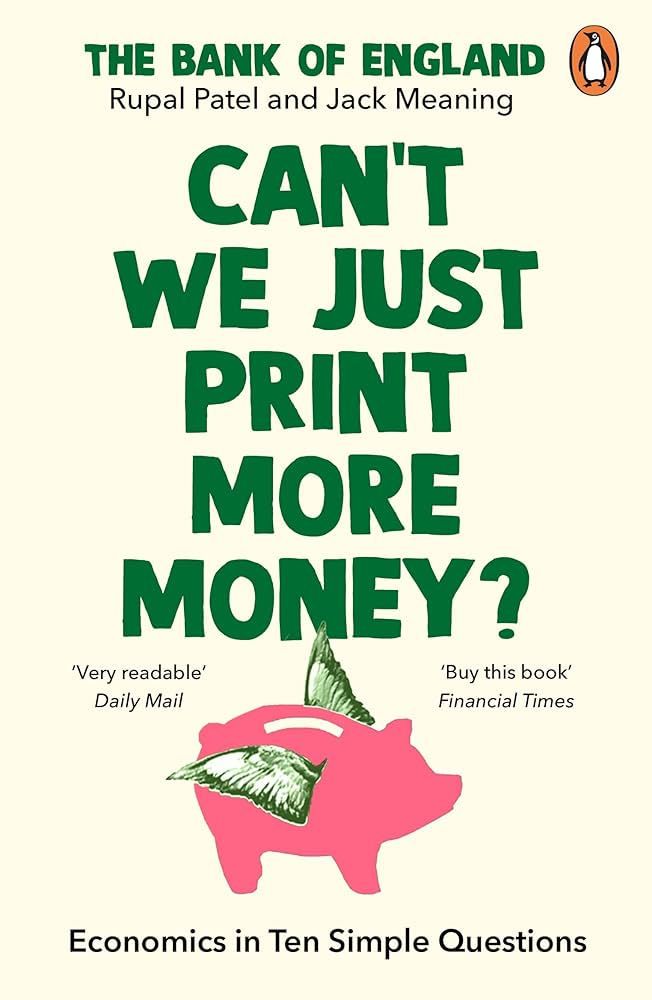
Written by economists at the Bank of England with a view to helping the public understand economics and economic matters, Can’t We Just Print More Money? represents an engaging and accessible contribution to the Bank’s purpose of contributing to the public good. As an exercise in explanation, there is no sustained argument to follow (or for a review to critique), which means that each chapter could be read in isolation – but considering how readable the prose is, there is no need to take such an approach.
Following an account of the reasons for writing the book, the introduction offers a series of illustrations to show the centrality of economics – as that which is concerned with decisions about how to use (scarce) resources – to many of our everyday experiences. The authors provide a brief history of the discipline and the tension between more ‘social scientific’ approaches and those more concerned to treat economics as a hard or mathematical science, and then explain the structure of the book: through a series of chapters, each raising one straightforward question, it will explore major issues of both micro- and macro-economics.
The first three chapters explore markets, with Chapter 1 focusing on the functioning of markets and discussing certain foundational concepts, such as ‘utility maximisation’, ‘monetary costs’, ‘opportunity costs’ and ‘marginal revenue’. In connection with these, it covers the importance of supply and demand and the factors that can influence each (such as pricing). The central point is that markets exist as the places where supply and demand (sellers and buyers) meet and prices are determined as the two are brought into equilibrium, with prices acting as signals to producers. In doing so, markets coordinate decisions made by countless individuals and bring about various outcomes that we find beneficial, without anyone managing the process or even in many cases directly intending those specific outcomes. Several useful examples illustrate these points perfectly, particularly in relation to pricing.
Subsequent chapters follow a similar pattern, the second covering the idea of market failure and the problems of externalities, imperfect knowledge and imperfect competition. These notions are brought to bear on the problem of climate change (or environmental damage more broadly) to illustrate not only the problems with markets, but also the reasons why some do not believe that market mechanisms can be employed to address the problem. Nevertheless, the authors consider the ways in which economic thinking can inform the alternatives and do discuss possible market solutions, such as carbon trading schemes. Chapter 3 turns to labour markets, framed in terms of the question of how to secure a pay rise.
From here, the book begins to shift towards macro-economic issues, considering (in Chapter 4) the question of growth by way of the question: Why am I richer than my great-great grandma? The authors discuss the concept of GDP and the ways in which it is measured, along with the factors affecting growth, its advantages and the negative outcomes of certain types of growth. Asking why so many clothes are made abroad, Chapter 5 focuses on trade, offering an explanation in terms of the specialisation brought about by the division of labour and the comparative advantage to each region or country of producing particular types of goods, components or services. The impact on trade of lower wage costs in some regions is considered, and the authors offer an interesting discussion of the controversies that arise from protectionist measures and competing interests – and the ways in which these can be (and have been addressed), reminding us that trade, and countries’ specialisms, are always shifting.
Chapter 6 addresses the issue of inflation, examining the factors that contribute to it and explaining the indices by which it is measured and the difficulties of doing so. The authors illustrate well the significance of the fact that inflation, by eroding the purchasing power of money, constitutes a major influence on our economic wellbeing. They also explain clearly why inflation constitutes a tax on savings and the reasons for which debt-laden governments are tempted to stoke inflation. This chapter also notes that moderate, controlled inflation tends to be favoured by economists as protection against the dangers of sustained deflation, and closes with a brief look at some of the major schools of thought on the causes of inflation. The discussion of a complex phenomenon that has been one of the major economic issues of recent years is very accessible. Opened (and closed) with the question of what was happening with the price of a Cadbury’s Freddo, it invites readers to look at the major causes of inflation, the reasons for which inflation is encouraged both responsibly and perhaps sometimes recklessly, who it tends to harm or benefit and its relationship with money. Missing perhaps, alongside the recognition that heavily indebted governments can be tempted to encourage inflation, is a short discussion of how the amassing of public debt can itself be inflationary.
Chapters 7 and 8 are also interesting and clear, focusing on the origin and functions of money and the role played by the banking system. With the recurring themes of the creation, storing, lending and circulation of money, these chapters cohere well and the authors emphasise the centrality of trust and confidence – though perhaps an opportunity was missed here to refer back to the discussion of inflation specifically in this regard.
The two final chapters look at economic crises. Chapter 9 addresses the question of why nobody saw the crisis of 2008 coming and considers the kinds of crisis that can occur, their causes and effects and the difficulties faced by economists in trying to foresee them. Chapter 10 raises the titular question of the book: Can’t we just print more money? It examines the measures that policy-makers can adopt to manage the economy. Some fairly difficult mechanisms connected with interest rates and their effects are handled well and there is a detailed discussion of how quantitative easing functions to affect the money supply and the reasons for which it affects rates of inflation. In addition to monetary policy, the chapter also looks at fiscal policy and the levers that governments have at their disposal in the form of taxation and spending to affect economic activity, closing with a discussion of government debt in relation to GDP and the debates surrounding the need to balance the books.
Following a summary conclusion that reiterates the importance and relevance of economics to our daily lives, a short appendix offers page references for answers to even simpler questions addressed in the course of responding to the major questions that form the basis of each chapter.
This is a lively volume that is richly illustrated with examples throughout, whether imagined for the purposes of explanation, or taken from history or current affairs. In consequence, it is easy to follow and material that could become abstruse is presented with clarity. The book’s stated aim is to enable readers to make more sense of the economic world they inhabit and in this, it is surely successful: all readers, including those with no grounding whatsoever in economics, ought to be able to understand the book without difficulty (and without becoming bored). It should therefore be read by anyone looking for an orientation in the major issues central to economics and clarity on the fundamental ideas and mechanisms that arise in public discourse on economic affairs.