
In this final article, I will draw from two stories in the Bible that will be well-known to many readers, to give an example of how those who read the Bible as scripture can draw from those stories in developing modern economic ethics.
The first story is of the Garden of Eden, and of the two trees about which God commanded Adam and Eve. One tree is said to be that of the knowledge of good and evil, and the other the tree of life. There is little dispute about the idea of the tree of life, but the tree of the knowledge of good and evil has occasioned considerable debate. One widely rejected interpretation, which was popular in the church for a long time, was that this knowledge was of concupiscence, that is, sexual desire.
Instead, a simpler interpretation is better, which is that the idea of the tree was to do what it says, that is, to give knowledge of good and evil (Gen 2.9), and to make a person wise (3.6). The question then is, why would the text portray the idea of becoming wise as a moral failure? It is this interpretive instinct that has led so many people to seek an alternative idea, largely based around the speculative suggestion that some side-effect, unmentioned in the text, is the key to understanding it.
My view is that Ellen Davis is correct in Opening Israel’s Scriptures when she identifies the issue as human wisdom needing proper bounds. The garden is described as a place where an abundance of economic goods are available — admittedly, it is a rather bucolic scene, where humans exist by eating fruit from trees, rather than an advanced economy. Nevertheless, it does paint a striking contrast to the reality of most ancient human life, because the primeval couple are not portrayed as slogging it out in a brutal effort to maintain life in the face of a harsh planet, scratching out a meagre subsistence. The picture is of ease and plenty. Little human effort is required, and great human flourishing is offered.
Why, then, is wisdom withheld? The key insight is that wisdom is being held alongside law, in this case represented by God’s singular commandment. Wisdom in scripture is often taken to be the ways in which a thoughtful person might prosper in God’s world. In the case of Eden, this was fairly straightforward: eat more fruit. We must not make the mistake of imagining this in the context of modern life with its calorific fountain and epidemic of obesity. Unlimited food, and luxurious food at that (when most people subsisted on a dull diet of grains) was a happy picture. So to flourish in the garden meant to consume, and wisdom might well have been understood to have meant something like, “make the most of the opportunity.” Indeed, this is what Eve adduces when she examines the forbidden fruit. Not only does it make a person wise, it is good for food, and beautiful (Gen 3.6).
The critical point being made by Gen 3 is a moral one, which has economic implications. God’s command forbidding unlimited consumption is motivated neither by a desire to avoid the irreplaceable use of resources (the garden has no such limits in the story), nor by potential impact on others with fewer resources (there are no other people to compete with).
The moral point being made is that there are proper limits to mortals, and that to pursue wisdom beyond the restraint which the law enjoins is to attempt to exceed mortality. In this, the story finds its place alongside the story of Babel, where humans attempt to climb to divine status through a skyscraper, and the story of manna in the desert. In relation to the latter, Ellen Davis, drawing on Gregory of Nyssa, is right when she states:
the first virtue that informs a godly food economy (and probably a godly economy altogether) is restraint in how we meet our most fundamental need. Our culture does not celebrate the virtue of restraint; witness the rampant popularity of “Let It Go,” Elsa’s song from the Disney film Frozen: “It’s time to see what I can do / To test the limits and break through / No right, no wrong, no rules for me—I’m free!” Contrast that sentiment with the instruction that the apostle Paul gave to the Roman governor Felix, who had inquired “about faith in Christ Jesus” and then was unnerved by Paul’s gospel lesson on “justice and self-restraint and the coming judgment” (Acts 24:24–25). The connection that Paul sees between justice and self-restraint, basic also to the manna economy, is the principle that all get what they currently need, and no more. Abiding by that limit requires trusting that God will provide “our daily bread,” enough for everyone. Moreover, that practice of self-restraint is essential to there being enough; our trust in God turns out to be part of the dynamic whereby God’s promise is fulfilled for the whole covenant community. That is why obedience to these two simple rules is a critical test of Israel’s ability to become a covenant community, of their willingness to walk in God’s torah, or not.
She goes on to explicitly link this to the Eden “story about eating within a divinely set limit—a limit that the first humans violated, with the result that they were expelled from Eden. Putting together these two stories of beginnings—of humanity as a whole and of the people Israel—we might infer that eating modestly and mindfully is one of our chief obligations to the God who created us and keeps us alive.”
Davis also alludes to a key aspect of the possibility of restraint: a belief or at least hope that in God’s world, there will in fact be enough. In combination with the mandate for humans to multiply, this suggests that there is a basic optimism which informs the viewpoints of the biblical world, an optimism that there is potential for growth and expansion in economic resources. This idea of growth is critical to seeing the world as having the capacity to support creative endeavour, entrepreneurial activity, and risk-taking which is not at the expense of other humans.
A more pessimistic view of the world often lies behind the idea that economic life is a zero-sum game, and that the solution to the woes of many is to redistribute the limited resources available. In my view this tends to in practice reduce the world to an equality of misery, and I think that part of the reason why the Bible as a text has continued to hold an evocative power in cultures with a historic connection to it is that it does hold out an idea of future growth which invites an optimistic participation in human endeavour.
So the cautionary stories about exceeding the proper limits of mortal humanity, in the context of divine commands, need to be read within the wider framing of a story of abundance, growth, and plenty. There is no need to exceed the bounds of restraint proper to humans, in at least one thread of biblical imagination, because there will be plenty for everyone and even some left over.
This dual possibility informs another story, the one which rounds out the book of Genesis. The story of Joseph as the archetypal wise administrator is well-known. What has not always been observed is the clever storytelling, which highlights the limits of wisdom. Joseph does indeed demonstrate that in God’s world, there is such an opportunity for growth and abundance that a wise person can produce vast growth of economic resources — enough, it turns out, not only for Egypt to survive a famine, but to act as a source of food for other countries.
The way in which Joseph achieves this, however, is by doing precisely those things which the law will later prohibit: he takes away the possessions, land, and eventually the freedom of the Egyptians. These were all perfectly normal things for ancient Near Eastern rulers to do, but in the Bible these actions are contrasted with the divine commands prohibiting them in the books of Exodus, Leviticus, and Deuteronomy which immediately follow the story. Recall, too, that the end of Genesis is a narrative which establishes how the nation of Israel found themselves enslaved — it turns out, of course, that this situation follow’s Joseph’s actions. Joseph is indeed the archetypal wise administrator, but the story shows the limits of human wisdom to achieve moral economic outcomes.
In summary, I would suggest that these two themes of growth and restraint, not often seen as particularly economic in nature, are narrative threads which offer a productive way to approach economic ethics. In my view, they offer modern economic ethicists more to work with than a rigid attempt to apply specific rules around debt, interest, and land tenure. They also, I suggest, offer a framing for those laws and the stories that engage with the specific economic practices of the ancient Near East. The laws of gleaning, for example, presuppose a situation where a farmer can expect to produce so much growth that they do not need to extract everything, and where the overflow of their produce can support those less fortunate. The presupposition of growth motivates a restraint in enjoying the bounty of God’s good world, a restraint that has less to do with ensuring sufficient for everyone else, and is mostly a morally-oriented choice to recognise the proper limits of humanity.
 Dr Lyndon Drake has recently completed a DPhil at Oxford on theology and economic capital in the Hebrew Bible/Old Testament. He also has degrees in science and commerce (Auckland), a PhD in computer science (York), and two prior degrees in theology (Oxford), along with a number of peer-reviewed academic publications in science and theology. From the Ngāi Tahu Māori tribal group, he currently serves as Archdeacon of Tāmaki Makaurau in the Māori Anglican bishopric of Te Tai Tokerau. Lyndon has written Capital Markets for the Common Good: A Christian Perspective (Oxford: 2017, Oxford Centre for Enterprise, Markets, and Ethics). He is married to Miriam with three children. Until 2010, Lyndon was a Vice President at Barclays Capital in London.

As I suggested in my previous article, my preferred way to read the biblical texts is to identify in them a particular kind of method, rather than precise prescriptions. In this article, I will suggest some specific aspects of method in modern, theologically-informed economic ethics.
Above all, I suggest that we give attention to human persons and to the institutions they construct, not just to systems. If it is at all legitimate to identify a common thread in scriptural texts, it seems to me that there is an idea of human dignity that has been compelling to readers of the scriptures down the ages. We see this reflected in a valuing of human life, and in a preference for certain kinds of freedom of choice — especially freedoms that include opportunity and risk while moderating harm. It is also reflected in an ideal of a modest egalitarianism of outcomes and a tendency to see baseline equality as a worthwhile ideal rather than a radical flattening of all distinctives. I also see an appreciation for humans as creative agents in the world. There is a common idealisation of being able to do new things and to grow beyond what already exists.
An example of this is the portrayal in Gen 4.17–22 of family groups developing new areas of industry. Cain is described as the first builder of a city, Adah of the developer of nomadic life, Jubal the inventor of musical instruments, and Tubal-Cain the inventor of metal tools. In the narrative, this is an ascription of creativity to human beings, and an idealisation of the development and growth of human endeavour. This view of humans as creative agents, who bring about growth in the world, is a particular kind of anthropology. It is also, though, a particular kind of economic view that does not envisage the existing state of the world as the sum total of all that can be. The economic world in which biblical humans exist is not a zero sum game.
Along similar lines, there is an attentiveness to human dignity that we can detect in the theological motivations that biblical texts present for prescriptions around poverty and its relief. The dignity of humanity is what can be damaged by economic hardship and it is often this attentiveness to dignity that has seemed distinctively interesting to modern readers.
An example of this is the characteristic use of the familial term ‘brother’ (ach) in Deuteronomy’s laws. This word is used in the motivation provided for generous lending practices: ‘If there is among you anyone in need, a brother in any of your towns within the land that the LORD your God is giving you, do not be hard-hearted or tight-fisted toward your needy brother.’ (Modern translations often translate the word as ‘Israelite,’ ‘member of the community,’ or ‘neighbour,’ no doubt from a praiseworthy desire to avoid gendered language.)
Some commentators have incorrectly seen this as a reference to a household economy, in which people only lend money to direct family members. In some cases, this has even led interpreters to draw the quite incorrect conclusion that Deut 15 is advocating for a ‘relational’ economy in which people only transact with those they are kin or at least friends with. (Note that the word is a kin word, not a word for a friend or a neighbour.)
The law is, of course, not intended to prescribe lending practices between biological siblings. In fact, throughout Deuteronomy, ‘brother’ is used to refer to people who are not biologically related, to encourage a different way of engaging. It is quite normal for human beings in our less-inspiring moments to treat people they do not know and are not related to less well than we treat our close friends and our family members. Throughout Deuteronomy, even the king is encouraged to see ordinary citizens as ‘brothers’ — that is, to consider people in the ancient Near East who would normally be viewed as socially and legally inferior as people of equal status.
The same is true in Deut 15. It is entirely common for wealthy people to see in our wealth a confirmation of our own excellence and superiority, and to look down on people in less-fortunate economic situations. In recent years, Western society has developed a new attentiveness to these kinds of dynamics around ideas of power distance and ‘other’-ing of groups and individuals. That this attentiveness has developed in the West is a testament to the enduring power of the idealisation of some kind of equality of dignity and personhood in Deuteronomy.
In biblical scholarship, this idealisation is often referred to as ‘fictive kinship,’ which is the idea that we should treat people as if they were our biological relations — even though they are actually not. The idealisation is so productive because in our better — I would say, in our more human — moments, this call to treat others with the kind of dignity we ascribe to those we know and love most seems persuasive to many people, including the wealthy.
In fact, I would suggest that a truly ‘biblical’ economic ethics is not particularly prescriptive around specific economic practices. I do not think we have much to learn from the details of ancient Near Eastern loans in order to reform modern lending. Nor do I think the various practices of land redemption attested to in the scriptures offer us a useful template for modern land tenure. Instead, an attentiveness to the human elements of the story is more productive, and I would argue, a more robust reading of these ancient texts. Ancient readers, I am certain, read in those texts other distinctives than modern readers have tended to, and we can attempt to follow their patterns of reading by noticing the aspects of the texts to which they gave priority.
This suggests that a biblical economic ethic will be creative and constructive. It will recognise the enduring power of the ideas about humanity, dignity, and creativity that have meant that the scriptures continue to captivate modern readers. From those ideas, and from studying carefully the ways in which biblical texts present distinctive aspects of common ancient Near Eastern economic practices, we have the opportunity to develop entirely new economic systems and practices which reflect the same kinds of modifications of modern economic systems and practices.
Biblical economics were not static, in the sense that we cannot reduce the study of economic aspects of biblical texts to a timeless prescription of an economic system. The biblical texts present a range of idealised economic practices, but in those texts there is never enough detail for a systemic economic prescription, nor have the texts endured because of a compelling handbook for national social and economic structures.
Instead, there are common threads, of virtues that tend to produce dignified human societies and beneficial outcomes for human persons. These threads are moral in type, not technical. The technical prescriptions that we can encounter are interesting not because of their specific technical aspects, but because of the moral and ethical tendencies they display, and because of the creativity they reflect.
In fact, biblical economic rules participate in the general optimism of the Bible about growth and the likelihood of surplus and improvement in the human condition. They are worked examples of the ways in which human creativity can build not only material artefacts, but a better society. The Bible’s economic aspects offers us a window into a point in time in a story which is still being written — and still ought to be written, with optimism and creativity.
Dr Lyndon Drake has recently completed a DPhil at Oxford on theology and economic capital in the Hebrew Bible/Old Testament. He also has degrees in science and commerce (Auckland), a PhD in computer science (York), and two prior degrees in theology (Oxford), along with a number of peer-reviewed academic publications in science and theology. From the Ngāi Tahu Māori tribal group, he currently serves as Archdeacon of Tāmaki Makaurau in the Māori Anglican bishopric of Te Tai Tokerau. Lyndon has written Capital Markets for the Common Good: A Christian Perspective (Oxford: 2017, Oxford Centre for Enterprise, Markets, and Ethics). He is married to Miriam with three children. Until 2010, Lyndon was a Vice President at Barclays Capital in London.
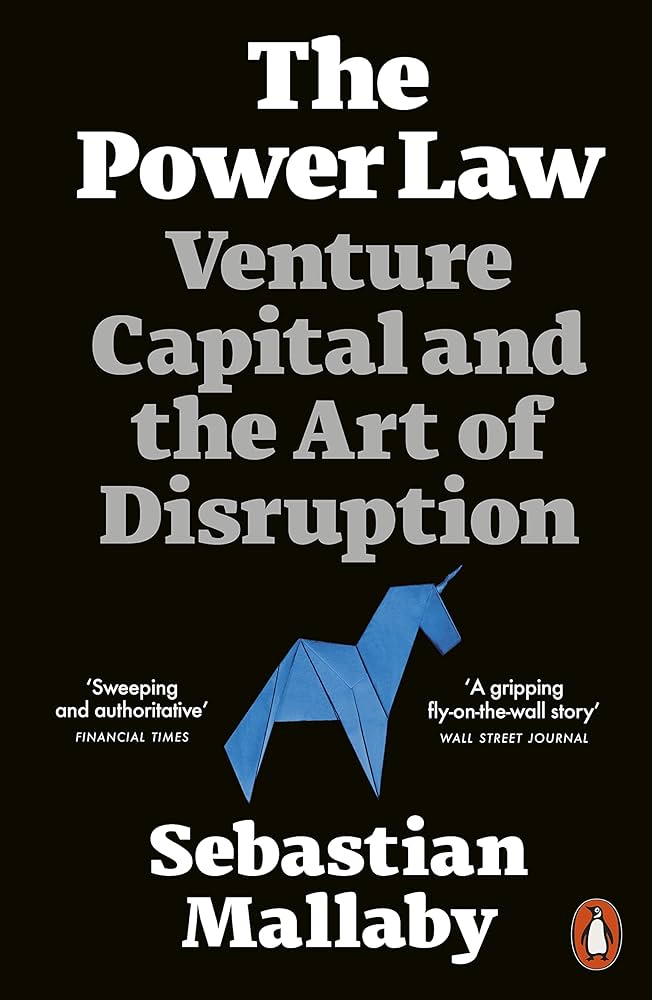
In the UK at least, the public image of the private equity industry is not good: those involved in it are widely regarded as a secretive, avaricious, immoral plutocracy that needs to be reined in. One may, however, wonder how many people know enough about the industry to be able to assess it properly, and how many realise that the technological revolution of the past 50 years would not have happened without the capital provided by venture capitalists to thousands of companies, including household names such as Intel, Apple, Cisco, Amazon, Google and Facebook. Even fewer people have any idea about the way in which the venture capital houses do business.
The Power Law sets out to remedy this ignorance. Sebastian Mallaby says that the book has two broad purposes: first, “to explain the venture-capital mindset” and, secondly, “to evaluate venture capital’s social impact” (page 14). However, its biggest strength is that it will ensure that its readers are better informed. It provides a sweeping overview of the fascinating history of venture capital from the early days of the 1950s to today and it gives the reader a good feel of the culture of the industry by drawing out common themes as well as stressing the differences in the approaches of the various venture capital houses and changes over time.
Sebastian Mallaby is a journalist and it shows. The Power Law is very readable and includes many stories and a considerable amount of direct speech. This may annoy some readers and obviously raises a question regarding the reliability of what is stated. For example, it must be doubtful whether those involved in the meeting between Don Valentine of Sequoia and Steve Jobs and Steve Wozniak of Apple in 1976 can really accurately remember precisely what was said but this has not prevented Mallaby setting out nearly half a page of quotations as if from a recording of the conversation (page 83f). There is also clearly a risk that the account of the meeting and other incidents related by Mallaby contain exaggerations brought about by people’s memories filtering the ordinary and over-emphasising the extraordinary. There may even be mythology creeping in. However, Mallaby says that he conducted “some 300 interviews” (page 405) as well as using written sources and this should at least mitigate the risk of distortion.
The book adopts a chronological approach and focuses on the people and organisations involved. Among the venture capitalists, it focuses on people like Arthur Rock (who more or less invented the industry), Don Valentine (of Sequoia, the most successful venture capital house over a long period of time) and Tom Perkins (of Kleiner Perkins Caufield & Byers). Among the founder entrepreneurs, it focuses both on household names like Steve Jobs and Mark Zuckerberg and others who may now be fading from memory such as Leonard Bosack and Sandy Lerner (the founders of Cisco). Mallaby does not seek to explain legal technicalities of the industry but he gives sufficient information to enable the non-specialist to appreciate the significance of developments such as the advent of equity-only time-limited funds, the use of limited liability partnerships and the grant of stock to employees.
The picture of venture capitalists that emerges is very different from their popular image. Of course, their aim is to make money but Mallaby is at pains to disprove the view that they make it by luck or simply by turning up like a predator when they sniff it. Their common characteristic is a willingness to take what many would regard as absurd risks. As Mallaby puts it, they acknowledge “the logic of the power law” (page 47). Put simply, venture capitalists see their downside as limited (they can only lose the money they put into a venture) but the upside as unlimited in a world in which “success multiplies success” (page 7) and thus “The best way to manage risk [is] to embrace it fearlessly” (page 47).
Uninformed public comment often seems to assume that venture capitalists are involved in win-win situations but Mallaby provides a wealth of evidence to the contrary including the fact that Kleiner Perkins lost money on six of the fourteen investments in its first fund, with Tandem and Genentec providing 95% of the profit in that fund (page 79), and “counting venture funds raised between 1979 and 2018, the median fund narrowly underperformed the stock market index” (page 376).
Mallaby draws attention to various things that will surprise many. In particular, the role of venture capitalists has been “to provide not simply money but also managerial counsel, assistance with hiring, and tips on everything from marketing to finance” (page 29). Furthermore, the culture within some of the most successful houses (notably Sequoia) has been remarkably team based and supportive rather than individualistic and aggressive and this spirit of co-operation has even extended to co-operation with competitors, “coopetition” as Mallaby calls it (page 107). Indeed, it could be argued that the existence of a community of venture capitalists has been key to the success of the industry.
The book also stresses the differences in the style of different houses: some (like Accel) focussing on a single industry and some on multiple industries; some (like Peter Thiel’s Founders Fund) not believing in the mentoring of founders but others regarding this as a key element of the necessary package; some (Arthur Rock’s Davis & Rock being the prime example) requiring a high degree of control but others being prepared to back the founders almost no matter what.
Mallaby’s portrait of the founder entrepreneurs has an element of the tabloid press about it and it will reinforce the popular image of them as a bunch of irredeemable oddballs. Mallaby makes sure that Arthur Rock’s comment about Steve Jobs’s hygiene is not forgotten (“I’m not sure, but it may have been some while since he had a bath”, page 86) and most readers will be entertained by the story of Mark Zuckerberg and Andrew McCollum turning up at the Sequoia headquarters late and in their pyjamas (page 194). After learning this, the reader may well be inclined to agree with the view of Peter Thiel that the best start-up founders are “often arrogant, misanthropic, or borderline crazy” (page 211).
The book provides an excellent analysis of the balance of power between the venture capital houses and the founder entrepreneurs. Those who see venture capitalists as ruthless puppet-masters may be surprised by this. For many years, the balance lay with the venture capitalists and there are well-known examples of them flexing their muscles (notably in the sacking of Lerner from Cisco following a venture capital “coup” led by Sequoia). However, Mallaby charts the changing balance of power over time including what he terms the “youth revolt” (i.e. the attitudes of a new generation of founders 20 or so years ago) facilitated by the considerable amount of capital then available in the market and the willingness of some investors to yield total control to the founders.
How should we evaluate the venture capital industry’s contribution to society? Mallaby turns to this question in the final chapter of his book and his conclusion is, rightly, overwhelmingly positive: “venture capitalists as a group have a positive effect on economies and societies” (page 379). Unfortunately, however, his analysis of the key issues is brief (occupying less than 13 pages) and, whilst much of what he says is powerful and he may legitimately point to the rest of the book as further evidence in support of his conclusion it would have been good to see a more in-depth analysis. Many people consider the rewards both for the venture capitalists and the founder entrepreneurs to be obscene and consider there to be a lack of accountability and a need for regulation, evidenced by some of the spectacular failures of venture capital backed companies (including the notorious Theranos scandal, the failure of WeWork and the governance and cultural issues at Uber).
The issue of rewards needs to be addressed head-on. They are, in part, an unalterable feature of the modern global economy and “the power law” and, unless those involved are to be severely taxed (which would remove the incentive to take risk), the high level of reward will remain. More fundamentally, the important issue is not how great the rewards are but what the impact on society of the actions of the venture capitalists and founder entrepreneurs is. Put simply, should we care that Steve Jobs and his venture capital backers became very rich? Surely not: they revolutionised communications for billions of people around the world and the impact of this has been overwhelmingly positive.
The demand for regulation is also misplaced. What exactly needs to be regulated? As Mallaby rightly points out (page 380), it is necessary to distinguish between the possible need to regulate the businesses in which venture capitalists invest and the question whether the venture capital businesses themselves need more regulation. The case for regulation of the latter is weak. Any attempt to regulate their investment decisions would either involve some kind of substitution of a regulator’s judgement of risk for that of the venture capitalists or be little more than the imposition of bureaucratic requirements. It is hard to see that either approach would have societal benefits.
The scandals, governance failures and bankruptcy of companies in which venture capitalists have invested do not in any way alter this point. In some cases, the venture capitalists were doing the right thing not the wrong thing. For example, the venture capital houses of Silicon Valley refused to invest in Theranos and it was venture capitalists who forced management change at Uber. We should also not forget that the technology revolution has required, and continues to require, that great financial risks be run by investors and some of the risks will materialise. The failure of a company does not demonstrate a flaw in the underlying economic system. Indeed, it frequently reflects the vibrancy of that system.
Of course, the venture capital industry has had its problems but so do all human institutions. The bottom line is that, to quote Mallaby, “Business schools and finance faculties have conclusively shown that VC-backed companies have a disproportionate impact on wealth creation and innovation” (page 389). This is for the benefit of the whole of society.
Mallaby has done well in presenting the positive story of the venture capital industry in an engaging and accessible manner. The Power Law deserves to be widely read.
“The Power Law: Venture Capital and the Art of Disruption” by Sebastian Mallaby was published in 2022 by Allen and in 2023 in Penguin Books (ISBN-13:9780141988948). 404pp.
 Richard Godden is a Lawyer and has been a Partner with Linklaters for over 30 years during which time he has advised on a wide range of transactions and issues in various parts of the world.
Richard’s experience includes his time as Secretary at the UK Takeover Panel and he is currently a member of the Panel. He also served as Global Head of Client Sectors, responsible for Linklaters’ industry sector groups, and was a member of the firm’s Executive Committee.

One way to approach biblical texts is to read them as if they prescribe economic medicine for modern social maladies. For example, Paul Mills argues that an appropriate and devout appreciation of the Jubilee of Leviticus 25 will result in the construction of an economic system where no interest is charged on debts. This has a venerable pedigree: for much of the Christian church’s life, it held a similar view. A similar approach takes the Jubilee as symbolic of an ideal of social order with economic consequences, as in Michael Rhodes’ work (for example, Practicing the King’s Economy, p. 174).
In this article, I propose an alternative way to appreciate the economic aspects of the biblical texts by locating the texts within what we know of the ancient Near Eastern world in general, and in Israel and Judah in particular. When we do this we will find that the economic aspects we encounter in the biblical texts are in one sense very normal — that is, rather than being radically different from the cultural and social settings in which they originated, they actually sound rather mundane. At the same time, though, a careful reading shows that in some instances the normal has been modified, and the modifications are rather interesting.
Let me give a concrete example. The ideas of redemption and Jubilee are often cast as at least somewhat distinctive. In fact, the components found in the various biblical texts all have precedent elsewhere in the ancient Near East: repatriation of land, forgiveness of debts, freedom from slavery, and controls on interest and debt. Even the Levirate marriage of Ruth to Boaz is associated with the redemption of land in a Phoenician text.
There are, though, some distinctive aspects in the biblical texts. One is simply that we find all of them within the single collection of texts which we now read as scripture. Even this is complicated: some scholars hold the view that they present a coherent economic system, but most scholars understand the texts to reflect variations of practices and ideals. In other words, there is no single, coherent economic prescription of a ‘Jubilee’ economic ethic, but a number of texts which refer to a collection of both traditional social practices and novel ideals. In the case of redemption of land and persons, the most striking feature seen in biblical law is that redemption is not a matter of a king’s whim, nor is it a matter of contract, but is idealised as periodic and systematic. The presentations in Jeremiah of both land redemption (Jer 32) and redemption of persons (Jer 34) differ in important details from those found in the law codes, but what is common between them is an egalitarian tendency and a valuing of human persons, in contrast to what was common in the ancient Near East: autocratic power, oriented towards the preservation of existing social and economic status.
In ancient Assyrian practice, for example, the remission edicts which gave a national forgiveness of debts and release from slavery came from the king’s personal decision. There was no guarantee for an indebted or enslaved person of experiencing remission of debts or redemption from slavery. It entirely depended on the will of a monarch. What is more, we have some insight into the motivations of the kings who instituted these remissions. The kings were theologically motivated, and sought to uphold ‘justice and righteousness,’ in obedience to a divine mandate and task given to kings. We must not be misled by the apparent familiarity of these words, though, because in Assyrian society, ‘justice and righteousness’ referred to the upholding of a right social order. While in some ways the outcomes of a remission edict might cohere with a modern, Western view of right social order — e.g. freeing enslaved persons — it certainly did not mean a radical or permanent equality, and nor was it motivated by a desire to remove a system of slavery and unequal social status. Instead, it meant maintaining those in power, and not allowing social unrest to build to the point where society was disrupted by the upheaval of a revolt. Remission edicts were release valves in an unstable, oppressive social order, intended to maintain that social order for the benefit of the elites.
The radical point in Deuteronomy 15, then, is not that debts were occasionally forgiven, nor that slaves were occasionally freed. These were well-known in the ancient Near East. What was unusual was the formation of an ideal, where debts would be forgiven periodically, and motivated by a humanitarian theology rather than a kind of structural conservativism. Deuteronomy 15’s prescriptions were about systematising a known practice, and giving that practice a distinctively Jewish theological framing.
The repatriation of ancestral land, as seen in Leviticus 25, is also known from elsewhere in the ancient Near East. In some places and times, ancestral land was inalienable (although in practice the desire to buy and sell land sometimes led to the development of legal fictions, such as ‘adoptions’ whose primary purpose was to effect a transfer of land ownership). In many places, though, ultimate ownership of all land was understood to rest with the king. This could then be the basis for the king granting ownership of land to people, in a kind of ownership that was always subsidiary to the king’s ultimate ownership. A novelty in Leviticus 25 was its ascription of overall ownership to Israel’s God, with a king not mentioned at all. In the ideational world of Leviticus 25 (that is, a world of the formation of concepts and ideas), there is God who owns everything, and household heads who have a kind of ownership which is inalienable over the long term, but which is relegated to the status of mere stewardship rather than ultimate ownership. There is an unmediated relationship of status, in terms of land rights, between God and the people — at least, those people fortunate enough to be heads of the patriarchal households of the time.
In both examples, I think we are justified in detecting a similar impulse towards some of the typical power structures of the ancient Near East, and a theological interest in humanitarian outcomes rather than a mere preservation of the existing ordering of society. These texts seem to reflect a common distrust of kings, even to the extent of eliminating them from the kinds of exercises of power which we might look back on with affirmation — after all, while we might prefer a reordering of society to eliminate the social institution of slavery altogether, we might well also be able to affirm the idea that releasing people from actual slavery is still praiseworthy.
Deuteronomy 15 and Leviticus 25 seem to be offering a different concept of power, in which the desirable outcome (people not being slaves) is severed from its typical ancient Near Eastern source (the power of kings). These ideas are given distinctive theological motivations, tied to the benefits to those with less social power, rather than the benefits to elites. To my mind, the idea of systematisation of good outcomes, and the distancing of these outcomes from the whims of elites, is more notable than the specific economic rules.
But we can push into this further. Rather than restricting ourselves to the specific ways in which the legal texts of Deuteronomy 15 and Leviticus 25 idealise a modification of ancient Near Eastern social and economic practices, we could also identify a kind of theological or ethical method. These texts have not posited a radical or idealised economic system. Neither Deuteronomy 15 nor Leviticus 25 can be compared to Das Kapital, to take a modern example. They are modest modifications of normality, not radical transformations into a new ideal.
So my suggestion is that if we are to attempt to undertake a reading of the biblical texts as modern people hoping to develop economic ethics, we will benefit most from an appreciation of the method of the biblical texts, rather than seeking prescriptions for specific economic and social practices.
Dr Lyndon Drake has recently completed a DPhil at Oxford on theology and economic capital in the Hebrew Bible/Old Testament. He also has degrees in science and commerce (Auckland), a PhD in computer science (York), and two prior degrees in theology (Oxford), along with a number of peer-reviewed academic publications in science and theology. From the Ngāi Tahu Māori tribal group, he currently serves as Archdeacon of Tāmaki Makaurau in the Māori Anglican bishopric of Te Tai Tokerau. Lyndon has written Capital Markets for the Common Good: A Christian Perspective (Oxford: 2017, Oxford Centre for Enterprise, Markets, and Ethics). He is married to Miriam with three children. Until 2010, Lyndon was a Vice President at Barclays Capital in London.
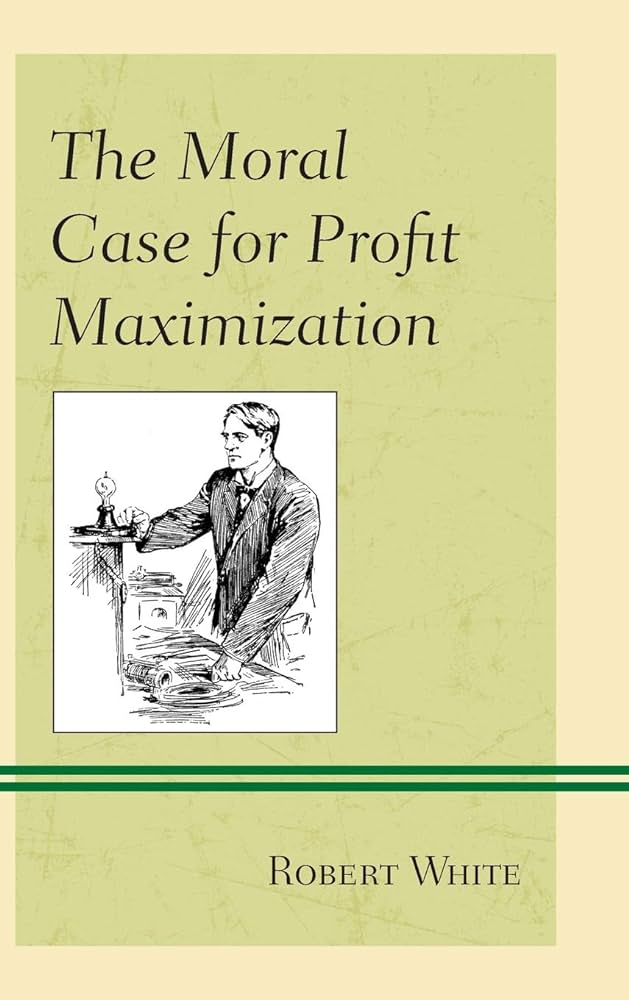
Robert White is dean of faculty and assistant professor of philosophy at the American University in Bulgaria. He was previously Chair and dean of the Faculty of Business. He teaches courses on business ethics and the philosophy of capitalism and has previously written on Adam Smith and also on aspects of the idea of profit. He is thus well-qualified to write on the moral case for profit maximization.
The book consists of 7 chapters, but in reality is a book of two halves around the pivotal chapter 4 which provides brief portraits of businessmen as examples of virtue and character necessary for the moral basis for profit maximization. The first three chapters deal with the more theoretical basis, identifying the questions (chapter 1), the moral basis (chapter 2) and the notion of objective value (chapter 3). The last three chapters turn to clarifications around the concept (chapter 5), incomplete defences (chapter 6) and finally a critique of Corporate Social Responsibility (chapter 7).
In a context of frequent confusion over the proper role of business, together with the emergence of differing approaches to purpose from B-Corps to mutuality, this book makes a welcome case for the morality of profit maximization. The author brings out some important points that are frequently lost in the discussion, not least the emphasis on the moral rather than simply the economic case. In doing so he brings the topic back to a philosophical debate about both value and values.
The writing, however, is somewhat repetitive, circular, occasionally “preachy” and rather laborious which consequently loses some of the impact. The second half is increasingly polemic and hence likely to alienate some readers, – apart from an excellent discussion in chapter 6 on Milton Friedman, to which I will return. It concludes with a rather wasted last chapter attacking corporate social responsibility.
The real strength of Robert White’s approach is brought out in the first half of the book. The moral case for profit maximization is based on the value of what business produces and the virtue of how it is produced. This is a useful couplet in discussions around profit, shareholder value and so on and I would have liked a more reflective discussion on the relationship between the two. In summary, White argues that “Profit maximization is moral because profit is a businessman’s reward for creating goods or services that are of objective value” (page 62). He goes on to cite the wheel, the refrigerator and the shipping container as examples of goods produced of objective value that significantly contributed to human life and well-being.
White makes the important point that profit maximization does not mean either that it is prioritized above all other values or that unethical or suspect business practices are an inevitable consequence of a quest for it – such behaviours would fail the virtue test. He makes a crucial distinction between profit maximization and profit prioritization, the latter would require a businessman to act against his values which would be contrary to White’s concept of profit maximization. However, the sorts of examples that White quotes are often, though not exclusively, those of personal morality (for example, pornography, page 122); a more comprehensive discussion of how this distinction operates in the area of competing business or economic values would have been helpful.
The book takes a slightly different turn in chapter 4 with profiles of several historically prominent business figures, J.P. Morgan (1837-1913), John D. Rockefeller (1839-1937) and Thomas Edison (1847-1931) together with the research scientist Louis Pasteur (1822-1895). He offers these as examples of virtuous businessmen and “models for a well-lived life” (page 96). To use just one example, that of Rockefeller, Robert White argues that through his Standard Oil company he both raised the quality of oil and reduced the price and, therefore, through this provision of fuel enhanced the quality of lives of millions of people. The point that we often overlook is the basic improvement in human life brought about through the efficient operation of the profit-maximizing corporation.
It is certainly true that Rockefeller identified goods of objective value that he was able to produce efficiently and effectively and that they contributed to the public good. In that sense a moral case is made. It would nonetheless have been helpful for White to set out explicitly why, in this example, there is an inextricably link to profit maximization.
We do, however, see traces in this chapter of the beginnings of some of the polemic that emerges in the second half of the book. White turns in the second half of chapter 4 to deal with what he calls unjust accusations against his selected examples. Clearly he chose some contested figures, which he acknowledges. There are a number of “straw targets” set up to be shot down. For example, Rockefeller obtaining preferential rates from the railroads is seen not as an example of oligopolistic power but a consequence of a mixed rather than market economy (page 113). White accepts his examples were mixed characters but the comparison is always with their personal lives rather than business practices.
Chapters 5 and 6 approach the debate about the morality of profit maximization from a negative perspective, concentrating on what profit maximization is not more than its positive presentation. This makes for a more defensive reading and reasoning. The highlight of these chapters is an excellent discussion in chapter 6 around Milton Friedman’s famous maxim, in his 1970 New York Times article, “The Social Responsibility of Business Is To Increase Its Profits”. White notes that Friedman argued that the business corporation and its executives had an absolute responsibility to the owners of the business on whose behalf they acted and points out that this is not profit maximization as such and, if the owners had different, or mixed objectives, then the corporation and its executives must serve those aims – Friedman’s real argument is for the rights of shareholders to determine a corporation’s direction (page 154).
I agree with a good deal of the critique of Corporate Social Responsibility (“CSR”) set out in chapter 7. However, this chapter sits somewhat ill-at-ease with the rest of the book and, in particular, falls into polemic. Why choose CSR for such treatment? The questions of business purpose and responsibility have rather moved on from the CSR approach. This chapter made the book feel somewhat dated and the chapter reads like an add-on, and, occasionally a rant. Why not an overview of alternative approaches to the morality of profit maximization?
This is an important book with a distinctive and creative approach to the question of the morality of profit maximization. It establishes a sound basic framework and asks some central questions. The book is, however, unnecessarily unbalanced, allowing polemic to emerge in defence of a rationale and well-founded set of ideas. It would have been improved by a more rigorous engagement with alternatives. The conclusion could, of course, remain, that there is a strong moral case for profit maximization rightly understood.
“The Moral Case for Profit Maximization,” by Robert White was published in 2020 by Lexington Books (ISBN: 978-1-4985-4265-4). 231pp.
 Dr Richard Turnbull is the Director of the Centre for Enterprise, Markets & Ethics (CEME). For more information about Richard please click here.
The Centre for Enterprise, Markets and Ethics (CEME) is pleased to announce the publication of The Challenge of Artificial Intelligence: Responsibly Unlocking the Potential of AI by Andrei E. Rogobete.
A PDF copy can be found here. A hardcopy of the publication can be ordered by contacting CEME’s offices at office@theceme.org
Artificial intelligence is reshaping business, security, transport, and everyday life at remarkable speed. But the rapid advance of machine learning and generative AI raises questions that go beyond efficiency and innovation: What does it mean to be truly human? What separates consciousness from computation? And what ethical framework should govern how these technologies are developed and deployed?
In this publication, Andrei Rogobete traces the evolution of AI from antiquity to the present day, before examining two contrasting case studies — the successful use of biometric identification at national borders, and the persistent difficulties facing autonomous vehicle technology. He then develops a distinctively Christian response, grounded in the biblical teaching that human beings are made in the image of God: uniquely capable of self-awareness, moral reasoning, love, and relationship with the divine. On this basis, he argues that AI — however sophisticated — cannot possess genuine consciousness or spiritual capacity, and that its development must remain in the service of human flourishing. Drawing on statements from evangelical, Catholic, and Anglican traditions, Rogobete offers practical principles for the responsible adoption of AI within an ethical framework shaped by Christian theology.

Join us for this episode of the CEME video podcast where our host Graeme Leach interviews Dr Andrew Lilico.
Dr Andrew Lilico is Executive Director and Principal of Europe Economics. He has over 15 years’ experience of providing expert economic advice to clients around the world. Andrew has previously been the Chief Economist of Policy Exchange and has also worked for University College London, the Adam Smith Institute, the Institute of Directors and the Institute of Fiscal Studies.
Full video available below:

Promising to loosen the constraints of the planning system on developers and reignite economic growth, Labour leader Keir Starmer sounded in parts of his speech to his party conference like he was the leader of the other party. While much of Europe is shifting to the right, the conservative party is trailing in polls by a wide margin after 13 years in power. This makes the change within Labour since the last election all the more interesting.
The UK has had perennially low levels of growth after the financial crisis. A litany of additional shocks has not helped and the growth outlook is not improving. In fact, on the day of Starmer’s speech, the IMF projected that the UK will have the lowest growth rate of the G7 in 2024. The economic situation is bad in many other countries in Europe which have generally diverged from US. They are growing at lower rates and starting at lower levels of GDP per capita. The best performing western European country, Germany, is facing its own problems. While many European states are in the running for the title, in her speech earlier in the week, the Shadow Chancellor referred to the UK as the “sick man of Europe.”
These speeches and the turn in Labour policy come on the back of a renewed explicit focus on economic growth from conservative leaders perhaps starting with the leadership campaigns to replace Boris Johnson. The ideology likely to be adopted by Labour in the next election and therefore by the next government is one of supply-side progressivism—an ideology that I blogged about as it was emerging a few years ago and noted was gaining steam on the left.
In The Economist, Duncan Robinson captures this view:
This version of supply-side economics fuses tools and rhetoric conventionally associated with the free-market right—deregulation and creative destruction—with the left’s emphasis on industrial subsidies, labour rights and public services. It stresses an abundance of infrastructure, energy and housing, as well as stable government to drive investment.
It is of note that more focus is on the basics of economic growth delivering policies rather than the loftier (and more dubious) claims of both Levelling Up and Net Zero. Regional disparities and a state-led transition to a new, greener economy were still discussed, but most of the attention was correctly on the planning system. It is the planning system and related drawn-out, costly processes for getting things built that interacts with both political goals mentioned. The planning system bogs down and raise the costs of the improvements to transit infrastructure that form a key part of Levelling Up. It is also the planning system that bogs down the generation and transmission infrastructure clearly needed to achieve Net Zero. Perhaps most importantly it is the planning system that prevents housing from being built in the places with economic opportunity where it is most needed (a statement that the leader himself disputed a few years ago).
Labour leaders themselves have noted that these goals are often shared with Tories who have failed to deliver the policies that they announce due to political constraints. On some of these issues it is unclear how the Labour will differ. The Times drily notes that “supply-side reforms look good, but politics may get in the way.”
Differences in their political coalitions may make it easier for Labour to achieve some greenfield building that Tories wouldn’t be able to. Like with the Cambridge plan announced by Michael Gove, there are sound economic and political reasons for concentrating developments. Labour has also suggested design codes with gentle density to both concentrate development and reduce opposition. More detail is needed to know the chances of meaningful reform, but the cross-party consensus on these important reforms is reassuring.
Despite an interest in growth there are many headwinds facing any government. The strained fiscal climate will have no easy remedy as growth will take time. Taxes are already high, and changing demographics will worsen the strain on existing services. The continuing deterioration of the NHS and local councils will only receive more attention. Furthermore, the rise in real interest rates has driven borrowing costs up on high levels of accumulated debt. In the wake of the historic failure of the previous leader who pushed for growth, it is worth noting that both the shadow chancellor and Labour leader are stressing fiscal prudence. They fear bond markets in a way that we know at least one prime minister didn’t.
 John Kroencke is a Senior Research Fellow at the Centre for Enterprise, Markets and Ethics. For more information about John please click here.

Join us for this episode of the CEME video podcast where our host Graeme Leach interviews Prof. Philip Booth.
Philip Booth is Professor of Finance, Public Policy and Ethics at St Mary’s University, Twickenham where he also serves as the Director of Catholic Mission. He teaches and researches in fields related to economics, political economy, business ethics, and Catholic social teaching. He also works for the Catholic Bishops’ Conference of England and Wales as Director of Policy and Research. He sits on the Shadow Monetary Policy Committee.
Full video available below:

We were delighted to host a joint event on the 30th November 2023 between the Centre for Enterprise, Markets & Ethics (CEME) and the Las Casas Institute for Social Justice (Blackfriars Hall, University of Oxford), on the theme of “Finance for the Common Good”. Our speakers addressed a range of issues such as the interplay between finance, greed and morality, a history of local banking, the role of Catholic Social Teaching, and the relationship of the corn laws, Brexit and the Common Good.
Edward Hadas is Research Fellow at Blackfriars Hall, Oxford prior to which he spent 45 years in finance and financial journalism. He is the author of Money, Finance, Reality, Morality (2022).
Richard Turnbull is the Director of the Centre for Enterprise, Markets and Ethics, visiting Professor at St Mary’s University, Twickenham and author of numerous articles, papers and books relating to ethics and business in historical perspective.
Jean Pierre Casey is the convenor of the UK Chapter of the Centesimus Annus Foundation, a member of the investment committee of the Holy See and formerly head of investments for both J.P. Morgan and Edmond de Rothschild.
Cheryl Schonhardt-Bailey is Professor in Political Science and Fellow of the British Academy and was head of the department of government at the LSE from 2019-2022. Her research interests are in political economy, legislatures, deliberation and accountability and she is the author of several books.
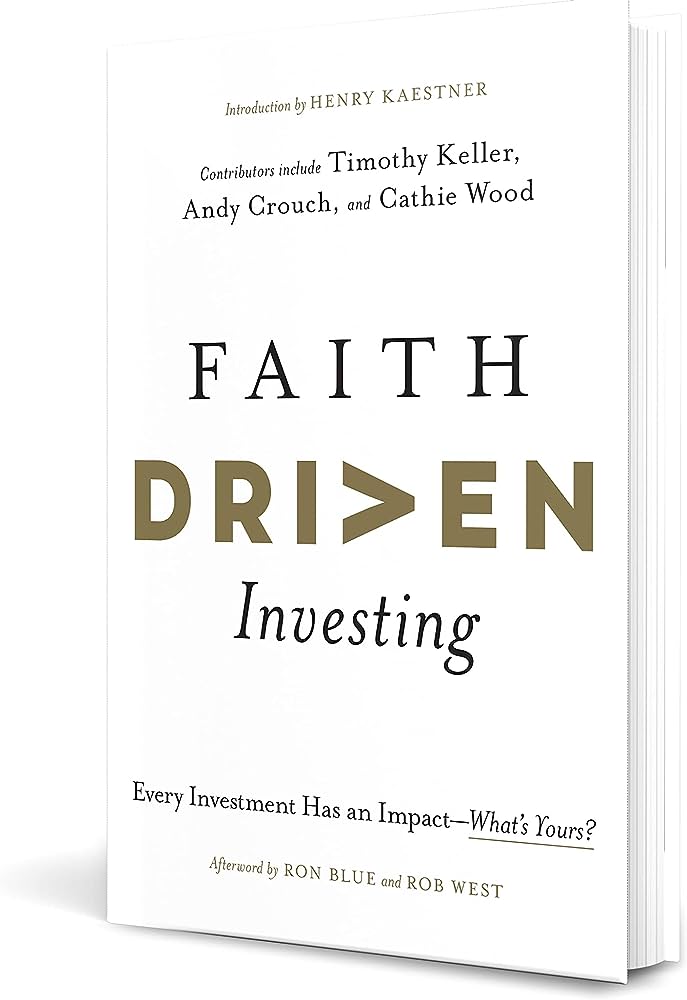
At first glance some readers (myself included), might be mistaken to assume that Faith Driven Investing is another “how to” guide on ethical investing – it is not. In fact, the book has very little to say about investing per say and rather focuses on the “faith driven” investors themselves and the wider role of the Christian faith: What makes a Christian investor? What drives them? How do they influence change? How should a Christian think about risk? How are Christians in the financial sector or in business called to engage with the capital markets and money more generally? (pages 3-4).
These broader questions are tackled in the book by a collection of authors (seventeen to be exact). The contributors are mostly prominent practitioners within the field such as Cathie Wood, Luke Rousch and Richard Okello, as well as those with more of a theological/pastoral background such as Timothy Keller and Andy Crouch.
The structure of the book therefore comprises fourteen chapters representing individual essays that are collated within two larger sections. The first is called “Faith Driven Investors are…” while the second is titled “Therefore, They…”, reflecting the overarching intention of exploring who faith driven investors are and what they are called to do. The main audience of the book is Christian investors and entrepreneurs but those with a wider general interest in business as a force for good will find it worthwhile. The various essays use minimal technical jargon (be that in respect to theology or finance), making the book accessible to the layperson and specialist alike.
Timothy Keller (1950-2023), the late pastor and theologian from New York opens up the discussion in Chapter 1 with an intriguing take on personal identity and what it means to have an identity that is rooted in Christ. Keller writes that “…an identity that flows from who he is and what he has done for us changes everything. It radically transforms the way we work, the way we invest, the way we view money, all of it” (page 14). He then goes on to list four different ways in which this happens. We won’t enumerate all here but the third makes an interesting and important point: God (being omnipotent) could provide for our material needs directly yet he chooses not to do so and instead uses human work as a means of provision (page 15). This raises profound implications for the nature and value of work which, according to Keller, means that: 1. All work carries great dignity, even the most menial; 2. Through work we are “…God’s hands and fingers, sustaining and caring for his world”; 3. One of the main ways of pleasing God is simply to do our work well (page 16). These assertions are consistent with the historic Protestant view of work of which Martin Luther was an early advocate. Those who wish to explore them further could read other books reviewed on our website such as Why Business Matters to God, Business for the Common Good and Tides of Life.
In Chapter 4 Luke Rousch, cofounder of Sovereign Capital brings a fresh challenge to some established normative positions that many Christian investors take. Rousch spent his entire career in large scale business commercialisation and development and argues that for too long faith driven investors have become known for what they are against, rather than what they are for (page 59). He rightly points out that this is a missed opportunity for Christian investors to become better known for what they stand for in the world and not merely for what they stand against. Part of the problem, Rousch argues, is “that it’s easier to avoid things than it is to engage with them. That’s also true in life, not just investing” (page 62). Avoiding “sinful” industries altogether such as tobacco, adult entertainment and so on is perhaps the most obvious example. The risk is that we end up steep in legalism and behaving like the Pharisees did. Sure, negative screening is important when it comes to constructing an investment portfolio but “…we are called to lean in, with truth shared in love, and celebrate the great things God is doing in and through the marketplace. We must seek out, embrace, and pour ourselves into the creation of new things” (page 62). Rousch thus argues for a more proactive approach where we should seek “…a balance between negative screens, positive screens and active engagement” (page 63).
Casey Crawford, CEO and founder of Movement Mortgage concludes the discussion with a reminder to seek God’s larger perspective rather than our own, “…are we working for our return of for God’s return?” (page 198). In the Parable of the Tenants we have the example of the tenant who did nothing with what was given to him, Crawford argues that we must maintain an attitude of expectancy of the coming new Kingdom. This doesn’t necessarily mean “…working harder so we’ll have more success to show God. It’s about seeking our work as an act of service to the Master” (page 199).
In summary, “Faith Driven Investing: Investment Has an Impact–What’s Yours?” is not a “how to” guide on ethical investing and those seeking investment strategies or advice should look elsewhere. It is however a compelling collection of essays that stand at the intersection of finance, theology, and the broader implications of truly living out the Christian faith. A thoroughly recommended read for all those with an interest in the subject.
“Faith Driven Investing – Every Investment Has an Impact–What’s Yours?” by Henry Kaestner, Timothy Keller et al. was published in 2022 by Tyndale House Publishers (ISBN 1496474481, 9781496474483), 240pp.

Andrei E. Rogobete is Associate Director at the Centre for Enterprise, Markets & Ethics. For more information about Andrei please click here.