
This is a repost of an appreciation of Pope Francis by CEME Fellow, Professor Philip Booth, first published on the Catholic Social Teaching blog of St Mary’s University. We thought it would be of interest to CEME readers, but reposting does not mean endorsement of every point.
In the coverage of the passing of Pope Francis to eternal life, surprisingly little has been said about an important aspect of Pope Francis’s social teaching – fraternity. This was the theme of his second social encyclical, Fratelli tutti. It is an important theme because it links the pastoral, spiritual, theological and social teaching of the late pope. The title of Fratelli tutti in English is ‘Brothers All’, and it is subtitled ‘On Fraternity and Social Friendship’.
Fraternity is part of the practice of the virtue of solidarity which was described clearly by Pope John Paul II:
Solidarity is not a feeling of vague compassion or shallow distress at the misfortunes of so many people, both near and far. On the contrary, it is a firm and persevering determination to commit oneself to the common good; that is to say to the good of all and of each individual, because we are all really responsible for all (Sollicitudo rei socialis, 38).
Fraternity has, of course, always been part and parcel of a good Christian life. As Pope Benedict wrote in an encyclical which returned to the roots of the practice of the early Church:
The State which would provide everything, absorbing everything into itself, would ultimately become a mere bureaucracy incapable of guaranteeing the very thing which the suffering person—every person—needs: namely, loving personal concern…This love does not simply offer people material help, but refreshment and care for their souls, something which often is even more necessary than material support (Deus caritas est, 28, emphasis added).
Just as Pope Benedict did, Pope Francis joins together the pastoral and the social. His exhortation to priests to ‘smell the smell of the sheep’ demonstrates how fraternity was an enduring, multi-faceted theme throughout his pontificate.
In Pope Francis’s social teaching, the idea of fraternity was developed in many ways.
Pope Francis is critical of individualistic ways of thinking, but also of bureaucratic solutions. He writes of how popular movements can make possible ‘an integral human development that goes beyond the idea of social policies being a policy for the poor, but never with the poor and never of the poor…’ (Fratelli tutti, 169).
The late pope wrote about how the virtue of solidarity starts with, and is authentically promoted within, the family but then radiates outwards, for example, in his letter following the synod on the family, Amoris laetitia: ’When a family is welcoming and reaches out to others, especially the poor and the neglected, it is a symbol, witness and participant in the Church’s motherhood’ (324).
Here we see the complementary nature of the Catholic social teaching principles of solidarity and subsidiarity. Pope Francis is showing how our human nature requires that our acts of solidarity start at the most basic level in society. However, the parable of the Good Samaritan shows how those acts should involve anybody with whom God’s providence leads us to have an encounter. Genuine solidarity requires a relationship and not just a cheque. These acts of solidarity can, if engrained in culture, radiate outwards and turn into a great social movement. But they can only take place if we have a political system which promotes the principle of subsidiarity and therefore allows the family to play its proper role.
Pope Francis’s teaching on migration is well known. Again, it is fraternity that is at the heart of his concerns. As he wrote in Fratelli tutti:
Our response to the arrival of migrating persons can be summarized by four words: welcome, protect, promote and integrate. For it is not a case of implementing welfare programmes from the top down, but rather of undertaking a journey together, through these four actions…(129)
In Fratelli tutti, Pope Francis attacks abstract proclamations of liberty (of a form which might be associated with socialism) as well as forms of liberty rooted in secular individualism. And he states that equality ‘[is not] achieved by an abstract proclamation that “all men and women are equal.” Instead, it is the result of the conscious and careful cultivation of fraternity’ (104). At the same time, he adds: ‘individualism [which might be associated with economic liberals] does not make us more free, more equal, more fraternal. The mere sum of individual interests is not capable of generating a better world for the whole human family’ (105).
But perhaps we can take this further. The French revolutionary mandates of liberty, fraternity and equality, are, according to a certain interpretation – indeed their original interpretation – incompatible with each other, despite the protestations of their proponents! If equality means equality of outcomes, its pursuit will, as Pope Leo XIII wrote in Rerum novarum, lead to a levelling down to a condition of equal misery and the loss of liberty. If freedom means a free for all, unconstrained by religious and moral norms, we will not achieve fraternity. But a Catholic interpretation of the slogan can enable us to achieve all three. If equality is equality before the law and before God, and freedom is the freedom to choose what is good guided by the grace of God, there is no obstacle to the promotion of fraternity. Indeed, our fulfilment as free human beings requires us to practise fraternity which is also necessary for the promotion of the common good and human dignity for all.
Globalisation has been a continual theme in politics since Pope Francis’s election in 2013. Some of his concerns were cultural. David Goodhart published a book in 2017 which captured a concern that some people, attracted to globalisation, became wealthy but lost their roots in their community. Others had strong community roots but were feeling marginalised from the mainstream and attracted to populism. In Fratelli tutti, Pope Francis captured this dilemma perfectly whilst giving sound practical advice to both groups based on principles of fraternity and openness.
It should be kept in mind that an innate tension exists between globalization and localization. We need to pay attention to the global so as to avoid narrowness and banality. Yet we also need to look to the local, which keeps our feet on the ground. Together, the two prevent us from falling into one of two extremes. In the first, people get caught up in an abstract, globalized universe… In the other, they turn into a museum of local folklore, a world apart, doomed to doing the same things over and over, incapable of being challenged by novelty or appreciating the beauty which God bestows beyond their borders. We need to have a global outlook to save ourselves from petty provincialism…At the same time, though, the local has to be eagerly embraced, for it possesses something that the global does not: it is capable of being a leaven, of bringing enrichment, of sparking mechanisms of subsidiarity. Universal fraternity and social friendship are thus two inseparable and equally vital poles in every society. To separate them would be to disfigure each and to create a dangerous polarization.
On a personal level, there are two things that I especially like about this theme of fraternity. In Catholic social teaching, it provides clear point of unity for people with different political perspectives. For example, the critique of the welfare state and of regulatory bureaucracies by supporters of a free economy is largely a critique of how these institutions have become impersonal: whatever their merits, it is argued that they erode relationships and personal responsibility for our fellow human beings whilst undermining civil society institutions for the provision of welfare lauded in Rerum novarum. At the same time, those on the left throw the same accusations at corporate capitalism. Both sides should be able to see the merit in the argument of the other and, in a spirit of intellectual generosity, discuss how we might bring about a more fraternal society. This can be a welcome change from two, or three, word phrases from Church documents being used to attack straw men in the attempted promotion of one’s own political cause.
Also, Pope Francis’s teaching in this area prompts personal reflection and an examination of conscience. It raises questions such as ‘do I give money to homeless charities but never stop to talk to a homeless person?’. ‘Do I campaign to change political structures, but never assist people personally or through community groups?’ ‘Do I write blog posts about Catholic social teaching but not actually make myself available to students to discuss their challenges?’.
We should end by noting again that Fratelli tutti is built on the parable of the Good Samaritan about which Pope Francis writes: ‘the parable shows us how a community can be rebuilt by men and women who identify with the vulnerability of others, who reject the creation of a society of exclusion and act instead as neighbours, lifting up and rehabilitating the fallen for the sake of the common good’ (67). And then, relating the parable to the modern world, he writes: ‘We can start from below and, case by case, act at the most concrete and local levels, and then expand to the farthest reaches of our countries and our world, with the same care and concern that the Samaritan showed for each of the wounded man’s injuries’ (78). This is a message that has been relevant from the very first book of the Old Testament to the modern Christian era.
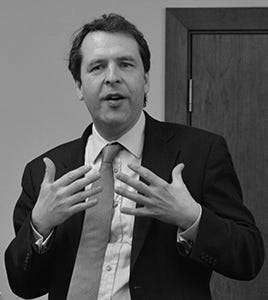
Philip Booth is professor of finance, public policy, and ethics and director of Catholic Mission at St. Mary’s University, Twickenham (the U.K.’s largest Catholic university). He also works for the Catholic Bishops’ Conference of England and Wales as Director of Policy and Research.
Image: Korea.net / Korean Culture and Information Service (Jeon Han), reproduced from Wikimedia commons under a Creative Commons Attribution-Share Alike 2.0 Generic licence.
Reproduced with permission of Church Times
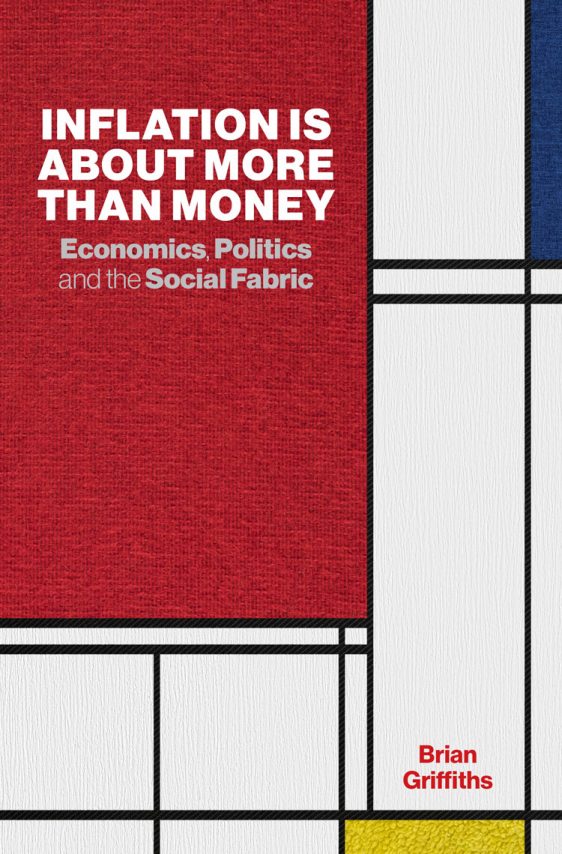
‘INFLATION is always and everywhere a monetary phenomenon’, says the title of chapter 7; at the same time, it is, as the book’s title affirms, ‘about more than money’. Those are the two pegs on which the argument of this courteously erudite tract hangs.
Published by the Centre for Enterprise, Markets and Ethics, the initiative inspired by Lord Griffiths to research and advocate for a market with a strong ethical base, the book represents the distillation of his long-held convictions. They have been firmed up in his academic career, as well as through his time on the Court of the Bank of England and his years as the head of Margaret Thatcher’s policy unit.
This is, therefore, a book marked by wide reading, historical perspective, and involvement in the hard task of policy-making. Although the book is not explicitly theological, Griffiths writes as a believer, both personally and in the connections that he makes between his economic subject matter, some of it quite technical, and the needs of society as a whole. This is decidedly a book that tells of ‘faith in the public square’.
We are plunged straight into inflation as a current issue in the chapter on the effects of ‘Wars, Covid and Ukraine’, where the pressures that lead to inflationary policies are highlighted. We are also taken into the moral passion behind the book, in a series of chapters on why ‘inflation is a bad thing’: we read of its costs to the economy and the pressure that it places on the lives of the poorest in society.
But the costs that are even more significant for this author are the moral costs: inflation is a kind of deception, in which what you pay back is not worth what you borrowed, and in which prices cease to function as signals of relative worth. Ultimately, trust is eroded across society, and social cohesion is placed in peril, as the heading of chapter 6 declares: ‘Things fall apart’.
How does this happen? This happens because ‘inflation is always and everywhere a monetary phenomenon,’ and printing money offers governments (and central banks) a way to avoid really difficult choices. ‘The case for pragmatic monetarism’ describes both diagnosis and prescription. (Do we guess that we are hearing some of the advice that Mrs Thatcher received from her Policy Unit head? Or are we hearing the 1970s voice of Enoch Powell, who once made the trenchant observation that inflation resulted from the behaviour of governments, not the behaviour of anchovies off the coast of South America? But he is not a person to quote, and Griffiths doesn’t.)
To deliver prevention and cure requires central banks and governments to exercise the discipline needed for sound money, and to bear the political cost of doing so.
There are particular reforms that that requires, Griffiths says, such as ensuring that the Bank of England focuses on its prime task, of controlling inflation, and is not diverted into fulfilling all sorts of other fashionable ends, such as supporting aspects of government policy or seeking remedies for climate change. It requires ensuring much more intellectual diversity than Griffiths currently sees in the decision-making committees at the Bank of England. Remedies that have been used in other economies, such as a “debt brake”, also need to be seriously considered.
Yet, Griffiths points out that what policymakers most significantly face are what he calls the ‘cultural headwinds’ that impede the fight against inflation. It is here that we meet Griffiths the person of faith and moral passion: he points to the absence of a unifying moral consensus in society. Here, the language is the nearest that the book approaches to a declaration of the faith that makes it — erudite and even deferential as it is to great figures of economic history — a tract pointing to the loss of the ‘sacred canopy’ over recent decades. Without that overarching and unifying social conviction, the hard choices required to prevent and to counter the lure of inflation, the cheap grace of economic policy-making, will not be made.
Here Griffiths’s tract encounters the questions on which the most important disagreements will appear; for, in the ‘sacred canopy’ from which the author draws his deepest inspiration, the Hebrew prophets and the New Testament Church, we encounter not the canopy of unifying moral perception, but sharp and costly critiques of economies organised at the expense of the most vulnerable. This book describes with great clarity the moral and economic costs of inflation, borne by the poor most of all. Yet, the record of attempts to arrest periods of serious inflation is that the cost is borne by — guess whom — the poor most of all.
Those reading this book will certainly be aware that this is the drama unfolding yet again before our eyes, for all the talk about those with the broadest shoulders bearing the heaviest load. It is the drama of government knowing that inflation is indeed about more than money — but the cure of inflation just as much. When governments declare inflation not just a bad thing, but the worst thing, they effectively weaponise the prevention of inflation to serve political choices that benefit the broad-shouldered as much as they hurt the poorest.
That is the most destructive ‘cultural headwind’, one that puts disciplining the money of those who have it ahead of ensuring justice for those who don’t.
‘Inflation is About More Than Money: Economics, Politics and the Social Fabric’ by Brian Griffiths was published in 2025 by The Centre for Enterprise, Markets and Ethics / London Publishing Partnership, (ISBN 978-1-910666-25-8), 157 pp.

The Rt Revd Dr Peter Selby is an Honorary Visiting Professor in Theology and Religious Studies at King’s College, London. He is a former Bishop of Worcester, Bishop to HM Prisons, and President of the National Council for Independent Monitoring Boards.
Reproduced with permission of Church Times: https://www.churchtimes.co.uk/

A recent article reports on work by researchers at Anthropic, the AI lab that developed a ‘reasoning’ AI model, and their ability to look into the digital brains of large language models. Investigating what happens in a neural network as an AI model ‘thinks’, they uncovered some unexpected complexity that would suggest that on some level, an LLM might have a grasp of broad concepts and does not simply engage in pattern matching. Conversely, there is evidence to suggest that when a reasoning AI explains how it has reached a conclusion, its account of how it has reasoned does not necessarily match what the ‘digital microscope’ suggests has gone on. Moreover, sometimes, an AI will simply produce random numbers in response to a mathematical problem that it can’t solve, and then move on. On occasion, it will respond to a leading question with reasoning that leads to the suggested conclusion, even if that conclusion is false. Thus, it seems, the AI will appear to convince itself (or the human interlocutor) that it has reasoned its way to a conclusion when in fact it has not.
The Human Foibles of AI
Should we consider this to be indicative of an approach towards human levels of intelligence or reasoning? After all, even the failings of AI are similar to our own. Most people have given up on a problem as being too difficult at some point in their lives, perhaps giving an inadequate account of their efforts to deal with it. Almost all of us, as school children, will have guessed at the answers to the questions in our maths books and shown some kind of working-out, even if we didn’t have any real confidence in what we had written. Similarly, if asked a difficult question in class, most of us will have attempted to give an answer that consisted of little more than repeating back to the teacher partial information – provided by the teacher in the first place and which we had not understood – in the hope of convincing him or her that we knew what we were talking about.
Perhaps, then, advanced AI models are closer to human beings than we have been willing to accept. If this is the case, where does the difference between AI reasoning and human reasoning lie? Or, rather, on what grounds can we say that human beings reason or think, while machines, however sophisticated, do not? What does it really mean to talk about computers ‘knowing’, ‘remembering’ or ‘working things out’?
Knowing That / Knowing How
There is a distinction to be drawn between conscious, propositional knowledge, and skill or aptitude – between ‘knowledge that’ and ‘knowledge how’. The former is a grasp of a matter of truth and can be held before the mind; the latter is something we are able to do and can often be executed with little thought. It is with this distinction in mind that we can easily agree with the philosopher and essayist Michel de Montaigne, who argued in his long essay An Apology for Raimond Sebond (1576), that if human beings can have knowledge, then animals surely can, too. When we look at the feats of which they are capable, beyond anything that human beings can manage without complex machinery and intricate calculations, how can we claim that they do not ‘know’? Surely a blackbird knows how to build a nest and a bumblebee knows when to hibernate? A spider’s web is a beautiful and intricate construction that any human being would struggle to build. Their levels of consciousness and their powers of reasoning are far below ours, yet in some sense they ‘know’ what they are doing (even if, we might claim that they do not know why or to what purpose – as a hamster probably does not have a long-term end in view when she hoards food and various other objects). If we think of the difference between the flight of a blackbird and what human beings have managed with aeroplanes and helicopters, the former is a natural aptitude, devoid of reason or thought, while the latter, cumbersome (yet ingenious) as it is, is based on vast array of theory, calculation and applied propositional knowledge.
Knowledge, Reason and Meaning
The distinction between knowledge how and knowledge that is not straightforward: there are various things we might know that might not cleanly fit into one category or the other – such as the knowledge that one is loved by one’s mother. There are also different ways of arriving at knowledge, some highly complex and based on extensive calculation, while others are simply intuitive. Similarly, there are different grades of reasoning, from basic connections of cause and effect or means and end, to highly abstruse relations between concepts. Nevertheless, when we ascribe to AI models the ability to reason or to know, we typically have in mind knowledge of the propositional variety: the AI model uncovers a fact or conclusion about some state of affairs, or provides an account of an expedient methods for achieving some goal, by way of a chain of steps.
Leaving aside the question of the extent to which animals possess such knowledge, we might say that in order to truly constitute knowledge, propositional knowledge requires the ability to understand. That is to say, for a human being to know, he or she must understand what is known, and where reasoning is involved, he or she must have a grasp of why the conclusion reached is valid. Moreover, he or she should understand what that piece of knowledge means in connection with other knowledge possessed, as part of a world filled with knowledge and meaning.
The Capacity of AI in the Absence of Consciousness
To illustrate this, we could point to the difference between solving a problem by understanding the nature of the problem itself, knowing the correct method for addressing it and understanding why the answer is right, and applying a process by conjecture, blindly following it and reaching a solution that might – or might not – be correct. Arguably the latter is still a form of reasoning, but a greatly diminished one. Even where the correct method is invariably applied and the solutions are always correct, the result surely does not constitute knowledge. In the absence of consciousness, these are the highest forms of reasoning and knowledge that AI can possess. When we say that a machine has reasoned or that it knows, we can really mean no more than this.
AI models can be incredibly efficient, solving problems and processing data more quickly than any human mind can manage; they can contribute to our knowledge and lead to hugely beneficial material improvements. For artificial intelligence, however, no matter how sophisticated and even when accompanied by an account of how a solution was reached, there is no knowledge or reasoning in the full, human sense. While a machine can disclose that the sun rose at 5:50 yesterday and can calculate the time of sunrise on any given date in the future, it cannot be said to know the time of sunrise. Between human beings and the most ingenious artificial intelligence, there remains the gulf of consciousness and the grasp of meaning that it renders possible. This might remain the case forever, but as machines approach more closely to human levels of intelligence, perhaps they will enable us to understand ourselves better and some of our own cognitive capacities.
Image: Designed by Freepik

Neil Jordan is Senior Editor at the Centre for Enterprise, Markets and Ethics. For more information about Neil please click here.

President Trump has certainly brought the issue to the fore with a bang. Perhaps his attempts at protectionism will show the error in the thinking of the anti-globalists in our own country. We don’t get many controlled experiments in economics. Perhaps this will be one.
The anti-globalisation trend, which is strongly supported by Christians in the US, has been around for ten years or more. Globalisation itself stalled following 2010, went into reverse by many measures (though not all) during the first Trump presidency, the policies of which Biden continued to follow. But things really do look grim now. It should not be thought that this is only a Trump phenomenon – protectionist sentiment is well engrained amongst Republicans and Democrats.
In the 2016 presidential election, Trump said: ‘You go to New England, Ohio, Pennsylvania …manufacturing is down 30, 40, sometimes 50 per cent. NAFTA is the worst trade deal maybe ever signed anywhere’. It is fair to say that he has not changed his view.
Those arguing for tariffs are wrong about whether there is a problem to be solved; wrong about the diagnosis of the problem they perceive; and wrong about the efficacy of their proposed solution to the non-existent problem.
In the same campaign, the left-wing Democrat candidate and Senator Bernie Sanders said: ‘I do not believe in unfettered free trade…We heard people tell us how many jobs would be created…you are now competing against people in Vietnam who make 56 cents an hour minimum wage.’
Reading his comments on Trump’s policies today, he seems simply to want a better ordered version of those policies.
I will leave the huge benefits of globalisation and free trade for another post. It is just worth noting that the development of the modern era of globalisation was coincident with a huge reduction in absolute poverty and the biggest reduction in global inequality the world has ever known.
But let’s go back to Bernie Sanders’ challenge. In responding to this, we effectively answer the concerns of Trump supporters about free trade. How can the US compete with Vietnamese producers paying 56 cents an hour? Surely, US industry will be wiped out, as Bernie Sanders suggests, if the US lets in Vietnamese imports.
The answer to this question is a clear ‘no’. US workers would earn vastly more than Vietnamese workers even if they were to produce garments because US workers are more productive: they have higher skill levels and use more capital equipment.
More importantly, though, US wages are higher than 56 cents because the US produces more valuable things than cheap garments. It makes sense to export other things that are more valuable and import cheap garments.
Free trade means that the US is able to produce goods and services that are more valuable than garments, export those goods and services and use the proceeds from selling its exports to buy garments. US consumers get cheaper goods from abroad and US producers are able to produce things of a higher value than garments. This is why the average income in the US is nearly 30 times that in Vietnam – it is not 56 cents an hour.
Furthermore, we have global supply chains in which countries produce those aspects of a product they are relatively best at producing. If you buy a shirt with ‘made in Vietnam’ on the label, the sewing machinery might have been made in South Korea or Japan, the dye might have been made in Germany, the cotton might come from Egypt, the shipping might be by a Greek firm, the finance and insurance for the shipping might be provided by a US bank, and so on. It is a collaborative effort. It would not benefit anybody if the whole process were ‘insourced’ and the Wall Street bankers had to go to work in garment and dye-producing factories.
There are significant problems in many developed countries, but I would suggest that they are caused much more by demographics (ageing populations), dysfunctional welfare states and the costs of family fragmentation. These are, essentially, religious and cultural problems which we should not blame on economic globalisation.
The US (like the UK), of course, has a large trade deficit: ostensibly, this is the reason for Trump’s tariffs. This deficit is caused by the US government and private sector (like the UK) being net borrowers – just as Germany’s surplus is caused by Germany being a net saver. [In reality, the situation is a little more complicated than this and issues to do with net direct investment, dividend flows, foreign holdings of dollars, and so on are also important.] If a country is a net borrower, it will import more than it exports and consume more than it produces. Tariffs will not change that situation – they will just make the country poorer.
Those arguing for tariffs are wrong about whether there is a problem to be solved; wrong about the diagnosis of the problem they perceive; and wrong about the efficacy of their proposed solution to the non-existent problem.
What is the Church’s position on free trade? Its position arises from her concern for the poor and is not unqualified. Pope Paul VI wrote in Populorum progressio in 1967: ‘trade relations can no longer be based solely on the principle of free, unchecked competition, for it very often creates an economic dictatorship’. This is interesting because Pope Paul is saying that poor countries lose from free trade whereas Trump is arguing that rich countries lose, and poor countries gain. Economists argue that both gain.
Pope Paul VI’s view reflected the ‘developmental state’ theory common in economics in the 1960s. John Paul II took a different view in his encyclical Centesimus annus:
Even in recent years it was thought that the poorest countries would develop by isolating themselves from the world market and by depending only on their own resources. Recent experience has shown that countries which did this have suffered stagnation and recession, while the countries which experienced development were those which succeeded in taking part in the general interrelated economic activities at the international level.
Empirically, this is correct. Even more pertinently for Catholic leaders of richer countries, Pope Benedict wrote of their obligations to poorer countries, in relation to trade, in Caritas in Veritate:
It should also be remembered that, in the economic sphere, the principal form of assistance needed by developing countries is that of allowing and encouraging the gradual penetration of their products into international markets, thus making it possible for these countries to participate fully in international economic life…Furthermore, there are those who fear the effects of competition through the importation of products — normally agricultural products — from economically poor countries. Nevertheless, it should be remembered that for such countries, the possibility of marketing their products is very often what guarantees their survival in both the short and long term. Just and equitable international trade in agricultural goods can be beneficial to everyone, both to suppliers and to customers.
It is difficult to think of any concern about free trade to which the right response is protectionism through tariffs. Putting aside its economic effects, protectionism creates disharmony and destroys relationships. It makes people who should gain from mutual co-operation believe they can gain at the expense of each other: we are already seeing this. Adam Smith taught us how countries gain from co-operation and exchange rather than from stealing each other’s ‘stuff’. We should not need to re-learn that lesson by having to endure the tragedy of ignoring it.
Image: Old cash register in Museum of Technology in Warsaw; reproduced from Wikimedia Commons using a Creative Commons Attribution-Share Alike 3.0 Unported licence.
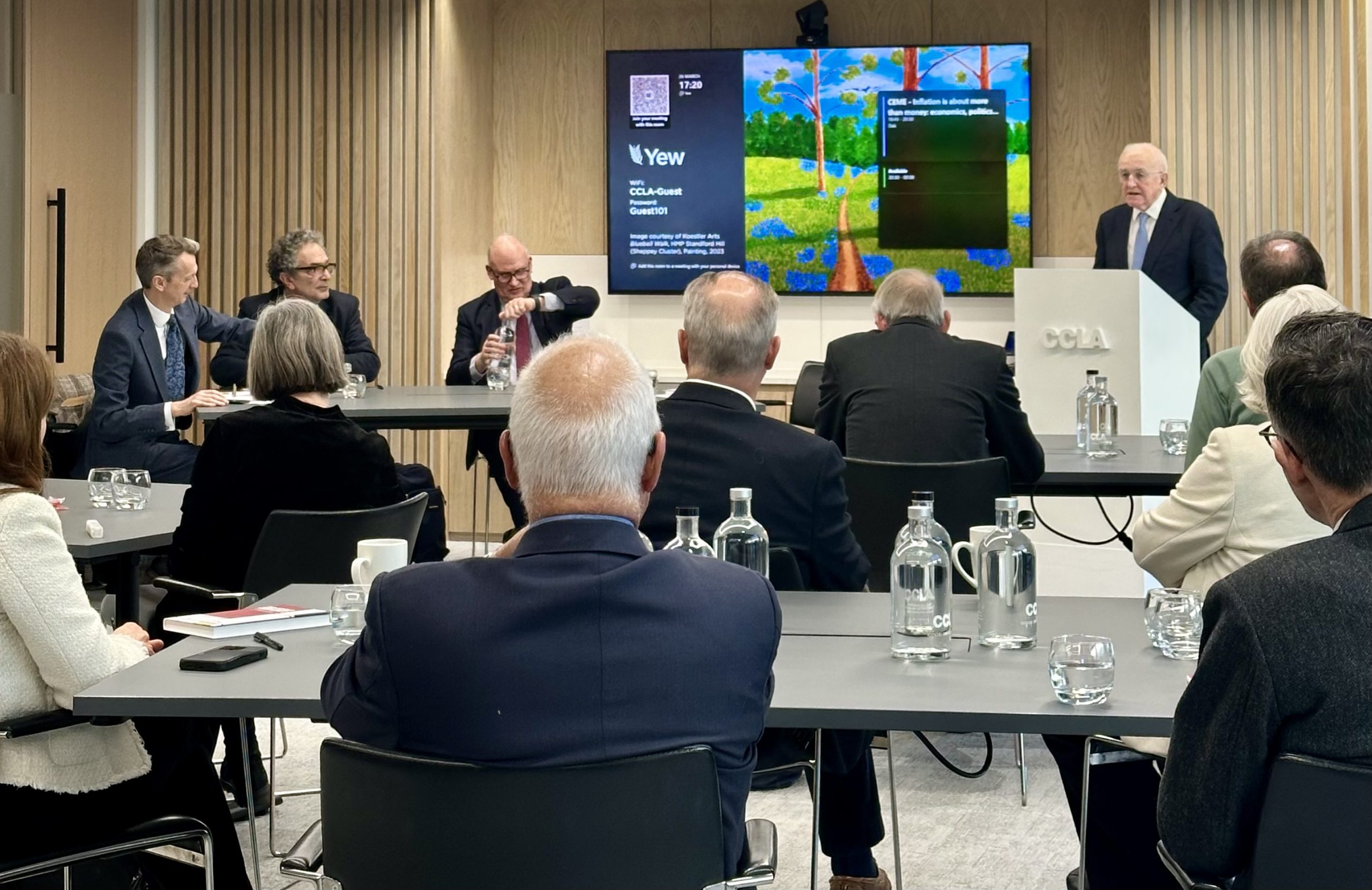
On Wednesday 26 March, in conjunction with CCLA Investment Management, CEME hosted an event to launch the publication of a new book by CEME Senior Fellow Lord Griffiths of Fforestfach (Brian).
The event featured a talk on the book by Brian with responses from Lord Glasman (Maurice), founder of the ‘Blue Labour’ movement, a conservative socialism that respects tradition, community and faith, and Andy Haldane, former Chief Economist at the Bank of England.
In Inflation Is About More Than Money, Brian Griffiths charts recent history and policy developments with regard to inflation. He sees inflation as a moral problem: a form of taxation and deceit that those in positions of authority should always seek to address.
Considering a range of theoretical approaches to inflation, he advances a pragmatic monetarist approach and offers a series of concrete recommendations for both dealing with inflation and protecting against it in the future. In addition, Brian examines the cultural factors at play, such as disillusionment with democracy and social fragmentation. He argues for the importance of a shared moral framework, or “sacred canopy”, to underpin our collective purpose and provide a foundation for economic, social and political stability.
Brian was professor of banking and international finance at City University and dean of the City University Business School. A former member of the Court of Directors of the Bank of England who later served as head of the Number 10 Policy Unit, he is now a member of the House of Lords. He was the founding chairman of the Centre for Enterprise, Markets and Ethics.
Inflation Is About More Than Money: Economics, Politics and the Social Fabric, was published jointly by the Centre and the Institute of Economic Affairs.







The Centre for Enterprise, Markets and Ethics (CEME) was pleased to host a roundtable event on the topic of non-executive directors.
The full report is available to download here.
The role of the non-executive director is essential to the proper functioning of corporate governance. The expectations on directors have been tested by corporate scandal. What are the reasonable expectations that society places on those that undertake this task and what are the appropriate legal responsibilities?
The event was chaired by Richard Turnbull and our main speaker was John Wood, Lecturer in Company and Insolvency Law at Lancaster University’s School of Law. He has a particular interest in the law around the duties of directors and has published numerous articles and several books.
This event took place on Thursday, 12th December in the Council Room at One Great George Street, London SW1P 3AA.

From April 1st this year, local authorities in England have the power, under the Levelling Up and Regeneration Act 2023, to charge a Council Tax Premium of 100% on second homes. Many councils have availed themselves of the opportunity.
The Justification
The move to charge a premium is driven by a number of concerns about public services and the cost and availability of housing. It has been suggested that the council tax premium will provide additional funding for public services. In addition, some argue that by attaching a premium to a second property, councils are in effect discouraging second home ownership with a view to making more houses available for local people to buy, who, it is claimed, have been ‘priced out’ of the market in the areas in which they have grown up and which they work, owing to the inflated prices occasioned by the purchase of second homes by wealthier buyers.
The Opposition
Against the new measures, many have argued that charging a premium on properties, the owners of which are absent for some – or much – of the year and who therefore do not use local public services to the same extent as full-time residents, is simply unjust. Others contend that by letting their properties to holiday-makers, second home owners are encouraging local tourism which brings money into regional economy, a proportion of which will, of course, find its way to the council in taxation.
In addition, it is argued, such measures, if they do deter second home ownership, will do little to provide additional housing stock, particularly in popular tourist areas, because second homes, often being character or luxury properties, are not typically the kinds of houses that are within the reach of many local buyers – particularly first-time buyers. Thus, buying such properties as second homes is not the cause of high house prices in the area; rather, the problem is the result of insufficient availability of housing more generally, which ought to be addressed by local development plans. Some even suggest that since not all second homes are habitable and often require considerable renovation at the owners’ expense, ultimately those buying second homes are adding to the stock of available housing. After all, they are unlikely to own the property forever and when it is sold in the future, a previously derelict building will be returned to the market as a useable home.
A Sumptuary Law?
The use of such premiums invites comparison with the sumptuary laws found throughout history, such as those of the Roman Republic and the imperial period which restricted spending on feasts or women’s jewellery. Such laws were usually aimed at deterring – or at least registering disapproval of –the indulgence in luxuries considered contrary to good morals, though in their attempts to limit displays of wealth by the upper orders, it is also likely that on occasion, their purpose was also to temper the resentment of the poor. One might see certain similarities with council tax premiums attached to second homes and wonder whether they will do less to address any real problems surrounding housing or public services than to express disapproval.
Difficulties and Assessments
Sumptuary laws have not proved easy to enforce and have frequently been avoided by their intended targets. More significantly, they often have unforeseen consequences, as a recent example from China shows. When, in 2012-13, the President launched a drive to cut back on lavish spending and tackle corruption, over 50 hotels soon sought to drop their five-star ratings in order to survive because local government officials could no longer stay in luxury hotels. One tourism group saw a fall in revenue of 18 per cent at its hotels, business declined at many private clubs and restaurants and luxury brands witnessed significant declines in sales (around 30% in one case) – yet many of the rich and powerful were able to move and conceal their wealth using offshore holdings (both legitimate and questionable).
Sumptuary laws are not only difficult to enforce: they are also complicated to assess. By what standard are we to measure whether they have achieved their objectives? Where they are aimed at preventing excess and restoring traditional virtues, which particular moral standard or virtue are we to identify as being the target of the legislation, and how are we to establish whether it has been successfully defended or re-established? The most likely concrete measure would consist of statistics indicating a satisfactory number of successful prosecutions for breaches of such laws, but these do not in themselves demonstrate an improvement in morals or restored personal virtue. Citizens are more likely simply to have kept the manifestations of vice sufficiently private, with no reduction in excess.
Similarities and Differences
Similar difficulties arise with regard to council tax premiums. In the first instance, there are suggestions that the premiums will simply be avoided, such that the charges will frequently miss their targets. For example where a second home is let for a certain proportion of the year – as is often the case with properties that also serve as holiday lets – owners might be able to register for business rates rather than council tax. In such circumstances, it has been claimed, local authorities might actually suffer a decline in council tax revenue.
How will their success (or otherwise) be ascertained? This is likely to be a subject of disagreement, but based on the justification for their introduction, measures of success for council tax premiums would surely include better-funding for (and perhaps improvements in) public services and, perhaps more significantly, greater availability of housing for local residents in a particular area, or at least lower prices. Doubtless there will be debates surrounding the interpretation of data when it emerges, but advocates and critics of the new measures are likely to look carefully for evidence of both in the coming years.
The major question that must be addressed when seeking to establish whether the council tax premium is a modern sumptuary law, is how it bears on morality. The laws of the past were often concerned at a decline in traditional virtue. Leaving aside the question of whether it is for governments to determine and enforce morality, which virtue, which ethical principle, which moral law has been breached by those who have invested their earnings in a second home? If none can be identified, then in the absence of evidence establishing their success in policy terms, council tax premiums will be increasingly hard to justify.
Neil Jordan is Senior Editor at the Centre for Enterprise, Markets and Ethics. For more information about Neil please click here.
Recent articles in the financial news (such as this one by the Telegraph) have been hastily calling for the abolition of Cash ISAs, claiming absurdities such as, ‘cash savers don’t deserve tax breaks’.
Here are a few reasons why they may be mistaken and why their approach is saliently unwise:
– Cash ISAs are a key component of diversified savings portfolios. Defenders of high-return investments often tout the benefits of diversification, and that’s exactly why Cash ISAs hold their own. They provide a robust, low-risk foundation to any savings or investment strategy that is shielded from drastic fluctuations. Companies such as Trading 212 and Chip offer interest rates of 5.16% and 5.15% respectively with unlimited withdrawals. Sure, critics would argue that these are introductory offers used to persuade customers onto other asset classes (i.e. stocks), but the option to exclusively utilise the Cash ISA remains. In this sense, Cash ISAs often act as a useful holding account for other investment decisions that will invariably arise.
– Cash ISAs don’t ‘dodge tax’.We need to be realistic here about who benefits from Cash ISAs. Spoiler alert: it’s not the ultra-wealthy! Cash ISA holders are overwhelmingly comprised of pensioners and those on middle incomes. Financial Planner Jordan Clark (of Quilter) reported that,
‘Older savers, in particular, tend to hold significant amounts in Cash ISAs. The average ISA value at the end of 2021 to 2022 was around £9,477 for the 25 to 34 age group [..] compared to around £63,365 in the 65 and over group’.
This hardly resembles a ‘wealthy’ group bent on tax avoidance, particularly since the lion’s share of savings found in Cash ISAs originates from earned income upon which tax has already been paid – making the whole situation feel rather disingenuous. In addition, Cash ISAs have also been part of people’s long-term pension strategy, saving for retirement and hence it would be unjust to move the goal posts. Government policy shouldn’t penalise diligence and financial planning.
– Cash ISAs offer simplicity and flexibility. Most Cash ISAs offer flexible features – such as the ability to withdraw and replace money without affecting the annual £20,000 allowance – which can be invaluable in times of financial need or uncertainty. Again, they can serve as a useful holding account for other investments – and in this area Exchange Traded Funds (ETFs) have dramatically lowered entry costs and opened the door for smaller retail investors (particularly in broad index funds, etc). This accessibility, combined with the security and ease of use, make Cash ISAs a versatile tool in both short-term saving and long-term financial planning.
– Cash ISAs promote the right values. When developing public policy it’s important to occasionally step back and ask the wider moral questions: what are the ethical implications of the proposed change? Indeed, what moral values do we wish to promote as a society and what should we expect of government? The reality is that financial instruments such as Cash ISAs promote a degree of pragmatism and financial prudence amongst the general population – and this is not something to be scorned. A healthy economy, though important, is not merely about GDP growth. It relies on robust levels of household savings that are able to weather economic storms. Cash ISAs may indeed be in need of a rebrand, but their utility and the underlying values of financial prudence ought to be championed.

Andrei E. Rogobete is the Associate Director of the Centre for Enterprise, Markets & Ethics. For more information about Andrei please click here.
Image: HM Treasury / Flickr. Reproduced using an Attribution-NonCommercial-NoDerivs 2.0 Generic licence.
Selected as a Financial Times Best Summer Book of 2025: Economics
Selected as a New Statesman Book of the Year 2025
The Centre for Enterprise, Markets and Ethics is delighted to announce the official release today of our latest publication, a book by Brian Griffiths (Lord Griffiths of Fforestfach) which addresses the problem of inflation – Inflation Is About More Than Money: Economics, Politics and the Social Fabric.
Further details can be found below.
Purchase Details
Available for purchase at London Publishing Partnership, Amazon, and can be obtained from retailers and booksellers.
It is also downloadable as a PDF.

The Centre for Enterprise, Markets and Ethics (CEME) is pleased to announce the publication of a report on the topic of non-executive directors.
Is the Non-Executive Director Worth Saving?
Richard Turnbull
Is the non-executive director (NED) an endangered species?
Does it matter?
This publication argues that the continued role of the NED matters not only to the individual director, to business and companies but also to society as a whole. The contention is that without effective NEDs, corporate governance will be weaker, companies more exposed and society less well served. If that is the case, then education is as important as law in enabling NEDs themselves, policymakers, media and wider society to understand and appreciate both the responsibilities and the limits of the NED role.
It is axiomatic that NEDs should discharge their duties competently in accordance with the law and with moral intent in the service of society. However, any lack of clarity over those duties, particularly in law, or potential exposure to regulatory action as a consequence of confusion over roles or responsibilities, will not only reinforce unrealistic expectations but also discourage NEDs from taking on this important corporate and social duty.
Non-executive directors should be reminded of their duties and responsibilities and given clarity as to society’s expectations. The answer is not further liabilities. Knee-jerk reactions to scandal are unhelpful – not all failures involve scandal and some, in the normal course of business, afford opportunity to learn lessons. We should clarify and celebrate. The NED is a bridge between business and society – ensuring proper corporate governance while playing a wider role in societal leadership. We need people of character and experience to discharge this role.
Richard Turnbull is the Director of the Centre for Enterprise, Markets and Ethics. He holds degrees in Economics and Theology and a degree of Doctor of Philosophy in Theology from the University of Durham. He is also a chartered accountant. He has authored or edited numerous books, articles and other publications in church history and business ethics, including an acclaimed biography of the Earl of Shaftesbury. He is a visiting Professor at St Mary’s University, Twickenham and a Fellow of the Royal Historical Society.
The author would also like to thank his colleagues at the Centre for Enterprise, Markets and Ethics, Andrei Rogobete (Associate Director) and Dr John Kroencke (Senior Research Fellow), who also contributed.

Of growing popularity at present is the phenomenon of the ‘mystery box’: a box or case purchased – usually from an online provider – that contains various ‘unknown’ objects. A fairly typical example would cost somewhere in the region of £90 and will be described by the seller as either unclaimed luggage from an airport or a collection of items including lost deliveries or goods returned to online retailers. Numerous questions can be raised with regard to the supply of the contents. We might wonder how these goods came to be lost in the first place and were never returned to or reclaimed by the original sellers or travellers, but have somehow made their way to online vendors. There are, however, interesting and salient considerations regarding the consumption of such boxes – the demand side of the equation, as it were. Is there anything unique or unusual about the market for mystery boxes and people’s engagement with them? And is its emergence indicative of any social or cultural trends?
Gambling and Games of Chance
There are certain features common to buying a mystery box and forms of gambling: the purchaser parts with money in the hope of a decent return, but there is also the prospect of loss. When the box arrives, it might contain something far more valuable than the outlay, such as a new laptop, but equally might contain something that the buyer will consider useless, such as some ill-fitting footwear and a damaged photograph frame. There are therefore elements of risk and luck involved, which might go some way towards explaining the growing popularity of mystery boxes. However, since there are no stated or calculated odds to inform the buyer’s decision, the comparison with conventional forms of gambling is limited. The absence of any clear element of play also puts strain on the idea that buying a mystery box is akin to well-known, small-scale games of chance, like hook-a-duck or a tombola. In spite of the similarities with gambling therefore, the transaction remains a purchase. That is to say, the buyer parts with money and expects to receive goods, even if he or she does not know what those goods will be. Moreover, the fact that the transaction is a purchase and not a bet in the usual sense is reinforced by the experience of disappointment frequently reported by buyers and their willingness to complain about the goods that they receive – a response that would be out-of-place in a casino or at a village fete.
The Experience Economy
Perhaps a more fruitful approach to making sense of the phenomenon of the mystery box would be to understand it as part of the experience economy. Reports indicate a shift among consumers towards the purchase of an experience rather than some concrete good – hence the growing importance of attending gigs over buying downloads of music. There is an increasing prevalence of themed evenings in the hospitality sector and a growing trend among some readers to visit a bookshop and pay for a book wrapped in brown paper, presumably with a view to being exposed to a kind of literature that they might not normally choose. In this light, the mystery box can be interpreted as the purchase of a certain type of experience involving uncertainty and excitement – an understanding that makes more sense when we consider that buyers will often upload to social media an ‘unboxing’ video when their purchase arrives. Thus, the mystery box purchase becomes a shared experience, additionally attracting followers to a social media channel, which itself potentially brings various emotional and often pecuniary rewards for the buyer (though it is unclear whether the financial return for attracting ‘views’ would cover the cost of the box itself). Nevertheless, we are still faced with the fact of disappointment. When customers buy experiences such as a bungee jump or a climb over the O2 Arena, there is an expectation of a certain quality or level of experience, commensurable with the price. Unlike mystery boxes, people do not make these purchases with the expectation that they might well be disappointed. Part of the appeal of a mystery box is doubtless lies in the ‘experience’ but it is not clear that the phenomenon is simply reducible to this.
Consumption, Desire and Catholic Thought
The philosopher Arthur Schopenhauer described boredom as a situation in which the pressure of the will remains but has no object towards which it can be directed – hence the prevalence of card games and habits such as smoking, as humanity devises means of passing time which is felt to be a burden. Schopenhauer’s famously pessimistic account of human existence was based on a very particular metaphysics but his account of boredom, by which we are led to ‘go in quest of society, diversion, amusement, luxury of every sort, which lead many to extravagance and misery’ might inform our understanding of the market for mystery boxes. Rather than having its explanation in a will that has no object, perhaps buying a mystery box is suggestive of an urge to consume, only without a clearly desired object. Thus, the act of buying itself becomes the object and in this, the purchase differs from normal transactions. However, when the goods arrive and prove not to have been worth the outlay, the usual norms of purchasing reassert themselves and the buyer feels disappointed.
If this is indeed what is going on – at least in part – then Catholic thought has something to contribute and might offer an analysis in terms of ‘disordered concupiscence’ or cupidity. Human beings have an array of natural and necessary desires, such as for life or food, but desires often extend beyond our needs and will reach for wealth, fashion or fame. Such ‘non-natural’ desires are potentially infinite and can run out of control. When unrestrained and no longer subordinate to reason, which aims at the good of the whole person, these appetites can affect our judgement, leading us to excess, intemperance and a focus on gratification, rather than the pursuit of a life of flourishing, informed by a correct understanding of goods and their relative importance in life. In short, we are lured away from our ultimate purpose.
No single account is able to explain entirely the emergence of the market for mystery boxes. Buyers are likely to be driven by different motives, but it seems clear that there are elements of risk, the hope of rewards beyond the outlay, the enjoyment of the experience itself and the potential to share this with others via social media. Importantly, the purchase – unconventional as it is – remains a purchase. The moral question arises when we consider the possible end or source of such transactions.
Image: Designed by Freepik (www.freepik.com)
Neil Jordan is Senior Editor at the Centre for Enterprise, Markets and Ethics. For more information about Neil please click here.