Rethinking Poverty by Barry Knight is an explorative study on the current deficiencies of modern western society and the restructuring that needs to take place for the ultimate goal of poverty reduction and indeed, poverty elimination. This may come across as overly ambitious and idealistic to some readers, but the aim of poverty elimination serves as a vision for developing the ‘good society’. The author himself admits that “…we cannot lay down hard-and-fast rules to prescribe what a good society would look like or how we can achieve it” (page 3). The book rather frames its approach around three main questions: 1. What is a good society without poverty? 2. How do we obtain it? 3. Who does what in order to achieve it? (page 2).
I’ll come back to these questions in a moment but first let’s take a quick look at the author himself. Barry Knight is a social scientist and statistician who as authored over 14 books on civil society, development, democracy and poverty. He is also the Director of the Webb Memorial Trust, a foundation promotes and pursues the intellectual legacy of Beatrice Webb. Knight previously advised the Ford Foundation and currently also works with the Global Fund for Community Foundation.
The book itself is well-researched and concise (184 pp.). While primary research is minimal, the book is effective at bringing together a broad range of sources and studies that have already been made available in the public domain. Barry Knight demonstrates significant knowledge and clarity of thought throughout his writing. The structure of the book is comprised of six main chapters and while I won’t go into much detail here, it is useful to gain a brief overview of some of the main points:
The first chapter looks at the general narrative surrounding poverty in the UK and why it has failed. The chapter gives a historical overview of poverty (particularly in the west) and our lack of understanding of poverty itself. Indeed, the author argues that poverty is a relative term: what do we mean by ‘poverty’? Barry Knight defines poverty in ‘absolute’ and ‘relative’ terms (page 7). Absolute poverty is a “lack of sufficient resources with which to meet basic needs’”, relative poverty is a “low income or resources in relation to the average” (page 8). Quite interestingly, the author acknowledges that while relative poverty has dropped following the financial crises of 2008, the reduction was due to a fall in median income rather than a real fall in poverty levels (page 23).
Chapter 2 turns the attention to current society. Touching upon everything from the EU referendum, social media, the economy and civil society in general. The central argument here is that regrettably, current society has drifted to a form of ‘Washington Consensus’ whereby the market becomes the central “arbiter of all things, government responsibility for social provision is reduced, and civil society takes on – or attempts to take on – that responsibility” (page 48).
The third chapter builds upon the second – if this ‘market-central’ society has failed and led to reduced social mobility and high levels of inequality, is there a credible alternative to be found? The response is based on five core principles for a ‘good society’: 1. We all have a decent basic standard of living. 2. We are secure and free to choose how to lead our lives. 3. We seek to develop our potential and flourish. 3. We treat all with care and respect. 5. We aim to build a fair and sustainable future for the next generations.
Chapter 4 explores ways to achieve a ‘good society without poverty’ (page 89). The author acknowledges that while global economic growth has lifted over a billion people out of poverty, the growth model fails to work in the UK. More specifically, the ‘trickle-down’ model of economics has failed (page 99). Wages have remained stagnant and poverty among those in work has experienced rapid growth. The solution? There must be a new paradigm built upon compromise.
Chapter 5 looks upon building this new consensus for a good society and what shape it may take. Barry Knight argues that the five principles mentioned in chapter 3 must ultimately “emerge out of a mass of civil society” (page 119) and the two vital ingredients for this are creativity and leadership. There is also a discussion on the need of the private sector to change its attitude toward the issue of poverty and start seeing it as an important part of their long-term business success.
The final chapter looks at transformation. A central component of this process is a framework for local development that encompasses, among others, citizens, business, work, anchor institutions, and a sense of ‘place’ (page 152). The role of national government is also of high importance. It acts as the “principal agent responsible for policy on poverty” and should have the “overarching plan” about the kind of society we want.
Rethinking Poverty by Barry Knight is a useful contribution to the discussion on poverty in the UK. There is no doubt that the book underestimates the transformative power of free enterprise and overestimates the benefits of central government – especially in the structuring of this new society that seeks to eradicate poverty. However, its ideologically leftist approach to poverty is set out in a manner that, unlike other authors, refrains from being overtly propagandistic. In concluding, the book is a worthwhile read but I have an uncanny feeling that there will be many who take issue with some of the means proposed in achieving this otherwise, noble goal.
“Rethinking Poverty” by Barry Knight was first published in 2017 by the Policy Press, University of Bristol (ISBN-10 1447340612), 184 pp.
 Andrei Rogobete is a Research Fellow with the Centre for Enterprise, Markets & Ethics. For more information about Andrei please click here.
Theology Reforming Society – Revisiting Anglican Social Theology arose out of a 24-hour conference held at Mirfield (a monastic community where Anglican ministers are also trained) in January 2017, on Anglican Social Theology. The various contributors were admirably swift in shaping and adapting their papers into a publishable form, and, for those who had not attended such as me, the resulting book brings the conference to life in a manner that is sometimes difficult to do. I found myself wishing that I’d been there.
Stephen Spencer’s introduction sketches out a loose definition of Anglican Social Theology (AST) as being something that attempts to ‘change the structures of society as a whole through changing relationships across social groups’ (page xii), and then outlines the historical shape of the tradition with reference to certain key people and church bodies. This sets the scene for eight different authors’ varied but complimentary chapters, followed by an Afterword from Peter Manley Scott. Each contribution stands alone, but there are good cross-references made.
Chapter 1 is by Jeremy Morris, and looks at F.D. Maurice, often felt to be the founding father of AST in the nineteenth century. I found this to be scholarly but very readable. Alison Milbank, in chapter 2, then takes the Maurice heritage and interprets it for today. I found at least two gems in her contribution, not least her comments on the proper place for nationalism.
Chapter 3, not in fact part of the January 2017 conference, is a short interpolation by Diane Ryan on Octavia Hill, who was deeply influenced by Maurice and is famous for her work as a reformer of the Victorian era, notably in social housing. This chapter is a clear and straightforward description drawing skillfully on a number of sources, but for me the comments Ryan makes about Hill’s emphasis on natural beauty, and its link to the inner, moral ‘beauty’, were particularly interesting. I found myself engaged by Ryan’s suggestion that this is perhaps one of the distinctive features of an English, if not Anglican, theology.
Chapter 4 is a very informative contribution from Paul Avis, shedding light on the significance of Brooke Foss Westcott, Henry Scott Holland, and Charles Gore, all in some sense inheritors and developers of the F.D. Maurice tradition. While broadly descriptive, Avis opens up plenty of ground for thoughtful engagement. For example, his account of Westcott on ‘progress’ (pages 59-60) set off all sorts of ideas in my own mind. Gore comes across as a thoroughly modern Bishop, ‘an inspirer and organiser of initiatives and projects – a strategist…’ (page 71), with probably too strong a focus on the life of the church. I had the feeling he would have thrived in today’s Church of England.
In chapter 5 Stephen Spencer describes William Temple’s towering role within the AST tradition. However, I found this chapter to be especially skillful in tilting history forwards so that it meets the present. Spencer achieves this by putting Temple in dialogue with Rowan Williams so as to elucidate an attractive description of how an individual relates to the state, and in some sense is superior to the state. Christianity and Social Order, Temple’s well-known 1942 book, is brought into the discussion, and I enjoyed reading again the eight policy recommendations that Temple added in an appendix (page 100). They suddenly seemed extremely current and relevant, for example the suggestion that labour should be represented on the directorates through the Unions, which is once again the subject of a lively political debate. I found myself re-assessing Archbishop Justin Welby’s September 2018 speech to the TUC as flowing directly from Temple. Spencer, of course, is not engaged in hagiography. Rather, he ends by pointing out that the Temple approach has become very influential in almost every space except the church.
Chapter 6 sees Susan Lucas bringing the Temple legacy more deliberately into dialogue with today’s world, and as a tool in the hands of today’s rather different church. I felt Lucas was the most successful contributor in making the AST tradition live, as a central part of the task facing Christians today, post-Brexit and in the Trump (if not quite Corbyn) era, perhaps because she is a parish priest in East London. Her description of the church needing to ‘recover again a vocation to be gracious at the margins…’ (page 110) with true prophetic imagination made me nod in agreement, and her concise description of the problems with neoliberalism is brilliant.
In chapter 7 Malcolm Brown has space to reflect on the 2014 book, Anglican Social Theology, which he put together and edited in response to a request from a number of Bishops. This allows him to develop the suggestion that the need to locate the evangelical tradition securely within (or alongside) AST has become the most pressing task. The changing political landscape also allows Brown to propose the idea that Anglicanism, a ‘contested tradition’ (page 126) is uniquely placed to speak into the highly contested contexts of today’s world.
Matthew Bullimore brings the main series of contributions to a close with chapter 8, a discussion weaving together Augustine’s two cities, William Temple, and the contemporary ecclesial way of doing ethics. I found this slightly pedestrian and somewhat defensive of the Hauerwasian method. This is followed by Peter Scott’s afterword, in which the idea that AST is distinctive for its pastoral style is floated and discussed.
I enjoyed this book, which while being properly scholarly has a liveliness that hints at its genesis at what was clearly a fine conference. For someone who knows relatively little about AST, or indeed public theology, it would make a challenging but good introduction that feels contemporary and relevant. In places the book also hints at the rapidly changing landscape, and so leaves me hopeful that there will be increasingly more to come from these and other authors, and that AST will be something of a strengthening counter-weight to the church’s tendency to look inwards and become preoccupied with its own initiatives, however laudable they seem to be.
“Theology Reforming Society – Revisiting Anglican Social Theology” Edited by Stephen Spencer was published in 2017 by SCM Press (ASIN B079KXQYB). 188pp.

Edward Carter is Vicar of St Peter Mancroft Church in Norwich, having previously been the Canon Theologian at Chelmsford Cathedral, a parish priest in Oxfordshire, a Minor Canon at St George’s Windsor and a curate in Norwich. Prior to ordination he worked for small companies and ran his own business.
He chairs the Church Investors Group, an ecumenical body that represents over £10bn of church money, and which engages with a wide range of publicly listed companies on ethical issues. His research interests include the theology of enterprise and of competition, and his hobbies include board-games, volleyball and film-making. He is married to Sarah and they have two adult sons.
Anglican Social Theology – Renewing the vision today, published in 2014, consists of four heavy-weight essays, by Alan Suggate, John Hughes, Jonathan Chaplin and Anna Rowlands, each of which wrestles in a different way with the idea that there has been and remains such a thing as a distinctive ‘Anglican Social Theology’. These four contributions are sandwiched by a thoughtful and helpful introduction and conclusion from Malcolm Brown, the Director of Mission and Public Affairs for the Archbishops’ Council of the Church of England.
Suggate and Hughes take the influential work of Archbishop William Temple in the years before and during the Second World War as a kind of sounding board, on which to explore the ways in which Anglicans have thought about social and political questions. Chaplin specifically considers the part that the evangelical tradition has played in this story, while Rowlands places Anglican Social Theology in dialogue with Catholic Social Teaching. The overall effect yields a book that combines a broad historical review with an instructive theological and philosophical treatment of Christian responses to the Enlightenment and post-Enlightenment world.
As Brown states (page 188), the book aims to ‘…set out the claim that the continuities in the tradition of Anglican social theology are sufficiently robust to have a great deal to offer the Church in its relationship to society, culture and politics today.’ As such, all of the authors are essentially optimistic, even if some notes of caution are sounded.
There were a number of specific points of interest for me. I enjoyed Brown’s description of Archbishop Justin Welby’s intervention over Wonga (page 20), with his acknowledgement that this was a new and fresh way of the Church speaking into a real and pressing situation. I was persuaded by Suggate’s argument and evidence that William Temple was rather less of a patrician than I’d previously thought (see especially page 66). I nodded as I read Hughes’ description of how both the world and the church have changed in very different ways since Temple’s day. I found myself reassured if not surprised by Chaplin’s suggestion that one of the main gifts to Anglican social theology from evangelicalism has been and remains an ‘associationist’ model of social transformation, based on self-governing voluntary societies. I was struck by the parallels Rowlands drew between the 1930s and today, within her discussion of what a proper vision of a national community might look like, especially in the face of fascistic tendencies (page 147).
The above are mere snap-shots, to illustrate the richness and quality of the discussion throughout all the contributions. However, I was left with two main concerns as I finished the book. First, I remained unsure who would read it. On one level it feels as though its purpose is to defend the need for such a tradition within today’s Church of England, and even to defend the work of the Mission and Public Affairs Department. If so, it should be read by members of the House of Bishops and the General Synod of the Church of England. My feeling, however, is that this probably hasn’t been the case; it is more of a theologians’ book than that. Similarly, it would be somewhat too abstract and theologically dense to give to someone thinking about setting up a food bank, not withstanding Bishop John Packer’s words of praise for the book in this direction (page 190). Is it then a book for theologians? Perhaps, although many of the themes are set out in general terms and would be familiar to anyone working in this field. Might it be helpful for a certain kind of thinking politician to read it? Again, this would be a possibility, but my hunch is that the jargon and assumed knowledge is rather too strong. I was left not entirely sure who the audience is supposed to be, although I would certainly recommend it to anyone seriously studying political theology.
My second concern connects to the fact that this book is now four years old. It was written prior to the ‘Brexit’ event and debates, prior to the election of Trump in the USA, and prior to the rise of Corbyn as Labour leader in the UK, and the outcome of the 2017 UK general election. The genesis of the book as it stands has more to do with the financial crisis of 2008 rather than the political crises to do with national identity, refugees, and protectionism. A few hints are tucked away within the book, for example when Suggate flags up the identity question: ‘what it means to be an ‘I’…’ (page 37), and an oblique reference to space/place by Rowlands (page 145). My own reflection was that the optimistic conclusions about the state of Anglican social theology had been found somewhat wanting by the weak and cautious public voice of the Church of England in the face of the EU referendum, and the rather impoverished theological discussion about the nature of geographical places in a world where huge population movements are of growing concern. Brown, with admirable prescience, worries in his conclusion that the Church of England may be poorly placed: ‘…today’s culture demands much greater clarity about identity and boundaries…’ (page 185), but on balance he feels able, in 2014 anyway, to set these worries largely to one side.
As an Anglican myself, I am confident that the theological resources are there to be found, and in that sense this book is helpful, by way of an intelligent reminder that the Church of England should speak and act in the public square. It would be interesting to ponder how a 2019 version should be updated.
“Anglican Social Theology – Renewing the vision today” edited by Malcolm Brown was published in 2014 by Church House Publishing (ISBN-10 0715144403). 226pp.
Edward Carter is Vicar of St Peter Mancroft Church in Norwich, having previously been the Canon Theologian at Chelmsford Cathedral, a parish priest in Oxfordshire, a Minor Canon at St George’s Windsor and a curate in Norwich. Prior to ordination he worked for small companies and ran his own business.
He chairs the Church Investors Group, an ecumenical body that represents over £10bn of church money, and which engages with a wide range of publicly listed companies on ethical issues. His research interests include the theology of enterprise and of competition, and his hobbies include board-games, volleyball and film-making. He is married to Sarah and they have two adult sons.

The Centre for Enterprise, Markets and Ethics (CEME) is pleased to announce the publication of The Challenges of Migration by Andrei Rogobete.
The publication can be downloaded here. Alternatively, paperback copies can be purchased by contacting CEME’s offices via email at: office@theceme.org
Kenneth Barnes currently holds the Chair in Work Place Theology and Business Ethics at Gordon-Conwell Theological Seminary. As might be expected, therefore, Redeeming Capitalism is about the theology and ethics of business. Its basic argument is simple: the capitalist economic system that now exists is not the same as that which has existed in the past and, specifically, is not that endorsed by Adam Smith; it suffers from serious flaws that derive from a “moral vacuum” (page 1), which is itself a product of post-modern thinking; yet no other economic system provides a better workable alternative, the thinking of writers such as Picketty and Poole is hopelessly Utopian (pages 81 and 86, respectively) and the solution does not lie in regulation (page 59); what is needed is, essentially, moral reformation and the replacement of “post-modern capitalism” (Chapter 6) with “virtuous capitalism”, being capitalism based on Aquinas’s cardinal virtues (Chapter 13).
There is little to criticise in this as an overall thesis. However, below this very high level, much of what Barnes says is superficial, questionable or simply wrong. Indeed, it is an example of the kind of thing that, a generation ago, Peter Bauer memorably described as “ecclesiastical economics”.
The book is littered with errors. Some of these are minor (e.g. the statement on page 23 that the lingua franca throughout most of the Roman empire was Greek). However, others are more serious. In particular, Barnes’ attack on the behaviour of investment banks in the run up to the Global Financial Crisis is undermined by mistakes such as his definition of derivatives as instruments predicated on the “anticipated performance, or cashflow” of the underlying assets (page 4, emphasis added) and his assertion that, whilst what people do with their own money is largely their business, the problem is that “investment banks deal with other people’s money, and the morality of gambling in the context, is at best, questionable” (page 7). The definition is only true of some derivatives; the assertion fails to recognise that it was proprietary business (i.e. banks dealing for their own account) that lay at the heart of the Global Financial Crisis, not agency business.
Overall, Barnes’ attack on modern capitalism is long on eye-catching statements and short on justification. His stark statement that “the cause of the Global Financial Crisis and the recession that followed was corporate greed and mismanagement” (page 71) is a case in point, as is his assertion that there is a “consensus that the financial services sector is rigged and that corruption and collusion between banks, central banks, regulators, and politicians is rampant” (page 75).
Furthermore, scattered through the book are remarks about particular issues that fail to engage with the underlying arguments. For example, his statement that “on average, women are paid about 20% less than men across the entire spectrum of the economy” (source unstated) followed by the assertion that “the numbers are simply too extreme not to be attributable, at least in part, to gender discrimination” (page 127) is inadequate. His statement (this time sourced) that “nearly eight per cent (7.8%) of Morgan Stanley’s employees went to Ivy League schools even though they represent less than one half of one per cent. (0.4%) of university students” (page 127) is not in itself problematic. However, he implies that the success of Ivy League students is the result of nepotism and is an “economic injustice” (page 128) but he never presents evidence to support these claims.
Barnes’ comments on the living wage are likewise superficial. He says that “Those who oppose this concept argue that it interferes with the free market and is therefore a fundamentally bad idea” (page 138) and later asserts that “It seems obvious to some … that the only real objection to the establishment of the living wage is the short-term effect it would have on company profits” (page 138). He has clearly not absorbed the writings of those like Thomas Sowell who presents cogent reasons for thinking that the living wage harms those it is supposed to protect.
A substantial part of the book is taken up by what Barnes concedes is “a very concise history” of economics (Chapter 2) and analyses of the views of Adam Smith, Karl Marx, Max Weber and some modern writers (Chapters 3 to 7). These chapters contain interesting material. Barnes highlights some points raised by Adam Smith that many today forget and rightly pinpoints some serious deficiencies in the views of others. However, the result of this is that Barnes doesn’t turn to his proposals until page 91 of his 207 pages. Rather less history would have left room for rather more precision in Barnes’ analysis of the current situation and his proposed remedies.
Unfortunately, the proposed remedies rarely go below a high level of generality and such specificity as he provides is unconvincing. For example, he mentions credit unions and micro finance initiatives but clearly they cannot constitute the solution to the macro problems of the world economic system. More seriously, his suggestion that we need to move from a system based on contract to a system based on covenant is bizarre. He suggests that “covenants are sacred oaths of mutual inter-dependents and fealty between two parties dedicated to a common cause” and that “Unlike contracts, which are based upon suspicion and anticipate violation, covenants are built upon mutual respect and trust and presume co-operation” (pp 164/5). Barnes never explains what he believes should happen in the commercial world in consequence of this but, in any event, what he says is not true. One can define words to mean anything but, in the commercial world, contracts are by no means always based on suspicion and by no means always anticipate violation. Indeed, normally, they simply define with precision the subject matter of the transaction, allocate risk and generally record the mutual understandings of the parties. Disputes are the exception not the rule.
The reader is provided with no ideas as to how in practice “virtuous capitalism” might be brought into being and, having finished the book, is likely to be left wondering whether he has simply been asked to favour moral good against immorality. Indeed, the reader might wonder whether, despite Barnes’ attacks on Utopianism, he has merely had his own dream of Utopia.
Barnes may have anticipated this criticism since, right at the end of the book he asserts that “This book is not the manifesto of a movement, but is the credo of a community that refuses to underestimate the power of God to do the impossible against great odds” and continues “Redeeming capitalism is not a project; it is a mission” (page 206). Giving people the desire to effect change and the hope that it can be achieved is worthwhile yet, after 200 pages, one might have hoped for more than simply “I believe in virtuous capitalism”!
“Redeeming Capitalism” by Kenneth J. Barnes, was published in 2018 by Wm. B. Eerdmans Publishing Co. (ISBN 978-0-8028-7557-0). 207pp.
 Richard Godden is a Lawyer and has been a Partner with Linklaters for over 25 years during which time he has advised on a wide range of transactions and issues in various parts of the world.
Richard’s experience includes his time as Secretary at the UK Takeover Panel and a secondment to Linklaters’ Hong Kong office. He also served as Global Head of Client Sectors, responsible for Linklaters’ industry sector groups, and was a member of the Global Executive Committee.
God and the Evil of Scarcity: Moral Foundations of Economic Scarcity was written in 2005, its central question is timeless. Why would an omnipotent and benevolent God permit evil? Theologians and philosophers have long struggled to explain why God would permit the suffering of innocents or natural disasters. Most conclude that God permits evil so some greater good may come forth. Ultimately, however, it is the belief that such a God exists and that He knows what is best for us which settles the argument. “Where were you when I laid the earth’s foundation?” is the beginning of God’s answer to Job (38:4).
Stronger faith and trust in God’s goodness is a pious response to the problem of evil, one that is perhaps most applicable to overwhelming evils such as those that afflicted Job. But what about those “lesser” evils, where the good God seeks involves human action of the mundane economic sort? Could it be that we are too fatalistic in the face of evil, cursing the stars when the fault is in ourselves? On the other hand, those who think they can “solve” the problem of evil may come to see themselves as gods, the self-creating masters of their own existence rather than humble servants of God.
Albino Barrera is a theologian as well as an economist. He grapples with the problem of material scarcity as a “participative theodicy” as opposed to a Malthusian one. Malthus (wrongly) predicted that population growth would outstrip the supply of the earth’s resources, leading to widespread penury and death. Barrera sees scarcity as an opportunity for human beings to partake in God’s goodness by learning through economics how to allocate scarce resources with alternative uses and sharing the resulting wealth for the common good of all, especially the less fortunate.
Actually, for Barrera, fortune has little to do with it. Material poverty is a moral evil that God wants us to eradicate through the redistribution and transfers of wealth to the poor. God commands that we care for the poor. Since we now have the means to lift people out of poverty, any shortcomings must be someone’s fault. (Presumably, the greedy rich are to blame, rather than certain policies that may keep their poor destitute.) Barrera’s economics is moralistic, in contrast with the technical studies of mainstream economics today. It is therefore part of an older tradition than modern social sciences which refuse to make “value judgments” about how human beings should live.
God gave us the material world to thrive and flourish together. Contra Malthus, Paul Ehrlich and other population control advocates, human beings are more than mouths to feed; they also have minds that can think and hands that can build, as well as hearts that feel pity for the poor. God does not simply give us what we need without our own effort and striving; faith and works complement each other. Barrera makes a strong case of the Catholic work ethic and the spirit of capitalism.
The bulk of this book, however, deals with metaphysics, not economics. The appendices contain extensive discussions of the three types of causation (formal, efficient and final) to explain how God can exercise providence, govern and still leave human beings free to act in accordance with His will. Human activity takes place within a twofold order (the whole and its parts) of the universe. These are philosophically dense but necessary treatments if one desires to bring the worlds of theology and economics together.
Yet between theology and economics, there is a yawning gap. Politics, the question of who should rule, determines the types of communities we have, how we promote the common good and much more. Law and history shape how we divide our public responsibilities. Who, for instance, will protect property rights and enforce contracts that make the creation of wealth possible? Who will ensure that wealth is not only produced but also adequately distributed? In addition, who will decide when goods such as national defense or social cohesion, to say nothing of religious observances, take precedence over material prosperity?
Barrera’s treatment of politics, law and history focuses on the Bible, especially the Old Testament. The covenantal politics of Israel offers many insights into its persistent disobedience and ingratitude towards God as well as His unbounded mercy and love for His chosen people. The political drama of the New Testament is less evident but vexing issues of Church and State are still with us. Jesus repeatedly denies to rule as an earthly king, despite the subsequent attempts of Christians to rule in His name. There have been many different forms of Christian rule, i.e. monarchic, aristocratic and democratic, through the ages. It is hard to believe that they shared the same metaphysical principles of economics, irrespective of their political arrangements.
It is unfortunate that Barrera does not engage with thinkers other than Malthus, who explicitly denied divine providence and turned out to be mistaken about economics as well. John Locke would have been a much worthier adversary, since he formulated a theological-political economy in the Two Treatises of Government, yet he only receives two brief mentions in the book. Adam Smith similarly receives short shrift, with just one citation. Both were much more influential in prescribing the transformation from feudal to commercial societies, likely contributing to the decline of metaphysics among the moderns.
It is unfair to criticize Barrera for the book he chose not to write, so let me conclude by recommending this important work to anyone seeking a deeper foundation to economics than self-interest or the profit motive. As an academic work, it is primarily intended for those who have had some exposure to, and some taste for, metaphysics and therefore not for the average entrepreneur and businessperson. It will serve its purpose if it helps high-minded theologians and philosophers understand the importance of economics in doing God’s will.
“God and the Evil of Scarcity: Moral Foundations of Economic Scarcity” by Albino Barrera was published in 2005 by University of Notre Dame Press (ISBN-10: 0268021937). 304pp.
 Kishore Jayabalan is Director of Istituto Acton, the Acton Institute’s Rome office. For more information about Kishore please click here.

The Centre for Enterprise, Markets & Ethics (CEME) was delighted to co-host an event on “The Management Practice of Decision-Making Through Discernment: What can we learn from the Quakers”.
The event took place Northumbria University (Newcastle) on Monday, 17th September 2018. For more details please see here.
Centre for Enterprise, Markets and Ethics (“CEME”)
Who we are and how to contact us
How does CEME collect personal information?
What personal data do we collect?
What is the purpose of the CEME’s use of your personal data?
What is CEME’s lawful basis for processing?
Will we collect sensitive or special category data?
Will the personal data be shared with any third parties?
How will CEME review or update this Notice?
The Centre for Enterprise, Markets and Ethics (“CEME”, “we”, “us”, “our”) takes its responsibilities in privacy and the handling of your personal data very seriously. We are committed to protecting the privacy of your personal data. We will respect any personal data you share with us and keep it safe. We aim to be clear when we collect your personal data and not do anything you wouldn’t reasonably expect.
This Notice describes how CEME uses personal data about you. Please read this Notice carefully to understand our practices regarding your personal data and how we will collect, use and store your personal data.
CEME is the data controller of the personal data it collects about you. CEME is a registered charity (registration number 1148345) and a company limited by guarantee (company number 08137333). Our registered office is at 31 Beaumont Street, Oxford OX1 2NP. We can be contacted at this address, on 01865-513453 or office@theceme.org.
The personal data collected will only be processed by personnel employed or contracted by CEME unless otherwise stated in this Notice. We do not use any form of automated decision-making in our processes.
For example, by filling in forms on our website (including signing up to our newsletters), communicating with us by phone, email or letter or filling out a survey.
Your information may be shared with us by third parties including, for example, sub-contractors in technical, payment and delivery services; advertising networks; analytics providers and search information providers. To the extent we have not done so already, we will notify you when we receive information about you from them and tell you how and why we intend to use that information.
Depending on your privacy settings for social media services, we may access information from those accounts or services. We also collect information from the public domain in order to contact Members of Parliament, Bishops and other church leaders, academics and university post holders and other think-tanks involved in public policy – where we do so we will notify you.
When you visit this website, we automatically collect certain technical information, including via cookies and similar technologies. CEME’s website uses “cookies”. A cookie is a text file that is placed on your hard disk by a Web page server. Cookies cannot be used to run programs or deliver viruses to your computer. Cookies are used to enhance the experience of using the website and for analytical purposes (for example, proportion of total visits to different sections of the website). Most browsers are set to automatically accept cookies by default, but you can change this setting. For further information please consult your web brower’s help pages.
We may combine your personal information from these different sources for the purposes set out in this Notice.
The personal data which we will collect includes name, address, email, telephone numbers, business occupation and biographical details. We will also collect donation information, information regarding preferences or needs for events (for example, dietary, seminar choice). We may also collect the necessary information to pay fees to individuals for services performed (writing, speaking, research) on our behalf, and any other information which is shared with us as per section 2.
We collect and use your personal data for the following purposes:
The law requires us to rely on one or more lawful bases to process your personal data. The lawful bases that we rely on for processing your personal data are:
We do not generally collect sensitive personal data from you (i.e. revealing your health, ethnicity, race, political opinions, religious or philosophical beliefs, trade union membership, genetic data, biometric data, sex life or sexual orientation). Where we do collect such sensitive data from you, we do so lawfull which usually means we will ensure that we obtain your prior explicit consent. You always have the right to withdraw your consent.
We will not share or sell any personal data to any third party to use for their own marketing purposes without your prior consent. We may share data with trusted partners to help us perform statistical analysis, send you email or postal mail, provide customer support, arrange for deliveries or to facilitate events. All such third parties are prohibited from using your personal data except as instructed by CEME and they are required to maintain the confidentiality of your information.
CEME may also disclose your personal data (a) if required to do so by law; (b) to protect and defend the rights or property of CEME; and, (c) act under exigent circumstances to protect the personal safety of users of CEME, or the public.
As part of the registration process for our newsletter, we collect personal data. We use a third party providers, MailChimp, to deliver our e-newsletters. We gather statistics around email opening and clicks using industry standard technologies to help us monitor and improve our e-newsletter. For more information, please see the relvant privacy notice for MailChimp.
You can unsubscribe to general mailings at any time of the day or night by clicking the unsubscribe link at the bottom of any of our emails.
Whilst CEME is UK-based, the personal data that we collect may be transferred to, and stored at, a destination outside the European Economic Area (“EEA”) for example where we use suppliers such as website hosts that are based outside the EEA. This may include suppliers who will undertake, among other things, the fulfilment of your order, the processing of your payment details and the provision of support services.
Some countries outside of the EEA have a lower standard of protection for personal information, including lower security requirements and fewer rights for individuals. In these cases, we ensure adequate safeguards have been put in place to protect your personal information, such as European Commission-approved contracts or transferring to suppliers who are subject to the EU-US Privacy Shield framework. We will follow the guidelines issued by the Information Commissioner. If you have any questions about the transfer of your personal information, please contact us using the details above.
This Notice does not cover the websites that our website links to. Those sites are not governed by this Privacy Policy, and if you have questions about how a site uses your information, you’ll need to check that site’s privacy statement.
CEME secures your personal information from unauthorised access, use or disclosure. We secure the personally identifiable information you provide on computer servers in a controlled, secure environment, protected from unauthorised access, use or disclosure.
Unfortunately, the transmission of information via the internet is not completely secure. Although we will do our best to protect your personal data, we cannot guarantee the security of your data transmitted to our site; any transmission is at your own risk. Once we have received your information, we will use strict procedures and security features to try to prevent unauthorised access.
We keep personal data for as long as there is a need to keep it in connection with the purposes for which it was collected and in accordance with our internal policies. In general, we will not retain data longer than 5 years from the date of our last contact with you unless the law requires us to keep it for longer. In the event that you ask us to stop sending you marketing communications, we will retain certain details, such as your name, to help us ensure that you are not contacted again.
You have the right to make a complaint at any time to the Information Commissioner’s Office if you are concerned about our use of your personal data – www.ico.org.uk/global/contact-us.
You also have the following privacy rights:
· Right to restrict processing – to require us to stop processing your personal data in a particular way if there is disagreement about its accuracy or legitimate usage.
· Right to erasure – you can request that your personal data is erased from our database in certain circumstances.
· Right of access – you can ask for a copy of the personal data we hold about you.
· Right to rectification – we also want to make sure that your personal data is accurate and up to date. Please let us know if your details change. You may also ask us to correct or remove personal data which is inaccurate.
· Right to object – you can also opt-out of receiving all or some of our marketing communications or request that we stop processing personal data about you for certain purposes (including marketing purposes or where we are processing your personal data on the basis of legitimate interests) at any time by contacting us using the details above.
· Right to data portability – in certain circumstances you have a right to data portability which means we will provide you (or a third party you nominate) with your personal data in a structured, commonly used and machine-readable format.
Please note that you may only use/ benefit from some of these rights in limited circumstances. For more information, we suggest that you consult guidance from the Information Commissioner’s Office (ICO) or please contact us using the details above.
We regularly review and, where necessary, update our privacy information. If there are any significant changes to this Notice we will communicate these to you where we have your contact details and it is reasonable for us to do so.
This Notice was last updated on 20th July 2018.
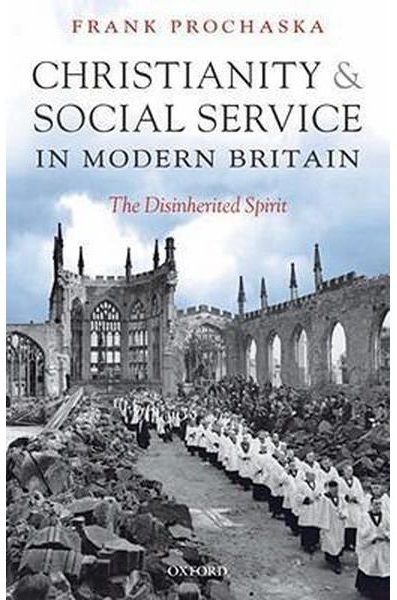
Frank Prochaska describes Christianity & Social Service in Modern Britain as “an interpretative study, which seeks to contribute to the history of social service, religious decline, and democratic traditions” (page (vii)). There is no doubt that, between the late Victorian years and the twenty-First century, the voluntary provision of social services in the UK was substantially replaced by State provision and, over the same period, Christianity in the UK declined. Frank Prochaska seeks to examine the connection between these two processes.
He does this by first examining the beliefs that underlay nineteenth century Christian social action and providing a general overview of the nineteenth century philanthropic landscape before moving on to consider four specific areas: schooling, visiting, mothering and nursing. In each case, he examines the motivation, nature and growth of voluntary Christian action during the nineteenth century and the changes (principally, the decline) that occurred between the last quarter of that century and the years following the Second World War and, to some extent, beyond. In the final chapter, he turns to examining post-war attitudes and endeavouring to draw broader conclusions.
These conclusions are damming of UK Christian leaders, especially those in the Church of England. Prochaska suggests that, by the post-war years “The ministerial, civil service state had dislodged civil pluralism, whose foundations lay in Christian notions of individual responsibility” (page 150) and that “Christian leaders failed to appreciate the consequences of endorsing a collectivist secular world without redemptive purpose” (page 151). Referring to the Church of England, he comments that “rarely has a British institution so willingly participated in its undoing. The Bishops blew out the candles to see better in the dark” (page 152).
Bishops and other Christian leaders would do well to reflect on this but they are not the only ones who should pause for thought. The book raises important questions about the impact of the Welfare State on moral responsibility, freedom and democracy. Prochaska’s conclusions should be considered by all those who have enthusiastically supported its creation and enlargement. He asserts that “in what may be seen as the welfare equivalent of urban renewal, comprehensive reconstruction ravaged much of the historical fabric of the voluntary social services” (page 150) and that, in the post-war years, “Individuals could take satisfaction from paying their taxes, but they were in many ways more impotent in an age of universal suffrage and Parliamentary democracy than their disenfranchised ancestors had been under an oligarchic system” (page 149).
Prochaska concedes that, to some extent, the landscape has altered in the past 40 years but he does not believe that the change is fundamental and he discusses with concern the increasing channelling of Government money through charities, suggesting that it undermines the essence of voluntarism. He suggests that “whether a voluntary sector increasingly funded and regulated by government will promote freedom remains an issue” (page 174).
Those of a left leaning disposition may well recoil from this kind of analysis but it would be wrong to conclude that Prochaska is on a crusade against the Welfare State. He does not in fact analyse the merits and de-merits of it. That is not his subject. Furthermore, whilst he clearly has respect for nineteenth century voluntarism and for what he calls “the religious temper and its role in society and politics” (page (vii), he is not starry eyed about it and his comments on the impact of Christianity and its decline come from outside the Church since he says that he has no personal religious faith (page (vii)).
The book has a number of failings. As the quotes above suggest, Prochaska has a penchant for big statements and many of these are less closely tied to the evidence that he has presented than might be expected of a senior Harvard-based academic. Furthermore, some of his assertions relating to Christianity are misguided. For example, on the basis of his understanding of John Wesley’s theology, he appears to believe that Arminianism had replaced Calvinism within British Evangelicalism by the end of the eighteenth century (page 7), which is certainly not the case.
More seriously, whilst many of the connections he draws between the rise of the Welfare State and the decline of Christianity are thought provoking, most readers are likely to be left questioning whether he has truly demonstrated a relationship of cause and effect between the two. The verdict on his fundamental thesis must be “unproven”.
That said, his examination of nineteenth century voluntarism is fascinating. It will be an eye opening to many readers who will have no idea of the enormous scale of Christian (largely Evangelical) voluntary endeavor in the nineteenth century. The description of the beliefs and societal structures that underpinned this (including the role of women) is of great importance. Any discussion of the Welfare State in the twenty-first century needs to take account of these things if it is to avoid proceeding on the basis of false premises as to what is and what is not possible.
More generally, few people today (whether or not Christian) have a clear appreciation of the extent to which the values and culture of the UK have changed over the past 125 years. In common with most generations, we have a tendency to dismiss our predecessors as ignorant or at least unenlightened and uncritically to equate change and progress. As Prochaska says, “As we reject the pieties and social hierarchies of our ancestors, we tend to forget that benevolence and neighborliness, self-help and helping others, were among the most urgent Christian values. We also tend to forget that much of Britain’s idealism and democratic culture grew out of these values” (page 2). Prochaska helps us to remember and understand.
What is more, the book is a good read and contains an informative and engaging mix of statistical and anecdotal evidence, the latter bringing the subject to life in a way that mere statistics can never do. Even those who fundamentally disagree with what Prochaska is saying should enjoy reading the book and benefit from doing so.
“Christianity & Social Service in Modern Britain” by Frank Prochaska, was published in 2006 by Oxford University Press (ISBN-10: 0199539790). 228PP.
Richard Godden is a Lawyer and has been a Partner with Linklaters for over 25 years during which time he has advised on a wide range of transactions and issues in various parts of the world.
Richard’s experience includes his time as Secretary at the UK Takeover Panel and a secondment to Linklaters’ Hong Kong office. He also served as Global Head of Client Sectors, responsible for Linklaters’ industry sector groups, and was a member of the Global Executive Committee.

The Centre for Enterprise, Markets & Ethics (CEME) was delighted to host roundtable discussion on the topic of “Offshore Financial Centres: Tax Havens or Capital Efficiency?”. Our distinguished speakers were Barbara Ridpath, Director of St. Paul’s Institute and Prof. Philip Booth, Director of Research at St. Mary’s University.
The event took place on the 23rd May 2018 at the London Stock Exchange.
The great contribution of this book, edited by Alex Nicolls, now a Professor at the Said Business School in Oxford, is that it brings together in one place, and for the first time, the exciting stories of social entrepreneurship, analysis of issues and the academic research agenda. In doing so, the book is well-placed to look forward.
Social enterprise and the wider agenda of social entrepreneurship is a creative and innovative agenda of new initiatives to deal with social need, harnessing business approaches to social objectives. Alex Nicholls, in his introduction, notes that has been ‘an unprecedented wave of growth in social entrepreneurship globally over the last ten years’ (page 3). Indeed, as another author in the compendium says, the ‘hallmark of social entrepreneurship is its’ ability to combine social interests with business practices to effect social change’ (page 205). The sector is not only expanding but in the light of ‘government failure’ or ‘social market failure’ new partnerships between the market, the state and civil society are essential. This of course raises questions of capital, of the place of philanthropy and so on which the book begins, but only begins to address.
The book is divided into four parts: New Perspectives, New Theories, New Models and New Directions. My only quibble is it is not all ‘new’ but it is all together in one place. The first section consists of the inspiring stories, the second of the academic research base, the third of approaches and paradigms around social entrepreneurship and the fourth challenges for the future. The variety of voices is both helpful and slightly confusing. It is excellent to bring praxis and theory together, but the style and tone did sometimes seem slightly discordant between chapters. Some of the academic chapters were somewhat turgid and somewhat repetitive. Consequently, they felt the least integrated. The answer really lies in recognising this is a first-class reference book and probably not to be read cover to cover in a single sitting.
The book it at its strongest in setting out the vision of practitioners and also setting out the different structural approaches to social entrepreneurship. Muhammed Yunus gets the volume off to a visionary start. Yunus founded Grameen Bank providing credit and loans to the poorer sections of Bangladeshi society. The loans range from study loans, micro-finance for establishing small businesses to loans for housing. The record speaks for itself, Grameen Bank ‘lends out half a billion dollars a year, in loans averaging under $200 (£116) to 4.5m borrowers, without collateral, and maintains a 99 per cent repayment record’ (page 44). One cannot help wonder whether domestic debates around credit, finance and even the role of credit unions in the UK seems rather stale when compared to more market-orientated social solutions? Yunis is clear that profit is not a dirty word. Bill Drayton, founder of Ashoka, refers to the productivity gain by bringing together business and social systems ‘that have not talked for centuries’ (page 51).
Certainly, for those for whom this field is relatively new, chapter 10, dealing with the variety of structural models of social entrepreneurship is essential and helpful reading. The basic distinction is between embedded models (the social programme is fully expressed within the organisation’s business, for example, the provision of health education through a for-profit business model), integrated models (the programmes are linked, for example, the provision of health education to poorer communities funded by the sale of health education on commercial terms elsewhere) and external models (the programme are not linked, for example, health education is funded by the commercial sale of a different product in a different market). There are, of course, many hybrids. Amongst the more conceptual chapters the challenge of bringing social entrepreneurship to the academic table, developing curricula and inter-disciplinary rigour whilst maintain a practitioner approach was an interesting read (chapter 13).
The book raises a number of important questions for the future. Conceptually the development of the idea of ‘blended value’ is an essential building block in the development of new rapprochement between enterprises which seek an economic return and those that seek a social return. These categories are not mutually exclusive. The provision of capital and indeed the availability of appropriate financial products (e.g. social impact bonds) and investors are increasingly recognised as essential to the future development of the sector and raise questions that really belong to the period after this book’s first publication.
Alex Nicholls has done a great service in putting this material together and into the public domain. Yes, the volume is probably more of a reference resource but it is none the worse for that. To put academic research and market practice together is an important linkage too often not made. As suggested, things have developed and moved on further and it seems to me that a new volume would be beneficial. The field is an increasingly important one; and we need to do everything possible to encourage innovative thinking and the placing of this material into context, conversation and collaboration.
“Social Entrepreneurship: New Models of Sustainable Social Change”, edited by Alex Nicholls, was published in 2006 by Oxford University Press (ISBN – 10: 0199283885). 498pp.
 Dr Richard Turnbull is the Director of the Centre for Enterprise, Markets & Ethics (CEME). For more information about Richard please click here.