
CEME is proud to be part of a conference taking place at St. Mary’s University, London on the rapid development of AI and the recent publication by Pope Leo XIV of the encyclical Magnifica Humanitas.
Location: Waldegrave Drawing Room, St Mary’s University, London (Twickenham TW1 4SX)
Cost: £25 (free for St. Mary’s University students and staff, and contributors to the programme)
The conference is hosted at St Mary’s University, London and cosponsored by the university, CCLA and the Centre for Enterprise, Markets and Ethics.
Schedule:
9.30 am Tea/Coffee
10:00 am Welcome – Philip Booth (Professor of Catholic social thought and public policy, St. Mary’s University and Director of Policy and Research, Catholic Bishops’ Conference of England and Wales)
10.15 am Reflections on AI and Magnifica Humanitas – Bishop Paul Hendricks (Lead Bishop for AI, Catholic Bishops’ Conference of England and Wales)
10.45 am AI and the future of business – James Poulter (ThreePoint Labs). Chair: Rev. Philip Krinks (Director, Centre for Enterprise, Markets and Ethics)
11:15 am Break
11:30 am AI Christian mission and evangelisation – Joe Hartropp, (Digital Labs Manager, Church of England), Dr. Collette McGovern (Permanent Mission of the Holy See, Geneva), Brenden Thompson (Director, Word on Fire UK), Maggie Doherty (Director, Centre for Living and Dying Well, St Mary’s University, Twickenham). Chair: Dr. Karen Singrayer (Vice Chair, Catholic Union)
12:30 pm Lunch Hosted by the Centre for Enterprise, Markets and Ethics, CCLA and the MA in Catholic social teaching with short talks by Rev. Philip Krinks, Celia Waring (Head of Client Relationships, CCLA), and Fr Ashley Beck.
1.30 pm AI: Enterprise, innovation and investment – Kumar Jacob (Mindwave Ventures). Further speakers to be announced. Chair: Josephine Carlsson (Church Ethics Lead, CCLA)
2.30 pm AI and the future of humanity – Prof John Wyatt (Faraday Institute for Institute and Religion, Cambridge). Chair: Naoise Grenham (Catholic Bishops’ Conference of England and Wales)
3.00 pm Human flourishing in the age of AI - Sr. Liz Dodd (Sisters of St Joseph of Peace), Rev. Philip Krinks (Director, Centre for Enterprise, Markets and Ethics), Delphine Chui (Independent Writer, Speaker and Content Producer), Rabbi Dr Harris Bor (London School of Jewish Studies). Chair: Rev. Prof. Oystein Lund (Vice Chancellor, St. Mary’s University)
4.00 pm Closing remarks, reflecting on the event and its relevance to the Catholic and Anglican traditions – Bishop Paul Hendricks and Rev. Philip Krinks
4.15 pm Finish
Anyone who has worked in a large corporation, or NGO, or even public sector organisation, will be familiar with the dreaded term, Organisational Restructuring – as in, there’s going to be … A Restructuring. That means everyone’s jobs will change. Some people will advance a bit, some people will lose out a bit, and sadly some people will have to leave the organisation. It can be a time of horrible uncertainty, and it can bring out the worst in people.
Imagine a corporate executive who listens to what her CEO is saying on the monthly management calls – and realises that restructuring is coming. The politics is against her. It’s been made to look like it’s her unit which is underperforming. So, sadly, her time with the firm is going to end. She’s going to be made redundant and at a very awkward time in life.
And then she says to herself: ‘What shall I do? For the restructuring is going to take away my job. I’m not suited to more manual work. I don’t want to be reduced to begging. But maybe … I’ve got a better idea: an idea which will make sure there’ll be something for me after this – on the buy side.’
So she calls each of her clients one by one. She says to the first, ‘How much have we invoiced you this quarter, how much are you due to pay us?’ And the client says: ‘£100,000, as I remember.’ And she says to him, ‘Take the invoice I sent, quietly cross out £100,000 and write £50,000.’ The client is a bit surprised, but goes away not exactly unhappy at the retrospective discount. And then she says to the second client, who’s in the Eurozone, ‘How much did we invoice you?’ and the client says, ‘€100,000.’ And she says to him, ‘Take the invoice we sent you – and quietly write €80,000.’
And the CEO hears about what the outgoing executive has done, and the CEO is actually rather impressed with her. ‘Very shrewd,’ the CEO thinks – and perhaps he’s even regretting his restructuring decision. ‘Very shrewd, to use the company’s money to hand out these discounts, and make friends on the buy side on the way out. That might well give her a safe harbour after she leaves our organisation.’ Because the CEO knows a man or woman of the world when he sees one. And he knows wisdom – at least, worldly wisdom – when he sees it.
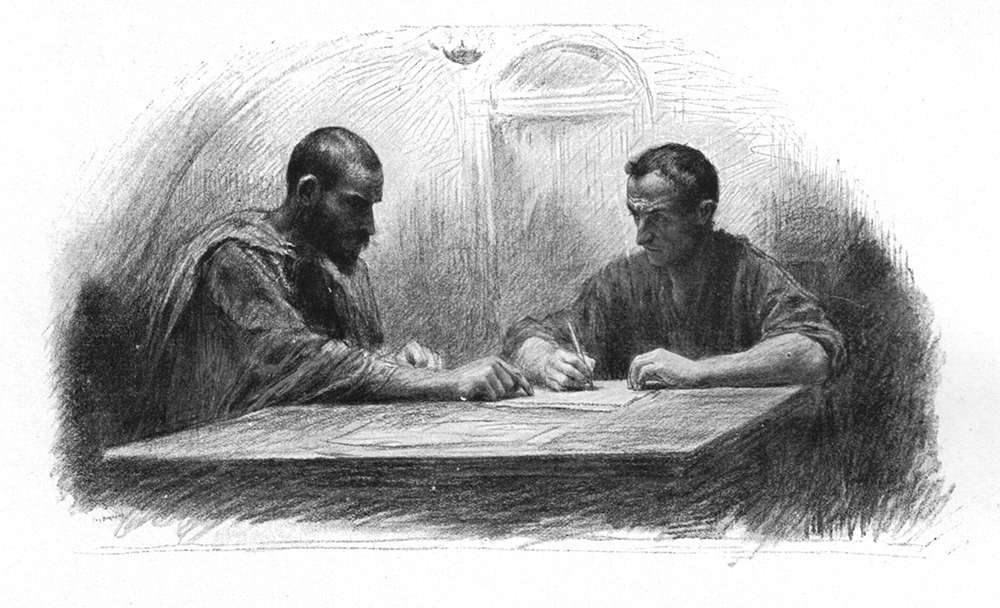
If you know your Bible, you’ll know that Jesus, perhaps surprisingly, tells a version of exactly this story. My parable is just a modernised version of Jesus’s famous one about the worldly wisdom of the rich man’s steward, a kind of estate manager, who is about to be dismissed. You can find ‘The Parable of the Unjust Steward’ in Luke’s gospel at the start of chapter 16. Like the executive, the steward goes round all those who owe his master money, and, to give himself some prospects for the future, gets them to discount his bills.
And what Jesus says to his disciples about his parable is something which most people initially find rather shocking. He says that, even though we are called to be children of light – and not children of this world – we can learn something from this kind of situation.
There are two things which Jesus suggests we can learn from his story, unedifying as it may first seem.
The first is that, even though as his disciples we are called to be children of light, and not children of the world, we must still live for now in the world as it is.
And in the world as it is we have to reckon with what Jesus calls ‘mammon’: with money, with finances, with all kinds of choices about how we acquire resources and how we steward them once we’ve got them.
The second is that in this world wisdom isn’t optional, but that there are higher forms of wisdom than the worldly wisdom, or shrewdness, of that corporate executive or unjust steward, who use their employers’ money to buy themselves into safety after the redundancy axe falls.
Jesus says that, when we as disciples deal with money, we must have as much, or even more wisdom, than the children of the world; not less. But it is not the same kind of wisdom. Jesus tells his disciples that we are to use our resources, and in particular our money, to make friends, to build relationships, yes; but not the kind of instrumental relationships of narrow self-interest sought by the worldly wise. Instead we are to form relationships which have ethical and spiritual integrity, friendships which will keep us safe, not just for a few years in a new role, or until we can take our pensions, but for eternity, because they are good for our souls. These friendships are as much, or more, about helping others, as getting them to help us. And we all have people we are in a position to help through our engagement in the economy: whether through our positive-sum exchanges in markets, or through our charitable giving, or even by paying our taxes.
We all know that mammon is able to express and cause all kinds of what previous generations would have called ‘unrighteousness’. And in fact in the passage Jesus calls it ‘the mammon of unrighteousness’. But that’s not all he says. He also says that mammon can be used for good. And that is the call Jesus makes to us in our economic exchanges: to use our money to do some good in the world, and to do ourselves some spiritual good in the light of eternity.
One way to express this is to say that human beings are always liable to make an idol out of money, to treat mammon itself as a kind of god. And indeed it is in this passage that Jesus famously warns us, ‘you cannot serve God and mammon’. He is telling us that only one of these can be ultimate in our lives. And that it is not in fact true wisdom to choose mammon as ultimate, but true foolishness, and indeed a kind of idolatry.
So let us not allow our use of money to make it an idol which competes with God. Rather let us make our use of money into the kind of beautiful icon we see in Orthodox churches, through which God’s goodness may be glimpsed. And if we can look at life’s challenges that way, we will find that God’s goodness helps us. We will find that Jesus’s call is not one we have to respond to solely in the strength of our small selves, but one for which we can draw energy from the transcendent, magnetic goodness of God, which we see revealed in the words and sacrificial love of Jesus himself.
Image: Drawing of L’Économe infidèle (The Unjust Steward) by Eugène Burnand, 1908
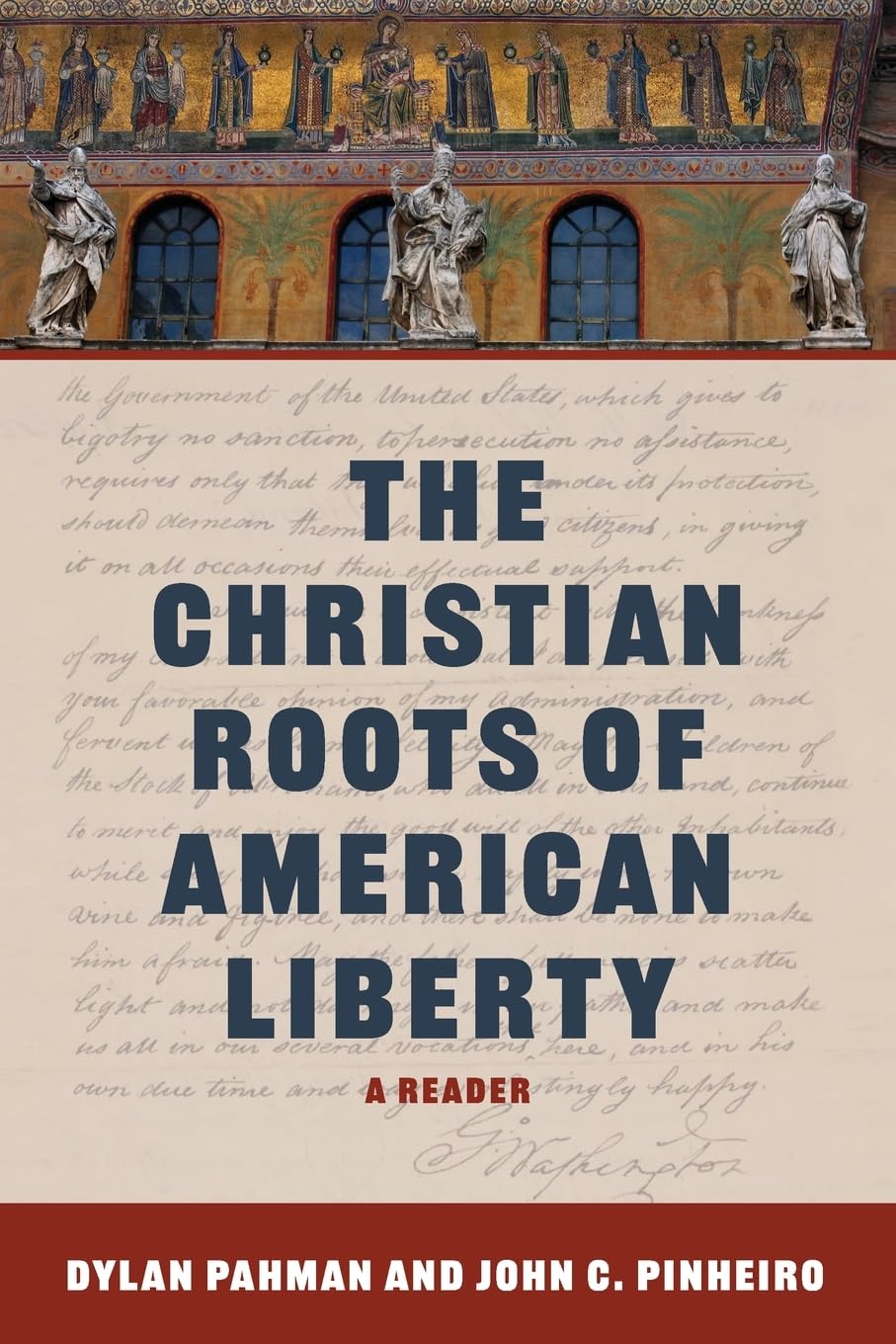
This collection of primary texts highlights liberal principles embedded in the history of Christian thought. Challenging efforts by Yoram Hazony, Patrick Deneen, and Adrian Vermeule to sever Christianity from liberalism, editors Dylan Pahman and John C. Pinheiro document the presence of liberal principles in the writings of church fathers, Christian edicts, and early modern philosophy. The editors also aim to show how liberal principles can be compatible with conservatism. Divided into five parts, with discussion questions at the end of each part, the book is organized to show Christian precedents for principles articulated in the founding documents of the United States.
While the title, The Christian Roots of American Liberty, may suggest otherwise, the book is not designed to show that American founders drew their ideas on liberty directly from Christian thought. Rather, the book culls excerpts on liberty from Christian history to highlight commonalities with liberal principles in America’s founding documents.
Part One: God, Natural Rights and the Rule of Law provides a strong case for this common bedrock. Thus, Justin Martyr claims that ‘every race of man’ shares in the Logos of creation and ‘those who lived reasonably are Christians,’ even if they lived before Jesus was born (page 21). Augustine of Hippo defines conscience is the principle of natural reason implanted in the human mind, with virtue the natural result, though often distorted by passion and dishonesty. Similarly for Aquinas, ‘to the natural law belongs those things to which a man is inclined naturally: and among these it is proper to man to be inclined to act according to reason’ (page 52). Thomas Jefferson develops the egalitarian implications of natural reason more fully, declaring ‘all men are created equal’ and ‘endowed by their Creator with certain inalienable Rights’ (page 64).
Part Two: Religious Liberty is less persuasive. Tertullian objects vigorously to punishing Christians for ‘the crime of treason’ (page 79). Constantine established religious toleration in 313, but it lasted only a few years before the Church began persecuting Arians, then Donatists, and eventually pagans. Protestant reformer Sebastian Castelllio pled with Catholics and evangelicals to stop condemning each other and in the seventeenth century, John Locke drew on natural reason to separate the reach of civil power from religion’s ‘inward persuasion of the mind’ (page 109). Jefferson also appealed to natural reason in his Statute for Religious Freedom written for the State of Virginia in 1779, which decreed any infringement of religious liberty to be a violation of natural rights (page 114). But Jefferson’s argument for religious liberty – not the same as religious toleration – is as much a break with Christian tradition as a continuation.
In Part Three: Private Property, the problems involved in culling sources become apparent. In the editors’ effort to join economic and political liberalism, medicant religious orders are brushed aside, and concerns about Christian displays of wealth and the monetization of penance are overlooked, along with connections between piety and vows of poverty. One of the most respected historians of early Christianity, Peter Brown, known for his interest in the tension between the teachings of Jesus and Christian management of wealth, is dismissed in a footnote (page 122 n. 4). Perhaps most telling, the rich history of Christian reflection on the acts and sayings of Jesus related to wealth receive no mention. The compromise struck in America between liberty and the right to slave property is not discussed.
Part Four: Limited Government highlights the Magna Carta as a precursor to Federalist No. 51, written by James Madison, which includes Madison’s famous but oblique reference to original sin: ‘If angels were to govern men, neither external nor internal controls on government could be necessary’ (page 149). But Madison’s leadership in conceptualizing a government based on checks and balances and the separation of powers goes unmentioned, as does his disagreement with Alexander Hamilton over limits on federal authority. In the footnote below the text from Federalist No. 51, the conservative Hamilton is mistakenly identified as the author.
Documenting the long history of episcopal elections, Part Five: Representation and Consent challenges anti-liberal writers who fail to recognize consent of the governed as a Christian principle. With the full text of Jefferson’s Summary View of the Rights of British America (1774) as the culmination of this section, and indeed of the book as a whole, the editors align the history of Christian thought with Jeffersonian liberalism. The problem with this alignment is that Jefferson and other American founders grounded their principles of liberty not in Christian writings but in pre-Christian Greek and Roman writings including Cicero, Tacitus, Homer, and in the case of Jefferson, Epicurus. While the editors acknowledge the contribution of ‘the Roman Republic and Athenian democracy’ on the American founders, they underplay its influence.
At the same time, the editors miss an opportunity to explore the Christian roots of Madison’s ideas about the separation of powers and the inevitability of factionalism. The influence of Presbyterian John Witherspoon on Madison, and the influence of Scottish Reformer John Knox on Witherspoon, are reflected in Madison’s recognition that contestations of wealth and power are part of human nature, consequences of what Witherspoon and Knox called natural depravity or original sin. This point is important for understanding Christian contributions to American liberty because Madison’s conceptualization of checks and balances and the need to account for factionalism may be the only elements reflected in the US Constitution ratified in 1789 that are rooted in Christianity but not in classical philosophy.
S. L. Frank’s liberal philosophy is a hidden twentieth century gem which integrates Orthodox Christianity and spontaneous order. It offers a way to ground personalist freedom, limited government, and Christian realism against utopian tyranny and autocracy today.
It was the end of a long day in London last July. My wife Kelly and I had seen Westminster Abbey and Westminster Cathedral that morning, and I spoke with the Catholic Bishops’ Conference of England and Wales that afternoon about my research and then-forthcoming book. Hendon Cemetery was only a mile or two north, though. How long could it take get there? As with anywhere in London traffic, the answer was about two hours.
As sundown approached, Kelly and I wandered lost in the graveyard. He was here somewhere, we knew that, but we hadn’t anticipated how large the cemetery would be. The London sky threatened rain, but it held off, and the happy chirps of rose-ringed parakeets kept us hopeful, even when we split up and I worried my phone battery might die before either of us found him. There among the graves, we passed many Greek Orthodox, Roman Catholics, and Muslims, all resting in peace together. My mind wandered to the great Scots novelist George MacDonald’s Lilith: ‘Of such as I could see, all were alike in the brotherhood of death, all unlike in the character and history recorded upon them.’ We’re all religiously tolerant in the end, whether we want to be or not. Then my phone buzzed. She had found him.
A tall, wooden, Russian cross, at least four feet high, with an engraved icon of the risen Christ over the top and middle, marks the final resting place of S.L. Frank. Kelly had to clear away a dense brush of vines just to read it. We must have been the first to visit in a long time. With the help of AI, we translated the epitaph. A plaque with a biblical quotation from the Wisdom of Solomon there reads, in Old Slavonic, ‘I loved wisdom and sought her from my youth … Knowing that I shall not otherwise obtain her unless the Lord gives her, I came to the Lord’ (Wisdom 8:2, 21). I couldn’t come all way to London and not pay my respects to Frank.
When people think of Russian civilization, ‘liberal’ isn’t their first descriptor. From Moscow’s tsars, to the Russian Empire, to the Soviet Union, to Vladimir Putin’s Russian Federation today – words like ‘autocratic,’ ‘totalitarian,’ ‘repressive,’ and other illiberal modifiers make more sense. Nevertheless, that is not the whole story, and the Russian Orthodox philosopher S.L. Frank puts the lie to the claim (often portrayed in positive terms by opponents of liberalism) that Russia and its dominant religious tradition, Orthodox Christianity, are fundamentally opposed to liberty.
‘Quite apart from his philosophy,’ writes his biographer Philip Boobbyer, ‘[Frank] lived a remarkable life.’ Semyon Lyudvigovich Frank was born to a Jewish family in Moscow on January 19, 1877. His father died of leukemia when he was only five years-old. His maternal grandfather taught him Hebrew, instructed him in the Bible, and took him to synagogue. Frank’s grandfather died when he was fourteen, however, and his teen years were shaped more by his stepfather, who fostered in him a growing interest in revolutionary Marxism. This phase, however, did not last long. According to V. V. Zenkovsky, ‘In 1899 Frank was arrested and exiled from the university cities; he went abroad, working in Berlin and Munich on political economy and philosophy. His first published work (Marx’s Theory of Value) was devoted to a critique of Marxism (1900).’
Though Frank soon made philosophy his lifelong vocation, his years studying economics, as well as his longtime friendship with economist Petr Struve, another Russian liberal, made their mark on his later work. In particular, as we’ll see, Frank has a clear appreciation for spontaneous order. ‘All that is generally accepted in society,’ he writes in The Spiritual Foundations of Society,
e.g., mores, habits, fashions, even law (insofar as it is common law) and the price of goods (insofar as taxes and tariffs are neglected), exists without any special contract or agreement, appears ‘spontaneously’ in some manner and not as the consciously set goal of the general will. History shows that the state itself and state power arise and exist precisely in this manner: ‘spontaneously’ and not as the result of conscious social agreement. Only on the basis of this elementally and unconsciously formed common order and unity is it possible to have, in certain particular and limited domains and cases, the conscious agreement of individuals (e.g., rulers, national representatives, statesmen) and the conscious action of these individuals upon social life.
For Frank, however, this spontaneity represents more than historical, cultural evolution – as it does for F.A. Hayek, for example, who was working in parallel in London in the 1930s and 1940s and with whom Frank otherwise has a lot in common, although there is no evidence that he knew of Hayek’s work. ‘The forms of social relations,’ writes Frank, ‘are normalized by rules … that are not consciously instituted by anyone but are generated spontaneously and have a direct religious sanction; common law is conceived as the self-evident eternal expression … of the “obligatory” in human relations.’ In this, Frank is closer to Adam Smith, who wrote in his Theory of Moral Sentiments, ‘When by natural principles we are led to advance those ends which a refined and enlightened reason would recommend to us, we are very apt to impute to that reason, as to their efficient cause, the sentiments and actions by which we advance those ends, and to imagine that to be the wisdom of man, which in reality is the wisdom of God.’
Following a brief period of youthful atheism, Frank came back to religion like many of his friends and peers, including the philosopher Nikolai Berdaeyev and theologian (then economist) Fr. Sergei Bulgakov. After a decade of discernment, in 1912 Frank was baptized into the Orthodox Church. Together with them and other critics of the Bolsheviks, Frank was exiled from Soviet Russia in 1922, settling in Berlin. By 1937, he again fled for his life, this time from the Nazis, to Paris. After the Fall of Paris in 1940, he and his wife Tatiana sent their adult children to London while they hid out in the mountains near Grenoble. These years of exile were remarkably productive for Frank. Several of his major works date to this period, all marked by an unmovable faith in God who both transcends the turmoil of the world and yet grounds its very existence, suffering along with us in Jesus Christ. Frank was acutely aware of the reality of evil and the perils of political power. Many of his friends and relatives died in the Holocaust. In 1945, after the end of the war, the Franks reunited in London, where Semyon died of lung cancer on December 10, 1950, three-times-over a refugee – a ‘remarkable life,’ indeed.
Against the conceit of central planners, Hayek distinguished between two types of knowledge: (1) ‘scientific knowledge’ of ‘general rules’ and (2) ‘unorganized,’ local ‘knowledge of the particular circumstances of time and place.’ Frank makes a similar distinction: ‘We have not one but two kinds of knowledge: (1) abstract knowledge about the “object” expressed in judgments and concepts – knowledge which is always of a secondary order; and (2) immediate perception or intuition of the “object” in its metalogical wholeness and indivisibleness – primary knowledge upon which abstract knowledge is based and from which it originates.’ Both reject the scientistic claim that all that can be known, or at least all that matters to know, is empirical observation, measurement, and deduction.
But for Frank, as we’ve already seen, there is a deeper, ontological dimension to this. As he writes in another work, ‘reality in its living concreteness is wider and deeper than “the world of objective fact.” A philosophy adequate to the task of obtaining true knowledge of reality is therefore always based upon the living inner experience, in some sense akin to the experience that is called “mystical.”’ The unfathomable aspect of reality that we know through living experience is possible only through an ultimate, ontological connection between all existing things, or ‘all-unity,’ a common theme of Russian religious philosophy.
To Frank, this unknowable ‘other’ at the base of and uniting all things is the divine, which, consistent with Orthodox Christian theology, we can conceptually only gesture at through apophatic reasoning and metaphor: ‘Although no positive determinations in the usual sense are applicable to God,’ he writes, citing the ancient Christian mystic Dionysius the Areopagite, ‘they are applicable to Him in a different, metaphorical sense. It cannot be said, for instance, that God is “good” in the sense of possessing this quality as something that determines His nature, but at the same time it can and must be said that, being the source of goodness, He is “surpassing good” ….’ As such, evil constitutes the rejection of this mystical aspect of life, thus always entailing, if only subconsciously, the rejection of God. Conversely, all good, even that done by atheists, represents some expression of communion with the divine or ‘Godmanhood,’ a term Frank takes from the Russian Orthodox philosopher Vladimir Soloviev. On this generous ecumenical basis, Frank affirmed freedom of conscience and religious liberty.
For Frank, errors of knowledge come from either mistaking one of the two types of knowledge for the whole, or else from confusing one with the other, rather than seeing both as reflecting essential aspects of reality. Because this applies to all reality, it also applies to society, which rests on this same spiritual foundation. ‘On the one hand,’ writes Frank, ‘society is constructed through conscious planning; on the other hand, it is formed and grows “by itself.”’ Thus, Frank outlines an identical distinction to Hayek between spontaneous order and centrally-planned order. Hayek laments that English does not contain two different words for this, so he employs the Greek cosmos and taxis, respectively. Frank, however, is able to use the Russian terms sobornost’ and obshchestvennost’. Sobornost’ literally means ‘catholic,’ deriving from the phrase ‘one, holy, catholic, and apostolic Church’ in the Nicene Creed in Old Slavonic. It refers to the conciliar nature of authority in the Orthodox Church – as distinct from papal authority in Roman Catholicism and sola scriptura in Protestantism – but by Frank’s time had been expanded to a general social and philosophical principle.
Failing to understand this twofold nature of social life generates errors of social theory, leading Frank to a Road to Serfdom-esque analysis of how the worst get on top. He writes in his political philosophy, The Light Shineth in Darkness,
All utopians transfer the function of salvation to the law, to measures of state compulsion or, at best, moral compulsion – a function that, in essence, only the free powers of God’s grace are capable of performing … Since the law in its essence is incapable of performing this task, it is necessary, in a vain attempt to perform this task, to immeasurably intensify the force of the law, to have recourse to tyrannically harsh and despotic forms of the law, normalizing all aspects of human life.
Just like Hayek, Frank notes how the impossibility of centrally planning all of social life leads to moral compromise – a Gresham’s Law of leadership. Bad leaders drive out good. He writes,
The bloody torture of living people, the crippling and repression of concrete life in the name of the attainment of absolute truth on earth, continues without end and without leading to the desired goal. But then, in the long process of this crippling of life, one more unexpected transformation occurs that is not part of the original plan of its initiators: the final goal itself, the kingdom of absolute good, begins to disappear from the consciousness, blocked by emotions that are necessary for this arduous path to its attainment. Power gradually passes into the hands of people whose character is adequate to the cruel, bloody work of the crippling of life, into the hands of villains and executioners, who naturally think of nothing but the protection – by all means of repression and falsehood – of their power. The radiant dream of salvation and the happiness of all people is transformed into the somber glorification of hate, cruelty, [and] inhumanity as normal motive forces of human life.
No doubt, Frank would agree with Acton (whose work he knew): ‘Power tends to corrupt and absolute power corrupts absolutely. Great men are almost always bad men, even when they exercise influence and not authority: still more when you superadd the tendency or the certainty of corruption by authority.’ The most noble ideal, combined with unchecked power, too often leads ‘great men’ to become ‘bad men.’
So if Frank rejects all such utopianism – and he lived through many tragic forms of it – what did he affirm? Boobbyer rightly refers to Frank as a ‘Christian liberal.’ ‘In practice, liberalism or Manchesterism contains a considerable amount of truth. But this truth usually receives an incorrect philosophical explanation,’ Frank explains. In particular, he takes issue with egoism, utilitarianism, and social atomism. He would not be a fan of Ayn Rand. Because Frank believes that all things are grounded and fulfilled in the ‘all-unity’ of ‘Godmanhood’ or sobornost’, he rejects atomistic individualism in favor of philosophical personalism. Or, Hayek might say, he rejects false individualism for true.
We could add to this by calling Frank a personalist liberal as well. There is a spiritual unity at the base of all human society that turns an external collection of individuals – ‘he,’ ‘she,’ and ‘they’ – into an inner unity of ‘I and thou’ or simply ‘we.’ All people come from ‘we’ as basic fact of biology, not to mention sociology. The family and religion thus represent the holiest of social spheres, but Frank insists that business and even the state can and must manifest this inner unity as well. Regarding the state, Frank insists that ‘state power is necessarily limited by the presence of civil society and the uneliminability of the latter.’ As we are not isolated individuals but rather persons embedded in various communities, the state must respect the autonomy of those communities. The state can impose rules that externally order collections of individuals, but it cannot create the inner unity necessary for healthy social life. Through civil law, solidarity and freedom – the planning of the state and the spontaneity of non-state social spheres (‘civil society,’ in Frank’s usage) – are harmonized into mutual service.
Thus, Frank insists, the law, which addresses impartial justice based upon natural law, must establish the necessary structure for free and personal mercy (or, Adam Smith would say, ‘beneficence’), by protecting rule of law, private property, religious liberty, economic freedom, freedom of speech, academic liberty, and democratic consent. At the same time, mores and common law must establish a moral culture that preserves the responsible use of freedom. For Frank, as for Edmund Burke, the extent of law will reflect the extent of a people’s moral character. Going beyond Burke from his Orthodox Christian perspective, Frank therefore insists on the importance of ascetic practices (e.g., prayer, fasting, almsgiving) for people to learn the self-restraint they need to be free and to encounter the unfathomable source of true freedom, God.
Like Reinhold Niebuhr (but independently of him), Frank accordingly refers to his own political position as ‘Christian realism.’ Acknowledging the imperfection of a world fallen into sin, from his Christian point of view, he does not expect utopian perfection, even while considering the task of saving or ‘perfecting the world,’ exercised within these constraints, to be a noble one. Understood in this context, Frank fondly quotes Vladimir Soloviev, who wrote, ‘The purpose of legal justice is not to transform the world which lies in evil into the kingdom of God, but only to prevent it from changing too soon into hell.’
Because, for Frank, a divinely-grounded freedom and unity lies at the basis of all society and, for that matter, all reality, he can only justify coercive force as a matter of the doctrine of double effect, i.e., when inaction or indifference would be a greater sin. ‘War is an evil and a sin,’ he said in a series of lectures, citing the most extreme example of state power, ‘and a monk and hermit is right when he abstains from participation in it. But he is right because he never uses the fruits of war, because he does not need the political state which is waging the war and all that the state gives to men.’ By contrast, ‘Those who are ready to use the fruits of war, those who still need a state, bear responsibility for the destiny of the state and, sinning together with the latter, they sin less than those who wash their hands of the matter and shift the sin to others.’ Thus, when coercive force is necessary to preserve the institutions of free and gracious spontaneity in social life, Frank supports it, but only as the less sinful option in an imperfect world.
Religious illiberalism is ascendent today with the surprising popularity of such books as Patrick Deneen’s Why Liberalism Failed, Adrian Vermeule’s Common Good Constitutionalism, Yoram Hazony’s The Virtue of Nationalism, and Stephen Wolfe’s The Case for Christian Nationalism – along with a Vice President and Secretary of War in the United States known to repeat their rhetoric. Yet what these authors still only hope for, Russia sadly has been doing in recent years. However, that is not the whole story. S.L. Frank, though an original thinker in his own right, nevertheless saw within his Russian Orthodox Christian tradition the foundations of a free society. Indeed, Russian history includes not only the despotism of its tsars and emperors, but also the more-than-three-centuries-long medieval republics of Pskov and Novgorod, and a century of Church-led liberalization in the Russian Empire before the tide turned following the Decemberists’ failed uprising in 1825. Even afterward, it was Metropolitan St. Filaret of Moscow who authored Emperor Alexander II’s 1861 Emancipation Manifesto, liberating the serfs.
Liberty is not just a ‘road untraveled’ in Russia and the Orthodox Church, it is a ‘road once travelled, but too briefly,’ a road on which, with S.L. Frank as a guide, others – of any nation or religion – could travel even farther today. It is high time to clear the brush away from this lost liberal’s grave and, in the words of the Orthodox memorial service, ensure that his ‘memory be eternal.’
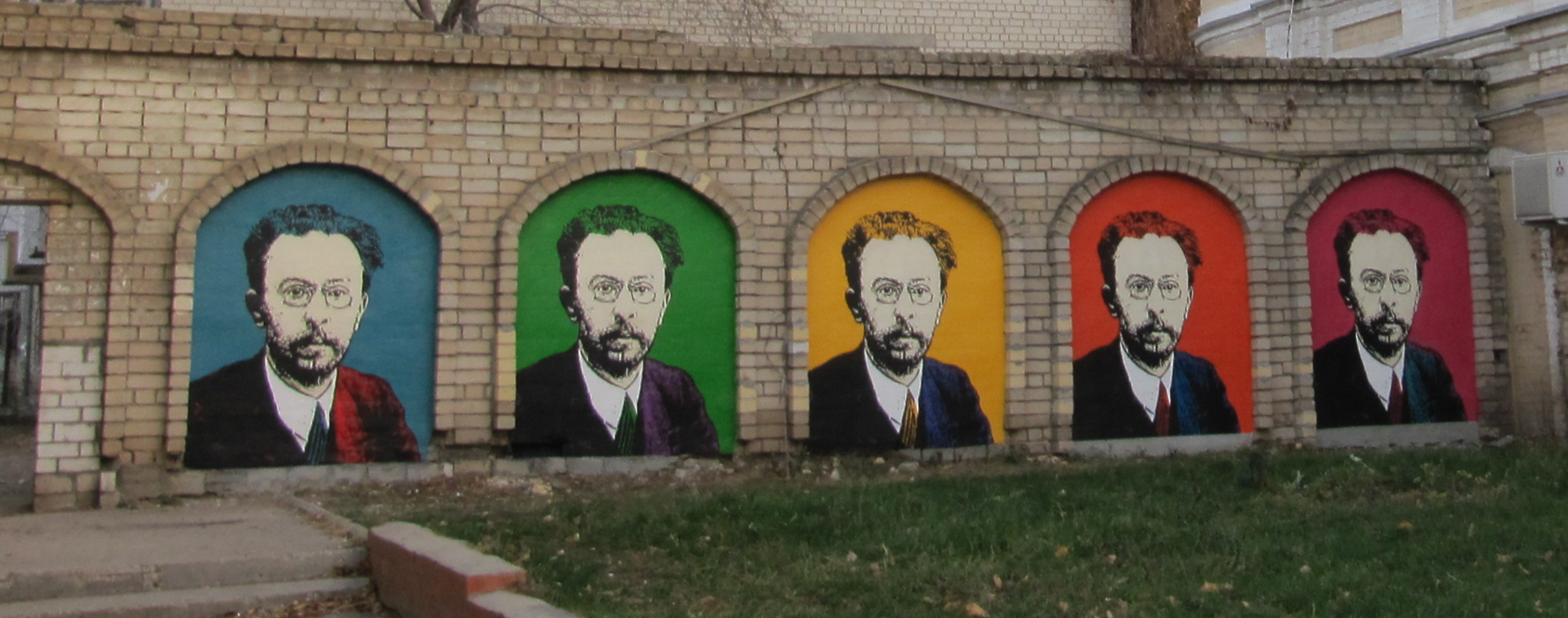
Image: S.L. Frank portraits on Radishchev Street, between buildings 16 and 18; Saratov. Sourced from Wikimedia Commons on a creative commons licence.
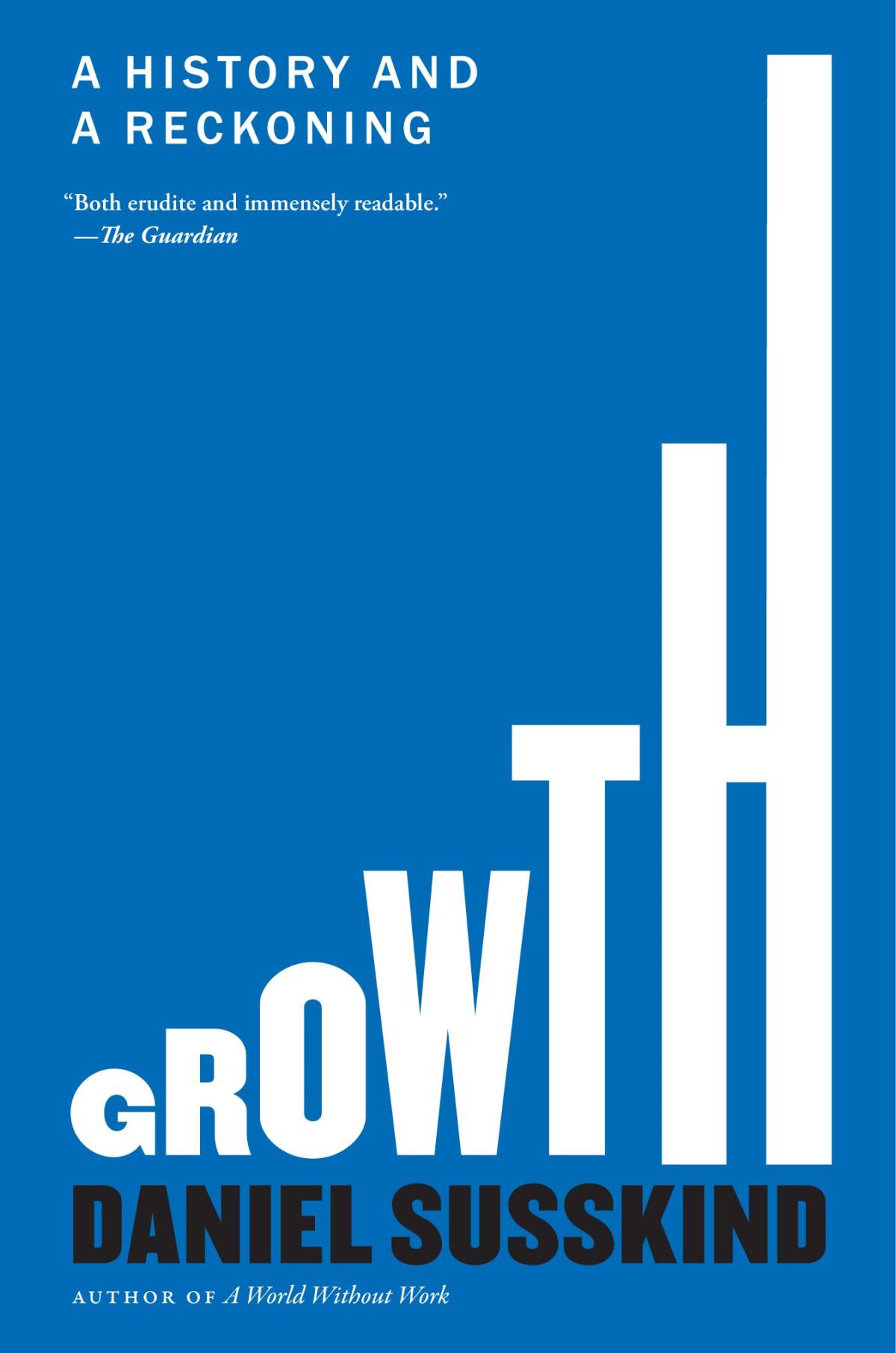
Anyone who follows the news in Britain, will have heard a lot about ‘growth’. Britain’s former Chancellor, Rachel Reeves, promised to turn the country into the fastest-growing economy in the developed world, while the last Prime Minister but three, Liz Truss, promised to take on the ‘anti-growth coalition’, even if she very quickly found that it was a lot more resilient than she could have imagined. Now that growth has largely disappeared, we spend more time discussing it than ever. And yet, in this timely and ambitious new book, Daniel Susskind, steps back from the debate, and asks some deeper questions. What is ‘growth’ anyway? Do we still need it? And if we do, how can we get it back on track?
At the start of his history of how output gradually started to expand, Susskind notes that ‘for most of the 300,000 years that human beings have been around, economic life was stagnant.’ Indeed, the standard of living of a Stone Age hunter-gathered and an 18th century labourer were remarkably similar. Over the last 200 years, something remarkable happened. Growth started to accelerate, and, once it started, it never really slowed down, even if there were inevitable bumps along the way. The result? We live in a world which, compared to any of our forebears, is marked by a material abundance that would have even relatively recently been unimaginable. There are lots of reasons for that, and in a comprehensive survey, Susskind identifies most of the factors that drove the sudden burst of prosperity. But what it really boils down to is this. It was driven by what he terms the ‘first industrial enlightenment – the first time that humankind engaged in the pursuit of useful ideas with a sustained intensity and moral seriousness.’
His conclusion is that it is basically knowledge and creativity that drives growth, and, as we embark on what may turn into the era of Artificial Intelligence, it is hard to dispute that. And yet, over the last few years, growth has been more contested than ever. In June, for example, the Global Justice Report led by the French economist Thomas Piketty proposed reducing the annual rise in GDP in the west to between zero percent to 0.5 percent to help create a fairer, more sustainable society, and that was just one example among many. In reality, the ‘degrowth’ movement is more powerful than ever. Championed by green activists such as Greta Thunberg, the ‘degrowthers’’ core point is that infinite growth is impossible on a finite planet. To Susskind, however, the argument is little more than failure of economic imagination. The ‘degrowthers’ treat the economy as a purely physical entity, ignoring the simple fact that growth is increasingly driven by intangible products. More seriously, ‘degrowth’ will quickly turn into a romantic euphemism for a deep global recession, and one that would permanently trap hundreds of millions of people in absolute poverty and require an authoritarian dismantling of western democracy to enforce. ‘There is no economic law which says growth promoting technologies must also ruin the environment, hollow out local communities, and rely on technologies we cannot properly control,’ he writes.
That is very true. Instead of condemning growth, the author is more interested in how we can revive it and give it greater moral purpose. There are, he argues, continual trade-offs that have to be made in any kind of economic policy, whether it is over the environment or the level of inequality we are willing to accept. Those decisions, he believes, are basically moral judgements, and can’t be left to the number crunchers calculating the quarterly GDP data, or technocratic officials. At one point, he suggests that discussion of the essential trade-offs could be made through ‘mini-publics’ or citizens’ assemblies, bodies where ordinary people work alongside the existing political system to make decisions that genuinely reflect broader society’s views about trade-offs. Well, perhaps. As it happens we already have a ‘citizens assembly’ – it is called a parliament – and we hardly need another one, especially as it could very easily be hijacked by special interest groups or hardcore activists. It would be far better if more politicians were willing to make a clear argument for growth, and why we need it, and what can be done to make sure it benefits everyone.
Those are minor quibbles, however. Susskind is writing for a global audience, and so, quite rightly does not trap himself in parochial arguments. A debate about ‘growth’ will be very different in Britain, or indeed most of the rest of Europe, where it has all but disappeared, than in the United States, or China, where economies are still expanding at a rapid rate. In the end, Susskind is a pro-growth optimist, firmly on the side of expansion and rising living standards. ‘For three hundred thousand years, humankind looked out on the future and saw what must have seemed inescapably bleak: a relentless, unforgiving struggle for subsistence,’ he concludes. ‘Modern economic growth has changed that.’ That is very true. We might be struggling to grow again, and many people have been questioning whether it is even worth trying. But as this excellent short guide makes clear, ‘growth’ is well worth having – and we will certainly miss it if it is gone for good.
Our seventh Fforestfach Colloquium was held on 2nd July, 2026, in Committee Room G of the House of Lords, and was attended by eighteen invited guests. The topic of the Colloquium was Antisemitism.
A panel of four distinguished speakers was invited to lead us in our thinking on the subject:
Our hope was that the speakers’ presentations and our subsequent discussion would range widely across people’s experience of the problem of antisemitism, both past and present, in our society. With the ‘Free Palestine’ marches and protest meetings, a politicised form of antisemitism has emerged, spilling over into party politics, in the outliers of the Labour Party and the Greens. Is this trend something more than a newly-minted version of the ever-shifting ‘progressive omni-cause’ (day before yesterday, women’s rights; yesterday, ethnic minorities’ rights; today, Palestinians’ rights; tomorrow, …)? Or is it a sign of a return to a more sinister prejudice against Jews, which many of us hoped had been purged from our society with the ending of the Second World War? To what extent is growing antisemitism in the UK and elsewhere bound up with the nature of the war in the Middle East? What part can and should Christian churches and individual Christian believers play in stamping out any form of antisemitism, conscious or unconscious, from our lives?
Our speakers and the discussion which followed certainly addressed these points, and gave us a poignant and challenging insight into the feelings and concerns of our Jewish brothers and sisters in Britain today.
“Antisemitism: A Spiritual Virus” by Rabbi S.F. Zimmerman
Rabbi Shraga Feivel Halevi Zimmerman is an American and English Haredi rabbi who since 2020 has served as the rov (senior rabbi) and av beit din (Head of the Court) of the Federation of Synagogues in London. He is a posek (a legal scholar who determines the application of halakha, the Jewish religious laws derived from the written and Oral Torah) and is regarded as one of the United Kingdom’s most influential Haredi rabbis.
“Antisemitism: A Biblical Reflection” by Rabbi Benjy Morgan
Rabbi Benjy Morgan was born in New York City and raised in the UK. He has spent 14 years studying in the top Rabbinic training academies in the world. Today he is the Chief Executive Officer of the Jewish Learning Exchange (JLE), a London-based organisation which aims to teach Judaism’s relevance and deeper meaning to 21st-century Jewish youth and young professionals, so as to enable them to connect with one another and make informed life decisions.
“Antisemitism and the Double Standard” by Graham Edwards
Graham Edwards is a British businessman and Conservative Party official. He is the former chief executive of property company Telereal Trillium (TTG), and the current Treasurer of the Conservative Party. In 2015/7 Graham studied for a Master’s degree in International Relations at King’s College in London, writing a dissertation on The Causes of the Failure of Camp David 2000, effectively a dissertation on the Israeli/Palestinian conflict.
“Antisemitism: From ‘Uncomfortable’ to ‘Intolerable'” by The Rt Revd Peter Selby
The Rt Revd Peter Selby is a retired British Anglican bishop who served as the Bishop of Worcester from 1997 until he retired at the end of September 2007. He was also the Bishop to HM Prisons from 2001 to 2007. Earlier in his career, he taught at Durham University as the William Leech Professorial Fellow in Applied Christian Theology, before returning to full-time ministry in the Church of England in 1997.

Plenty of people have probably inadvertently thanked a machine at some point in their lives, perhaps when taking a cup of coffee from the dispenser or before leaving a self-service checkout. Evidently, this is a momentary lapse of thought: offering thanks amounts to recognition of a service rendered, whether gratuitously or as part of an exchange, and where there exists only automation devoid of consciousness and therefore any intention to serve, thanks are out of place.
When this occurs, the individual has simply responded – a result of a childhood education or training – in a perfectly normal fashion to the experience of receiving something. He has merely overlooked, temporarily, the fact that he has received from something rather than someone. We might even say that his mistake demonstrates good manners, albeit in error, and a measure of decent character.
Clearly, no thanks are due to a coffee machine, but we might ask whether we have any moral duties to machines, particularly apparently intelligent ones, such as advanced artificial intelligence. On one level, it would appear not. We can no more be duty bound to treat an unthinking assemblage of silicon and plastic in a particular manner than we can have a moral obligation to our car or mobile phone. Would this remain the case if the technology were more advanced, however?
Imagine a situation in which artificial intelligence is so advanced as to enable humanoid robots to behave more or less exactly as human beings do. They are able to communicate, process information quickly and perform all manner of tasks just as well as human beings, or better – so much so that they begin to displace human beings from their places of work. Some are even programmed to respond to certain types of behaviour just as humans do, such that, while not conscious or possessed of feelings, they might cower and cry out if damaged, as though in pain and afraid. Suppose a worker who has lost her job to one such robot returns to her former place of work and, out of frustration and anger, attacks one of the machines that she believes has cost her her livelihood.
In these circumstances, what has the frustrated ex-employee done wrong? This question admits of different answers. One response would be to say that she has done no wrong to the robot at all. In spite of its apparent cries for help and ‘fear-behaviour’, as a non-conscious, unfeeling machine, without subjectivity, intentions, future-orientation or any conception of its own wellbeing, there is no real sense in which she can have wronged it. She might completely destroy it, but since the notion of ‘wronging’ another appears to depend on the presence of some level of personhood, and ‘harm’ to require at the very least life if not consciousness in the other, we would probably not say that she had ‘harmed’ it in the usual sense of the word – not as we would say that she had harmed or wronged her manager if she had turned upon him after destroying the robot.
Nevertheless, our neo-Luddite has clearly done something wrong. In the first instance, she has violated the property rights of the owners of the robot and, we might suggest, failed to accord respect to the work of its creators. In a sense, she is guilty of a similar kind of wrongdoing to that of a protester who enters a car showroom and damages one of the display vehicles. This perhaps provides a clue as to where our moral considerations in relation to artificial intelligence ought to be focused: not on the technology itself, but on other human beings according to their relationships with it. Perhaps there is a sense in which, by according a degree of respect to artificial intelligence, as with any product of human creation, we do right by according respect to those who create, own and make use of it.
By extension, our moral concerns might also focus on ourselves. That is to say, turning our attention from the act to the agent, we could go beyond the claim that in smashing the robot, the angry former-employee has wronged other people and ask ourselves what sort of person she is. At the very least, we might say that in acting in this fashion, she displays certain vices and in so doing harms her own character. Her actions show insufficient self-control and manifest vices such as irascibility and even spite or envy (as opposed to good-temper or righteous indignation, which, incidentally, does not preclude a measure of anger, properly manifested), along with impatience and foolhardiness (or a lack of fortitude).
Virtue-based approaches to morality, with their focus on the character of the moral agent, contend that in being taught to be good as we grow up and in seeking to practise the virtues, we cultivate our character in such a way that, as we acquire and develop certain excellences, good conduct becomes more natural to us. Where we neglect to do this or have never been taught, we fall into vice and good conduct is rendered difficult. Just as good conduct emanates from and reinforces virtuous dispositions, poor conduct encourages vice and itself flows from a vicious character. Thus, where the agent in our example gives in to rage and attacks a robot, we might identify not only failures of virtue but a corrupting influence on her own character.
It is perhaps fair to say that we have no duties to machines. We cannot harm or wrong them in the way that we can harm or injure human beings – at least not in the current state of technological development. However, there are relevant moral considerations to reflect upon. Thanking a machine for dispensing a cup of coffee is clearly unnecessary, while vandalising a machine does no wrong to the machine. Each, perhaps, can be considered indicative of certain attitudes and character traits that are morally significant. If we look beyond the machines themselves as the objects of our conduct, it becomes clear that our interaction with and treatment of artificial intelligence is not morally neutral.
We have duties to other people and insofar as our interaction with artificial intelligence is germane to those, our treatment of technology matters. Similarly, our treatment of artificial intelligence is potentially significant for our own moral development. As such, while we owe nothing morally to machines in any direct sense, through our treatment of them we can meet certain moral obligations in relation to others and ourselves. Any duties we have to machines, therefore, might best be considered indirect duties to human beings.
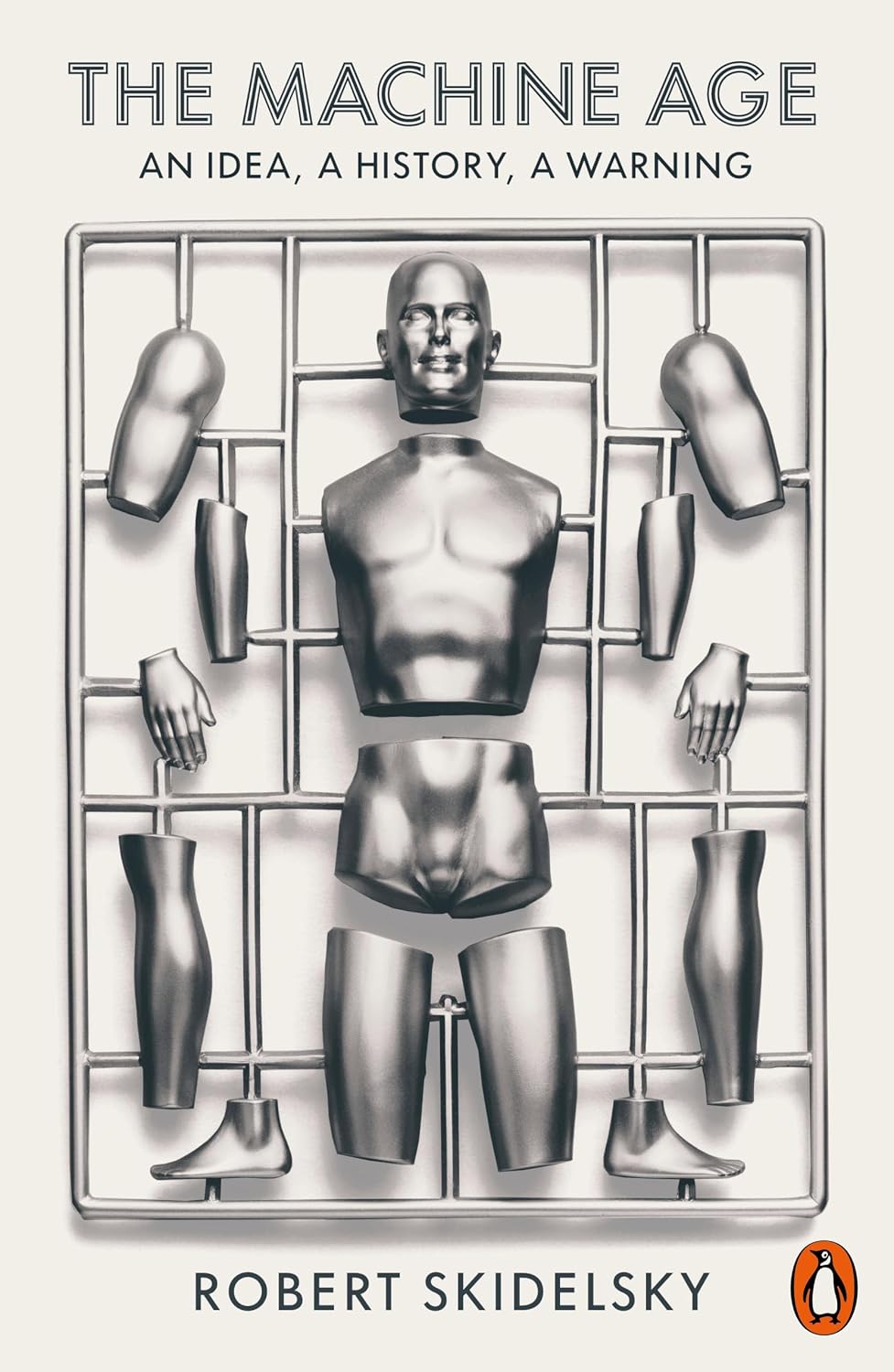
Robert Skidelsky, Baron Skidelsky, was Emeritus Professor of Political Economy at the University of Warwick. He is most well-known for his award-winning three-volume biography of John Maynard Keynes. The Machine Age: An Idea, a History, a Warning marks a departure from Skidelsky’s home domain of Keynesian macroeconomic thought into a comprehensive, interdisciplinary interrogation of humanity’s relationship with technology. The book is an ambitious, almost encyclopaedic project that touches upon everything from history and economics, to theology, philosophy and technological futurism. The core thesis serves as a cautionary call against the misguided overreliance on technology and indeed, the blindsighted surrender of human will in a technologically deterministic future.
Skidelsky’s prose is clear and the book is thoroughly researched, with a comprehensive bibliography for readers wishing to explore the subject further. Specialised terminology is used sparingly, making the text accessible to a broad audience of inquisitive readers. Yet the breadth and density of the material make it a demanding read, requiring sustained and uninterrupted attention. This challenge is heightened by the book’s frequent and sometimes abrupt shifts between disciplines.
The contents are comprised of three distinct thematic parts which chart the progressive encroachment of mechanisation from the Industrial Revolution to the contemporary frontier of artificial intelligence. Skidelsky notes at the outset, the text ‘tells three stories about the impact of machines on the human condition: on the way we work, on the way we live and on our possible future’ (page 1).
Chapters 1–7 consider ‘The Mechanisation of Work’ and establish the economic and historical foundations of technological proliferation. Skidelsky examines the onset of machines, the natural obstacles to early innovation and the structural alignment between technological progress and the rise of capitalism. In analysing modern labour dynamics Skidelsky offers a rather bleak outlook that dismisses the conventional economic reassurance that ‘with suitable education and training workers will be able to take on higher-level… tasks’ (page 94), landing instead on a systemic bifurcation of employment into ‘lovely and lousy’ jobs and increasing structural pressures towards downskilling (Chapter 6).
Chapters 8–13 look at ‘The Quest for Perfection’. Here, the text shifts from economic history to an intellectual and cultural critique. Skidelsky explores the Enlightenment ambition to ‘straighten the crooked timber’ of humanity through rationality and mechanisation. He investigates the cultural anxieties surrounding the ‘Devil in the Machine’ (Chapter 10) and the philosophical evolution of technology from a utopian vision of human liberation to a dystopian framework of surveillance and control (Chapter 13). Drawing a parallel with Jeremy Bentham’s Panopticon, Skidelsky warns that ‘we enter Bentham’s prison voluntarily, oblivious to its snares. But once inside, it is increasingly difficult to escape’ (page 184).
The third and final section, ‘Towards Apocalypse’, is covered in chapters 14–17 and as the title suggests, is mostly dedicated to confronting contemporary risks. It traces the advent of modern computation and AI from the 1950s, critically interrogates some of the salvific rhetoric surrounding AI and explores the clash between digital liberation and technological entrapment. An important and interesting discussion on conscience can be found in Chapter 15 where Skidelsky points out that AI succeeds in syntax but falters at semantics and experience: ‘Take for example, the tree outside my window […] I not only see the tree but I am aware that I am seeing it, and have beliefs and feelings about the tree; they signify an intentional relationship between the subject (me) and the object (the tree). A purely material account of the world runs into problems trying to explain this relationship’ (page 220). The book concludes in a sober evaluation of potential hazards of human obsolescence, where ‘the continuing threat of technological innovation is to rob ever-larger fractions of people of their employment, livelihood, status, skills, usefulness, and identity, and finally make them redundant’ (page 269).
Although historically a champion of the Keynesian macroeconomics, Skidelsky utilises Marxian concepts of alienation (Entfremdung) and the subordination of living labour to ‘dead capital’ to explain the trajectory of automation. He conceptualises technological advancement not as an autonomous, neutral byproduct of human curiosity and ingenuity, but as an instrument weaponised by capital to extract surplus value, control the workforce and lower production costs. Readers looking for an appreciation the free innovative and entrepreneurial spirit will not find it here – for Skidelsky capitalism is fuelling technological entrapment. Crucial to this dynamic is his critique of consumer capitalism’s manufactured needs, where he notes that ‘it is insatiability, natural and deliberately created, which keeps machines in business, by ensuring that the material requisites of happiness remain permanently scarce’ (page 112).
No doubt some readers will take issue with this approach. By framing the evolution of technology almost exclusively as a vector of capitalist exploitation and class subjection, Skidelsky underemphasises the adjacent positive outcomes such as market innovations, improvements in working conditions due to technology and even state-directed geopolitical initiatives (such as military R&D during the Cold War). All of these have historically led to technological advancements that do not fit neatly into a binary class-struggle paradigm.
Compounding this challenge is the immense, near encyclopaedic scope of the book. While the polymathic breadth is intellectually stimulating, it is likely to leave some readers overwhelmed and, at times, confused. The book functions more as a history of ideas about machines rather than a history of technology itself (which is what many might expect from the cover).
However, that is not to say there isn’t much to commend – there is. The Machine Age deserves significant praise because stands as a vital and sophisticated counterweight to the uncritical ‘techno-hype’ and hubristic boosterism propagated by many Silicon Valley CEOs with utopic promises or apocalyptic threats. Skidelsky’s triumphs in his ability to de-naturalise technology as foreign and offer a defence of human distinctiveness which is profoundly articulate and compelling. He ably reminds readers that economic efficiency and technological change should remain subordinate to human well-being and democratic values.
The Machine Age provides a sweeping and erudite critique of modern technological society. While the volume’s expansive breadth brings challenges and its rather unduly negative assessment of technology may alienate some readers, its foundational thesis remains robust. The book is best viewed as large warning sign held up against humanity’s somnambulation into a techno future driven primarily by the needs of software and hardware. It is a timely and valuable contribution to developing a contemporary philosophy of technology and serves as a powerful reminder that machines must ultimately serve human purposes – not dictate them.
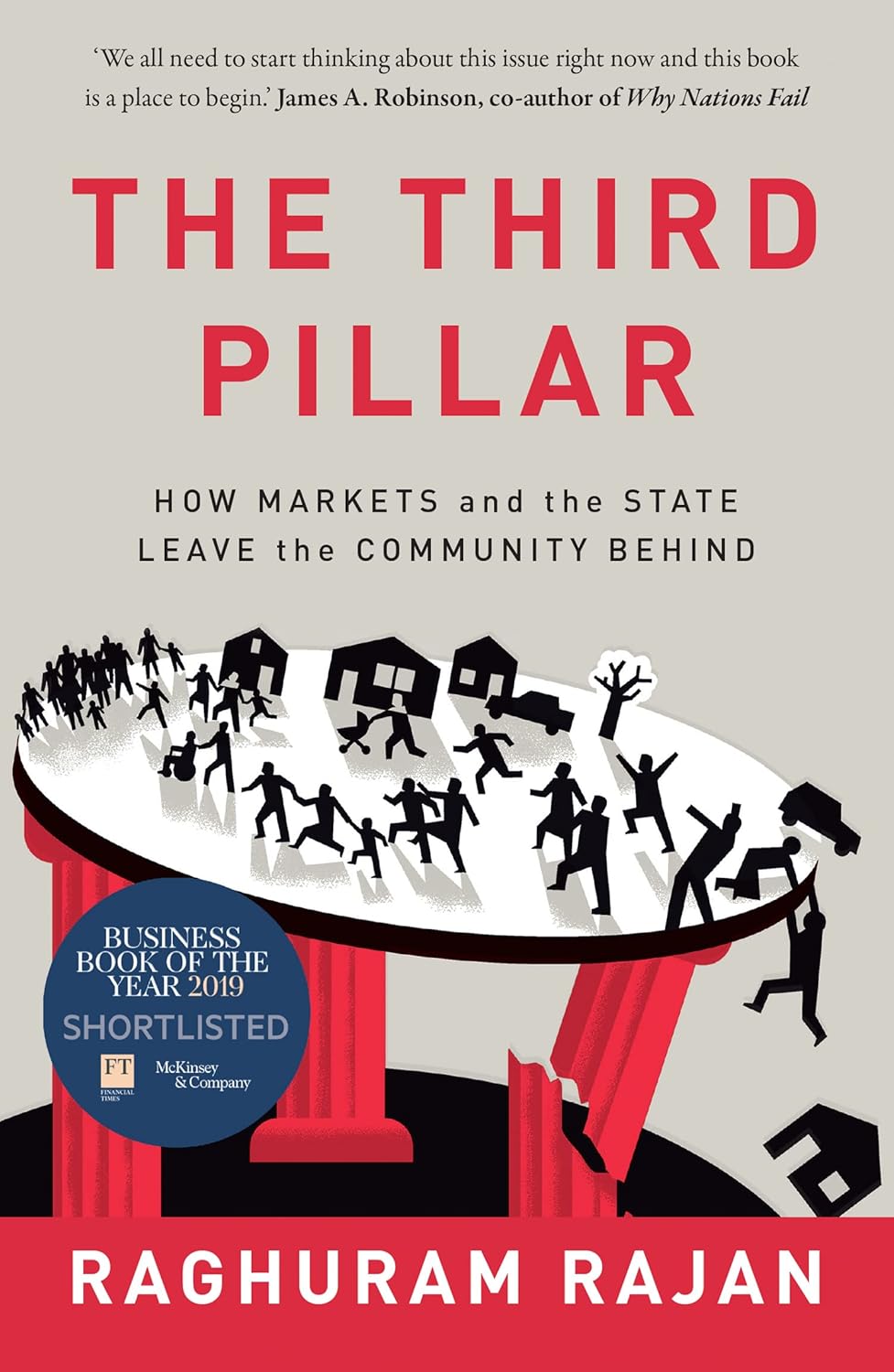
Raghuram Rajan’s central claim in his book The Third Pillar is that modern societies have allowed markets to globalize and states to centralize while neglecting what he calls the third pillar: community. The result of this neglect is economic imbalance, social and political fragmentation, loss of belonging and shared purpose, and a decline in social trust. The Third Pillar makes a thorough inventory of the decline of community. It documents the widespread dissatisfaction with institutions in the Western world and some of its unfortunate consequences, like the deaths of despair cataloged by Anne Case and Angus Deaton (Case and Deaton 2020). Rajan offers a strong diagnosis, but the strength of his diagnosis also exposes the limits of his framework. The book gestures towards a richer understanding of community, but never fully delivers on developing the conceptual or institutional foundations necessary to sustain it. As a result, Rajan’s proposal for a cure to the illness he identifies also falls short. He relies on state incentive programs to try to reinvigorate community and constraints imposed by the state on communities to keep them from becoming too exclusive.
One of the most valuable contributions of Rajan’s book is its insistence that community is more than a residual category. He goes to great lengths to retell the story of industrialization and globalization over the course of the 20th century as well as the Information and Communication Technology (ICT) revolution, but while his retelling gestures at the decline of community, the substance of his argument is limited to cataloguing the effects of these changes on the other two pillars: economy and government.
The examples of communal actions he does offer are only marginally communal: take for example the Indian city Indore, which went from one of the dirtiest towns in India to being celebrated as a zero-litter city. Rajan ostensibly tells the story of Indore to offer an example of a community that self-organized to solve a problem. But even in his account of the example, it becomes clear quickly that the city’s government was crucial in achieving the desired outcome. Just like in his description of the larger 20th century industrialization and communication trends, it is unclear that the example really speaks to the lack of community, because the central player in the clean-up effort seems to have been Indore’s city government. This is where Elinor and Vincent Ostrom’s work on self-governance could have been a natural complement to Rajan’s ideas. Over the course of their careers, the Ostroms accumulated empirical evidence as well as theoretical frameworks that can explain authentic communal self-governance ‘without the sword’ of state coercion in the background (E. Ostrom, Walker, and Gardner 1992).
This lack of a substantive discussion of community pervades Rajan’s entire book. He stops short of offering a more profound explanation of how community performs important functions in every chapter of the book. To make sense of his work, one must supply a conceptual framework that the book itself only hints at. The absence of an explanation haunts the book from beginning to end and leaves this reader chasing from chapter to chapter, hoping that what comes next may fill the void, only to be disappointed again. One example of this lack of explanation can be found in chapter 6, which discusses the information and communication technology (ICT) revolution. Rajan carefully analyzes its effects on production, inequality, employment, and educational stratification, but he doesn’t explain why stratification is a problem or exactly what it is about community that is weakened by the ICT revolution. While the weakening of community is central to Rajan’s argument, the mechanism remains underdeveloped. Without a better understanding of what exactly community does to provide meaning and belonging, it is impossible to tell what the cure may be.
The lack of a clear mechanism is also the missing element in Rajan’s proposed solution: inclusive localism. Rajan argues for greater communal autonomy to rebalance the pillars, insisting that this greater autonomy cannot come at the expense of inclusiveness. While his proposal is attractive in principle, it also reveals a deeper tension in Rajan’s thought. On the one hand, he recognizes that community must be thick enough to provide identity, belonging, and shared purpose. On the other hand, he insists that communities must not become exclusionary or restrict individual mobility. While he celebrates diversity among individuals, he views differentiation among communities with suspicion. The question of how communities can be thick enough to provide meaning yet not so thick as to exclude is left unanswered but is arguably the crux of the problem. Rajan argues for national governments to prevent the exclusionary tendencies of communities by requiring inclusiveness, but he does not explain how those same national governments refrain from crowding out community in the process, as his own account of the 20th century has shown they did. The Ostroms’ work could have again been helpful here. Throughout his work, Vincent Ostrom, in particular, emphasized the importance of overlapping and competing jurisdictions (V. Ostrom, Tiebout, and Warren 1961), which allow for both a strengthened community with shared meaning and a systemic check on exclusionary tendencies through competition among self-governing communities. Importantly, however, as Elinor Ostrom shows (E. Ostrom 1990), clearly defined boundaries between groups or effective exclusion of outsiders, are essential for self-governance communities to function.
On the whole, Rajan’s book diagnoses an important problem: community has been hollowed out as states and markets have expanded in scope and scale. His diagnosis is begging for a deeper assessment of the effects of the imbalance he diagnoses and the likely channels by which they affect individual feelings of belonging and meaning. In the end, The Third Pillar offers us an important diagnosis but only the beginning of a theory. What remains is to develop a theory that offers a more complete account of why community matters and how it can be sustained realistically in a complex, modern society.
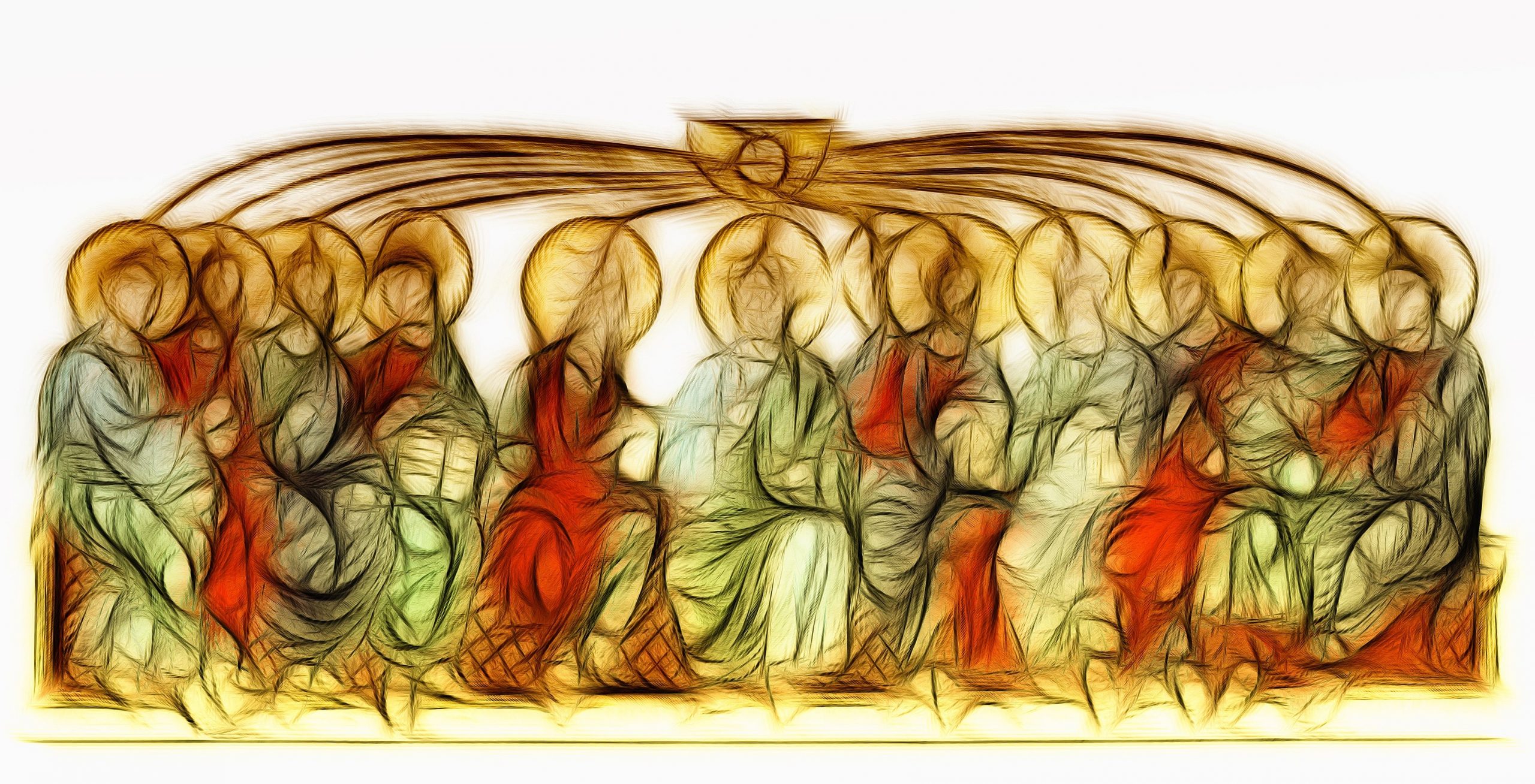
In some economic theories we are told to trust the market: as a reliable arbitrator between supply and demand, and as a price-setter. Yet in their daily decisions Christians are encouraged to trust God. Are these the same kind of trust? If they are two different types of trust, are they in competition with each other?
It might be tempting to think that the two kinds of trust are at least similar: that proponents of the market economy call for trust in markets in the same way Christians are called to have faith in God. For Christians, however, believing in free markets cannot quite be the same as faith in God – and not only because market models inevitably contain oversimplifications, flattening particular aspects of reality to fit general economic theory.
Rather, Christians are called, first, to shift our trust to God rather than any human being, institution or other created thing, and, secondly, to relate to one another in a moral way. These two are commandments and are absolute: trust in God and loving our neighbour cannot be conditional.
This does not mean we cannot trust markets to do certain things well. But the two sentences I started with were not talking about the same kind of trust. What we mean by trust needs further differentiation. My argument is that how we trust, and whom we trust, is both the basis for economic decision-making and a profoundly moral choice.
Luke the Evangelist offers radical teaching on faith and economics. Some have portrayed Luke as an early opponent of a market economy, misunderstanding his calls to all believers to hold goods in common and share resources in Acts 2 and Acts 4. Yet these are in fact best interpreted, not as a narrowly economic teaching, so much as a teaching about our relationship to God, and how it informs our economic decisions.
Luke’s focus is on the call to radically trust God, including in our economic choices. The Greek word Luke uses repeatedly, ‘pistis’, is arguably closer to ‘trust’ or ‘fidelity’, than to ‘faith’ or ‘belief’ in our contemporary understanding – although it is often translated with these terms. For example Luke’s description of the Early Church, often translated as the ‘Community of Believers’, or ‘Community of Faith’, could equally be translated literally as ‘the group of those who trusted’.
In an earlier blog post for both the LSE and the World Economic Forum, I argued that, ‘throughout Luke’s Gospel and the Acts of the Apostles, those who trust in God and his providence are able to be generous: Zacchaeus and the poor widow are examples given by Luke. That trust in God is so central to Luke’s message, that those who preferred to trust in their own investments rather than in God were chastised by the Early Church: Judas, who bought a field with the betrayal money, and Ananias and Sapphira, who kept part of the proceeds from the sale of their land.’
For Luke, trust in God, or a lack thereof, is what informs economic decisions and makes them intrinsically moral acts. There is a direct correlation, arguably a causal relationship, between the level of trust in God that the Community of Believers then, and the whole Body of Christ now, places in God, and the generosity they demonstrate.
What Luke invites us to see is more profound than simply teaching us not to put trust in idols, including any form of economic ideology. He is asking us to see that our economic actions go beyond material advantage, or rational calculations driven by our self-interest: in Acts 2, Luke describes how the newly baptised, who received the Holy Spirit, make certain economic choices as a direct result of trusting – having confidence – in a faithful God who has shown himself to be at work in this world. It is not that we know ex ante that this trust will necessarily be materially rewarded, either immediately or even long-term. Otherwise it would not be trust, but expectation with a high, if not absolute, degree of probability. The basis of Christian economic decision-making is therefore not rationality in the secular economic sense, but rather it is rational morally and spiritually, because it is doing the objectively right thing.
At the same time Luke’s teaching cannot be understood as encouraging us to be bad stewards of our money, or not to plan long term. Someone might look at the case of Ananias and Sapphira, and, assuming good intent on their part, ask what they did wrong. After all, all other things being equal, buying and keeping land whilst collecting rent from it, for example, to give it to the poor would be a perfectly rational thing to do. But in the context of the decision of that group of believers to engage in a practice of radical sharing, Luke’s point is to ask why they could not trust God sufficiently to join in with it.
This thought has the potential to create radical freedom for those who are fortunate enough to have assets to invest. They are not obliged to focus purely on financial return. Consider an entrepreneur who invests in a community project with a high risk of financial failure because it serves the vulnerable. A standard economic model might label this to be economically irrational, due to the likelihood that the return on investment will be low at best. Even if the decision to invest is construed as maximising a sense of doing the right thing, this still misses Luke’s point. For the believer, this is neither a miscalculation of risk, or nor a matter of optimising their feel-good factor: it is a deliberate act of ‘pistis’. In other words, an investor who commits to a morally worthwhile venture despite financial risk is not doing it to maximise ‘warm, fuzzy feelings’ or virtue signalling; they are investing because the act itself is a moral act, fully aware that the venture may fail.
It would not be going too far to say that Luke has no opinion to offer on whether markets are a good thing or not – only on how we ought to act within them. Ananias and Sapphira, and Judas, used a market exchange to invest and receive their proceeds, but it was not the mechanism which was at fault. It was their own lack of trust in God.
Accounting for the role of trust in economic exchanges is a question relevant both for Christians and others. This is because markets must be understood as more than mechanical instruments to regulate supply and demand, even if that is their primary benefit. They are also social institutions, embedded in relationships, which inevitably have a moral dimension. Trust is key in enabling voluntary exchanges between participants. At a first order of analysis this is about trust between individuals, but that is related to shared values and to the belief systems in which they are grounded. For Christians, and those of other faiths, these include trust in God.
Critics might argue that if everyone acted on unconditional trust, the market would collapse, as free riders would exploit the virtuous. This is a valid concern, but it misses the point. Lukan trust is not naïve. Indeed it is explicitly viewed as a virtue that requires a community to sustain it. A market economy cannot create a community of believers, but it turns out to depend on multiple forms of trust and belief. This – and relatedly whether it is based on generosity or greed – will determine what its outcomes are.
When we conflate trust in market mechanisms with trust in human relationships, we miss the moral prerequisites that markets cannot generate themselves. As the Vatican’s 2018 economic teaching document ‘OPQ’ observes, ‘the market needs anthropological and ethical prerequisites that it is neither capable of giving for itself, nor producing on its own’ (s.23).
From Pius XI’s warning in Quadragesimo Anno that ‘the right ordering of economic life cannot be left to a free competition of forces’ (s.88), to Pope Francis’s rejection of ‘trickle-down theories’ in Evangelii Gaudium (s.54), the Catholic Church has consistently called for discernment rather than ideological adherence. Yet this is not a call to abandon markets, but to recognise their proper role. The question we are called to discern is how markets and our actions within them can serve the common good.
As Christians, we are called to recognise that we are moral agents as much as economic ones when engaging in exchanges; we bear the responsibility to ground economic activity within the realm of morality, acting through both personal choices and the creation of structures that empower good decisions without coercion. The challenge for secular economic thought is that such good choices are not easily reduced to utility-maximising functions.
Luke invites us to consider trust (‘pistis’) in God as a virtue with great salience for economics. Whereas some market logics may attempt to reduce trust to a calculation, the biblical tradition calls us to act on the basis of our trust in God. From that Biblical perspective the debate is not ‘pro-market versus anti-market’, but rather whether markets can be tools for human flourishing. If we determine that trust is a virtue to be pursued by moral agents in a market economy, the question then is not whether to trust markets, but rather how markets can enable virtuous behaviours. For the believer the market is not a god to be trusted, but a stage upon which the virtue of ‘pistis’ is tested and lived out.
For some Christians, including many bishops and other senior clergy, business presents a problem: they consider that business people habitually behave in ways that are inconsistent with Christian morality and assert that a complete change in business behaviour is necessary. At the other end of the spectrum, some people suggest that morality has no applicability in business and that, subject to compliance with the law, business people should concentrate on making money. Most people, however, including probably most Christians, feel uncomfortable with both these extremes: they feel that business is, in principle, morally unobjectionable but are uneasy about how they reach this conclusion or precisely how moral rules should be applied in a business context.
In Ethics for Capitalists Joseph Heath rejects both extremes and provides a framework for the discussion of moral issues in a business context. He does not provide detailed moral guidance in relation to specific issues and some readers will find the moral philosophy in the book heavy going. Furthermore, Christians are likely to take issue with his starting point, which is John Rawls’s theory of justice, since it is based on seeking normative principles that produce institutional structures that will be broadly accepted rather than being based in the character of God. However, Heath writes well. He explains his points clearly and his analysis introduces much needed conceptual clarity to the discussion of business ethics. Provided that they are prepared to take time over Ethics for Capitalists, readers coming from all viewpoints will find in it much to think about.
Perhaps the most important point made by Heath is that business ethics must be assessed in the context of the economic system that exists in the West today (i.e. the market economy). Many ethical purists forget this point and demand behaviour on the part of business people that is unrealistic since it essentially requires that they do not participate in the economy of which their business is a part. For example, competition is a fundamental part of a market economy and it is promoted by regulators and others since it is perceived to be the key to desirable outcomes. Thus, to demand that business people reject competitive behaviour is to demand that they opt out of the economic system, which is impossible.
In the light of this, before considering business ethics, Heath considers the justification for the market system. His purpose in doing so is not so much to establish its superiority over other systems (although he does in fact establish this) but to explain the rationale for its existence so that this rationale can inform his analysis of the kinds of behaviour of market participants that are and are not acceptable. He believes that, in a perfect world, the economic system would be based on pure selfless cooperation but argues that, in the real world, this is impossible owing to human nature and, in particular the ‘free rider’ problem. Hence, one is driven towards a system that involves what Heath terms ‘staged competition’ (i.e. a structure that is deliberately designed to create competition rather than cooperation, on the basis that the overall societal outcome is positive).
There are a number of aspects of Heath’s analysis that are questionable: his suggestion that the market would not exist in a perfect world is probably only viable if one assumes that this perfect world is not only inhabited by morally perfect beings but also that these beings have perfect knowledge and foresight; his analysis of the downsides of a planned economy largely omits consideration of the loss of freedom and agency that it entails (which is itself a moral issue) whilst his analysis of markets tends to exaggerate their moral downsides; and his analysis treats the market economy as, essentially, an artificial creation that is designed to avoid the problems inherent in a cooperative (i.e. planned) system whereas, in reality, a market economy naturally comes into existence unless it is prevented from doing so by human intervention (whether lawful or otherwise). Heath’s acceptance of the market economy, although clearly real, lacks enthusiasm.
These are serious issues but they don’t undermine Heath’s argument that the basic justification for the market economy relates to the objective of inducing an efficient allocation of goods and ‘the fact that the competitive market does a better job at achieving this objective than the most feasible cooperative alternative’ (page 85) and that our approach to business ethics has to be consistent with this justification.
With this point as his foundation, Heath’s analysis of business ethics begins with the assertions that ‘it is not difficult to show that capitalism violates certain moral constraints’ (page 1) and that market institutions ‘are designed in such a way as to permit, and in some cases encourage, certain forms of behavior that are normally regarded as anti-social’ (page 2). However, his central claim is that ‘in the context of market exchange economic actors are permitted to violate certain rules of everyday morality’ (page 5). He believes that ‘the ethical principles preached in churches’ have no applicability in that context or, perhaps more precisely, he believes that they have to be materially adjusted in order to be usable in it.
Once again, one can take issue with Heath’s approach. He appears to imagine that there is a set of ethical rules that are ‘normally’ to be adhered to and that we need to ask what adjustments are necessary in a market context. Of course, if one adopts a simplistic moral absolutist approach to everyday ethics based on a list of universal propositions, then conflicts with the behaviour required by market institutions will soon emerge and adjustments will be necessary. However, as Heath concedes, this is no different from the situation that exists in relation to war and one can easily find other situations in which a simplistic approach falls down (e.g. how does the golden rule apply to the treatment of criminals or to many of the difficult divisions that have to be made by governments?). It seems far better to recognise that there is no base line of ‘normal’ morality from which situations like the market and war require departures. Instead, there are principles and considerations that need to be applied in an infinite variety of different situations.
At a theoretical level, Heath appears to concede this. Indeed, he says that ‘The basic conundrum of business ethics is caused … by the insistence that there must be a “one size fits all” solution to moral problems’ (pages 26-27) and he recognises that those who adopt a consequentialist or utilitarian view of ethics will not have any problem in adjusting their ethical requirements to the market situation. However, he does not seem to recognise that one can be a moral realist, adopting an objective view of ethics that is not based purely in utilitarian considerations or other consequences, and yet still believe that ethical obligations are context specific. This point is frequently forgotten by moral absolutists, including those in the pulpit, but it is consistent with the Biblical approach and thus with what ought to be ‘the ethics preached in churches’.
For example, Heath asserts that ‘there are no plausible formulations of … the golden rule that permit price competition’ (page 18) and he would presumably take a similar view in relation to the related principle of loving our neighbours. However, their application is situation specific: one has to think about all those impacted by our actions and, in some situations, ask which neighbours should take priority and precisely what love requires (which may not be obvious in complex economic situations). The benefits to society of the market are, therefore, relevant in assessing what behaviour the golden rule and the principle of loving our neighbours requires. Actors in markets do not need to cast these principles aside and should not do so. In particular, suppliers of goods may thus conclude that they are observing these principles by competing vigorously with another supplier since, although that other supplier may suffer as a result, the customers and general society (who are also ‘neighbours’) will benefit.
That said, the end result of Heath’s approach is probably close to the end result of the approach that a Christian moral realist will adopt. Both approaches recognise that participation in the competitive world of business does not necessitate unethical behaviour but that this does not mean that ethics have no application to such participation. Furthermore, Heath’s suggestion that ethical issues are engaged when there is market failure, in the sense of a failure to produce an efficient allocation of goods, although perhaps not sufficient to ground the whole of business ethics, is worthy of serious consideration. Heath’s analysis and his high level application of his analysis (in chapters 7 and 8) is thus valuable and is useful as a framework to assist business people in assessing the ethical requirements to which they are subject.
In the second half of Ethics for Capitalists, Heath turns his attention to various aspects of business and seeks to apply his approach to them. These include: ethics within companies and other organisations (where, as Heath points out, there is a co-operative rather than a competitive market model in operation); the ethics of labour relations (where there is both a co-operative and a competitive element that complicates the analysis); and the ethics of business ownership and the maximising of shareholder value.
Heath has worthwhile things to say about all of these subjects but his most interesting analysis relates to business ownership and shareholder value. He distinguishes the main constituencies of businesses (providers of capital, suppliers, workers and consumers) and points out that, in principle, the residual financial interest and control can be vested in any one or more of these constituencies. He then argues that there are good practical reasons why the residual interest and control are generally vested in the same group and why this group is normally the providers of equity capital. He defends the modern norm of shareholder primacy not on the ground that it is morally superior to other models (e.g. consumer, supplier or worker co-operatives) but on the ground that it is the option that has been found most workable in practice and that is does not suffer from inherent ethical problems. Along the way, he convincingly argues that what he calls ‘multifiduciary stakeholder theory’ (page 20) is not morally superior to shareholder primacy, that it suffers from a serious ‘multi-agency’ problem that is itself a moral problem and that it imposes moral demands ‘that could only be satisfied in the public sector and thus under a socialist reorganisation of the economy’ (page 20).
Ethics for Capitalists is a short book (209 pages) but it covers a lot of ground and deserves to be read slowly and carefully. Any business person who wants to come to grips with their ethical duties should read it, as should anyone who comments on business ethics, including many church leaders.