
In the discussion about Magnifica humanitas, a great deal of concern is expressed about the concentration of power in a small number of companies.
The concentration of economic power in an area such as AI can arise for a number of reasons. There can be natural monopolies caused by very high fixed costs of research and development which make it difficult for new entrants to enter the industry. And there can be network effects or ‘winner takes all’ situations. In such cases, the success of a particular company might rely on there being a large number of users interacting with each other and sharing information. This is the main reason why social media platforms tend to be monopolistic.
The dominance of large firms is not always a problem. Consumers may prefer that situation to the realistic alternative market structures. And, often, waves of innovation mean that today’s monopoly becomes tomorrow’s forgotten giant.
But, when it comes to AI, there are real fears that its abuse by a powerful corporate entity could damage the vital functions of society.
What can we realistically do?
We might hope that the political authorities can regulate ‘big tech’ to more effectively promote the common good. They could try to eliminate existential threats, ensure that monopoly power is not abused and try to promote the use of AI in ways that genuinely lead to integral human development.
In Church documents following the financial crisis, such as Caritas in Veritate and Oeconomicae et pecuniariae quaestiones (‘Considerations for an Ethical Discernment Regarding Some Aspects of the Present Economic-Financial System’), a considerable amount of confidence was placed in states regulating the financial sector to avoid crises, such as the financial crisis of 2008. But how do we make sure that statutory regulators promote the common good?
Regulators can become captured by the regulated entities. Furthermore, they simply do not possess the knowledge to be able to perfect markets. Indeed, their actions may cause more harm than good: before the financial crisis, financial regulation expanded dramatically, but there was nothing that regulators did which made the crisis less likely or its effects less problematic. Securitisation was welcomed by regulators and promoted by regulatory codes, for example. And reports by prominent economists, such as Joseph Stiglitz, seemed to hugely under-estimate risks involved with complex financial instruments that were underwritten by US taxpayers in government-sponsored agencies.
The lessons from these, and many other similar errors by those close to the government regulatory system is not that regulators are especially error prone but that they are not especially omniscient. There are limits to what we can expect from statutory regulation.
But when it comes to AI and big data, there is an additional problem. Just as we might be worried about the abuses of AI and big data by large corporations, might we not similarly be concerned about abuses by the state? Are we comfortable with the current administrations in the world’s largest countries (or, indeed, many of the smaller ones) being the final arbiter of how our data is used and how AI is used? We are hardly in an era of virtuous government. When it comes to AI, there is a real danger of accidents or malign actors creating chaos in economic or social systems or of promoting vicious forms of warfare. AI can develop, to use a phrase which is not technically correct but conveys the challenge, ‘a mind of its own’, outpacing any attempts to control it both in general and in specific situations. Even if we limit ourselves to the G20, how many of those countries might we be concerned about being the ultimate gatekeeper of how AI and big data are used?
In the ‘frequently asked questions’ document, published with Magnifica humanitas, a pertinent question was raised about the state and the regulation of AI. Unfortunately, that document seems no longer to be available online. The answer given was both sensible and consistent with the long-standing teaching of the Church down the ages. It is a messy solution, but we are in a messy world. It is a solution that is mentioned in the encyclical itself.
Specifically, Pope Leo wrote:
[T]he Social Doctrine of the Church calls for a shared responsibility. It asks that these processes be guided with foresight: by institutions capable of regulating without stifling, and protecting without taking over; by businesses that recognize work and dignity as measures of success; by intermediary organizations and educational communities that rebuild trust and relationships; and by citizens who cultivate responsibility, moderation, discernment and a sense of truth. Only in this way can innovation genuinely serve integral human development, rather than becoming a source of exclusion and dominance (181).
These sentiments were echoed elsewhere in the document.
Indeed, we can learn from how we regulated markets in the past. In finance, for example, there was very little role for the state in regulating markets before the mid-1980s. Regulation came from professions, bodies such as exchanges, industry agreements, and so on. Their replacement by state regulatory bureaus has not been an obvious success – they can concentrate power and risk instead of dispersing it, as we saw in the financial crisis. Within a diverse regulatory eco-system, states and international institutions should play roles that are appropriate to their nature. Understanding exactly what international institutions can do and what states can do (which other bodies cannot do) to appropriately limit the dangers of AI is likely to lead to better results than an approach in which committees proliferate without any clear understanding of their role and limitations and in which the state alone is responsible for regulation. Instead, we can work to create a ‘polycentric’ ecosystem, within which there is also an important role for the family and schools in promoting virtuous behaviour in all markets, including in relation to AI, tech and big data.
Another long-forgotten instrument for regulating behaviour indirectly is tort law. Those who misuse AI in such a way that it creates harms should be held accountable through the civil legal code. This is not just an instrument of justice; the requirement to provide redress provides incentives to avoid recklessness. To be effective, tort law requires a clear understanding of citizens’ rights as well as effective protections of the right to property, including intellectual property. This includes the intellectual property of citizens – we often forget that the purpose of tort law is to protect the weak from the strong, not the other way round.
Overall, this approach would apply principles developed by Elinor Ostrom derived from her research on the management of environmental resources. Her work, surprisingly rarely mentioned in discussions about Catholic social teaching, is certainly compatible with that teaching. Polycentricity does not seek perfection, but workable and practical solutions with different entities within society taking on responsibilities appropriate to their nature.
One final consideration is worth bearing in mind. There is an assumption, which seems to come through Magnifica humanitas, that the problems that arise with AI and ‘big data’ come from a small number of big players: ‘When such power is concentrated in the hands of a few, it tends to become opaque and evade public oversight’ (95). This is not necessarily so, and it has not been the experience in banking. The much more dispersed US banking model has been historically much more fragile than the more concentrated UK system. The UK experienced the crash of 2008, but that was the first in 140 years and many previous crises were averted by industry (and central bank) action – something made possible by the concentration of the sector. A relatively small number of parties had a strong interest in resolving the problems and could overcome collective action problems.
My hunch would be that the most dangerous events in AI will actually come from somebody working on something we don’t know about. It is the hundreds of millions of actors, some of whom will be deliberately malign and who will be extremely innovative, who may well create the fragilities about which we should be most concerned. A large company with a huge research lab might create a deadly bacterium using AI techniques. But there is good reason to be more concerned about the large number of small organisations that may well cause problems about which few people know until it is too late. There are, currently, literally millions of cyberhackers in the world. Whilst we might be worried about Google, Nvidia, Amazon, and so on, it is not clear that they are the biggest dangers in the world of AI. This is not an argument for or against state regulation. However, the more society as a whole is orientated towards promoting the common good as a result of the actions of families, educators, civil society, the civil legal code and tort law, supported by appropriate, but limited, regulatory responsibilities for states and international institutions in a polycentric order, the more exceptional bad actors will be. We cannot perfect the world; we cannot expect everybody to be a paragon of virtue; but we can try to make the promotion of vice less likely and create structures that seek to promote virtue.
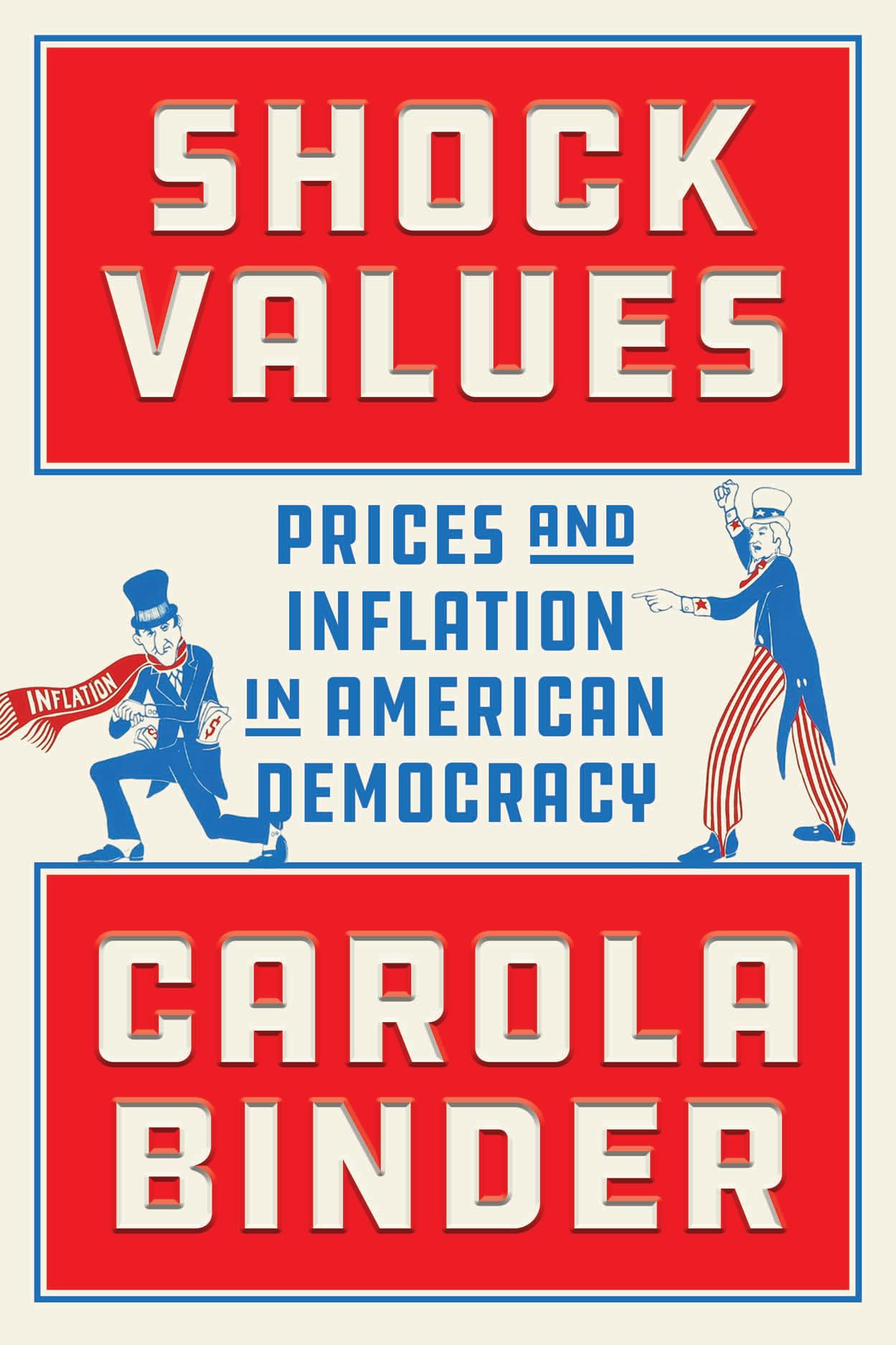
Why do Americans repeatedly turn changes in prices into arguments about democratic power? In Shock Values: Prices and Inflation in American Democracy, Carola Binder follows that question from the improvised currencies of the colonies to the inflation that followed the COVID-19 pandemic. That inflation brought renewed accusations of corporate greed, demands to punish price gouging, and proposals for direct controls. These responses, Binder contends, belong to a much older political tradition.
Her main argument is that American ideas about price stability and democracy evolved alongside one another. Debates over who should control money and prices have also been debates over political authority. She organizes the history of these debates around four themes: (1) price fluctuations redistribute income and wealth; (2) stabilization policies intended to address this redistribution often interfere with contracts and raise questions of due process; (3) emergencies have tended to enlarge the government’s economic role permanently; and (4) repeated crises and policy experiments eventually led the Federal Reserve to adopt an explicit inflation target.
The political response to economic crises follows a familiar pattern. Price changes help some groups and harm others. Those who lose lobby for compensation or protection to alter the result. Depending on the period, that pressure produced currency changes, tariffs, antitrust campaigns, rate regulation, price supports, or ceilings.
Price controls display this logic most clearly. From local committees during the Revolution to twentieth-century wartime agencies and Nixon’s peacetime freeze, advocates repeatedly treated high prices as evidence of misconduct by sellers. Supporters of price controls in Massachusetts blamed the rising cost of necessities on the ‘avaricious conduct’ of merchants; food trusts drew similar accusations during World War I, as did corporations after the pandemic. Enforcing such controls required officials to distribute scarce goods, detect evasion, and decide who qualified for relief from the rules. Those decisions generated another round of winners, losers, and political pressure.
Viewed against this history, the absence of broad federal wage and price controls after the pandemic is striking. Nixon imposed them in 1971, when inflation was well below its post-pandemic peak. In 2021 and 2022, familiar claims of profiteering and calls for direct intervention returned, but the federal government did not freeze wages and prices. Binder does not emphasize this contrast, yet it may be one of the most encouraging implications of her account.
Binder also shows how conflicts over prices reshaped political coalitions. Farmers supported inflationary reforms when deflation lowered crop prices, then backed proposals to stabilize the purchasing power of money. Progressive reformers were among the earliest advocates of a price-stability mandate for the Fed. Decades later, price stability became more closely associated with conservatives, while critics on the left accused the Fed of favoring Wall Street.
Binder is especially effective when she follows monetary conflict into the courts. The controversy over Civil War greenbacks illustrates why the legal questions mattered. Salmon Chase oversaw their introduction as Treasury secretary, then ruled as chief justice that applying their legal-tender status to earlier debts violated due process. After President Grant appointed two new justices, the Court reversed Chase the following year. Similar disputes accompanied later attempts to regulate prices and delegate monetary authority. Economic policy repeatedly forced judges to decide how far public power could alter private bargains.
Efforts to manage prices also changed the machinery of government. Every system of wartime controls required information, detailed rules, and enforcement. Delegating monetary management to the Federal Reserve raised a different institutional problem: how should experts be insulated from electoral pressure without escaping democratic accountability? Binder traces that tension from Andrew Jackson’s attack on the Second Bank to modern disputes over Federal Reserve independence.
Binder concludes by favoring a nominal GDP target over an inflation target. Her own historical analysis, however, complicates that recommendation. I agree that stabilizing nominal spending would be preferable in principle. It would allow productivity growth to produce falling prices and adverse supply shocks to produce temporarily higher inflation while keeping total dollar income on a steadier path. Yet the history recounted in Shock Values gives reason to doubt that such a regime would prove politically durable.
Some of the deflation from 1879 to 1896 reflected productivity growth. It nonetheless generated demands for tariffs, agricultural support, and monetary expansion, culminating in the free-silver movement and William Jennings Bryan’s 1896 campaign. Those experiencing falling prices cared less about deflation’s underlying cause than about its effects on their incomes and debts. Binder acknowledges that nominal GDP targeting is no panacea. Her history suggests a deeper political obstacle. Because such a regime requires the price level to adjust to supply shocks, its survival would depend on the public tolerating price movements that her historical actors repeatedly demanded the government reverse.
Economists often teach these events as technical problems. Binder returns them to the political world in which they occurred. She asks what Americans thought had caused a change in prices, who bore its costs, and what institutional changes emerged from the ensuing conflict. The book therefore explains more than why prices rose or fell. It shows how monetary controversy gave rise to constitutional arguments, interest-group conflict, and administrative change. Anyone seeking to understand the country’s economic history must understand those connections, and Shock Values is an excellent guide to them.
‘Shock Values: Prices and Inflation in American Democracy’ by Carola Binder was published in 2024 by University of Chicago Press. (ISBN 978-0-226-83309-5). 352 pp.

CEME is proud to be part of a conference taking place at St. Mary’s University, London on the rapid development of AI and the recent publication by Pope Leo XIV of the encyclical Magnifica Humanitas.
Location: Waldegrave Drawing Room, St Mary’s University, London (Twickenham TW1 4SX)
Cost: £25 (free for St. Mary’s University students and staff, and contributors to the programme)
The conference is hosted at St Mary’s University, London and cosponsored by the university, CCLA and the Centre for Enterprise, Markets and Ethics.
Schedule:
9.30 am Tea/Coffee
10:00 am Welcome – Philip Booth (Professor of Catholic social thought and public policy, St. Mary’s University and Director of Policy and Research, Catholic Bishops’ Conference of England and Wales)
10.15 am Reflections on AI and Magnifica Humanitas – Bishop Paul Hendricks (Lead Bishop for AI, Catholic Bishops’ Conference of England and Wales)
10.45 am AI and the future of business – James Poulter (ThreePoint Labs). Chair: Rev. Philip Krinks (Director, Centre for Enterprise, Markets and Ethics)
11:15 am Break
11:30 am AI Christian mission and evangelisation – Joe Hartropp, (Digital Labs Manager, Church of England), Dr. Collette McGovern (Permanent Mission of the Holy See, Geneva), Brenden Thompson (Director, Word on Fire UK), Maggie Doherty (Director, Centre for Living and Dying Well, St Mary’s University, Twickenham). Chair: Dr. Karen Singrayer (Vice Chair, Catholic Union)
12:30 pm Lunch Hosted by the Centre for Enterprise, Markets and Ethics, CCLA and the MA in Catholic social teaching with short talks by Rev. Philip Krinks, Celia Waring (Head of Client Relationships, CCLA), and Fr Ashley Beck.
1.30 pm AI: Enterprise, innovation and investment – Kumar Jacob (Mindwave Ventures). Further speakers to be announced. Chair: Josephine Carlsson (Church Ethics Lead, CCLA)
2.30 pm AI and the future of humanity – Prof John Wyatt (Faraday Institute for Institute and Religion, Cambridge). Chair: Naoise Grenham (Catholic Bishops’ Conference of England and Wales)
3.00 pm Human flourishing in the age of AI - Sr. Liz Dodd (Sisters of St Joseph of Peace), Rev. Philip Krinks (Director, Centre for Enterprise, Markets and Ethics), Delphine Chui (Independent Writer, Speaker and Content Producer), Rabbi Dr Harris Bor (London School of Jewish Studies). Chair: Rev. Prof. Oystein Lund (Vice Chancellor, St. Mary’s University)
4.00 pm Closing remarks, reflecting on the event and its relevance to the Catholic and Anglican traditions – Bishop Paul Hendricks and Rev. Philip Krinks
4.15 pm Finish

Criticism has not been lacking of a recent project to train AI models that resulted in the destruction of books. According to reports, tech companies have been approaching dealers of rare and antiquarian books and placing large orders – sometimes for over a hundred volumes – in order to train their AI models on the content. The use of high-speed scanning machines in the process involves spines being cut off pages being shredded or pulped, thus destroying the books. While one of the companies involved has claimed that its offer to acquire content was made to explore demand and was never actually pursued, the nature of the project has provoked disapproval.
There are numerous reasons for which people object to the mass ingestion and destruction of books: breach of copyright, the threat of human obsolescence and the straightforward destruction of books – a practice with grim historical precedents. All have merit, albeit to varying degrees.
If the term of copyright has expired on books, then feeding their content into AI is not a breach of the rights of estates or authors, but for titles used in this way that are still copyright protected, there certainly are questions of ownership. Indeed, many publishers have licensed their content to tech companies for the purposes of training their AI models, though there have been suggestions that in reality, such agreements constituted a surrender on the part of publishers who were struggling to protect their content from being scraped by online bots anyway: if the content is going to be taken and used without an agreement, there is sense in reaching a formal licensing arrangement with a fee.
The argument regarding human obsolescence is more complicated. It is probable that human work in some fields will be replaced by AI and this may well become more likely if training AI models on human-produced content renders them better able to compete with human authors. However, it is far from clear that the development of AI will result in a ‘jobs apocalypse’. It is quite possible that while rendering some forms of work obsolete, AI will create new jobs or render existing roles more rewarding by removing a measure of repetitive work. Moreover, while the writing prepared by AI models is improving, most readers seem to agree that it is formulaic and inelegant. Perhaps the human (in literature) will not go the way of the horse (in agriculture) as a result of automation. Nevertheless, while perhaps over-stated, potential human obsolescence occasioned by a mere likeness of human effort, itself made possible by the use of genuine human-produced content, is a legitimate area of concern.
Opinions might vary but the destruction of rare or antiquarian books is surely distasteful. Books are cultural objects, the products of human endeavour and part of humanity’s collective heritage. Even if the content of those books is preserved in digital form and made accessible in its entirety to a wider readership – which is surely a service to culture and education – something of importance is irreplaceably lost when the original object is destroyed. Old or rare books have a value not simply because of their scarcity, but because they are the incarnation of human effort. Their embodiment of the intellectual concerns or literary (and manufacturing) endeavours of those who produced them goes beyond their monetary price: no pecuniary reward can replace them or compensate for their loss as products of human thought and creativity.
While these objections each have a different focus, they share an underlying concern with the devaluing or inadequate recognition of human effort and creativity. This fact invites an observation on the nature of AI and a question about the trade-offs involved in its development, as illustrated by the AI training project that provoked such visceral condemnation in some quarters.
Books can be scanned without destroying them, so a certain amount of the opprobrium occasioned by the project in question is connected to the needless destruction involved. Nevertheless, it is important to keep in mind the fact that the destruction, though thoughtless, lazy or wasteful, was not capricious: there was no desire to destroy purely for the sake of doing so. There was a purpose, of sorts: to train AI models. This can take place in various ways, sometimes through human interaction as ‘trainers’ correct the model’s ability to recognise images, for example. Alternatively, models can crawl the internet and scrape information from websites. It is now possible for more advanced AI models to train other models and there is talk of recursive AI development, whereby models improve their own code and capabilities without the need for human input.
However, the use of books reminds us that the training of models also relies upon human-produced content. As the website that originally reported the story states, the models have absorbed so much data and the internet is now so full of AI-generated ‘slop’ that fresh, human-made data is required if the models are to improve.
This in itself perhaps tells us something of significance: no matter how sophisticated it has become, no matter how much data it is fed, AI remains substantially less than human. In order to advance further, it needs content created by human beings. What it is crucial to recognise, however, is that even were it to absorb all of the books in the world, it would still neither know nor understand anything. Creativity, understanding, critical thought and imagination are fundamentally human traits, and for all the advances in artificial intelligence, such capacities remain – and one might believe will forever remain – beyond the reach of machines. Put simply, in important respects human beings are by their very nature fundamentally different from AI. Human creativity has a unique value and this is recognised by AI developers – albeit perhaps for different reasons – even when they are destroying its fruits.
In light of this observation about the uniqueness of human thought and effort, how are the trade-offs involved in the development and implementation of AI to be addressed? In short, are the costs ‘worth it’? The answer will depend on what it is that AI is believed to be capable of and what it is that is being lost. One social media user commented that books that had survived wars and fires were being destroyed so that AI could write a better marketing email. If that is the case, the standpoint is obvious: valuable and rare artefacts are being lost to pursue an end of highly questionable value.
The trade-offs connected with artificial intelligence are unlikely always to be so clear-cut. In order to assess them, it is important to keep in mind the status of AI and the uniqueness of human beings. Artificial intelligence is emphatically not human and remains only an artifice or tool. As such, the question that must be asked is what AI is being developed and used for. Is it in the service of human beings – and if so, does it meet some genuine human need or realise some definite good?
Much is said at present about the capacity of artificial intelligence to transform the way we work, to increase productivity, to assist with medical research and improve healthcare. The destruction of books – some of which were rare and valuable – to increase incrementally the power of a large language model is of dubious worth. It is far from clear what good this achieves. Will faster or more accurate answers to users’ online queries compensate for what has been lost? Would the development of an ‘agentic’ AI bot that can book flights for busy executives be sufficient? Perhaps tech companies have reason to believe that the more advanced models that emerge will lead to medical breakthroughs. Or are they simply engaged in a development race based on ever greater levels of investment and spending without a clear object in view?
Moreover, the costs – real or potential – beyond the destruction of books must also be considered. Are these – the surrender of copyright or the loss of livelihoods – justified by concrete human goods realised by advancing AI?
Put simply, the development of AI, as a device, is properly conducted in a manner that focuses on genuine goods and human flourishing. (For a fuller discussion, see Andrei Rogobete’s work on human-centred artificial intelligence). In the case of this project, much of the opprobrium online was fuelled by the destruction of books and putative breaches of copyright. However, even with proper licensing of copyright-protected material, even with the preservation of rare books or their return to suitable custodians or re-circulation in the market, the question that needs to be addressed is, ‘To what end?’ or more specifically, ‘For what human good?’ It is the failure adequately to value such human goods that lies at the heart of the major criticisms levelled at the project in question. This single instance illustrates a far broader principle: without some clearly defined human good in view, AI-development risks appearing speculative, indeterminate and of questionable value.
Anyone who follows the news in Britain, will have heard a lot about ‘growth’. Britain’s former Chancellor, Rachel Reeves, promised to turn the country into the fastest-growing economy in the developed world, while the last Prime Minister but three, Liz Truss, promised to take on the ‘anti-growth coalition’, even if she very quickly found that it was a lot more resilient than she could have imagined. Now that growth has largely disappeared, we spend more time discussing it than ever. And yet, in this timely and ambitious new book, Daniel Susskind, steps back from the debate, and asks some deeper questions. What is ‘growth’ anyway? Do we still need it? And if we do, how can we get it back on track?
At the start of his history of how output gradually started to expand, Susskind notes that ‘for most of the 300,000 years that human beings have been around, economic life was stagnant.’ Indeed, the standard of living of a Stone Age hunter-gathered and an 18th century labourer were remarkably similar. Over the last 200 years, something remarkable happened. Growth started to accelerate, and, once it started, it never really slowed down, even if there were inevitable bumps along the way. The result? We live in a world which, compared to any of our forebears, is marked by a material abundance that would have even relatively recently been unimaginable. There are lots of reasons for that, and in a comprehensive survey, Susskind identifies most of the factors that drove the sudden burst of prosperity. But what it really boils down to is this. It was driven by what he terms the ‘first industrial enlightenment – the first time that humankind engaged in the pursuit of useful ideas with a sustained intensity and moral seriousness.’
His conclusion is that it is basically knowledge and creativity that drives growth, and, as we embark on what may turn into the era of Artificial Intelligence, it is hard to dispute that. And yet, over the last few years, growth has been more contested than ever. In June, for example, the Global Justice Report led by the French economist Thomas Piketty proposed reducing the annual rise in GDP in the west to between zero percent to 0.5 percent to help create a fairer, more sustainable society, and that was just one example among many. In reality, the ‘degrowth’ movement is more powerful than ever. Championed by green activists such as Greta Thunberg, the ‘degrowthers’’ core point is that infinite growth is impossible on a finite planet. To Susskind, however, the argument is little more than failure of economic imagination. The ‘degrowthers’ treat the economy as a purely physical entity, ignoring the simple fact that growth is increasingly driven by intangible products. More seriously, ‘degrowth’ will quickly turn into a romantic euphemism for a deep global recession, and one that would permanently trap hundreds of millions of people in absolute poverty and require an authoritarian dismantling of western democracy to enforce. ‘There is no economic law which says growth promoting technologies must also ruin the environment, hollow out local communities, and rely on technologies we cannot properly control,’ he writes.
That is very true. Instead of condemning growth, the author is more interested in how we can revive it and give it greater moral purpose. There are, he argues, continual trade-offs that have to be made in any kind of economic policy, whether it is over the environment or the level of inequality we are willing to accept. Those decisions, he believes, are basically moral judgements, and can’t be left to the number crunchers calculating the quarterly GDP data, or technocratic officials. At one point, he suggests that discussion of the essential trade-offs could be made through ‘mini-publics’ or citizens’ assemblies, bodies where ordinary people work alongside the existing political system to make decisions that genuinely reflect broader society’s views about trade-offs. Well, perhaps. As it happens we already have a ‘citizens assembly’ – it is called a parliament – and we hardly need another one, especially as it could very easily be hijacked by special interest groups or hardcore activists. It would be far better if more politicians were willing to make a clear argument for growth, and why we need it, and what can be done to make sure it benefits everyone.
Those are minor quibbles, however. Susskind is writing for a global audience, and so, quite rightly does not trap himself in parochial arguments. A debate about ‘growth’ will be very different in Britain, or indeed most of the rest of Europe, where it has all but disappeared, than in the United States, or China, where economies are still expanding at a rapid rate. In the end, Susskind is a pro-growth optimist, firmly on the side of expansion and rising living standards. ‘For three hundred thousand years, humankind looked out on the future and saw what must have seemed inescapably bleak: a relentless, unforgiving struggle for subsistence,’ he concludes. ‘Modern economic growth has changed that.’ That is very true. We might be struggling to grow again, and many people have been questioning whether it is even worth trying. But as this excellent short guide makes clear, ‘growth’ is well worth having – and we will certainly miss it if it is gone for good.

Plenty of people have probably inadvertently thanked a machine at some point in their lives, perhaps when taking a cup of coffee from the dispenser or before leaving a self-service checkout. Evidently, this is a momentary lapse of thought: offering thanks amounts to recognition of a service rendered, whether gratuitously or as part of an exchange, and where there exists only automation devoid of consciousness and therefore any intention to serve, thanks are out of place.
When this occurs, the individual has simply responded – a result of a childhood education or training – in a perfectly normal fashion to the experience of receiving something. He has merely overlooked, temporarily, the fact that he has received from something rather than someone. We might even say that his mistake demonstrates good manners, albeit in error, and a measure of decent character.
Clearly, no thanks are due to a coffee machine, but we might ask whether we have any moral duties to machines, particularly apparently intelligent ones, such as advanced artificial intelligence. On one level, it would appear not. We can no more be duty bound to treat an unthinking assemblage of silicon and plastic in a particular manner than we can have a moral obligation to our car or mobile phone. Would this remain the case if the technology were more advanced, however?
Imagine a situation in which artificial intelligence is so advanced as to enable humanoid robots to behave more or less exactly as human beings do. They are able to communicate, process information quickly and perform all manner of tasks just as well as human beings, or better – so much so that they begin to displace human beings from their places of work. Some are even programmed to respond to certain types of behaviour just as humans do, such that, while not conscious or possessed of feelings, they might cower and cry out if damaged, as though in pain and afraid. Suppose a worker who has lost her job to one such robot returns to her former place of work and, out of frustration and anger, attacks one of the machines that she believes has cost her her livelihood.
In these circumstances, what has the frustrated ex-employee done wrong? This question admits of different answers. One response would be to say that she has done no wrong to the robot at all. In spite of its apparent cries for help and ‘fear-behaviour’, as a non-conscious, unfeeling machine, without subjectivity, intentions, future-orientation or any conception of its own wellbeing, there is no real sense in which she can have wronged it. She might completely destroy it, but since the notion of ‘wronging’ another appears to depend on the presence of some level of personhood, and ‘harm’ to require at the very least life if not consciousness in the other, we would probably not say that she had ‘harmed’ it in the usual sense of the word – not as we would say that she had harmed or wronged her manager if she had turned upon him after destroying the robot.
Nevertheless, our neo-Luddite has clearly done something wrong. In the first instance, she has violated the property rights of the owners of the robot and, we might suggest, failed to accord respect to the work of its creators. In a sense, she is guilty of a similar kind of wrongdoing to that of a protester who enters a car showroom and damages one of the display vehicles. This perhaps provides a clue as to where our moral considerations in relation to artificial intelligence ought to be focused: not on the technology itself, but on other human beings according to their relationships with it. Perhaps there is a sense in which, by according a degree of respect to artificial intelligence, as with any product of human creation, we do right by according respect to those who create, own and make use of it.
By extension, our moral concerns might also focus on ourselves. That is to say, turning our attention from the act to the agent, we could go beyond the claim that in smashing the robot, the angry former-employee has wronged other people and ask ourselves what sort of person she is. At the very least, we might say that in acting in this fashion, she displays certain vices and in so doing harms her own character. Her actions show insufficient self-control and manifest vices such as irascibility and even spite or envy (as opposed to good-temper or righteous indignation, which, incidentally, does not preclude a measure of anger, properly manifested), along with impatience and foolhardiness (or a lack of fortitude).
Virtue-based approaches to morality, with their focus on the character of the moral agent, contend that in being taught to be good as we grow up and in seeking to practise the virtues, we cultivate our character in such a way that, as we acquire and develop certain excellences, good conduct becomes more natural to us. Where we neglect to do this or have never been taught, we fall into vice and good conduct is rendered difficult. Just as good conduct emanates from and reinforces virtuous dispositions, poor conduct encourages vice and itself flows from a vicious character. Thus, where the agent in our example gives in to rage and attacks a robot, we might identify not only failures of virtue but a corrupting influence on her own character.
It is perhaps fair to say that we have no duties to machines. We cannot harm or wrong them in the way that we can harm or injure human beings – at least not in the current state of technological development. However, there are relevant moral considerations to reflect upon. Thanking a machine for dispensing a cup of coffee is clearly unnecessary, while vandalising a machine does no wrong to the machine. Each, perhaps, can be considered indicative of certain attitudes and character traits that are morally significant. If we look beyond the machines themselves as the objects of our conduct, it becomes clear that our interaction with and treatment of artificial intelligence is not morally neutral.
We have duties to other people and insofar as our interaction with artificial intelligence is germane to those, our treatment of technology matters. Similarly, our treatment of artificial intelligence is potentially significant for our own moral development. As such, while we owe nothing morally to machines in any direct sense, through our treatment of them we can meet certain moral obligations in relation to others and ourselves. Any duties we have to machines, therefore, might best be considered indirect duties to human beings.
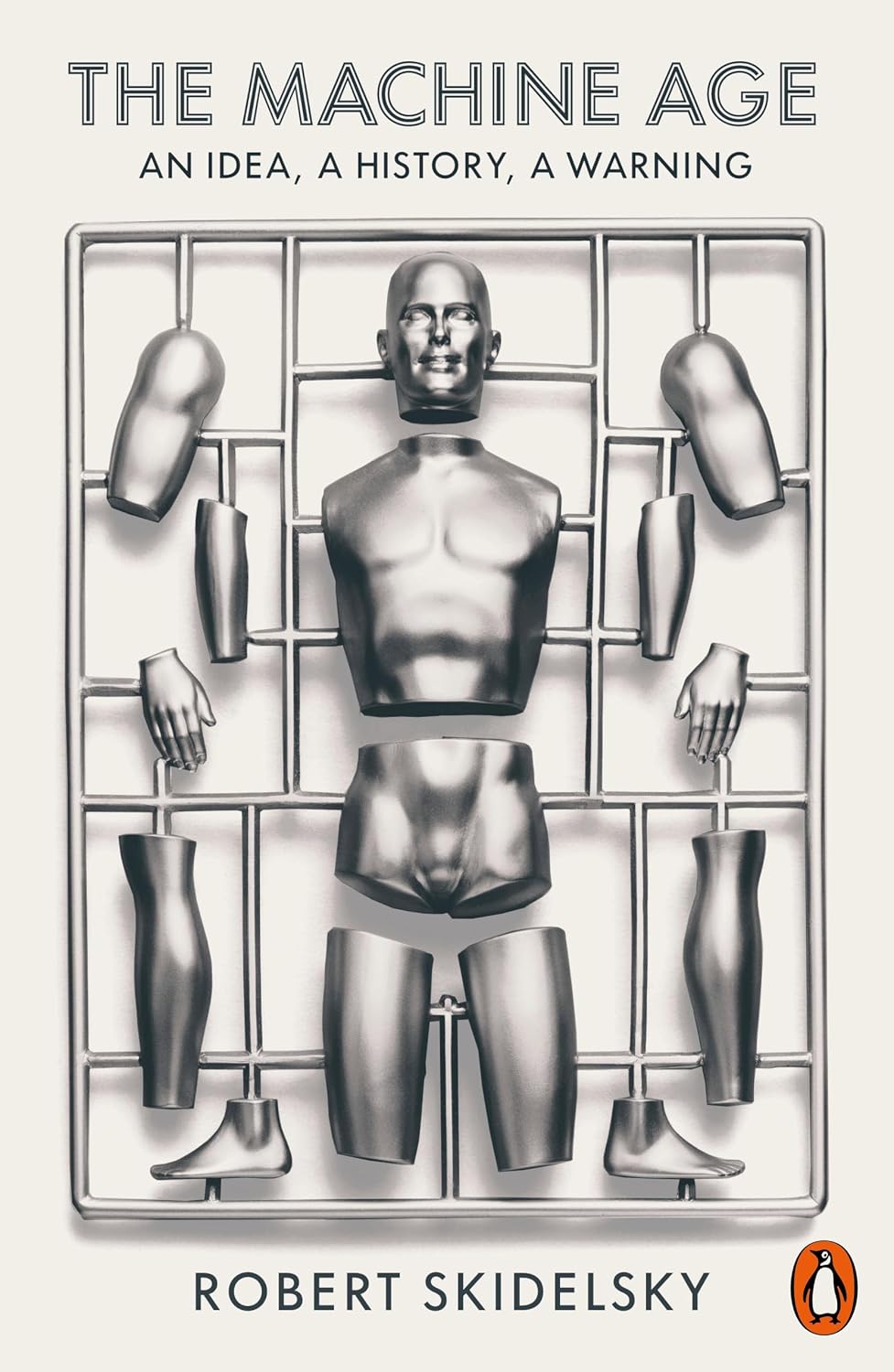
Robert Skidelsky, Baron Skidelsky, was Emeritus Professor of Political Economy at the University of Warwick. He is most well-known for his award-winning three-volume biography of John Maynard Keynes. The Machine Age: An Idea, a History, a Warning marks a departure from Skidelsky’s home domain of Keynesian macroeconomic thought into a comprehensive, interdisciplinary interrogation of humanity’s relationship with technology. The book is an ambitious, almost encyclopaedic project that touches upon everything from history and economics, to theology, philosophy and technological futurism. The core thesis serves as a cautionary call against the misguided overreliance on technology and indeed, the blindsighted surrender of human will in a technologically deterministic future.
Skidelsky’s prose is clear and the book is thoroughly researched, with a comprehensive bibliography for readers wishing to explore the subject further. Specialised terminology is used sparingly, making the text accessible to a broad audience of inquisitive readers. Yet the breadth and density of the material make it a demanding read, requiring sustained and uninterrupted attention. This challenge is heightened by the book’s frequent and sometimes abrupt shifts between disciplines.
The contents are comprised of three distinct thematic parts which chart the progressive encroachment of mechanisation from the Industrial Revolution to the contemporary frontier of artificial intelligence. Skidelsky notes at the outset, the text ‘tells three stories about the impact of machines on the human condition: on the way we work, on the way we live and on our possible future’ (page 1).
Chapters 1–7 consider ‘The Mechanisation of Work’ and establish the economic and historical foundations of technological proliferation. Skidelsky examines the onset of machines, the natural obstacles to early innovation and the structural alignment between technological progress and the rise of capitalism. In analysing modern labour dynamics Skidelsky offers a rather bleak outlook that dismisses the conventional economic reassurance that ‘with suitable education and training workers will be able to take on higher-level… tasks’ (page 94), landing instead on a systemic bifurcation of employment into ‘lovely and lousy’ jobs and increasing structural pressures towards downskilling (Chapter 6).
Chapters 8–13 look at ‘The Quest for Perfection’. Here, the text shifts from economic history to an intellectual and cultural critique. Skidelsky explores the Enlightenment ambition to ‘straighten the crooked timber’ of humanity through rationality and mechanisation. He investigates the cultural anxieties surrounding the ‘Devil in the Machine’ (Chapter 10) and the philosophical evolution of technology from a utopian vision of human liberation to a dystopian framework of surveillance and control (Chapter 13). Drawing a parallel with Jeremy Bentham’s Panopticon, Skidelsky warns that ‘we enter Bentham’s prison voluntarily, oblivious to its snares. But once inside, it is increasingly difficult to escape’ (page 184).
The third and final section, ‘Towards Apocalypse’, is covered in chapters 14–17 and as the title suggests, is mostly dedicated to confronting contemporary risks. It traces the advent of modern computation and AI from the 1950s, critically interrogates some of the salvific rhetoric surrounding AI and explores the clash between digital liberation and technological entrapment. An important and interesting discussion on conscience can be found in Chapter 15 where Skidelsky points out that AI succeeds in syntax but falters at semantics and experience: ‘Take for example, the tree outside my window […] I not only see the tree but I am aware that I am seeing it, and have beliefs and feelings about the tree; they signify an intentional relationship between the subject (me) and the object (the tree). A purely material account of the world runs into problems trying to explain this relationship’ (page 220). The book concludes in a sober evaluation of potential hazards of human obsolescence, where ‘the continuing threat of technological innovation is to rob ever-larger fractions of people of their employment, livelihood, status, skills, usefulness, and identity, and finally make them redundant’ (page 269).
Although historically a champion of the Keynesian macroeconomics, Skidelsky utilises Marxian concepts of alienation (Entfremdung) and the subordination of living labour to ‘dead capital’ to explain the trajectory of automation. He conceptualises technological advancement not as an autonomous, neutral byproduct of human curiosity and ingenuity, but as an instrument weaponised by capital to extract surplus value, control the workforce and lower production costs. Readers looking for an appreciation the free innovative and entrepreneurial spirit will not find it here – for Skidelsky capitalism is fuelling technological entrapment. Crucial to this dynamic is his critique of consumer capitalism’s manufactured needs, where he notes that ‘it is insatiability, natural and deliberately created, which keeps machines in business, by ensuring that the material requisites of happiness remain permanently scarce’ (page 112).
No doubt some readers will take issue with this approach. By framing the evolution of technology almost exclusively as a vector of capitalist exploitation and class subjection, Skidelsky underemphasises the adjacent positive outcomes such as market innovations, improvements in working conditions due to technology and even state-directed geopolitical initiatives (such as military R&D during the Cold War). All of these have historically led to technological advancements that do not fit neatly into a binary class-struggle paradigm.
Compounding this challenge is the immense, near encyclopaedic scope of the book. While the polymathic breadth is intellectually stimulating, it is likely to leave some readers overwhelmed and, at times, confused. The book functions more as a history of ideas about machines rather than a history of technology itself (which is what many might expect from the cover).
However, that is not to say there isn’t much to commend – there is. The Machine Age deserves significant praise because stands as a vital and sophisticated counterweight to the uncritical ‘techno-hype’ and hubristic boosterism propagated by many Silicon Valley CEOs with utopic promises or apocalyptic threats. Skidelsky’s triumphs in his ability to de-naturalise technology as foreign and offer a defence of human distinctiveness which is profoundly articulate and compelling. He ably reminds readers that economic efficiency and technological change should remain subordinate to human well-being and democratic values.
The Machine Age provides a sweeping and erudite critique of modern technological society. While the volume’s expansive breadth brings challenges and its rather unduly negative assessment of technology may alienate some readers, its foundational thesis remains robust. The book is best viewed as large warning sign held up against humanity’s somnambulation into a techno future driven primarily by the needs of software and hardware. It is a timely and valuable contribution to developing a contemporary philosophy of technology and serves as a powerful reminder that machines must ultimately serve human purposes – not dictate them.
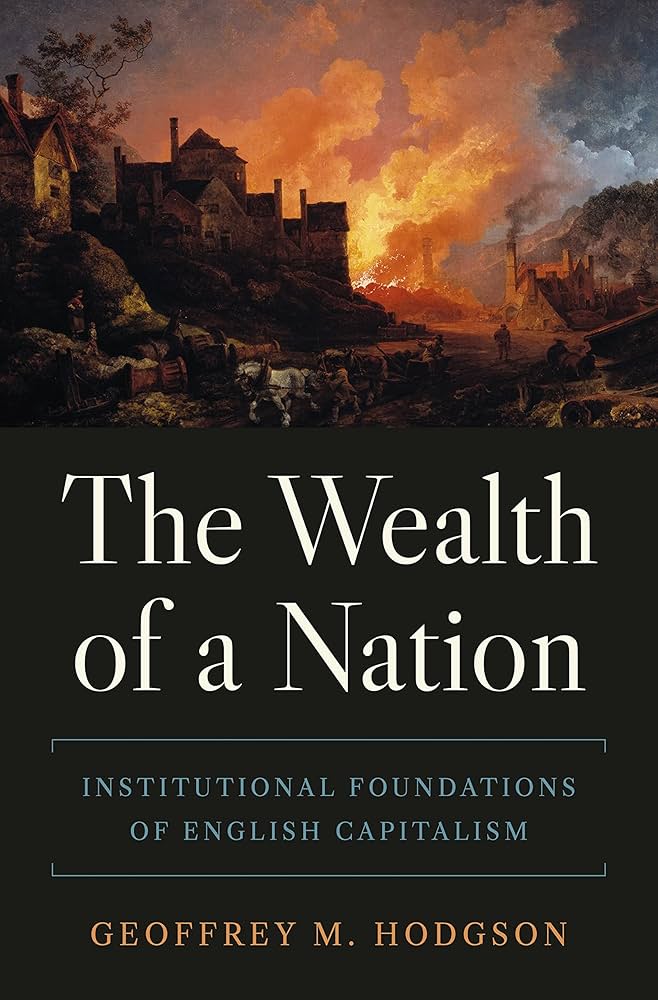
In this impressive work, Geoffrey Hodgson, a leading scholar in evolutionary and institutional economics, presents an interdisciplinary approach, including anthropology and neuropsychology, to demonstrate the fundamental importance of legal and financial institutions in the development of capitalism in England between 1300 and 1820. Determining the foundations of the ‘First Industrial Nation’ has long been a staple of economic history, often laden with a tendency to focus on quantifiable factors of production and resources, what Hodgson terms the ‘physicalist perspective in economics’ (page 182).
The notion of English exceptionalism has often informed historical accounts in this area, from self-congratulatory and often chauvinistic narratives of earlier centuries, which stressed nationalistic and religious attributes of ‘free-born Englishmen’, anti-Catholicism, and the virtuous worldliness of Protestantism, to those documenting the carefully-crafted application of hegemonic domestic and imperial economic policies. More recently, the cultural and intellectual dimensions of Enlightenment culture have been identified, especially by Joel Mokyr, as components of emergent capitalism.
While promoting a ‘legal institutionalist’ interpretation, Hodgson concedes that ‘multiple dimensions’ informed capitalist development (page 228). Yet, he seeks to revise an outlook whereby the apparatus of property rights, legal structures, and financial institutions have been understated in the historical literature. Thus, a ‘hidden wiring’ metaphor is appropriate, with the primacy of institutions representing a less fashionable, less heroic, and less visible element than the content of pre-existing interpretations.
The book is divided into three parts. Part I examines explanatory frameworks of capitalist development, including Marxist historical theory, as well as the role of technology, religion, and ideology. Part II, comprising over 50% of the book’s content, explains England’s economic development by reference to land, law, war, and finance. Part III narrows the focus by assessing institutions as drivers of economic transformation, while providing international comparative analysis.
The introduction presents the conceptual approach of ‘legal institutionalism’ with Thorstein Veblen and Joseph Schumpeter referred to as core influences. In Schumpeterian fashion, finance is held to have preceded enterprise, with rules-based institutions and organisations projected as the foundations and facilitators of transformation. A welcome semantic precision is employed in defining terms like ‘capital’ and in attempting to establish a sequential timeline of causal factors. Resisting Whiggish conceptions of linear progress, Hodgson argues for uneven development, especially of financial institutions and instruments, instancing that mortgaging rules were not established in England before 1670, and debt markets fully emerged only in the later eighteenth century (page 12 note 24).
Unpicking Marxist historical theory is a significant element of Part I. For Marx, law was not part of the economic base but rather the superstructure, yet Marx had to reference property since the social classes of capitalism were defined according to ‘specific institutional relations of property and power’ (page 47). Indeed, the very claim for an English bourgeois revolution is problematic, as the aristocracy retained enormous political and economic power, status, wealth, and privilege well into the twentieth century. With law considered constitutive of social relations, rather than simply an epiphenomenon, Hodgson allows himself the aphorism: ‘The history of all existing society is the history of institutional change’ (page 48).
Similarly, technology, religion, ideology, and culture are framed as limited explanations. China’s institutional failures in sustaining its earlier technological advances are taken as indicative of why technology alone is an insufficient explanation for capitalist development. Equally, while Calvinism, famously termed the parent of capitalism by Max Weber, ‘impelled a capitalist mentality’ of hard work, diligence, and literacy, it cannot explain the capitalist structures and institutions of non-Calvinist territories such as the Italian city-states (pages 55-56). Nonetheless, adjudging the different contours and outcomes might have been worth pursuing further.
Similarly, the presence of liberal ideas did not necessarily translate into policies or a particular policy agenda. The impact of Enlightenment networks, the ‘Republic of Letters’, and transmission of ‘Useful Knowledge’, even the influence of the great ‘Cultural Entrepreneurs’, Newton and Bacon, is taken as overstated, with too much weight ‘placed on too few extraordinary people’ (page 65). In sum, property rights, the rule of law, and financial institutions were more vital foundational factors, with transmission and circulation of knowledge depending on ‘higher-level evolution of organized authority’ (page 67). Hodgson viably suggests that the covert nature of evidence surrounding institutions, rules, and regulations often leads to historical understatement or neglect of these factors. The persistence of instincts and habits are also intriguingly referenced in the same sense.
Part II contains extended, and at times breathless, historical analysis. Thematically, the focus is on the transformative effects of landownership and warfare. The survival of feudal property laws are considered in terms of the limitations of capital formation and investment, with Entails and Strict Settlements reducing availability of marketable land, while also buttressing Primogeniture, meaning estates couldn’t be sold, divided, or collateralised (page 81). Land was an intergenerational trust rather than a marketable, collateralised asset, and across the centuries, landowners successfully prevented freer trade in land, while extensive enclosures facilitated greater concentration of landownership (pages 96-101). Not for nothing have historians adopted the term ‘Territorial Constitution’.
Socially, these events are correctly identified as misaligned with the Marxian ‘rise of the bourgeoisie’ with ‘capitalist’ landowners dismantling feudalism. Such a tidy pattern of development in social relations and economic policy seems too reductionist. An economic mosaic appears more accurate, with the Aristotelian legacy via Aquinas, natural law ideas of ‘just price’, and residual anti-usury sentiment vying uneasily with foreign trade monopolies and restrictive customary practices, into a period of supposed economic modernity and individual freedom. In fact, as Anthony Howe, Miles Taylor and others have described, many bourgeois were willingly coopted by the aristocracy, to the fury of Radicals like Cobden and Bright. Conversely, aristocratic attitudes towards commerce remained ambiguous. Despite the presence of many landowners in commercial ventures, it could take generations before, as Sir Lewis Namier famously related, ‘the stain of trade’ was eradicated.
In England, no government department was exclusively concerned with land, nor was there a Land Registry. The absence of the latter meant land sales and mortgaging were further inhibited (page 108). Moreover, with no English equivalent to the French Notaires, mortgaging was mostly conducted on an ad hoc basis by attorneys and scriveners acting as financial intermediaries. As transactions were likely widely-dispersed and with many as yet undiscovered in private archives, the importance of mortgaging may be understated. Nonetheless, the book intermittently details the vibrancy of local credit mechanisms and networks, with the Manchester cotton merchant Samuel Greg mortgaging land, and mortgaging also applied to lenders receiving toll revenues generated by investment in canal, river, and turnpike infrastructure. Country banks were also important to development, with Adam Smith arguing that the ‘most judicious operations of banking can increase the industry of the country’, but even by 1776 this remained as much an aspiration as a reality.
The orthodox view of early industrial finance was that it was largely self-generated (pages 158-159). Family firms and partnerships were based on trust and honesty in periods where limited liability was not yet legislated, and joint-stock status was reserved for highly-capitalised ventures, like Chartered Companies. Though start-up costs varied, capital formation was not always easy, and even Boulton and Watt had difficulties securing reliable sources of capital (pages 175-180). Nonetheless, England found a way.
Warfare in the form of the ‘Military Revolution’, consisting of more powerful firearms, stronger fortifications, and larger standing armies, features as a vital catalyst for State-based institutional development. The author adopts a traditional interpretation of the emergent Fiscal-Military State, with war the forcing-house for the creation of financial institutions, as previously noted by John Brewer, Werner Sombart, and Francis Fukuyama (page 155). Though not purely an English phenomenon, England was the primus inter pares whose State-building and institutional development advanced after the 1688 Glorious Revolution, aided by the sophisticated apparatus of ‘Dutch finance’ which ultimately created a pathway to industrial growth (pages 164-165). Despite indications that the process began earlier, under the Protectorate, the paradigm shift whereby England, as a Dutch ally, engaged in European and colonial conflict throughout the ‘long’ eighteenth century is fairly established. The contrast with Japan, South Korea, and Taiwan demonstrates similarities and differences in path dependency, but the notion that there exists a template for understanding economic development remains elusive.
Ultimately, Hodgson presents an interpretation of the imperatives of war finance overcoming the structural limitations of using collateralisable assets, especially land, for capital investment. Yet, despite any perceived shortcomings, perhaps Entails, Strict Settlements, and Primogeniture actually promoted the essential systemic stability for economic growth. The ‘Territorial Constitution’ was the institutional articulation of the permanence of land, and the political authority of the landed classes, and capitalism could only evolve and thrive if widespread confidence existed in the legitimacy of financial and political authorities and institutions. Additionally, the role of the State as a more interventionist economic actor is perhaps understated. The expansive protectionism of earlier centuries, including Navigation Acts and sector-specific tariff schedules, were influential in industrial growth, with the cotton industry a notable beneficiary of a deliberate ‘infant industry’ tariff strategy. Equally, the institutional maturity of England can be questioned. A considerable raft of commercial legislation, providing codification and legitimacy, had to wait until the nineteenth century, with repeal of the Bubble Act (1825), Bank Act (1844), Joint Stock Act and Limited Liability Acts of the 1850s and 1860s creating a more identifiable and self-conscious commercial society.
Hodgson has produced an interesting and thoughtful book which, perhaps inevitably in such a wide-ranging and ambitious work, underplays some features. Occasionally, the prose is a little staccato, but mostly it is measured and even, and the pace neither leisurely nor hurried. The book is recommended as a valuable addition to the fields of legal institutionalism, economic history, and development studies.
There is a sense that histories which ‘discover’ new features or relate understated factors often meet a receptive audience, as they can appear to validate historical study, and by extension, the historical profession. Hodgson’s book fits that category but more granular research needs to be conducted before the institutionalist theory can be more fully validated and readily accepted.
For some Christians, including many bishops and other senior clergy, business presents a problem: they consider that business people habitually behave in ways that are inconsistent with Christian morality and assert that a complete change in business behaviour is necessary. At the other end of the spectrum, some people suggest that morality has no applicability in business and that, subject to compliance with the law, business people should concentrate on making money. Most people, however, including probably most Christians, feel uncomfortable with both these extremes: they feel that business is, in principle, morally unobjectionable but are uneasy about how they reach this conclusion or precisely how moral rules should be applied in a business context.
In Ethics for Capitalists Joseph Heath rejects both extremes and provides a framework for the discussion of moral issues in a business context. He does not provide detailed moral guidance in relation to specific issues and some readers will find the moral philosophy in the book heavy going. Furthermore, Christians are likely to take issue with his starting point, which is John Rawls’s theory of justice, since it is based on seeking normative principles that produce institutional structures that will be broadly accepted rather than being based in the character of God. However, Heath writes well. He explains his points clearly and his analysis introduces much needed conceptual clarity to the discussion of business ethics. Provided that they are prepared to take time over Ethics for Capitalists, readers coming from all viewpoints will find in it much to think about.
Perhaps the most important point made by Heath is that business ethics must be assessed in the context of the economic system that exists in the West today (i.e. the market economy). Many ethical purists forget this point and demand behaviour on the part of business people that is unrealistic since it essentially requires that they do not participate in the economy of which their business is a part. For example, competition is a fundamental part of a market economy and it is promoted by regulators and others since it is perceived to be the key to desirable outcomes. Thus, to demand that business people reject competitive behaviour is to demand that they opt out of the economic system, which is impossible.
In the light of this, before considering business ethics, Heath considers the justification for the market system. His purpose in doing so is not so much to establish its superiority over other systems (although he does in fact establish this) but to explain the rationale for its existence so that this rationale can inform his analysis of the kinds of behaviour of market participants that are and are not acceptable. He believes that, in a perfect world, the economic system would be based on pure selfless cooperation but argues that, in the real world, this is impossible owing to human nature and, in particular the ‘free rider’ problem. Hence, one is driven towards a system that involves what Heath terms ‘staged competition’ (i.e. a structure that is deliberately designed to create competition rather than cooperation, on the basis that the overall societal outcome is positive).
There are a number of aspects of Heath’s analysis that are questionable: his suggestion that the market would not exist in a perfect world is probably only viable if one assumes that this perfect world is not only inhabited by morally perfect beings but also that these beings have perfect knowledge and foresight; his analysis of the downsides of a planned economy largely omits consideration of the loss of freedom and agency that it entails (which is itself a moral issue) whilst his analysis of markets tends to exaggerate their moral downsides; and his analysis treats the market economy as, essentially, an artificial creation that is designed to avoid the problems inherent in a cooperative (i.e. planned) system whereas, in reality, a market economy naturally comes into existence unless it is prevented from doing so by human intervention (whether lawful or otherwise). Heath’s acceptance of the market economy, although clearly real, lacks enthusiasm.
These are serious issues but they don’t undermine Heath’s argument that the basic justification for the market economy relates to the objective of inducing an efficient allocation of goods and ‘the fact that the competitive market does a better job at achieving this objective than the most feasible cooperative alternative’ (page 85) and that our approach to business ethics has to be consistent with this justification.
With this point as his foundation, Heath’s analysis of business ethics begins with the assertions that ‘it is not difficult to show that capitalism violates certain moral constraints’ (page 1) and that market institutions ‘are designed in such a way as to permit, and in some cases encourage, certain forms of behavior that are normally regarded as anti-social’ (page 2). However, his central claim is that ‘in the context of market exchange economic actors are permitted to violate certain rules of everyday morality’ (page 5). He believes that ‘the ethical principles preached in churches’ have no applicability in that context or, perhaps more precisely, he believes that they have to be materially adjusted in order to be usable in it.
Once again, one can take issue with Heath’s approach. He appears to imagine that there is a set of ethical rules that are ‘normally’ to be adhered to and that we need to ask what adjustments are necessary in a market context. Of course, if one adopts a simplistic moral absolutist approach to everyday ethics based on a list of universal propositions, then conflicts with the behaviour required by market institutions will soon emerge and adjustments will be necessary. However, as Heath concedes, this is no different from the situation that exists in relation to war and one can easily find other situations in which a simplistic approach falls down (e.g. how does the golden rule apply to the treatment of criminals or to many of the difficult divisions that have to be made by governments?). It seems far better to recognise that there is no base line of ‘normal’ morality from which situations like the market and war require departures. Instead, there are principles and considerations that need to be applied in an infinite variety of different situations.
At a theoretical level, Heath appears to concede this. Indeed, he says that ‘The basic conundrum of business ethics is caused … by the insistence that there must be a “one size fits all” solution to moral problems’ (pages 26-27) and he recognises that those who adopt a consequentialist or utilitarian view of ethics will not have any problem in adjusting their ethical requirements to the market situation. However, he does not seem to recognise that one can be a moral realist, adopting an objective view of ethics that is not based purely in utilitarian considerations or other consequences, and yet still believe that ethical obligations are context specific. This point is frequently forgotten by moral absolutists, including those in the pulpit, but it is consistent with the Biblical approach and thus with what ought to be ‘the ethics preached in churches’.
For example, Heath asserts that ‘there are no plausible formulations of … the golden rule that permit price competition’ (page 18) and he would presumably take a similar view in relation to the related principle of loving our neighbours. However, their application is situation specific: one has to think about all those impacted by our actions and, in some situations, ask which neighbours should take priority and precisely what love requires (which may not be obvious in complex economic situations). The benefits to society of the market are, therefore, relevant in assessing what behaviour the golden rule and the principle of loving our neighbours requires. Actors in markets do not need to cast these principles aside and should not do so. In particular, suppliers of goods may thus conclude that they are observing these principles by competing vigorously with another supplier since, although that other supplier may suffer as a result, the customers and general society (who are also ‘neighbours’) will benefit.
That said, the end result of Heath’s approach is probably close to the end result of the approach that a Christian moral realist will adopt. Both approaches recognise that participation in the competitive world of business does not necessitate unethical behaviour but that this does not mean that ethics have no application to such participation. Furthermore, Heath’s suggestion that ethical issues are engaged when there is market failure, in the sense of a failure to produce an efficient allocation of goods, although perhaps not sufficient to ground the whole of business ethics, is worthy of serious consideration. Heath’s analysis and his high level application of his analysis (in chapters 7 and 8) is thus valuable and is useful as a framework to assist business people in assessing the ethical requirements to which they are subject.
In the second half of Ethics for Capitalists, Heath turns his attention to various aspects of business and seeks to apply his approach to them. These include: ethics within companies and other organisations (where, as Heath points out, there is a co-operative rather than a competitive market model in operation); the ethics of labour relations (where there is both a co-operative and a competitive element that complicates the analysis); and the ethics of business ownership and the maximising of shareholder value.
Heath has worthwhile things to say about all of these subjects but his most interesting analysis relates to business ownership and shareholder value. He distinguishes the main constituencies of businesses (providers of capital, suppliers, workers and consumers) and points out that, in principle, the residual financial interest and control can be vested in any one or more of these constituencies. He then argues that there are good practical reasons why the residual interest and control are generally vested in the same group and why this group is normally the providers of equity capital. He defends the modern norm of shareholder primacy not on the ground that it is morally superior to other models (e.g. consumer, supplier or worker co-operatives) but on the ground that it is the option that has been found most workable in practice and that is does not suffer from inherent ethical problems. Along the way, he convincingly argues that what he calls ‘multifiduciary stakeholder theory’ (page 20) is not morally superior to shareholder primacy, that it suffers from a serious ‘multi-agency’ problem that is itself a moral problem and that it imposes moral demands ‘that could only be satisfied in the public sector and thus under a socialist reorganisation of the economy’ (page 20).
Ethics for Capitalists is a short book (209 pages) but it covers a lot of ground and deserves to be read slowly and carefully. Any business person who wants to come to grips with their ethical duties should read it, as should anyone who comments on business ethics, including many church leaders.
In his new book, Shared Prosperity in a Fractured World: A New Economics for the Middle Class, the Global Poor and Our Climate, Dani Rodrik of the Harvard Kennedy School argues that the three biggest challenges as we continue to march through the 21st century are mitigating climate change, saving democracy, and alleviating poverty. The good news is that we have made remarkable progress on these fronts; the bad news is that there is much left to accomplish. On this, there is much to agree with Rodrik, yet his proposed solutions, while eschewing technocracy and autocracy, almost necessitate those outcomes.
Rodrik is a renowned political economist. Yet, his book lacks clarity on the political economy of rent-seeking and cronyism that will emerge from subsidies and government-controlled international rules. It’s as if the government can be not only a referee of the rules of the game but also an active player, rearranging pieces on a chessboard to achieve its desired outcomes. He fails to bring in the essential public choice critique to his proposed solutions to understand if they can both achieve their goals and remain resilient to rent-seeking and perverse unintended consequences.
Rodrik sees our current series of problems stemming from the rapid acceleration of globalization and economic integration that began in the 1990s. In his view, global anarchy and the pursuit of a borderless global economy have undermined not only the American economy but also economies worldwide. He suggests that this exacerbates inequalities, has led to global populist politics and the rise of the Trump administration, whom he rightly chastises for his tariff policies, which not only hurt the US economy but also the world.
Hyperglobalization steered us in the wrong direction and is ultimately unsustainable, according to Rodrik, because it led to distributional struggles (page 33) and to the rise of geopolitical competition between the US and China. He is right to urge us not to see geopolitics as a zero-sum game. Yet he sees this as the case because of the ‘excesses of neoliberalism,’ which he uses interchangeably with ‘market fundamentalism.’ He goes so far as to suggest that the American left has failed the working and middle classes because it capitulated to hyperglobalization, which he argues generated the crisis. In other words, the left failed because they embraced a version of market liberalism.
The only bright light for Rodrik was the Biden Administration’s industrial policy. He, in part, blames the educated elite for progressives losing their way. No argument here. Yet, shockingly, he argues that it is because the progressive left moved from a ‘Keynesian, social democratic worldview to a more market-friendly, government-skeptic one’ (page 213). We would be hard-pressed to find evidence that Paul Krugman, Ezra Klein, or Elizabeth Warren have embraced market-friendly policies over the past quarter-century – quite the contrary. Paul Krugman calls for universal healthcare and Warren wants government ownership of private companies.
Rodrik is correct in his arguments that we do not need to overemphasize manufacturing jobs as a mechanism for income mobility and productivity enhancement. The focus is now on the service sector. In the first wave of the industrial revolution, manufacturing and industry were the path to success. Workers have always adapted to technological transformation, from farm to factory to cubicle, and artificial intelligence is simply the latest chapter in that story. The question is not whether that transformation will happen, but whether government intervention or market dynamism is better equipped to manage it. After all, today, the United States is an economic powerhouse precisely because it is engaged quite productively in all three sectors; agriculture and manufacturing continue to produce more with less. This is the source of economic progress, and it’s brought to us by open and free markets, the rule of law, and entrepreneurship. Rodrik is right to worry about how low-skilled workers will adapt to that transformation so that they do not get left behind. But he argues that the government can step in to help these workers, thereby strengthening economic dynamism and safeguarding the middle class.
To achieve what he calls shared prosperity, Rodrik focuses on second-best solutions, a framework premised on the idea that when markets are imperfect or distorted, targeted government intervention can improve on market outcomes. It is a seductive premise that, in practice, opens the door to almost unlimited intervention. He, for instance, argues that some subsidies are justified because they address climate externalities. In contrast, others are harmful because they entrench market failures, but this distinction assumes policymakers can reliably tell the difference. Both the public choice framework and the Hayekian knowledge problem are essential here: not only will self-interested actors inevitably capture subsidy programs for their own ends, but policymakers also cannot know which interventions to implement, when, or at what scale. The information required to make such judgments well does not exist at the central level, and the incentives to make them honestly rarely do either.
He recognizes self-interest as a problem in theory while counting on enlightened policymakers to transcend it in practice. Rodrik argues that we should focus on the service sector and enhancing worker productivity. Agree. He sees the world as if we could somehow sit above it, observe what is happening, and then use incentives, rules, and altered norms to achieve different outcomes.
To realize this vision of managed growth, he calls for a new progressivism in which the left connects with the middle and working classes to ‘convince them that it offers a path to middle-class prosperity’ (page 215). He suggests that we create good jobs through micro-interventions targeting structural change and macroeconomic management to ensure full employment, thereby necessitating an industrial policy.
Contrary to this pessimistic view, the middle class has achieved enormous success since the 1990s, and that success is due to market liberalism both at home and abroad. The data bears this out in ways that cut directly against Rodrik’s narrative. Economist Jeremy Horpedahl has shown that both Gen Z and Millennials are doing better financially than Boomers and Gen X were at the same stage of life, when adjusted for inflation. To the extent that the middle class is not gaining as we might hope, it is precisely because government has grown in both size and scope.
Rodrik’s understanding of what is broken in the American economy is misdiagnosed. He is correct that the Trump administration’s aggressive tariffs harm economic growth and development. But this raises the question of why that is the case. Free trade is not zero-sum. The author spends a great deal of time deriding market fundamentalism and neo-liberalism, which are terms tossed around jubilantly by both the progressive left and the progressive right. Yet market trade is, by its nature, voluntary and thus win-win. This is not to say there are no costs to a global free-trade regime under global anarchy. Creative destruction not only reigns, but no one can know what technologies will emerge and how they will destroy the old way of doing things. Free markets buttressed by the institutions of economic freedom, which include low levels of regulation, free international trade, limited government, private property rights, sound money, and the rule of law, spur the very economic growth Rodrik is rightly after.
Both Rodrik and the current Trump administration miss the point that the abundance we have is due precisely to the institutional environment the United States has long experienced. This is true across the world; in any country with greater economic freedom, there is growing income mobility and a robust middle class that often becomes part of high-income groups. Market abundance isn’t trickle down, beggar thy neighbor, or zero-sum. The best thing we can do is to remove artificial barriers and allow the progress to continue.
I was struck while reading this book on the plane as a flight attendant passed through the cabin with his trolley, asking, ‘Any waste, rubbish or trash?’ Three words to say the same thing, I thought, but a clear attempt to do exactly what this book was describing: connect with people who experience and express things in different ways.
The Last Human Job is premised on the concept of connective labour as an essential element of human relationship through work. ‘The crux of this labour,’ Pugh tells us, ‘involves “seeing” the other and reflecting that understanding back. … Yet it is work that is essentially invisible, only partially understood, and not usually recognised, reimbursed, or rewarded, despite its ubiquity and importance’ (page 2). It is also, Pugh argues, only doable by a human being.
Pugh endeavours to prove this by sharing the studies and interviews she has undertaken with people working across a range of professions whose success relies on connective labour. She shares the stories of chaplains, nurses, teaches, therapists, cashiers and sales staff, and argues that human beings and connective labour must be protected in an age where automation and artificial intelligence are trying to create shortcuts or replace them.
The book is in itself an attempt at connective labour as Pugh seeks to break down complex psychological and sociological concepts and terminology for the reader. Whether or not she achieves this depends also on the reader and their ability to understand the scientific analysis within the book, which is unavoidable and also gives this research its credibility. I would argue that for the non-scientific reader, of which, as a musicologist and ethicist, I am one, Pugh’s message resonates most when supported by the voices of her interviewees, which are quoted directly and conversationally: ‘I was just like, something was kind of off, like, it didn’t feel the same’ (page 117).
I would argue that this, too, lends the book credibility and is what makes it accessible to an audience which reaches well beyond the academic readership such research might traditionally attract. The anecdotal style might seem jarring at first, compared to the formal analytical prose which precedes these examples, but Pugh weaves these voices in throughout the book often making it feel more like a narrative with characters who the reader gradually gets to know over the course of its nine chapters. The result is that reading The Last Human Job does not feel like someone is explaining something to or at you, but rather that you are there in the room with them, learning and growing in understanding of each other as human beings, and equipping the reader with the skills to improve one’s own connective labour practices in work and daily life.
A lot of Pugh’s theory seems obvious: be a good listener, use your body language to make others comfortable, speak with authenticity. However, the reality described by those who do this work is much more complex: motivate a depressed stage four cancer patient to take their medication, inspire a truant pupil who is living in poverty and abusive parental relationships to come to school. There are challenges which humans face which a machine or automated sequence are simply unable to fix.
Pugh proposes that we are in a moment of ‘cultural reckoning of what it means to be human’ (page 60), and argues that as a result of increased automation and loneliness, we are ‘in the midst of a depersonalisation crisis’ (page 282). Discussion of artificial intelligence figures surprisingly little in the book, and Pugh does not reject or negate its positive uses and attributes. However, her focus on human relations and connection, and her thorough exploration of various and sometimes surprising professions and the connective labour they involve provide the critique in itself. For example, a lot of time is devoted to the work of chaplains in hospitals.
My ten years of working in social justice policy, research and programmes in the Catholic Church have given me, I will admit, a not entirely unfounded but certainly prejudiced expectation that religion or spirituality is somehow frowned upon by the more ‘logical’ fields. In addition to this, we are living in a cultural context in the UK where religious literacy seems to be increasingly non-evident. I therefore found it pleasantly surprising that a scientific book would consider such a profession as worth exploring at all.
‘The power of connective labour,’ Pugh concludes, ‘is in its capacity to knit together communities of disparate souls – in other words, to create belonging’ (page 280). Human beings crave recognition, not in terms of fame, but feeling understood and that they belong: ‘Through connective labour, we enact respect for the other; across our differences, witnessing conveys that someone is a fellow human being who deserves to be known’ (page 282). If this all seems a little too sugar-coated, we are brought back to reality a few pages later when Pugh gives us the stark choice: ‘the real question we face in an AI future is whether, as humans, we choose to be pets or livestock’ (page 282).
Pugh admits that the future she is proposing, one in which authentic human relationships rule supreme, seems ‘almost utopian’ (page 288); however, she also states, and I too was convinced, that the stories and cases she has recounted over these 365 pages prove that it is possible. In the same way that the readership of feminist literature is mostly women who often already know and agree with what they are reading, The Last Human Job is surely more likely to attract an audience which is already seeking to build the future for which Pugh is advocating.
Much like feminist literature, I hope that The Last Human Job will also fall into the hands of those who may not necessarily immediately agree with its argument. I would suggest that the people in the powerful position of shaping the future through AI and automation could do with receiving a copy as a matter of greater urgency.
The Last Human Job is more than a piece of sociological research, it is a masterpiece in the art of connective labour, at times technically challenging, other times deeply moving. Pugh tells us early on that ‘in German, the world Herzensbildung means “training one’s heart to see the humanity of another”’ (page 24). The Last Human Job is calling us to rise to this challenge.
Some airline companies now provide their flight attendants with a badge on which is printed their name and the flags of the countries whose languages they speak, evidently to help those passengers for whom the standard English announcements may not be easily understood. So, as I sat on the plane reading with this book with my empty plastic cup ready to throw into the rubbish cart, I looked up and saw a Spanish flag on the flight attendant’s badge. ‘Gracias,’ I said, and smiled to myself.