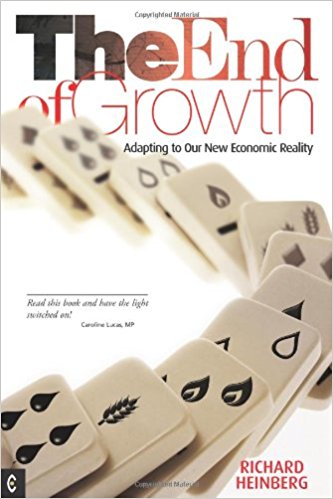
Richard Heinberg is an American journalist and author that has dedicated most of his writing career to environmental causes. His most notable works include publications such as, The Party’s Over: Oil, War, and the Fate of Industrial Societies (2003), and Powerdown: Options and Actions for a Post-Carbon World (2004).
Just from the book titles alone, an astute reader can gain a sense of Richard Heinberg’s environment angle. Indeed, there is a common thread that flows throughout his body of work and which is probably best exemplified in the book we are reviewing here: The End of Growth: Adapting to Our New Economic Reality (2011).
In a nutshell, Heinberg’s thesis is this: Global economic growth as we have become accustomed to over the past century or so is “…over and done with” (page 1). When talking about “growth”, Heinberg is referring here to the overall size and expansion of the economy, i.e. an increase in both consumption and production (ibid.).
So how come? Why will there be no more economic growth? Throughout the book Richard Heinberg builds his argument on three main assumptions. First, the depletion of natural resources (fossil fuels & minerals). Secondly, the negative environmental impact of exploiting resources (e.g. Deepwater Horizon, the BP oil spill disaster). And thirdly, the ‘financial disruptions’ caused by our defective banking and regulatory system and its inability to deal with both “resource scarcity and soaring environmental costs” (page 2). For these three main reasons, historical records of economic growth are no longer sustainable in the future.
Let’s turn slightly to the structure and content of the book. “The End of Growth” is well-written and thoroughly researched. From the onset, it becomes apparent that the author has a wealth of experience and knowledge of the subject. Indeed, Heinberg spent over two decades examining and writing about environmental issues and this clearly shows throughout the book.
The book is structured around seven main chapters. The first two open the discussion with a more generalised debate on historical economics and the influences of both Marxist and capitalist ideology in shaping the current state of global macroeconomics. Heinberg also talks about the financial crisis of 2007/8 and how the actions of the Federal Reserve (like Quantitative Easing) are akin to a “Ponzi Scheme” that could ultimately lead to rising interest costs and even currency failure (page 75).
Chapters three and four turn towards the environment and the limitations of earth’s natural resources. Economists and experts in the field have largely ignored the obvious: natural resources are finite. As they become increasingly scarce, the race and exploitation in finding them will have dire consequences on the environment. The BP Oil Spill is given as a clear example of how petroleum companies need to search in deeper and more dangerous areas to find oil. Heinberg goes through all the major natural resources and explains their limitations, including, Oil, water, food, and metals. In chapter four Heinberg remains sceptical that new technologies and innovations will be sufficient to promote growth and stop climate change. He asserts that, “Civilisations advance human knowledge and technical ability, but they also tend to generate levels of complexity they cannot support beyond a certain point. When that point is reached, civilisations decline or collapse” (page 187).
Chapters five and six move the discussion toward a more international dimension. Heinberg effectively sees China’s recent economic growth as a “bubble” (page 190). A bubble that is overwhelmingly dependent on favourable age demographics and a reliance on coal as a primary energy source. Chapter 6 talks about how ill-equipped our current geopolitical system is to both adapt and succeed in a post-growth, contracting economic climate.
Finally, chapter seven concludes with an explorative study in how society (especially civil society) can adapt and grow in a post-growth world. In short, Heinberg believes that organising and local community initiatives will have a crucial role to play. He speaks about “Transition Towns” and “Common Security Clubs” where “The work of local groups should include the sharing of practical skills such as food production and storage, home insulation, and the development and use of energy conserving technologies.” (page 270).
At the end of the day, Richard Heinberg’s “The End of Growth: Adapting to Our New Economic Reality” remains something of a paradox. On one hand, the core of his message rings true: we are consuming and in some cases, abusing resources that are by definition, finite. On the other hand, it feels like the book is too pessimistic and sceptical – it underestimates the power of new and innovative technologies and overemphasises the negative impact of consumerism. For instance, his analysis on electric cars in Chapter four (page 159) is superficial at best. Heinberg fails to consider the rapid advancement in battery technology and their ability to store power.
Readers in search of a gloomy, sceptical analysis on the future of the environment and economic growth should pick up this book. Those seeking a more balanced account should look elsewhere.
“The End of Growth: Adapting to Our New Economic Reality” was published in 2011 by Clairview Books (ISBN-10: 1905570333). 231pp.

Andrei Rogobete is a Research Fellow with the Centre for Enterprise, Markets & Ethics. For more information about Andrei please click here.

Peter Selby’s polemic against modern money, An Idol Unmasked, was published a few years ago now, in 2014, but captures an attitude to money and modern finance that remains widely prevalent. It is, as he says, a book ‘about money, what it has become, and what it represents in our lives’ (page 3). His key claim, expressed repeatedly throughout the book, is that money has acquired the characteristics of an idol. It now rules peoples’ lives in a way it never quite did before. ‘The quite widely held view,’ he says, ‘that money is not in itself harmful, only the love of it or greed for it, is turning out to be out of date’ (page 3). Over two of the main chapters, Selby links this claim to the decreasing sovereignty of nation states over money, and the increasing role of global financial institutions in the creation and movement of money. More than that: ‘money has long since passed from the control of the public authorities and has become itself the major controlling force behind the organisation of society’ (page 30). Having identified the idol of money and its power over us, he then turns in the final chapters of the book to some theological reflection.
One immediately obvious flaw with Peter Selby’s claim to have unmasked the idol of money (expressed, for example, in the title of the book) is the inconvenient truth that associating money with idolatry is hardly a new idea. Identifying money as an idol or potential idol has deep roots in Judeo-Christian thought. It’s there in the Hebrew Prophets, in Jesus’ teaching about ‘Mammon’, in the apostolic teaching about greed (‘which is idolatry’, Col 3:5), and plays in important role in Christian ethical discourse thereafter. Selby clearly knows this, and even makes reference to some of this material, but seems strangely slow to acknowledge or engage with what others have said.
To be saying something new, Selby needs to demonstrate that money has changed somehow – that it has become ‘more of’ and idol, with a more powerful role over peoples’ lives than it has ever had before. But the argument here is unclear. One problem is that he never quite defines what he means by ‘money’, and seems to use the word in a number of different ways — sometimes referring to currency, sometimes wealth, sometimes ‘a set of ideas’ or even a ‘controlling force’. Another problem is the absence of any evidence or data beyond the anecdotal to back up the claims being made. These are basic issues of method. There also seems to be an insufficient grasp of some of the issues. For example, Selby argues that the globalization of money creation – removing some of the sovereign power once possessed by individual nation states over their currencies – has given money a destructive, anarchic life of its own, ‘acting only on its uncontrolled instinct to produce more of itself’ (page 53). It doesn’t seem to occur to him that the decentralization of money creation might have some good features – taking away too much power from any one player in the system, for example. No doubt there’s much more to say on this, and these are complex issues. The problem is: the issues and counter-arguments are hardly raised at all. Selby generates considerable heat as he develops his polemic – but not much confidence in his depth of understanding.
What then of the theological reflection towards the end of the book? This begins well enough with some reflections on the nature of idolatry. But we then get some very strained readings of Jesus’ parables as anti-market polemics (pages 98–110) – a classic case, if ever there was one, of someone reading into a text precisely what they want to hear. Weaker still is the proposed solution to the problems Peter Selby finds in modern money – what he calls ‘the mercy economy’ (pages 111–126). Given everything he’s said earlier in the book, this rather surprisingly doesn’t seem to involve getting rid of money altogether. It is in fact quite hard to work out quite what it is or might involve, beyond perhaps some debt forgiveness and maybe, perhaps, some kind of universal basic income (page 124). Whatever the ‘mercy economy’ is in detail, Selby seems to be suggesting that the solutions to the problems of money-idolatry lie in structural change or intervening to reform ‘the system’. For a theological reflection, there is precious little on the battle in the human heart behind our tendency to idolatry – and what can be done about that – which is where a deeper reflection on the Scriptures might have taken him.
Reviews of bad restaurants can be fun to read and I suspect they are quite fun to write (which then compensates, somewhat, for the critic’s experience of the meal itself). Every failed dish or example of poor service is described and unpicked with a darkly humorous glee and relish. One could probably do the same with the claims and arguments of An Idol Unmasked, picking over them one by one. But the practical purpose of a bad restaurant review is to advise readers to find a meal elsewhere. Likewise with this book. Anyone in search of a balanced and insightful analysis of contemporary monetary systems and markets, coupled with some deep theological reflection, is not going to find it here.
“An Idol Unmasked: A Faith Perspective on Money” was published in 2014 by Darton, Longman and Todd Ltd (ISBN 978-0-232-53111-4), 140pp.
 Revd Dr Ben Cooper is Minister for Training at Christ Church Fulwood in Sheffield. He holds doctoral degrees in both Theology and Economics. Before training for ordained ministry, he was a post-doctoral research fellow in economic theory at Nuffield College, Oxford. He is married to Catherine and has three children.

In this book, Yanis Varoufakis (Professor of Economics at the University of Athens) gives a highly informative and very well-informed account of the austerity measures enforced by the institutions of the European Union (EU) since the financial crisis which began in 2007-2008. He also sets these events and policies in the wider context and history of the EU, and especially of the economic relationship between the EU and the USA. As the title shows, Professor Varoufakis is deeply concerned about the impact of these policy measures on the people who are weakest in a society: most plainly, the weak in Greece (his own country), but also in other EU countries. This is a concern which Christians must of course share, given the many biblical injunctions to uphold the cause of the poor and needy.
Varoufakis’ account is especially well-informed because of his (short-lived) role as Greece’s Finance Minister between January and July 2015: he was directly involved in many lengthy meetings between the Greek government and the major EU bodies. These negotiations were focused on the debt crisis which hit the Eurozone in 2010 (a direct consequence of the 2007-8 crisis in London and Wall Street), and in which the desperate finances of the Greek banks were a central part. Prof Varoufakis was already well underway with writing this book when he chose to stand for election in Greece – motivated by precisely the concerns and arguments about which he was already writing.
More than half of the book is taken up with an account of the economic relationship between the USA and the EU and its predecessors: the European Coal and Steel Community, which evolved into the European Economic Community [Common Market]. The key aspects here centre on macroeconomic policy and the nature of global capitalism: and these are, as Varoufakis shows, central to the contemporary challenges for policymakers, for capitalism and indeed for democracy.
This material (chapters 1 to 5) often takes a fair amount of wading through (although it is thoroughly researched). But the case he presents is a strong one. In his own words (pp137-8): ‘The reason Europe seemed to be prospering in the late 1990s and until 2008, despite having introduced an unsustainable gold standard [i.e. permanent monetary union in the form of the Euro], had little if anything to do with the design of its single currency and everything to do with the fact that there was no need for political surplus recycling [emphasis added], as the world of private finance was doing plenty of fair-weather recycling’. What Varoufakis means here by ‘recycling’ is nothing to do households with putting plastics and paper into bins of various colours (!). Instead he is talking about macroeconomic and monetary flows between and within countries. In essence, during the 1950s and 1960s, the ‘Bretton Woods’ economic institutions helped to ensure that no developed economy slumped into permanent recession or depression; and, even after the collapse of those arrangements in 1971, the large and growing ‘twin deficits’ of the USA (i.e. both a Balance of Payments current account deficit, with imports exceeding exports, and a public sector deficit, with government expenditure exceeding tax receipts) helped to enable economic growth to continue in the EU and the Eurozone. There was no need for the countervailing current account surplus in countries such as Germany to be recycled by the hand of politicians, since the macroeconomic ‘weather’ continued to be fair – until 2008. However, the 2007-8 crisis brought all of this crashing down; and the poor design of the Euro, Varoufakis argues, meant that the Eurozone countries had no defence against the ensuing crisis.
Varoufakis also makes a strong argument for what is many ways is a very depressing proposition. The argument is that – in the light of the above history – the EU’s political, economic and monetary institutions do not have it in their DNA to provide a suitably flexible response to a crisis such as that of 2007-8 and its aftermath. In essence the EU’s structures centralize power (e.g. in the hands of ‘bureaucrats’) and are incapable of being made democratically accountable.
On that basis, in the remaining chapters Varoufakis proceeds to explain the interconnections between the post-2008 debts of private (commercial) banks, the perceived need to bail out these banks, and the EU’s requirement that governments must introduce austerity measures as the price for the EU agreeing to complex packages to try to resolve the severe difficulties. Crucially, argues Varoufakis, the ‘no bailouts of EU countries’ rule was at the heart of why the follies of bankers led to the price being paid by the weakest citizens (in the form of austerity measures), most especially in Greece. ‘A clueless political elite, in denial of the nature and history of a crisis whose roots go back to at least 1971, is pursuing policies akin to carpet-bombing the economies of proud European nations in order to save them’ (p192).
Varoufakis makes no secret of his left-wing convictions, and his atheism is also evident. He writes with passion and intelligence about some very serious challenges facing European and global capitalism, and the book is well worth reading.
Let me conclude with some questions that are raised by this book, especially from a Christian perspective. First, are we sufficiently concerned for how macroeconomic and political forces impact on the weakest in our societies? The title of the book, as Varoufakis explains on p19, is drawn from Thucydides’ Peloponnesian War: at one point the powerful Athenian generals explained to the helpless Melians that ‘the strong actually do what they can and the weak suffer what they must’ [translation by Varoufakis]. Substitute ‘politicians and bankers’ in place of ‘the strong’, and it is hard not to find this very chilling.
Secondly, what is the future for the EU? This is evidently a question not only for the UK (whatever one’s views about Brexit). Varoufakis is an internationalist, and sees nationalism as a great problem; yet he is deeply pessimistic about the EU.
Thirdly, how can global capitalism be better managed, so that the power of money and finance (we might even say ‘Mammon’) is circumscribed and a more truly democratic political economy is shaped?
“And the Weak Suffer What They Must? Europe, Austerity and the Threat to Global Stability” was published in 2016 by Nation Books (ISBN – 10: 1568585047), 368pp.
 Revd Dr Andy Hartropp is an economist, theologian and church minister. He has two PhDs, one in Economics and one in Christian Ethics. He lectured in financial economics for 5 years at Brunel University, west London. He also worked for a year with the Jubilee Centre in Cambridge, primarily leading a team doing research on families in debt. He trained at Oak Hill College, London, for ordained ministry in the Church of England. His (second) PhD was published as: What is Economic Justice? Biblical and secular perspectives contrasted (Carlisle: Paternoster, 2007). He has spent 13 years in parish ministry. He worked for eight years with the Oxford Centre for Mission Studies, where he was the Sundo Kim Research Tutor in Mission and Economics. In March 2016 he joined Waverley Abbey College as Director of Higher Education. He chairs the Ethics and Social Theology Group of the Tyndale Fellowship. He is married to Claire, and they live in Bicester, near Oxford.
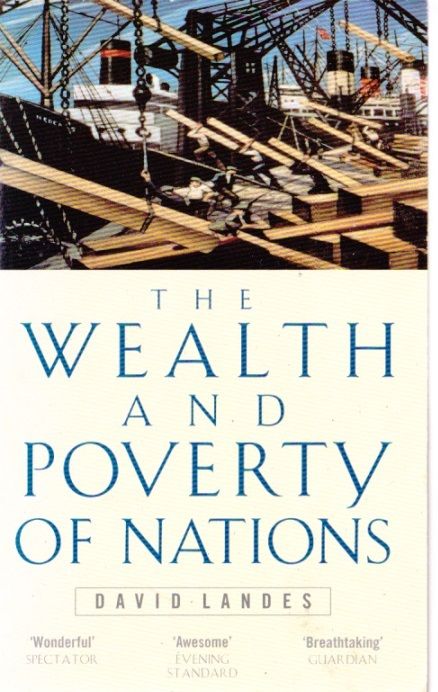
American essayist and novelist William Styron once said that “A great book should leave you with many experiences, and slightly exhausted at the end.” If we judge the late David Landes’ ‘Wealth and Poverty of Nations’ by this criterion, it most certainly fits the bill of a ‘great book’. It is a majestic display of his deep insight and vast knowledge of global economic history. It comes as no surprise, therefore, that the book has been all but universally acclaimed by literary critics.
David Landes was Professor of History and Emeritus Professor of Economics at Harvard University. His other works include Bankers and Pashas, Revolution in Time, The Unbound Prometheus and Dynasties. As one might expect, therefore, ‘Wealth and Poverty of Nations’ is no short and easy read: half a millennia of global economic history are covered in over 600 pages and 29 chapters.
Landes’ primary aim in the book is to better understand how nations have evolved to reach their current state. Landes’ main thesis of the book is that cultural traits and cultural values play a key role in determining whether a country fails or succeeds economically. As he points out in the Preface, the analysis is not one of a “multicultural, anthropological sense of intrinsic parity: all peoples are equal and the historian tries to attend to them all. Rather, [to]…understand how we have come to where we are, …[through] making, getting, and spending” (page xi).
In this sense, ‘The Wealth and Poverty of Nations’ provides a fascinating and distinctive historical angle that considers the cultural circumstances, as well as the economic trends of the time – thus, viewing economic history through a cultural lens.
Landes opens up the discussion with the premise that the old dichotomy of the West vs. the East, or better said, West vs. the ‘Rest’ has largely dissolved (page xx). The more pertinent split in today’s ‘globalised’ world is between ‘Rich’ vs ‘Poor’ countries. The common thread of questioning that is present throughout the entirety of the book is this: why have some countries come to be so poor and some so rich?
In the opening chapters Landes presses the idea that the technological and cultural advancements enabled the (relatively small) nations of western Europe to significantly punch above their weight (page 137). The Industrial Revolution in Europe brought technological innovations that had tremendous long-term impact on economic development. Basic advancements cotton manufacturing for instance, enabled the creation ‘washable’ clothes. This in turn led to better personal hygiene and therefore, better health and an increase in life expectancy. The technological advancements improved all areas of life in the Continent
Landes also points out that throughout the late 17th Century and 18th Century, England’s relative open society enabled it to flourish at a faster pace than its European counterparts, many of whom were deeply embattled with religious persecution (page 223). As a result, England managed to ‘profit from other nation’s self-inflicted wounds’ (ibid).
Yet arguably one of the most powerful and convincing arguments of the book is raised in Chapter 12 (page 175 – 181). Here David Landes reinstates Max Weber’s thesis on the Protestant work ethic. The core argument here is that the Protestant revolution in Europe brought with in a change in the role and responsibility of work. The influence of Protestant thinking encouraged people to value, creativity, hard work, timeliness, and free-thinking. This in turn acted as a catalyst for economic growth not only in Europe, but also in the early development of America (CEME’s Director, Richard Turnbull, wrote on the impact of Quakers in Quaker Capitalsim: Lessons for Today)
The latter half of the book bring the discussion back to the impact of culture on economic performance and how the two are intrinsically linked. In Thailand for example, young men are encouraged to spend a few years in religious (Buddhist) monasteries before entering the world of work. Landes argues that this sets their priorities right – and makes them more effective once the do enter the ‘materialistic’ world of work, where money plays a major role (page 517).
Landes concludes the book with a discussion on the current tensions between globalisation and the nation-state, but also the merits of free-trade and some of the benefits and dangers of international aid (Page 519-521). In a nutshell (and without giving too much away), the book argues that free trade between nations is disproportionately beneficial and foreign aid can do as much damage as it does good. Landes overarching conclusion is that the adoption of a free market economy (especially by poor countries) is the surest and safest way to long-term economic development and wealth creation.
‘The Wealth and Poverty of Nations’ leaves its reader with a completely new, and unique understanding of the role that culture plays in the historic economic development of countries. Finding criticism for this book is a challenge in itself, I have found myself nit-picking at best. One possible observation is that, even in 600+ pages, it remains difficult to comprehensively capture half a millennia of world history.
Some may say that it is too Eurocentric. Yet the book’s apparent Eurocentrism is part of the presentation and hypothesis that is put fourth – it is the angle that the author adopts rather than an inherit bias. In response to this perceived ‘Eurocentrism’ and being a ‘Westerner’, Landes himself acknowledges that, “I feel surer of my ground” (page xxi). Nonetheless, one could argue that the cultural intricacies of each geographical region can, and deserve to be explored in greater depth.
‘The Wealth and Poverty of Nations’ has become a staple in the field of economic history.
A definite read.
“The Wealth and Poverty of Nations” was published in 1999 by Abacus, ISBN-10: 0349111669, 672pp.
Andrei Rogobete is a Research Fellow with the Centre for Enterprise, Markets & Ethics. For more information about Andrei please click here.

Saving Capitalism – For the Many not the Few is the latest addition to Robert Reich’s cohort of publications. He is perhaps best known for his previous work, The Work of Nations (1992) which raised the issue of growing inequality to the public sphere. Alongside his writing, Robert Reich is also a Professor at the University of California, Berkeley, and has served in various positions under the administrations of Gerald Ford and Jimmy Carter. Most notably, he was US Secretary of Labour under the Presidency of Bill Clinton between 1993 – 1997.
At the age of 71, Reich brings a lifetime of experience in both academia and politics to the table. As a true social-democrat, Reich’s Saving Capitalism is a continuation of the themes he discusses in previous publications – some of which include: rising inequality, the not so ‘free’ marketplace, the over-concentration of political and economic power in the hands of a few, the disenchantment of the masses, and others.
As the title may suggest, Saving Capitalism is a critique of the free market structures and modern-day capitalism. Reich argues that decision-making power is increasingly concentrated in the hands of a few, at the expense of the ‘many’. The very rich get richer and more powerful, while the middle and lower classes get weaker and poorer. The entire system is rigged against the majority in favour of a concentrated few. The solution to this injustice, Reich suggests, is an “…activist government that raises taxes on the wealthy, invests the proceeds in excellent schools and other means people need to get ahead, and redistributes wealth to the needy” (page xvii).
Does this narrative sound familiar? To many it certainly will. Robert Reich’s Saving Capitalism is therefore one among numerous publications that champion the social inequality-class warfare thesis. In that sense, the book brings little to nothing new to the debate. Nonetheless, it is well-written and its use of colloquial language grapples the reader. This does however make the book read like more of a socio-political novel rather than a macroeconomic or political account. One cannot help but feel that Reich’s desire to push his own personal narrative has come at the expense of rigorous analysis.
But before jumping to any conclusions, let’s briefly touch upon the structure and content.
Saving Capitalism is comprised of three main parts. The first chapter, entitled “The Free Market” aims to show how in fact ‘free markets’, are not ‘free’ (page 85).
As you may have already guessed, Reich argues that this is due to them being controlled by a select, powerful few that both establish and control rules in which a ‘free market’ operates. He argues that there are five ‘building blocks’ of a free market: property, monopoly, contracts, bankruptcy and enforcement. Each of these require human governance and can be used to either, promote a fair and decent society or can be manipulated to benefit a select few (page 9). This first part of the book argues that the latter has occurred. The stronghold on patent laws by pharmaceutical companies, the large lobby budgets of corporations to maintain dominant market positions, the abuse of bankruptcy laws, are all cited as evidence that the entire system is rigged in favour of on elite few.
The second part of the book is dedicated to showcasing the consequences of such a rigged system. Here Reich argues that free market meritocracy is in fact, a myth. Those at the top increase their own wages whilst those at the middle and bottom see their wages stagnant and in many cases, decline (pages 134-167).
In the third and final chapter, Reich argues for a restoration of countervailing power, or in layman’s terms, bringing power back to the people. The means by which he believes this can be achieved are certainly not new: an increase in the minimum wage, amending labour laws to favour unions, and changing contract laws as to encourage employees and workers to take action against unjust employers (pages 153 – 217).
So while Robert Reich’s latest work presents a compelling critique of the challenges facing 21st century capitalism, it brings little new to the table. Moreover, any truly impartial reader that has some basic understanding of economics would be quick to observe that Saving Capitalism is unabashedly lopsided. There is no doubt that western capitalism is at a crossroads, and the aftermath of the financial crisis has left millions feeling disenfranchised. However, Robert Reich portrays injustices within the free market (as real as they may be), as characteristic of the entire economy. It’s a bit like saying, we can’t play football anymore because one of the players faked an injury.
He also seems to portray an over-the-top form of class warfare: the elite vs. the rest. As if the classes are statutory and unitary groups with no movement or change between. The rich and powerful only stay rich and powerful while the rest suffer the consequences of their actions. We know this is simply not the case – a free market economy does indeed reward creativity and work. Whether, intentional or unintentional, Reich left out any deeper economic discussions, such as aggregate supply/demand and its impact on market meritocracy. This brings us to what is perhaps the most significant pitfall of the book, it is far to rooted in empirical storytelling rather than political or economic analysis. No matter how broad Robert Reich’s experience may be, personal examples should always be an addition to the argument and not its foundation.
Having said that, Saving Capitalism offers some captivating thoughts on the current state of free market. Provided that its rather superficial and politicised arguments are viewed through a critical lens, the book is certainly a worthwhile read.
“Saving Capitalism: For the Many, not the Few” was published in 2016 by Icon Books Ltd. (ISBN: 9781-78578-0677). 279pp.
Andrei Rogobete is a Research Fellow with the Centre for Enterprise, Markets & Ethics. For more information about Andrei please click here.
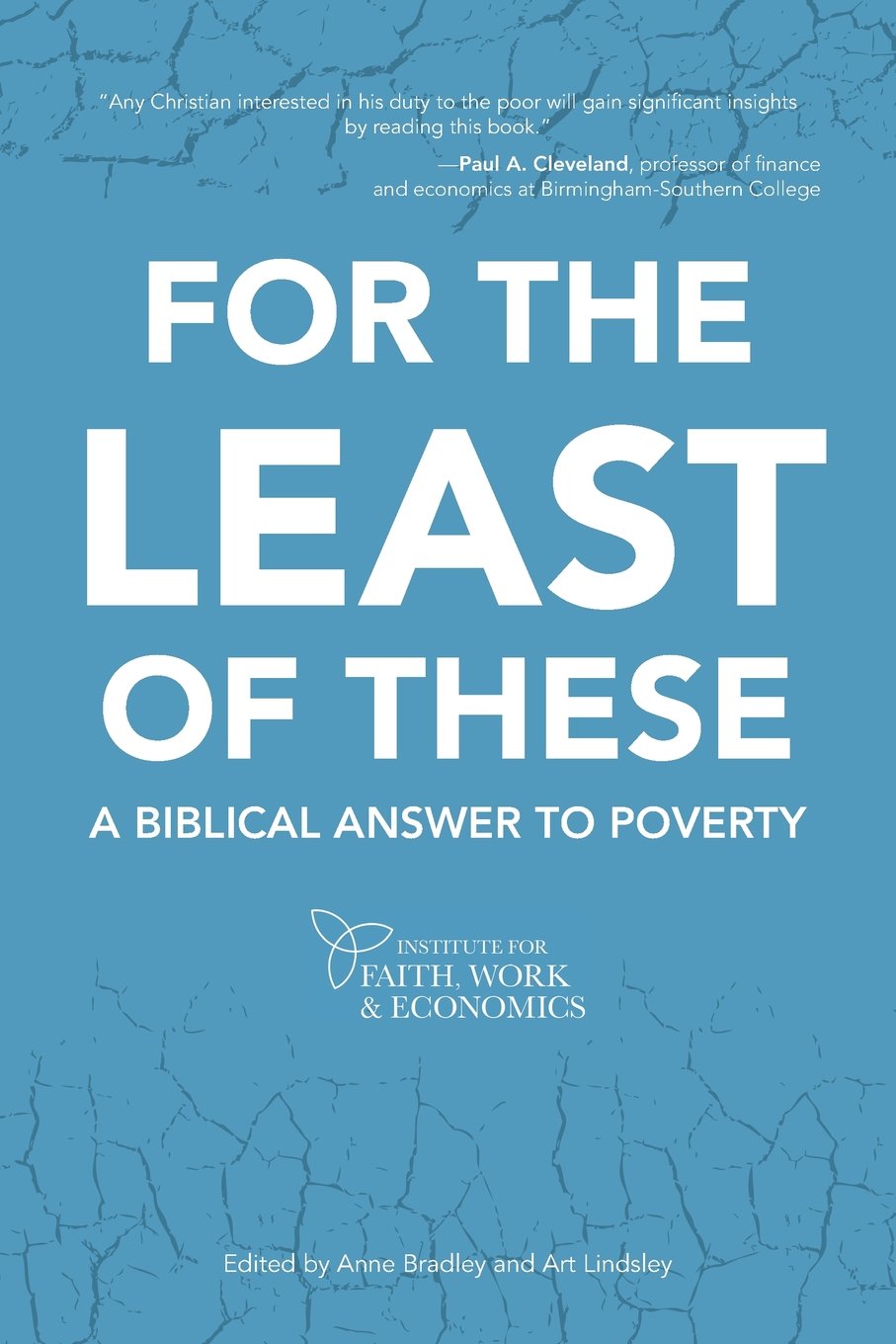
For the Least of These comprises a collection of short essays. Its purpose is clearly articulated by Arthur Brooks in the first paragraph of the Foreword: “The Christian Gospels make it abundantly clear that Jesus called on us to care for the poor. What is not at all clear, however, is the best means by which Christians living in a modern, industrial society … can and should carry out the Lord’s directive. This volume takes on the challenge of beginning to answer that question” (page 7).
The book seeks to fulfil its task through twelve chapters grouped under three headings: “A Biblical Perspective on the Poor”; “Markets and the Poor”; and “Poverty Alleviation in Practice”. As might be anticipated by those aware that its editors are Vice-Presidents of the Institute for Faith, Work & Economics, its basic thesis is that a free market economy is the best foundation for the alleviation of poverty. The authors are careful to avoid suggesting that the market automatically provides the solution or that the market is in some way an end in itself but they see it as having inherent potential. As Robert Sirico puts it in his chapter, “The price system in a free economy does not provide a moral foundation for a society. It does not remove opportunities for ill-gotten gain. What it does do is beat every form of socialism at generating moral socially beneficent options for escaping poverty” (page 179).
Negatively, the authors take issue with what Jay Richards (in the Conclusion) calls the “untutored intuition” that “if there are some rich people and some poor people, we can cure poverty by taking some of the wealth of the rich and giving it to the poor” (page 247). It is suggested that both government action (e.g. foreign aid) and some charitable activity (e.g. some gifts by churches to support people in the third world) is misconceived, if well meaning.
Positively, the promotion of trade and enterprise is advocated as the best long-term solution to poverty. For example, Brian Griffiths and Dato Kim Tan suggest that “Intentionally building a new factory close to a slum, creating jobs, and contributing to the local economy through its monthly wage bill, is far more effective in tackling poverty than all the CSR activities that companies can ever do” (page 145).
Most of the book is relatively high level. There are some interesting specific proposals for change. For example, Griffiths and Tan suggest that it is illogical to allow tax deductions for donations to charity but not to apply the same tax incentives to impact investing that builds social enterprises among the poor (page 151). However, proposals of this kind are few and far between. This is a pity since the inclusion of some more would have improved the book. In particular, the book’s suggestion that a lot of government action has produced drug like dependency cries out for proposals as to how the patient should undergo detoxification without dying in the process! On the other hand, the authors might legitimately respond that it is necessary to win the conceptual battle at the macro level before moving to the detail and that this is a small book devoted to that conceptual battle. Furthermore, by its very nature, a market based approach is likely to involve a multitude of approaches informed by general principles rather than large over-arching policies centrally implemented. That, indeed, is one of its advantages.
Of course, the essay format has some drawbacks. In particular, as might be expected in a book with fourteen different contributors, the arguments are not developed in a linear manner, the chapters overlap and not all of the arguments are consistent with one another (e.g. there are differences of view as to how bleak or otherwise the outlook for global poverty really is and different levels of optimism are expressed regarding micro-finance initiatives). In addition, some of the authors have tried to cram too much into their chapters, with the result that they are longer on assertion than argument and adopt language which, at least to UK ears, is unduly polemical (e.g. Jay Richards won’t win many friends by suggesting that Lyndon Johnson’s “War on Poverty” could just as well be called the “War on the Poor”, page 250).
Most readers will want to take issue with at least some of the arguments that are advanced, although they may not agree which arguments should be challenged! For example, David Kotter’s distinction between “wealth” and “riches” (page 60) and Robert Sirico’s suggestion that something is disordered “when it is imbalanced and disregards reason as well as the mandate of scripture” (page 176) are contentious interpretations of the bible. More generally, with the exception of Brian Griffiths, Dato Kim Tan and Richard Turnbull, all of the authors are based in the USA and the book has a clear US perspective. Indeed, some of the chapters relate almost entirely to the US experience (e.g. Anne Bradley’s chapter on Income & Equality). This US experience is important and interesting. There is much to learn from it. However, it would be good to consider other perspectives.
That said, each author contributes something worth thinking about and some of the contributions are very good: the chapters examining historic attitudes and actions in the UK and the USA (by Richard Turnbull and Mark Isaac, respectively) are particularly interesting since they allow the past to challenge contemporary attitudes; Art Lindsley’s short chapter on wealth redistribution comprises a concise demolition of superficial interpretations of the Old Testament Jubilee laws and of the practices of the New Testament Church; and Marvin Olasky’s chapter on the US welfare system, although in some respects perhaps over journalistic, raises a number of issues that deserve careful consideration.
For the Least of These is not a book for those looking for careful engagement with academic debates. Those looking for a systematic explanation of the potential of the free market to alleviate poverty should also look elsewhere. However, it is well worth reading. Few readers will come away without being challenged in some respect and the range of subjects covered should be a spur to further reading and thought.
“For the Least of These” was published in 2014 by Zondervan (ISBN – 10: 0310522994). 252 pages (excluding notes and glossary).
 Richard Godden is a Lawyer and has been a Partner with Linklaters for over 25 years during which time he has advised on a wide range of transactions and issues in various parts of the world.
Richard’s experience includes his time as Secretary at the UK Takeover Panel and a secondment to Linklaters’ Hong Kong office. He also served as Global Head of Client Sectors, responsible for Linklaters’ industry sector groups, and was a member of the Global Executive Committee.
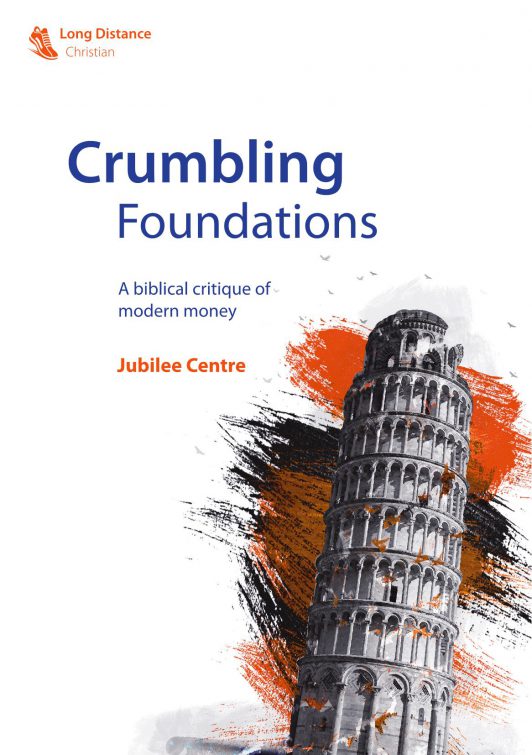
Crumbling Foundations is a stimulating and largely informative introduction to money and monetary systems. It includes a brief account of the history of money, an analysis some of the issues and problems of contemporary monetary systems, and some thoughts about how money might develop and diversify in the future. It also claims to be a biblical critique of modern money. The bulb on the back of the booklet says it brings biblical principles to bear ‘on a monetary system [that] is fundamentally unjust and unstable’.
The descriptive elements of the booklet are mostly good, much as one might find in a chapter on money in an introductory book on economics — with only a few places where an economist might want further clarification. Moreover, as a critique, this booklet has some important things to say. It’s very helpful to understand what money is, how it works, how it’s ‘made’ — and how it can be manipulated by the parties involved. It’s important to understand the vulnerabilities of different monetary systems, not least our own, and the different possibilities for monetary reform or innovation. That said, this booklet presents an almost entirely gloomy picture of the role of money in recent economic history. I would have liked more on the positive side — the contribution of banking and money to innovation, growth and the reduction of poverty, for example.
I was less persuaded by the many claims in the booklet to be a biblical analysis. There are two main ways the biblical material is brought to bear on the contemporary issue of money. The first relates to the biblical material concerning lending at interest. The claim is that the Bible presents lending at interest as ‘a form of injustice and oppression’ (page 25). This places the biblical approach at odds with modern monetary systems in which ‘debt and interest are inherent’ (page 19) and where most money is ‘created hand-in-hand with debt’ (page 41) — suggesting the need to develop systems of ‘positive money,’ created without debt (pages 41–42). But the biblical material on lending at interest is almost entirely concerned with situations of borrowing as an emergency measure to survive a period of extreme poverty. The biblical case laws regulate lending in this case, so that lenders do not profit from the misfortune of their neighbours, and so that borrowers have every opportunity to escape their poverty. To extrapolate from these cases to issues of debt and lending in general is quite unwarranted. Indeed, from Deuteronomy 23:20 it’s clear that lending at interest in some cases absolutely fine — ‘you may charge a foreigner interest’. This exception to the ban on charging interest in the rest of these verses does get a mention (page 20), but is skipped over with such unsatisfactory brevity that it renders this part of the booklet wholly unpersuasive.
The second way the biblical data is applied in the booklet relates to the wariness we find in the biblical account to centralised authority (page 12). Biblical teaching is concerned with ‘limiting [the] concentration of power’ (page 44). We can agree this is a biblical principle — although it’s perhaps more implicit than explicit, and certainly not spelled out in any great detail. But how much traction it gives us when we apply it to questions of money and the design of monetary systems is doubtful. After all, monetary systems are already to some extent decentralised. Individual nations tend to have their own currency, and individual governments frequently discover they have far less control over the money supply than they would like. How much centralisation is too much centralisation? It seems to me the Scriptures don’t give us any explicit guidance here. We have to come to a conclusion some other way.
Guy Brandon doesn’t fall into the trap of taking biblical descriptions of money and monetary practice and turning them into contemporary prescriptions. That would be a mistake, and he recognises this very clearly (page 34). (Just imagine doing something similar with the biblical descriptions of agricultural practice in the ancient world and building a ‘biblical critique’ of modern mechanised farming techniques.) Nonetheless, he does get pretty close to this mistake, especially in the concluding comments (pages 44–45). And he does overstate what the Bible has to say explicitly and directly on the ethics of money and monetary systems. It may well be in the end that money is one of many issues on which the Scriptures do not speak directly. As creative beings made in the image of God we are expected to work it out for ourselves — within broad parameters, summarized as loving God and loving neighbour. An exercise in biblical wisdom, then. To which at least some parts of this booklet make a useful — if rather one-sided — contribution.
“Crumbling Foundations: A Biblical Critique of Modern Money” was published in 2016 by The Jubliee Centre, Cambridge, 56pp.
Revd Dr Ben Cooper is Minister for Training at Christ Church Fulwood in Sheffield. He holds doctoral degrees in both Theology and Economics. Before training for ordained ministry, he was a post-doctoral research fellow in economic theory at Nuffield College, Oxford. He is married to Catherine and has three children.
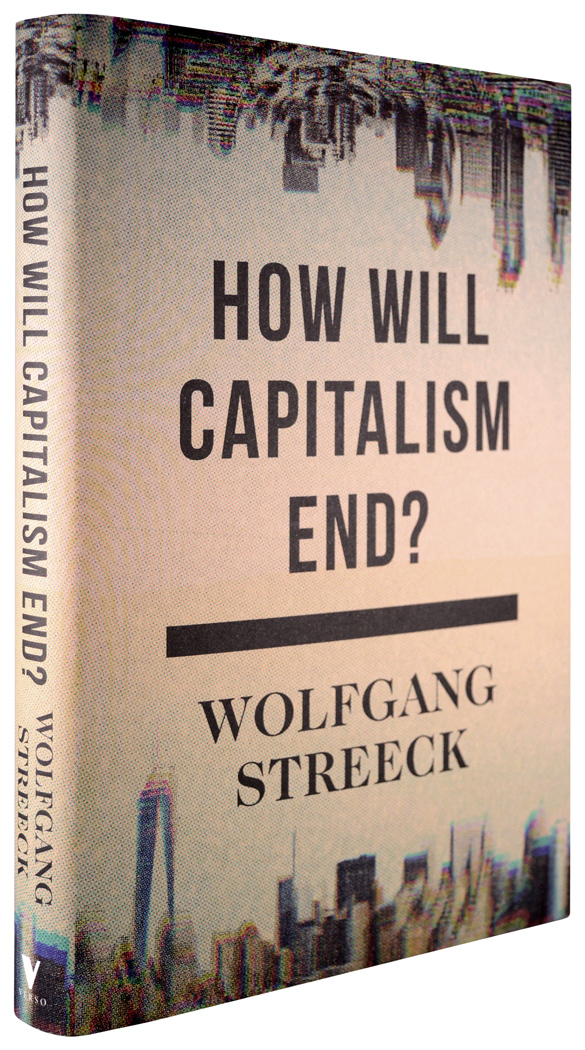
This book is a collection of previously published articles and one unpublished conference paper, with a new 46 page long introduction. It is therefore not a book that develops an argument skillfully and steadily, rather it hammers away at certain themes, sometimes repetitively. Streeck acknowledges this in his Note on the Text, where he admits to an ‘occasional overlap between chapters’ (p. ix). Having read through them all I did feel that at times this repetitiveness was unfortunate, although there is undoubted value in having the various articles gathered in one place.
The organizing theme taken by Streeck is that capitalism is collapsing because of certain internal contradictions. What is more, the author believes that we are living in a period of ‘deep indeterminacy’ (p. 12) in which it is difficult to predict what will happen, and that there is nothing obvious to replace our contemporary capitalist system. Other than at two brief moments, the prophetic message given is one of doom and gloom throughout the entire book, with no real sense of hopeful possibilities. In an emotional sense, and perhaps also because of its repetitive nature, I therefore found that reading this book left me dispirited, but also with a sense that the analysis might be incomplete or flawed.
One of the recurring strands running through the book is that of the relationship between economics and sociology. This is addressed through the lenses of economic history, the nature of money and debt, the difficult relationship between capitalism and democracy, commodification and inequality, and a consideration of the class structures within society (Marx certainly gets several mentions). This is summarized admirably concisely and clearly in the final paragraph of Chapter One, which bears the same title as the book itself, and which started life as a lecture given at the British Academy on 23rd January 2014.
At heart, although he never exactly states it in this way, Streeck presents a vision of capitalism as an epoch within history, whose time was always going to be limited, rather than accepting a view of history that must fit within a capitalistic meta-narrative. In order to sustain this argument, the author needs to describe capitalism in a certain, rather dysfunctional, way. So for example, Streeck sees innovation as something that ‘attacks and destroys in particular firms and markets that operate to everybody’s satisfaction.’ (p. 39) I was not convinced by this. It seemed to me that the author’s structuralist view of society had left little space for human creativity, and left him unable to see individuality as anything except a problem. However, prompted by Streeck’s analysis I did find myself asking about the nature of a wholesome vision of collective life within which individuals can flourish, and what kind of ‘progress’ this would mean.
The two moments, hinted at above, when Streeck himself ventures into the territory of suggestions or answers to these questions come at the end of Chapters Eight and Nine. Chapter Eight considers the troubled relationship between democracy and capitalism, taking the work of Wolfgang Merkel as a foil, but I was heartened to discover the suggestion of ‘de-globalizing capitalism’ (p. 198) and the idea that ‘restoring embedded democracy means re-embedding capitalism’ (p. 199) (italics in the original). For me, this idea offers the genesis of a new piece of work, different in tone to the current collection, and I would encourage Streeck to reflect on how this could be developed. Rather different, but equally important, is the moment at the end of Chapter Nine when Streeck feels for ‘…a non-capitalist politics capable of defining and enforcing general interests in the sustainability of human society’ (p. 225). I took this to be a call for the complex relationship between politics and economics to be re-imagined.
This brings me to another problem that I had with this book; it has in a sense been overtaken by the events of the Brexit referendum and the election of Donald Trump. The relationship between politics and economics is being re-drawn before our eyes, the old assumptions are unraveling, and faltering attempts at what could be called a ‘non-capitalist politics’ are emerging. I feel sure Streeck must now be writing something new, and I would encourage him to do so. From a Christian perspective, deep questions of identity connected to the individual and to society are very resonant with theological reflections on the nature of life itself, and the way in which societies and economies are arranged. I was therefore pleased to have been stimulated in my own thinking as I read this book. I look forward to a more cohesive, less repetitive, and post-Brexit sequel.
The book is nicely presented with a good index. The author is the Director of the Max Planck Institute for Social Research in Cologne and Professor of Sociology at the University of Cologne.
How Will Capitalism End? Essays on a Failing System – by Wolfgang Streeck, 2016, ISBN 13: 978-1-78478-401-0

Edward Carter is Vicar of St Peter Mancroft Church in Norwich, having previously been the Canon Theologian at Chelmsford Cathedral, a parish priest in Oxfordshire, a Minor Canon at St George’s Windsor and a curate in Norwich. Prior to ordination he worked for small companies and ran his own business.
He chairs the Church Investors Group, an ecumenical body that represents over £10bn of church money, and which engages with a wide range of publicly listed companies on ethical issues. His research interests include the theology of enterprise and of competition, and his hobbies include board-games, volleyball and film-making. He is married to Sarah and they have two adult sons.
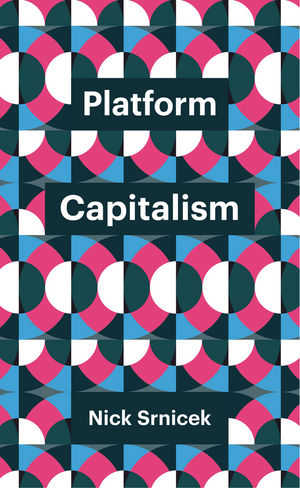
Those who have studied modern technology based or enabled companies will doubtless consider Platform Capitalism to be superficial. Srnicek does not provide any worked through suggestions that will be useful either to the makers of public policy or to those involved in the management of business and many of his conclusions are contentious and appear to be based more on his prior left-wing accelerationist philosophical position than on the evidence presented in this book.
And yet: the book is interesting and thought provoking. Leaving aside the eccentric use (or, rather, minimal use) of paragraphing, Srnicek has an engaging style and presents a readable and helpful overview of the impact of technology on economic activity and of the strategy of technology companies. The book is short (l29 small pages) and can easily be read carefully in a couple of evenings. It is worth devoting this time to it.
Srnicek’s subject is the effect of digital technology on capitalism. He claims that “the platform” has emerged as a new business model and his aim is “to set these platforms in the context of a larger economic history, understand them as a means to generate profit, and outline some tendencies they produce as a result” (page 6). After a reasonably orthodox (if very obviously left-wing) review of economic and business trends since the 1970’s (primarily focussed on the USA and UK), he moves on to consider the emergence of “platforms”, which he defines as “digital infrastructures that enable two or more groups to interact” (page 43). He distinguishes five types of these: advertising platforms (e.g. the Google search engine), which allow their owners to extract information on users, undertake analysis, and use the product of this to sell advertising space; cloud platforms (e.g. Amazon Web Services), which comprise hardware and software that is rented out to digital-dependent businesses; industrial platforms (e.g. that of GE), which comprise the hardware and software necessary to transform traditional manufacturing; product platforms (e.g. that of Rolls Royce), which transform a traditional good into a service; and lean platforms (e.g. that of Uber), which are like product platforms but whose owners attempt to reduce their ownership of assets to a minimum.
The analysis of each of these business models is much the most interesting part of Platform Capitalism. Srnicek concludes, perhaps surprisingly, that lean platforms “seem likely to fall apart in coming years” (page 88) but he recognises that the other types of platform are here to stay. He sees some benefits in this (e.g. better products for customers) but his main focus is on the concerns to which the emergence of platforms gives rise.
His biggest concern is the perceived monopolistic tendency of platform capitalism. He returns to this on a number of occasions and asks “Will competition survive in the digital era, or are we headed for a new monopoly capitalism?” (page 94). This is certainly a question that needs to be addressed but, Srnicek’s analysis points to various factors that suggest that there will continue to be significant competition among the platform providers. Nonetheless, his prognosis is bleak. “Let us be clear,” he says, “this is ….. the concentration of ownership” and, he continues, “Far from being mere owners of information, these companies are becoming owners of the infrastructures of society” (page 92). This is surely unduly apocalyptic.
Srnicek’s other major concern relates to labour. It is here that his left-wing philosophy is most apparent. He points to some real concerns (e.g. the mis-labelling of employees as independent contractors with a view to avoiding employment protections) and he dismisses the absurd idea that user-created data comprises the exploiting of free labour. However, he makes many statements that rely on assumptions that are at best dubious. For example, his suggestion that “In a healthy economy [people such as Uber drivers] would have no need to be micro-tasking, as they would have proper jobs” (page 82) seems to be based on the assumption that the job market of, perhaps, 50 to 70 years ago is the only acceptable model and smacks of left-wing nostalgia for the days of manufacturing-based factory capitalism. Likewise, his suggestion that companies such as Airbnb have “off-loaded costs from their balance sheet and shifted them to their workers” (page 83) suggests preference for the rigidities of integrated corporate monoliths over the more flexible models permitted by modern technology.
The book also suffers in some places from loose use of terminology. For example, Srnicek several times mentions (with apparent disapproval) the “cross-subsidisation” that he believes is inherent in some platform business models (e.g. Googles) that involve providing a free service that enables advertising space to be sold. This use of the term is eccentric. Google is no more involved in cross-subsidisation than are the owners of commercial television stations or free local newspapers that have historically survived by selling advertising space. It is hard to see what is wrong with the Google “cross-subsidisation” model from a competitive or any other point of view.
More seriously, Srnicek’s frequent attacks on “tax evasion” are mis-directed. Many people are rightly concerned about tax evasion but he confuses illegal evasion with legitimate tax minimisation. In particular, he seems unaware that, pursuant to express US law, US corporations may legally avoid the payment of US tax on foreign profits for so long as these are not repatriated. He may not like the relevant US legislation but there is logic behind it and, in any event, companies can hardly be criticised for making use of it. His statement that “The leaders of tax evasion have …… been tech companies” (page 59) followed by a list of well-known names, without any supporting evidence, is both disturbing and disappointing.
The final section of the book (relating to what the future may hold) is less disturbing but equally disappointing. One idea is piled on another. In less than two pages, there are suggestions of: co-operative platforms; anti-trust action; regulation of, or even the banning of, lean platforms; co-ordinated action on tax; the creation of “platforms owned and controlled by the people”, which must nonetheless be “independent of the surveillance State apparatus”; “post capitalist platforms” (whatever they might be); and the collectivisation of platforms (pages 127/8). None of these ideas is explored and one may doubt the realism of at least some of them and the practical benefits of others.
This is a pity because there are many issues arising from “platform capitalism” that should be explored by both policy makers and those involved in business. What are the implications for privacy and, indeed, personal freedom and how should we respond to these? What kind of protections for “workers” are practicable and appropriate in a digital world? Where do the responsibilities of the platform companies to employees, customers, suppliers and others begin and end and how can they best discharge them? What kinds of regulatory regimes (if any) are needed for this kind of company and how can they be imposed in a digital, cross-border world? Generally, what does responsible digital business look like?
Srnicek fails to offer any insights into these matters. None-the-less, his analysis of the platform companies is important because it should help others to do so. It should also help all of us to note the way in which the business world is moving and avoid suggesting outdated solutions to modern business problems.
“Platform Capitalism” was first published in 2017 by Polity Press (ISBN 1509504869, 9781509504862), 120pp.
Richard Godden is a Lawyer and has been a Partner with Linklaters for over 25 years during which time he has advised on a wide range of transactions and issues in various parts of the world.
Richard’s experience includes his time as Secretary at the UK Takeover Panel and a secondment to Linklaters’ Hong Kong office. He also served as Global Head of Client Sectors, responsible for Linklaters’ industry sector groups, and was a member of the Global Executive Committee.
Revd Dr Ben Cooper is Minister for Training at Christ Church Fulwood in Sheffield. He holds doctoral degrees in both Theology and Economics. Before training for ordained ministry, he was a post-doctoral research fellow in economic theory at Nuffield College, Oxford. He is married to Catherine and has three children.
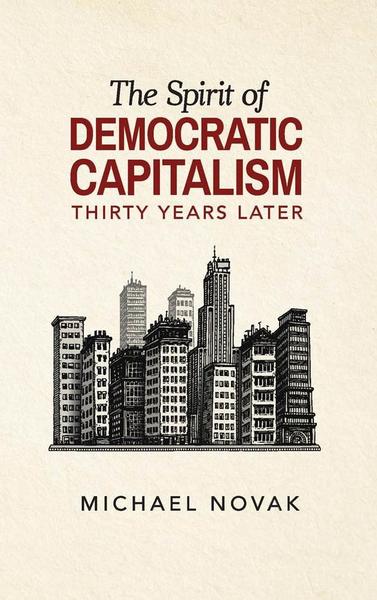
Martin Novak is an American Catholic author, philosopher, and theologian. Born in 1933, he tells of how he took seriously Aristotle’s advice that a man cannot write well on ethics until he is at least fifty, and so waited until the late 1970s before starting work on what has become his most influential book, The Spirit of Democratic Capitalism. In the intervening years, he had become increasingly convinced that the actual practice of what he calls “democratic capitalism” is more consistent with the high ideals of Judaism and Christianity than the practice of any other system. This was a radical conclusion to reach. As he notes (page 242), it was generally assumed at the time that prominent thinkers like Paul Tillich were right to say, “Any serious Christian must be a socialist”. The term “capitalism” was used in many Christian circles, as it was by many in the academy, with contempt.
The Spirit of Democratic Capitalism was published in 1982 — just before Novak’s fiftieth year, as it happens, but it is nonetheless ethical writing on political economy of the highest quality. The book is divided into three parts, beginning with an enquiry into “the ideal of democratic capitalism”. The term “democratic capitalism” was not in wide usage at the time, and Novak appropriates it to describe a three-fold dynamic system: “a democratic polity, an economy based on markets and incentives, and a moral-cultural system which is pluralistic and, in the largest sense, liberal” (page 14). Novak challenges the negative stereotypes: “The spirit of democratic capitalism is the spirit of development, risk, experiment, adventure” (page 48). It is pluralistic: power and control is dispersed, countering any tendency to tyranny. It is relatively resilient to errors of unintended consequence. It doesn’t make the mistake of thinking economic decisions constitute a zero-sum game. It’s more conducive to community than you might think, especially in relation to the family. All this, Novak contrasts with socialism in the second part of the book, “The twilight of socialism”. In the light of its practical failures, socialist thinkers have retreated into idealism and claims of moral vision, mostly centred around questions of equality and justice (page 207). Novak critiques these claims both at the level of ideals and, in one of the rare empirical sections of the book, in terms of real outcomes. In the final section, he then attempts “A theology of economics”, critiquing a number of approaches before outlining his own, rather limited, account of the theological doctrines underpinning democratic capitalism.
This is a lengthy book, requiring some perseverance to work through its 460 pages. I found myself on occasion yearning for a more orderly and concise argument. Other times, I felt in need of some more formal analysis or hard evidence. Nonetheless, The Spirit of Democratic Capitalism is essential reading for anyone interested in the ethics of political economy. The basic argument is, on the whole, satisfying and persuasive. Socialism claims, in part, that capitalism institutionalizes greed and selfishness (page 92), and positions itself as an antidote. But socialism cannot do away with greed and selfishness. Rather, these negative impulses survive to inflict enormous damage, because the rigidity of a centralised system means there are relatively few checks and balances to constrain them. Under capitalism, the constraints on the damaging social effects of greed and selfishness turn out to be superior, because success typically depends on doing something that will be of benefit to other people (although, as Novak and others have noted, this requires a democratic polity and strong moral cultural foundations to function well). Moreover, capitalism provides a setting within which some of the more positive aspects of human nature, such as creativity and invention, can flourish. In such a setting, many kinds of failure are actually part of the learning process through which innovations develop and improve, and cause economies to grow. Importantly, in none of this does Novak claim perfection for democratic capitalism. It “does not promise to eliminate sin” (page 85). His claim is a relative one: “all other known systems of political economy are worse” (page 28). It’s in democratic capitalism, he goes on to say, that our best chances lie: “Such hope as we have for alleviating poverty and removing oppressive tyranny — perhaps our last, best hope — lies in this much despised system”.
So successful is Novak’s basic argument that the question now is not so much whether one should be “for” democratic capitalism or “against”; rather, the question becomes what kind of democratic capitalism should we favour and promote? Given that “the democratic capitalist revolution is moral, or not at all” (page 439), Christian thinkers should have plenty to contribute on this question. Novak’s own attempt to do so in the final section of the book is perhaps its weakest and most undeveloped part. There is only the faintest glimpse of how democratic capitalism might fit with the wider plans and purposes of God in history across the nations. On such things Novak was very clear even as he wrote that there is much more to say.
“The Spirit of Democratic Capitalism” was first published in 1982 by Simon & Schuster. This is a review of the revised edition, published in 1991 by Madison Books (ISBN-10: 0819178233), 460pp.
Revd Dr Ben Cooper is Minister for Training at Christ Church Fulwood in Sheffield. He holds doctoral degrees in both Theology and Economics. Before training for ordained ministry, he was a post-doctoral research fellow in economic theory at Nuffield College, Oxford. He is married to Catherine and has three children.
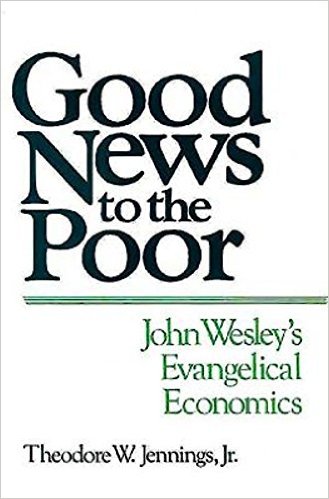
John Wesley’s influence in the history of Christianity is indisputable. His movement for ‘scriptural holiness,’ his foundation of Methodism as both movement and denomination, his organisational prowess, his spiritual passion for the established church, all form part of his legacy. His Journals, letters and sermons are a goldmine of information and insight. Naturally this wealth of primary resources has also generated a history of interpretation. The fire in his parents’ Rectory at Epworth (‘a brand plucked from the flames’) came to form part of the providential history of Methodism, as indeed did his ‘conversion’ experience at a meeting of the Moravians in Aldersgate Street in London in May 1738. Wesley also was a political conservative, a supporter of the monarch, willing to pray against the French and resistant to the rebellion of the north American colonies.
So, a quest for Wesley’s economic and social ethic is an attractive possibility. Surely if there is an ‘evangelical economics,’ we will find Wesley an able exponent? The enormous strength of this book is that it gathers into one place Wesley’s writings and teachings on economic and social matters. The weakness lies in the interpretation in which we learn more about the author than we do the subject.
Professor Theodore Jennings is currently an affiliated Faculty member of Chicago Theological Seminary as Professor of Biblical and Constructive Theology. He has been a local pastor and also taught at the Methodist Seminary in Mexico City. He clearly stated aim is to re-interpret Wesley through the lens of liberation theology. So his starting point is a ‘demystification of wealth and power’ and a ‘preferential option for the poor’ (pp24-25). By ‘evangelical economics’ the author means ‘the criticism of wealth, the forms of solidarity with the poor, the notion of stewardship, and the vision of an economic practice based on the example of the Pentecostal community’ (p24). Intriguing though these themes are, they hardly form an adequate definition for ‘evangelical economics.’
The book is constructed around these key themes together with chapters on ‘The Theological Basis of Wesley’s Ethic,’ ‘Why did Wesley Fail?’ and ‘The Relevance of Wesley,’ together with an appendix on ‘Wesley on Politics.’ These chapters, forming the second half of the book, are essential to Jennings interpretative exercise – because he has, by his own admission, to deal with Wesley’s well-known conservatism, his swift abandonment of the Pentecostal ideal, Wesley’s own contra-writings to the liberation theology theme and the unwillingness of Methodism to embrace the apparent ideals of their founder.
Jennings powerfully brings out Wesley’s critique of wealth and excess. Wealth was a temptation and increasing riches increase the temptation and conformity to the world. Luxury leads to laziness and contempt for the poor. Jennings here draws upon Wesley’s Journal and his sermons, On Riches, The Danger of Riches, On the Danger of Increasing Riches. Wesley expounds the theme that all our riches and wealth are held on stewardship from God and with a purpose:
Do you not know that God entrusted you with that money (all above what buys necessaries for your families) to feed the hungry, to clothe the naked, to help the stranger, the widow, the fatherless; and, indeed, as far as it will go, to relieve the wants of all mankind (p102, quoting the sermon on ‘The Danger of Increasing Riches’).
Wesley’s most famous treatise on the matter was his well-known sermon on ‘The Use of Money,’ and the famous three-fold injunctions of ‘Earn all you can, save all you can, give all you can.’ Jennings does recognise the complexity of this sermon but we see also his own forced interpretation here by his description of this sermon as ‘the source of most of Wesley’s problems with the Methodists’ (p167). This is wholly inadequate by way of interpretation. Wesley refers to money as ‘an excellent gift of God’ and being of ‘unspeakable service to all civilised nations,’ whilst also arguing for ‘honest industry’ and for the avoidance of sinful trade or the undercutting of competitors. In reality there is little economics (evangelical or otherwise); the feel is very much that of a preacher.
There is also the vexed question of Wesley’s advocacy of the ‘community of goods,’ upon which Jennings places great store but about which two things are clear. First, that Wesley experimented intellectually (and hoped to do so practically) with the idea in the 1740s and, secondly, that he subsequently abandoned it either because he considered it to be unrealistic or because his thought had moved on, perhaps as he preached his sermon on “The Use of Money” (which he delivered on 23 occasions according to the sermon register, starting in 1744, and which was printed in 1760).
Despite his occasional radical thoughts Wesley stood in the mainstream tradition; he accepts the basic role of the market, offers strictures against excess and looks to the voluntary principle as a response to social need. However, for all that, we should not underestimate the power of his critique of wealth and money.
Ultimately, Jennings forces the material to his theme. He makes far too many pejorative interjections in his interpretation for the contemporary age. That is not to say that there is nothing powerful about gathering together from their disparate sources Wesley’s economic and social thought. However, he does so partially. By separating those writings of Wesley which operate in the opposite direction we are left with two halves of a theological tradition without the necessary interpretation of the complexity. Wesley was not an economist and his writings on economics – claimed indeed by both ‘free-marketers’ and ‘socialists’ (which merely illustrates the complexity) – simply cannot be garnered into some overarching economic strategy. As a preacher he certainly knew the challenges wealth brought; about business and market itself (the use of the word capitalism would be an anachronism) he was unquestionably equivocal.
“Good News to the Poor: John Wesley’s Evangelical Economics” was first published in 1990 by Abingdon Press (ISBN-10: 0687155282)

Dr Richard Turnbull is the Director of the Centre for Enterprise, Markets & Ethics (CEME). For more information about Richard please click here.