Skip to content
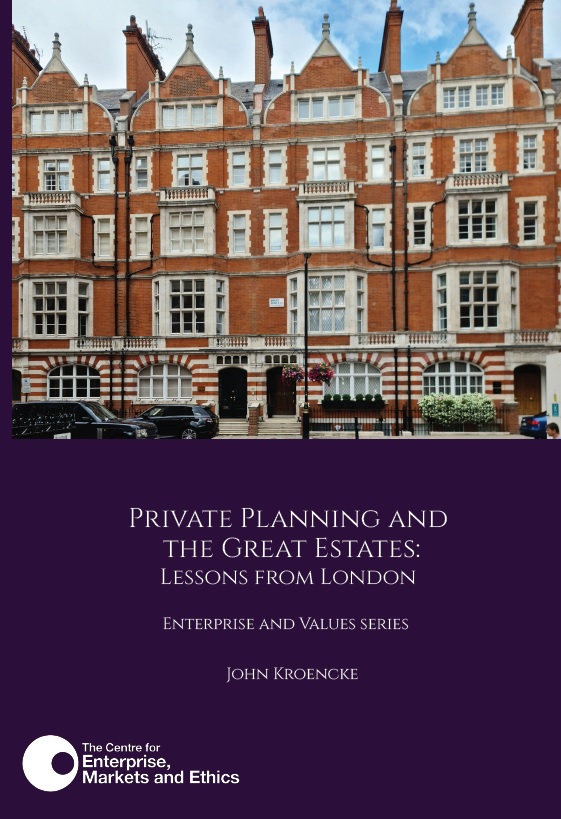
Private Planning and the Great Estates Cover

Private Planning and the Great Estates (Conclusion)

What lessons are to be learnt from the great estates and their role in the development and redevelopment of London? The physical development of a city is not, as is often supposed, merely another aspect of its economic activity. Decisions on the use of land are absolutely fundamental to the (...)

Continue Reading
Private Planning and the Great Estates Cover

Chapter 3: The Rise of Public Planning

Parts 2 and 3 emphasised the historical role of private planning in the development and redevelopment of modern London, and argued that it had some of the benefits often claimed for regulated systems, such as responding dynamically to changing circumstances and solving externality problems. This chapter traces the role of (...)

Continue Reading
Private Planning and the Great Estates Cover

Chapter 2: Falling in and building up: adaptation and the leasehold system

London’s expansion was neither uniform nor managed: London was expanding in the 1870s hand over fist, or rather in fits and starts. How was all that growth managed? Of planning in the modern sense of the word there was none to speak of, either physical or economic. London was still (...)

Continue Reading
Private Planning and the Great Estates Cover

Private Planning and the Great Estates (Introduction)

    We can learn much from urban history. Perhaps more interesting than the record of any particular time period are the dynamics of the system: how cities respond to changes in markets, technology and social forces. In the last 70 years, parts of London have changed greatly. The skyline, (...)

Continue Reading
Private Planning and the Great Estates Cover

Chapter 1: Basics of Leasehold Development and Planning on the Great Estates

From the seventeenth century onward countless town planners (who would never have called themselves that) were engaged in imposing rationally conceived patterns of growth and development on London. For the most part they were not associated with any political body but were connected with one or another of the ground (...)

Continue Reading

Interviews

Conversations with the Centre for Enterprise, Markets and Ethics Perspectives on contemporary issues There are growing concerns that capitalism and democracy are in crisis. Despite the success of free markets in creating global prosperity over two centuries, the recent slowdown in growth in Western economies, the persistence of inflation, increasing (...)

Continue Reading

Neil Jordan: (How) Does Artificial Intelligence Think? (What) Does it Know?

A recent article reports on work by researchers at Anthropic, the AI lab that developed a ‘reasoning’ AI model, and their ability to look into the digital brains of large language models. Investigating what happens in a neural network as an AI model ‘thinks’, they uncovered some unexpected complexity that (...)

Continue Reading
Is The Non-executive Director worth saving

Is the Non-Executive Director Worth Saving? (1/5)

PDF Introduction Is the non-executive director (NED) an endangered species? Does it matter? Neither corporate collapse nor corporate scandal are new. They rightly attract media scrutiny and the interest of policymakers and regulators. Illustrative examples include Thomas Cook (2019), Carillion (2018), Patisserie Valerie (2018), Northern Rock (2007) and, earlier, Barings (...)

Continue Reading

The Centre for Enterprise, Markets and Ethics (CEME)

  Ethical foundations for a market economy

Continue Reading

Brian Griffiths: A Celebration of Advent

By Brian Griffiths

  The meaning of Advent I must first make a confession. I love carol services. I love singing carols. I love the Christmas tree. I love Christmas decorations. I love the festivities of Christmas. They remind me of when I was very young singing carols from house to house in (...)

Continue Reading

Long a political target, big business polls better than you might think

By John Kroencke

Despite criticising the actions of big business being a favourite pastime of many a business minister, John Kroencke writes that wider opinion of big business is actually more favourable than we might expect.  Like many I rely on Amazon. In fact, there is rarely a week where a package doesn’t (...)

Continue Reading