
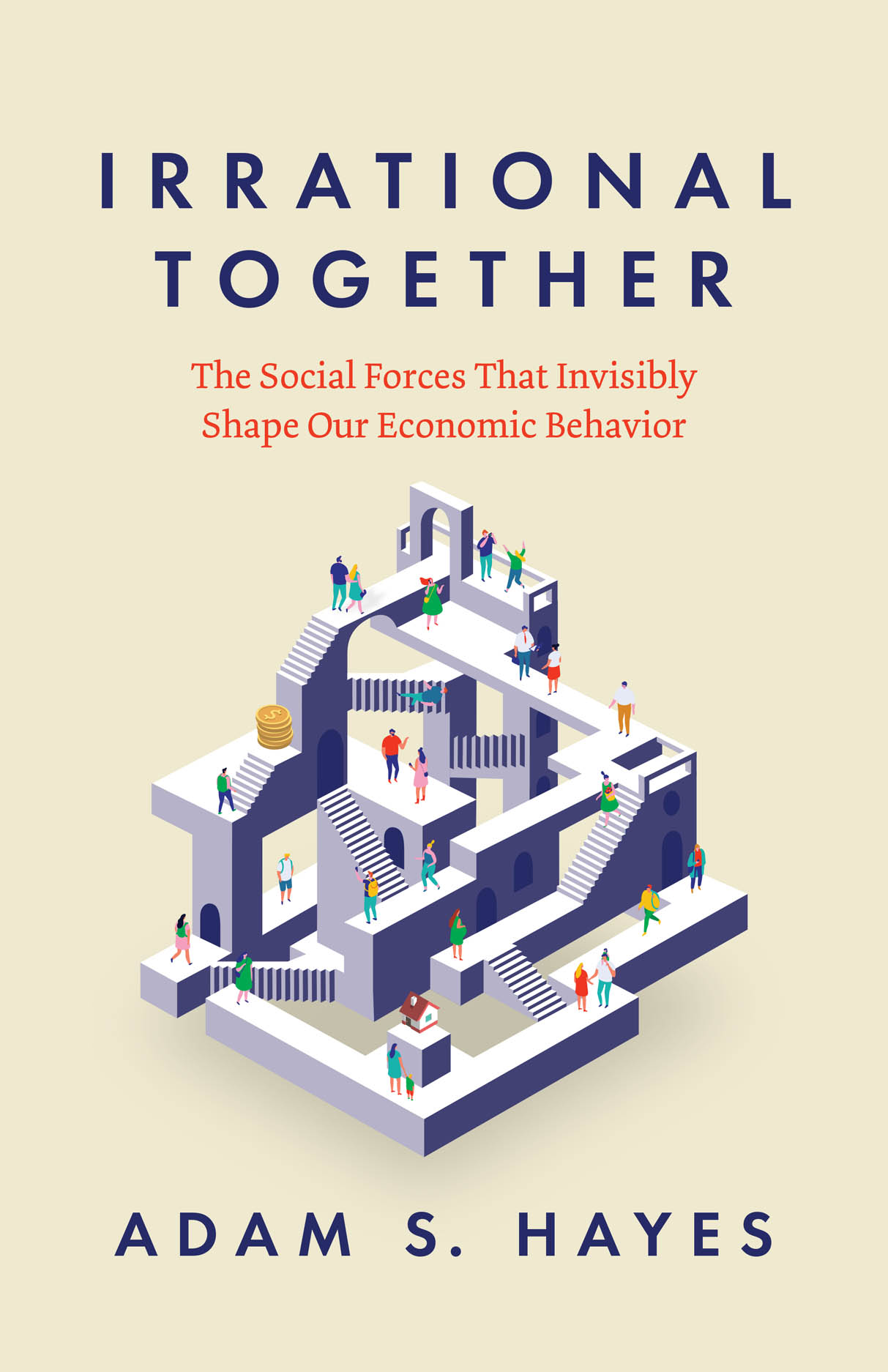
In Irrational Together, Adam S. Hayes (Professor of Sociology at the University of Lucerne) seeks to show that our economic decisions are not simply a matter of rational self-interest as traditional economic thought would suggest; rather, ‘our thinking is influenced by a mix of psychological and sociological factors, which often defy traditional economic reasoning’ (page 5). The point is that in order to truly understand our economic behaviour, we must look beyond economics itself and pay attention to sociological factors. Economic life is social and involves more than just rational calculation: ‘economic behaviours, therefore, cannot be fully understood without considering the social world in which they occur’ (page 11).
Thus, the purpose of the book, as stated in the introduction, is to examine the interplay of the social world with economic decisions: ‘economic behavior does not emerge in a social vacuum’ (page 18). In spite of the advances in economic thinking about human behaviour, the discipline does not adequately recognise the importance of social influences and tends to fall back on the assumption of rationality. However, sociological perspectives ‘can enrich our understanding of seemingly irrational economic actions by revealing the influence of social structures, relationships, and contexts’ (page 19).
In the second chapter, the author explores the thought of the French sociologist, Pierre Bourdieu, whose work on capital posits that in different spheres or activities (or ‘fields’) we engage in accumulating different kinds of currency (or ‘capital’), which is collected and deployed according to various rules in order to acquire status. In the economic field, we make decisions and take risks with a view to acquiring wealth, while capital in the cultural field might consist of acquiring cultural objects such as works of art, together with refined taste and the ability to explain the meaning of such objects. While we may all possess different kinds of capital, the ‘rules of the game’ vary in different fields, such that what counts as rational in the economic sphere is not rational when assessed purely in terms of the cultural sphere (for example). The author’s own experimental research supports this analysis and he argues that we do not make rationally optimal decisions because no such things exist: ‘our economic choices are not entirely our own, nor are they made in a vacuum. They emerge from a blend of social, cultural, and psychological factors that mold distinct dispositions toward money, markets, and risk – depending on where we are located in society and from where we came’ (page 37).
Chapter 3 turns to the roles of social networks and identity, considering the significance of personal contacts and relationships on economic behaviour. The author shows how different types of relationship inform our decisions, delineate the information available to us, and generate trust and obligations. We frequently follow social norms simply because they exist rather than because they achieve any particular individual advantage – and even companies engage in ‘herd behaviour’. The point is that these kinds of behaviours are not anomalous. They can be made sense of when viewed from a sociological perspective: ‘In the economic game, what looks like irrational behavior might be perfectly reasonable within the context of someone’s social environment’. (page 110).
The fourth chapter moves from the broad level of social influences on our economic behaviour to the micro-level effects of specific, concrete relationships, pointing out that our economic decisions are shaped by ‘relational work’ that maintains these relationships. Money thus becomes imbued with moral, emotional and symbolic meaning and is not simply a neutral method of exchange, where every pound or dollar has the same worth, regardless of its source or intended use. This helps to account for a number of apparently ‘irrational’ behaviours and as the author’s research suggests, relational factors have an influence on the way that money (and not simply goods such as heirlooms or houses) is invested and used.
The fifth chapter concentrates on gender, revisiting earlier concepts to explore their gendered elements and arguing that discrepancies in financial literacy and risk aversion between women and men are the results of gender socialisation. The author’s own research on the gendered biases contained in the presentation and reception of financial advice from online influencers underscores the point that traditional economic concepts of rationality fail to take account of gender differences, which do matter. The interesting question here is whether, if there are various biases at play of which we are largely unaware, there might in fact be an argument in favour of seeking fundamental economic truths by way of a basic rationality free from socially constructed, supervening influences – a ‘gender neutral’, purely economic rationality, as it were.
Chapter 6 turns to the use of ‘nudges’: the attempts to alter the ‘choice architecture’ of our environment in order to steer us towards more rational decisions without actually using coercion – an example being the strategic placement of goods in shops aimed at encouraging more healthy selections. The approach works on the level of individual psychology and is founded on the assumption of rational self-interest, but ‘For behavioral nudges to work in real-world settings and with real people, it is essential to address social context.’ (page 181). The author’s extensive research on Fintech apps that employ algorithmic calculations based on the principles of mainstream financial theory – itself grounded in assumptions of rational self-interest – to assist investors, suggests that efficient as such platforms are, they effectively discipline users, thereby constructing a body of almost perfectly rational investors of a kind that has never actually existed. Reforming human behaviour in this way creates risks of its own, by treating as a bug and eliminating the natural ‘irrationality’ that has always been a feature of human behaviour and markets: ‘… the market is never just “the market.” It’s a complex social institution, affected by a multitude of rational and irrational behaviors and motivations. When we talk about the limitations or dangers of an “overly rational” market, what we’re really talking about is the danger of forgetting that markets are social constructs, embedded in complex webs of human relations, politics, and collective values’ (page 206).
The book is very well-written throughout: the style is very accessible and illustrated with clear examples. Each chapter presents the author’s own research and most frequently revisit key concepts from behavioural economics to demonstrate the salience of sociological factors. There is, therefore, a consistent structure and focus, the author always returning discussions to the central issue under consideration
Across the book the argument emerges that that while much of our behaviour could be described as irrational from the point of view of pure economics, it is not irrational in itself and can be accounted for by sociological perspectives. Thus, we do not need to be ‘reformed’ or educated so as to improve our rationality; rather, economics needs to broaden its terms of reference. This is not to say that economics needs to plug more factors into its models; rather, as a discipline, it simply needs to accept insights from other fields: ‘Economic behavior is, therefore, far from being a one-dimensional issue. And it’s not something that can be explained by one theory alone – psychological, sociological, or otherwise. It’s an amalgam of many elements: individual self-interest, cognitive biases, social networks, interpersonal relationships, and cultural contexts, among others. These elements, while they may be practically siloed in their respective academic disciplines, are rather interconnected when it comes to real-world decision-making’ (page 98). Irrational Together deserves to be read by anyone interested in a broader understanding of economic life and the question of what other disciplines can offer economics.
‘Irrational Together: The Social Forces That Invisibly Shape Our Economic Behavior’ by Adam S. Hayes was published in 2025 by The University of Chicago Press (978-0-226-83931-8). 254pp.