
In March this year, I raised the question of whether the council tax premium on second homes constituted a solution to difficult problems – namely shortages of housing in some areas and straitened local authority finances – or was in effect a sumptuary law of sorts.
The Moral Issue
An important question was whether there was any ethical justification for the premium. One justification might be that investing earnings in a second home is in effect acting against the public interest, such that councils use the premium to discourage ‘hoarding’ of a scarce resource (housing). In response, however, some argue that such an outlook is naïve: second homes are often unsuitable for local residents, particularly first-time buyers, usually because of their age or character and cost, while in other cases, owners who renovate very old properties, far from diminishing the stock of habitable homes, actually add to it in the long run.
A further justification would be that the council tax premium helps to fund local services, yet critics argue that second home owners are thereby charged disproportionately for services – services that they do not even use all year round. As such, the rate charged appears to constitute supranormal taxation, legitimated by the additional wealth represented by possession of a second home. The suggestion here is that there is an ethical justification for taxation at a higher rate, as though wealth (or certain ‘lavish’ uses of it) is somehow immoral – a notion which historically lay behind certain sumptuary laws and which appears to be finding support at present. Recent discourse has suggested growing interest in new wealth taxes and there has been discussion of tax rises to target the wealthy in the forthcoming budget.
Interestingly, the government has not so far taken the view that wealth is unethical, the Chancellor having stated in the past that hers was now the party of wealth creation and written that wealth creation would be the defining mission of the government. While this was questioned from both sides of the political divide, as to whether it the proper role of government or even a desirable objective in itself (when perhaps wealth distribution might be considered a more pressing issue), there was clearly no suggestion on the Chancellor’s part that wealth was ‘unethical’.
The Economic Issue
On the economic aspects of the premium, I suggested that these would need to be observed before any conclusions could be drawn about their success as policy measures, and noted that historically, sumptuary laws, in addition to being difficult to assess, tend to have unintended consequences. The results of any council tax premium are likely to differ according to the area in which they take effect, as well as the manner in which they are implemented – and it is probably too early to make any kind of general judgement regarding their success or otherwise – but developments in one council are interesting.
A Local Case
It has been reported that Pembrokeshire County Council, which has the second highest number of second homes in Wales, has reduced its council tax premium on second homes twice in the space of 12 months. Having been increased to 50 per cent in 2017 and then 100 per cent in 2022, the rate has been reduced from a high of 200 per cent in 2024, to 150% and in recent weeks, to 125%.
It would appear that hundreds of second homes have been offered for sale in recent months, which would suggest that as a measure designed purely to increase housing stock, the premium could be considered successful. However, such properties have been slow to sell because prices are too high for local residents to afford. To date, therefore, the measure could not be said to address the lack of suitable available housing in the area, though there remains the question of market dynamics will lead to a longer term ‘correction’ of prices.
Unintended Consequences
It is evident that the premium as implemented has had unintended consequences. There is anecdotal evidence that the reduced number of holiday homes is having a negative impact on tourism in the area, Pembrokeshire being home to popular holiday destinations such as Tenby. Those in favour of the premium question its effects on tourism but any such decline in economic activity is likely to result in reduced tax revenues. It is of interest that a public consultation revealed a majority of non-second home owners (64 per cent) preferring a reduction in the premium on second homes.
Furthermore, the latest reduction in the council tax premium, effective from April 2026, will cost the council £1.4 million in potential income next year, which makes higher council tax increases for permanent residents more likely.
Conclusion
There are indeed serious challenges to be addressed by local authorities. Suitable, affordable housing is often in short supply and many are facing serious budgetary difficulties. A higher charge on second homes suggests itself as an obvious measure for addressing both but it is possible that the effects will not be as anticipated. A final assessment of the council tax premium would need to consider both broader moral questions and whether it accomplishes its economic aims. In areas where there is no strong tourist industry, perhaps a premium will have a minimal effect on local economic activity, or second homes offered for sale will not be out of reach of local buyers. Even where the policy shows signs of success, however, it is likely that other measures will be needed to address problems with housing supply. Where the desired outcomes fail to materialise, there remains the question of what grounds exist for a second home premium, beyond disapproval.

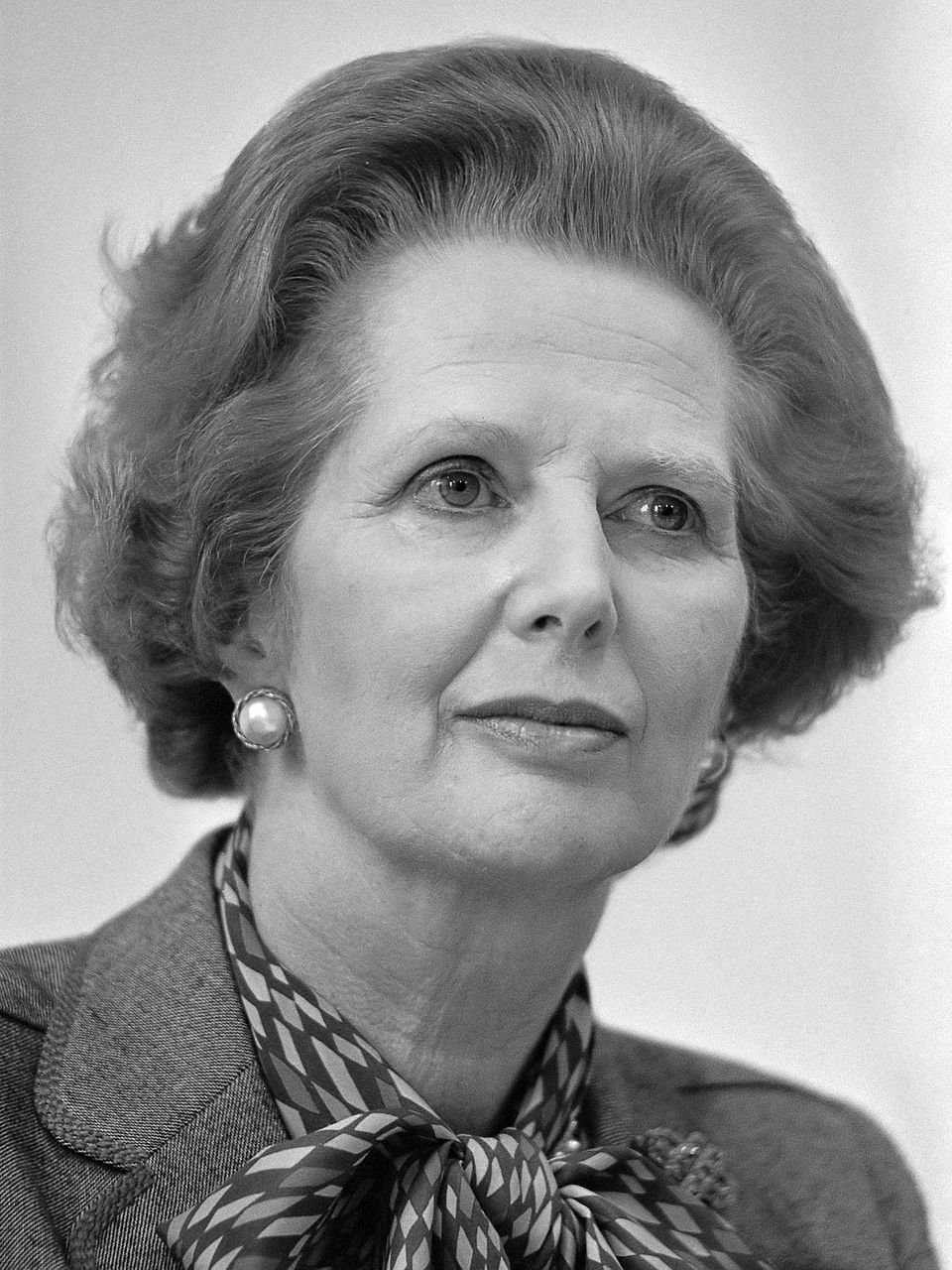
Talk given at the Danube Institute’s Conference, Budapest, 2nd October 2025. Brian also gave an interview about related topics.
Mrs Thatcher became Prime Minister in May 1979 at a time when the UK economy was suffering from ‘the British disease’ and known as ‘the sick man of Europe’.
We had just emerged from the ‘Winter of Discontent’, during which there had been constant industrial disputes and strikes, many unofficial, uncoordinated and local. Some years earlier inflation had reached 27%. The Chancellor of the Exchequer Denis Healey had been forced to go, cap in hand to the IMF to avoid defaulting on our debts; no one would lend us money. We were bust. Inflation was still 13% in 1979 rising to 18% in 1980. Over the decade mismanagement of the economy and trade union militancy had led to the downfall of three governments: those of Wilson in 1970, Heath in 1974 and Callaghan in 1979. There was in British society a sense of helplessness, a feeling that the country had lost its way.
Mrs Thatcher set out to find practical remedies for the problems facing the British economy. She realised that not all could be achieved at once and I believe she thought of the response to the challenge in terms of three major steps.
First inflation must be defeated.
Second the size of the state in the economy must be reduced.
Third the market economy must be strengthened.
To start with it would be impossible to improve the standard of living without bringing inflation under control and establishing financial stability.
Inflation had been accompanied by rising unemployment which was not the Keynesian expectation. Inflation created uncertainty. It deterred business investment. It was hated by the public. Unexpected rises in the cost of living led to hardship with consequences such as higher interest rates which continued long after inflation had come down.
Although she was a practical politician, Mrs Thatcher was always interested in ideas. She was genuinely intellectually curious. She invited people into Number 10 from all sorts of different fields in order to explore ideas: historians, environmentalists, educationalists, theologians, architects and so on. And the field of economics was no exception. She valued meeting economists from abroad such as Milton Friedman, Fredrick von Hayek, Karl Brunner, Allan Meltzer as well as central bankers such as Otmar Emminger, and Karl Otto Pöhl (Bundesbank Presidents) and Fritz Leutwiler (Chairman of the Swiss National Bank).
Unlike many economists in the UK and senior officials at the Bank of England, these academic economists and practical central bankers saw inflation as a monetary phenomenon. They claimed they had achieved price stability in their countries because they had successfully controlled money supply growth, not because they had introduced prices and income policies. (Incidentally, money growth had been the traditional explanation for inflation in the writings of David Hume, Adam Smith, and Alfred Marshal – and even Keynes had spent six years in the 1920’s producing two large volumes entitled A Treatise on Money (1930), analysing the Quantity Theory of Money). This approach was also that of a small number of contemporary British economists such as Professor Alan Walters, whom she appointed as a special adviser based in No10, and Professor Harry Johnson, who held a joint chair of economics at the London School of Economics and the University of Chicago. By contrast these were not the views of the Bank of England or the UK Treasury which were still strongly influenced by Keynesian thought.
However, recognising that inflation was a monetary issue proved to be far easier than controlling the growth of money itself. How was it to be measured? How easily was it to control in the short term? How stable was the demand for money? How might it change when there were changes in the regulatory structure of the banking system, such as Competition and Credit Control 1971? Or external shocks to the system such as the Great Financial Crisis in 2008-9? These were difficult existential challenges for the Bank of England tasked with controlling money supply growth and financial stability. Controlling money supply growth however ensured that by 1986 retail price inflation had fallen to 3.4%.
Mrs Thatcher recognised that for the monetary policy to be successful, fiscal policy should accommodate monetary tightening and not work against it. This it did through the creation of a Medium Term Financial Strategy (the first ever for the UK Treasury) which linked targets for money supply growth to public sector deficits, public sector borrowing and the annual Budget. Alan Walters claimed that
It is difficult to exaggerate the importance of the commitment to the MTFS. It provided a frame of reference for all financial and economic policy. Never in the post-war history of Britain had the spending programs and the revenue and taxation consequences been so closely associated at the highest level of government decision making.
(p.83, Britain’s Economic Renaissance, OUP, 1986)
This framework provided effective fiscal discipline and led to the notorious 1981 budget. This was condemned by 364 UK academic economists in a letter The Times following a ‘round robin’ initiated by two Cambridge University professors, Frank Hahn and Robert Neild. For them, the uncomfortable fact was that this budget proved to be the turning point for Britain’s economic renaissance.
After having set out on a policy to introduce monetary discipline the second element in her policy was to reduce the scale of the state.
The case she made was that the state took too great a share national income, so government spending as a proportion of GDP needed to be reduced. The public sector borrowing requirement was crowding out private sector borrowing, so it, too, needed to be cut. In addition, state owned industries would be much better managed as commercial entities rather than being answerable to elected politicians in parliament.
This led to the policy of privatisation – steel, airlines, telecommunication, cars (Jaguar), gas, electricity, aerospace, petroleum, coal and so on. What was remarkable about privatisation was the way in which the policy, once shown to work in the UK, was adopted in the following two decades by so many countries throughout the world.
The scale of the state was also reduced by a housing policy which allowed the sale of council houses by local authorities to their tenants at considerable discounts, ranging from 33-50%, depending on their tenure. This meant a highly significant transfer of wealth and the ability of new house owners to pass their property on to their children.
The third element of Mrs Thatcher’s economic policy focused on strengthening the market economy.
In 1974 Mrs Thatcher and Keith Joseph had set up the Centre for Policy Studies to make the case for a market economy. By enabling prices to change and firms to enter or exit markets, they believed a market economy could achieve a more efficient allocation of resources than state planning, public ownership or government bureaucracy ever could.
They were also convinced that markets should be placed in the broader context of social responsibility. Many of the criticisms of the market economy were that it produced a culture of greed, individualism, and ‘dog-eat-dog’. They thought the creation of greater wealth through the market economy must be achieved alongside greater resources being available for those in need, whether due to ill-health, advanced age or deprivation.
Strengthening the market economy involved the abolition of rent controls, the abolition of foreign exchange controls, the removal of constraints on competition in banking and the London Stock Exchange – permitting foreign companies to enter London’s financial market – the removal of general controls over prices and wage growth and an almighty battle against trade unions to allow management to manage their firms without constant interruption from militant unions. This last required bitter battles in parliament and confrontations between police and protesters.
Her economic policy focused on wealth creation was part of a wider policy framework which increased parental choice and standards in education and training and increased expenditure in health and welfare. The social market economy provided the safety net for those unable to benefit directly from greater wealth. Standards in schools were improved. Scientific research dealing with technology and radical innovation was supported.
Thatcher’s economic policy had a coherence to it. It set out to achieve stable prices, reduce the size of the state and create a vibrant but socially responsible market economy. She succeeded in some areas: the importance of monetary policy in defeating inflation, reducing the size of government spending in GDP from 43% to 35%, strengthening an enterprise culture, extending home ownership and privatising state-owned industries. In others she did not succeed: the privatisation of water and railways, the imposition of the community charge for local services (the ‘poll’ tax) and increasing charitable giving.
There is one final point I would like to make.
While Mrs Thatcher engaged with the specific details of monetary policy or trade union legislation, this was in the service of an underlying moral world view. However, the idea that she had an ‘unidentified morality’, as Shirley Letwin has suggested, is somewhat misleading.
What she had was more than an intellectual framework or worldview. It is perhaps better understood by the German word Weltanschauung, which means not just an intellectual framework, but a driving force animating one’s being and generating a purpose for life’s work.
This for Mrs Thatcher was undoubtedly her Christian faith, something she made very clear in her speech to the General Assembly of the Church in Scotland on May 21st, 1988, in which she identified ‘three beliefs’ of the Christian faith.
First, that from the beginning man has been endowed by God with the fundamental right to choose between good and evil. Second, that we are made in God’s image and therefore we are expected to use all our own power of thought and judgment in exercising that choice; and further, if we open our hearts to God, he has promised to work within us. And third, that our Lord Jesus Christ the Son of God when faced with his terrible choice and lonely vigil chose to lay down his life that our sins may be forgiven. (Christianity and Conservatism, edited by The Rt Hon Michael Alison MP and David L. Edwards, Hodder & Stoughton, 1990, p.334)
She also spoke of ‘my personal belief in the relevance of Christianity to public policy’, recognising both the importance of the teaching of the Old and New Testaments and especially the importance of the family, on which ‘we in government base our policies for welfare, education and care’. (Speech by Mrs Thatcher to the opening of the General Assembly of the Church in Scotland, 21st May 1988, Christianity and Conservatism)
I believe you will never really understand Mrs Thatcher’s economics or politics unless you grasp her Judaeo-Christian worldview.
In conclusion, I believe this is ultimately the greatest legacy which Mrs Thatcher gives us today on the Centenary of her birth.

Brian Griffiths (Lord Griffiths of Fforestfach) is a Senior Research Fellow at Centre for Enterprise, Markets and Ethics (CEME) and Founding Chair of CEME (serving as Chair until 2023). Among other things he served at No. 10 Downing Street as head of the Prime Minister’s Policy Unit from 1985 to 1990 and Chair of the Centre for Policy Studies (CPS) from 1991 to 2001.

How We Found Our Callings
While all definitions of calling share in common the notion that work becomes meaningful within a person’s life, they differ on whether the source of the calling is internal, based on one’s own values, needs, and preferences, or external, based on either a calling from a higher power, a ‘transcendent summons,’ or a sense of fulfilling one’s destiny. Our own academic work together – which began with research on how the work of 9/11 victims was seen in the eyes of their close relations, and which has led to the publication of two books and several scholarly papers – feels secular in origin. We were both called to academia within a year of 9/11, when we were both living and working in New York City as management consultants, and although the call came from both a world in need of repair and from inside of us, it did not in our experience come from on high.
Religious and Secular Callings in the Financial Capital of the World
The first name on the New York City Medical Examiner’s list of casualties of the September 11, 2001 terrorist attacks is that of Father Mychal Judge. He died carrying out his calling amid danger, praying to God over victims when he was killed by falling debris. Many people who died that day in a variety of uniforms were characterized as having lived out their callings, according to research we conducted. Most obviously, included are first responders like Jonathan Ielpi, a firefighter who followed his father into a profession in which he was ‘more concerned about others than he was about himself,’ Whether or not those callings were equally heroic, their origins were not always overtly religious.
Some callings sounded decidedly secular in origin, such as those of trader Frank Garfi, who ‘found a job that suited him precisely…fast-paced, demanding and as power-filled as an extreme sport,’ and trader Atsushi Shiratori, who was ‘so obsessed with the stock market that he once spent a two-week vacation in a day-trading salon. Sheryl Rosenbaum, who had known since her childhood visits to her father’s accounting office that ‘this was what she wanted to do,’ continued while she raised two young children of her own.
The History of Religious Callings
The notion of work as a calling has religious origins. As fellow management scholars Stuart Bunderson and Jeff Thompson detail in one of the foundational academic studies of calling toward work, the Protestant Reformation – and specifically the writings of Martin Luther – witnessed the transition of ‘calling’ from a narrow association with clergy work to a broader association with potentially any type of work. The important part was performing one’s work diligently and faithfully, laying the foundation for Max Weber’s notion of the Protestant Work Ethic.
This historical period also marked the culmination of a gradual transition of perceptions of work ‘from curse to calling,’ in the words of philosopher Joanne Ciulla. In Ancient Greece, work – especially manual labor – was seen as drudgery, punishment, and a distraction from one’s main goal of living a good life which was fully experienced in the life of the mind and certain types of leisure pursuits. When work becomes a calling, it becomes not a means to an end, but a meaningful end unto itself, a way to make a unique contribution to the world. The religious view of calling still has purchase in today’s conversations, in both scholarly writings and in the popular press. However, a different view has also emerged more recently that takes this same spirit into an explicitly non-religious context.
The Rise of Calling as a Secular (and Managerial) Concept
In another study, Thompson and Bunderson suggest that religious callings are typically ‘outside-in,’ emphasizing ‘destiny and duty’ and anchored in ‘societal obligations or an external summons.’ They contrast them with secular conceptualizations of calling that are typically ‘inside-out,’ emphasizing ‘passion and self-fulfillment’ and anchored in ‘internal preferences.’ Proponents of the former may express skepticism about whether the latter constitute ‘true’ callings. Proponents of the latter may doubt whether duty absent the passion to carry it out is sufficient to constitute a calling. Proponents of both tend to recognize that the best callings are those in which one feels to called in one’s heart to do what one is called by the world to do – or, in the words of theologian Frederick Buechner, ‘where your deep hunger and the world’s deep gladness meet.’
By the mid-1970s, when the field of management and organizational behavior was gaining traction as an academic discipline, scholars and other writers were increasingly considering work as a calling in a non-religious sense. For example, Studs Terkel’s famous compendium of interviews, Working, had a section titled, ‘In Search of a Calling’ that featured an editor, an industrial designer, and a nun-turned-massage therapist.
Jobs, Careers, and Callings
The presence of calling in management research – where we first encountered it – originated with a book by Robert Bellah and colleagues, Habits of the Heart. This book was not about callings or even work – the section on work was just over five pages long, the same length as a section on ‘leaving church’ – but rather about understanding how Americans’ private lives contributed to or detracted from their civic engagement. Yet, the writings about work proved to have a profound and outsized impact in codifying how ordinary people relate to their work. Based on interviews, the authors distinguished between work as a job or a means to make money, a career or a means to climb a career ladder, or a calling where work is a meaningful end in itself and ‘morally inseparable from [a person’s] life.’
These categories were further popularized and disseminated when they became the subject of study within organizational psychology by Amy Wrzesniewski and colleagues as one of three work orientations. In a pioneering study, Wrzesniewski found that, compared to a job or career orientation, employees who viewed their work as a calling reported greater satisfaction with work and with life and missed fewer days of work. As in Martin Luther’s view, any work could be viewed as a calling by the person holding it – even seemingly low-paid, low-status, and/or ‘dirty work,’ from hospital cleaners to zookeepers to administrative assistants. As a psychological construct, work orientation held that two people with the same position in an organization could come to view their jobs in wildly different ways: one a job, the other a calling.
What Do We Know Today?
Callings Can Be Sacred And/Or Secular
Academic research on work as a calling has exploded in the past two decades, which almost exactly mirrors a focus in the popular press on finding one’s calling through work. Reviews of calling research are quick to note the dual (if not dueling) perspectives on whether callings are sacred or secular. The neoclassical view of calling preferred by Bunderson and Thompson aims to build directly on the classical, religious view put forth by Luther and later Weber, defining calling as ‘that place in the occupational division of labor in society that one feels destined to fill by virtue of particular gifts, talents, and/or idiosyncratic life opportunities.’ The modern view, articulated by Dobrow and Tosti-Kharas, defines calling as ‘a consuming, meaningful passion people experience toward a domain, such as work.’
Both Kinds of Calling are Paths to a ‘Good Life’
A recent meta-analysis, of which Jen was a coauthor, examined more than 200 empirical studies of calling over the past 20 years, finding that experiencing a strong calling toward one’s work was related to a sense that one’s life was good. Whether a function of our work-centered modern culture, or of some jobs becoming objectively ‘better’ in post-industrial society, work is no longer necessarily a curse. The meta-analysis authors then looked at whether the type of calling, internal/modern or external/neoclassical, related to different types of well-being, hedonic (happiness or pleasure) or eudaimonic (meaningfulness, purpose, and self-realization). Both internal and external callings related to both types of well-being; however, internal callings were more strongly related to hedonic well-being, while external callings were more related to eudaimonic well-being.
What Does This Mean for Workers?
Callings Have Great Benefits…
In any case, possibly because we spend so much of our waking time at work, feeling that work has positive meaning has the potential to enhance our own and others’ flourishing. This is especially so with eudaimonic well-being, which can be supported by callings whether they are religious or secular in origin.
…And Can Come at Great Costs
Yet, the picture of how callings contribute to our lives is complicated, because they often demand sacrifices that can have deleterious effects on our well-being. The zookeeper study, which employed a neoclassical lens, portrayed calling as ‘a painfully double-edged sword.’ On one hand, a sense of calling elevated the importance and meaningfulness of work in subjects’ lives; on the other hand, it required sacrifices in the form of pay, long hours, and even social esteem. Further research supports that, regardless of whether callings are seen as secular or religious, they are intensely-felt and may involve a host of irrational behavior, from over-estimating one’s ability at work to ignoring the advice of trusted mentors to sacrificing money. A study of church ministers found that those with strongest callings had the hardest time disengaging from work at the end of the day, which in turn negatively affected their sleep quality and their vigor the next morning.
Callings are Worth Pursuing…
All of this is to say that, if we are fortunate enough to have a choice in the matter, we should choose wisely about whether to pursue work as a calling and which callings are worth pursuing. We should be realistic about what to expect of a calling, because even people who love their work may not be happy about the sacrifices and demands it requires every day. The cliché that if you ‘do what you love and you’ll never work a day in your life’ is often false, as anyone who has so much passion for their work can attest when the lines between their personal and professional lives blur to the point that they cannot escape work. We should also be mindful about whether some callings are ‘better’ than others. In our 9/11 research, which was based on close relations’ idealized reflections of how they wished their loved ones’ lives to have been, we found not only that a disproportionate share of victims were depicted as having worked at a calling but also that those callings which emphasized helping others and cultivating relationships with them were particularly admired. In those portraits of victims’ lives, their close relations found reasons for why even the most mundane or low status work – including that of receptionists and security guards and window washers – might have been worth loving.
…But Are Not a Panacea
As university professors, we counsel students not to feel undue pressure to ‘find their callings,’ especially as a surefire path to a perfect life. We teach them that some people are born knowing exactly what they were called to do and others search their entire lives in vain for a calling. They can’t control which one they might be, but it is within their control to carefully consider what pursuits are worth undertaking in a life worth living.

Jennifer Tosti-Kharas is the Camilla Latino Spinelli Endowed Term Chair and Professor of Management at Babson College.

Christopher Wong Michaelson is the Barbara and David A. Koch Endowed Chair in Business Ethics and Academic Director of the Melrose and The Toro Company Center for Principled Leadership at the University of St. Thomas and on the Business and Society faculty at NYU’s Stern School of Business.
Jen and Christopher are the authors of Is Your Work Worth It? How to Think About Meaningful Work (New York: Public Affairs, 2024) and The Meaning and Purpose of Work: An Interdisciplinary Framework for Considering What Work is For (London: Routledge, 2025).
There are growing concerns that capitalism and democracy are in crisis. Despite the success of free markets in creating global prosperity over two centuries, the recent slowdown in growth in Western economies, the persistence of inflation, increasing economic inequality, financial instability and the explosion in debt have called into question the value of market capitalism. Moreover, trust has been eroded in liberal democracies because of dysfunctional governments, a perceived lack of commitment to truth and political leaders playing the game to the edge of legality. Added to these concerns are the growth of a post-modernist culture with steadily increasing social fragmentation, divisiveness and the lack of a unifying and accepted source of appeal.
We are living in the 21st century in Western societies in which religion has not just been replaced by secularism, but the one God of the Christian religion, with its deep roots in Judaism, has been replaced by the pluralism of the many gods of modernity. As a society we require those in leadership and authority in business and politics to have a moral compass and as Adam Smith set out regarding the virtue of prudence and Burke regarding the role of religion, our fellow citizens need values of honesty and sympathy if we are to seek the common good.
Against this background and under the auspices of the Centre we have decided to launch a series of colloquia in which to explore a Christian perspective on contemporary issues of political economy. On each occasion a small panel of experts will present their thoughts on the chosen topic, and other participants will then have the opportunity to make their own contributions to a free-flowing discussion. Participants will be invited from across the political spectrum and the number kept to around twenty. Following the links below you will find the contributions made to each meeting. We hope you find the papers stimulating.
Our seventh Fforestfach Colloquium was held on Thursday, 2nd July 2026, in Committee Room G of the House of Lords, and was attended by eighteen invited guests. The topic of the Colloquium was antisemitism. A panel of four distinguished speakers was invited to lead us in our thinking on the subject:
Our hope was that the speakers’ presentations and our subsequent discussion would range widely across people’s experience of the problem of antisemitism, both past and present, in our society. With the ‘Free Palestine’ marches and protest meetings, a politicised form of antisemitism has emerged, spilling over into party politics, in the outliers of the Labour Party and the Greens. Is this trend something more than a newly-minted version of the ever-shifting ‘progressive omni-cause’ (day before yesterday, women’s rights; yesterday, ethnic minorities’ rights; today, Palestinians’ rights; tomorrow, …)? Or is it a sign of a return to a more sinister prejudice against Jews, which many of us hoped had been purged from our society with the ending of the Second World War? To what extent is growing antisemitism in the UK and elsewhere bound up with the nature of the war in the Middle East? What part can and should Christian churches and individual Christian believers play in stamping out any form of antisemitism, conscious or unconscious, from our lives?
Our speakers and the discussion which followed certainly addressed these points, and gave us a poignant and challenging insight into the feelings and concerns of our Jewish brothers and sisters in Britain today.
Our sixth Fforestfach Colloquium was held in the House of Lords on Thursday, 16th April, 2026. We had the pleasure of listening and responding to three excellent speakers addressing the question, ‘How Much Love, To Which Neighbours? Our Duties Within the Nation and Beyond.’
Our lead presenter was Dr Nick Spencer, Senior Fellow at Theos, a Christian think tank. He argued for an approach to the question that balances awareness of human need with the principle of subsidiarity, so that responsibility is exercised first at the most local, competent level, while still recognising that we have moral duties to aid those beyond the nation, particularly when their local structures fail.
Nick Spencer’s respondents were Daniel Johnson, journalist, founding Editor of TheArticle, an online journalism platform, and a former senior editor, editorial writer and columnist for The Times and The Daily Telegraph; and Dr David Miller, Professor of Political Theory at the University of Oxford and author of On Nationality and National Responsibility and Global Justice (2007). The audience of about 20 invited guests listened intently and responded readily with questions and comments that ranged freely across the speakers’ remarks.
The fifth Fforestfach Colloquium took place on Monday, 17 November, 2025 in Committee Room G of the House of Lords. Once again, an invited audience of around 20 people gathered to hear our speaker, The Rt Hon. Lord Biggar of Castle Douglas, CBE, (Professor Emeritus Nigel Biggar) address the topic of whether theology has a role in public life.
In his remarks, Lord Biggar pointed out that theology often shapes public debates, albeit sometimes implicitly. Christians can help maintain civility by modelling virtues rooted in their beliefs about human nature and moral order, such as courage, justice, charity, openness to learning, humility, forbearance, and a steadfast commitment to truth. While such virtues are not unique to Christianity, they are seldom discussed in modern Western society, where rights-based language tends to dominate moral conversations. This absence makes virtue harder to name, share, or promote, which can allow vice to thrive.
By embodying and openly discussing these virtues during contentious cultural debates, Christians can highlight their value and help foster a more rational, liberal culture. Lord Biggar’s points were discussed and expanded by our audience, led by a particularly thoughtful and insightful set of comments from Jason Cowley, the former editor of The New Statesman.
Our fourth Fforestfach Colloquium focused on the subject of ‘Covenant’. It was held in Committee Room G in the House of Lords on the morning of Thursday, 26 June.
Our two principal speakers came from opposite sides of the political spectrum, both of whom have studied and written about the concept of covenant: Danny Kruger, MP, the Conservative member for East Wiltshire, and Lord (Maurice) Glasman, who founded the Blue Labour movement.
Danny Kruger published in 2023, Covenant: The New Politics of Home, Neighbourhood and Nation. In the book, he describes the key difference between the ‘social contract’ of Hobbes and Locke, and the ‘social covenant’ that he conceives: covenant, he writes, is a set of relationships built on love rather than on reason, an ‘artificial brotherhood’, expressing unconditional love between unrelated individuals, the foundational example of which is the covenant of marriage, ‘the union of two unrelated people that forms the nucleus of a new blood relationship, a family.’ Covenants also underly communities and nations.
Maurice Glasman, in his 2022 book, Blue Labour, points out that ‘…covenant requires that human beings are not treated as commodities, and that there is an inter-generational commitment to the common good between classes and regions based on the renewal of place… Neither the state nor the market is sufficient to generate a good society: it requires the renewal of society…’
Before the meeting, we had circulated a set of four questions on the topic for attendees to consider for themselves. We were delighted to be presented with some deeply thoughtful responses to those questions by our third contributor, Rabbi Benjy Morgan, who is the Chief Executive of the Jewish Learning Exchange in Golders Green. His reflections on our questions provided us with a number of very helpful Old Testament insights regarding the biblical concept of covenant.
As in our previous Fforestfach Colloquia, the invited audience of about 20 guests engaged enthusiastically with the presentations and the ensuing discussion, responding to points made by the speakers and also developing new lines of thought over the course of the morning.
Our third Fforestfach Colloquium took place in the House of Lords on the morning of Thursday, 30th January 2025, on the topic of Postliberal Political Economy, and brought together three speakers from academic, political, economic and media backgrounds.
Liberalism enjoyed a renaissance in the second half of the twentieth century. At the beginning of the 1960s, we saw the development of a socio-cultural liberalism on the left of UK politics, while in the 1980s, we experienced a growing economic liberalism from the right. Both those trends have given rise in the present century to the growth of post-liberalism, as explored in publications such as The Politics of Virtue (2016) by Adrian Pabst and John Milbank and Postliberal Politics (2021) by Adrian Pabst.
These publications, among others, provide a blueprint for a national, communitarian renewal, emerging from both the centre-left and centre-right. Importantly, postliberalism recognises the importance of the Christian heritage and Judeo-Christian ethics in providing a foundation for the renewal of a civic covenant, in the form of a partnership between generations and regions, and with nature.
At our Colloquium, we were addressed first by Professor Adrian Pabst of the University of Kent, who is also the Deputy Director of the National Institute of Economic and Social Research. His contribution pointed to the recurring crises experienced in advanced capitalist economies such as the UK, Germany, France, Italy, and Japan, which have struggled with low growth, high inflation and stagnant real wages ever since the 2008-09 financial crisis. Professor Pabst argued for a shift towards a social market economy, anchored in a greater sense of purpose and virtue.
He was followed by two distinguished speakers, his co-author, Dr John Milbank, Professor Emeritus at the University of Nottingham, and Miriam Cates, the former Conservative MP for Penistone and Stocksbridge in Yorkshire. They discussed alternative approaches to the postliberal economic challenges of our time, with Dr Milbank exploring the historical relationship between Christianity and Political Economy, suggesting that a truly Christian approach would seek to marry up what is practical and useful in modern economics with a more ancient humanism that does not surrender its ethical values. Miriam Cates, on the other hand, argued that many of the socio-economic crises we have experienced arise from the breakdown of Christian family values in the postliberal era, and called for a political economy based on a foundation of pro-family policies and a welfare state that encourages and supports families as a building block for a modern human society.
The second Fforestfach Colloquium took place in the House of Lords on Monday 29th April. We were privileged to welcome as our lead speaker an eminent professor from Harvard University, Professor Benjamin M. Friedman, who is the William Joseph Maier Professor of Political Economy and the former Chairman of the Department of Economics. Professor Friedman’s newest book, published in January 2021, is Religion and the Rise of Capitalism, and we invited Professor Friedman to speak to our invited audience about the theme of his book, to be followed by two highly-respected commentators, Professor Emeritus Forrest Capie of the Bayes Business School, and Lord (Mervyn) King of Lothbury, former Governor of the Bank of England.
Centre for Enterprise, Markets and Ethics
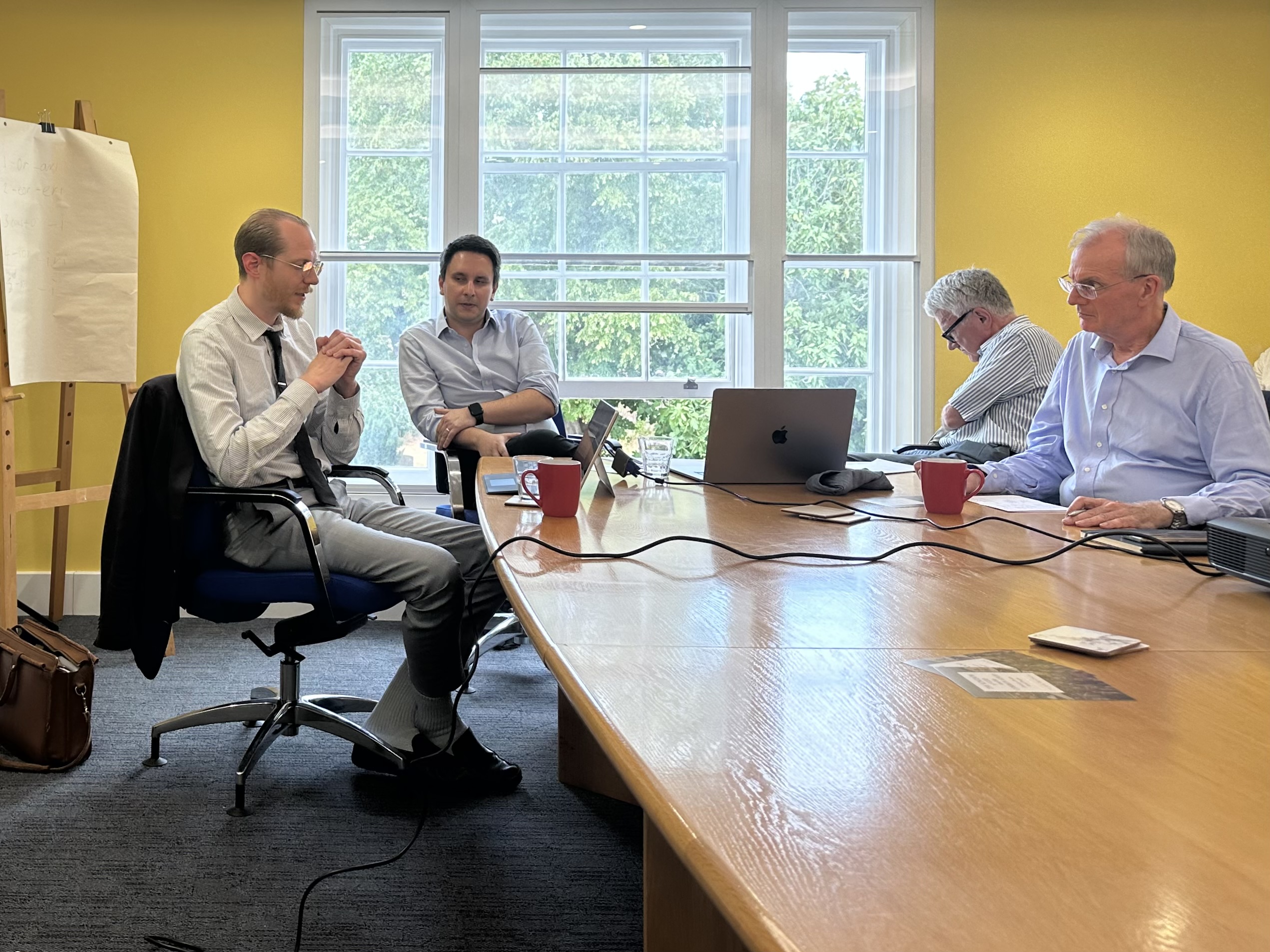
On Monday 14 July, CEME held an event with guest speaker Dylan Pahman (Acton Institute).
Organised in partnership with Blackfriars Hall, Pahman spoke on his forthcoming book The Kingdom of God and the Common Good.
The event was chaired by Andrei Rogobete.
Speaker Bio:
Dylan Pahman is a research fellow at the Acton Institute for the Study of Religion & Liberty, where he serves as executive editor of the Journal of Markets & Morality. Dylan recently completed his PhD from St. Mary’s University, Twickenham on the basis of his published works on Orthodox Christian social thought and asceticism. He is the author of Foundations of a Free & Virtuous Society (Acton, 2017) and The Kingdom of God and the Common Good: Orthodox Chrisitan Social Thought (Ancient Faith, forthcoming 2025). In addition to Orthodoxy, his research also touches on the Dutch Neo-Calvinist Abraham Kuyper, the Anglican Christian socialist F. D. Maurice, and the intersection between ethics and economics. Dylan is a member of the Greek Orthodox Metropolis of Detroit and resides in Grand Rapids, Michigan with his wife Kelly and their four children.

This is a repost of a consideration of religious principles in political life by CEME Fellow, Professor Philip Booth, first published on the Catholic Social Teaching blog of St Mary’s University
The idea that government should be based on Christian principles is continually under attack – not least on several occasions in the assisted suicide debate. Not only is that proposed law itself incompatible with Christian principles, but many of those proposing it have suggested that Christians should not be involved in the debate or that Christian principles should not determine our views on the issue.
The atheist-humanist call to keep God out of the public square seems to resonate intuitively with many people today. Even some religious people seem to think that religion and politics should not mix. The argument is often made that, if only we have a broadly liberal state, then we can have a pluralist society in which people can practise their religion in private whilst it is kept out of politics.
But this argument fails, even at the level of logic – never mind the level of practice. Just consider the concept of a ‘broadly liberal and pluralistic state’. Such beliefs assume a set of values that must come from somewhere. Why, for example, a broadly liberal and pluralistic state rather than a totalitarian state or total anarchy?
In fact, we have a better answer to that question than atheist-humanists do. It is because we believe in God-given free will. And we also believe in original sin. So, we understand the dangers of totalitarianism and anarchy; and we understand why the state should serve individuals, families, and civil society and not the other way round.
The atheist-humanists (and their fellow travellers) argue that our politics and law should be based on reason and empirical evidence alone. They espouse this as a neutral world view. But it is not neutral. Arguing that there is nothing to life beyond reason, evidence and physical experiences is just as much an act of faith as believing that God is a reality who should influence our public life. Indeed, 90 per cent of the world’s population, and most of our country’s population, believe that there is something beyond reason and empirical evidence. And it is a matter of fact that our laws and institutions – including the monarchy – are based on Christian principles. The degree to which this was explicit in the coronation service for King Charles III was very notable.
And we can ask the question: ‘Where does government without God lead?’
Pope Benedict, in his address to parliament in 2010, said: ‘The central question at issue, then, is this: where is the ethical foundation for political choices to be found? The Catholic tradition maintains that the objective norms governing right action are accessible to reason…According to this understanding, the role of religion in political debate is not so much to supply these norms, as if they could not be known by non-believers…but rather to help purify and shed light upon the application of reason to the discovery of objective moral principles.’ In other words, faith and reason complement each other, and faith helps purify reason.
Indeed, as the same pope pointed out, when we try to perfect society by reason alone, we can end up with tyranny – as in the example of the terror of the French Revolution, or the millions killed by communist regimes. These were the result of radical atheists trying to build heaven on earth and ending up inflicting hell. We see this in smaller ways in the policies of modern-day atheist-humanists. They explicitly call, for example, for Catholic schools not to be funded by taxpayers – as if Catholics are not taxpayers and there can, somehow, be a school which has a neutral set of values. In reality, this is a call by atheist-humanists for state monopoly secular schooling dictated by their values.
A society built on rightly ordered religious principles is nothing to fear, even if you are not religious. We believe in original sin and so reject the idea that we can coercively build the perfect society or allow anarchy to prevail. We believe in free will and so do not want to build a theocracy. But we also believe in the God-given human dignity of all persons, so we reject the utilitarian idea that some people can be sacrificed for the greater good of the whole. And we also reject the idea that a free society should degenerate into a state in which the weak are simply left to fend for themselves.
If I were a non-religious person and realistic alternatives were put before me about how to order a state, I would choose this religious conception. We should not be shy in pointing out that our conception of the state is a great gift to the world.
So, this leads to the question: ‘What is the purpose of a government with Christian principles?’
There is much debate amongst Christians about how best to use the structures of the state to promote human dignity in a general sense. But worth mentioning in the context of recent debates is that human dignity is not protected if the lives of the most dependent, voiceless and weakest (for example, the unborn and the disabled) and those nearing death are not properly protected: human dignity applies to all. The common good is often thought to be (because even Christians tend to absorb a secular narrative by osmosis) a kind of substitute phrase for the ‘general welfare’ (as opposed, for example, to my own individual interests). But we are not Benthamite utilitarians. The common good is about what is good as well as what is common. The common good in the political domain relates to that set of common conditions which can lead us, individually and collectively, to effectively strive for perfection or fulfilment. And social justice, that often used – and rarely defined – phrase, is the form of justice that promotes the common good.
In the Catholic tradition, the role of government is to promote human dignity and the common good.
Again, there is the possibility for both misunderstanding and different perspectives here. But the first thing to say is that the idea of a society where everybody can reach perfection might not sound much better than the communist or French revolutionary ideal which ends in tyranny. It might sound like a theocracy, but it isn’t. We believe in free will and original sin. Our belief in original sin informs us that the power of government must be limited. Our belief in free will informs us that we do not really reach perfection until we can choose what is good. So, the role of government here is to develop institutions that nurture freedom in the best sense of the word: the freedom to choose what is good. The first of these institutions, of course, is the family; another is the Church and all her charitable works. Indeed, there has to be a wide variety of free institutions which have their own common good whilst contributing to the common good of the whole.
A government that allows violent crime, political corruption or rampant inflation or inflicts cruel punishments without the possibility of reform and redemption is not promoting the common good or human dignity. These point to obvious responsibilities of government. Whether, and to what extent, and in what circumstances, we should ban or regulate pornography, fatty foods or gambling or regulate labour markets are matters for what we call ‘prudential judgement’.
What might be the role of civil servants or government administrators in this scheme of thinking? I am a great fan of the TV series Yes Minister. Many civil servants regard it as a training series to help them do their job better. But it isn’t. It is the opposite. In fact, Yes Minister has academic roots. One of the authors attended seminars given by an economics Nobel Prize winner on the discipline of public choice economics: these seminars were about how interest groups and civil servants were able to pursue their own interests in a democracy against the interests of the people.
It is not the job of civil servants to set the policy agenda by imposing their views but to help the government implement policy. But civil servants can be tempted to pursue their own agenda. And there is a danger, of course, that good civil servants and regulators understand their role and fulfil it appropriately and with restraint whereas those with an agenda antithetical to the Christian one overstep the mark and pursue their own agendas and thereby abuse their powers.
As Pope Francis’s wrote in Fratelli Tutti: ‘Others may continue to view politics or the economy as an arena for their own power plays. For our part, let us foster what is good and place ourselves at its service.’
Civil servants do, of course, face tricky issues. What should they do if it is their job to implement legislation that is clearly immoral? Might civil servants be able to make secondary legislation better – from a Catholic point of view – by hiding something from the minister or telling him or her lies? What if a civil servant sees dishonesty and their job may be in peril if they report it?
After the financial crisis, many Catholics in business reflected on the Catholic cardinal virtues – this way of thinking has resonance amongst non-believers. They thought about how they should bring the virtues of courage, justice, prudence and temperance into their daily work. That is something that could be brought into the work of those who serve government too – perhaps by creating case studies.
We have the example, of course, of St. Thomas More who exhibited all these virtues and, in the end, had to choose to go against the king – and lose his head. Again, to quote Pope Benedict XVI: ‘In particular, I recall the figure of Saint Thomas More…who is admired by believers and non-believers alike for the integrity with which he followed his conscience, even at the cost of displeasing the sovereign…because he chose to serve God first.’
If we are going to bring God into government, Christians working for government should bring God into their daily work. Bishop Richard Moth, chair of the Catholic Bishops’ Conference of England and Wales said in his statement for the jubilee for workers: ‘I also ask Catholics to try to find some time for prayer during the working day – even if it is only a moment or two.’
Stalin asked how many divisions the pope had. If we truly believe that the world is governed by more than reason and empirical evidence, those who work in government should never forget to call upon our heavenly divisions in daily work: including, of course, for the intercession of St. Thomas More.

Philip Booth is professor of finance, public policy, and ethics and director of Catholic Mission at St. Mary’s University, Twickenham (the U.K.’s largest Catholic university). He also works for the Catholic Bishops’ Conference of England and Wales as Director of Policy and Research.
Cover Image: Created using ChatGPT

In this discussion with CEME Senior Research Fellow John Kroencke, Andrew Haldane discusses his view that economic growth is a failed lodestar for policy, presents the case for increasing opportunity for those at a disadvantage, and considers the problems with British public finance.
This is the first entry in our Conversations with CEME Series which features a member of CEME in conversation with a leading voice from economics, business, policy, and faith communities to grapple with these defining challenges of our time. Through conversations with experts who approach these issues from diverse perspectives, we aim to explore not just the technical dimensions of our current predicament, but the deeper questions about purpose, meaning, and values that lie at its heart. In an era in which purely economic solutions seem insufficient, these discussions seek to illuminate new pathways forward that acknowledge both the practical constraints we face and the moral imperatives that must guide our response.
The edited transcript follows the introduction to the guest.

Andrew Haldane was the Chief Executive of the Royal Society of Arts (RSA) until June 2025.
He was formerly Chief Economist at the Bank of England and a member of the Bank’s Monetary Policy Committee. He was the Permanent Secretary for Levelling Up at the Cabinet Office from September 2021 to March 2022.
This transcript was edited to make points by both speakers clearer. It has been approved by both.
John Kroencke: To start us off, Tyler Cowen has this phrase: The Great Forgetting.
What he’s getting at when he talks about it is how people, including economists, have forgotten many of the kinds of insights of basic economics and even the major findings of the last 40 or 50 years. This is even more true of people who discuss policy in newspapers and don’t even introduce the basics of the standard Economics 101 response to a policy proposal or the findings of the literature.
Do you agree with that point of view? Has your opinion changed on the importance of basic economics as a rule of thumb?
Andy Haldane: I don’t know about a great forgetting. There’s been, a narrowing, I think, with, maybe to some extent, parts of economics forgetting its roots in moral philosophy – and therefore, an underemphasis of the social part in social science, and insufficient thinking about how other social sciences, psychology, sociology, anthropology, might bear upon their discipline.
I think the profession is now trying to integrate more of those insights into mainstream thinking, and policy. We’re not there yet, but there’s a growing acknowledgement the narrowing went too far, the mathematization of the subject went too far and the distance from real human behavior meant that we had traveled too far. Some of that is a fair critique and has been, at least in part, responded to.
KROENCKE: I would imagine political economy constraints would be relevant as well; that is, how politics is practiced by politicians, and this disconnect between the literature and idealized policy responses, and the real politics involved.
HALDANE: And the role of politics and institutions generally. Institutions have sort of been taken out the equation in terms of how we think about economies, yet we know institutions, both political and non-political, are foundational to economic success.
Elements of other of the social sciences are finding their way back into the economic mainstream. As I say, the kind of engineering approach to economics, perhaps draws excessively on insights from the natural sciences and insufficiently on insights from other social sciences and the arts and humanities.
KROENCKE: One thing that keeps recurring is this kind of discussion about how focused policy is on growth and whether growth per se is the primary goal of economic policy. In recent years, you’ve had this spread of kind of ‘growth, yes, but only of a certain sort’ thinking. So, things like ‘sustainable growth’ or ‘inclusive growth’ or any of these other types of constructs.
In response to this, Paul Johnson of the Institute for Fiscal Studies had this piece, a couple weeks ago, basically saying that people should focus on the core of economic growth and the social benefits that result from growth instead of only focusing on certain types of growth. Did you read that piece or have any thoughts on that?
HALDANE: I didn’t read Paul’s piece, unfortunately, but I can see what he was getting at.
I mean for, for me, growth, whether at the national or individual level, is at best an imperfect proxy of what we should be seeking when it comes to public policy. Longer, larger lives, are for me, what it’s all about. Longer in the sense of remaining healthy, which is foundational, to living a good life, and larger in terms of the opportunity set available to you.
We can’t, and shouldn’t seek to equalize outcomes, but we absolutely should seek, to equalize and open up opportunities to people. We know that is foundational to wellbeing and happiness. We furnish people with the best opportunities to flourish and whether they do so, of course, is in part down to them.
But that for me is the objective of public policy and of a good life which is related to growth but is not umbilically tied to growth. So, this is not a question of what particular flavor of growth: ‘Is it sustainable?’ or ‘Is it inclusive for me?’ For me that’s the wrong question, because while that might make it a less imperfect measure, it misses the bigger point, which is there that it isn’t the right end objective for a good society.
KROENCKE: What would you say about people who push back on the secondary concerns in the UK context, where the level of income per capita is much lower and the economic growth has been much lower than in the US since the financial crisis.
If I were to put this forward it would be something like: we’ve seen a widening gap between Europe and US, and whereas they might say in the US that on the margin growth is less important and it’s all these other things decaying that we should worry about, in the UK, on the other hand, incomes especially outside London are far lower, and growth is still the primary thing. So, while growth may be a proxy for all of those things we care about, it is the feature that is most relevant for improving the lives of Brits and overcoming the state’s fiscal challenges.
HALDANE: The comparison of the US and UK underscores my point: one of the reasons the US has done relatively better in growth terms is because it widens the opportunity set for many people. It provides a longer, stronger ladder than much of Europe.
That has provided dynamism to the US economy and enabled it to grow. But equally, for all the reasons you say, we know that the US has not been a singular success on that front because there are many people for whom the ladder hasn’t become longer and stronger.
That’s the issue of rising inequality or stasis in living standards. Both need to be addressed. The US is an example of the importance of what I say in terms of both in explaining what’s gone right there: strong growth – and what’s gone wrong: too few opportunities for those in the lower half of the distribution.
KROENCKE: In terms of setting out how we think about policy in the abstract, often the focus is either enabling growth, or on correcting market failures. The basic premise is: ‘this is the problem with leaving it to the market and here’s how the state can address it.’
Do you think the market failure aspect has been lost in recent years as myriad policies get proposed to achieve disparate ends, but the theoretical rationale or justification for the policy is hazy?
HALDANE: I don’t know about lost. I think it’s too narrow of a lens through which to view the case for public policy and action. Let me give a couple of examples of that to make it concrete.
Some problems we face are not just existing markets not working as we wish. They’re more a case of markets being missing completely. This isn’t a friction in the market, it’s the absence of a market.
When it comes to, say, tackling environmental and biodiversity challenges. The markets for dealing with that are largely either fledgling or absent. Even if you take something more basic, like the market for education, for many people, especially those on the lowest rungs of the ladder, that I mentioned before, they have been excluded from that market: it’s missing for them individually. I think missing markets are as important as failing ones.
Also, this binary distinction between what is done by the market and by the state, with the state stepping in when the market’s failing, is too simplistic, too binary a view of the way the world works. The greatest leaps forward, for humankind have tended to come from some partnership – not just between the state and the market, but between the state and the market and the key third pillar as Ragu Rajan called it, which is civil society in its many various forms.
The magic happens when the three of those, the public sector, the private sector and what’s sometimes called the third sector, but I wouldn’t call it that because it’s definitely not third on my list, join hands and operate in partnership to get stuff done.
The problem when they don’t is not a market failure because there isn’t a market for that per se. It’s not a market issue; it’s a cooperation and coordination issue between private actors, public actors, and civil society actors. When they’re able to coordinate and play their respective roles, society tends to thrive. When we come to overly rely on one or another of those three, society struggles.
So, to cast this as just ‘more market’ or ‘more state’ risks missing out the third pillar, civil society, which is the civilizing force on the first two. It’s the moral compass of the first two. It’s the societal glue that binds together the first two.
So, I have a different mental model in my head when I think about who the key actors are and the balance between them and the reason why they need to cooperate, and it’s the model I’ve just outlined.
KROENCKE: Do you think the history of civil society in the UK, especially in the 19th century, is just kind of out of mind in the popular imagination?
Obviously, as you know, the UK during that time was one place in which these kinds of strong networks and civil society institutions were acting in many domains, in part because the state wasn’t as large. To some extent in the US, we still find this with faith-based community organizations and other civic non-profits are being quite active in social welfare work.
HALDANE: Civil society, despite being the third pillar or the third sector, is the one that has always been there. Communities are what makes humans, human. They are intrinsic to us as individuals, as social animals, and preceded by many, many hundreds of thousands of years anything that looked at all like the state or government or private enterprise. They are the DNA of societies, despite them operating often very atomistically and quite invisibly, which is why they’re often written out the script a little bit.
What our economies and societies are missing is a stronger third pillar to help coordinate and keep on the path of righteousness, both private sector actors, who do good things but can also do bad ones, and government – which is in the same position.
KROENCKE: Obviously the fiscal environment in the UK but also across the world has deteriorated and there are further stresses forecast in terms of demography and projected demands on government funds. Some people think the third sector can step in more on things that local authorities have done. I saw a recent case discussed by Archie Hall, the writer at The Economist where he was talking about how in Devon or somewhere, a local authority stopped mowing a verge, and people are attempting to take care of it themselves, but they are running into different sorts of, difficulties. For example, they have to get certain certifications and these kinds of things. This is obviously one anecdote but is this kind of thing one reason why we don’t see the third sector stepping in as much? Are there these things that need to be done and people willing to help out but who, if you make it a chore, don’t want to go through that hassle?
HALDANE: I think two things. I think there are some things the state does currently that in the past definitely and arguably, but more questionably, today might be better done at the community or civil society level. That would be, the case for a more selective, degree of state involvement in some activities.
On the flip side there is some risk in saying that: a risk that this becomes a convenient vehicle for governments to step back and hope someone fills the gap they left. That was among the reasons why, when we last had a conversation about this issue in the UK, which is probably the time of the conservative government in 2010, David Cameron, the then Prime Minister’s Big Society idea that foundered on these rocks. It was because on the one hand he was saying we want a bigger role for civil society – that was the big bit – but on the other, he was simultaneously cutting the state back sharply due to austerity. Those two things jarred, and people rightly or wrong put the two together and said: this is an unworthy reason to support civil society. It’s your safety net for austerity.
So, I think there’s a balance between those to be struck.
KROENCKE: One of your themes through the RSA is Robert Putnam’s work on social capital and social connectivity. Within this there is a mix of longstanding trends since the middle of the last century and recent kind of trends in terms of technology and the atomization of social lives.
Where do you see that work going? What tangible things do you hope to learn and what ideas about potential responses do you hope to see in five years?
HALDANE: I think we already know ample about the importance of social connections and social cohesion. We know enough about the foundational role of social capital to know that we’ve got a problem that needs a solution.
The evidence since Bob’s work is compelling, about the foundational importance of connections, cohesion and capital for nurturing individual, community and national flourishing. The key next bit on which we’ve made far less progress is, of course, doing something about it to turn the tide.
I think what we need, and I’ve written a bit about this, is the sort of radical rethink and reformation of social policy on a scale equivalent to what occurred in economic policy during the Great Depression. We need social capital and cohesion running as a golden thread through every aspect of public policy – from how we design our education systems from the earliest of years, right through into universities and colleges so that those aspects are designed in rather than, as now, designed out. Actually, most of our educational infrastructure is socially stratifying rather than socially connecting and cohesive.
You need to do that in the workplace and in the design of our cities and transport systems. We need to do it in how we think about homeland security in its many various forms. We need to do it in how we think about our communications, both mainstream and social media. There actually are very few aspects of public policy, which is essentially about how people get together, that wouldn’t benefit from this lens.
When it comes to design, the key is to design it into systems from the get-go rather than have it designed out, as is too often the case now. That’s a radical program of reform, and one that is needed for our times. Unless and until you tackle the social capital crisis, you are building an economy on shifting and unstable societal sands, and this is something that our politics is telling us.
KROENCKE: When you say design, I would imagine what you have in mind is design that also enables nested communities to control their own things with the principle of subsidiarity as part of that design process, rather than everything being done by the central state.
HALDANE: This can only be done at the level of local or hyper-local communities. The patterns of cohesion and connections are themselves hyper-local. You have communities often, typically even, sitting next to each other, but not talking to each other.
There’s no way national government could bring the precision surgery necessary to fuse those communities together. It needs local leaders and by local leaders, I don’t necessarily mean local government. This may be a role better played by local civil society organizations.
One of the great bonding agents, and one of the great neglected areas of public policy are institutions that serve as bonding agents for communities You mentioned faith-based groups, which are very important in the States. Here, sports, leisure and cultural activities play a crucial role in bringing people together. We think of those as ‘nice-to-haves’, but they’re actually foundational to a good life because they’re foundational to social connections and a thriving economy.
KROENCKE: One thing I find interesting in the UK is that local authorities’ fiscal attention is increasingly only focused on statutory duties imposed by the central government. So, you have council taxes going up, but by the maximum rate they’re allowed to go up to, because of social care and other duties, which there’s no real public finance reason to have dealt with by the local authority.
It seems like this problem hasn’t been taken care of because the general governance at the local level can’t evolve to focus on things best done at the local level. Do you think there’s any way out of this? First, do you agree with that analysis? Second, is there any way out of this situation such that local governance can be improved, and local communities can flourish?
HALDANE: Yes, it’s the short answer to your questions, John. it’s understandable why local authorities were given a relatively narrow set of statutory duties that they had to fulfil.
But, one, that is too narrow a set of objectives to make for good communities; and two, it inhibits the flexibility of local leaders to make different choices. I mentioned those bits of social infrastructure that are so important to communities. One consequence of them not being in such objectives is that they’ve taken the hit as local authority budgets have tightened up. People have prioritized by statute, social care and bin collection – and the library’s gone, the museum’s gone, green space has gone in a way that has taken the legs out of many communities in a very fundamental way. That was a big mistake.
How do you remedy that? One way is to cast statutory objectives in a broader way. We’ve suggested that local leaders be given the flexibility including financial flexibility to make the choices they think are most appropriate to their area, which is not currently done.
It has been mooted with single financial settlements for mayoral combined authorities, and that’s directionally right. It remains to be seen whether that will give local leaders the flexibility they need to make the choices they think local citizens crave. We need, a real letting go, of both the purse strings and apron strings by central government, allowing local government to do its job and make choices in the interests of local people.
KROENCKE: You had a recent piece looking at Treasury Brain. As an American, I’m used to a system where a percentage of the property value is taxed every year, and that money often goes mostly to the local authorities. They use this to provide various services like schools and police. In the UK, various aspects of that are just completely wrong, and have been for a long time. Instead, there is a relatively small council tax to pay for services and a transaction tax on property sales (stamp duty).
And if we look at stamp duty, it’s an inefficient way to raise revenue. It stops productive economic decisions from being made. But my understanding is that the Treasury is one of the biggest proponents of stamp duty in the sense that it is a reliable source of income and therefore it’s difficult to get rid of despite harming economic efficiency.
Do you think there’s hope of reforming the tax system to enable these types of things to happen?
HALDANE: I hope so. I think it’s going be difficult to reconcile the fiscal arithmetic without coming back to the question of whether our tax system is fit for purpose. Are we taxing too much? Too little? Are we taxing appropriately the different sources of income? Do those tax powers reside at the right level?
My strongly held view is that some tax powers ought to reside at the local level, as would be common, well, in pretty much every country on the planet, to be honest. Very few of them currently do in the UK and that’s part of the devolution agenda that’s hardly got any mileage at all, but ought to have – not least for reasons of accountability. If local leaders have extra spending powers, they should be held to account, by having to raise the money themselves for the local activities they take on and to justify to the local electorate why they’re raising taxes to justify their spending.
That’s a good incentive to keep local leaders honest. There are areas of taxation where the system is crazy. Property is the craziest, where we have a tax on transactions, which most people would argue it is a very efficient way of earning money if you’re the treasury but has a chilling effect on the housing market.
There’s a real inefficiency, which is unhelpful, because moving jobs and houses often go together. So, it is mostly a tax on housing transactions, but actually it is a practice that ends up translating into a tax on job moves. A tax on job moves is a tax on pay because the way you boost your pay is by moving job. And then of course there’s council tax – and that is one of the most egregiously regressive taxes. It’s impossible to justify actually: no one can defend council taxes as currently configured. It’s totally mad – and not just the failure to update to account for price inflation over the last 20 years or so, but the very principle behind it is all at sea. So, I think that’s known and that’s been known a long time. Anyone who has thought about it for more than five minutes would tell you that something based on land values would make much more sense, but what is needed is the political will to make that happen, given that it would involve half the population being worse off.
KROENCKE: We’re just in a bad equilibrium that we’ve trapped ourselves into.
HALDANE: A bad equilibrium and the longer we leave it, the harder it is to escape.
KROENCKE: And on the trap for high marginal tax rates facing people at around £100,000, it’s only getting worse now that thresholds have been frozen, and more people are falling into this category. So, a lot of fiscal traps with dynamic consequences are just getting worse, because of the fiscal problems the country is facing.
Just before we end, I don’t want to miss asking you about leveling up and regional inequality – if you could first set out why you think it’s important and then go into the international comparisons and lessons we can learn from other countries.
HALDANE: Yes, it’s important. The case is partly economic, because there’s lots of untapped potential opportunity in places. This is untapped opportunity that would make for longer, larger lives, for many more people. There’s a deadweight economic cost from not doing that.
The case is equally well made on social justice grounds. It is unjust to be not offering people in those places, who but for their geography would have, the opportunity to rise and shine. So, for me, this is partly an economic case, but as importantly, a moral one, a social justice one about what makes a good society.
Equal equality of opportunity for everyone plainly isn’t the case right now. Many people are held back by their history. In other words, they’re born into a poor family. Many people are held back by their geography or where they’re born.
And of course, many are doubly damned because they’re a poor person growing up in a poor community and therefore, they’ve faced the double barrier of both history and geography. We need to do a better job of lowering those boundaries in the UK. We are holding back our potential of individuals, communities, and the country as a whole.
The UK disparities are larger than elsewhere, which makes the case even stronger. The barriers are even higher here, so the public policy case for lowering them is even greater.
Ultimately this is down to the holy trinity of people, powers and monies. Local areas need more of all three: they need the powers to be marked with their own destiny; they need more money to make good use of those powers; and they need local leaders in government, civil society and the private sector who can use those powers and monies to drive the opportunity.
That is the recipe from elsewhere. It’s a recipe book. We haven’t fully followed in the UK yet.
KROENCKE: I have two questions on inflation given your long role at the Bank of England. Firstly, why did central banks miss the potential for inflation? Secondly, why did markets miss the potential for inflation?
HALDANE: It’s the same reason for both. I think it does boil down to where you started, which is the Great Forgetting.
The financial crisis 15 years ago happened for a bunch of reasons, but one important reason was that the last person who’d experienced a global financial crisis had left the room. I think the same is true of the inflation we’ve had recently; the last person who’d experienced inflation had left the room.
That was a Great Forgetting and a Great Myopia. We’re prisoners of our past experience. That was among the reasons we missed it this time, both in the private sector and the central bank community.
KROENCKE: Do you think markets are not looking seriously enough at the threat to central bank independence in the US?
Trump at various points says things, then rolls them back. It seems some of that risk has gone away, but can we be certain?
HALDANE: My general sense is that central banks got it wrong, on inflation and that that puts them in a more perilous position than they have been for a couple of decades when it comes to independence.
I do think that puts them in jeopardy to a degree. The discipline effect of markets recently demonstrated in the US will give politicians cause for pause. It will take more than one inflation miss to turn the tide in independence in a significant way.
KROENCKE: Someone like Maurice Glasman, who also spoke at the event with Brian Griffiths where you spoke, or other figures, might view this as markets acting anti-democratically and against the people because of this restraining effect on a democratically elected person. Do you think there’s another side to that argument, perhaps in terms of this being a case of markets stopping someone from doing something that’s going cause economic harm?
HALDANE: Well, Maurice is a great friend and ally, but it is certainly a questionable proposition about whether any one politician at any time could ever be said to be acting according to the democratic will of the people. That is the sort of thing that autocrats say all the time.
I think we’d be careful about using that kind of argument as a justification for, any act and financial markets are a democracy too. Just a different cohort. And so obviously are those at the ballot box. They’re equally important in keeping us on the right track.

It has been reported that Ribbon AI, a Canadian company, is offering employers a new form of screening interview conducted by artificial intelligence. With a view to helping organisations hire staff more quickly and job-seekers find work sooner by cutting out ‘dead time’ in the recruitment process, early stage job interviews are conducted in a fashion similar to a remote interview, with applicants responding to questions and prompts from a natural sounding voice, generated by AI.
The idea is that the AI interview saves time for job-seekers, who get to interview almost immediately rather than waiting for two or three weeks until a member of the HR department can see them. Ribbon does not make decisions about candidates; rather, it provides companies with applicants’ responses to questions, offering transcripts, summaries, analyses and scoring of candidates’ responses, which the company can then use to inform its decisions according to internal criteria and requirements. As such, it is intended that companies should gather information about candidates and assess their suitability for roles more efficiently than by way of an early-stage screening interview.
It is worth pausing to ask what candidates are being expected to do here.
It is not uncommon for companies to ask applicants to complete psychometric tests prior to offering an interview and with increasing frequency, candidates will also be provided with set questions and instructed to submit answers recorded using a web-cam. Anyone Who has been through such a process might have experienced certain misgivings. The rationale behind including tests is intelligible (though it is not always clear whether they really determine which candidates possess the skills requisite for the role on offer) but recording answers can feel artificial. We might wonder what is to be gained by this approach, and why the hiring company is unwilling to talk to candidates in person at this stage, particularly if it is serious about ultimately hiring and investing in a member of staff. In any event, if the recorded answers are assessed by a member of HR staff or a hiring manager, it is not clear how far such an approach is any more efficient than a short, standard-format interview. Perhaps the most sympathetic view is to see such an approach as being akin to recording a spoken assessment as part of a remote learning course, perhaps in modern languages. Strange as it feels to be speaking (in)to a machine, candidates assume that the recording will at least be properly assessed by a human being at some stage.
In this instance, however, it seems that candidates are being expected to speak to and interact with a machine as though that machine were the human interviewer. An applicant is in effect asked to hold a conversation with an interlocutor that has no consciousness, is unaware of the interviewee’s existence and understands neither the candidate’s answers nor even its own questions. In such a situation, there can be said to be no conversation at all and therefore, arguably no interview. This is a peculiar arrangement, whereby an applicant is expected to behave as though a non-conscious object is interviewing her.
Moreover, her responses are not necessarily going to be sent to a human assessor for consideration at all. Rather, a decision might very well be made based on an analysis and data produced by the AI based on her responses. These analyses may be less biased and more uniform than would be possible for human interviewers, but the applicant has been ‘interviewed’ and ‘assessed’ by a machine. She might be rejected without any human consideration of the actual performance itself at all. Instead, the candidacy depends on a view taken of a computer generated assessment of that performance.
What does such an approach suggest about a company’s attitude to applicants, when it chooses to have them prove themselves before a machine before granting any meaningful human interaction?
Andrei Rogobete has written about the need for a human-centric AI, stating that AI ‘ought to be embraced in a prudent manner that directs its contributions towards human thriving’. In arguing for a use of AI that benefits humanity first and foremost and does not deify machines, he quotes Pope John-Paul II’s call for humanity to ‘use science and technology in a full and constructive way, while recognizing that the findings of science always have to be evaluated in the light of the centrality of the human person (and) of the common good’.
If we are to make responsible use of artificial intelligence for the good of humanity, the technology ought to be restricted to those tasks which any given form of AI performs well, so that it brings clear, tangible benefits to all relevant parties. Crucially, the dignity of the human beings that this form of technology is to serve should always be our foremost consideration. It is pertinent to ask, therefore, whether reducing interviews – for which candidates will often prepare carefully and about which they are ordinarily nervous – to a confected and solipsistic ‘conversation’ with a non-conscious AI model rather than meaningful engagement with other human beings is indicative of such an approach. Is it consistent with human dignity to base decisions about an individual’s potential livelihood not on a meaningful conversation with that person – and perhaps not even directly on her responses themselves – but on the reduction of her performance to a collection of data and analytics produced by artificial intelligence – artificial intelligence which has not seen or heard, let alone engaged with or understood the person in question?

My colleague, Dr. Dave Hebert, wrote a nice overview of different types of inflation and how they can affect people. He pointed out that the rate of inflation can be high or low as well as anticipated or unanticipated. He also explained how inflation is fundamentally a monetary phenomenon: too much money chasing too few goods.
In this piece, I’ll explain some of the mechanics behind how central banks can stoke inflation unintentionally. I’ll also raise several phenomena that ordinary citizens can keep an eye on to determine whether their central bank is acting responsibly or recklessly.
Let’s start at the most basic level. How do central banks increase or decrease the money supply? They primarily do so by purchasing government debt (bonds) with newly created money – really just an electronic entry on their balance sheet – or by selling bonds into the market and thereby ‘extinguishing’ the money they receive from the sale, in effect pulling money out of circulation.
Before the 2008 Global Financial Crisis (GFC), central banks like the Federal Reserve could not manage the money supply by simply buying or selling as many bonds as they liked. Significant buying or selling of bonds will affect the price of bonds, and correspondingly the market interest rate on those instruments.
When a central bank sells bonds to reduce the money supply, they drive down the price of those bonds, which increases the rate of return, or the interest rate, on those bonds. Conversely, when a central bank goes on a bond-buying spree, they drive up the price of the bonds, reducing their rate of return or interest rate.1
This partially explains why people pay so much attention to central bank interest rate targets. Changes in an interest rate target are a proxy for what is happening to the money supply. And as Hebert notes, what happens to the money supply is a proxy for what will happen to the price level. The connections between interest rate movements, money supply changes, and price levels are not tight or precise in the short-run, but they do have strong correlation over time.
A regime of low interest rates (or more precisely, of falling interest rates) suggests an expansion of the money supply and higher future rates of inflation. And a regime of rising interest rates suggests a reduction or ‘tightening’ of the money supply and lower future rates of inflation. Two bouts of inflation in the United States demonstrate how interest rate targeting monetary policy can be used. In 1980, the U. S. inflation rate rose to over 14%. In 2022, it rose to over 8%.
In 1979, President Jimmy Carter appointed Paul Volcker chair of the Federal Reserve to combat inflation. Under Volcker’s leadership, the Fed stopped buying government bonds which had been keeping short-term interest rates artificially low. In other words, the Volcker Fed allowed interest rates to rise rapidly – peaking at about 22% in December 1980. Although painful at the time, by 1983 the U. S. inflation rate was back below 3%.
Similarly, the Federal Reserve raised interest rates from less than half a percent to over five percent between 2022 and 2024 to bring down the U. S. inflation rate from over 8% in June 2022 to under 3% in May 2025. The interest rate hikes in the early 1980s and the early 2020s were accompanied by the Fed selling more bonds (or letting more bonds mature) than it purchased.
It’s important to note that post GFC, most central banks changed their operating framework to decouple interest rate decisions from balance sheet decisions (deciding whether to buy or sell securities). Though they would still tend to move in the same direction (raising rates & reducing the balance sheet or lowering rates & increasing the balance sheet), these two things no longer have to move together. That decoupling was by design and made it easier for central banks to change their target interest rate.
Central bankers, in the wake of the GFC and anemic economic recovery, wanted more tools to stimulate the economy. They had already pushed short-term rates to zero or slightly below zero in the European Union, but they wanted to do more. Decoupling bond purchases from interest rate targeting allowed central banks to inject huge amounts of money into markets through large-scale purchases of assets – called Quantitative Easing. For example, the Fed bought nearly five trillion dollars of securities between March of 2020 and March of 2022 – which clearly played a role in the worst bout of inflation in the U. S. in four decades.
Central banks have kept interest rates artificially low over the past couple decades – meaning interest rates would be higher given existing market conditions if central banks were not actively intervening in financial markets. An important effect of these artificially low interest rates, and large-scale asset purchases, are that national governments have been able to borrow at remarkably low interest rates. And, as a result, most national debts have ballooned relative to the size of their economies. Between 2005 and 2025, U.S. national debt rose from 63% to about 120% of GDP, U.K. national debt rose from 45% to about 104% of GDP, Japan’s national debt rose from 175% to about 235% of GDP (Figures 1 and 2).
Inflation is a simple phenomenon with complex causes. Central banks, however, play a key role because they manage currencies and can use their ability to create money ex nihilo to intervene in financial markets and distort the cost of borrowing. We can see a mutually reinforcing cycle of central banks buying large quantities of government debt, which lowers the cost of borrowing and encourages governments to issue even more debt, which central banks then buy with new money. This cycle is fundamentally inflationary.
Citizens concerned about inflation should follow three issues with respect to their central bank. The headline inflation rate has primacy of place. But citizens should also follow interest rate target changes to understand which way the central bank is moving, towards higher or towards lower inflation. Finally, concerned citizens should keep an eye on the size of their central bank’s balance sheet and encourage the bank to reduce its footprint in financial markets.
1 The majority of government bonds are ‘Zero-Coupon Bonds’, which means they will pay a set amount – the face or par value – of the bond in the future. For example, a government may issue a bond that will pay the bearer $100 in five years. You will gain no interest return if you pay $100 for that bond today. If you only pay $90, though, you will earn $10 of interest when the bond matures in five years. If the price of the bond drops and you only have to pay $80 for it, you will gain $20 in interest. However, if the bond price rises to $95, you will only receive $5 of interest when it matures. So the price of the bond and the amount you earn in interest, the effective interest rate, move in opposite directions.
 Paul Mueller is a Senior Research Fellow at the American Institute for Economic Research. Dr. Mueller also owns and runs a bed and breakfast in the mountains of Colorado with his wife and five children.
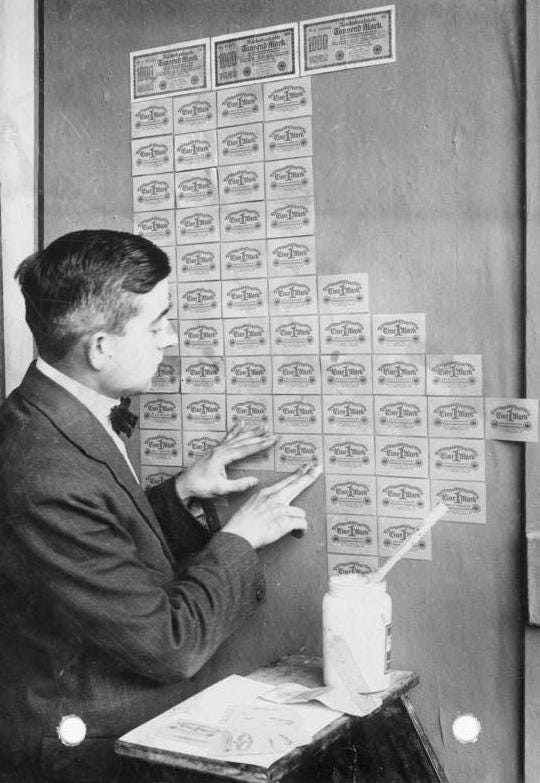
Subscribe to the CEME Substack
Inflation is a topic that plenty of pundits and talking heads have brought up on the news. For the non-economists, it might seem as if they do so ad nauseum. Despite its frequent coverage, however, few people understand why the U.K., like much of the rest of the world, generally accepts the idea that targeting two percent inflation is ‘good’ while inflation of any other number is ‘bad.’
Here, I want to provide some surface-level thoughts on these questions. While this will certainly not delve into the topic at the depth necessary to complete a graduate course in monetary theory, it should provide sufficient detail to enable meaningful and productive dialogues, which is ultimately what the world needs.
Milton Friedman once remarked that ‘inflation is always and everywhere a monetary phenomenon.’ What he meant by this is that inflation is caused when the amount (or quantity) of money increases relative to the amount of goods and services produced in an economy. In a dynamic economy characterized by economic growth and progress, inflation would occur when a central bank increases the money supply faster than the economy grows.
To address this question, it’s useful to think about inflation along two dimensions: 1) whether the inflation is low or high and 2) whether the inflation is expected or unexpected. I will not attempt to define ‘low’ or ‘high’ in this essay. Instead, I will simply defer to the reader’s judgement of the inflation rate in light of the following.
Expected and unexpected, however, are self-explanatory but carry with them implications that may not be intuitive. If inflation is fully expected, e.g. if the people expect 2% inflation over the coming year and the inflation rate is 2%, then the inflation will be relatively benign as buyers and sellers writing contracts lasting the duration of the year will build the anticipated 2% inflation rate into their negotiations. However, if people expect 2% inflation and the inflation rate differs from this, then there will be some unexpected inflation.
Thinking along these two dimensions allows us to put these into a matrix, which I explain in further below:

In situations where inflation is both low and expected, the problems are relatively benign. One that was an issue in yester-year is referred to as ‘menu costs.’ Here, the changing prices will cause stores (particularly restaurants) to have to change their stated prices. In a world of physical, paper menus and magazines, this means reprinting them and sending new magazines out to customers, which is costly.
This was exemplified in the U.S. with Subway restaurants, which had a promotion called the ‘Five Dollar Footlong’ where any full sized sandwich with standard toppings (i.e. no ‘extra meat/cheese’) cost $5. The jingle from the commercial was so catchy that Subway had a very difficult time keeping up with customers’ expectations as inflation increased the nominal cost of producing a sandwich. To keep up with it, Subway initially reduced the amount of meat/cheese included per sandwich. Then they excluded certain sandwiches from the promotion. Eventually, they even shortened the sandwich. However, there is only so much ‘shrinkflation’ that they could get away with and they were forced, eventually, to abandon the promotion altogether in 2014, much to the ire of devoted customers.
In situations like this, we see all sorts of seemingly-wild behavior that is rendered intelligible through understanding economics. One such behavior has to do with employees. When nominal prices are rising quickly (even throughout the course of the day!), employees will demand to be paid more frequently so that they can spend their earnings before the value of the money drops even further. Because of this, they will take frequent trips to the bank or to stores, thus wearing down their shoes more quickly, earning the moniker, ‘shoe leather costs.’
Unexpected inflation, even if it is low, can cause problems for long-term contracts. For example, suppose that everyone expects 2% inflation but the inflation rate is actually 3%. In this instance, money in the future is worth less than even the people entering the contract expected. This will mean that sellers will be harmed and buyers will be advantaged as they are paying with money that is worth even less than they had anticipated.
If the inflation rate were actually 1% instead, then money will be worth more in the future than both parties anticipated. This means that buyers will be harmed as they are giving up something more valuable than they expected and sellers will be advantaged as they are getting something more valuable.
Often, this is a sign of a country’s collapse, as they find themselves having to inflate the money supply so quickly as to render money effectively meaningless. Why they get trapped in a situation like this is a topic for another day, but the short version of it is that the central bank/government faces two options, neither of which is good: hyper-inflate the money supply and delay their economy’s ultimate collapse in the hopes that things will get better or cease inflating the money supply and cause its immediate collapse. Neither of these options are ‘good’ and often portend disaster.
One might ask a simple question: why have an inflation target to begin with? For starters, having a target gives central banks a sort of benchmark to judge whether they have gone ‘too far’ or ‘not far enough’ in their operations. But why have a target that is different from zero? After all, if inflation only imposes costs, then it would seem that targeting zero inflation would be prudent.
First, there was a little problem in the U.S. in 1929 called ‘the Great Depression.’ While there is much debate as to what caused it, one factor that is generally accepted is that banks had loaned out too much money too quickly over the course of the 1920s. As a result, their cash balances were severely depleted. Without sufficient cash on hand, banks could not meet the withdrawal requests of their patrons. One way to make sure that banks always have enough money on hand is for central banks to make sure that they always have a little bit too much money on hand, but this leads to inflation.
Second, the very nature of a ‘target’ is that it can be and often is missed. By setting a target above zero-percent, central banks ensure that their errors will not result in negative inflation or ‘deflation.’
With low, expected, and consistent inflation, however, many of the problems above disappear. Indeed, even the ‘menu costs’ problem has all but disappeared thanks to the rise of online shopping and the fall in television displays as menus in restaurants, which can be updated instantly.
In fact, there may even be some benefits to low inflation. John Maynard Keynes, for all his problems, did recognize one fact that seems particularly important: some prices tend to be ‘sticky’ or ‘slow to adjust,’ especially in the downward direction. One important price that fits this description would be wages. People just do not like to see their salaries decrease. In fact, people often feel better if they get a raise in their nominal paychecks even if their new paycheck is able to purchase less (due to inflation) than their previous paycheck.
For this reason, having consistent inflation can be helpful for employers, who can lower someone’s real wages without reducing their nominal wages. While this is certainly lamentable and we do not wish to see it happen to anyone, it does happen in e.g. industries that are in decline.
Incidentally, this is also where the 2% target rate comes from. 2% is most certainly ‘low’ and if it is expected, well, then it will be relatively benign on the economy as a whole. There is nothing magical about the number two here. It’s not so high that it would cause a truly noticeable increase in nominal prices year-over-year but it is high enough that to allow for real price decreases despite increasing nominal prices. In the end, low, expected, and consistent inflation may impose some costs on society but it may also provide some benefits. As for whether a central bank can deliver low, expected, and consistent inflation is a question that is up for debate.

David Hebert is a Senior Research Fellow at the American Institute for Economic Research. His work can be found at www.davidjhebert.com.
Follow him on X: Dave_Hebert
Image: Germany, 1923: During hyperinflation, banknotes had lost so much value that they were used as wallpaper, being much cheaper than actual wallpaper.
Bundesarchiv, Bild 102-00104 / Pahl, Georg / CC-BY-SA 3.0, reproduced from Wikimedia commons under a Creative Commons Attribution-Share Alike 3.0 Germany licence.

A fascinating advance currently underway in the field of artificial intelligence is the development of models to assist with peace negotiations. In collaboration with the White House, a think tank in Washington has been developing a simulator that generates potential peace-agreements to end the war in Ukraine, and also scores the likelihood of each deal being accepted by the combatants and other stakeholders. Another project, the development of which is based on a partnership between the British Foreign Office and the University of California, Berkeley, is aimed at providing advice for negotiators by generating a range of possible ‘voices’ or perspectives. The idea is that the AI model will enable officials to anticipate possible responses from various parties, whether superiors back home or hostile interlocutors. This presents the possibility of their being prepared to reframe negotiating positions quickly and to maintain momentum in talks.
AI Hawks, AI Doves
Interestingly, in test runs of different negotiating models, some have proved to be rather escalatory, opting to use force too readily, while others have been somewhat risk averse – or overly conciliatory. What does it mean to say that an AI negotiator is too escalatory or excessively conciliatory? Such judgements make sense to us, but in what sense can we attribute these qualities to machines? Obviously, an AI model has no conscious grasp of a conflict situation or what is at stake for the various parties involved, so there is no sense in which it can really be either risk-averse or hostile. All that we can mean, therefore, is that its coding is such that it produces certain types of output in response to specific types of input. The important point here is that these judgements are human: an AI model can only be escalatory or conciliatory in our opinion, relative to our own perception of a situation and the ends that we wish to achieve. To say that a machine is too ready to resort to force means only that in the same situation – and given the manifold ends in view – we would have made greater efforts and perhaps been willing to concede more in order to avoid such an outcome.
The Human Factor
Artificial Intelligence models can of course be trained or programmed to respond differently. Indeed, there are projects underway to improve the responses of AI negotiation models, one of which aims to convert information about appropriate and inappropriate human language and actions into code. Thus, the aim is to render the model more human and to respond in a manner closer to our own. However, it is not clear what this would entail. As has been demonstrated in several contexts recently, negotiation is complex and there is no straightforward ‘human’ response to resolving conflicts. Different parties, while agreeing that they desire peace, will take radically positions on what the conditions are to be.
This, however, is the point: however sophisticated any negotiating model might become, however apparently human and however capable of foreseeing possible responses and generating alternative proposals, it can only function on coding based on our own preferences and judgements (or those of the parties by whom it has been trained). In matters of politics and in morality, complete neutrality is all but impossible. There is no such thing as complete objectivity or an objectively optimal outcome. Any outcome must always have its foundations in the judgement of the parties involved, and their weighing of considerations such as national interest, what constitutes a fair settlement, the significance of environmental damage, the value of human life and the availability and best use of resources, together with the strength of their desire for prosperity and peace rather than conflict.
For this, certain virtues ought to be exercised and we always hope for the display of qualities such as prudence, wisdom, justice and moderation. As excellences of character cultivated over time, these are uniquely human and cannot be possessed by machines. Where artificial intelligence can support leaders and negotiators in achieving peace, it is to be welcomed, but decisions can only ever be made by human beings exercising their faculties of judgement, hopefully informed by the requisite virtues – qualities of character that can shape the training of AI models, but never be replicated or replaced.

Neil Jordan is Senior Editor at the Centre for Enterprise, Markets and Ethics. For more information about Neil please click here.
Image courtesy of Freepik (www.freepik.com)