
Anthropomorphising AI is rhetorically seductive but intellectually unsound. We must remember that the analogy between artificial intelligence and human intelligence is a distant one. Otherwise, we risk conflating computer systems with human-like agents and automation with autonomy. The anthropomorphisation of artificial intelligence – i.e. the attribution of human characteristics, intentions, or moral status to computational systems – has become a pervasive feature of public discourse, marketing (particularly in the private sector), and even some strands of academia. Popular narratives describe AI systems as entities that ‘think’ ‘understand’ or ‘want’, and conversational interfaces are explicitly designed to reinforce such impressions. The problem is that anthropomorphising AI is both conceptually mistaken and practically harmful. It obscures the technical limitations of AI systems, and misleads users about capabilities and risks, and ultimately cloaks moral reasoning behind syntax with no regard for semantics. More importantly, it confuses our understanding of what it is to be human: to be able to build authentic loving relationships as beings who are not only physical and mental (particularly with regard to our assumed rationality), but also emotional and spiritual.
Anthropomorphising AI leads users to systematically overestimate what such systems can do. Statements such as ‘the model knows’, ‘the system decided’, or ‘ChatGPT says…’ suggest agency and human-like comprehension where neither exist. In reality, most deployed AI systems optimise objective functions (which in turn are defined by human designers), using training data curated – often imperfectly – by institutions with specific incentives (i.e. Meta, Alphabet, Anthropic, etc).
Researchers in machine learning have repeatedly emphasised this point – Professor Emily Bender from the University of Washington famously pointed out that large language models are ‘stochastic parrots’: systems that reproduce patterns in data without grounding in the world. While the phrase is polemical, it captures an important truth. The appearance of understanding is an emergent property of scale in datapoints and statistical regularity, not evidence of human-like cognition. Treating this appearance as reality risks unwarranted trust in AI outputs, particularly in high-stakes domains such as medicine, law, or public administration. This is not to diminish the significant potential of AI in such spheres but rather to acknowledge the inherent risks involved.
Contemporary AI systems, including large language models, are fundamentally artefacts: engineered systems that operate through statistical pattern recognition and optimisation. Mental states such as beliefs, intentions, or understanding belong to agents with human consciousness and intentionality, not hardware-intensive, software-executing algorithms. John Searle’s well-known critique of complex AI remains instructive here. Searle argued in his Chinese Room thought experiment that symbol manipulation alone does not constitute understanding: ‘Syntax is not sufficient for semantics’. When an AI system generates fluent language, it does not follow that it understands the content of that language. It cannot, because understanding in any normal sense requires human consciousness. Anthropomorphic descriptions blur this distinction, encouraging the false inference that linguistic competence entails cognitive or experiential depth.
There is also a further consequence of anthropomorphisation: When AI systems are framed as quasi-persons, responsibility subtly shifts away from human actors. Failures can be deflected to ‘the AI’, rather than to designers, deployers or institutions that selected training data, defined objectives and chose deployment contexts.
Anthropomorphising AI also affects how users relate to technology. Human beings are predisposed to attribute agency and emotion, particularly in interactive settings. Designers exploit this tendency through conversational cues, names and simulated empathy. While such design choices may improve user engagement, it remains an illusion that risks fostering emotional dependency or misplaced trust.
A recent article in The Economist illustrated some worrying concerns regarding the use of AI in early years education. Children growing up anthropomorphising AI companions that never express fatigue, frustration or any form of negative emotion is poor preparation for human relationships later in life. It is also emerging that users who perceive AI systems as social actors are more likely to disclose sensitive information and less likely to critically evaluate outputs, leaving children particularly vulnerable to the pitfalls. When a system appears to ‘care’ or ‘understand’, children may suspend scepticism. This is not merely a theoretical concern but has wider practical implications for privacy, manipulation and informed consent.
Many ethical systems point to humanity which is more than its biochemical build. Aristotle himself saw the cultivation of intellectual and moral virtues as realising a distinctly human form of flourishing (i.e. eudaimonia), that transcends basic biological functioning. A Christian perspective would focus not only on the development of the whole human person, in body, mind and spirit, but in particular on the mystery of love. Christianity points to the formation of committed, loving relationships as the supreme human ability gifted to us from God – indeed, human beings were created for a loving, covenantal, transformative relationship with the Creator and with each other.
The transformative power of this intimate love between God and human beings is expressed in its fullness in Christ. The Triune God – Father, Son and Holy Spirit – is defined as three persons consubstantially rooted in the perfect relationship of selfless love. When the Son embraces full humanity in the incarnation, it is this interpersonal selfless love that becomes available to all. It is in Him, as the true image of God (Latin: imago Dei), that true humanity is revealed, and it fundamentally includes the question of love. This is indeed the uniqueness of the Christian faith: in Christ, divine, eternal and selfless interpersonal love is not only revealed as an external reality, but as fully available and accessible to every human being. Humanity in Christian thought is both interrelational and fundamentally defined by love. AI systems do not have the capacity to partake in this. These ethical issues are crucial and a misconceived engagement with AI will likely leave us face-to-face with many of the dangers discussed here.
A disciplined refusal to anthropomorphise AI is therefore not a matter of pedantry, but a prerequisite for technical accuracy, moral lucidity and responsible adoption. If AI is to be conscientiously integrated into our spheres of social and institutional life, it must be understood for what it is: a powerful class of tools created, constrained and deployed by humans that ought to be accountable to human values and institutions. Clear, non-anthropomorphic language would also support clearer policy. Describing AI systems as tools with specific affordances and limitations enables policymakers to focus on risk management, transparency and accountability, rather than non-existent computer semantics.
This is not a call for the adoption of a luddite lifestyle or indeed for all kinds of regulation to limit our use AI, but rather an effort to maintain proper perspective and understanding of a technology that is already permeating our daily lives.

Andrei E. Rogobete is Associate Director at the Centre for Enterprise, Markets & Ethics. For more information about Andrei please click here.

Before the torrent of games available on your phone, a popular game in magazines was ‘spot the difference’. It’s amusing to play and realise that often we don’t immediately spot all the differences even when we stare at both pictures intently. But I wonder if the same issue arises in spotting a Christian in the workplace. What differences can we expect to find? In contrast to many religions, Christians don’t display external markers beyond, perhaps, wearing a cross or if you’re more edgy a tattoo – my daughter has a Bible verse tattooed on her foot which I guess could be a conversation starter if she’s willing to go in feet first! Christians don’t wear a veil and relate to God with unveiled faces but does that relationship with Christ that transforms us from within make it all the way to the outside?
When Jesus commands us to let our light shine before others he is assuming that what people will see is our good deeds and that as a result they will glorify our Father in heaven (Matt 5:16). He makes a connection between our deeds and our devotion that will point people to the glory of God. Glory is the manifestation of God on earth, and our good deeds are evidence of God at work. That’s what makes the study of Christian ethics so important. It is about understanding the distinctives of character by which followers of Christ display Christ in action. Interestingly, the apostle Paul in one of his early letters to the Christians in Thessalonica says that he is assured they are Christians who have turned from idols to serve the true and living God (1Thess 1:9) because their work is produced by faith, their labour prompted by love and their endurance inspired by hope in the Lord Jesus (1Thess 1:3). It’s the fruit of faith, love and hope that he sees as they discover more of God’s love, work out how to show that love to others, explore more of the resurrection future and apply lessons to their present lives. At its heart a Christian ethic is the practical outworking of an encounter with the Living Lord
There are three distinctive characteristics of Christian ethics:
Christian ethics is based on Christ, the Word of God and the wisdom of God through whom all things are created and hold together (Col 1:16-17). Jesus is the incarnate Word – wisdom with flesh on. When Jesus teaches, he uses the term, ‘I say…’ rather than ‘the Scriptures say’ and has that direct authority which people noticed wasn’t like the teachers of the law (Mk 1:27). The implication for ethics is that we are reading the source code and don’t need to add our own, or filter it, or choose parts or test its veracity and efficacy. Christian ethics goes straight to the source by going to the person who made it, the living Lord of Creation, and lived it, in the fullness of grace and truth. The more we get to know the person who made the rules, the more we understand the purpose behind the rules, appreciate the posture with which they give the rules and incorporate the priorities they embed into the rules.
In business, therefore, Christian ethics has the clarity of being the pure unadulterated principles embedded into the fabric of creation. The economic principles of generative growth are productive because God embedded fruitful work into the way the world works. He formed what was formless and filled what was empty and then commanded us to do the same in fruitful and multiplying labour (Gen 1:2, 28). The relational principles of truth, trust and kindness are part of business because they are part of how God has made us in his image (Gen 1:26). ‘My word is my bond’ is good business because it’s how God acts in covenant faithfulness towards us (Gen 17:7). Christians practise the universal principles found in the Bible with a confidence in the manufacturer’s instructions.
Like any relationship, our willingness to follow someone else’s advice or commands will depend on how much we trust that they are on our side. When someone can guarantee their promises, we have confidence rather than risk. When someone has our best interests at heart then we have gladness rather than reluctance in following their instructions. Jesus says when we approach God in prayer we’re talking to a Father who knows what we need and loves to give good gifts to His children (Matt 7:11). If God’s motivation in giving the law is fatherly love with abundant grace, then our attitude to following his law is childlike trust. If God’s motivation were vindictive judgement with impossible achievement, then our attitude would be fear and failure.
Our attitude to the law is shaped by our perception of why the law is there. For example, do you consider speed cameras to be there to spoil your fun, get revenue from you or protect people from harm? Your answer to that will be informed by your experience. For me, my middle name roots my attitude to traffic speed. Before I was born my cousin was killed by a speeding car when playing with his brother outside their home on a residential street. I was born soon after and named Jonathan in his memory. It’s personal and I get why reducing speed is vital. Christian ethics gets personal and understands the heart of God, the lawgiver. That’s why the Psalmist can say: ‘how I love your law…it is a lamp to my path and a light to my feet’ (Ps 119:97, 105).
In business, therefore, Christian ethics has the confidence of being from a good God, slow to anger and abounding in love. Like the ring of steel that surrounded the City of London in response to a terrorist bombing incident, the law of God is a strong guardrail that keeps us from harm and gives us the confidence to build life on and enjoy the freedom of life in the fulness that God intended in the beginning (Ps 119:97-105).
Ethics in the business world can become depersonalised into a compliance department or obfuscated with reams of exceptions or vague aspirational statements. Ethics in our personal lives can provoke nervousness or be avoided for fear of being made to feel guilty. Christian ethics is distinct because it is in facing up to our failure that we immerse ourselves fully in God’s forgiving grace.
The classic example is King David who committed adultery with another man’s wife and then conspired to have her husband killed. David was aware that what he was doing was wrong, but he did it anyway because in his position of power he thought he could make his own rules. He followed his personal desires and treated the law as an inconvenience. It took the Prophet Nathan to bring him back to his senses. David threw himself on God’s mercy and knew both forgiveness and restoration of iniquities blotted out and of bones that were metaphorically crushed by guilt restored (Ps 51).
Christian ethics is willing to admit we are at fault and that we need forgiveness. In the business world people are wary of admitting fault and act with competitive harshness with the excuse that ‘it’s only business.’ But we can become minimised by expressive individualism and hardened by toxic practices. Personal repentance and forgiveness transform. To return to King David, his prayer of ethical repentance goes on to ask for a new ethical experience so that he can come into God’s presence and meet with him face to face (Ps 51: 9, 11). What David longs for and expresses in his prayer is not just a clean slate but a new heart, not just relief from guilt but joy of salvation: ‘Create in me a clean heart, O God, and renew a right spirit within me… Restore to me the joy of your salvation and uphold me with a willing spirit’ (Ps 51: 10, 12).
The deepest, most life changing truth in the universe is that God’s forgiving grace renews us on the inside by restoring us to God’s presence and empowering us with God’s atoning love. When ethics consists of rules that impose on us from the outside, it can add pressure of compliance without heart-change or just be stubbornly resisted. But when ethics is an encounter with atoning love that changes us on the inside, it transforms our experience through receiving and therefore transforms our actions in giving. The more I know forgiveness the more I want to forgive, the more I’m shown generosity the more I want to act generously, the more I’m trusted and spoken truth to the more I can trust others and speak truth. For many business leaders, it is the experience of God that founds their practice in business. Take, for example, John Pierpont Morgan, the founder of the bank that bears his name and churchwarden of his local church in Manhattan, who wrote at the start of his will:
“Article 1. I commit my soul into the hands of my Saviour, in full confidence that having redeemed it and washed it in His most precious blood He will present it faultless before the throne of my Heavenly Father.”
His understanding of atonement was the main thing he went on to entreat his children about and was clear in some of the institutions he created and funded. Knowing we’re loved and are presented faultless before the throne (Col. 1:22) changes everything about how we see ourselves and others and therefore how we practise ethics. Christian ethics isn’t just behaviour modification but personal transformation. It’s not simply compliance with company policies but acting according to inner character because the law isn’t just written on a scroll but on our hearts (Jer 31:33).
Corporate strategy is all about finding your distinct value proposition that gives clarity to what you offer and how you act in the marketplace. A Christian worldview offers a distinct ethical proposition – rather than being based on utilitarian advantage or human imperatives, it’s a response to who God is, what he’s done and where his purposes are heading. A great example is Boaz who was a successful business owner and is described in the book of Ruth as being held in high esteem by his workers. He didn’t just follow the letter of the law by allowing Ruth to glean from the edges of his fields, he gave her more than enough and acted to restore land to her even though he wasn’t required to do so. Why did he do what others wouldn’t? He says it’s because of who the God is that he follows – a God of generosity and refuge (Ruth 2:12).
How do we live a distinct Christian ethic? Be more Boaz in business! Deeply encounter the Living Lord and wear the distinct clothes of Christ to the office each day.
Andrew Baughen is a management consultant specialising in mapping the whole value of organisations. He researches business worldviews and teaches ethics at Bayes Business School and is also an associate minister at St Margaret’s Lothbury.
This is a repost of an article originally published on the Catholic Social Teaching blog of St Mary’s University (https://catholicsocialthought.org.uk/).
In this final part of the encyclical, the treatment and protection of the working class is dealt with directly and at length.
It begins by noting that working people may resort to striking because of their working conditions and, because strikes are injurious to the public and may create violence and disorder, the state may act to remedy working conditions (39).
The document immediately moves on to matters of the soul. It is stated that our final purpose is not life on earth. Nobody is entitled to harm the dignity that God gives us or stand in the way of the ‘higher life’ which is our path to heaven (40). As such, all must have the opportunity to rest from labour and practise religious observances on Sundays and holy days of obligation (41). We need to rest from the business of everyday life to turn our thoughts heavenwards. God taught the world by ‘His own mysterious rest’ the need to rest on the Sabbath day.
Employers are then told that working men must not be mere instruments of money-making. Men’s minds should not be ‘stupefied’ nor their bodies ‘worn out’. Daily labour should not require longer hours than strength permits, and the hours of work should depend on the type of work and season of the year. Women and children should only do work that is appropriate for them – ‘rough weather spoils the buds of spring and life’s hard toil blights a child and renders true education impossible.’ It is stated that a woman is by nature fitted for home work ‘and it is that which is best adapted at once to preserve her modesty and promote the good bringing up of children and the well-being of the family’ (42). This is not just because of the bonds of motherhood, but also the practical reality of physical factory and mining work at the time Rerum novarum was written.
The next topic is described as being of great importance and one where extremes are to be avoided. One such extreme is that any agreement by free consent is sufficient, and that the public authorities should only intervene when the employer withholds wages or the work is not entirely done (43).
The argument for a different approach and for a living wage is then laid out. Work is personal and, insofar as it is personal, a man can accept any wage he wants. However, man cannot live without labour and the proceeds from it. The poor can only get what they need through work. The preservation of life is the duty of all, and all have a natural right to procure what they need to live. Natural justice therefore demands that wages ought to be sufficient to support a frugal and well-behaved wage-earner. If, through necessity or fear, the employee accepts worse conditions, he is the victim of force or injustice. The idea of a free wage agreement is not objectionable in principle. However, if it is necessary, ‘societies or boards’ should bring about the conditions for a just wage to prevent ‘undue interference’ on behalf of the state. The state should be appealed to only should circumstances require (45).
A workman, after looking after his family, should practise thrift. This point was closely connected to the importance of private ownership and will lead to the following beneficial results:
But, the document states, these benefits can only be realised if a family’s means are not drained by taxation. The state would be unjust and cruel if through taxation it were to deprive the owner of more than is fair (47).
Rerum novarum then goes on to discuss how employers and workers may better the conditions of workers and draw the classes closer together if they form associations of mutual aid to help those in distress – including to help widows, orphans, those who fall prey to a sudden calamity or sickness, and institutions for the welfare of boys, girls and the old (48).
Of such organisations, unions were stated to be the most important. Scripture is used to support the idea that if two or more are together they can support each other (50). Unions, it is noted, are private societies carrying out private objects (St. Thomas is referred to). They therefore cannot be prohibited by the state because entering into a society is a natural right: this is also a theme of Centesimus annus. If a state prevents its citizens from forming associations, it contradicts the principle of its own existence which is based on the natural tendency of man to dwell in society.
Religious orders, confraternities and societies have also done much good. The rulers of the state have no rights over them, nor can they claim any share in their control. The state should respect, cherish and defend such organisations: it is to be regretted that secular states are attacking such communities (53).
Pope Leo then expresses concern that associations are being set up that are trying to attract working men but the principles of which are not in accordance with Christianity (54). He argues that this creates a dilemma. Either working men must join them, thereby exposing their religion to peril, or they must form their own associations. Pope Leo strongly recommends the second approach: there should be Christian unions and Christian working men’s associations. Clergy should provide for the spiritual needs of such organisations. The benevolence of Catholics who have sponsored benefit and insurance societies financially is also praised. The state should watch over such societies but should not involve itself in their organisation: ‘Things move and live by the spirit inspiring them, and may be killed by the rough grasp of a hand from without’ (55).
In summary, organisations of working men should be designed to better the condition of body and soul, and they must pay special attention to the duties of religion and morality whilst promoting social betterment. We are reminded: ‘What doth it profit a man, if he gain the whole world and suffer the loss of his sou?l’ (57). Our associations ‘should look first and before all things to God’: they should include religious instruction. They should involve co-operation between employers and employees and provide support for accident, sickness, old age and distress. Associations should help people to be hard-working, industrious and bound together in brotherly love (57).
The importance of Catholic associations of working men is stressed at great length. Working men should join associations and choose wise guides. And we must bring back those working men who have lost their faith altogether or whose lives are at variance with its precepts. They are likely to resent their employers mistreating them and, if they belong to a union, it is likely to be one that is based on conflict and not one sustained by religion. Catholic associations are of great value in reaching out to such people.
Pope Leo ends by stating that each person should do that task which falls to him before the evil at hand grows to be beyond remedy (62).
For her part, the Church will intervene with greater effect if her freedom of action is not restrained. Ministers of religion must urge the adoption of ‘Gospel doctrines’, strive to secure the good of the people and promote Christian charity amongst all people as the best antidote against worldly pride (63).
This trilogy has simply recounted the content of Rerum novarum with little analysis. However, as a final remark, it is worth pointing out that the document makes no sense unless it is regarded as a radical call to sanctify all aspects of working, civil and political life and to ensure that work and economic life provide the material conditions which help all people reach salvation. Indeed, there is a strong attack on secular institutions such as secular trade unions. Salvation and our duties to God are at the centre of Rerum novarum, and the document should not be read as a set of political proposals to be translated, somehow, into the modern day: without the grace of God, we will fail.
Philip Booth is professor of Catholic Social Thought and Public Policy at St. Mary’s University, Twickenham (the U.K.’s largest Catholic university) and Director of Policy and Research at the Catholic Bishops’ Conference of England and Wales. He is also Senior Research Fellow and Academic Advisor to the Centre for Enterprise, Markets and Ethics.

We ended Part One of this guide to Rerum novarum with the encyclical’s reminder to the rich that they would have to answer to God if they were not generous with their riches. The focus of that first part was the staunch defence of the right to property. This part will look at the relationship between the state, the family and the Church and the responsibilities we have to the poor.
Just as Rerum novarum could be described as the ‘workers’ encyclical’, it could also be described as the ‘family encyclical’. It is noted that the family is a ‘true society’ which should govern itself (13). The family has rights prior to those of the community, and these rights arise from nature. It is stated firmly that: ‘The contention, then, that the civil government should at its option intrude into and exercise intimate control over the family and the household is a great and pernicious error’ (14). The state should assist a family if it needs aid and cannot get help from wider family or friends. Furthermore, the public authority should only step into the workings of the family to ensure that legitimate rights are enforced (perhaps if there is abuse or violence). Rulers, it is argued, should go no further (‘nature bids them stop’) because parental authority cannot be absorbed by the state. The encyclical notes: ‘The socialists, therefore, in setting aside the parent and setting up a State supervision [sic], act against natural justice, and destroy the structure of the home.’
It is argued that no practical solution will be found to the questions under discussion that does not incorporate religion and the authority of the Church: ‘All the striving of men will be in vain if they leave out the Church’ (16). The Church enlightens the mind, guides actions by her precepts, helps working people through the many associations she establishes, and also indicates where intervention by the state is necessary. It is then pointed out that inequality is both natural and advantageous, arising, as it does, from the many differences between people (17). Also, there will always be suffering, and those who pretend otherwise are deluding us and will bring forth ills worse than any from which people suffer currently (18).
Throughout the encyclical, class conflict is explicitly rejected because labour needs capital, and capital needs labour: ‘Mutual agreement results in the beauty of a good order, while perpetual conflict necessarily produces confusion and savage barbarity’ (19).
The duties of employers to employees (and the other way round) are then laid out (20).
Regarding the former:
The question of how to determine wages is then discussed. It is recognised that many things should be considered. However, somebody’s weakness or desperation should not be a consideration (20).
The question of the responsibilities of the rich, and the account which they will have to make at the last judgement, alluded to in Part One, is now addressed explicitly.
Riches are obstacles to heaven, and the rich should ‘tremble at the threatenings of Jesus Christ’ to whom ‘a most strict account must be given to the supreme judge for all we possess.’ The sharing of possessions with those in need is a duty only to be enforced by the law in extreme cases, but we must be generous with our riches. The distinction between our obligations under the law and those out of the generosity of our hearts is stressed (22).
It is also stated clearly that poverty is no disgrace, as Christ became poor for our sake. And there is nothing to be ashamed of in working for a living. Jesus not only spent most of His life as a carpenter, He was known by his trade: ‘Is not this the carpenter, the son of Mary?’ (23). It is our moral qualities and virtue that will lead to eternal happiness, not our status. Rich and poor need to join hands in concord and not indulge in class conflict. Strife would quickly cease if it were understood that we are all children of God. We all have a desire for the same last end, and the last end of eternal happiness is only withheld from the unworthy. The Church alone can reach our hearts and consciences so that we will love God and break down any barrier that blocks the way to virtue.
As well as the teachings of the Church, we also have her institutions within what we might now call ‘civil society’. These have lifted up the human race. If society is to be healed, there can be no other way than returning to the Christian life and Christian institutions (27). Though the Church is pre-occupied with spiritual concerns, she does not neglect earthly interests, and she desires that the poor rise out of poverty. The Church has always maintained many associations that provide relief to the poor, and this is an activity that was admired even by the enemies of the Church (29). The proposed systems of relief that are to be organized by the state will never make up for the devotedness and self-sacrifice of charity which should be drawn from the most Sacred Heart of Jesus Christ (31).
However, we should ask what part the state should play in providing relief, and the encyclical moves on to address this.
Rerum Novarum makes clear that any government should be properly constituted from a Christian perspective. The laws and general administration of the state should be such as to promote public well-being and private prosperity. This requires ‘moral rule, well-regulated family life, respect for religion and justice, the moderation and fair imposing of public taxes, the progress of the arts and of trade…’. This way, it is argued, every citizen will be happier and there will be peace and prosperity. Furthermore: ‘The more that is done for the benefit of the working classes by the general laws of the country, the less need will there be to seek for special means to relieve them’ (32). This is a point that would resonate with those economists who stress the importance of good governance and the rule of law for economic development.
All citizens should contribute to the common good of a nation, and they also share in the common good. But all citizens do not contribute to the same extent or in the same way. Those who govern the nation, and defend it in times of war, should be held in high esteem. Those who have a trade contribute to society in a different way, and government must watch over the interests of the working class so that they receive what is their due. It is for the good of all society that the working classes are treated with justice.
Once again, it is emphasized that the state must not absorb the individual or the family. Both must be allowed ‘free and untrammeled action’ consistent with the common good. The power to rule comes from God and, just as God acts with a fatherly love, the state should also serve the community (35).
Situations where the state might intervene through the ‘aid and authority of the law’ are mentioned (36). These include (inter alia) where any particular class is threatened with harm; maintaining peace and good order and a high standard of morality; where a strike puts people in imminent danger or may lead to a disturbance of the peace; where workers do not have time for religious duties; or where employers impose degrading conditions. However, ‘the law must not undertake more, nor proceed further, than is required for the remedy of the evil or the removal of the mischief’ (36). Again, this is consistent with the primacy of the family and civil society.
In 37, a sort of ‘preferential option for the poor’ is introduced. It suggests that the rich are better able to look after themselves and need less help from the state, but the poor need to be given special consideration – this especially includes wage-earners.
In the following paragraph, Pope Leo returns to the right to property which must be protected: nobody should seize what belongs to another in the name of equality or otherwise. It is argued that workers better themselves by justly acquiring property rather than by taking that of another person. The law should put a stop to revolutionaries who want to lay their ‘violent hands’ on the property of others, and we should protect the working class from them and stop the working class from being led astray (38).
Part Three will examine the later part of the encyclical which deals directly with the condition of workers, wages, unions and associations that assist workers.
Philip Booth is professor of Catholic Social Thought and Public Policy at St. Mary’s University, Twickenham (the U.K.’s largest Catholic university) and Director of Policy and Research at the Catholic Bishops’ Conference of England and Wales. He is also Senior Research Fellow and Academic Advisor to the Centre for Enterprise, Markets and Ethics.

Providing Christian commentary on the recent budget is not especially easy. There was a measure to remove the two-child cap on Universal Credit payments that was welcomed by many Christians. But the rest of the budget was really a collection of bits and pieces with many deferred tax rises, on which it is difficult to provide a Christian analysis.
Some Christians might welcome the significant increase in gambling taxes which will bring in relatively little revenue. However, even if we regard gambling as an ‘occasion of sin’ (to use the Catholic terminology), it does not follow that governments should tax or regulate it more. Taxes in this area can lead to serious problems of black markets. They also land squarely on the shoulders of the less-well-off.
One of the reasons for a succession of budgets which have involved tinkering around the edges is that the level of debt and social spending on the growing elderly population is so high, with the result that Chancellors of the Exchequer have been focusing on shoring up revenue – or at least attempting to do so. We thus have a situation where people are simultaneously complaining about record levels of taxation, a squeeze in welfare provision to people of working age and to children, problems in the provision of public services, and rising levels of debt. All these complaints have merit. Indeed, one of the problems is that we seem to demand incompatible policies from politicians: we should, perhaps, whatever our political sympathies, pause for a moment and empathise with politicians. Maybe we demand too much.
A time of crisis is a good time to go back to fundamentals. The Catholic Bishops’ Conference of England and Wales did that recently with the publication of Render unto Caesar, which included fine chapters from CEME staff members. Below I will highlight four areas from the document which merit further reflection from Christians. I will start with a major challenge and then move on to what could, in a sense, be regarded as responses to the challenge.
The UK, in common with most other developed countries, has a historically large peacetime national debt. This is a burden we are imposing on future generations and, as Christians, we should be able to shed light on this topic. Whilst the subject is complex, it can be regarded as an injustice if a government consistently spends more than it takes in taxation without very good reason. Today, we spend the same on debt interest as we do on education and this has a real cost in terms of the tax burden on families. If the impact on disposable income leads to social conflict, government indebtedness injures the common good and human dignity. Indeed, people may misattribute blame for falling living standards to vulnerable groups such as migrants, thus undermining both the common good and the dignity of those groups.
Related to this problem of the government debt are the promises made to future generations of older people in terms of future pensions and healthcare provision. The projections of the government’s Office for Budget Responsibility suggest that our national debt will explode to around 350% of national income on current policies because of those obligations – and that is on pretty optimistic assumptions. No advanced provision was made by way of some sort of capital fund when these promises were made. It was just assumed that the number of younger people would always be sufficient to support the system. It was never realised that fertility rates might plummet, and people would live longer. These plummeting fertility rates are, in and of themselves, something which the Church might be concerned about. Does our society support family life? We will come to that topic below.
There is no shortage of examples where the common life of society and social peace have totally broken down as a result of high levels of government indebtedness. I hope that we are not going to relive that in the West, but we might.
But what about taxation? Let us consider three areas.
It can be argued that we have a very bad and inefficient approach to climate change policy. For around 100 years, economists have favoured taxes designed to reflect environmental harms caused by consumers or producers. Interestingly, the last two popes have done so too – in papal encyclicals Laudato Si’ and Caritas in Veritate. For example, Laudato Si’ mentions the ‘obligation of those who cause pollution to assume its costs’. This is a question of both distributive justice and economic efficiency. What politicians tend to do when it comes to climate change policy is to come up with incredibly complex and expensive methods of reducing carbon emissions rather ineffectively because they are frightened of the electoral consequences of explicitly taxing carbon emissions (for example by putting value added tax on domestic fuel consumption and using the revenue to reduce other taxes paid by the less well off). Once again, we should make it easier for politicians to do the right thing in this respect.
Another area which is ripe for reform is the relationship between local and central government. We cannot look through the lens of the Catholic principle of subsidiarity or the Calvinist principle of sphere sovereignty without being critical of the centralisation of government in the UK. This really involves delegation of certain powers to local authorities from central government. We must reform government so that at a variety of levels (starting with parishes and towns) local communities can have true responsibility in a whole range of areas and not just act as branch offices of national government.
Taking the principle of subsidiarity one step further, we should also ask whether we have a tax system that is designed to ensure that families can flourish. In the UK, unlike in countries such as France and Germany, the concept of the family is largely ignored in the tax system which is based on individual rather than household income, so that families in which one adult undertakes caring responsibilities rather than paid work are strongly discriminated against.
The way in which the tax and welfare systems interact penalises marriage and family formation – especially for people on low incomes. Figures produced by Marriage Care show that fewer than a quarter of low earners marry. And it is at low levels of earnings that the tax and welfare system are least conducive to marriage and family life. Christian teaching on the nature of marriage and the family would suggest that our tax system is fundamentally flawed and should be reformed.
We should remember, as Christians, that our obligations to the poor do not end when we have paid our tax bill. The early Church fathers gave pretty stark warnings about the duties of the rich. Riches can be ruinous of the soul. We must use our wealth to promote the common good whether through business, philanthropy, social enterprise or otherwise. In turn, the state should not take all our wealth from us. It should tread lightly and leave room for philanthropy and civil society (including Church) solutions to poverty and the promotion of welfare. This also involves having a tax system which encourages philanthropy. As it happens, that is one thing our tax system does get right.
Philip Booth is professor of Catholic Social Thought and Public Policy at St. Mary’s University, Twickenham (the U.K.’s largest Catholic university) and Director of Policy and Research at the Catholic Bishops’ Conference of England and Wales. He is also Senior Research Fellow and Academic Advisor to the Centre for Enterprise, Markets and Ethics.
This is a repost of an article originally published on the Catholic Social Teaching blog of St Mary’s University (https://catholicsocialthought.org.uk/).
Historical Context
Upon his election, Pope Leo XIV said that he was inspired to take the name ‘Leo’ by Pope Leo XIII’s work on Catholic social teaching. The newly-elected pope especially mentioned Pope Leo XIII’s encyclical, Rerum novarum. Pope Leo XIV related this to the current need to think about things afresh given the development of artificial intelligence (AI). This series of three blogs explores Rerum novarum. It is a radical and holistic call to orientate our whole lives towards God – including in the political, economic and social sectors. To try to distil it for its proposals, as many do, in the political, economic and social domains alone and to take it outside its religious context leaves it stripped of its essence.
After describing the context below, the three posts will take the themes of the document strictly in the order that they appear.
The encyclical begins by describing the situation in the world. Rerum novarum means ‘of new things’ in Latin. The document begins with the words: ‘That the spirit of revolutionary change, which has long been disturbing the nations of the world, should have passed beyond the sphere of politics and made its includence felt in the cognate sphere of practical economics is not surprising’. It quickly moves on to list a whole set of social relationships which were changing.
Arguably, Rerum novarum came about 140 years after the beginning of the events that inspired (or necessitated) it: the Church took time to reflect. Those events were (inter alia):
1760 – the beginning of the industrial revolution and urbanisation
1776 – US independence, and the publication of ‘The Wealth of Nations’ by Adam Smith
1789 – the French Revolution
1824 – the first commercial railway
1848 – revolutions across Europe (though not in Britain)
1867 – the publication of ‘Das Kapital’ by Karl Marx
1870 – Italian unification
Many of the changes above were related to the introduction of radically secularist ideas into the political domain.
There was an intellectual upheaval greater than any since the Reformation which would include widespread discussion about a range of ideas concerning political and economic organisation. These ideas included: total economic laissez-faire; utilitarianism; Scottish enlightenment liberalism; socialism; Marxism; secular republican nationalism; constructivist-atheist-rationalism (for example, French Revolutionary ideas). Many of these ideas proposed, in effect, an alternative state religion of secularism which posed an existential threat to the institutions of the Church and the promotion of the common good. There was a real fear, for example, that anti-Christian republicans, socialists, nationalists and Marxists (and these are different groups of people) would try to stamp out the Church. At the same time, there was a real fear that certain liberal or laissez-faire ways of thinking would destroy the dignity of the worker or remove Christian moral reasoning from the economic sphere.
Overall, Rerum novarum navigated the choppy waters of socialism and certain forms of value-free liberalism. It provided a modern alternative to, and a strong rebuttal of, radical secularism that was attacking the Church, often with the aim of replacing her with unrestrained political power.
The Right to Property
In the remainder of these posts, we will look at the specific issues discussed in Rerum novarum. But it must never be forgotten that there was one over-arching theme: the salvation of souls and the development of institutions, policies and the economic, social and political relationships conducive to that end.
Pope Leo begins by setting the scene, recognising the poor material condition of the working classes and the exploitation by richer classes. He notes the need to ensure the just protection of the poor, including by public institutions. However, he quickly states that socialism is no solution. He describes how ‘crafty agitators’ are perverting men’s judgements to stir up revolt: these crafty agitators were socialists and communists who had been criticised in no uncertain terms in earlier papal writing.
Indeed, the first remedy proposed in Rerum novarum is a very strong defence of private property. It is argued that the socialisation of property would be to the detriment of the working man, distorting the functions of the state and creating utter confusion. Rerum novarum contained a trenchant defence of the right to property and the institution of private property. The political context of the desire by socialists and secularists to destroy the Church, take the property of the Church and take the property of all individuals is important. However, it would be entirely inappropriate to dismiss Rerum novarum’s defence of private property by suggesting that it was contingent on these conditions. It is a central part of the document’s teaching and uses language that is clearly not context specific. Also essential, according to Rerum novarum, is the development of a polity in which many have the opportunity to hold property.
The argument for private property is tied to the status of a workman’s wages (5). A family’s savings, it is stated, are accumulated from wages and are therefore wages in another form. Given that Christians regard the taking of a person’s justly acquired earnings as a sin worse than theft, this has implications for how we view property. We are told that every person, by nature, has the right to hold property (6). This is part of our human nature because, in contrast to animals, man can reason and can therefore possess things not just for momentary use, but also to provide for the future.
It is then clearly stated that the right to private property does not contradict the principle of the universal destination of goods. Firstly, private property is a way of distributing responsibility for the goods of the world. Secondly, even if we are not owners, we benefit from what property produces. Private property is described as having, down the ages, been found to be pre-eminently in conformity with human nature and necessary for peace and tranquillity (11). Pope Leo then quotes divine law in relation to not coveting the property of another.
The tranquillity of a social order, which is an important justification for private property (a point also made by St. Thomas Aquinas), is then contrasted with socialism based on the community of goods which, Pope Leo states, would lead to ‘envy, mutual invective and to discord – the source of wealth would run down and that ideal of equality would involve a levelling down of all to a condition of misery and degradation.’ (15) The encyclical continues: ‘Hence, it is clear that the main tenet of socialism, the community of goods, must be utterly rejected, since it only injures those whom it would seem meant to benefit, is directly contrary to the natural rights of mankind, and would introduce confusion and disorder into the commonweal.’ It was then stated that the right to property is ‘inviolable’.
It is also important to note that the Catholic Church is very clear that, whilst the right to private property is conducive to a well-ordered, peaceful and prosperous society, this teaching sits alongside an obligation to use property for good purposes, including the support of the needy. In the modern world, we have come to assume that the state is the vehicle for the redistribution of property. In Christian thought through the ages, a strong moral responsibility is put on those who have material goods to help those who do not with substantial benefactions, a point developed later in the encyclical. If we do not live out that moral responsibility, we will have to answer to God.
This first blog post on Rerum novarum has only taken us through about a quarter of the encyclical. There is much to come on the family, the provision of welfare and the treatment of labour – once again, the teaching is placed in a very strong Christian context. These topics, and the rest of the encyclical, will be covered in the second and third posts.
Philip Booth is professor of Catholic Social Thought and Public Policy at St. Mary’s University, Twickenham (the U.K.’s largest Catholic university) and Director of Policy and Research at the Catholic Bishops’ Conference of England and Wales. He is also Senior Research Fellow and Academic Advisor to the Centre for Enterprise, Markets and Ethics.
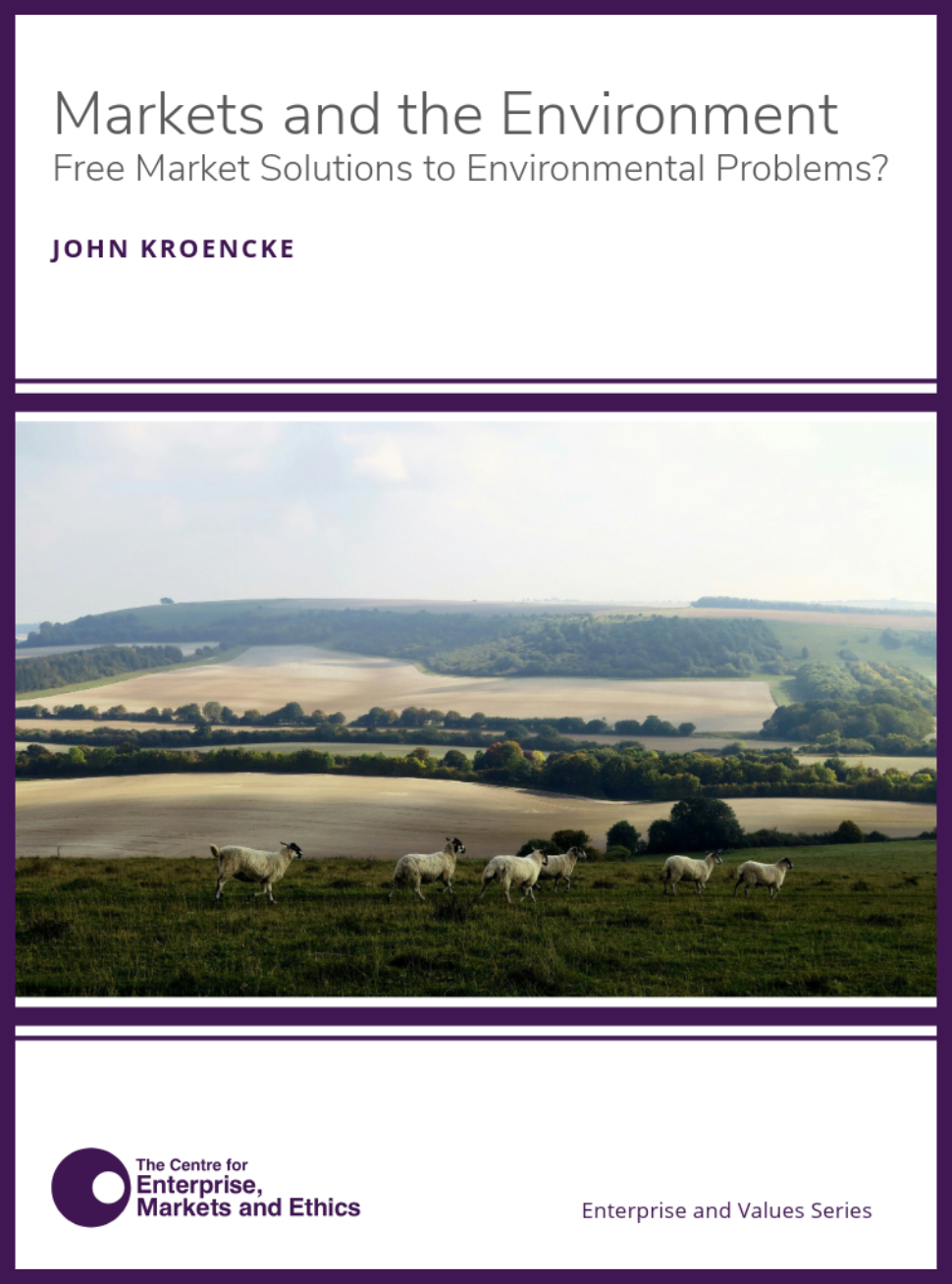
Web-friendly and divided into sections (clickable endnotes):

Environmental sustainability is a central challenge for humanity. In areas of the United Kingdom water has been rationed in two of the last four years, partly because we have not managed to build a major reservoir for over 30 years. Not only greenfield, but also brownfield land on which housing could be built to ease our chronic shortage lies undeveloped. Fish stocks in some important species have dropped to dangerously low levels with high government-set catch levels aiming partly to preserve the UK’s fishing fleet. The carbon emissions strategy pursued by all recent governments has put the goal of achieving net zero by 2050 within reach, albeit at considerable, but perhaps now reducing, cost.
The first fruits of CEME’s programme on the economics and ethics of the sustainability challenge are published today. Markets and the Environment, by our Senior Research Fellow, Dr John Kroencke, considers what economic theory and the history of environmental policy tell us.
If we accurately grasp the scale of the challenge, we will immediately have strong feelings. One reason is that, once the fragility of the ecosystems in which we live is exposed, we see how precious they are. In Christian ethics we express this by saying that humankind and the world in which we live our earthly lives is part of a single created order, which the Creator lovingly holds in being. In the poetry of Genesis 1, God saw all that he had made, and it was very good.
A second reason is that sustainability challenges give us an insight into our own mortality and limitedness. In the earthier imagery of Genesis 2, our earthly bodies are of the same stuff as the dust of the earth. In that sense dust we are, and to dust we shall return.
A third reason is that we see stark trade-offs. The goods of conserving or regenerating ecosystems appear to conflict with other social goods. That is certainly a feature of all the UK challenges mentioned above. In these trade-offs we seem to face a certain loss, either of one kind of good, or of the other. We fear these losses in prospect. When they happen, they grieve us.
These strong feelings can lead us into one of two unhelpful responses. The first could be called environmental absolutism. We all feel that sometimes. Looking at some part of the planet, which particularly strikes us at that moment in all its preciousness and fragility, we have what seems like a moment of moral clarity. We can make no trade-offs. The very idea of cost-benefit analysis seems out of place. ‘Conserve or regenerate this at all costs,’ we feel, ‘and let the heavens fall.’
Yet we do have to make trade-offs, not only between environmental and other social goals, but even between different environmental goals. So we need not only moments of moral clarity, but also a worked through ethics and theology which is integrated with, not insulated from, economic thought.
Another unhelpful response is at the other extreme: what could be called laissez-faire fatalism. I suspect we all have moments of that too. It’s just too difficult, we feel, to work out these difficult trade-offs. If we try, there will be too much conflict, too much ‘politics’. Or, in a different version, the costs of environmental protection seem just too vast to contemplate: intuitively ‘it is just not worth it’. Surely ‘the market’, if left to itself, can work it out. Or can’t the economists just make the problem go away?
But that response will not work either. When we talk to economists about ‘leaving it to the market’, or indeed to them, they will first tell us that the losses in value caused by environmental harm will be in many cases far higher than the potential gains from the activities that cause it. They will tell us also about externalities and market failures. They will be disinclined to tell us what our environmental goals should be, and instead offer us efficient ways to achieve goals which we put to them.
They will also tell us that this kind of fatalism risks legitimising positions which have nothing to do with economics at all, but are rather forms of political posturing and the instrumentalisation of environmental policy for a broader ‘culture war’. This is one way one could see the 2024 manifesto pledge of the Reform Party to axe the UK’s Net Zero target, or the pause on renewable energy projects on federal land in the US. Economists can help us to get the economics right, but only if the politics and ethics of the debate permit that.
Once we accept that we need to think both economically and ethically, we then need to avoid two mistakes in how we do so. The first could be described as market-phobic. It is markets, some might say, which have created these problems. Do we not all agree that environmental goods are often public goods? Do they not often function as externalities to markets in other goods, which therefore inevitably fail to value them? Should we not then use market mechanisms as little as possible in addressing them? Should we not look instead to decisions by politicians and government officials to design the necessary actions, such as reductions in pollutants or emissions, and command and enforce them through the coercive power of the state?
The problem with this response is that it both exaggerates the ability of the state to do this with any efficiency, and overlooks the potential gains from well-shaped markets. A well-shaped market will harness large amounts of real-time information, even as that remains decentralised. It will summarise this in the rich, responsive information of price signals. These will enable diverse and dispersed individuals and groups to align their voluntary actions. By preserving existing property rights, or generating new ones, it will provide incentives for enterprise and innovation.
This type of potential has often been lost due to crude regulation, such as: opposition to zonal pricing for energy; regulated prices for water use; and the failure to develop more than an embryonic market in credits for nutrient run-off caused by much-needed house building. On the other hand the extraordinary growth of solar energy generation in Texas, stereotypically a place of ‘cowboy’ spirit and free-market principles, illustrates the power of a well-shaped market.
A second mistaken response could be described as market-fundamentalist. Have we not learned from other sectors of the economy, others might say, of the perils of government control of economic activities? Do we not know the challenges of intermittent, centralised decision-making, and the likelihood of political capture of the process? Therefore a market solution is always to be favoured. The role of government should be as limited as possible, shaping a market with the largest possible scope, and leaving it to run.
The problem with this response is that it confuses a general, ideological claim with a specific, empirical one. Ideologically one can believe that markets generally have great benefits, while at the same time insisting on the need to consider what institutional arrangements will in fact best address each specific environmental challenge.
A better way than these is suggested by the insights which won Ronald Coase a Nobel Prize in Economics. These are considered by John in Chapter 2 of his report. If we consider the relative merits of addressing an environmental challenge through governmental command and control, or through community-based self-governance, or through a market system, this should be seen as a choice between institutional arrangements.
The relative efficiency of these depends in large part on what economists call transaction costs. Coase’s contribution was to emphasise their significance. They include costs: to gather information about needs, counterparties, costs and prices; to establish property rights, whether over fish or water; to draw up, negotiate, monitor and enforce agreements; and to resolve disputes. These costs exist in all kinds of institutional arrangements, but in different patterns.
In Chapter 3 John develops Coase’s insight and applies it to environmental regulation. Since the pattern of transaction costs differs in each context, different institutional arrangements will be superior in different contexts. The arrangement selected can best be seen as an emergent solution to a specific environmental problem.
This has implications for business-people. Sometimes they fear they will be perceived as complicating political solutions designed to cut-through and connect with the strong feelings mentioned at the outset. But John’s report implies that a more complex and nuanced debate is likely to be in the public interest. There is no substitute for close, comparative analysis. We need to relinquish the doctrinaire stances through which someone might try to short-circuit decision-making by, for example, putting trust always in the state, or always in an impersonally and abstractly conceived market.
At other times business-people fear that policy-makers or the public will see them as advocating for market solutions only because they suit them. Coase’s thought yields a framework for policymakers and citizens to distinguish proposals which offer efficient solutions, from narrowly self-interested arguments. This enables the formation of the durable coalitions needed to support long term investments. For example, on nutrient neutrality a well-designed market overcoming barriers to win-win trades between existing polluters and homebuilders could attract broad support.
The need is for a real-world approach which keeps initial assumptions down, takes the trouble to understand the context without pre-emptively ruling anything in or out, and prioritises arrangements which best promote flourishing and welfare.
That allows the re-integration of economics with ethics. It certainly introduces an ‘anthropological’ element. In choosing between state, community or market solutions we will need to attend to what kind of state, community or market will in practice exist. That will depend in part on what kind of people are making decisions in the state, community or market, and how they relate to one another.
As Christians we have particular insights to offer. The impossibility of outsourcing our personal ethical responsibilities wholly to state or market arises from the irreducibly personal call God makes on our lives. Each of us must respond to the call to follow the way of Christ. We have each been given a will and a mind. With these comes the ability to make our own decisions – and an accountability for them.
The primary commitment to the welfare of our neighbours, rather than to any form of ideology, including economic ideology, is seen in the command to God’s exiled people to attend to their context and to work to improve it: to ‘seek the welfare of the city where I have sent you… and pray to the Lord on its behalf’ (Jeremiah 29.7). Indeed our cities in all their diversity do need our prayers – as does the City and its economic and commercial institutions – as well as our government and other communities.
We know that markets work, but also that they work in different ways in different contexts. Perhaps it’s time for some of us to stand up as ‘Christian Coaseans’, committed to tackling environmental challenges, and committed also to the hard work of comparing solutions and championing the most effective.

Revd. Dr. Philip Krinks is the Director of CEME.

The Centre for Enterprise, Markets and Ethics was pleased to hold an event on 13 November 2025
Bishop of Oxford’s Office and the Church of England’s specialist on AI and tech within the Faith and Public Life Team
Tech Entrepreneur


It has been reported that executives within the motor industry have expressed frustration at the Chancellor’s intention to end the provision of luxury cars through the Motability scheme, which assists those in receipt of disability benefits with funding to lease a new vehicle. Motability itself is a private company and accounts for about a fifth of sales of new cars in the UK, last year having spent £2.8 billion in the provision of vehicles for about 815,000 users. Of the 700,000 vehicles that constitute Motability’s stock, around 50,000 are considered luxury brands, such as BMW, Audi or Mercedes-Benz. In addition to removing luxury vehicles – defended by Motability as representing only seven per cent of its offering – the government is considering other reforms, including reducing the tax breaks available through the scheme, such as exemptions from VAT and insurance premium tax.
While Motability itself has pledged to crack down on potential abuse of the scheme, figures from within the motor industry have criticised the possible reforms. They argue that reform will reduce the size of the market for new cars, increase prices, deter investment, cost jobs and reduce the number of vehicles subsequently moving into the used car market, with knock-on implications for pricing. In addition, it is claimed, the planned changes will affect social mobility and cost the Treasury revenue.
The two latter claims have arguably been addressed. On the matter of tax revenue, it has been estimated that ending the tax relief on Motability vehicles will save the Exchequer over £1 billion per year. With regard to the question of social mobility, a reformed scheme would still deliver that. As the Transport Secretary indicated in a recent radio interview, the government considers the scheme to provide important support for those with mobility needs and believes that it should continue to do so. At issue, therefore, according to a Treasury official, is the question of whether the scheme has lost sight of its original purpose and whether, by providing premium vehicles rather than essential transport, it is making good use of public money. As such, the government’s concern is essentially with matters of fairness.
The other concerns raised by industry figures – concerning jobs, investment, prices and the state of the market more broadly – are interesting in so far as they focus entirely on issues within the automotive sector. What, precisely, is being sought? It is natural for businesses to wish for certainty and consistency, without which it is difficult for them to make plans or operate with any confidence. This, however, does not appear to have been mentioned. Rather, what seems to be at issue is the financial support provided to the sector by way of the Motability scheme.
One might wonder, therefore, whether this constitutes an example of the kind of rent-seeking behaviour deplored by Adam Smith in his comment that ‘People of the same trade seldom meet together, even for merriment and diversion, but the conversation ends in a conspiracy against the publick, or in some contrivance to raise prices.’ While this observation was made in the context of a discussion of trade corporations and competition in employment, it reflects Smith’s concern at the tendency of those in business to seek monopoly advantages or government regulation that favours their own operations. Such behaviour – whether in the form of lobbying for special tax exemptions or using a dominant market position to exclude competitors – aims to increase one’s own profits without offering any additional productivity in return. Is this what figures within the automotive industry are engaged in, essentially seeking government financial support for their own advantage? Are they arguing that the proposed reforms should be abandoned because they are ‘bad for the sector’?
It could be argued – and perhaps this is the contention of the executives in question – that helping the motor industry is in the public interest. Maybe there are grounds for continued government support – in effect by leaving the scheme to operate as it is – based on the wider economic benefits. Through the Motability scheme in its current form, the argument might run, the government supports investment and research within the motor industry, or at the very least the provision of jobs. It thereby restricts unemployment and encourages spending, thus stimulating economic activity more broadly and contributing to economic growth.
There may be an argument of this kind to be made, but it invites the question of whether a scheme designed to assist those with mobility problems represents the best means by which the government could provide a stimulus to growth via the automotive sector – and why via this sector rather than any other? We might wonder whether the Motability scheme has accidentally become part of the UK’s industrial strategy. That is to say, a scheme intended to support those with mobility problems – that is, a supposedly targeted form of welfare provision – appears to be serving as a form of demand support for the automotive industry, to which some within the sector feel entitled or believe is essential to their economic success.
The purpose here is not to adjudicate the merits of either the Motability scheme or the effectiveness of any form of government-funded demand support for industry. However, an arrangement that seems to function as both, without necessarily doing either well, surely requires revision, particularly if, to follow Smith, those who benefit commercially come to see the provision as something to which they are entitled – all the more so if that form of unintended support is in danger of collapse when government thinking on welfare provision is revised.
A more effective approach would be to consider the UK’s welfare needs independently of any industrial strategy and to implement policies designed to achieve the best outcomes in each area respectively. Such an approach could reflect a coherent economic vision aimed at yielding the economic goods of labour market participation, increased prosperity and targeted and effective welfare provision.
To develop this kind of economic vision, we must engage with fundamental issues concerning our values, the kind of society we want to build and the kind of economic arrangements which will support it. Do we seek simply an increase in wealth, or are there other outcomes to be pursued, too? Are we hoping simply for growth, or growth of a particular kind? How should the increased wealth be distributed? What kind of employment do we wish to see provided: simply ‘jobs now’, or sustainable, productive work that is conducive to human flourishing in the long run? These questions oblige us to consider what kind of prosperity we seek.
Ultimately, we are brought to reflect on our conception of the good – both for individuals and society more broadly – for it is only with a grasp of such notions that we can make sense of the question of whether a particular sector ought to receive support from government, or whether measures to grow the economy are appropriate.
Without this, there is the possibility that economic support from government will always be subject to the competing claims of self-interested groups seeking their own advantage, used haphazardly to address one crisis after another as each arises, or spent on various projects to ‘promote growth’, without coherence or overall purpose.

Neil Jordan is Senior Editor at the Centre for Enterprise, Markets and Ethics. For more information about Neil please click here.

You may work, but are you a working person? This might just sound like an annoying exam question: probably one from the exams once sat by CEME’s philosophers and theologians, rather than by our economists. In fact it now appears to be crucial. It could determine your, and Britain’s, prosperity.
Back in 2024 page 21 of the Labour Party election Manifesto pledged not to ‘increase taxes on working people, which is why we will not increase National Insurance, the basic, higher, or additional rates of Income Tax, or VAT.’ In other words, while there would be tax rises after the election, there was a pledge to protect a defined group of ‘working people’. This made good sense as an electoral strategy, even if depended partly on vagueness. A lot of people assumed, perhaps naively, that the protected group included them. Because they worked, they were a working person.
A year ago, as the new government’s first Budget neared, the Prime Minister was pressed to clarify the definition. In an interview on 23rd October 2024 with the BBC’s Chris Mason he was asked whether ‘those who work, but get additional income from assets such as shares or property, would count as working people’, Keir Starmer said, no, they did not count. What he meant was a person who ‘goes out and earns their living, usually paid in a sort of monthly cheque’ and who can’t ‘write a cheque to get out of difficulties’.
The problem was that this definition now excluded anyone with a small amount of savings. A Number 10 spokesperson rushed to clarify. People with a ‘small amount of savings’ were included in the protection. This was not quantified, but included ‘cash savings, or stocks and shares in a tax-free Individual Savings Accounts (ISA)’. (Depending on the punctuation, that example may prove to have been a hostage to fortune, given rumoured changes to Cash ISAs.)
The next day on the Today programme the very capable Exchequer Secretary (now Chief Secretary) to the Treasury, James Murray, was asked five times whether landlords were also protected. Do they work? With grace and admirable resilience he declined to answer. He may have understandably felt there ought to be easier questions on the exam paper. Entrepreneur and broadcaster Steph McGovern pointed out wryly on The Rest Is Money that caring for tenants as a landlord had been the toughest job she ever had.
Later that day the Chancellor was asked on LBC, perhaps mischievously, whether the Prime Minister, already lavishly pensioned after retirement as Director of Public Prosecutions, counts as a working person. ‘The Prime Minister gets his income from going out to work and working for our country,’ she said. ‘He’s a working person. He goes out to work.’
Ultimately the major tax measure in the 2024 Budget was a rise in Employer National Insurance Contributions. To preserve the manifesto pledge, the Chancellor relied, not on a definition of the group of people involved, which was wide, but on the type of impact. She made a distinction between payment and incidence. Still not to be raised were taxes where the payments were actually made by working people: happily for her this was not true of Employer NICs. Able to be increased, however, were taxes where the incidence fell on working people: unhappily perhaps for them this was true of Employer NICs.
Fast forward a year and the approach of the 2025 Budget has raised the definition again. It appears the definition of working people may be about to narrow considerably. Sky News obtained last week what it described as ‘an internal definition of “working people” used by the Treasury’, where ‘officials have been tasked with protecting the income of the lower two-thirds of working people’, estimated as people earning below around £46,000. If so the Manifesto pledge would be being retrospectively redefined as applying to only this sub-group of working people.
In addition the concept of ‘protecting income’ could also drastically water down the pledge for everyone. It would shift it from the level of each individual tax to the collective net impact of tax changes. The pledge had been understood as capping the level of individual taxes: ‘we will not increase National Insurance, the… rates of Income Tax, or VAT.’ That may no longer hold, even for the lower two thirds of workers. Rather, one or more of the broad-based taxes could be raised on the lower two thirds of workers, so long as the net impact of tax, or even overall fiscal, changes leaves the lower two thirds of workers no worse off. (This is the kind of thinking used in the ‘distributional analysis’ tables which accompany UK budgets, showing the net impact of budget measures on each percentile of income.)
Much could be said about the economic wisdom of all this. No doubt it will be, including by us at CEME. For now I want rather to make a theological point about the whole debate. Theologically I would certainly give the government credit for their original pledge and their willingness to wrestle with a definition.
That is because they are acknowledging that work matters. And that is right. It matters to each of us, and to our neighbours, and to God. As Richard Turnbull puts it in Work as Enterprise: Recovering a Theology of Work, ‘Christian theology provides both a moral and a spiritual language about work – a language that conveys principles of enterprise, beauty and relationships’ (page17). There is a trace of this in the government’s pledge: an instinct to valorise work, to encourage it and to preserve as much as possible of a worker’s share of the fruits of their labour.
On the other hand the pledge, even as originally framed, has three drawbacks. First it risks creating a divisive narrative. It identifies one group, the real workers, who will be protected from tax increases, and an out group, who will not be. By making pledges only about income and consumption taxes, it also implies that the wealth which some work generates is somehow a particularly legitimate target for additional taxation, as Neil Jordan suggested last week. Perhaps the language was even intended to carry a hint of Marxist class analysis. But certainly it was about ‘othering’. (In that way it recalls equally unhelpful attempts in the past to distinguish the ‘deserving poor’ from those taken to be less deserving.) Of course choices have to be made about who pays what. Of course the argument of broader shoulders bearing heavier burden always has merit in any community. But setting the issue up in the language which hints at class conflict has many downsides.
Secondly identifying a sub-group as working people encourages a debased view of work. Surely most of the population aged 8 to 88 are working people. Retired people supporting charities with their time and wisdom are doing work. Family members who care for their loved ones are doing work. Even our young people at their studies and training are doing work, if of a preparatory kind. Richard Turnbull suggests definitional features of work (page 17) include: human activity which carries both intrinsic and extrinsic value; requiring physical, emotional or intellectual energy; resulting in human development; and providing for human need. Of course another important characteristic of much work is that it relates in some way to economic exchange, and that is also to be celebrated. But when the concept of work is deployed within a potentially divisive narrative about differential tax policy, it risks being narrowed. Something which should be seen as having, to use Tom Holland’s favourite word, a ‘sacral’ element, is reduced to the financial element of paid employment.
Finally the understanding of paid work which underlies this policy narrative seems outdated, if not nostalgic. Like the Prime Minister, I grew up with a cheque book. Now ‘just Monzo me, bro’, as the younger generation would say. But, more fundamentally, as Richard Turnbull’s thoughtful introduction also suggests, ‘work is not a static concept’ (page 7). Payroll employment remains the most significant form of paid work, but it is no longer the only form available. We have now had four industrial revolutions, not just one. To look ahead, at CEME we have already been working on, and are about to discuss, the issues raised by a fifth: the use of Artificial Intelligence, which has the potential to change the world of work.
Over the next month it looks like some or all British working people may need to prepare for unwelcome fiscal news. Looking even further ahead, as the AI revolution accelerates, perhaps we will have to adopt Bill Gates’ suggestion and ‘tax the (Working) Robots’. I don’t know what political leverage robots will have, working or otherwise, but I fear they will find that Benjamin Franklin’s rule applies no less to them. If so they had better prepare like us for the two certainties of death (or at least obsolescence) and taxes.

Revd. Dr. Philip Krinks was recently appointed as Director of CEME.