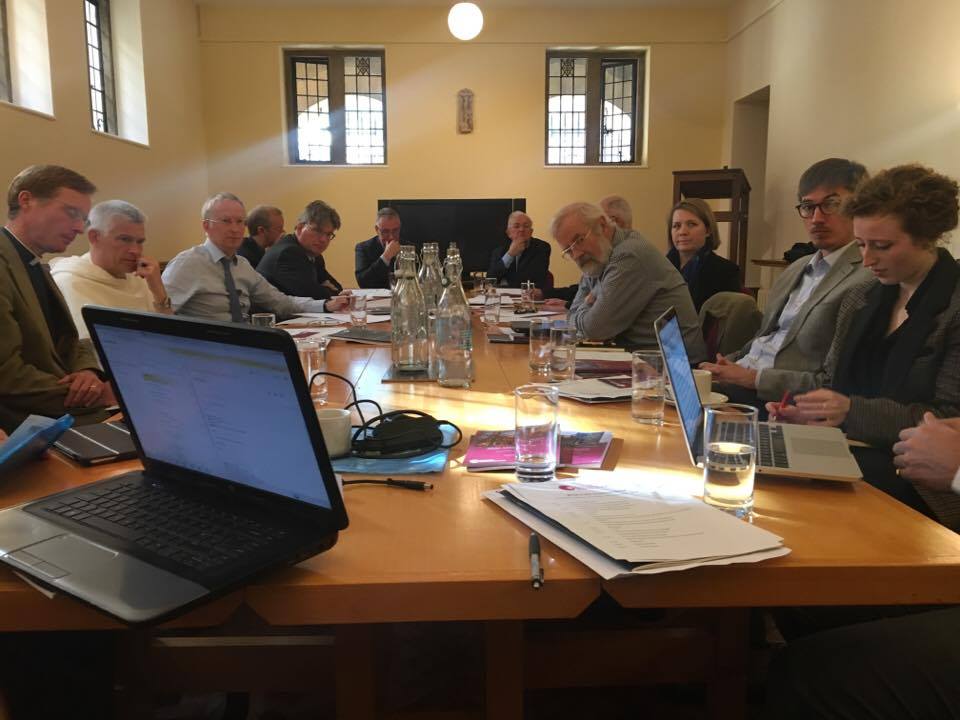
The Center for Enterprise, Markets and Ethics, in conjunction with Campion Hall (University of Oxford), held a roundtable discussion on the “Common Good”.
We were delighted to have, among others:
Brian Griffiths (Lord Griffiths) – Chairman, Centre for Enterprise, Markets and Ethics
Revd Dr James Hanvey – Master, Campion Hall
Professor Philip Booth – St Mary’s University, Twickenham
Dr Adrian Pabst – University of Kent
Dr Samuel Gregg – Director of Research, Acton Institute
Revd Dr Patrick Riordan – Heythrop College
Professor John Barton – emeritus Professor, University of Oxford
Revd Dr Richard Finn – Director, Las Casas Institute, Blackfriars Hall
Rt Revd Dr Peter Selby – former Bishop of Worcester
Revd Dr Malcolm Brown – Director, Archbishops’ Council Mission
Revd Canon Dr Edmund Newell – Principal, Cumberland Lodge, Canon of Windsor
The debate took place on the 4th – 5th of October, 2016 at Campion Hall. A publication of the discussion is due to be released shortly.
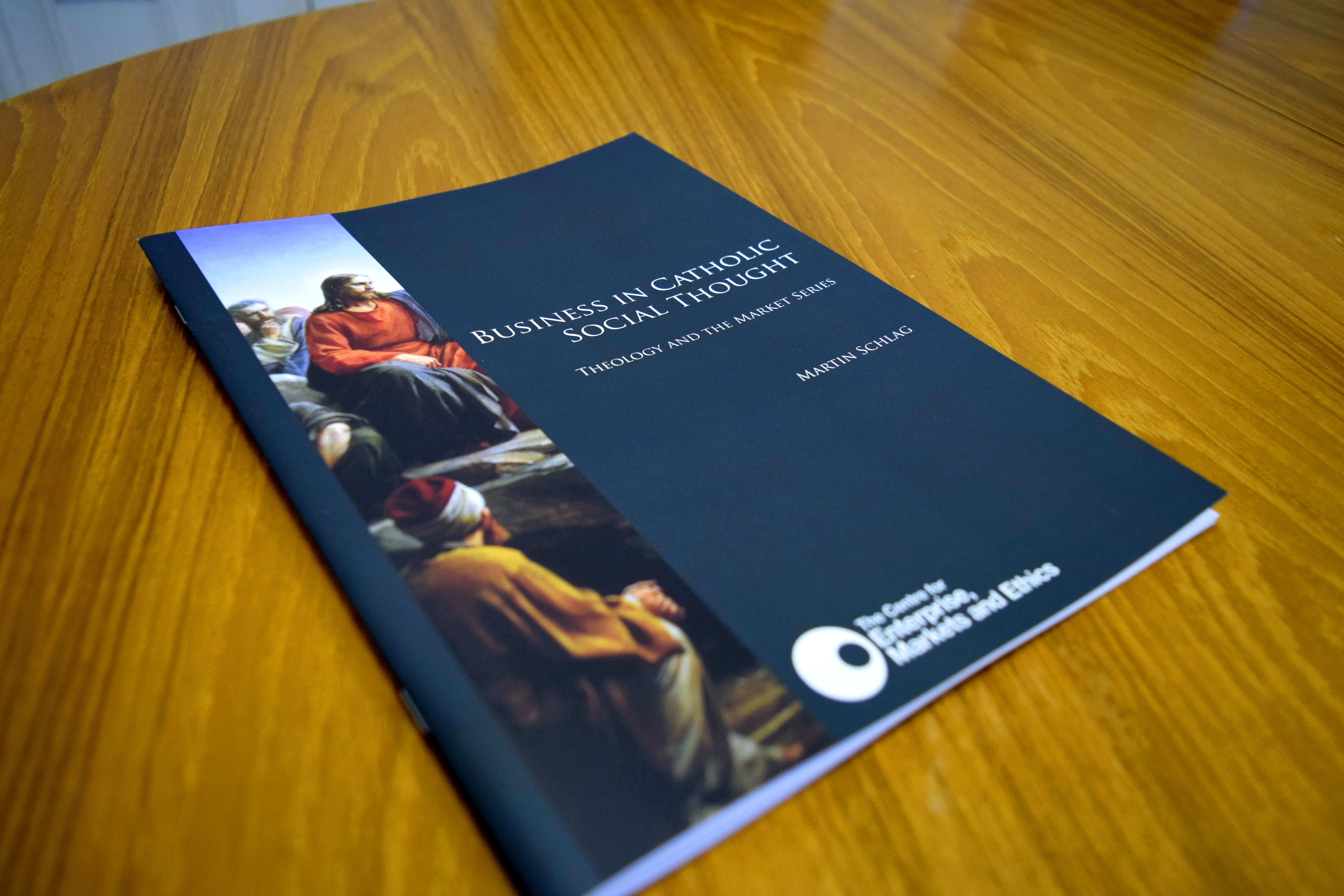
The Centre for Enterprise, Markets and Ethics (CEME) is pleased to announce the publication of Business in Catholic Social Thought by Martin Schlag.
The publication can be downloaded here. Alternatively, paperback copies can be ordered by contacting CEME’s offices via email at: office@theceme.org or by telephone at, (+44) 0186 5513 453.
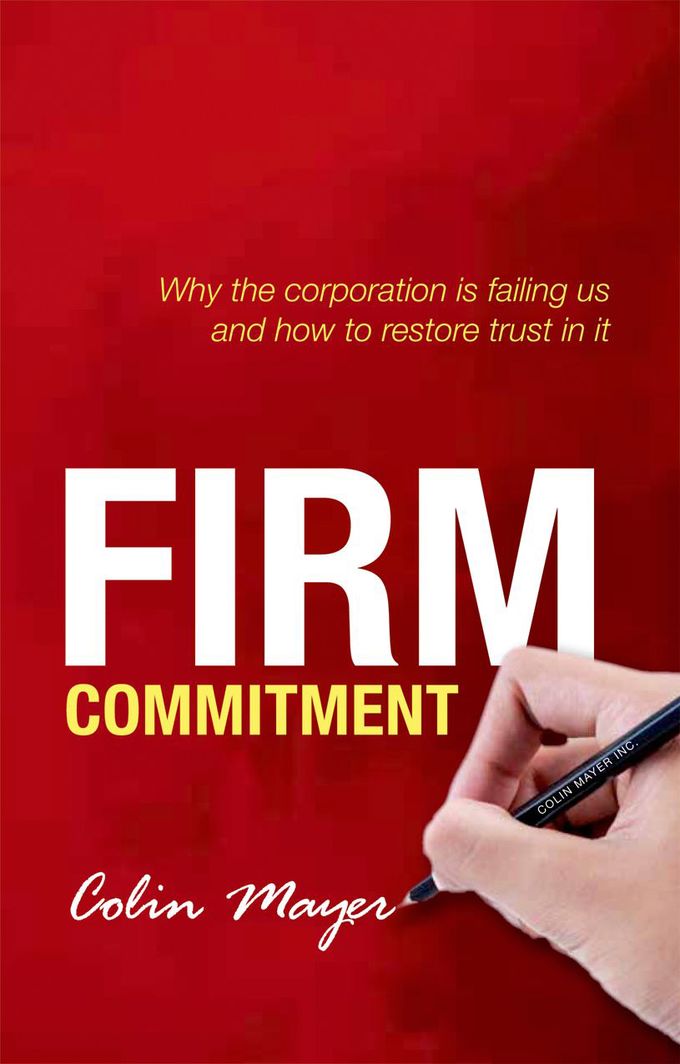
Colin Mayer is Professor of Management Studies at the Saïd Business School in Oxford. He believes that “the corporation is failing us” and that dramatic changes in the rights and obligations of those who control corporations are needed. Firm Commitment explains why and makes proposals for change.
Mayer uses the term “corporation” to refer to the kind of limited company that is commonly used by large businesses. He recognises the huge benefits that corporations have brought but he considers them to be seriously flawed. Indeed, he describes his book as “both a tribute to and a condemnation of this remarkable institution that has created more prosperity and misery than could have ever been imagined”. He perceives the main problem to be that corporations are seen as the creatures of their shareholders, rather than as independent entities, and this leads to the pursuit of shareholder value over the interests of stakeholders other than shareholders. In support of this, he cites numerous well-known corporate scandals.
The primary focus of his book is the UK and Mayer appears to believe the position here is worse than elsewhere. However, he is not starry eyed about any currently available option. Notably, he recognises that family and other tightly owned companies may have their own problems and scandals (citing Parmalat) and, in any event, family ownership “is not the resolution to the 21st–century corporation’s problems”. He is also dismissive of the attempts that have been made in recent years to correct problems through regulation (which, he asserts, “promotes immoral conduct”) or through enhanced corporate governance (which, he suggests, may promote increased shareholder control to the further detriment of other stakeholders). He suggests that what we need is “to find mechanisms by which companies can demonstrate a greater degree of responsibility themselves without relying on others to do it for them”. Specifically, he suggests that “we need to establish the means by which corporations can demonstrate more commitment to their stakeholder community”.
Salvation is in what he calls “trust firms”, which would be like existing corporations subject to three adaptations: entrenched within their constitutions would be corporate values (which might reflect the values of their founders, public policy or other things); there would be trustee boards to act as custodians of these values; and the corporation would have “time dependent shares” whereby the voting rights of shareholders would depend upon the extent of their commitment to hold their shares for the longer term (e.g. a share which its holder is committed to hold for a further ten years would have ten times the voting rights of a share which the holder is only committed to hold for one more year).
Mayer does not want any compulsion to be applied in relation to this. He argues that diversity in corporate forms should be permitted. He does, however, suggest that there be tax incentives to encourage the use of trust firms.
There is a lot to applaud in this book. In particular, there is depressingly little evidence that increased regulation or the focus on corporate governance in recent years has materially improved the corporate world and, against this background, Mayer’s stress on the importance of “commitment” as opposed to “control” deserves serious consideration. It links with ideas derived from the work on “relational thinking” that has been undertaken in recent years by, amongst others, the Relationships Foundation and Tomorrow’s Company. Furthermore, the concept of a “trust firm” is an interesting one that could contribute to the development of a broader view of corporate purpose and responsibility.
Unfortunately, however, this is a flawed book. Perhaps Mayer has tried to cram too much into 250 pages. Whatever the reason, almost every page contains contentious statements or statements that require significant qualification. Although there are plenty of footnotes referring to past research, there are also many ex cathedra statements as well as many assertions and assumptions with which specialists will take issue. For example, some of the statements of law are, at best, partial and Mayer seems unaware that much of what he proposes can already be achieved through existing law (as, for example, the entrenchment of editorial independence within the constitution of The Economist Newspaper Ltd illustrates). He also accepts dubious interpretations of past events. In particular, his long description of the Cadbury takeover accepts the views of its former chairman, Sir Roger Carr, without examination. This is a pity because others involved in that takeover (including former Cadbury directors) have different views and consideration of these might have led to Mayer modifying some of his suggestions.
More seriously, Mayer’s analysis of the objective of corporations is unhelpful. He states that “shareholder value is an outcome not an objective” and even quotes former GE CEO Jack Welsh in support of his views. However, his argument only addresses the use of short term share prices as the test of shareholder value and his suggested alternative as a corporate objective is demonstrably inadequate. He asserts that a corporation’s “first and foremost objective is not to its shareholders, or to its stakeholders. It is to make, develop, and deliver things and to service people, communities, and nations”. It is unclear from where he derives this overarching normative assertion and, in any event, it is no more useful than saying that the objective of corporations is “to do things”! It does not help a corporation’s management to decide whether they should remain in heavy engineering or move to IT or whether to be a volume manufacturer or a niche player.
Finally, Mayer’s evident confidence that the trust firm does not suffer from serious flaws and is the solution to the myriad of issues that he has identified is not backed-up by careful analysis. He appears to recognise this since he says that his ideas need to be “subject to careful scrutiny”. They certainly do and, whilst they are undoubtedly worth such scrutiny, it may be seriously doubted whether they are the “cure all” that Mayer appears to believe.
That said, provided that the book is read critically, it is well worth reading.
“Firm Commitment” by Colin Mayer was first published in 2012 by Oxford University Press (ISBN-10: 0199669937).

Richard Godden is a Lawyer and has been a Partner with Linklaters for over 25 years during which time he has advised on a wide range of transactions and issues in various parts of the world.
Richard’s experience includes his time as Secretary at the UK Takeover Panel and a secondment to Linklaters’ Hong Kong office. He also served as Global Head of Client Sectors, responsible for Linklaters’ industry sector groups, and was a member of the Global Executive Committee.

This is a talk given by Lord Griffiths of Fforestfach at an event organised jointly by the Centre for Character and Values at the Legatum Institute and Clifford Chance LLP. and Chaired by Christina Odone, Chair of the Centre. (May 9th 2016).
I am a great admirer of Alasdair MacIntyre. He is one of the world’s greatest living philosophers, invariably provocative and controversial but never without interest or depth of thought. A few years ago he gave a lecture with the arresting title “The Irrelevance of Business Ethics”. He set out to argue that the financial crisis of 2008 was not the result of a lapse in ethics by bankers but that the very nature of dealing in financial markets was to offload risk on to a counterparty or client with no ethical consideration whatever, “the better the trader the more morally despicable”. The result is that trying to teach ethics to traders was like reading Aristotle to a dog.
From the evidence of opinion polls the very expression ‘business ethics’ in an oxymoron. The fact that since the financial crisis banks have been fined over $300 billion, Volkswagen has admitted cheating on emission tests on potentially 11 million cars, Mitsubishi has acknowledged that it intentionally mislead regulators, shareholders of blue chip companies have revolted over executive pay and the House of Commons Select Committee has investigated the sale of BHS for £1 which was subsequently put into administration with a huge pensions deficit the following year, all suggest that ‘business ethics’ is for the general public a contradiction in terms.
Ethical behaviour by business is important for a number of reasons.
One is that the public expect business to be ethical. They expect business to be conducted in an honest, fair and transparent manner, which serves the greater good of society and not just the interests of management and shareholders. They expect the senior managers of business firms and the entrepreneurs who set up private companies to have a moral compass which respects the dignity of those who work in the organisation and those they serve as customers. They expect that businesses will have standards which do not seek to mislead or misinform customers regarding the true price and the quality of the products and services which they provide.
The fact that the public hold such views is important because through their elected representatives who pass legislation in parliaments it is the public ultimately who grant business a license to operate. Without such a license for example, limited liability companies would not exist. That license can be changed at the will of Parliament. What has become increasingly clear is that the public will not put up with unethical business. Without ethical business regulation will increase. Just look at what’s happened in banking following the financial crisis. Regulation is at best a blunt instrument in that it cannot easily be tailored to meet the needs of individual companies. Not only that but regulation is a form of taxation and like most taxes it has a deadweight cost to society.
A second reason why ethics in business matters is that it underpins the legitimacy and attractiveness of a market economy. From the latter half of the eighteenth century and Adam Smith’s great work on the causes of the growth in the wealth of nations, a market economy which fosters enterprise and freedom and allows markets to work and is by far the best driver of prosperity that we know not only that but a market economy entails a degree of economic freedom which is a key element of political freedom. Business without ethics and values therefore undermines the appeal of a market economy and a free society.
A third reason why ethics in business matters is a personal observation. Working in a company with ethical business principles and a culture built around strong values is far more fulfilling than working in a company which turns a blind eye to ethical standards and in which the culture is based principally on success and money. I have sat on the boards of fifteen companies in the private sector since working for the first 25 years of my career in the public sector. These companies were varied. Some were main boards with shares traded on the NYSE, NASDAQ or LSE; others were wholly owned subsidiary boards; some were large, others medium, some small in terms of size; two were joint ventures. The products and services covered were extensive: banking, broking, rail freight, care homes, music, cable communications, television, cleaning, killing bugs.
For me and I suspect for most of those who worked for the companies the most distinguishing factor in terms of a company being ‘a great place to work’ was the respect shown to fellow employees, the pride the firm took in its products and services, the sense of community which existed in the organisation, management’s commitment to help people develop to their full potential and the fact that it served a greater purpose than just focussing on maximising the bottom line. It is because of these qualities that such a company is trusted by its customers and the community in which it operates. It is also the reason it is able to build up a culture of trust within the organisation so that management can be trusted to make the right decisions.
If businesses are to act ethically there are three questions business leaders must ask themselves.
First, Who Are We? Put differently, What do We Stand for? What is our Purpose?
This I believe is the most fundamental and difficult question for any business leader to ask. To explore the purpose of a business is to go beyond profit. Without profit – which is the financial return to those who provide equity capital – a business will not survive. However asking about purpose raises broader issues than the bottom line. Does the company take pride in the product or service it provides? Is being part of the firm a source of human flourishing? How does the company contribute to the common good by what it does?
The reason it is difficult to ask these questions is that they in turn ask each of us to turn inward and ask ourselves a far more searching set of questions, Who am I? What am I doing with my life? What is the purpose of my existence? Most of us most of the time want to park such questions and get on with the day to day challenges of running the business. Far better and more productive to log on and check what the markets have been doing overnight. Then respond to e-mails. After that a look at today’s calendar with slots filled in from early morning to late at night.
I served for 21 years on the Board of a US company, Herman Miller which designed and manufactured office furniture. It was in the twentieth century a world leader in its field both in terms of design (it attracted great designers such as Eames, Ngouchi, Nelson, Gehry, Stumpf and environmental stewardship well before that became an important item on corporate agendas. The Chairman who invited me to join the board was Max de Pree. It was only many years later that I came across an essay written by Nicholas Wolterstorff, a distinguished Yale professor of philosophy, that I became aware of the importance of the purpose of a business. This is what he said;
“About ten years ago now I served – quite amazingly – as a philosophical consultant to the Herman Miller Furniture Company in New Zeeland, Michigan. Max de Pree, the executive officer of the company, had invited an architect, a physician, a journalist, a furniture designer, a theologian, and me to an all-day session with him and about five of the top officers in his company. At the beginning of the day he posed ten questions that he wanted us to discuss, in whatever order we wished. He asked us not to concern ourselves with trying to say things that we thought would be useful to the company; he wanted the discussion to take whatever shape it wanted to take. I remember three of the questions. “What is the purpose of business?” he asked. Some of his younger executives were saying that the purpose of business was to make money. He himself didn’t believe that; but he wanted to talk about it. Second, he wondered whether there was “a moral imperative”, as he called it, for companies to produce products of good design. And third, he wanted to discuss whether it was possible to preserve what he called “intimacy” in a large company.
It became clear, in the course of the discussion what de Pree himself regarded as the purpose of business. The purpose, as he saw it, was twofold: to produce products that serve a genuine need and are aesthetically good, and to provide meaningful work in pleasant surroundings for those employed in the company. He added that these purposes had for a long time shaped his operation of the company.
Now it seems to me that these two purposes are, or can be, an expression of charity – that is, both consist to promote the welfare of the other. As a matter of fact, it became clear in the course of the discussion that it was de Pree’s religious commitment – specifically, his Christian commitment – that had led him to embrace these goals. He saw his operation of the company as an exercise of charity – though he didn’t use the word. His own case, at least as he presented it, was a case of “transcendental faith” shaping economic activity.
Was he prevaricating? Or deluded?”
Second, is the question What are our values? Have they been set out explicitly? Are they so general as to be vacuous? Who in the firm owns the values?
It is easy to write down a set of values for a business. Indeed nearly all large companies have similar sets of values: respect for the individual, honesty and integrity, social responsibility to the community, environmental stewardship and so on. Far more difficult is to assess their effectiveness. How do the values shape the way I work and the decisions I make? How do I behave differently because these values are set down and I am a member of that firm? What responsibilities do I now have because of these values? Do I treat colleagues differently? Do I treat clients differently?
I have found that the key to effective values in business is that they must be lived by the leadership of the company. The leadership must walk the talk. Without that the values are empty and the leaders guilty of hypocrisy. Preaching one thing but practising another. The leaders of a business cannot rely on regulation. Leadership cannot outsource the values of a business to regulators.
One test is what the leaders of a business think their values really are? Would that be shared by the average employee? Would it also be the perspective of clients and suppliers?
I was reminded of this recently in an article which appeared in Forbes magazine by Professor James Heskett, professor emeritus at Harvard Business School on the subject of servant leadership which is a more used term in the US than in Europe. The concept of servant leadership places great emphasis on the role of a business leader serving employees. Heskett recalls an incident at a ServiceMaster board meeting at which I was present and remember distinctly when the Chairman and CEO, William Pollard spilled a cup of coffee prior to the board meeting. “Instead of summoning someone to clean it up, he asked a colleague to get him a cleaning compound and a cloth, things easily found in a company that provided cleaning services. Whereupon he proceeded to get down on his hands and knees to clean the spill up himself. The remarkable thing was that board member and employees alike hardly noticed as he did it. It was as if it was expected in a company with self-proclaimed servant leadership”. (Forbes 5/01/2013. “Why Isn’t Servant Leadership More Prevalent?”)
The third question is ‘What is going on in our business?
As a non-executive director of a company whose board meets four or six times a year, one of the most frustrating challenges is obtaining sufficient information to really find out what is happening in the business. I believe it is very important that non-executives meet not only senior but middle management and even junior staff. Only once have I ever found senior management reluctant to allow non-execs talking directly to management. Frequently the binding constraint is the time non-exec’s are able to devote to meeting employees. However it is only then that they find out what is really happening in the business.
In small companies finding out what is really going on in the business is not really a problem. In large multi-nationals however the issue is a major challenge. In the money laundering activities carried on by certain banks the sheer size, organisational structure and large number of countries in which the bank operated have proved a major obstacle to effective control.
A number of steps are necessary in making values effective in business.
First, it is important to set out explicitly the purpose of the business. For this a one-time mission statement is typically far too general and vague and begs the question of what the purpose of a business really is when spelt out in practical terms.
Second, it is important to set out in some detail the ethics, values and business principles of the firm. The temptation is to frame these in general terms. Management must accept that the actions of today will be judged by the standards of tomorrow, which means being ahead of the curve.
Third, on the basis of its purpose and values, it must build a culture with implications for all employees, affecting every aspect of the business; reporting, firing, promotion, human resources, selling, buying, accounting, auditing and so on.
Fourth, senior leadership must show through ‘the tone from the top’ that they live the values and they are committed to ensuring that the same values permeate the middle and lower echelons, the ‘permafrost’ of the firm.
Fifth, the leadership must be able to constantly appraise the effectiveness which its values, code of ethics, business principles have on conduct. They must trust but verify. This will include keeping a close eye on disciplinary matters and terminations, with regular surveys of staff and clients. Such information is important in compensation discussions and promotion recommendations.
Sixth, in all of this non-executive directors have a key role to play in that on behalf of the shareholders and stakeholders they are the guardians of the purpose, values and ethics of the company.
The challenge of implementing values in a business can be made easier or more difficult by certain factors, namely size, ownership and the extent of competition in the markets in which the firm operates.
The size of a business matters. Implementing values in a small firm is easier than in a large firm. In a small firm it is much easier for senior management to know what is going on. A large firm needs systems of control and trust in those responsible for them. It may also be easier in a firm delivering a single product or service rather than in a conglomerate in which there are different kinds of businesses with different business cultures, something which becomes even more challenging when the company has operations in different countries.
Different forms of ownership will face different challenges. A private firm and especially a family business may find it easier to develop an effective culture than a publically traded company. A partnership may have built in checks and balances to maintain high standards. That any concept of intimacy has disappeared.
The competitiveness of the markets in which a firm operates is a further factor to be taken into account. Competition is beneficial. It drives down costs and will lead to lower prices for consumers. It allows new firms to enter the business. It encourages innovation. However, in a highly competitive market when margins are under pressure, hiring staff is difficult and expensive; if competitors begin to use questionable methods (“tolerated practice”) ethical standards will be under pressure. This raises an important issue for public policy. What is the optimal degree of competition? Reducing barriers to entry and opening markets to foreign companies is beneficial but is there a point at which competition becomes excessive and undermines ethical behaviour? Will the market itself be self-correcting? Should it be left to regulation? And if it will, at what social cost?
I believe that the subject of maintaining ethical standards in business, of creating business cultures in firms which make them “great places to work” and of punishing wrongdoers for illegal activity is fundamental to a market economy and a free society. I am grateful for this opportunity to raise some issues associated with it this evening and look forward to our discussion.
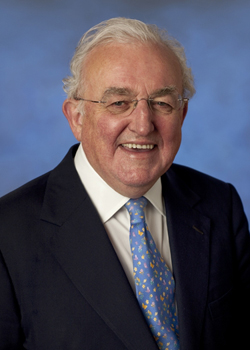
Lord Griffiths is the Chairman of CEME. For more information please click here.
This was a speech given at a reception for the New City Initiative hosted by the Lord Mayor of London, the Rt Honourable Lord Mountevans – July 7th 2016, Mansion House. To request a full copy of the Report please contact office@theceme.org
May I, first of all, add my own thanks to the Lord Mayor, to Jamie Carter and to the NCI?
There may be, in the minds of many of our fellow citizens, something rather incongruous about asset managers even beginning to think about morality. That in itself illustrates that the importance of returning to our basic purposes, role, intent and vision, could not be greater.
Why is it that efficiency of asset allocation, pooling risk, providing liquidity and so on can be seen as contributing to moral purpose? It is because at the heart of the asset management task lies the collective management of wealth and economic growth that not only provides for individual well-being, but is also an essential component for the provision of public services in any free society. Unless we have the former, we cannot have the latter. So that is our first and most basic moral purpose, the creation of wealth, individual and corporate, and we should articulate it rather more than we do.
Second, the very nature of the firms gathered here gives us some clues about moral purpose at the micro level. Intelligent people, thinking about investment, markets and companies; the alignment of interests through co-investment; a culture that focuses on the offering to the client; an alternative to the index-driven retail industry; stewards of value – all of these are moral benefits of NCI member firms.
Are there challenges? Of course. We need to be transparent on fees and the relationship of remuneration and performance; fee structures have sometimes rewarded mediocrity. We should recognise that many of our clients will have non-financial objectives as well as financial. We should encourage a culture that places long-term thinking at the heart of the investment objective.
Finally, regulation and reputation. Regulation is necessary, but government and regulators alike are mistaken if they think that regulation enforces moral behaviour. NCI members are uniquely placed to shape the culture, the structure and indeed the long-term growth that alone can deliver performance and restore reputation. We should indeed articulate it more than we do, at both micro and macro levels.
Well, I encourage you to read the booklet, and if I can be of assistance to you, your partners or clients, to help you achieve these goals, then please do not hesitate to contact me.
Dr Richard Turnbull is the Director of the Centre for Enterprise, Markets & Ethics (CEME). For more information about Richard please click here.
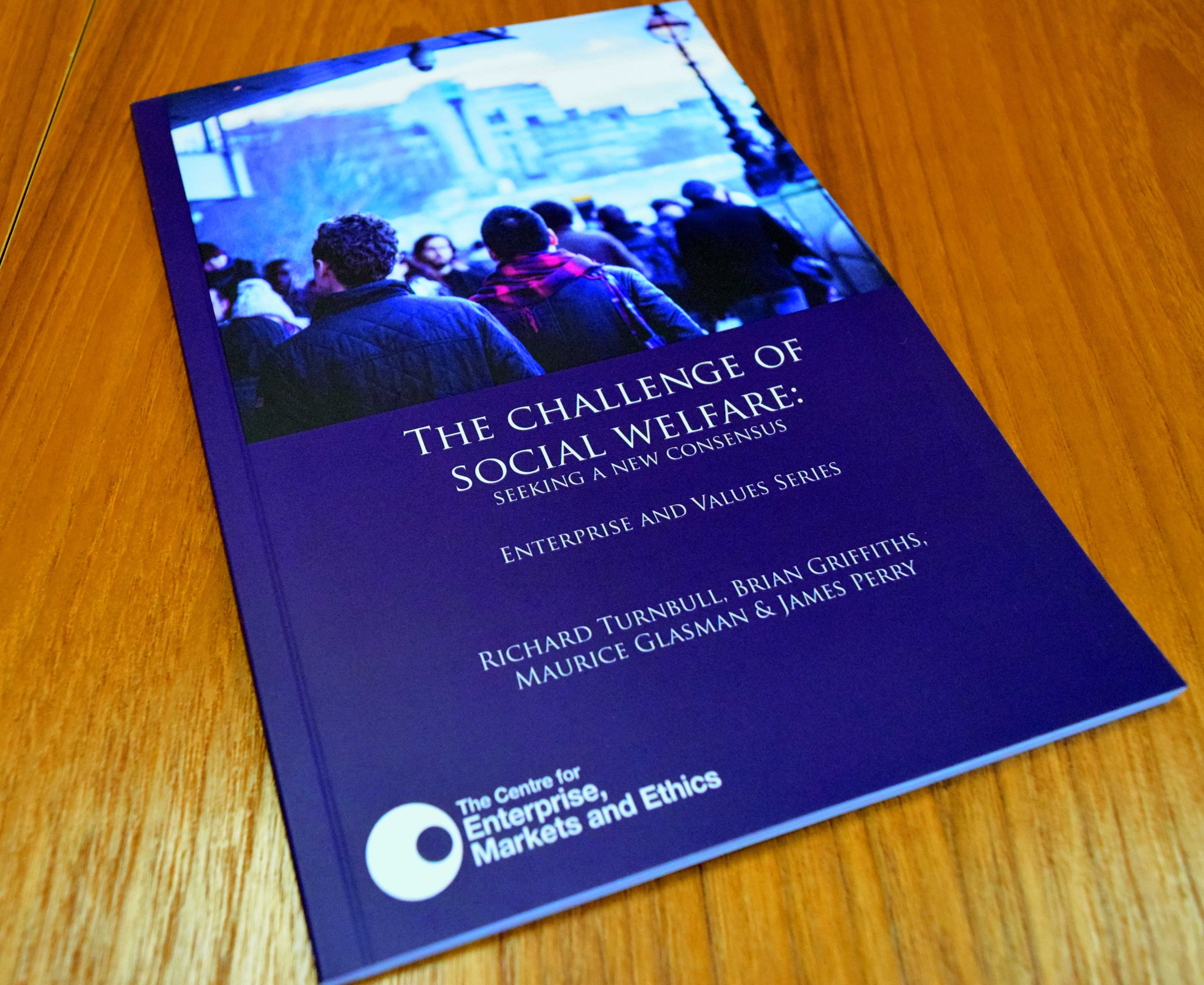
The Centre for Enterprise, Markets and Ethics (CEME) is pleased to announce the publication of The Challenge of Social Welfare: Seeking a New Consensus by Richard Turnbull, Brian Griffiths, Maurice Glasman and James Perry.
In July 2015 the Centre for Enterprise, Markets and Ethics, an independent think tank dedicated to research into enterprise and the economy from an ethical perspective for the good of society, held a symposium at the House of Lords.
The purpose was to ask questions about how we might seek a new consensus in the areas of welfare and social justice. The contributors were deliberately diverse. However, our conviction was that something had gone wrong in the debates about welfare that was preventing collaboration towards solutions. We were united in our conviction that poverty was not acceptable in a civilised society. However, we also felt that new ideas, new thinking, some hard but honest questions about morality and responsibility needed to be brought to the table. Similarly we felt that business and enterprise were part of the solution to the equation, but that new models of approach and structure were needed.
The essays that follow have been gathered together by the Centre’s Director, Richard Turnbull. Two of them, those by Maurice Glasman and James Perry, represent their contributions on the day. Brian Griffiths has added some further reflections to his work and Richard Turnbull has contributed a piece putting the debate into context.
We are very grateful indeed for the support of CCLA Investment Management Limited for their sponsorship of the original event and this publication.
Moral Questions by Richard Turnbull
A Welfare Society by Brian Griffiths, Lord Griffiths of Fforestfach
Welfare and the Common Good by Maurice Glasman, Lord Glasman of Stoke Newington
The Role of Business in Social Welfare by James Perry
Lord Griffiths of Fforestfach
Lord Griffiths taught at the London School of Economics, was Professor of Banking and International Finance at the City University and Dean of the City University Business School. He was a director of the Bank of England from 1983 to 1985. He served at No. 10 Downing Street as Head of the Prime Minister’s Policy Unit from 1985 to 1990. Since then, Lord Griffiths has been Vice Chairman of Goldman Sachs International and an international advisor to Goldman Sachs. He is currently a non-executive director of Times Newspaper Holdings Ltd.
Brian Griffiths has written and lectured extensively on economic issues and the relationship of the Christian faith to economies and business, and has published various books on monetary policy and Christian ethics.
Lord Glasman of Stoke Newington
Lord Glasman has been a Labour member of the House of Lords since 2011. He was brought up in a Jewish family. He studied at the University of York and then undertook a PhD in Florence on the German social market economy. Lord Glasman was Reader in Political Theory at London Metropolitan University, where he was also Director of the Faith and Citizenship Programme. Maurice Glasman pioneered the development of ‘blue labour’, emphasising the conservative and communitarian values of the Labour Party.
James Perry
James Perry co-founded Cook Food, which now employs around 650 people and is committed to the role of business in creating social value. Through the Panahpur foundation James has also led an extensive programme of social impact investment and finance. James also sits on the Advisory Council of Big Society Capital. He is also co-founder of B Lab UK, the charity co-ordinating ‘B corp’ activity in the UK – the movement that seeks to encourage business to incorporate social objectives into their constitutional documents.
Revd Dr Richard Turnbull
Richard is the Director of the Centre for Enterprise, Markets and Ethics. He studied economics and then spent eight years as a chartered accountant with Ernst and Young. He holds a first-class honours degree and a PhD in Theology from the University of Durham. Ordained in the Church of England, Richard has served as a member of the Archbishops’ Council, the Chairman of the Synod’s Business Committee and has chaired church working parties. Richard served as a minister for ten years and was Principal of Wycliffe Hall, a Permanent Private Hall of the University of Oxford from 2005 to 2012. He has authored several books (including an acclaimed biography of the social reformer Lord Shaftesbury), is a member of the Faculty of Theology of the University of Oxford, Visiting Scholar at Campion Hall and a Fellow of the Royal Historical Society.
The full publication can be downloaded here.
Alternatively, a hardcopy can be ordered by contacting CEME’s offices via email at: office@theceme.org or by telephone at, (+44) 0186 5513 453.
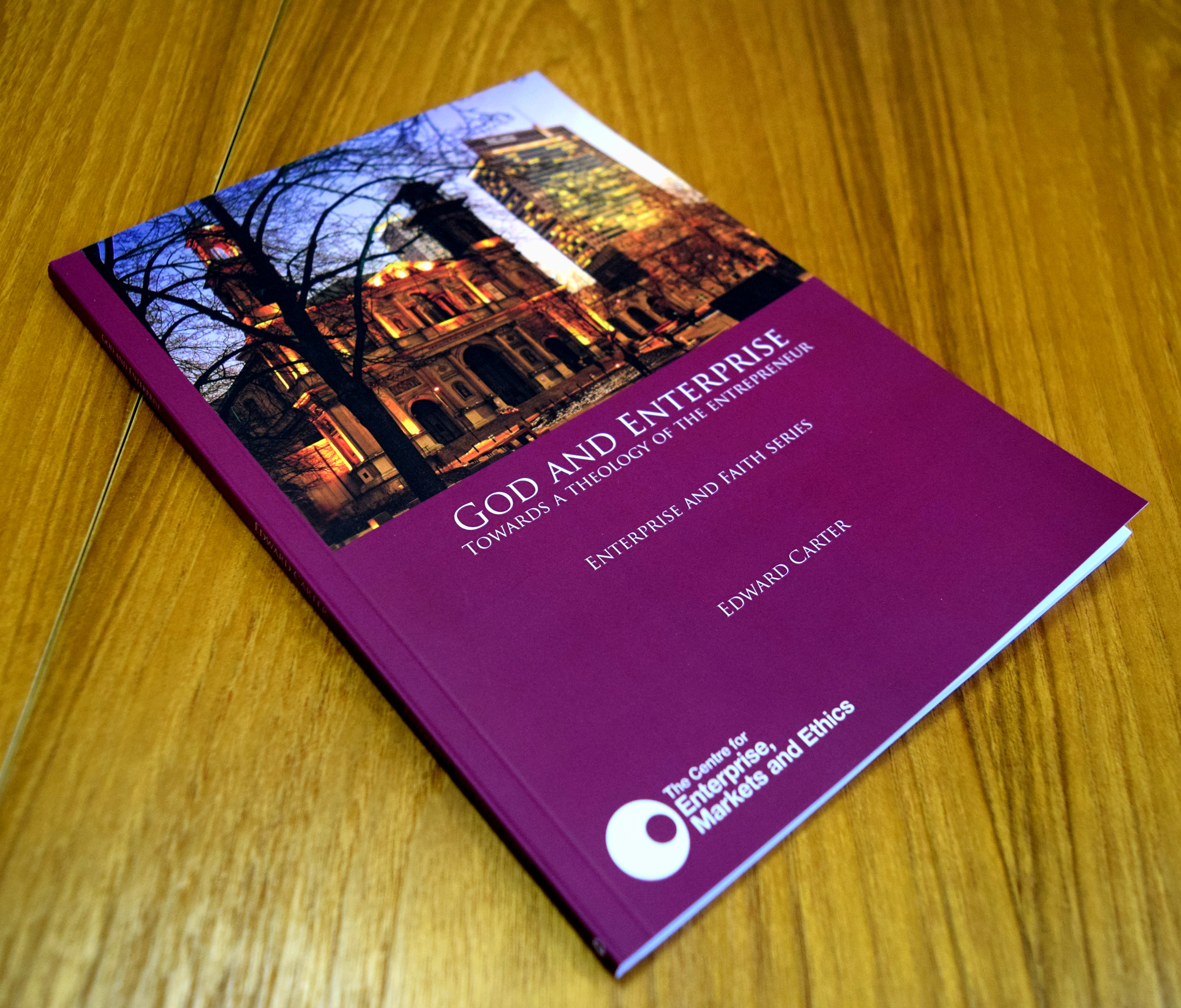
The Centre for Enterprise, Markets and Ethics (CEME) is pleased to announce the publication of God and Enterprise: Towards a Theology of the Entrepreneur by Edward Carter.
The publication can be downloaded here. Alternatively, hardcopies can be ordered by contacting CEME’s offices via email at: office@theceme.org or by telephone at, (+44) 0186 5513 453.
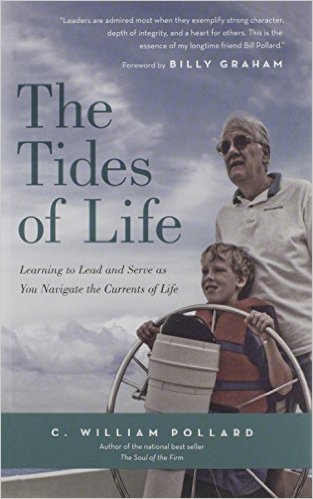
The Tides of Life is impossible to categorise: it is not an autobiography, although the majority of it comprises autobiographical material; it is not a business leadership and management manual, although it contains a lot about leadership and management; and it is not a systematic work about Christian living, although it is full of guidance about just that.
Bill Pollard was for many years the CEO of ServiceMaster, the much studied and admired former Fortune 500 Company. Prior to that, he was, for a time, a practising lawyer in private practice and, for a brief period, an academic. Throughout his life he has been involved in educational projects and charities. He has seen much success, including the extraordinary growth of his company, but has also experienced the varying “tides of life”, including the early death of his father and, recently, the death of an evidently much loved grandson (who appears on the cover of this book). Now, in the evening of his life, he has written a book about what he calls the “lessons and choices in life”. Essentially, it is an overview of what he has learned through his many and varied experiences.
The result is a structured miscellany: there are reflections on what “our humanity is all about” and on God’s ordering of the world; thoughts about responsibility and stewardship; discussions of the nature of work of and purpose of business, the role of leaders and managers and how God may be served by those in business; and, last but not least, reflections on the importance and nurturing of relationships. In all cases, Bill Pollard teaches by means of stories from his own life, which are placed within the framework of a biblical world view.
Happily, in recent years there has been a considerable upsurge of interest in the calling of Christians to serve God throughout their everyday lives rather than through some detached “Christian service” element of them. Bill Pollard believes passionately in this calling and wishes to pass on what he has learned about how to put the theory into practice. He is clearly a man who has never stopped learning and, judging by the number of times he quotes what others have said to him over the years, a man who never forgets advice that he has been given. Above all, he is a man who believes in providence and who lives his life in the light of Proverbs 19:21 (“Many are the plans in a man’s heart but it is the Lord’s purpose that prevails”), which is quoted at the head of one of the chapters of his book.
Arguably, he tries to cram too much into the space available. For example, the seventeen pages devoted to good corporate governance include matters as diverse as the ideal size for a corporate board and comments regarding what went wrong in the banks in the run up to the global financial crisis. Some business people will find this section of the book superficial. However, this is a quibble rather than a serious criticism.
More significantly, even having read Bill Pollard’s fierce criticism of the results of the absence of morality in the market place, some Christians may question the merits of the market economy to which he is committed and may be disappointed that he largely asserts these benefits rather than arguing for them in an academic manner. He similarly asserts his Christian world view rather than seeking to defend it. This, however, merely reflects the nature of the book: it does not purport to be a work of free market or Christian apologetics. It is thus unlikely to persuade a reader to accept its basic premises. However, it demonstrates how these premises may be lived out in practice and may cause sceptics to ask themselves whether this might indeed be the way that we should live our lives. Furthermore, if like me you agree with the premises, you will find here a mine of practical Christian teaching and advice.
This is not a book to read quickly. It is worth reading in short sections over a prolonged period of time, reflecting on each part of it before moving on to the next part. It may be impossible to categorise but it is none the worse for that.
“The Tides of Life” by Bill Pollard was first published in 2014 by Crossway Publishing (ISBN 1433541742, 9781433541742).
Richard Godden is a Lawyer and has been a Partner with Linklaters for over 25 years during which time he has advised on a wide range of transactions and issues in various parts of the world.
Richard’s experience includes his time as Secretary at the UK Takeover Panel and a secondment to Linklaters’ Hong Kong office. He also served as Global Head of Client Sectors, responsible for Linklaters’ industry sector groups, and was a member of the Global Executive Committee.

It is often argued that taxation to promote the position of the poor is somehow a moral act on behalf of those that are better off and paying taxes to finance the transfers to those who are worse off. It is not.
It is not an intrinsically moral act for the same reason that, if I go out this evening with the intention of beating up my brother and I am stopped from doing so because he is with two muscly friends, I have not committed an act of moral restraint. If I am put in prison for not paying taxes, I have not committed a moral act as a result of paying those taxes. There is no moral equivalence between paying taxes because you have to and the self-sacrifice that comes with philanthropy. Indeed, taxation can exhaust our ability to make moral choices to help our families, our neighbours and society more widely.
The moral problems that people often feel exist with a free and prosperous economy such as selfishness and an individualistic mindset are no less inherently present in an economy with high taxes. Self-interest can be every bit as present in the political system as it is amongst individuals. The idea that we have two natures – a selfish one in the private sphere but a better, more refined, less self-interested nature that is present in the public sphere has no justification in moral philosophy or empirical evidence. After all, when did you ever see a demonstration in a town calling for the local hospital to be closed down so that the neighbouring town could have more resources? Indeed, the zero-sum-game nature of public sector activity promotes selfishness and conflict – witness the lengths people go to in order to obtain places in good state schools, including fraud. In the private sphere, co-operation and providing something of value to customers tend to be rewarded.
The moral limits of taxation
So, there is no credible moral case for a high tax economy. But we can go further. Ultimately, taxation is an issue of how we view property rights. As Pope Leo XIII noted, property (the money that we have) is just wages in another form. To take another person’s property through taxation is to deprive a person of his justly earned wages.
Of course, the state does need resources and it is legitimate to tax people’s earnings in relation to their ability to pay in order to provide those things that are needed for the protection of society as a whole (defence, police etc.). It is also legitimate to tax people to ensure that all in society can have the resources to live in dignity if they are not provided by charity (through the provision of housing, food, healthcare etc.) – though these things do not need to be provided directly by the state.
This might justify taxation of between 5 and 20 per cent of national income – nothing like the 46 per cent of national income that the state spends in the UK today.
Practical aspects
In many practical ways, our tax system is morally problematic. It discriminates against family formation – with results that we see very clearly and, of course, it discourages work. A tax system that undermines family and work cannot be thought of as moral.
And, of course, when the state is spending nearly half of national income, there can be no general agreement about the morality of the things on which it spends money. In spending over 46 per cent of national income, the state finances all sorts of other things with my money that I think are morally wrong – and probably different things that you think are morally wrong.
A tax system in a nation of 65 million people, mediated by a huge bureaucracy controlled by a government called to account in elections every five years, cannot possibly replicate the true personal human compassion and philanthropy that is necessary if we are to provide the poor with genuine help. The individual, in this context, becomes a small cog in a giant wheel whose right of initiative has, in large part, been taken away and who has been encouraged to delegate his genuine societal responsibilities to those in need to the state. As Pope Benedict has said: solidarity is the responsibility of everyone to everyone and it cannot be delegated to the state.
This does not mean that the state should not provide for the poor. However, a low tax economy is conducive to social co-operation, individual initiative, the flourishing of families and high levels of employment. Furthermore, it is also conducive to the genuine voluntary assistance that the better off must give to those who need it. Society is not more moral when we discharge our responsibilities to those in need by voting for a party that will form a government that will manage a bureaucracy that takes money from one group of people to give to another group of people with neither group ever meeting each other.
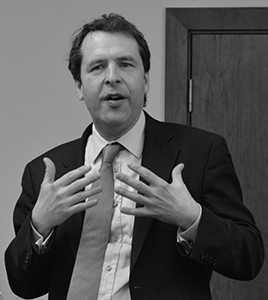
Philip Booth is Senior Academic Fellow at the Institute of Economic Affairs and Professor of Finance, Public Policy and Ethics at St. Mary’s University, Twickenham. He also holds the position of (interim) Director of Catholic Mission at St. Mary’s having previously been Director of Research and Public Engagement. From 2002-2016, Philip was Academic and Research Director (previously, Editorial and Programme Director) at the IEA. From 2002-2015 he was Professor of Insurance and Risk Management at Cass Business School. He is a Senior Research Fellow in the Centre for Federal Studies at the University of Kent and Adjunct Professor in the School of Law, University of Notre Dame, Australia. He is also an Associate Fellow with the Centre for Enterprise, Markets and Ethics (CEME).

Sports Direct’s founder and Chief Executive, Mike Ashley has admitted to paying staff below the minimum wage. The consultancy firm Mckinsey & Co. has been found to have a ‘secretive’ £5bn proprietary investment fund for its partners and BHS, the high street retailer has filed for bankruptcy in a downward spiral of events that would put most soap operas to shame.
What a week it has been!
It sure does feel like the year’s business stories have all been compressed in the space of one week.
Here are some thoughts:
1. There will always be a few bad apples
In the ‘free’ marketplace there will always be those that play so close to the legal line that they sometimes trip themselves over. Such was the case with Mike Ashley’s Sports Direct where staff were required to go through excessive security checks during which time they were not paid. In the parliamentary enquiry, Mike Ashley admitted that staff were paid below the minimum wage and also that the company “outgrown his ability to manage it”.
I remain rather sceptical.
Within a free market economy there will always be some (especially at the low-cost end of the spectrum of any given industry) that are so ruthless in minimizing costs that they sometimes, intentionally or unintentionally, dip into illegal territory.
Alongside Primark, Sports Direct is effectively the Ryanair of the sports retail industry. And like Ryanair, Sports Direct operates with an iron fist on efficiency.
But financial efficiency should not come at the cost of employee fairness and the well-being of staff. Indeed, the two are prerequisites for the long term stability of a company (see also point 3 below).
Perhaps of even greater moral concern is the widespread use of zero-hours contracts by Sports Direct as the normal means of employment.
There is a case against the minimum wage and there is a case in favour of zero-hours contracts. However, for wages to be so low as to breach (even on a technicality) the law and for zero-hours contracts to be the norm rather than the exception does not give confidence that the directors and senior executives of a business are aligning the interests of all rather than just some of their stakeholders.
Mike Ashley’s admission that the company has got too big for him to run raises very deep questions about governance.
2. Not all businesses are evil
We must not assume that all businesses are run in this way. The majority of businesses, and therefore people, involved in the private sector are upright and strive to do well in the workplace as well as their private lives.
It’s difficult to believe this when you hear stories like BHS owner Dominic Chappell giving death threats to Darren Topp, then CEO of BHS. When Darren questioned him about an unannounced £1.5 million withdrawal from the company’s accounts, Mr Chappell reacted by saying that “If you kick off about it I’m going to come down there and kill you.”
As atrocious as these events may sound, we must not lose hope in the good that business can bring.
Yes, the collapse of BHS was ugly beyond imagination and yes, the 11,000 people that are now unemployed is a tough pill to swallow – but despite all this we must not paint the entire private sector with the same colour.
Simon Walker from the Institute of Directors recently said in an interview that “… [the BHS case is] completely inexcusable and outrageous, and what worries me is that it makes people think that’s what British business is like and it’s not. British business is about hard working people who have often mortgaged their houses to get businesses going, this is as far from the world of normal businesses in this country as anything can be” (BBC Newsnight).
We need to hear some good stories.
3. It all comes down to Ethics
I have said it before and I will say it again: A company’s genuine commitment to a set of core moral values is crucially important to its long-term financial and reputational stability.
A strong commitment to a set of moral values will impact the entire business. From staff pay and working hours to the firm’s products and services, the senior management should strive to ensure that their decisions and actions are aligned with the firm’s core values.
Businesses that fail to instil a sense of morality and wider responsibility will sooner or later, have to pay the consequences of their actions.
It’s people’s livelihoods on the line so the stakes couldn’t be any higher. Let’s hope businesses are listening.
Business needs to argue its case.
Andrei Rogobete is a Research Fellow with the Centre for Enterprise, Markets & Ethics. For more information about Andrei please click here.

This is an excerpt of a speech given at the GSM Annual Conference on the 12th May 2016.
I would like begin by saying it is an absolute pleasure to be with you today. I was originally born in Timisoara but I have lived for most of my life in the UK – so it’s always great to come back home and see my family and friends.
In the brief time that I have at my disposal I hope to convince you of the importance of ethics and moral behaviour in our Globalised world of Business.
Most economists and news agencies like to claim that we are currently living in the “post-financial crisis era”.
But I would like to argue that at heart of the financial crisis was not just a crisis of finance but a crisis of morality – with reckless behaviour driven by greed and the pursuit of ever faster and larger profits. This was well illustrated in the gross and artificial subprime mortgage bubble in the United States.
Despite this challenge, the free market remains the most effective form of wealth creation: more people have been lifted out of poverty in the last century than any other time in recorded history. The United Nations reports that extreme poverty has been reduced by over 50% since the early 90s. A market economy gives people hope, purpose, and a genuine sense of achievement – but clearly we have a remaining problem: human greed and misconduct.
What would a solution to the problem of greed look like? Should the Government impose higher taxes and regulations on the private sector? Should the penalties be so high that no company would risk illegal or corrupt activity? Would a highly regulated market protect consumers without slowing innovation and growth? These are approaches that have been tried and tested, and failed time and time again.
It is my belief that we need a free market economy, but one that is built upon a foundation of ethics and moral values.
In business we are often encouraged to look forward – And rightly so. Whether it’s planning for a new product or service, it is crucial to be forward-looking in the world of business.
However, we must also be aware of the past. History is a blessing because it shows what works, and what doesn’t.
If we are not aware of the events that have occurred in the past, we end up repeating the same mistakes over and over again – And sadly, that is often the case.
It is for this reason that I would like us to take a look at the Quakers of 17th Century England. Here we will see how deep-rooted values played a critical role in business success.
But who exactly are the Quakers?
The Quakers were a group of English Puritans that emerged in the midst of the Civil Wars of the 17th Century. It was a time of fertile ground for the emergence of new ideas in the political, social and religious spheres.
One man named George Fox was a substantial provider of such new ideas. Very much a product of his time, George Fox became deeply disconnected with the teachings of the Church and its approach to faith. More specifically, the fundamental clash with the Established Church came when he advocated the notion that each individual can have a direct relationship with God without the need of ordained clergy.
Born in a ‘middle-class’ family, Fox grew up in an environment of tough religious discipline and Christian teaching. However, Fox went beyond the formalities of doctrine and his faith a deeply personal affair – one that would dictate his path in life.
But how did the Quaker’s faith shape their business values??
Equality of value should not be confused with uniformity. Clearly, human beings are different, each unique in their own traits. However, historically Quakers believed that “There is that of God in everyone”.
This belief effectively translated into a practice of equality and respect within the workplace in stark contrast to the customary hierarchy of the time. A ‘flat’ organizational not only allowed Quaker businesses to be effective organizations on the inside, it also enabled them to build long-lasting relationships on the outside.
The reputation Quaker businesses established in society would go before them in the marketplace, almost guaranteeing their success in building a network of trust and ultimately, ensuring profitability.
In claiming that each individual can have a direct, personal relationship with God, the Quakers found themselves under systematic persecution from the Church and State. However, it was their personal faith that guided their moral business code of conduct.
This core Quaker belief is rooted in a strong sense of community with other human beings – all sharing together in God’s creation. This led Quakers to organize in fellowships and large groups where they would meet regularly and share in the faith that united them.
For business, it translated to a great sense of responsibility and stewardship toward their entire business ecosystem. Whether work or private, a sense of collective responsibility and respect entered all aspects of life.
So were the Quakers successful in business?
Highly Successful. Here are some examples..
Barclays – UK’s largest retail bank
Lloyds – Major UK bank
Clarks – UK’s largest shoe manufacturer
Cadbury – Major chocolate manufacturer
And others…
However, what happens when companies forget about upholding the ethical values the proclaim to believe in?
CASE : Volkswagen
One example that I’m sure you are all familiar with is the Volkswagen Emissions Scandal.
Although not a Quaker business, the Volkswagen emissions scandal was arguably the defining corporate story of 2015. It came as a shock not only because millions of customers were deceived (11 million according to VW), but rather because the culprit was the ‘peoples-car’, Volkswagen.
The Volkswagen group has over 550,000 employees and a presence in more than 150 countries worldwide. Over the decades the Volkswagen brand has established a global reputation of reliability, robust ‘German’ engineering, and value for money.
VW built a reputation of being a brand that you can wholeheartedly trust. The company prided itself on upholding the very highest ethical values and business practices.
The Emissions scandal caused colossal damage to the Volkswagen Group. Like the Barclays LIBOR scandal, the damage was both financial and reputational.
If on the Friday, the 18th September 2015 VW’s shares were trading at 161 euros per share; by the end of Monday, the 21st September Volkswagen’s share price dropped to 111 euros per share, losing almost 30 per cent of its market value. That’s close to a 30-Billion-euro devaluation in one day of trading. Fig. 1.2 illustrates the share price plummeting.
It is a big price tag to pay for something that other car manufacturers like BMW, Toyota and Mercedes have been able to comply with. Therefore, we can only conclude that it is not an issue of technological knowledge but an attempt to maximize profit through illegal business practices.
As damaging as the financial costs are, the reputational damage even worse. It will take years for Volkswagen to win back trust from its customers and the general public. As Warren Buffet once said, “It takes 20 years to build a reputation and five minutes to ruin it. If you think about that, you’ll do things differently”.
The Volkswagen Emissions scandal is a clear example of a company failing to uphold an ethical culture and paying the price for it.
So then, what are some lessons that we can learn from the Quakers and the example of Volkswagen?
Purpose trumps profit. The successful business of the 21st Century is one that sets its aims above profitability. While profit is crucially important, the objective of financial profit should become the result of a purpose-driven business model. The Quakers set up businesses in obedience of God and fair treatment of others. Their main objective was not just profit.
But it is not only Quaker businesses that were successful because they were driven by purpose. Arthur Guinness, the founder of Guinness Beer wanted to help alleviate the severe alcoholism in Dublin so he introduced a lighter beer as an alternative to gin or the other strong spirits. Henry Ford envisaged a nation on wheels and in 1908 he introduced the first mass-production car, the Ford Model T.
The vast majority of long-term, successful businesses have one thing in common: they are driven by a purpose that goes beyond profit.
Companies must truly uphold a set of moral values in the pursuit of achieving their purpose. In the global marketplace of the 21st Century, a company’s set of values must be seen as a critical part of the long-term business plan.
Values must be practiced, not just preached. They must be truly lived out in the day-to-day activity of the business.
Chief executives and senior managers have the responsibility to influence the rest of their staff and employees. They must strive to embody of the company’s culture and shared values.
Businesses that fail to implement a sense of morality will sooner or later, have to pay the consequences.
This is mainly due to two global forces: globalization and the widespread use of social media.
In this sense the rapid growth of social media can be seen as an effect of technological Globalization. Social media has become a global platform of discussion and sharing of information at lightning speeds. It has brought millions of people closer together regardless of geographical distance. It has democratized information, giving tremendous collective power to online communities – A power that can expose morally corrupt companies.
I would like to end on saying that ultimately, a business should not promote a moral culture simply out fear of social media or the online backlash – it should because it is the right thing to do: for the long-term prosperity of the business, as well as the wider society it operates in.
Thank you!

Andrei Rogobete is a Research Fellow with the Centre for Enterprise, Markets & Ethics. For more information about Andrei please click here.