
This is a repost of an article originally published on the Catholic Social Teaching blog of St Mary’s University (https://catholicsocialthought.org.uk/).
Discussion of the term ‘social justice’ generates quite a bit of heat and some confusion. This probably arises because of the way in which, in secular circles, ‘social justice’ has become almost synonymous with justice in relation to how incomes and wealth are distributed. This particular concern in Catholic social teaching falls under the conceptually distinct (though not entirely practically distinct) domain of distributive justice – that is, the set of criteria by which we determine how the goods of this world should be distributed between people.
Social justice is about how our actions promote the conditions for the achievement of the common good. The object of social justice is society as a whole. The common good, in turn, represents ‘the sum of those conditions of the social life whereby men, families and associations more adequately and readily may attain their own perfection.’ Thus, we promote social justice when we promote the conditions necessary for all to reach perfection or fulfilment, and we promote injustice when we undermine these conditions for some or for all.
For the common good of the whole of society (such as the whole country) to be achieved, it must be achieved for communities within society. For example, there are particular features of the common good that relate to schools – such as not promoting an atmosphere of fear amongst children. While this is the responsibility of the school, the common good of the wider society depends on the promotion of the common good within these local environments, such as schools. Different associations within society have their own common good, and the common good of all associations within society contributes to the common good of the country as a whole.
Even if we struggle to define social justice, most Catholics know it when they see it. We correctly describe a whole range of activities as ‘social justice’ activities (such as the way we treat migrants and refugees, how we support those leaving prison and victims of crime, and how we treat those who have been trafficked).
It is also important to note that addressing offences against social justice is likely to affect the distribution of income and wealth, perhaps greatly (addressing corruption, for example) – social and distributive justice are related even if conceptually distinct.
Indeed, in the first papal encyclical to mention the idea of social justice by that name (Quadragesimo anno), a strong link was made between social justice and the material position of the working classes. Without distributive justice we will not have social justice. If some do not have the basic goods they need to flourish, society will be beset by misery, envy and conflict. In addition, some will lack the material things they need for a dignified life and, if some people lack these things, society as a whole is scarred.
In Catholic teaching, the advancement of both distributive justice and social justice is the responsibility of each and every member and institution in society, starting with the family, and we can illustrate this using the Parable of the Prodigal Son. While the deeper meaning of the parable concerns God’s justice and mercy and the requirement not to be self-righteous, the depiction of the social and economic relations between the family members offers an interesting perspective on distributive and social justice.
The parable begins with the younger son asking for his share of his father’s wealth. His father gave him that share. It would appear that distributive justice was achieved – the younger son got no more and no less than was due to him. However, he then went off and wasted it on a life of debauchery. Although he led a terrible life, there was no obvious offence against distributive justice: it was his inheritance to waste. He then suffered greatly, living amongst the dirtiest animals. It may seem harsh, but many people would think that his parlous situation also met the criteria for distributive justice. He had been a rich young man and wasted his money; did he deserve more than to live in poverty?
He then returned to the father, who welcomed him and held a party to celebrate his return. The dutiful elder son, who had never left home, was greatly upset at the apparent injustice of rewarding disobedience. The father took the trouble to explain that the elder son would get his half of the fortune too: ‘My son,’ the father said, ‘you are always with me, and everything I have is yours.’ In other words, the father is explaining that strict distributive justice has been achieved. As far as the father is concerned, the relationships between the individuals within the family, at least in relation to the distribution of property, were not damaged.
But what about the family as a miniature society? What about the common good of the family?
Importantly, the common good cannot be distributed – this alone suggests an important distinction between distributive and social justice. If a business partnership exists it will have assets in which partners have a share. Hopefully, the business will also thrive because of bonds of trust and other forms of goodwill between the partners; perhaps the partners will have a similar, praiseworthy moral outlook towards each other too – these are part of the conditions that promote the common good within the business. And maybe the business has excellent personal relationships of trust with other commercial partners. If the business is dissolved, distributive justice is done if each takes his or her share of the assets. However, the members cannot take away their share of the common bonds and moral outlook that have been necessary to create a thriving business: the common good cannot be distributed. However, I can act to promote, or destroy, the common good of the business. Interestingly, in accounting terms, the ‘goodwill’ of the business is that part of the value of the business over and above the value of the assets. However, the goodwill only exists if the business is maintained in some form. You could describe goodwill as the ‘common good premium’.
Returning to the parable, while distributive justice seems to be achieved, the common good and social justice within the family are not restored – though much would depend on the behaviour of the two sons as the story developed beyond the narrative in the Gospels.
Whilst the younger son was away, there were clearly rumours about his behaviour. The younger son promoted waste and debauchery in wider society. Within the family, he created fracture, disharmony and, no doubt, caused his parents to be greatly concerned in a way which could have eaten away at them, mentally and spiritually. The younger son destroyed the conditions necessary for the common good within the family as well as negatively impacting on the common good of society through his collusion in a culture of sin. His actions led the elder son to be resentful on his return. That resentment is, in itself, a problem and a barrier to restoring social justice and the common good within the family. Perhaps the younger son was in despair at the elder son’s resentment, as he had done what he could to make amends on his return. The behaviour of the elder son may have made the father despair too. The conditions necessary for the family to have harmonious relationships with each other and with God continued to be undermined. The family was potentially riven with disunity and, disharmony, leaving their relationships fractured and the conditions for the common good in their small family community, and by extension the wider community, sorely absent. Social justice and the common good were restored in this case by forgiveness, understanding, tolerance and a real desire for each family member to contribute to harmonious relationships within the family.
If the common good of society as a whole is to be achieved, then the common good of its constitutive elements must be achieved too – for example, in families, schools, communities, associations and business. We each have a responsibility to promote the common good and social justice in all the institutions with which we are connected – and we all belong to the nation as a whole, of course. Just as the common good of the country cannot be achieved without the common good of its elements being achieved, the government of the country has a responsibility to ensure that certain conditions exist that support the common good of families, schools and businesses. Distributive justice is important in any country, society or association. But, as we see from family relationships, work relationships and elsewhere, there is so much more that we need for a happy and fulfilled life: we also need social justice.
Image: The Prodigal’s Return by Edward Poynter
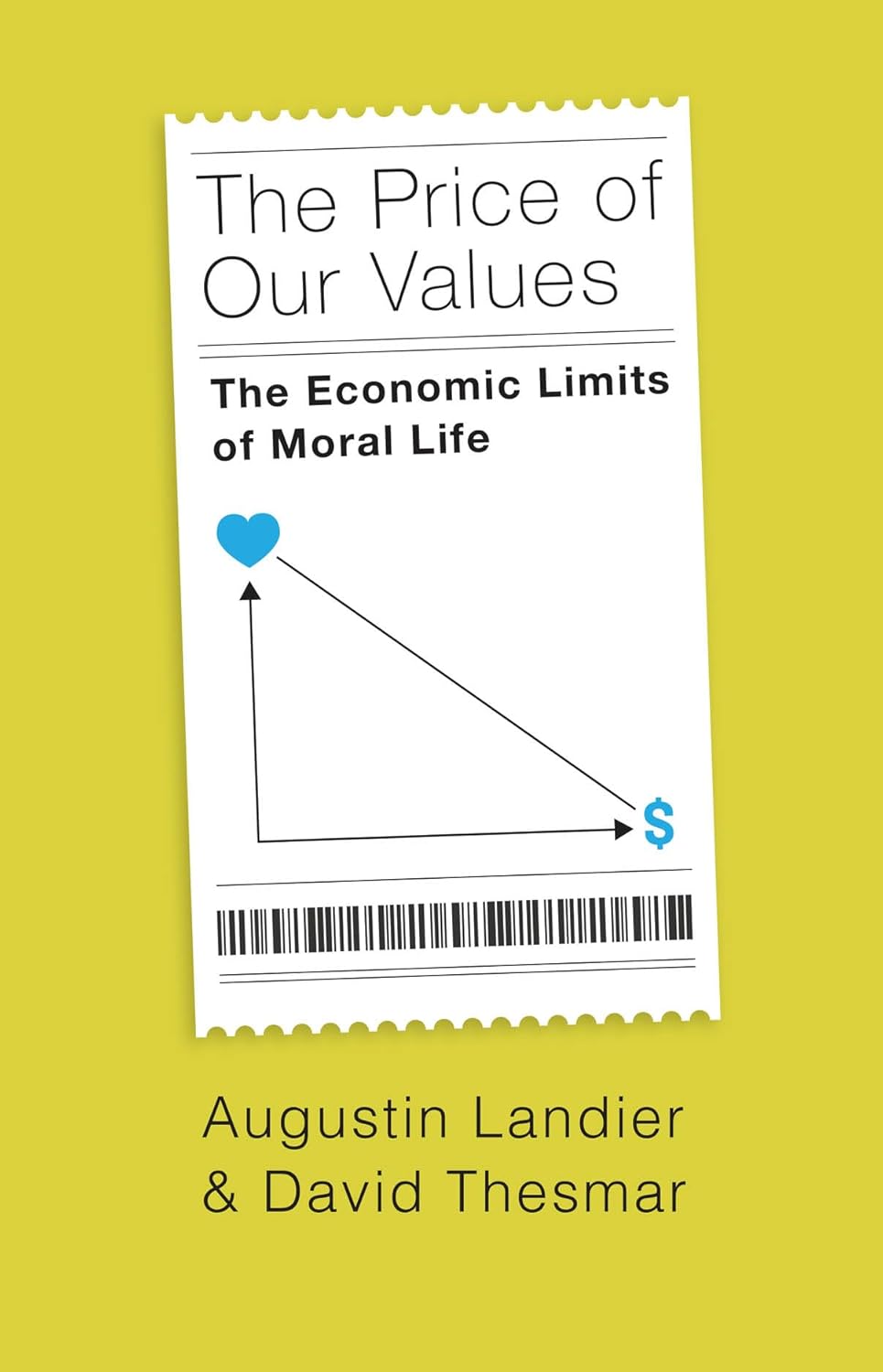
Written by two professors of finance (at HEC Paris and the MIT Sloan School of Management, respectively), this book considers the connection between economic thought and moral values, and the fact that they frequently come into conflict. Through a series of chapters on different issues, it focuses on the need for our moral decisions need to acknowledge their own costs – whether direct monetary costs, or simply the costs that arise in consequence of choosing one path over another – while economic analysis needs to acknowledge more fully the moral aspects inherent in any problem. This requires a willingness to include economic reflections in our moral thinking, but also a preparedness in economics to look beyond the default position of economic analysis – a utilitarian aggregation of pleasure, economic gain or material wellbeing – acknowledge its shortcomings and consider other moral perspectives.
The first two chapters set up the book, pointing out that we often separate economic thinking from moral thinking, as though economic thought has a corrupting influence on or no place in ethics. As the authors remind us, however, too often real life forces us to engage in both (for instance when deciding how to allocate resources in healthcare settings). They trace the emergence of utilitarianism as a central part of economic analysis, which, in its aggregation of ‘wellbeing’ or ‘pleasure’ also appears to make room for moral concerns, provided these are approached from a consequentialist perspective. Following a critique of utilitarianism, the book examines the shift in economic thought away from seeing people as self-interested and towards a recognition of altruism in human decision-making and policy-making. Nevertheless, the authors contend that in its treatment of ethics, economics still assumes a consequentialist outlook, continues to see human-beings as essentially selfish and views altruism as a form of universal or impartial utility-maximisation – all of which is open to question and does not appear to be supported by existing social scientific research into the ways in which people actually approach moral questions.
The point therefore emerges that greater recognition of ‘value pluralism’ is required: an acknowledgement that people do not typically think and behave as economics tends to assume, even when it takes account of moral considerations. As such, the authors state their intention of raising a series of dilemmas with a view to inviting readers to consider a range of responses, which draw on various philosophical positions beyond utilitarianism, as well as survey results, to show the trade-offs involved in each case and shed light on how people do in fact think.
Each subsequent chapter addresses a particular issue, covering liberty, competition and rents, justice, globalisation, cultural goods, companies and corporate virtue, and responsible investment. The treatment of each issue tends to differ. In some chapters, the authors outline a fairly characteristic approach from within economics and then subject it to criticism, showing that in their actual thinking, people do not tend to bear out the wisdom of the discipline but in fact have other legitimate concerns. For example, Chapter 6 examines the many reasons for which the population at large does not necessarily adhere to the general approach within mainstream economics that favours globalisation. This might not be because the public is simply bigoted or ignorant of the net benefits of free trade or migration, but because people have in mind not so much their own economic self-interest as concerns about socio-cultural and moral issues.
Other chapters, such as those on responsible investing or ‘beauty’, offer a more general discussion of relevant economic and non-economic considerations, and the trade-offs that have to be faced. Chapter 7, for instance, is concerned with cultural goods such as art and nature, and examines the ways in which we tend to view them not for their utility as consumption goods, but as having a value in their own right. This is a very interesting chapter that presents more in the way of philosophical discussion of our relationships with nature, heritage, science and the arts, closing with some reflections on possible cultural policy and the nature of the decisions that we might sensibly be expected to consider in relation to cultural goods.
This is not to say that chapters clearly follow one of two models but readers who begin the book expecting to find in each chapter a sustained discussion of ‘economic’ utilitarianism, deontological ethics and virtue ethics in relation to a specific issue, are likely to be disappointed. Instead, the book draws on these different approaches as they appear relevant to the direction of the discussion in hand. This approach does work but some might be of the view that this is not what they had come to expect from reading the introduction – but neither is the book a straightforward critique of the assumptions of economics. Indeed, the authors are keen to point out that they have themselves often argued for the positions that they subject to criticism – for instance in support of free trade – so in no sense is the work a rejection of the methods and models of economics as a discipline.
One or two chapters (particularly Chapter 5, on justice) probably attempt more than the space available allows, with the result that some of the discussions (such as the one on algorithms) are left somewhat short and leave the reader wondering what the purpose of their inclusion really is. Nevertheless, the book is clearly written in engaging prose and the purpose is clear: to call for ‘value pluralism’ in our consideration of important questions and to urge economic analysis to engage more fully than it currently does with the kinds of moral concerns that will often shape our thinking. This occupies more space in the book than the argument that our moral thinking needs to allow greater room for economic considerations, such that the subtitle (The Economic Limits of Moral Life) is arguably the wrong way round, but the book has much to recommend it. Importantly, in stressing ‘the need to understand and incorporate diverse perspectives on moral-economic trade-offs,’ the authors draw attention to the implications for public discourse. As they point out, such a ‘pluralistic approach acknowledges that different persons may prioritize different, yet equally legitimate, values, such as freedom, justice, tradition, or economic efficiency,’ adding that the ability to recognise ‘various moral perspectives on economic issues facilitates discussions about difficult choices’ (page 162). The book leaves open the question of how to balance these differing values and reach a consensus when they come into conflict or when policies are unpopular, but in calling for value pluralism, it represents a first step in making these conversations possible. It is certainly to be recommended to those interested in the relationship between economic analysis and moral reflection.
‘The Price of Our Values: The Economic Limits of Moral Life’ by Augustin Landier and David Thesmar was published in 2025 by The University of Chicago Press (978-0-226-82708-7). 191pp.

Neil Jordan is Senior Editor at the Centre for Enterprise, Markets and Ethics. For more information about Neil please click here.

Adapted from a talk at the UNIAPAC Think Tank meeting, December 2025
People often look to priests to appear at the end of a conversation and offer a blessing as it concludes. However, I have always believed, following St. Ignatius of Loyola, that priests should not be the ones who close conversations, but the ones who ignite them. St. Ignatius once wrote to St. Francis Xavier as he sent him across the world to share a message of hope: Ite, inflammate omnia. Go, set everything on fire.
My own understanding of the relationship between faith and economic life has been significantly shaped by a document published by the Vatican in 2018: The Vocation of the Business Leader. One reason that it has been so influential is that it resists the simplifications which often dominate discussions on the role of ethical leadership in the business world. Instead of reducing business to technique, or spirituality to interior sentiment, it insists that business leadership is a genuine vocation. It is a calling rooted in human dignity and oriented towards the common good.
And yet, for all its depth, this document is not as widely read, discussed, or implemented as it deserves to be. If you have not read it, or not returned to it recently, I deeply encourage you to do so. For those interested in an ethical standpoint inspired by Christian, and especially Catholic thought, it offers a lens through which we can interpret the world of business. Its central triad offers a valuable and demanding framework: good goods, good work, good wealth. It reminds us that producing excellent goods, creating dignified jobs and distributing wealth in ways that strengthen society are not optional extras: they lie at the very heart of ethical leadership.
But this triad reveals something further. It exposes the moral depth of the economic sphere. It invites us to confront a dimension of human life that the modern business environment often avoids, and that even many faith-based organisations hesitate to name explicitly: the reality of sin. If we misunderstand this word, we will misunderstand our vocation.
When a writer in the Christian tradition, such as for example St. Augustine, speaks of human shortcomings, of sin, he does not begin by condemning behaviour. He begins by describing the human heart. He describes challenges which every human being is familiar with, whether they are Christians, or not. Sin, for St. Augustine, is fundamentally the disordering of desire. It is the restless, self-enclosed movement by which the human heart loses its orientation toward the good. Pride replaces humility; fear replaces freedom; control replaces trust. And whenever desire becomes disordered, human structures – including economic structures – reflect that disorder.
St. John Paul II extended this insight further by speaking of structures of sin. The economy is not a machine insulated from the moral life. It is shaped by the desires, choices, and relationships of human beings. If pride becomes the organising force of the heart, then inequality is not an accident; it is a structural expression of a spiritual wound. If fear governs decision-making, then precarious labour is not merely a technical outcome; it reveals something about our anthropology.
More recently another theologian, William Cavanaugh, reminded us that modern markets often present themselves as morally neutral mechanisms, but that this neutrality is an illusion. Markets shape desires, habits, and forms of belonging. They are not only systems but liturgies: they teach us how to imagine the good life. That is also what Alasdair MacIntyre warned. We live in a world where the meaning of virtue has been largely hollowed out. Institutions pursue efficiency without purpose; technique replaces teleology; moral language becomes decorative rather than operative.
This matters for business leaders concerned with ethics because, if we do not dare to speak in these categories – desire, virtue, sin, conversion – then we allow economic discourse to be dominated by a vocabulary too thin to sustain the hope we proclaim. We cannot speak of ‘vocation’ without speaking of moral anthropology. We cannot speak of ‘good wealth’ without recognising that both good and evil can structure the economic world.
And that is why advocacy, important as it is, will never be enough. Advocacy influences conversations. But the vocation to ethical leadership, certainly if it is Christian, must transform structures. Our mission is not merely to promote good causes but to implement an ethical approach in the concrete realities of business life. Christian business leadership is therefore not philanthropy, nor is it corporate social responsibility layered onto existing practices. It is the integration of Gospel principles into wages, taxation, governance, workplace culture, supply chains, investment decisions and distributive policies. It is an incarnational ethic. A former President of the UNIAPAC network, José Ignácio Mariscal, insisted on this time and time again, and we should not become numb to his warning.
Business leaders sometimes feel like this is all too hard, that it cannot be done. But there are many examples to inspire us and to provoke us. Consider the lives of three business leaders, which reveal what business leadership looks like when it becomes a form of ethical commitment, indeed of discipleship.
José María Arizmendiarrieta, the founder of the Mondragón movement, understood that economic structures could be shaped from within by the logic of cooperation. For him work was a participation in God’s creative action; economic organisation was an expression of fraternity; inequality was not destiny but the result of ethical failure. His vision demonstrates that solidarity is not sentiment; it is action – in a way which almost makes one wonder if he was a regular reader of Maurice Blondel. It is possible to create systems where the human person is not an instrument, but a co-creator.
Léon Harmel, whose spiritual and social intuition anticipated much of modern Catholic Social Teaching, insisted that justice must be woven into the fabric of industrial life. His factories pioneered fair wages, worker participation, social protection, and mutual aid. More radically, he believed that holiness and business leadership were not incompatible. Holiness was not reserved for monasteries; it was available, indeed demanded, in the factory, the workshop, the boardroom.
Finally, Enrique Ernesto Shaw, the Argentine businessman, offers a profoundly contemporary model of Christian economic leadership. His life embodied what Benedict XVI would later call an ‘economy of gratuity,’ in which business becomes not merely a space of efficiency and profit, but an arena of gift, responsibility, and communion. Shaw was known for treating workers not as human resources, but as human persons, investing in their families, their education, and their long-term well-being. He insisted that profit and care were not rivals but partners. His decisions were guided by a deep conviction that trust is a form of capital, and that a company prospers when its people flourish. Even during moments of economic difficulty, Shaw sought ways to protect employment rather than sacrificially reduce the workforce. In Shaw’s example therefore we see that a Christian leader does more than manage an organisation. He or she builds a moral ecosystem, a community where virtue becomes operative, where justice and charity shape strategy, and where the leader’s deepest identity is not proprietor but steward.
From these three lives I draw two specific provocations for leaders in 2026. The first concerns Artificial Intelligence. There is no need to talk about it for too long; we already hear enough about it. But we can at least say this: AI offers an opportunity to improve working conditions for those whose tasks are hardest and least recognised. Used ethically, it can free people from repetitive labour, open opportunities for education, and contribute to greater human dignity. The question is not simply how to mitigate risks, but how to orient AI toward justice. We tend to forget that in the 19th century all humanity dreamed of was the arrival of the machine, something particularly evident in Jules Verne’s novels, because automation would mean being freed from the manual and servile labour which was and still is demeaning to so many of our brothers and sisters around the world. So: can we use AI in a way that would be fitting to the lives of Arizmendiarrieta, Harmel, and Shaw? Can we use it to the benefit of the poorer, the frailer, the ones who suffer the most violence? Can we consider it not just from the point of view of the time it saves, but also from the point of view of the lives it saves?
A second provocation concerns peace. In a world increasingly shaped by polarisation, inequality, and conflict, business leadership can be either a source of peace or a source of fracture. Christian leaders are called to build peace through transparency, stability, inclusion, and the generation of trust. Peace is not only a political concept; it is a daily economic practice. Pope Francis was almost obsessed with the need for the Church to be the promoter of peace. Arizmendiarrieta, Harmel, and Shaw built peace around them in noticeable ways: by improving the quality of life of their employees, by bringing education to contexts that did not hope to get it, or just by being caring and gentle and warm-hearted in their interactions with people. How far can we go here? How much can we actually aspire to build a peace that is concrete through our business vocations?
Let me end where I began. As a priest, I hope not to offer closure, but to kindle desire. My hope is that these sparks might take hold in the business community, and especially among Christians; that our spaces for ethical reflection might become not just fora for ideas but laboratories of moral transformation; that The Vocation of the Business Leader may become not a beautiful text but a living guide; that we may learn to name both the sin and the grace at work in the economic world; and that the lives of Arizmendiarrieta, Harmel, and Shaw may continue to challenge us with missionary clarity.
St. Ignatius knew that some words belong not at the end, but at the beginning of mission. Ite, inflammate omnia. Go, set everything on fire – the economy, the world of business, and most of all, the hearts of those who you lead and who lead with you.
Francisco Mota S.J. is the Spiritual Advisor of UNIAPAC International, a global federation of Christian business organisations. He is a Portuguese Jesuit and was formerly Director of the Maputo campus of the Catholic University of Mozambique and Chairman and Executive Director of Brotéria. Fr. Mota currently serves as Province Treasurer for the Portuguese Jesuits.
Main photograph by Julen Iglesias, 2022, from Wikimedia Commons
Used in accordance with a Creative Commons Attribution-Share Alike 4.0 International licence
For the first three years of our marriage, my husband and I lived in a small apartment with our children and dog. The building sat in the middle of a booming city block, ringed on all sides by construction. I must have mentally recited Walt Whitman’s ‘I Hear America Singing’ hundreds of times as I walked the dog around the block, both of us surveying the steady transformation. There is something deeply satisfying about watching a structure rise at such close quarters, being privy to the immense effort of coordination, craft, and discipline it requires to manage something of that size.
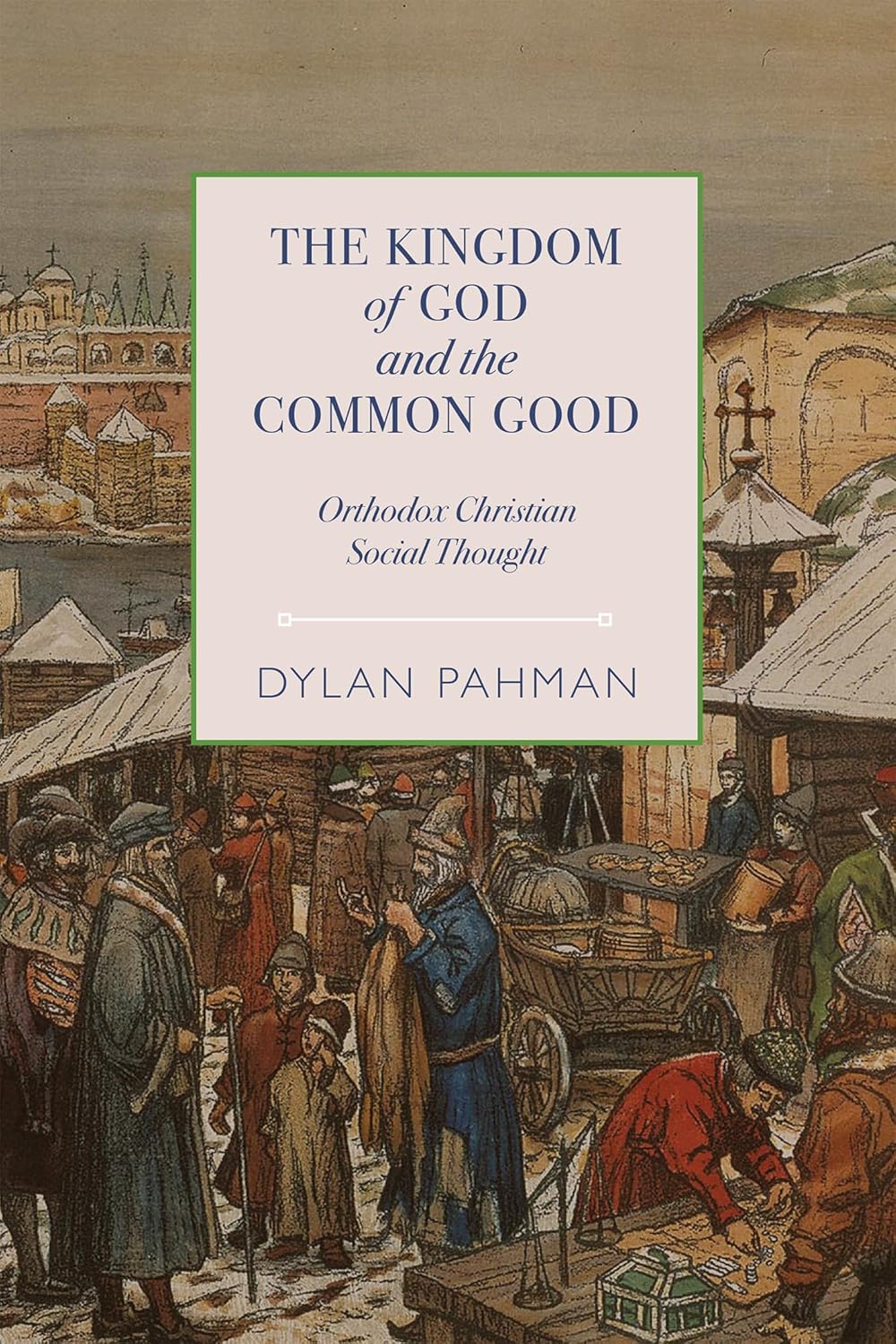
Reading The Kingdom of God and the Common Good produces a similar sensation. Rather than waiting for someone else to begin a broad, accessible conversation about Christian social thought — and the distinctive Orthodox contribution to it — Pahman simply started building. Like an experienced construction manager, he brings decades of preparation to the task: years as a Research Scholar at the Acton Institute, a PhD in Theological Studies from St. Mary’s University (Twickenham, London), and his work as the Executive Editor of the illustrious Journal of Markets and Morality. Unlike the typical book in this genre, his knowledge extends as comfortably to the economic contributions of Smith, Keynes, and Hayek as it does to Scripture and history.
The first section of this review will provide a summary of the book and explain four key terms – kenoticism, symphonia, Sophia, and sobornost’ – that play a special role in Pahman’s understanding of the Orthodox contribution to Christian Social Thought. The next section of the review will engage more with some strengths and shortcomings of the text. A third section will conclude, offering suggestions and encouragements for future research.
The Kingdom of God and the Common Good is written for readers without prior background in Christian social thought. Each section opens with references to familiar cultural works and closes with discussion questions, making the book well suited for classroom or parish study. Pahman intentionally selects topics likely to interest Orthodox readers and highlights moments where insights from other Christian traditions or historical episodes might deepen Orthodox reflection.
The first part surveys modern Christian social thought, focusing on the Roman Catholic, Lutheran, Neo-Calvinist, and Social Gospel traditions. The second discusses related aspects of biblical theology, reminding us to read the Scriptures not alone but ‘with the church.’ A third part surveys Church history beginning with Pagan Rome and ending with the Russian Empire. A fourth part provides the reader with a primer on modern economics. Finally, the fifth part engages with contemporary Orthodox sources and argues for Pahman’s vision of a uniquely Orthodox social thought that draws from Scripture, Church history, liturgy, and the best of other Christian social thought traditions.
The most distinctive contribution of the book is the recurrence of four Orthodox terms—kenoticism, symphonia, Sophia, and sobornost’—to articulate this uniquely Orthodox social vision. While asceticism and liturgy also play especially important roles in the Orthodox approach to the world, these may be more familiar to Christian readers of other traditions and so I leave discussing them to the next section.
Kenoticism derives from the Greek kenosis, ‘self-emptying,’ used in Philippians 2:7 to describe Christ’s voluntary humility in the Incarnation. Orthodoxy insists this act did not diminish Christ’s divinity; rather, it reveals that God’s nature is self-giving love. Socially, kenoticism implies humbling ourselves before each person we encounter, especially the vulnerable. In a manner resonant with Catholic social teaching and thinkers in the social gospel tradition, it affirms human dignity while emphasizing the paradox that divine glory is revealed in meekness.
Symphonia describes the ideal harmony between the church and the world, especially when it comes to the state. While it is difficult in practice to protect the church from worldly interference, separate institutions remain necessary for securing the array of moral and material goods that humans require. The common good requires vigilance and prudence in this division of labor and trade. Pahman is fond of reminding the reader that Christ tells us that we do not live by bread alone, not that we do not live by bread.
Sophia, or Holy Wisdom, refers to the divine order manifested in creation and revealed in Christ. It underscores the contemplative dimension of social life and how human work can participate in God’s ongoing creative purpose. This theme echoes Protestant reflections on vocation, suggesting that our faithful attention to ordinary tasks is more beautiful and more consequential than we initially perceive as we cooperate with grace.
Lastly, sobornost’, a central concept in Russian Orthodox thought, describes freely chosen communal unity. To be sustained, this unity must be grounded in both truth and love. This term captures the Catholic social thought principles of solidarity, emphasizing that flourishing emerges from organic community and freedom within those communities, rather than various forms of social engineering.
The book has many strengths, making it a bookshelf essential for those interested in Christian social thought more broadly. Among the book’s strengths is its fair treatment of contentious issues such as usury, profit, and socialism. Pahman clearly identifies shared principles of Christian social thought, including private property and freedom of association. Most compelling is his recurring emphasis on asceticism. Orthodox ascetic practice, such as fasting from food or certain luxuries, reorders human desires toward higher goods and exposes how easily economic life becomes governed by disordered loves. Markets respond to preferences, but preferences themselves require moral formation. In this light, asceticism serves as a corrective not only to personal materialism but also to short-term economic thinking.
While reading The Kingdom of God and the Common Good, I was struck by how lopsided some strains of Christian social thought can and have become without this essential commitment to asceticism alongside beautiful liturgy. Ascetic practices force us to reorder our loves toward the highest goods, instead of idolizing things which cannot fulfill us. It is the liturgy, and our active participation in the liturgical calendar with our households, which reveals to each of us that which is truly valuable. It is how we store up treasure in heaven. This, in many ways, is the fundamental problem of the Christian in economic life. I would like to read many more books about the importance of asceticism and liturgy in modern economic life.
The book has few weaknesses. Readers new to Orthodoxy may wish for more historical and doctrinal background, which would help situate the social arguments. As an economist, I have a minor quibble with Pahman’s critique of modern economists as being too unwilling to engage explicitly in moral reasoning. While the earliest economists (such as the Late Scholastics or Adam Smith) often arrived at their economic analysis by way of contemplating specific moral questions, contemporary scholarship tends to separate analytic and ethical tasks for methodological clarity. This division does not eliminate moral reflection; it relocates it to different genres of writing, thus allowing scholars to specialize in their comparative advantage and trade insights with one another. Another Orthodox social thinker, Alex Salter, has a helpful piece on the matter, entitled ‘What, to a Christian, Is Economic Efficiency?’ (2024). Salter defends the positive economic analysis of efficiency as a means to limit the scope of the discipline and to allow normative analysis its own space to argue directly for moral goods rather than being constrained by the tools of economists or other social scientists.
Orthodox Christianity is often associated with mystery and paradox – liturgical beauty and disciplined asceticism. Pahman’s book brings these two dimensions into conversation with modern social questions, offering a vision in which sacrifice and beauty together illuminate Christian economic life. I hope that he, and many other Orthodox thinkers, will continue building this magnificent tradition.
‘The Kingdom of God and the Common Good: Orthodox Christian Social Thought’ by Dylan Pahman was published in 2025 by Ancient Faith Publishing (ISBN: 978-1-955-89080-9). 408pp.

Clara Piano is currently a Visiting Assistant Professor of Economics at the University of Mississippi, a position which will become tenure-track in Fall 2026. Her primary areas of research are family economics, law and economics, and public choice. She also serves as Managing Editor of the Journal of Markets & Morality and holds positions as an Affiliate Scholar at the Acton Institute, a Family Policy Fellow at the Archbridge Institute, a Senior Fellow in the Family Program at Cardus, and a Law & Economics Fellows Advisor for the International Center for Law & Economics.

If markets are to function effectively, prices need to be agreed and respected. However, confidence in the ability of free markets to allocate resources efficiently through the price mechanism is in decline. Minimum wages are accepted despite evidence that they price the unskilled out of work. The manifesto of the newly elected mayor of New York, Zohran Mamdani, includes a $30 minimum wage, rent freezes and city-run grocery shops.
For those from a Common Law background, price is generally, in the absence of fraud, as agreed between buyer and seller. However, not only is there a long tradition of thinking about whether a price is ‘just’, and if not, how to remedy it, those principles survive in contemporary legal systems.
The idea of a just price, while owing something to Aristotle and Roman law, was developed by Scholastic theologians who believed that commutative justice required that the items being exchanged should be of equal value. For Thomas Aquinas, justice required that in an exchange one should be concerned to ensure that the counterparty receives what is due to them. While for Hayek this was a ‘futile medieval search’, the concept allowed, by the application of the Roman law principle of laesio enormis, land transactions at less than half their ‘true’ value to be void so that the seller recovered their property. In common law systems that concept has been dismissed as contrary to the principle of the autonomy of the contracting parties, while elements of this thinking survive, for example in Germany and France.
While Just Price Theory and Just Price in the Markets cover similar ground, with the latter, by Charles R. Geisst, focussed on the history of the idea and Joaquin Reyes using it in the former as the basis for a reassessment, they make a stark contrast. Though Reyes is markedly less accessible, he seeks to explain the ideas behind a ‘just price’ and argues that it deserves renewed attention. By contrast, Geisst writes at greater length, but to less effect. His previous work on usury may not be unconnected to significant material on that subject being included here which is only, at best, tangentially relevant. He includes material on well understood subjects from monetary theory in the seventeenth century, to the development and problems of mercantilism and public markets in the eighteenth and the gold standard and anti-trust legislation in the twentieth, although the connection to the concept of a just price is far from clear. Much of his material is not only largely irrelevant but underlines the lack of originality. Neither Hayek nor Collingwood feature in the bibliography or index. Errors – including on the nature of feudalism – add to the impression of existing material being recycled without anything new to say.
Reyes sets out the various ways that the idea of a just price have been regarded as misleading. In the view of free market critics, it is impossible in a free market to sell an item for more than its worth, as its value is that which someone is willing to pay for it. The idea of a just price undermines the ability of an individual to make a contract. The sovereignty of the individual requires that he is able to exercise autonomy in agreeing a price. It may transpire to have been a mistake to agree that price, but the individual had the freedom to make that decision. For others, the concept of a just price fails to recognise the efficiency with which market prices provide signals to buyers and sellers which ensure demand is met efficiently.
While recognising these counterarguments, Reyes suggests that the concept deserves to be reconsidered on the understanding that the price agreed reflects an imbalance of power between buyer and seller. He explores the tension between the autonomy of the individual and the risk of injustice. His purpose is to demonstrate that market economics are unjust by favouring the rich. While confused by a style which prefers complexity over clarity, at its heart his view is that ‘prices are the product of choice and power’, tending to reinforce inequalities of power. There are arguments to be made for more equal distribution of resources, but Reyes’ attempt to argue that disparities of wealth mean that market pricing is unfair is undermined by a lack of credible analysis. His examples tend to the extreme; the person obliged to sell their organs or markets characterised by extortion.
He quotes R.G. Collingwood who described a just price as a ‘contradiction in terms’. Collingwood also noted that it is reasonable to demand a higher wage if it is lower than it should be due to circumstances which ‘ought not to exist’. Collingwood makes the point that this is not an argument for legislation controlling wages, but for it to prevent exploitation of workers. For Collingwood ‘a wage fixed by any but economic considerations ceases to be a wage’. Reyes misrepresents the argument by suggesting that Collingwood’s characterisation of a just price is contradicted by his support for a freely organised labour market. He claims that Collingwood ‘did not really believe that the idea of the just price was contradictory, although he believed that he did’. Reyes’ argument in support of this contention is obscure and does not deal with Collingwood’s analysis.
While noting that people will not work as hard without wage differentials, he suggests that a virtue based approach ‘allows us to challenge this assumption by noting that this is merely a contingent feature of our current society’. No detail is given of the alternative arrangements, ‘shaped by a more egalitarian ethos’ which would avoid this problem. Animal Farm is not referred to.
While his work is characterised by the repetition of chains of logic, this does not prevent Reyes from making suggestions with no obvious support. Having quoted Adam Smith suggesting that wealth is power, he moves without comment to suggest that that the rich impose prices on the poor. He gives no examples of public markets that function in this way but argues that market economics can only operate efficiently ‘if equality of wealth obtains.’ This leads to the conclusion that ‘in societies in which wealth is unequally distributed, … very few (if any) of the prices that we pay and receive are just’. His purpose is to suggest that, to use a much favoured word, ‘normative’ pricing, dependent on ‘virtue’, should replace prices set by free well-functioning markets. In making this argument he suggests that contract law should recognise ‘distributive justice’ by setting prices which lead to greater equality of wealth. The autonomy of the individual to make a contract is only partially accepted.
A book reviewed by Richard Turnbull illustrates the sustained interest in this area. Richard’s comment that the content was ‘shrouded in a mystical academic language of a rather obscure discipline’ can equally be applied to Reyes. That review provides case studies where attempts to replace market prices were resisted by those with less resources than the counterparty.
One might dismiss this line of thought as ignoring generations of experience. From attempts to limit wages after the Black Death to the wages and prices policies of the 1970s or the experience of eastern Europe after 1945, the attempt to replace a market by prices controlled by executive action has been both damaging and ultimately unsuccessful. However, the interest in the idea of a ‘just price’ demonstrated by these two books underlines the fact that for many this is an attractive idea. If the voters of New York elect a mayor who thinks that state controlled grocery shops will reduce prices, it would be a mistake to dismiss this line of thought as redundant. Many simply do not trust market economics. Academics like Reyes seek to provide credibility for distributive justice as a replacement for the operation of the market and they have a receptive audience. Making the argument for the central importance of market economies in generating the wealth needed to provide prosperity and reduce poverty is a priority for a generation attracted by the idea that ‘justice’ can be achieved by replacing the freedom of individuals with direction by the state.
‘Just Price Theory: A Reassessment’ by Joaquin Reyes was published in 2025 by Bloomsbury (978-1-509-96354-6). 256pp.
‘Just Price in the Markets: A History’ by Charles R. Geisst was published in 2023 by Yale University Press (978-0-300-26833-1). 280pp.

Andrew spent his career with PricewaterhouseCoopers where he was a partner for more than 25 years. He led a variety of the firm’s businesses both in the UK and globally, with a focus on the pharmaceutical industry. He also led the firm’s work on explaining corporate taxation to civil society and the public. Since retiring from PwC he has completed a master’s in history at Oxford and is hoping to undertake further research. He is also a trustee at the London Handel Society and the Open Spaces Society.

A ‘Failed-Again’ Christian: Explaining Why I Believe is an intimate spiritual memoir that wrestles with some of the most pertinent and enduring questions linked to the reconciliation of faith, science and the problem of evil. As hinted at by the subtitle, Explaining Why I Believe, the book’s purpose is two-fold: first, to recount Tan’s life story and spiritual journey; second, to offer a rationale for his faith, grounded in his experiences and knowledge. It is a personal account that takes readers on a journey of both inquiry and discovery, and hopes to address the apparent contradictions between faith and science that have so often been popularised in public discourse.
Kim Tan is one of the UK’s most successful biotech entrepreneurs: he is co-founder of the Transformational Business Network (TBN) and a trustee of the John Templeton Foundation. He is also Pro-Chancellor of the University of Surrey (UK) and a fellow of the Royal Society of Medicine (UK).
The book is comprised of 11 short chapters and is well-written, maintaining a clear and informative style throughout. It does not rely heavily on technical language and even in areas where more specialised matters such as DNA composition are explored, Kim masterfully translates the terminology and adapts his thinking for the lay reader, which makes the book accessible to a wide audience. In this review we will briefly touch upon some book’s highlights.
Within the first chapter, Kim traces his personal journey to faith: from growing up in a Taoist family in Malaysia, through a period as a ‘half-baked Darwinist’, to eventually becoming a committed Christian. Underlying this narrative is a humble, honest reflection: Tan identifies himself not as a exultant believer but as a ‘failed-again Christian’ (page 7). For Tan, the Christian faith represents an acknowledgement of the reality that we are imperfect: we keep failing, yet in this failing we are met by the grace of God and return to forgiveness and peace: ‘The Church is a hospital and rehab centre for sinners, not a museum for saints’ (page 10). The style of the book has a raw, relatable honesty which doesn’t sugar-coat. This kind of transparency may resonate with readers who themselves struggle, doubt or sometimes feel unworthy.
The body of the book is opened with a clear assertion that, contrary to popular belief, science and religion are not inherently at odds. Some of the most influential scientists in history were theists, including, Mendel, Pascal, Newton, Cuvier, Collins, and even Einstein, who rejected the premise that science and religion are mutually exclusive (page 10).
Tan highlights that while it is important to recognise the truths of science, we must not place these matters on a pedestal but rather recognise their limitations: ‘…while scientific truth is exact in its specificity, it is also incomplete. Our scientific knowledge and theories necessarily change when presented with evidence from new discoveries’ (page 17). More importantly, science struggles when it comes to things like meaning, value and beauty, and here the author quotes Stephen Hawking who acknowledges that science may one day figure out how the universe began, yet ‘…it cannot answer the question: why does the universe bother to exist?’ (page 18).
Tan then introduces his perspective on the Bible, pointing out that it was not primarily a scientific book intended for a scientific audience; rather it attempts to explain the ‘…who and the why behind the universe, not the how’s’ – and in this regard, ‘…it is the perfect complement to science, not a contradiction’ (page 21). The book then touches upon some misconceptions surrounding the interpretation of biblical books like Genesis, where ‘days’ did not refer to 24h periods but to epochs, stages, order, and a beginning (pages 22-23).
An interesting point is made on DNA composition where evolutionists argue that we are derived from chimps because we because we share 98.4% of our DNA with chimpanzees. The problem is that, as Tan puts it, we also share 75% of our DNA with the zebra-fish and 50% with a banana. So a more useful and accurate understanding of evolution places it within a common design framework and indeed, within the hands of a designer. This is known as evolutionary creationism (page 24).
The book then turns its attention towards God’s character as it is revealed in nature. Here Tan argues that at God is powerful, creative, orderly, intelligent and personal (pages 31-33). Looking at humanity itself, Tan argues that two core teachings found within scripture, identifying human beings as image bearers of the divine yet tainted by sin, ‘…make perfect sense of the human experience’ (page 37).
A particularly intriguing point in the book comes when Tan then opens a discussion surrounding the problem of suffering and evil. In light of original sin, Tan points out that ‘when humankind became infected with evil, nature too became infected and the harmony was shattered’ (page 41). Diseases like cancer or natural disasters can, in part, be attributed to ‘…an imperfect world populated by imperfect people operating on imperfect laws’ (ibid). Not that this offers complete justification but for some readers it may bring a degree of explainability.
The book concludes with a sincere account where Kim Tan acknowledges his own doubts, ‘For me the journey to faith is a “long and winding road”. But doubt is healthy. It forces me to re-think my assumptions and prejudices’ (page 57). Yet the beauty and complexity of nature coupled with the reality of the human condition as reflected in scripture compel Tan to believe that a ‘…theistic worldview might be more consistent with our experience of life’ (page 58).
While the book is not aimed specifically at a business audience, those within the private sector or working with the natural sciences will find much use in it. It offers a sharp and captivating analysis at the intersection of science and faith. Above this, it is a story of personal transformation where Kim Tan offers hope: the emphasis is on grace, forgiveness and humility rather than gallant certainty and triumphalist language. Tan underscores a Christianity rooted in human fallibility, dependence on God’s mercy and continual discovery. That message will feel refreshingly down-to-earth for many.
A ‘Failed-Again’ Christian is not a theological book – but rather a testimony which invites the reader not to ‘arrive’ but to walk, stumble, and keep seeking. For the vast majority, reading it will be a wise use of time.
‘A “Failed-Again” Christian: Explaining Why I Believe’ by Dato Kim Tan was published independently in 2025 (ISBN 979-8-3163-8248-4). 63 pp.

Andrei E. Rogobete is Associate Director at the Centre for Enterprise, Markets & Ethics. For more information about Andrei please click here.

Before the torrent of games available on your phone, a popular game in magazines was ‘spot the difference’. It’s amusing to play and realise that often we don’t immediately spot all the differences even when we stare at both pictures intently. But I wonder if the same issue arises in spotting a Christian in the workplace. What differences can we expect to find? In contrast to many religions, Christians don’t display external markers beyond, perhaps, wearing a cross or if you’re more edgy a tattoo – my daughter has a Bible verse tattooed on her foot which I guess could be a conversation starter if she’s willing to go in feet first! Christians don’t wear a veil and relate to God with unveiled faces but does that relationship with Christ that transforms us from within make it all the way to the outside?
When Jesus commands us to let our light shine before others he is assuming that what people will see is our good deeds and that as a result they will glorify our Father in heaven (Matt 5:16). He makes a connection between our deeds and our devotion that will point people to the glory of God. Glory is the manifestation of God on earth, and our good deeds are evidence of God at work. That’s what makes the study of Christian ethics so important. It is about understanding the distinctives of character by which followers of Christ display Christ in action. Interestingly, the apostle Paul in one of his early letters to the Christians in Thessalonica says that he is assured they are Christians who have turned from idols to serve the true and living God (1Thess 1:9) because their work is produced by faith, their labour prompted by love and their endurance inspired by hope in the Lord Jesus (1Thess 1:3). It’s the fruit of faith, love and hope that he sees as they discover more of God’s love, work out how to show that love to others, explore more of the resurrection future and apply lessons to their present lives. At its heart a Christian ethic is the practical outworking of an encounter with the Living Lord
There are three distinctive characteristics of Christian ethics:
Christian ethics is based on Christ, the Word of God and the wisdom of God through whom all things are created and hold together (Col 1:16-17). Jesus is the incarnate Word – wisdom with flesh on. When Jesus teaches, he uses the term, ‘I say…’ rather than ‘the Scriptures say’ and has that direct authority which people noticed wasn’t like the teachers of the law (Mk 1:27). The implication for ethics is that we are reading the source code and don’t need to add our own, or filter it, or choose parts or test its veracity and efficacy. Christian ethics goes straight to the source by going to the person who made it, the living Lord of Creation, and lived it, in the fullness of grace and truth. The more we get to know the person who made the rules, the more we understand the purpose behind the rules, appreciate the posture with which they give the rules and incorporate the priorities they embed into the rules.
In business, therefore, Christian ethics has the clarity of being the pure unadulterated principles embedded into the fabric of creation. The economic principles of generative growth are productive because God embedded fruitful work into the way the world works. He formed what was formless and filled what was empty and then commanded us to do the same in fruitful and multiplying labour (Gen 1:2, 28). The relational principles of truth, trust and kindness are part of business because they are part of how God has made us in his image (Gen 1:26). ‘My word is my bond’ is good business because it’s how God acts in covenant faithfulness towards us (Gen 17:7). Christians practise the universal principles found in the Bible with a confidence in the manufacturer’s instructions.
Like any relationship, our willingness to follow someone else’s advice or commands will depend on how much we trust that they are on our side. When someone can guarantee their promises, we have confidence rather than risk. When someone has our best interests at heart then we have gladness rather than reluctance in following their instructions. Jesus says when we approach God in prayer we’re talking to a Father who knows what we need and loves to give good gifts to His children (Matt 7:11). If God’s motivation in giving the law is fatherly love with abundant grace, then our attitude to following his law is childlike trust. If God’s motivation were vindictive judgement with impossible achievement, then our attitude would be fear and failure.
Our attitude to the law is shaped by our perception of why the law is there. For example, do you consider speed cameras to be there to spoil your fun, get revenue from you or protect people from harm? Your answer to that will be informed by your experience. For me, my middle name roots my attitude to traffic speed. Before I was born my cousin was killed by a speeding car when playing with his brother outside their home on a residential street. I was born soon after and named Jonathan in his memory. It’s personal and I get why reducing speed is vital. Christian ethics gets personal and understands the heart of God, the lawgiver. That’s why the Psalmist can say: ‘how I love your law…it is a lamp to my path and a light to my feet’ (Ps 119:97, 105).
In business, therefore, Christian ethics has the confidence of being from a good God, slow to anger and abounding in love. Like the ring of steel that surrounded the City of London in response to a terrorist bombing incident, the law of God is a strong guardrail that keeps us from harm and gives us the confidence to build life on and enjoy the freedom of life in the fulness that God intended in the beginning (Ps 119:97-105).
Ethics in the business world can become depersonalised into a compliance department or obfuscated with reams of exceptions or vague aspirational statements. Ethics in our personal lives can provoke nervousness or be avoided for fear of being made to feel guilty. Christian ethics is distinct because it is in facing up to our failure that we immerse ourselves fully in God’s forgiving grace.
The classic example is King David who committed adultery with another man’s wife and then conspired to have her husband killed. David was aware that what he was doing was wrong, but he did it anyway because in his position of power he thought he could make his own rules. He followed his personal desires and treated the law as an inconvenience. It took the Prophet Nathan to bring him back to his senses. David threw himself on God’s mercy and knew both forgiveness and restoration of iniquities blotted out and of bones that were metaphorically crushed by guilt restored (Ps 51).
Christian ethics is willing to admit we are at fault and that we need forgiveness. In the business world people are wary of admitting fault and act with competitive harshness with the excuse that ‘it’s only business.’ But we can become minimised by expressive individualism and hardened by toxic practices. Personal repentance and forgiveness transform. To return to King David, his prayer of ethical repentance goes on to ask for a new ethical experience so that he can come into God’s presence and meet with him face to face (Ps 51: 9, 11). What David longs for and expresses in his prayer is not just a clean slate but a new heart, not just relief from guilt but joy of salvation: ‘Create in me a clean heart, O God, and renew a right spirit within me… Restore to me the joy of your salvation and uphold me with a willing spirit’ (Ps 51: 10, 12).
The deepest, most life changing truth in the universe is that God’s forgiving grace renews us on the inside by restoring us to God’s presence and empowering us with God’s atoning love. When ethics consists of rules that impose on us from the outside, it can add pressure of compliance without heart-change or just be stubbornly resisted. But when ethics is an encounter with atoning love that changes us on the inside, it transforms our experience through receiving and therefore transforms our actions in giving. The more I know forgiveness the more I want to forgive, the more I’m shown generosity the more I want to act generously, the more I’m trusted and spoken truth to the more I can trust others and speak truth. For many business leaders, it is the experience of God that founds their practice in business. Take, for example, John Pierpont Morgan, the founder of the bank that bears his name and churchwarden of his local church in Manhattan, who wrote at the start of his will:
“Article 1. I commit my soul into the hands of my Saviour, in full confidence that having redeemed it and washed it in His most precious blood He will present it faultless before the throne of my Heavenly Father.”
His understanding of atonement was the main thing he went on to entreat his children about and was clear in some of the institutions he created and funded. Knowing we’re loved and are presented faultless before the throne (Col. 1:22) changes everything about how we see ourselves and others and therefore how we practise ethics. Christian ethics isn’t just behaviour modification but personal transformation. It’s not simply compliance with company policies but acting according to inner character because the law isn’t just written on a scroll but on our hearts (Jer 31:33).
Corporate strategy is all about finding your distinct value proposition that gives clarity to what you offer and how you act in the marketplace. A Christian worldview offers a distinct ethical proposition – rather than being based on utilitarian advantage or human imperatives, it’s a response to who God is, what he’s done and where his purposes are heading. A great example is Boaz who was a successful business owner and is described in the book of Ruth as being held in high esteem by his workers. He didn’t just follow the letter of the law by allowing Ruth to glean from the edges of his fields, he gave her more than enough and acted to restore land to her even though he wasn’t required to do so. Why did he do what others wouldn’t? He says it’s because of who the God is that he follows – a God of generosity and refuge (Ruth 2:12).
How do we live a distinct Christian ethic? Be more Boaz in business! Deeply encounter the Living Lord and wear the distinct clothes of Christ to the office each day.

Andrew Baughen is a management consultant specialising in mapping the whole value of organisations. He researches business worldviews and teaches ethics at Bayes Business School and is also an associate minister at St Margaret’s Lothbury.
This is a repost of an article originally published on the Catholic Social Teaching blog of St Mary’s University (https://catholicsocialthought.org.uk/).
In this final part of the encyclical, the treatment and protection of the working class is dealt with directly and at length.
It begins by noting that working people may resort to striking because of their working conditions and, because strikes are injurious to the public and may create violence and disorder, the state may act to remedy working conditions (39).
The document immediately moves on to matters of the soul. It is stated that our final purpose is not life on earth. Nobody is entitled to harm the dignity that God gives us or stand in the way of the ‘higher life’ which is our path to heaven (40). As such, all must have the opportunity to rest from labour and practise religious observances on Sundays and holy days of obligation (41). We need to rest from the business of everyday life to turn our thoughts heavenwards. God taught the world by ‘His own mysterious rest’ the need to rest on the Sabbath day.
Employers are then told that working men must not be mere instruments of money-making. Men’s minds should not be ‘stupefied’ nor their bodies ‘worn out’. Daily labour should not require longer hours than strength permits, and the hours of work should depend on the type of work and season of the year. Women and children should only do work that is appropriate for them – ‘rough weather spoils the buds of spring and life’s hard toil blights a child and renders true education impossible.’ It is stated that a woman is by nature fitted for home work ‘and it is that which is best adapted at once to preserve her modesty and promote the good bringing up of children and the well-being of the family’ (42). This is not just because of the bonds of motherhood, but also the practical reality of physical factory and mining work at the time Rerum novarum was written.
The next topic is described as being of great importance and one where extremes are to be avoided. One such extreme is that any agreement by free consent is sufficient, and that the public authorities should only intervene when the employer withholds wages or the work is not entirely done (43).
The argument for a different approach and for a living wage is then laid out. Work is personal and, insofar as it is personal, a man can accept any wage he wants. However, man cannot live without labour and the proceeds from it. The poor can only get what they need through work. The preservation of life is the duty of all, and all have a natural right to procure what they need to live. Natural justice therefore demands that wages ought to be sufficient to support a frugal and well-behaved wage-earner. If, through necessity or fear, the employee accepts worse conditions, he is the victim of force or injustice. The idea of a free wage agreement is not objectionable in principle. However, if it is necessary, ‘societies or boards’ should bring about the conditions for a just wage to prevent ‘undue interference’ on behalf of the state. The state should be appealed to only should circumstances require (45).
A workman, after looking after his family, should practise thrift. This point was closely connected to the importance of private ownership and will lead to the following beneficial results:
But, the document states, these benefits can only be realised if a family’s means are not drained by taxation. The state would be unjust and cruel if through taxation it were to deprive the owner of more than is fair (47).
Rerum novarum then goes on to discuss how employers and workers may better the conditions of workers and draw the classes closer together if they form associations of mutual aid to help those in distress – including to help widows, orphans, those who fall prey to a sudden calamity or sickness, and institutions for the welfare of boys, girls and the old (48).
Of such organisations, unions were stated to be the most important. Scripture is used to support the idea that if two or more are together they can support each other (50). Unions, it is noted, are private societies carrying out private objects (St. Thomas is referred to). They therefore cannot be prohibited by the state because entering into a society is a natural right: this is also a theme of Centesimus annus. If a state prevents its citizens from forming associations, it contradicts the principle of its own existence which is based on the natural tendency of man to dwell in society.
Religious orders, confraternities and societies have also done much good. The rulers of the state have no rights over them, nor can they claim any share in their control. The state should respect, cherish and defend such organisations: it is to be regretted that secular states are attacking such communities (53).
Pope Leo then expresses concern that associations are being set up that are trying to attract working men but the principles of which are not in accordance with Christianity (54). He argues that this creates a dilemma. Either working men must join them, thereby exposing their religion to peril, or they must form their own associations. Pope Leo strongly recommends the second approach: there should be Christian unions and Christian working men’s associations. Clergy should provide for the spiritual needs of such organisations. The benevolence of Catholics who have sponsored benefit and insurance societies financially is also praised. The state should watch over such societies but should not involve itself in their organisation: ‘Things move and live by the spirit inspiring them, and may be killed by the rough grasp of a hand from without’ (55).
In summary, organisations of working men should be designed to better the condition of body and soul, and they must pay special attention to the duties of religion and morality whilst promoting social betterment. We are reminded: ‘What doth it profit a man, if he gain the whole world and suffer the loss of his sou?l’ (57). Our associations ‘should look first and before all things to God’: they should include religious instruction. They should involve co-operation between employers and employees and provide support for accident, sickness, old age and distress. Associations should help people to be hard-working, industrious and bound together in brotherly love (57).
The importance of Catholic associations of working men is stressed at great length. Working men should join associations and choose wise guides. And we must bring back those working men who have lost their faith altogether or whose lives are at variance with its precepts. They are likely to resent their employers mistreating them and, if they belong to a union, it is likely to be one that is based on conflict and not one sustained by religion. Catholic associations are of great value in reaching out to such people.
Pope Leo ends by stating that each person should do that task which falls to him before the evil at hand grows to be beyond remedy (62).
For her part, the Church will intervene with greater effect if her freedom of action is not restrained. Ministers of religion must urge the adoption of ‘Gospel doctrines’, strive to secure the good of the people and promote Christian charity amongst all people as the best antidote against worldly pride (63).
This trilogy has simply recounted the content of Rerum novarum with little analysis. However, as a final remark, it is worth pointing out that the document makes no sense unless it is regarded as a radical call to sanctify all aspects of working, civil and political life and to ensure that work and economic life provide the material conditions which help all people reach salvation. Indeed, there is a strong attack on secular institutions such as secular trade unions. Salvation and our duties to God are at the centre of Rerum novarum, and the document should not be read as a set of political proposals to be translated, somehow, into the modern day: without the grace of God, we will fail.
Philip Booth is professor of Catholic Social Thought and Public Policy at St. Mary’s University, Twickenham (the U.K.’s largest Catholic university) and Director of Policy and Research at the Catholic Bishops’ Conference of England and Wales. He is also Senior Research Fellow and Academic Advisor to the Centre for Enterprise, Markets and Ethics.

We ended Part One of this guide to Rerum novarum with the encyclical’s reminder to the rich that they would have to answer to God if they were not generous with their riches. The focus of that first part was the staunch defence of the right to property. This part will look at the relationship between the state, the family and the Church and the responsibilities we have to the poor.
Just as Rerum novarum could be described as the ‘workers’ encyclical’, it could also be described as the ‘family encyclical’. It is noted that the family is a ‘true society’ which should govern itself (13). The family has rights prior to those of the community, and these rights arise from nature. It is stated firmly that: ‘The contention, then, that the civil government should at its option intrude into and exercise intimate control over the family and the household is a great and pernicious error’ (14). The state should assist a family if it needs aid and cannot get help from wider family or friends. Furthermore, the public authority should only step into the workings of the family to ensure that legitimate rights are enforced (perhaps if there is abuse or violence). Rulers, it is argued, should go no further (‘nature bids them stop’) because parental authority cannot be absorbed by the state. The encyclical notes: ‘The socialists, therefore, in setting aside the parent and setting up a State supervision [sic], act against natural justice, and destroy the structure of the home.’
It is argued that no practical solution will be found to the questions under discussion that does not incorporate religion and the authority of the Church: ‘All the striving of men will be in vain if they leave out the Church’ (16). The Church enlightens the mind, guides actions by her precepts, helps working people through the many associations she establishes, and also indicates where intervention by the state is necessary. It is then pointed out that inequality is both natural and advantageous, arising, as it does, from the many differences between people (17). Also, there will always be suffering, and those who pretend otherwise are deluding us and will bring forth ills worse than any from which people suffer currently (18).
Throughout the encyclical, class conflict is explicitly rejected because labour needs capital, and capital needs labour: ‘Mutual agreement results in the beauty of a good order, while perpetual conflict necessarily produces confusion and savage barbarity’ (19).
The duties of employers to employees (and the other way round) are then laid out (20).
Regarding the former:
The question of how to determine wages is then discussed. It is recognised that many things should be considered. However, somebody’s weakness or desperation should not be a consideration (20).
The question of the responsibilities of the rich, and the account which they will have to make at the last judgement, alluded to in Part One, is now addressed explicitly.
Riches are obstacles to heaven, and the rich should ‘tremble at the threatenings of Jesus Christ’ to whom ‘a most strict account must be given to the supreme judge for all we possess.’ The sharing of possessions with those in need is a duty only to be enforced by the law in extreme cases, but we must be generous with our riches. The distinction between our obligations under the law and those out of the generosity of our hearts is stressed (22).
It is also stated clearly that poverty is no disgrace, as Christ became poor for our sake. And there is nothing to be ashamed of in working for a living. Jesus not only spent most of His life as a carpenter, He was known by his trade: ‘Is not this the carpenter, the son of Mary?’ (23). It is our moral qualities and virtue that will lead to eternal happiness, not our status. Rich and poor need to join hands in concord and not indulge in class conflict. Strife would quickly cease if it were understood that we are all children of God. We all have a desire for the same last end, and the last end of eternal happiness is only withheld from the unworthy. The Church alone can reach our hearts and consciences so that we will love God and break down any barrier that blocks the way to virtue.
As well as the teachings of the Church, we also have her institutions within what we might now call ‘civil society’. These have lifted up the human race. If society is to be healed, there can be no other way than returning to the Christian life and Christian institutions (27). Though the Church is pre-occupied with spiritual concerns, she does not neglect earthly interests, and she desires that the poor rise out of poverty. The Church has always maintained many associations that provide relief to the poor, and this is an activity that was admired even by the enemies of the Church (29). The proposed systems of relief that are to be organized by the state will never make up for the devotedness and self-sacrifice of charity which should be drawn from the most Sacred Heart of Jesus Christ (31).
However, we should ask what part the state should play in providing relief, and the encyclical moves on to address this.
Rerum Novarum makes clear that any government should be properly constituted from a Christian perspective. The laws and general administration of the state should be such as to promote public well-being and private prosperity. This requires ‘moral rule, well-regulated family life, respect for religion and justice, the moderation and fair imposing of public taxes, the progress of the arts and of trade…’. This way, it is argued, every citizen will be happier and there will be peace and prosperity. Furthermore: ‘The more that is done for the benefit of the working classes by the general laws of the country, the less need will there be to seek for special means to relieve them’ (32). This is a point that would resonate with those economists who stress the importance of good governance and the rule of law for economic development.
All citizens should contribute to the common good of a nation, and they also share in the common good. But all citizens do not contribute to the same extent or in the same way. Those who govern the nation, and defend it in times of war, should be held in high esteem. Those who have a trade contribute to society in a different way, and government must watch over the interests of the working class so that they receive what is their due. It is for the good of all society that the working classes are treated with justice.
Once again, it is emphasized that the state must not absorb the individual or the family. Both must be allowed ‘free and untrammeled action’ consistent with the common good. The power to rule comes from God and, just as God acts with a fatherly love, the state should also serve the community (35).
Situations where the state might intervene through the ‘aid and authority of the law’ are mentioned (36). These include (inter alia) where any particular class is threatened with harm; maintaining peace and good order and a high standard of morality; where a strike puts people in imminent danger or may lead to a disturbance of the peace; where workers do not have time for religious duties; or where employers impose degrading conditions. However, ‘the law must not undertake more, nor proceed further, than is required for the remedy of the evil or the removal of the mischief’ (36). Again, this is consistent with the primacy of the family and civil society.
In 37, a sort of ‘preferential option for the poor’ is introduced. It suggests that the rich are better able to look after themselves and need less help from the state, but the poor need to be given special consideration – this especially includes wage-earners.
In the following paragraph, Pope Leo returns to the right to property which must be protected: nobody should seize what belongs to another in the name of equality or otherwise. It is argued that workers better themselves by justly acquiring property rather than by taking that of another person. The law should put a stop to revolutionaries who want to lay their ‘violent hands’ on the property of others, and we should protect the working class from them and stop the working class from being led astray (38).
Part Three will examine the later part of the encyclical which deals directly with the condition of workers, wages, unions and associations that assist workers.
Philip Booth is professor of Catholic Social Thought and Public Policy at St. Mary’s University, Twickenham (the U.K.’s largest Catholic university) and Director of Policy and Research at the Catholic Bishops’ Conference of England and Wales. He is also Senior Research Fellow and Academic Advisor to the Centre for Enterprise, Markets and Ethics.

The Centre for Enterprise, Markets and Ethics was pleased to hold an event on 13 November 2025
Bishop of Oxford’s Office and the Church of England’s specialist on AI and tech within the Faith and Public Life Team
Tech Entrepreneur

If one wanted to run a political campaign as an idealist left-leaning technocrat, this would be the book to write or use as manifesto. A Brief History of Equality is Thomas Piketty’s attempt to synthesize multiple years of research into a manifesto (albeit one published by Harvard University Press) that a politician could pick up to showcase not only a consistent vision of the world but also the remedies and solutions to make a better one.
Piketty argues there have been strong egalitarian forces—generated via political action leading to institutional and social change—that have worked to moderate the natural forces of capitalism that increase inequality (the argument for this natural tendency is the subject of his famous Capital in the Twenty-First Century). It was the twentieth century—particularly the period from 1914 to 1980—that generated a long egalitarian trend because this is when the egalitarian counterforces gathered momentum: progressive taxation, expansion of public education, greater regulation and social welfare program policies. Ultimately, the proposal is to continue and expand these policies.
Beyond this, any reviewer faces a struggle after reading the book. How should it be reviewed? As political manifestos go, this is outstanding work. There is substance and coherence. At the same time, however, I doubt how much a politician can win on such a manifesto because the remedies offered are also accelerants to the forces of populism and illiberalism. The politics of redistribution can lead to tensions between those who pay and those who receive. This is why numerous economists point out that policies reducing the size of the state (in both scale and scope) are associated with less populism.
For example, when using ‘economic freedom’ indices—which weigh components such as property rights protections, free trade, business regulation, monetary policy, and the size of government—in conjunction with measures of political populism (both right and left), one finds that ‘economic freedom’ depresses populism. In other studies, what some call ‘welfare chauvinism’ is what drives anti-immigrant feelings (nativism). As Krishna Vadlamannati and Indra de Soysa summarized, the ‘positive effect of a bigger immigrant share of the population on support for nativist populism is conditional upon higher degrees of social welfare’ spending. In other words, the book proposes remedies that have fueled the rise of the populist right and left.
It is not surprising, then, that in Piketty’s home country of France, the Rassemblement National of Marine Le Pen and Jordan Bardella (which seems poised to win in 2027) has been a confused mix of left-wing economic policies and right-wing identitarian ones. France, with its sprawling welfare state that goes well beyond what the near-totality of economists would call the optimally sized state, has already implemented most of what Piketty recommends—and it is precisely there that liberal democracy appears most threatened, both from the left and the right.
So, what if the book was reviewed on deeper grounds—that of the deeper scholarly arguments embedded in it? There, I feel I am hardly more positively inclined. This is because the book relies on research that has been heavily criticized in top journals and in ways that dramatically alter the interpretation of the evolution of inequality in western countries.
Consider chapters 6 and 7 where Piketty discusses the fall of income and wealth inequality from 1914 to 1980 and its partial reversal thereafter. Considerable (though not exclusive) attention is devoted to America in these chapters. The decline is causally assigned to the rise of the welfare state and higher tax rates on the rich. However, this ignores multiple works showing that inequality started to decline before 1914—an age tied to ‘laissez faire’ and free markets. The decline has recently been noticed when some researchers (including myself) pointed out that the prices of goods and services consumed by the poor fell faster than those consumed by the rich. This means there was ‘declining’ inequality in the cost of living. This most egalitarian force essentially reverses any increase in inequality between 1870 and 1914 between the top 10% and the bottom 90% and eliminates half of the measured increase in inequality between the top 1% and the bottom 90%. At the same time, there were massive improvements in living standards which means the poor were getting richer nearly as fast as the wealthy.
Then, when one accounts for spatial differences in price levels within the country (suggesting that real incomes differed less than nominal incomes), one further reduces the level of inequality. Because of internal migration, one also reduces the trend of inequality. Extending both adjustments from 1914 to 1941 shows that inequality did not behave at all as depicted. It either stagnated or declined between 1870 and 1941.
But this is not all. The tax data used has many known flaws that historians have long documented (and that contemporaries themselves knew about), but that Piketty has ignored even after their importance was pointed out to him. For example, it is well established that unlike today, tax evasion in America was the ‘poor man’s business’ prior to the introduction of tax withholding in 1943. This is because the IRS had too few resources to investigate anyone but the very rich, and it even advertised that it never really investigated tax returns below $5,000—essentially applying to everyone below the top 1%. The result was widespread evasion below the top 1%. This evasion affects both the estimate of income of the ‘higher income groups’ and the total income of society (because tax evasion also depressed the source materials downward). The result is that we know tax evasion leads to an overestimation of inequality before 1943. By how much? Take any estimate pre-1943 and cut one fifth of it—that is the effect of tax evasion below the top 1% on the estimates of inequality.
Probably most egregiously, Piketty, alongside his co-authors Emmanuel Saez and Gabriel Zucman, was shown to have misused and misunderstood the tax data they employed while making crude assumptions to estimate inequality—even though data that would have avoided these assumptions existed in an easily available form. Correcting these errors (which I documented here before), I have shown that the level of inequality prior to 1943 is overestimated by roughly one fifth of what is reported. Combining this with the effect of evasion mentioned above is difficult because the corrections for the multiple errors of Piketty and Saez overlap with some of those to correct for evasion. However, all the clearly independent corrections suggest that a quarter of pre-1943 inequality is ‘artificial’.
Moreover, most of the decline in inequality did not happen in 1943 with the advent of a more robust tax administration, higher tax rates, and a more generous welfare state. Most of it occurred between 1929 and 1935—during the Great Depression, when virtually everyone was getting poorer. Separate independent works have pushed in exactly the same direction. A large share of the decline is due to the errors but it is computed by the use of a far-less than ideal statistical method. When we shift to a method that is more data-driven and give far fewer degrees of freedom to researchers, we see that the level of inequality is further overestimated by a bit less than one twenty-fifth of the level. Moreover, the errors induced by Piketty and Saez’s choice of method are mostly concentrated in the 1940s in ways that artificially enhance their story. With the superior data method, the majority of the decline occurred during the Depression as a result of collapsing incomes (and notably capital gains income, which is to say the income of the rich).
The overall level and movements of inequality are so massively changed—something which is also confirmed in multiple other pieces of research showing the poor understanding and shoddy treatment of the data by Piketty and his acolytes—that it leads one to accept to a more familiar claim that the only forces that can massively reduce inequality in a short period of time are wars and other catastrophes (e.g., the Great Depression). The tax policies and welfare state praised by Mr. Piketty played a minor support role.
Things only get worse from there since the argument is that the reversal of the golden age of egalitarianism from 1914 to 1980 is due to a reversal of social-democratic policies (and a turn to far more ‘liberal’ policies). In recent years, a great deal of attention has been dedicated to the estimates of inequality after the 1960s. They all show the same thing. For example, Gerald Auten and David Splinter show that the ‘golden age’ of equality was overstated. Once correcting for tax policies that altered how income was reported, they find inequality rose far more modestly. Whereas Piketty estimates the top 1% share of income rising from between 12% and 14% in the 1960 to 1980 period to 20% today, Auten and Splinter place it at between 8% and 10% in the 1960 to 1980 period with a rise to 14% today. Those results are confirmed in separate works using different methods.
Auten and Splinter also reveal that after taxes and redistribution, inequality has not risen since 1960—despite smaller government and lower tax rates—undercutting Piketty’s case for high taxation and expansive welfare states. That finding is echoed in the work of Sylvain Catherine, Max Miller and Natasha Sarin, who showed that once the valuation of social security (National Insurance in Britain) is accounted for, there are no wealth inequality changes between 1960 and today. The welfare state, despite claims to it being slashed, did what it aimed to do—redistribute and moderate inequality. Given that social security is only a part of the welfare state, this also indicts the broader claims that massive expansions of the welfare state generated the golden age.
Other parts of the book are even more problematic than this. Chapter 8 is one of the lesser offenders in that matter. There, Piketty speaks of educational equality. This is in line with a standard view in economics that human capital is important to growth and that inequality affects the capacity to make human capital investments for poor people. Nothing controversial there even if there are quibbles on details. In any case, the importance of human capital to growth and development (especially of the poor) is empirically well documented. When discussing the leveling of 1914 to 1980 and then when discussing what would be needed to generate further leveling in the future, the answer is ‘more education’ and ‘more educational access’. The problem is that there is an implicit assumption that all of the gains in human capital can be attributed to the state’s efforts to provide schooling. Ergo, since schooling reduced inequality and schooling is state-provided, more state-provided schooling is needed. There is a vast literature showing that state provision of education is often of low-quality in developing countries and that a sizable chunk of improvements in human capital (which then contributed to reductions in global economic inequality) actually comes from the market–based provision of schooling. Moreover, empirical studies of ‘educational mobility’—which compare the educational attainment of parents with that of their children—as well as studies of educational achievements over time (without comparing children and parents) consistently indicate that regions characterized by lower tax burdens and greater economic freedom exhibit higher levels of upward mobility in education and higher levels of educational achievements.
In other words, the very institutional arrangements and policy frameworks that Piketty criticizes as obstacles to equality appear, in practice, to foster intergenerational progress in educational achievement. Far from hindering mobility, economic freedom and moderate taxation seem to create an environment in which children are more likely to surpass the educational outcomes of their parents. What this chapter amounts to is a complaint about ‘not enough’ (an arguably fair complaint) and then a series of rehashed clichés about solutions for which there are good reasons (not discussed and ignored) to believe would make things worse.
The most important criticism, however, concerns something barely mentioned in the book—social mobility. The word mobility itself appears only once (page 121). There is a well-documented link between inequality and social mobility, with the logical connection being that inequality limits the ability of the poor, all else equal, to seize opportunities for upward advancement relative to the rich. This is why some speak of the ‘social reproduction of inequality,’ often with tedious distinctions that are without real differences. Yet, that argument has merit. Yet another, equally (and maybe even superior) meritorious argument exists: market–based economies systematically display higher intergenerational and intra-generational income and social mobility.
Using economic freedom indices (notably the Fraser Institute’s Economic Freedom of the World), one can assume that higher scores correspond to more capitalist economies with more liberal policies—precisely less of what Piketty prescribes. Evidence shows that ‘big liberalizations’ not only raise average incomes but also lift those in the bottom deciles along with the top, leaving inequality relatively unchanged. Conceptually similar results apply to economically disadvantaged groups such as women who gain noticeably from liberalizations (there is evidence that this applies to minority groups as well). Crucially, such liberalizations also generate large increases in income mobility. These causal results align with a growing body of associational studies linking economic freedom to greater upward mobility—relationships consistently stronger than those between inequality and mobility.
The reason for this connection is that the welfare state advocated by Piketty does have some potential for uplifting. However, through taxation, it can also discourage effort and innovation, thereby pushing people down. A modest welfare state—designed to target help while minimizing these downsides—is possible. Such a welfare state can be found in the visions of Milton Friedman and Charles Murray (libertarians), Marcel Boyer and Peter Lindert (social democrats), and Arthur Brooks (a conservative). Yet the key ingredient accompanying it must be open markets, minimal regulation, a limited state, and secure property rights (another term that appears only rarely in the book, and when it does, it carries a soupçon of disdain). Ignoring this point—as I was compelled to emphasize earlier in a symposium in Analysis & Kritik (in which Piketty participated, alongside my coauthor Nick Cowen of the University of Lincoln, to discuss another book which is a longer pre-iteration of this book)—is essential for Piketty. After all, the book is a political manifesto. It is not meant to engage with academic or scholarly arguments.
Indeed, to paraphrase Percy Shelley’s Ozymandias, little beside remains of A Brief History of Equality. Round the decay of its pretensions to scholarly output, the only monument left standing is a political manifesto. If the mighty seek to run for office, they may find some use in these pages; so too might Piketty himself, should ambition turn him toward politics. But manifestos are poor substitutes for analysis. They bend to fashion and fleeting desires for fame and popularity, drift with the winds of ideology, and mistake slogans for substance. What endures is not truth, but rhetoric. And, as with so many manifestos before, the time will come when even this too will be forgotten—leaving nothing besides.
‘A Brief History of Equality’ by Thomas Piketty was published in 2022 by Harvard University Press (ISBN: 978-0-674-27355-9. 288pp.

Vincent Geloso is assistant professor of economics at George Mason University and fellow at the Centre interuniversitaire de recherche en analyse des organisations (CIRANO). He has published multiple articles on estimating historical income inequality in multiple journals such Economic Journal, Economic Inquiry, Cliometrica and Southern Economic Journal. He is also senior economist for the Institut économique de Montréal.