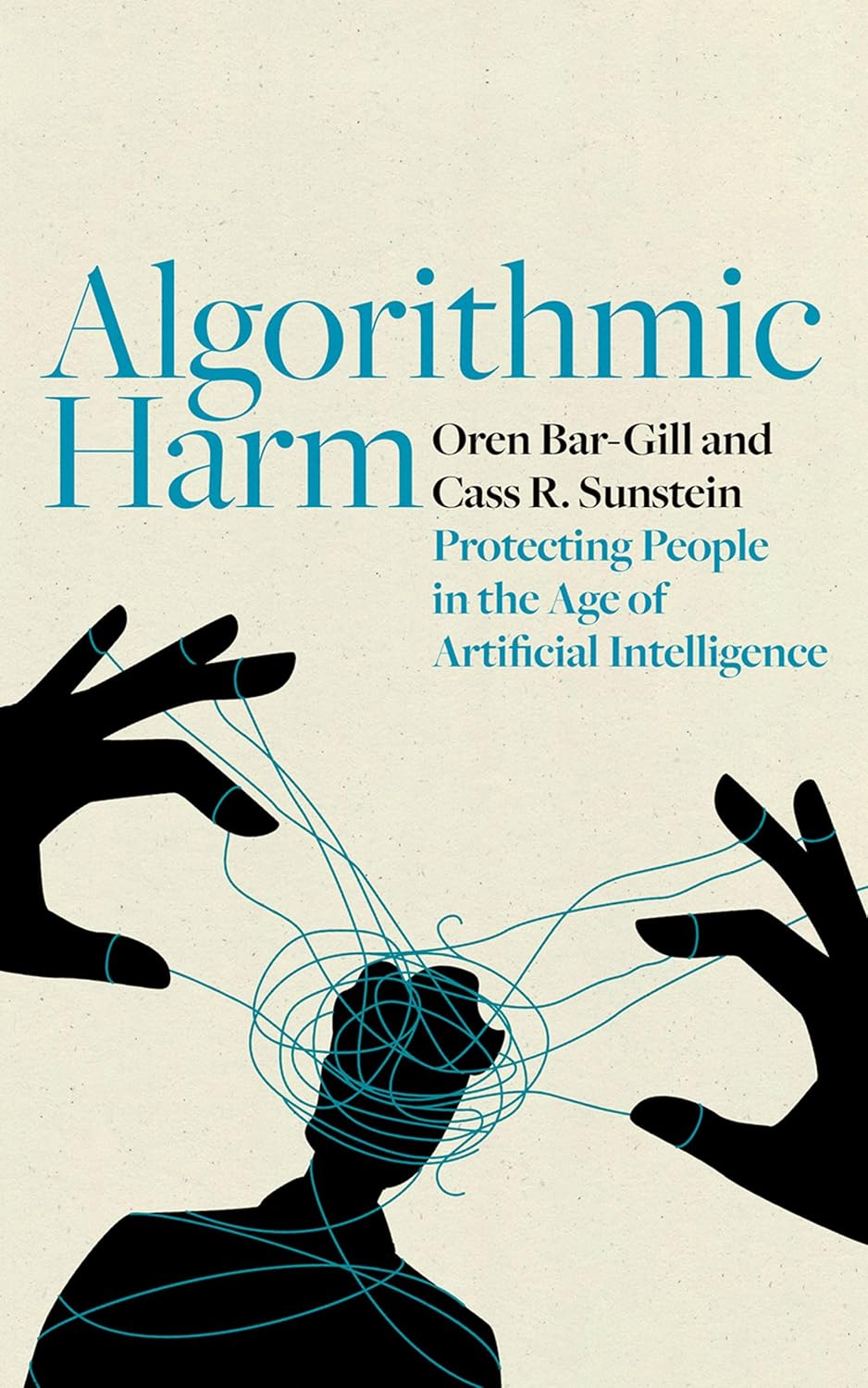
The question of whether artificial intelligence will help or harm ordinary people sits at the centre of some of the most consequential policy debates of our time. In Algorithmic Harm, the authors, Oren Bar-Gill and Cass R. Sunstein bring both rigour and accessibility to a subject that too often generates more heat than light. The book is neither a celebration of algorithmic innovation nor a counsel of despair. Its ambition is analytic: to identify precisely when and why algorithms cause harm, and to propose regulatory responses proportionate to those specific conditions. In that sense, it is a timely and disciplined intervention in a debate that is frequently distorted by ideological excess at both ends of the spectrum.
The book’s organising framework is a distinction between two types of consumer markets. ‘S markets’ are populated by sophisticated consumers – those with sufficient information and the rational capacity to use it effectively. ‘U markets’, by contrast, are populated by unsophisticated consumers who either lack relevant information or are subject to behavioural biases such as unrealistic optimism, present bias, or availability bias. The authors are careful to note that this is a shorthand: when they speak of S and U consumers, they should be understood as referring to the likelihood of mistakes rather than fixed categories of persons. Nevertheless, dividing the analysis in this way allows them to advance a clear overarching conclusion: ‘algorithmic differentiation is generally beneficial in S markets but often harmful in U markets.’
The book is structured in three parts. Part I focuses on algorithmic harm in consumer markets and is the analytical core of the work, comprising seven chapters. These cover algorithmic price discrimination and its extensions, algorithmic targeting, algorithmically enhanced misperceptions, algorithmic coordination, race and sex discrimination and consumer-side algorithms. Part II turns to policy and law, addressing how regulators might intervene through disclosure mandates, algorithmic transparency requirements and a combination of ex post policing and ex ante regulation. Part III extends the analysis beyond consumer markets to labour markets and political markets, closing with a warning that democracy and self-government are also at risk and that the same framework of analysis applies.
The treatment of price discrimination is among the most sustained in the book. The authors demonstrate that where consumers are sophisticated, algorithmic price discrimination reduces consumer surplus while increasing overall efficiency. In U markets, however, the analysis shifts: the willingness to pay of unsophisticated consumers includes a misperception component, meaning that pricing algorithms trained on behavioural data may exploit distorted signals rather than genuine preferences. The Facebook example the authors cite is instructive here – a leaked internal document reportedly showed the platform identifying when young users felt stressed, defeated or anxious, and using those emotional states to micro-target advertising. This is algorithmic targeting at its most troubling: not merely personalisation, but the deliberate exploitation of psychological vulnerability.
The dynamic dimension of the argument is also significant. Over time, as sellers accumulate more data about consumers’ past behaviour, the degree of price discrimination increases. The authors flag the case of behaviour-based pricing (BBP), noting that consumers with lower willingness to pay – who are likely to be poorer – may, in some respects, benefit from BBP because lower prices allow them to enter markets they would otherwise be excluded from. The labour market chapter draws the parallel explicitly: employers, like sellers, are increasingly using AI to make or assist in hiring and wage-setting decisions, and the asymmetry of sophistication between employer and employee maps closely onto the seller-consumer dynamic explored in Part I.
On the regulatory side, the authors propose that policing algorithms – tools developed by regulators to monitor sellers’ pricing algorithms – could play an important role, noting that the actual number of commercially deployed algorithms is smaller than it might appear, with a handful of large technology firms and a small number of developers supplying the market. They also argue that regulatory approaches should be designed to remain relevant as technology evolves, rather than becoming obsolete with the next wave of innovation.
Bar-Gill and Sunstein’s analytical framework is genuinely valuable, and the S/U market distinction gives the book a clarity of argument that some of the writings I have read on AI and regulation lack. The progression from consumer markets through to labour and political markets is coherent, and the policy prescriptions – disclosure mandates, algorithmic transparency, and the development of regulatory policing algorithms – are grounded and reasonable.
Yet the framework has vulnerabilities that the authors do not fully reckon with. The binary of sophisticated and unsophisticated consumers, however carefully the authors caveat it, risks masking important gradations within the ‘sophisticated’ category itself. What an engineer understands about AI is not the same as what a product manager understands, which in turn differs from what a marketing executive understands. A consumer who is sophisticated about one domain of algorithmic activity may be significantly less so in another. The authors’ own observation that willingness to pay includes a misperception component is worth pressing further here: even informed consumers may suffer from confirmation bias or operate with bounded knowledge about rapidly shifting technologies. The disruption caused by DeepSeek’s emergence is one recent illustration of how quickly the landscape can shift beneath even technically literate observers. The ‘S consumer’ may be a more unstable category than the book seems to acknowledge.
There is also a structural assumption embedded in the analysis that deserves scrutiny. The behaviour-based pricing discussion largely treats consumer decisions as driven by willingness to pay and the presence or absence of misperception. But purchasing decisions are also shaped by circumstances entirely outside the algorithm’s model — emergencies, sudden changes in income or one-off windfalls. These exogenous shocks do not map neatly onto the S/U framework, and their exclusion risks overstating the predictive tidiness of algorithmic consumer profiling.
One question that lingers after reading this book is whether the regulatory architecture the authors propose is politically achievable within the currently flailing democracy systems, as it’s a generally known fact that governments play catch-up with technological advancements. The suggestion that policymakers develop policing algorithms to monitor sellers’ pricing behaviour is intellectually coherent, but it rests on assumptions about regulatory competence and political will that the current environment does not obviously support. In a context where major technology firms are significant funders of electoral campaigns and cultivate close relationships with elected officials, the appetite for robust algorithmic oversight may be structurally limited in ways the book does not confront directly. The authors recommend that regulatory approaches be designed to avoid obsolescence as technology evolves – a sound principle, but one that presupposes a regulatory body both technically capable and institutionally independent enough to keep pace with commercial AI development. In my opinion, that presupposition deserves to be stated and interrogated rather than assumed.
There is also a broader geopolitical dimension that sits largely outside the book’s frame. The framework is calibrated primarily to Western liberal market economies and the consumer protection traditions of the United States and European Union. How the analysis translates to emerging market contexts where regulatory capacity, data infrastructure, and levels of consumer digital literacy may differ is a question the book’s scope does not seem to address, but that a globally oriented reader will find pressing.
Algorithmic Harm is recommended reading for scholars of law, marketing, behavioural economics, business management/leadership and technology policy, as well as for policymakers and practitioners engaged with AI governance. Bar-Gill and Sunstein have produced a framework that is both analytically rigorous and practically oriented, and their extension of the consumer market analysis to labour and political markets gives the work a reach that elevates it above a mere academic work. Some readers will find the S/U binary simplistic, and the book’s engagement with the political economy of regulation could be deeper. But as a serious, evidence-based and accessible intervention in one of the defining debates of the present moment, this work appropriately contributes to contemporary discussions and deserves recognition within the field.

Akin Akinbusoye is a PMP-certified IT Project Manager at HAP Consulting LTD with over 12 years of experience specialising in digital transformation, IT sourcing, and technology investment optimisation. His professional interests lie at the intersection of technology implementation, business strategy, business ethics, and the policy implications of algorithmic systems in organisational contexts.
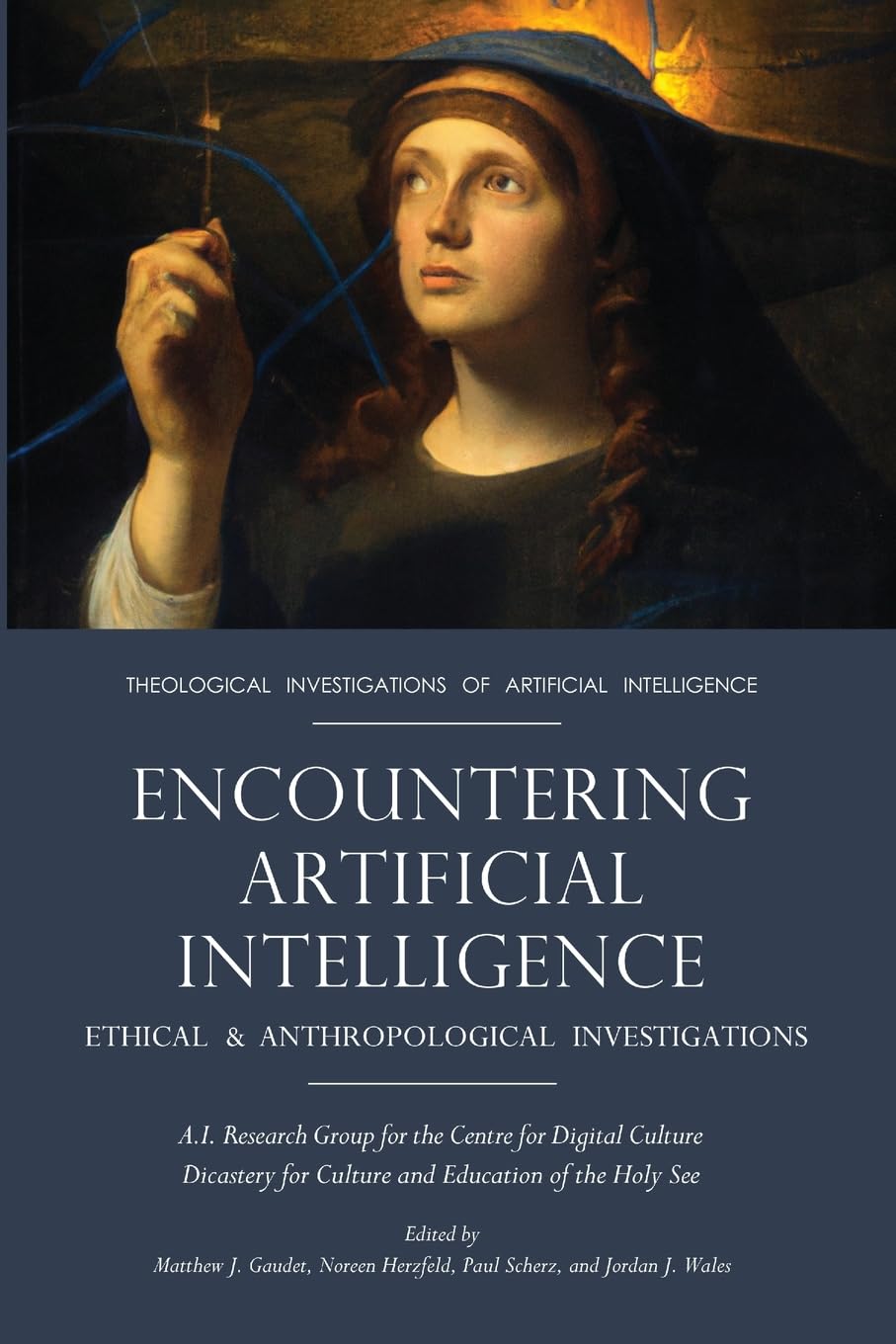
What has Silicon Valley to do with Rome? One moves quickly and breaks things; the other holds fast to timeless tradition. One seeks to maximise utility; the other seeks to preserve human dignity. One pursues technological salvation in this life; the other patiently waits for divine salvation in the next. Founded in disparate worldviews, motivated by different objectives and driven by divergent incentives, the Artificial Intelligence (AI) hubs of San Francisco Bay seem a world away from the ancient halls of the Vatican.
And yet, it is in this wide, surprisingly fertile, plain that Encountering Artificial Intelligence: Ethical and Anthropological Investigations clears the soil, plants the seeds and gently waters the green shoots of ethical and theological insight that have begun to bloom into a fruitful dialogue between Catholic social teaching and the development and use of AI.
Through a series of learned, thoughtful and perceptive reflections, the authors of Encountering Artificial Intelligence shine light on the possibility of positive-sum games between tradition and innovation, human dignity and prosperity, and right relationship with God alongside technological advancement. Neither naively credulous nor narrowly cynical, there is acknowledgement of both the great gift of technological advancement for human flourishing as well as the reality of human fragility and the attractive temptation towards an idolatrous worship of AI.
Why Should the Catholic Church Discuss AI?
Encountering Artificial Intelligence is the first fruit of multi-year collaboration between the AI Research Group for the Centre for Digital Culture, part of the Holy See’s Dicastery for Culture and Education, and the Journal of Moral Theology. Formed under the shadow of the COVID-19 pandemic in March 2020, the A.I. Research Group gathered a range of North American theologians, philosophers and ethicists for a series of discussions over three years on the promises and pitfalls of AI for our common life and society. Between the four lead authors and sixteen contributing authors, a valuable breadth and depth of insight permeate the writing. Pleasingly, Encountering Artificial Intelligence is only the first of three volumes in this new Theological Investigations of Artificial Intelligence book series.
The stated objective of the collaborators is to promote dialogue between the world of faith and the world of technology, between a culture of Christian humanism and a culture of positivism, to better discern the ways in which to be most fully human in our increasingly digital world. The volume is presented as akin to an ‘instrumentum laboris’ (working instrument), which communicates a general Catholic consensus on the emerging issue of AI while leaving space for further dialogue and discernment. It is an example of the Catholic social teaching principle of subsidiarity in action: the Church, alongside the rest of civil society, has a critical role to play in supporting state and market to understand and respond to the crucial cultural, legal and political issues of our time.
The open-hearted and open-minded approach of Encountering Artificial Intelligence is guided by the influence of Gaudium et Spes (1965), visible from the first footnotes of the introduction. Promulgated by Pope Paul VI in 1965 as a principal document of the Second Vatican Council, Gaudium et Spes (Joy and Hope) called on Christians to integrate ‘new sciences and theories […] with Christian morality and the teaching of Christian doctrine, so that religious culture and morality may keep pace with scientific knowledge and with the constantly progressing technology’ (Gaudium et Spes, 62). Through engagement with a variety of scriptural, traditional and intellectual authorities (from the Book of Genesis and St Benedict of Nursia, to the writings of British mathematician Alan Turing and the American sociologist Sherry Turkle), the volume responds to the call of Gaudium et Spes with a truly catholic, as in universal, appetite for knowledge and wisdom in its attempt to analyse AI in an authentically Christian fashion.
A helpful introduction sets the scene, establishing the longstanding Catholic embrace of the mutual benefit of faith and reason and firmly stating the compatibility of religious belief and scientific progress. For less tech-savvy readers, there is a succinct summary of the historical development of AI and a neat primer on the key concepts. Thereafter, a brief but significant chapter addresses the various ethical approaches being taken to AI, from human rights-based perspectives to more utilitarian calculus.
The book is divided into two main sections: Anthropological Investigations and Ethical Challenges with AI. These represent separate but connected lines of enquiry: what does it mean to be human in an age of AI, and how can we best respond to the threats, challenges and opportunities presented by AI across our personal and professional lives?
Anthropological Investigations
The emergence of AI has raised some fundamental philosophical questions about the similarities and differences between human nature and the nature of AI. What is AI? What is AI not? What does it mean to be human?
A chapter on ‘AI and the Human Person’ uncovers the deep Christian understanding of personhood and intelligence. Made in the image and likeness of God, the human person is deeply relational and intuitively intelligent in ways that imitate the divine life of the Trinity, and which transcend any of the impressive capabilities of AI.
A deep exploration of ‘Consciousness’ demonstrates its necessity for human relationality and rationality and the limitations of mechanistic arguments for AI consciousness based on physiology, behaviour or functionality. Consciousness, properly understood, involves a full grasp of reality, which allows for the authentic mutual encounter of another person and participation in the divine life of grace.
‘Encounters with Seemingly Personal AI’ offers fascinating analysis of the complex relational dynamics between humans and AI. While the prospect of employing AI models as a ‘good enough’ substitute for a friend or romantic partner can be attractive, any truly authentic mutual encounter between a human and an AI agent is impossible, not least because of the impossibility of mutual vulnerability. The authors caution against the use of AI in caring contexts, especially the risk of moral and relational deskilling through the loss of opportunities to grow in the capacity to care for others.
An intriguing section on ‘AI and Our Encounter with God’ reveals the limitations of AI as a tool in sacramental or spiritual mediation. Rather than succumbing to idolatry of AI as an omnipotent and omniscient source of spiritual truth, there is a call to reclaim a providential vision of human creation and salvation in which AI can only play a more minor assisting role.
In the face of significant philosophical challenges presented by our interactions with AI, the authors mount a strong defence of the irreplaceable magnificence of humanity. Formed in the imago Dei (image of God), intended for a life of relational self-gift with others, and empowered by grace to participate in divine life, human beings are uniquely different from any AI programmes.
Ethical Challenges with AI
Having provided greater clarity on the nature and purpose of AI, the authors turn to the practical ethical problems and possibilities posed by these new technologies.
A strong defence of the relevance of Catholic social teaching to the treatment of AI starts this section. Catholic understandings of human dignity, subsidiarity and the common good are highlighted as helpful resources for understanding and responding to the signs of these new times. Particular attention is paid to the late Pope Francis’ influential critique of the so-called ‘technocratic paradigm’, especially the modern-day temptation to exploit human beings as machines of efficiency and optimisation.
An expansive entry on ‘The Promises and Pitfalls of AI in Contemporary Life’ showcases the upsides and downsides of applying AI across different domains. From the prospect of AI-improved diagnostic and treatment applications to the potential for unequal access to AI to further entrench educational inequities, a realistic Catholic vision of both the limitations of human nature and the limitation of technology allows for an effective cost-benefit analysis of the adoption of AI across various fields.
In closing, an engaging reflection on ‘Recommendations for an AI Future’ proffers practical advice on living and working well alongside AI in new and changing contexts. Notable recommendations include the importance of offline creative activities, prudent regulation to limit the harms of AI programmes, and the need to incentivise better behaviour in our digital culture.
Legacy
Encountering Artificial Intelligence is an excellent start to this new Vatican-led, three-volume series of theological investigations into AI. It should surely serve as an essential textbook for Christian, and non-Christian, students of AI anthropological and ethical questions. The chapters themselves are worthy of standalone treatment, especially the rich anthropological reflections of ‘Encounters with Seemingly Personal AI’ and the extensive ethical coverage of ‘The Promises and Pitfalls of AI in Contemporary Life’. While these sorts of publications may typically tend to be of greater interest and importance to an internal Christian audience than an external secular audience, there is no reason why technologists, entrepreneurs and investors would not find some value in reflecting on these philosophical and ethical matters.
The impact of Encountering Artificial Intelligence has already been felt in the Catholic world, not least through its clear influence on the form and content of the landmark Vatican publication on AI, Antiqua et Nova: Note on the Relationship between Artificial Intelligence and Human Intelligence, which was published the following year in January 2025. Naturally, much more remains to be said in several areas of AI ethics. The emerging threats of AI hallucination and deception, the practical and economic effects of AI on the creative industries, and the ways in which our use of AI may reshape our methods and models of thinking, writing and communicating each merit closer attention.
Although Pope Leo XIV now carries the baton for the development of the Catholic Church’s engagement with AI, the influence of the late Pope Francis’s theology of encounter, which runs throughout this volume, is likely to loom large. As the late Pope Francis emphasised, there is a profound and persistent human desire for the ‘truly real’, which can ultimately only be experienced through authentic mutual encounter with another thinking, feeling and loving human being (Pope Francis, Fratelli Tutti, 33). Given that the phenomenon of ‘AI companionship’ seems to be growing from strength to strength, not least in its promise of risk-free relationships, there will be an equal and opposite need for the Church to communicate the enormous and irreplaceable value of risky but rewarding human-to-human relationships compared to the simulated substitutes supplied by AI models.
There is no shortage of AI coverage and commentary at present. Predictions, prognostications and prophecies of the future impact of AI abound in plentiful supply. Yet amid the heat of ever-evolving debate over job losses, regulatory options and corporate liabilities, there can sometimes be precious little light of insight. Here, through cohesive anthropology and coherent ethics, is where Encountering Artificial Intelligence bears fruit.
‘Encountering Artificial Intelligence: Ethical & Anthropological Investigations’ by the Dicastery for Culture and Education of the Holy See was published in 2024 by Pickwick Publications (979-8-385-21028-2). 274pp.

Naoise Grenham is a senior policy and research analyst for the Catholic Bishops’ Conference of England and Wales, where he advises Catholic bishops in areas of artificial intelligence, criminal justice reform and healthcare. He is one of the inaugural Edington Fellows of the Prosperity Institute in Mayfair, London, and serves as a Trustee for the national Catholic domestic charity, Caritas Social Action Network (CSAN).
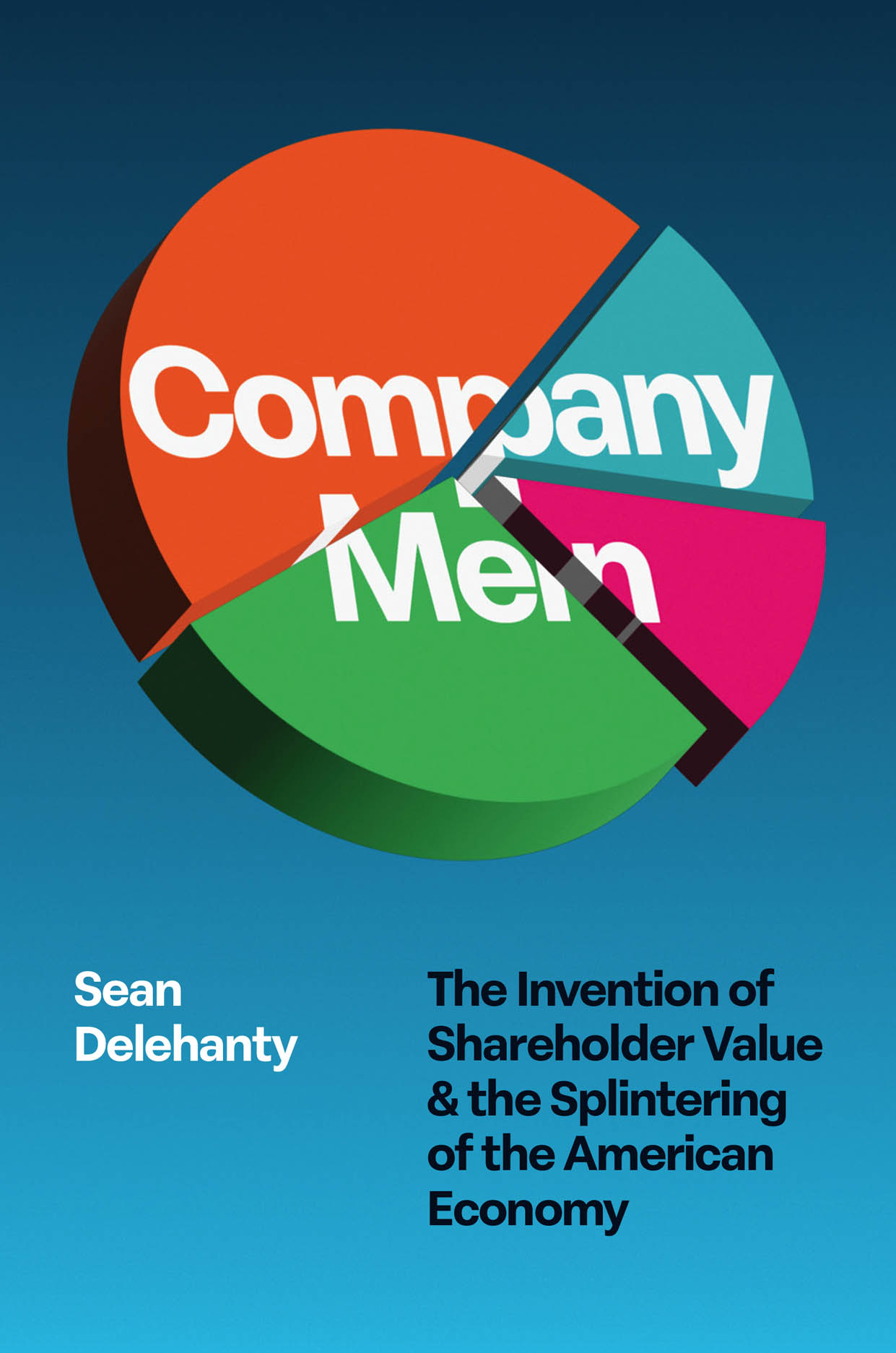
In one of the many mansions of today’s obsession with ‘neoliberalism’ resides a long-running debate about the nature and role of the corporation. Those arrayed on one side of the debate argue that stockholders do not own the corporation – all they own are their own shares – and that corporations should (perhaps consequently) be managed in the interests of a wide variety of ‘stakeholders’. At the other table sit those who believe that, as possessors of the residual rights of control, shareholders are indeed the owners of the corporation and that corporations ought (perhaps consequently) to be managed so as to create the most value for the shareholders. In Company Men, Sean Thomas Delehanty promises to illuminate this debate through an intellectual history of the shareholder-value idea. Unhappily, he is more successful at throwing shade than at throwing light.
On the plus side, the book is well written, and it covers a lot of the right ground. Emerging from Delehanty’s dissertation at Johns Hopkins, it is an attempt to craft the kind of intellectual history of free-market thinking that his advisor Angus Burgin achieved in his important study of the Mont Pèlerin Society. But unlike his mentor, Delehanty is unable to sublimate his own strongly felt ideological position. The result is not only ideological bias – which is common enough, and fair enough with a good argument – but also, in this case, an overall shallowness.
The shareholder-value debate has deep roots, but Delehanty focuses on the modern-day fons et origo of the idea that corporations should be run in the interests of shareholders, a wildly influential 1976 paper by Michael Jensen and William Meckling. Delehanty rightly sees this paper as an attempt, by two free-market-oriented, Chicago-trained economists, to develop the ideas in a famous article by Milton Friedman: that the only ‘social responsibility’ of business is for employees to pursue the goals of the firm’s owners within the constraints of legal and ethical norms. (That would usually, but not always, mean making as much money as possible.) Jensen and Meckling recognized that this implied what economists were coming to call a principal-agent problem. Employees would very likely arrive at work with their own goals, which they could typically pursue at the expense of the goals of the owners.
Jensen and Meckling made this agency problem the centerpiece of their theory of the firm – an attempt, as they saw it, to open up the black box of the firm as portrayed in conventional price theory. On the one hand, the separation of ownership from control in the modern public corporation had untethered the provision of capital from personal supervision, thus unleashing the massive real capital flows that underpinned economic growth. But on the other hand, the agency relationship had its own costs, in response to which firms had generated organizational responses that economists could study. The 1976 paper would become a landmark – though by no means the last word – in the economics of organization, a subfield that was beginning to gain traction in the 1970s.
Delehanty chooses to read the Jensen and Meckling paper, and indeed all of their (mostly Jensen’s) work, as nothing more than ideological weaponry, ‘part of their broader political project of protecting capitalism from democracy. A commitment to shareholder value maximization insulated businesses from the kinds of democratic pressures Jensen and Meckling warned about in their political work, which in turn had a profound effect on the nation’s political economy’ (page 61). As a result, Delehanty never engages with Jensen’s intellectual contributions in any substantive way.
Did the ideas of Jensen and Meckling have ‘a profound effect on the nation’s political economy’? The economic historian Deirdre McCloskey has warned against conflating what she calls think-history with do-history. Good intellectual history must surely engage with the events of the world in order to understand the evolution of thought. Similarly – but with far more difficulty – good economic history must confront ideas as it chronicles events and unearths the economic forces that operate behind events. But it is all too easy to depict a think-history as if it were causative of do-history. Although he occasionally backs off and portrays Jensen’s work as merely ‘justifying’ the movement for shareholder value, Delehanty sometimes seems, especially in an impassioned conclusion, to want us to believe that Jensen’s ideas are largely at fault for the increasing ‘financialization’ of the economy in the late 20th century, which is in turn largely at fault for a litany of what the author believes to be society’s ills.
The U.S. economy was already on the road to financialization early in the twentieth century. But, as I have argued, wars, depression, and the New Deal effectively de-marketized the economy for much of the middle of the century, giving comparative advantage to the large corporations as a locus of economic institutions and to their managers as arbiters of capital allocation. Managerialism continued after World War II, which had bolstered the capabilities of American corporations while destroying their foreign competitors. This was a stable era that saw the slow consolidation of the innovations of the second industrial revolution. Many now look back on the post-war period with nostalgia, even though most segments of American society are far better off today in material terms – and even though critics once complained about the depredations of managerialism in the same loud tones they now use to complain about financialization.
By the 1960s, large American firms were earning economic rents, which appeared to managers in the form of what Jensen famously called free cash flow. Rather than returning those rents to stockholders in the form of dividends, managers acquired firms in wholly unrelated lines of business, creating the conglomerate. (Significantly, conglomerates are in a sense a manifestation of both managerialism and financialization: managerialism because the managers not the market were making decisions about capital allocation; financialization because managers acquired assets in financial transactions rather than developing them internally.) This turned out to be as inefficient in practice as it is in theory, and entrepreneurs arose to unbundle the conglomerate by buying up stock and attempting to unseat the incumbent management, often forcing the selloff of the unrelated divisions. Thus was born the era of the takeover, both hostile and otherwise, which picked up pace over the next decades with the emergence of strong foreign competition and a dramatically changing macroeconomic environment. The assault on the conglomerate both initiated and benefited from the rapid development of external financial markets, which had been a sleepy, clubby sector in the middle of the century.
Delehanty tells much of this story, often in the same terms I have used. But in his account the events of economic history fly by like Burma Shave signs, leaving little real effect. All that seems to matter are the ideas of Jensen, who did indeed provide an intellectual framework for understanding how the market for corporate control created value in the economy. It shouldn’t be surprising that financialization created value, even despite the dramatic (and by no means waste-free) forms it took at the height of hostile takeovers. Handing the task of capital allocation off to a specialized industrial sector brings to bear many more perspectives and much more knowledge than is available to managers for internal decisions, and this is true even if one believes in only the weakest forms of the efficient-markets hypothesis.
What about the terrible effects of financialization? Jensen and others marshaled empirical evidence that takeovers did not reduce overall employment, investment, or R&D but had significantly increased productivity. Delehanty sees these as merely ideological efforts to ‘fully leverage the argumentative power he could gain from claiming the mantle of “scientific” research’ (scare quotes original). Like Nicholas Lemann, whose marvelous if often problematic Transaction Man covers much of the same ground as this book, Delehanty lays the blame for late-century deindustrialization and job loss on financialization while actually using as examples industries – like steel and automobiles – populated by the most managerial and least financialized firms in the economy.
So how important to the events of economic history were the ideas of Jensen and fellow proponents of the shareholder-value theory of the firm? It is certainly true that these ideas were influential. Raiders like T. Boone Pickens could be heard talking about the problem of free cash flow. But would events have moved along much the same path if these ideas had never been uttered? Company Men doesn’t take us much closer to an answer.

Richard N. Langlois is Professor of Economics and Head of the Department of Economics at the University of Connecticut. He is the author of The Corporation and the Twentieth Century: The History of American Business Enterprise (Princeton University Press 2023).

Adapted from a talk at the UNIAPAC Think Tank meeting, December 2025
People often look to priests to appear at the end of a conversation and offer a blessing as it concludes. However, I have always believed, following St. Ignatius of Loyola, that priests should not be the ones who close conversations, but the ones who ignite them. St. Ignatius once wrote to St. Francis Xavier as he sent him across the world to share a message of hope: Ite, inflammate omnia. Go, set everything on fire.
My own understanding of the relationship between faith and economic life has been significantly shaped by a document published by the Vatican in 2018: The Vocation of the Business Leader. One reason that it has been so influential is that it resists the simplifications which often dominate discussions on the role of ethical leadership in the business world. Instead of reducing business to technique, or spirituality to interior sentiment, it insists that business leadership is a genuine vocation. It is a calling rooted in human dignity and oriented towards the common good.
And yet, for all its depth, this document is not as widely read, discussed, or implemented as it deserves to be. If you have not read it, or not returned to it recently, I deeply encourage you to do so. For those interested in an ethical standpoint inspired by Christian, and especially Catholic thought, it offers a lens through which we can interpret the world of business. Its central triad offers a valuable and demanding framework: good goods, good work, good wealth. It reminds us that producing excellent goods, creating dignified jobs and distributing wealth in ways that strengthen society are not optional extras: they lie at the very heart of ethical leadership.
But this triad reveals something further. It exposes the moral depth of the economic sphere. It invites us to confront a dimension of human life that the modern business environment often avoids, and that even many faith-based organisations hesitate to name explicitly: the reality of sin. If we misunderstand this word, we will misunderstand our vocation.
When a writer in the Christian tradition, such as for example St. Augustine, speaks of human shortcomings, of sin, he does not begin by condemning behaviour. He begins by describing the human heart. He describes challenges which every human being is familiar with, whether they are Christians, or not. Sin, for St. Augustine, is fundamentally the disordering of desire. It is the restless, self-enclosed movement by which the human heart loses its orientation toward the good. Pride replaces humility; fear replaces freedom; control replaces trust. And whenever desire becomes disordered, human structures – including economic structures – reflect that disorder.
St. John Paul II extended this insight further by speaking of structures of sin. The economy is not a machine insulated from the moral life. It is shaped by the desires, choices, and relationships of human beings. If pride becomes the organising force of the heart, then inequality is not an accident; it is a structural expression of a spiritual wound. If fear governs decision-making, then precarious labour is not merely a technical outcome; it reveals something about our anthropology.
More recently another theologian, William Cavanaugh, reminded us that modern markets often present themselves as morally neutral mechanisms, but that this neutrality is an illusion. Markets shape desires, habits, and forms of belonging. They are not only systems but liturgies: they teach us how to imagine the good life. That is also what Alasdair MacIntyre warned. We live in a world where the meaning of virtue has been largely hollowed out. Institutions pursue efficiency without purpose; technique replaces teleology; moral language becomes decorative rather than operative.
This matters for business leaders concerned with ethics because, if we do not dare to speak in these categories – desire, virtue, sin, conversion – then we allow economic discourse to be dominated by a vocabulary too thin to sustain the hope we proclaim. We cannot speak of ‘vocation’ without speaking of moral anthropology. We cannot speak of ‘good wealth’ without recognising that both good and evil can structure the economic world.
And that is why advocacy, important as it is, will never be enough. Advocacy influences conversations. But the vocation to ethical leadership, certainly if it is Christian, must transform structures. Our mission is not merely to promote good causes but to implement an ethical approach in the concrete realities of business life. Christian business leadership is therefore not philanthropy, nor is it corporate social responsibility layered onto existing practices. It is the integration of Gospel principles into wages, taxation, governance, workplace culture, supply chains, investment decisions and distributive policies. It is an incarnational ethic. A former President of the UNIAPAC network, José Ignácio Mariscal, insisted on this time and time again, and we should not become numb to his warning.
Business leaders sometimes feel like this is all too hard, that it cannot be done. But there are many examples to inspire us and to provoke us. Consider the lives of three business leaders, which reveal what business leadership looks like when it becomes a form of ethical commitment, indeed of discipleship.
José María Arizmendiarrieta, the founder of the Mondragón movement, understood that economic structures could be shaped from within by the logic of cooperation. For him work was a participation in God’s creative action; economic organisation was an expression of fraternity; inequality was not destiny but the result of ethical failure. His vision demonstrates that solidarity is not sentiment; it is action – in a way which almost makes one wonder if he was a regular reader of Maurice Blondel. It is possible to create systems where the human person is not an instrument, but a co-creator.
Léon Harmel, whose spiritual and social intuition anticipated much of modern Catholic Social Teaching, insisted that justice must be woven into the fabric of industrial life. His factories pioneered fair wages, worker participation, social protection, and mutual aid. More radically, he believed that holiness and business leadership were not incompatible. Holiness was not reserved for monasteries; it was available, indeed demanded, in the factory, the workshop, the boardroom.
Finally, Enrique Ernesto Shaw, the Argentine businessman, offers a profoundly contemporary model of Christian economic leadership. His life embodied what Benedict XVI would later call an ‘economy of gratuity,’ in which business becomes not merely a space of efficiency and profit, but an arena of gift, responsibility, and communion. Shaw was known for treating workers not as human resources, but as human persons, investing in their families, their education, and their long-term well-being. He insisted that profit and care were not rivals but partners. His decisions were guided by a deep conviction that trust is a form of capital, and that a company prospers when its people flourish. Even during moments of economic difficulty, Shaw sought ways to protect employment rather than sacrificially reduce the workforce. In Shaw’s example therefore we see that a Christian leader does more than manage an organisation. He or she builds a moral ecosystem, a community where virtue becomes operative, where justice and charity shape strategy, and where the leader’s deepest identity is not proprietor but steward.
From these three lives I draw two specific provocations for leaders in 2026. The first concerns Artificial Intelligence. There is no need to talk about it for too long; we already hear enough about it. But we can at least say this: AI offers an opportunity to improve working conditions for those whose tasks are hardest and least recognised. Used ethically, it can free people from repetitive labour, open opportunities for education, and contribute to greater human dignity. The question is not simply how to mitigate risks, but how to orient AI toward justice. We tend to forget that in the 19th century all humanity dreamed of was the arrival of the machine, something particularly evident in Jules Verne’s novels, because automation would mean being freed from the manual and servile labour which was and still is demeaning to so many of our brothers and sisters around the world. So: can we use AI in a way that would be fitting to the lives of Arizmendiarrieta, Harmel, and Shaw? Can we use it to the benefit of the poorer, the frailer, the ones who suffer the most violence? Can we consider it not just from the point of view of the time it saves, but also from the point of view of the lives it saves?
A second provocation concerns peace. In a world increasingly shaped by polarisation, inequality, and conflict, business leadership can be either a source of peace or a source of fracture. Christian leaders are called to build peace through transparency, stability, inclusion, and the generation of trust. Peace is not only a political concept; it is a daily economic practice. Pope Francis was almost obsessed with the need for the Church to be the promoter of peace. Arizmendiarrieta, Harmel, and Shaw built peace around them in noticeable ways: by improving the quality of life of their employees, by bringing education to contexts that did not hope to get it, or just by being caring and gentle and warm-hearted in their interactions with people. How far can we go here? How much can we actually aspire to build a peace that is concrete through our business vocations?
Let me end where I began. As a priest, I hope not to offer closure, but to kindle desire. My hope is that these sparks might take hold in the business community, and especially among Christians; that our spaces for ethical reflection might become not just fora for ideas but laboratories of moral transformation; that The Vocation of the Business Leader may become not a beautiful text but a living guide; that we may learn to name both the sin and the grace at work in the economic world; and that the lives of Arizmendiarrieta, Harmel, and Shaw may continue to challenge us with missionary clarity.
St. Ignatius knew that some words belong not at the end, but at the beginning of mission. Ite, inflammate omnia. Go, set everything on fire – the economy, the world of business, and most of all, the hearts of those who you lead and who lead with you.
Francisco Mota S.J. is the Spiritual Advisor of UNIAPAC International, a global federation of Christian business organisations. He is a Portuguese Jesuit and was formerly Director of the Maputo campus of the Catholic University of Mozambique and Chairman and Executive Director of Brotéria. Fr. Mota currently serves as Province Treasurer for the Portuguese Jesuits.
Main photograph by Julen Iglesias, 2022, from Wikimedia Commons
Used in accordance with a Creative Commons Attribution-Share Alike 4.0 International licence

An interesting example of market transformation can be seen in the growth of worldwide spending on beauty products, which reached $440bn in 2024. There are various trends (or pressures) at work, with men now feeling freer to spend on beauty products and demand growing among young people, who are purchasing such products at much earlier ages than their grandparents. Social media has played a significant role: as influencers share their beauty regimes, the online space is becoming the biggest shop window for the beauty industry. Additionally, there has been a shift in the marketing and consumption of beauty products, as consumers have become increasingly interested in the ingredients of the products that they buy and their supposed effects. In consequence, packaging is now plainer and bears something of the ‘laboratory look’.
Naturally there are concerns about trends among young people. With reports that beauty products are now being bought by children as young as eight, there has been alarm at the loss or increasing sexualisation of childhood, as well as concern about the damage that certain products can do to children’s skin. In consequence, there have been calls for regulation. It is normal to seek restriction or regulation of products that are deemed harmful, as witnessed in relation to tobacco, for instance, and more recently in connection with tobacco alternatives, such as of vapes and nicotine pouches. In connection with the beauty industry, one might wonder whether (or hope that) a ban on social media accounts for under-sixteens, as implemented in Australia and currently under consideration in the UK, will have an effect. Regulation in one sphere might affect associated behaviour in another. If young children are heavily invested in ‘beauty’ in an unprecedented manner – to the point of talking about anti-ageing products before they reach their teens – and social media influencers are in part responsible for driving such an interest, then restrictions on social media access could go some way towards addressing the problem. However, it is important to consider whether regulation is the answer.
The thought of the sociologist Max Weber (1864-1920) perhaps offers one means of shedding light on the issue. Weber described the phenomenon of ‘disenchantment’ and its effects on society. With the advance of reason and scientific principles, it becomes increasingly difficult to believe in spirits, gods or supernatural forces, with the result that the influence of religion and superstition is diminished. As the world becomes demystified and science is able to explain everything in rational terms, the world loses its mystery and appears mechanised and predictable. However, science cannot adequately fill the void created by the ousting of religion and people are no longer able to find the kind of meaning once provided by the values grounded in traditional beliefs; moral questions can be articulated and analysed, but not satisfactorily answered.
Some have questioned Weber’s account of the disenchantment of society, while others have proposed the possibility of re-enchantment: meaning and value – if they have indeed been lost – can be restored to the disenchanted world, either by projecting subjective values onto it, or by locating value as objectively existing in nature itself.
One interpretation of a shift in the market for beauty products might employ these concepts. Is the move towards a greater interest in the active ingredients of cosmetics a sign of an increasingly ‘scientific’ mindset, as society becomes more rational? Or is this in fact a form of re-enchantment, whereby ‘science’ – however ‘science’ is understood – is elevated to the status of religion and becomes a new dogma or article of faith? Do those who seek to buy plainly packaged cosmetics that resemble medicines display a tendency to deify ‘science’, almost to the point of seeking purpose and meaning in it? If influencers with questionable credentials in dermatology are helping to drive sales, perhaps such an account is not so far-fetched.
Perhaps the disenchantment thesis is able to make some sense of the disproportionate interest in beauty among young people, with children buying – or being given – adult cosmetics. In a disenchanted society in which transcendent values and traditional notions of meaning are lacking, preferences are shaped by other forces – or themselves become the locus of value and meaning. In either case, they can become disordered and unrestrained. Might skewed and superficial notions of beauty, driven in part by the forces of consumerism and assisted by social media, be behind the behaviour of some children? Where certain values have lost their influence, it is possible that people no longer see anything wrong with eleven-year-olds using anti-ageing products. If that is what they want and their parents have no objection, the thought might run, then so be it.
It is no surprise that there are calls to regulate access to social media for children. Social media – or its excessive use – has been associated with all manner of ills. The question is whether restriction will solve the problem. Likewise, we might ask whether, should the trend towards childhood use of adult cosmetics reach a scale at which it is felt that something must be done to protect the physical and developmental health of children, regulation would prove effective.
Markets simply match vendors with buyers, and it is something of a truism that businesses, if they want to survive, adapt to markets – or seek to shape them – in order to be able to offer a product for which demand exists. In the sense that the demand side of the ‘supply and demand relationship’ characteristic of markets is shaped by societal values, it is clear that markets do not simply serve society; they reflect it, too. When we hear calls for regulation to address problems, it is important to consider whether regulation can achieve the desired outcome. For instance, what manner of legislation could ever prevent parents from buying anti-ageing or beauty products for their barely-teenage children? In the absence of parental oversight, can any regulation really prevent determined teenagers from accessing social media? Parents who buy £1,000 phones and let their children scroll through social media until the small hours, or buy expensive, adult cosmetics for their children because ‘this is what she wants’ or ‘these are what her friends have’ are arguably not matters for regulation. These are questions of values.
Markets can only serve a society because to some degree, they act as a mirror of that society. Where markets are an expression of who we are or what we have become, concerns ought perhaps to be directed not at the statute book with a view to controlling the market itself, but at our own values: the attitudes of the society that the market both reflects and serves.
Image by Freepik (www.freepik.com)

Neil Jordan brings to CEME seventeen years’ experience of academic publishing, having previously served as a senior commissioning editor for Ashgate and Routledge where he specialised in research level publications in the social sciences. His primary focus was on sociology and social theory. Neil has also been employed as a teacher of philosophy and religious studies. He holds bachelor’s and doctoral degrees in philosophy, both from the University of Southampton, and has published on the subject of ethics.
Corporations and Persons is not for the casual reader: the first half comprises a dense and highly contentious examination of the nature of personhood and moral responsibility and the second half includes a torrent of assertions relating to alleged duties of corporations which requires slow and careful consideration.
That said, the book deals with important issues. David Silver argues that ‘the corporation is … a kind of person in moral relationship with human beings, and in particular with democratic society’ (page 1). He thus considers that corporations have moral responsibilities and, ‘in a certain abstract sense’ (page 5), moral rights and he seeks to describe these responsibilities and rights. Unsurprisingly, he considers the acceptance of his thesis to be important, stating ‘I have written this book to urge all of us to adopt an understanding of the relationship between corporations and the rest of democratic society which is grounded in a commitment to liberal democratic values’ (page 186).
Silver rejects ‘the idea that we have theoretical intuitions which directly provide us with knowledge of the nature of moral responsibility’ (page 12) but his view of such responsibility is nonetheless ultimately subjective. He refers to our ‘reactive attitudes’, which he describes as ‘a family of mental states which includes blame, resentment, gratitude, indignation, and appreciation’ (page 11) and he goes on to assert that ‘we should understand our theoretical intuitions about moral responsibility as arising out of our efforts to make sense of our reactive attitudes, and then judge their validity insofar as they accurately make sense of them’ (page 12). It is thus ultimately on the basis of our ‘reactive attitudes’ that he concludes that corporations have moral responsibilities.
He recognises that he is dealing with ‘age-old questions’ of philosophy (page 9) and he seeks to deal with a number of modern objections to his theories. However, although some of what he says is powerful, it does not dislodge the most serious objections. In particular, Christians and other monotheists must surely start with a concept of morality that relates to God: to say that someone has a moral duty is to say that they are accountable to God in respect of their behaviour. The implication of this is that only sentient beings can have moral responsibilities and, since corporations are not sentient (a fact that Silver accepts [page 4]), they cannot have such responsibilities. In this connection, it is interesting that Silver himself slips into using language about corporations that implies sentience (e.g. ‘corporations can have a messy set of dispositions towards their moral obligations’ [page 20]).
Quite apart from theistic arguments, contrary to Silver’s view, David Shoemaker is surely right to assert that corporations (in contrast to their directors and managers) ‘cannot be sensible targets of angry blame’ (page 17). To say that a corporation ought to have done something is no more than a shorthand way of saying that those running the corporation ought to have ensured that the relevant thing was done. Anger is only meaningfully directed at them. Anyone who doubts this should imagine a situation in which a corporation has no directors or managers and ask whether they could meaningfully be angry with it.
Silver accepts the existence of objective value and thus objective morality and he centres the latter in ‘the intrinsic value of human beings qua sentient person’ (page 45). Such a starting point may well lead to conclusions similar to those that Christians draw from the idea that human beings are made in the image of God. However, on its own, it leads to an entirely human centred morality which is rather narrower than a morality that starts with God’s creation and care of all things and the notion of responsibility to God. Furthermore, Silver goes on to state that his theory ‘analyzes the world in terms of how to create the greatest level of rational self-governance that can be made available to each person in society’ (page 46; emphasis Silver’s), which elevates self-governance from being a relevant consideration to a central position that is potentially dangerous and is certainly contrary to a monotheistic view of the world.
On the basis of his theories of personhood and morality, Silver seeks to establish the purpose of corporations, which he believe is ‘to create products and services that provide a benefit to those who ultimately use them’ (page 63). He then moves on to describe a large number of duties that he believes corporations owe (25 of varying levels of specificity are listed on page 174) and a lesser number of rights that he believes they enjoy. His view of purpose is contentious but not new and there are books that argue for similar purposes in more detail (e.g. the books by Colin Mayer reviewed on this website). Likewise, there is little new in the duties and rights that he advocates, although this is not to say that they are either uncontentious or even clear. Indeed, many of the alleged duties, as listed on page 174, are not adequately backed up by argument and many of them are vague (e.g. the assertions that corporations should not seek more than their ‘fair share of attention from policy makers’ [page 155]).
Much more seriously, there appears to be a fundamental conflict between, on the one hand, Silver’s reaction to the divergence between his views and the laws of the USA and, on the other hand, his stated commitment to the upholding of democracy. This conflict is most evident in relation to corporate purpose. Silver’s view is, of course, out of line with the law of the State of Delaware (where a large proportion of major US corporations are incorporated), which requires that corporations focus, at least primarily, on the pursuit of profit. At one point, Silver appears to accept that Delaware law inevitably trumps his view: he says that ‘It is up to each democratic society to make its own determination regarding the purpose of the firm’ (page 53). Indeed, he goes further, saying that ‘democratic citizens have the prerogative to institute a system of democratic social governance, which assigns moral and legal rights and duties to individuals and institutions’ (page 54; emphasis Silver’s), which is a truly extraordinary statement in so far as it asserts that morality is determined by the state! However, at the same time, Silver argues for civil disobedience by the managers of Delaware corporations (i.e. non-compliance with the Delaware law relating to corporate purpose [pages 96-99]). How does he reconcile these statements?
The answer is: by characterising the relevant Delaware law as ‘authoritarian’ and ‘undemocratic’. He says that ‘I call a social decision-making process authoritarian if it does not track the values and judgments of the people it affects’ (page 91) and, having stated that ‘interstate competition for corporations is an authoritarian force’, he concludes that ‘to the extent that Delaware’s corporate code posits a legal duty to maximise profits, this lacks democratic legitimacy’ (page 93). This in turn leads to the conclusion that ‘non-compliance [by managers with that legal duty] can be justified given that the law’s understanding of their duties was generated in an authoritarian manner’ (page 98).
This is breathtaking! He simply redefines the word authoritarian so as to include, and the word democratic so as to exclude, things that he does not like. Delaware’s laws may be undesirable, even unethical, but they are constitutional, established through the democratic process and not authoritarian, using these words in their normal senses. Furthermore, leaving aside the linguistic sleight of hand, if a democratic society is to survive, the bar for civil disobedience must be set far higher than Silver suggests.
Silver uses the same technique to attack court decisions that he does not like, including both cases upholding and interpreting the Delaware laws that he dislikes and the much debated Citizens United case, in which the US Supreme Court overturned laws restricting political spending by corporations. He describes the latter as ‘highly antidemocratic’ (page 115) and, at one level, he has a point in relation to this: the role of the US Supreme Court has the effect of transferring power from the legislatures of the USA to the courts. However, while this may or may not be desirable, it is the consequence of the US constitution, which is itself a democratically adopted and amendable instrument. Furthermore, the nature of a Supreme Court decision (i.e. whether or not it is antidemocractic) cannot possibly turn on whether or not it determines that a particular matter is or is not in breach of that constitution.
The strangest thing about Silver’s book is the fact that he could have argued in favour of the duties (and indeed rights) that he discusses in the second half of the book without the need to argue that corporations are morally responsible persons. For example, he could have argued in favour of his view of the purpose of corporations by arguing that their managers have a duty to pursue this purpose. Indeed, as the book progresses, Silver talks more and more about managers and, even human beings in general. In particular, he recognises that the question of civil disobedience is, in reality, a question of the conflict between what he sees as the moral duties of the managers of corporations and their legal duties. He also acknowledges that many of the duties he asserts are duties applicable to all people and his comments about democratic legitimacy are clearly independent of the philosophical issues that he has considered earlier in the book.
This contributes to the impression that Silver may have an agenda that goes beyond that which is the book’s stated purpose or at least a desire to appeal to a particular audience: at several points, there are passing references to stock issues that suggest virtue signalling (e.g. there is a short paragraph on page 49 that crams references to ‘racial and ethnic minorities’,’ indigenous peoples’ and ‘people with nontraditional genders and sexual orientations’ into a few lines); his comments on the Citizens United case include the statement that the decision ‘reflected … close personal connections between the national political and industrial elites, and perhaps a new understanding of their shared class interests’ (page 115); he asserts (without argument) a duty ‘to develop an historical awareness of … the ways that the history of capitalism is intertwined with the history of colonialism, racial oppression, and slavery’ (page 167); and the main part of the book ends with criticism of the repeal of the provisions of the US Glass-Steagall legislation that, in essence, required the separation of commercial and investment banking, an attack on the suggestion that misguided government policy relating to lending to minorities was a cause of the Global Financial Crisis, an attack on the ‘unfair’ response of the US Government to the crisis, and statements relating to the duties of corporations in respect of climate change – all in the space of just over two pages (pages 176-178)!
The book raises important issues but it is deeply flawed. The examination of the philosophical issues in its first few chapters is worthy of study, albeit with considerable care. However, those wishing to consider in detail the duties of corporations and their managers would be better off looking elsewhere.
‘Corporations and Persons: A Theory of the Firm in Democratic Society’ by David Silver was published in 2025 by Oxford University Press (978-0-198-94068-5). 189pp.

Richard Godden is a Lawyer and a Consultant of Linklaters. He was a Partner of Linklaters for 36 years during which time he advised on a wide range of transactions and issues in various parts of the world.
Richard’s experience includes his time as Secretary of the UK Takeover Panel and later as a member of its rule making committee. He also served as Global Head of Client Sectors, responsible for Linklaters’ industry sector groups, and was a member of its Global Executive Committee.
He has been the chair of the CEME board since 2023.
The timing could hardly be better. Elisabeth Braw’s Goodbye Globalization: The Return of a Divided World was published just as Donald Trump returned to the White House, and it has lost little of its pertinence in the year since then. And yet Braw, an Atlantic Council fellow delivers a deeper message. Trump isn’t the cause of deglobalization. He’s merely the symptom of a much deeper malaise that the Western establishment spent three decades pretending didn’t exist.
The book’s central thesis is brutally simple. The globalization project that dominated from the fall of the Berlin Wall until roughly the mid-2010s is already dead. Braw traces the story chronologically, from the giddy optimism of the 1990s through to today’s fractured world order. Back then, we were assured that opening up trade with China would inevitably lead to political liberalization. Beijing would discover the joys of democracy once its middle class got rich enough. Meanwhile, integrating Russia into the global economy would prevent any return to Cold War tensions. Financial deregulation would spread prosperity. Supply chains spanning multiple continents would deliver ever-cheaper goods to grateful consumers.
It all sounded fantastic in the economics faculties and corporate boardrooms. Out in the real world, however, it did not work out quite so well. Manufacturing workers in the West watched as their jobs vanished to China. Entire communities were hollowed out. The promised retraining programmes turned out to be worthless. The nineties offered plentiful opportunities, but there were plenty of people who were left behind.
What makes Braw’s account particularly valuable is her willingness to name names and tell human stories. This isn’t some dry academic treatise. She’s spoken to executives, policymakers, and ordinary workers across the globe. The result is a book that comes vividly to life with the full cast of characters who shaped this era.
The financial crisis of 2008 should have been the wake-up call that something was not working. Instead, the elites doubled down. Yes, there were problems with financial integration, but surely the answer was more regulation, not less interconnection? Then came Brexit. Then Trump’s first presidency. Then Covid, which revealed just how dangerously dependent Western nations had become on Chinese manufacturing for everything from pharmaceuticals to personal protective equipment. Russia’s invasion of Ukraine, with tacit Chinese support, delivered the final blow. Suddenly, all those smart people who’d been lecturing us about the virtues of economic interdependence had to confront an awkward reality: authoritarian regimes don’t share our values and will happily weaponize trade relationships when it suits them. Who could have guessed?
Braw documents how China has used its dominance of supply chains and critical materials to pursue strategic advantages. An increasingly authoritarian China’s control over products and materials needed for the energy transition has created dependencies that Western governments are only now scrambling to address. But it’s rather late in the day to suddenly discover that outsourcing your entire industrial base to a geopolitical rival might have downsides.
The book excels at explaining why plenty of leaders have concluded that globalization simply isn’t working anymore. Supply chains are vulnerable. National security has been compromised. Domestic social cohesion has frayed as entire regions were sacrificed on the altar of cheaper consumer goods and fatter corporate margins. So what comes next? For Braw, the answer is ‘friendshoring’. The idea is straightforward: trade should continue, but primarily with countries that share Western values of human rights, free markets, and the rule of law. Build supply chains through allied nations. Accept that this will mean higher costs, but gain security and resilience in return.
It’s a sensible enough prescription, though one can’t help wondering if it’s practical. Most countries quite sensibly want to trade with everyone. Consumers choose the best value products, which is precisely why Chinese electric vehicles are proving so popular despite Western politicians’ huffing and puffing. Raising tariffs to force friendshoring will increase costs for ordinary people and risk making Western industries permanently uncompetitive. Likewise, the Trump administration seems keener on battling with Europe than China. There is not much sign of ‘shared values’ in its tariff schedules.
Still, Braw deserves credit for facing up to uncomfortable truths. The West was naive and arrogant in assuming liberal democracy would inevitably spread alongside McDonald’s franchises. The assumption that economic integration would automatically produce political convergence was always wishful thinking dressed up as sophisticated analysis. The book won a gold medal at the 2024 Axiom Business Book Awards, and it’s easy to see why. This is sharp, well-researched work that cuts through decades of conventional wisdom to explain how we arrived at this fractured moment. Braw writes with authority but also wit, making complex geopolitical developments accessible without dumbing them down. As Trump imposes sweeping tariffs and the EU erects barriers against Chinese imports, we need clear-eyed analysis of what deglobalisation actually means for economies, businesses, and ordinary people. Braw provides exactly that.
Her conclusion is bracing: the world is dividing once again into competing blocs, but international cooperation remains possible if we’re more realistic about who we’re dealing with. The era of naive globalization is finished. What replaces it depends on whether Western nations can rebuild industrial capacity, strengthen alliances, and accept that cheap stuff from authoritarian regimes comes with a price tag that goes far beyond the sticker on the shelf. It’s going to be expensive, difficult, and politically fraught. But then, perhaps we should have thought of that before we outsourced our future to Beijing.
‘Goodbye Globalization: The Return of a Divided World’ by Elisabeth Braw was published in 2025 by Yale University Press (ISBN: 978-0-300-28263-4). 352pp.)

Matthew Lynn is an author, journalist and entrepreneur. He writes for The Daily Telegraph, The Spectator and Money Week, is the author of the Death Force thrillers, and is the founder of Lume Books.
In Work as a Calling, Garret Potts (Professor in the Department of Religious Studies for Business & Healthcare Professionals at The University of South Florida) asks: ‘could it be the case that many modern people prevent themselves from experiencing the fulfillment that they hope for by focusing so much on themselves’ (page 16)? He answers this question by arguing for a return to the moral vision of work as a calling, whereby ‘meaningful work’ is ‘good work’ that pursues the common and individual good together. Influenced strongly by the work of Robert Bellah et al. in the sociological classic Habits of the Heart, the author contends that the view of the calling orientation found there has given way to a view of calling based on self-interested rewards and individualistic concerns about how workers feel about doing good work.
The first two chapters show how the major academic literature on ‘work as a calling’ can be seen to have departed from the vision of Bellah et al. The author points out that ‘Contemporary notions of work as a calling stress that work should provide individuals with a deep sense of meaning and personal fulfillment. Such notions demand that work ought to be a therapeutic source of individual happiness’ and that ‘notions of “meaningful work” are often divorced from moral considerations about (a) good work (i.e., the production of excellent products/services), (b) the good of individual lives (including one’s very own), and (c) the common good of communities that one’s organization reaches’ (page 14-15). Thus, much of the existing literature sees a calling as being bound to identity exploration, such that accounts are centred on subjective fulfilment as distinct from the pro-social dimensions and communal goods that characterised traditional understandings. Even those authors who are critical of this trend ultimately themselves lapse into the individualistic outlook, or end up using its vocabulary. All of the leading authors in this field, while acknowledging their debt to Bellah, ultimately adopt an individualist position that is incompatible with his approach – incompatible because such an outlook both reduces pro-social tendencies and over-emphasises personal autonomy, with the result that notions of the meaningful life, ‘often construed in a consumeristic way, have become divorced from considerations about goods that are necessary for individual and communal flourishing’ (page 51).
Chapter 3 is a dense, theoretically heavy chapter that shows how heavily influenced Bellah’s vision of the calling orientation was by the practice-based theory of the virtues propounded by the philosopher Alasdair MacIntyre. MacIntyre’s thought is complicated but in essence it sees virtues as excellences or dispositions of character that enable us to serve and achieve the internal goods of certain practices, sustaining those practices and helping us to flourish as individuals and communities. For example, architecture, as a practice, requires the achievement of certain types of excellence (professional and technical skill, the use of the right materials and so on) in order to bring about certain goods internal to the practice, such as excellent houses – rather than simply profit, which, though a good, is an external one. Where practitioners focus on external goods instead of the internal goods, they risk falling into certain kinds of vice (such as greed) and the practice suffers (with the construction of shoddy homes). As such, those genuine goods which enable us to flourish – as individuals, as communities of practitioners and as a society – lie outside of ourselves. Indeed, our preferences and desires need to be ‘tutored’, as it were; we have to learn, within a practice – a living tradition that is maintained and passed on with its own standards of excellence – and by deliberation with others over ends, what things are genuinely good, rather than focus on the fulfilment of those preferences that we do in fact happen to have. The author draws on this approach to distinguish between a true calling and a fake one: a true calling cannot ultimately be based on the individual’s un-schooled preferences, for ‘meaning emanates from one’s shared participation in good work that genuinely contributes to the flourishing of individuals and communities’ (page 60). A true calling cannot treat work as a means to personal fulfilment; rather, it must involve good work within a community of practice and sound judgement, which results in genuine goods, such that work has meaning and value in its own right.
The fourth chapter looks at the social implications of the fake, individualist calling. In the modern, Western world (particularly the U.S.) working as part of practice-based communities reflecting on genuine goods or ends that ought to be desired has given way to a focus on individual autonomy, and this has left the individual as the locus of value, with the preferences that he or she happens to have. This individualism – as expressed in fake callings which centre on maximising the satisfaction of preferences or expression of the self – is mirrored at the organisational level with a focus not on genuine goods to be pursued together, such as excellent products, but on ‘effectiveness’, by which is usually meant the maximisation of profit or production. In both individual and corporate life, ends are simply given, therefore, and all reflection is on the means of achieving them. In our Western society, these ends are shaped by consumerism, such that the meaning in life is not based on the development of virtues centred on individual and common goods, but on ‘achievement’, ‘self-realisation’, wealth, or making something of oneself at work. However, as the author points out, the individualist approach does not deliver what it promises, for it would appear that the more people pursue such forms of ‘fulfilment’, the less happy and meaningful they find their lives and work to be and the greater the incidence of problems such as anxiety, or the feeling of not being valued as a person by one’s employer (whose attempts to keep staff happy seem to consist of solutions that distract from dissatisfaction and restlessness at work, such as the provision of pinball machines or ping pong tables). Thus, there are various consequences of the ‘junk’ values on which contemporary fake callings are based, and the author connects them with the fragmentation of individual lives, for example, and the ‘burnout society’ described by the philosopher and cultural theorist Byung-Chul Han.
In the final chapter, in an effort to show how it is possible to reclaim the kind of life envisioned by Bellah et al., Potts gives several examples across various sectors (such as education, retail, food and drink and cybersecurity, among others) of what he, following Robert K. Greenleaf, calls ‘servant leaders’, who live in accordance with a true calling, focusing on the genuine goods of their work rather than their own untutored preferences. He outlines some of their characteristics – such as empathy, seeking to persuade rather than coerce, striving to build community, choosing service over self-interest, for instance – with a view to showing that a true calling orientation is possible. For each example, the author shows why the person is following a true calling, often referring to MacIntyrean notions – for example, reflecting on genuine goods, participating in a practice-based community, or providing an excellent service that benefits a community – or showing how that person embodies the characteristics of a servant leader.
The book is at its best in the two final chapters as the author turns to the ‘real-world’ effects of the misconceptions surrounding work as a calling and meaningful work. The discussion is very interesting and extends far beyond the very short and incomplete summary provided here. These chapters should be of interest to readers with general interests in such issues and could be read in isolation from the earlier chapters centred on understandings of Bellah and his reliance on MacIntyre’s thought, which themselves have a far more limited appeal. The analysis would suffer from such an approach, however, because it is in light of those earlier chapters that readers can see precisely why the individualist approach to work as a calling is mistaken and why it is associated with the societal problems identified by the author. Similarly, one can see why the servant leaders described by Potts are chosen as examples. While there is real value in chapters 4 and 5 for readers concerned with wider questions of business purpose and meaningful work, the book is clearly a scholarly volume, aimed at an academic readership. In its entirety, therefore, it can really only be recommended for those with academic interests in these areas, as well as some grounding in MacIntyre’s neo-Aristotelianism and Bellah’s sociology.
Work as a Calling: From Meaningful Work to Good Work by Garrett W. Potts was published in 2022 by Routledge (ISBN: 978-0-36-772441-2). 164pp.
Neil Jordan is Senior Editor at the Centre for Enterprise, Markets and Ethics. For more information about Neil please click here.

Web-friendly and divided into sections (clickable endnotes):

Environmental sustainability is a central challenge for humanity. In areas of the United Kingdom water has been rationed in two of the last four years, partly because we have not managed to build a major reservoir for over 30 years. Not only greenfield, but also brownfield land on which housing could be built to ease our chronic shortage lies undeveloped. Fish stocks in some important species have dropped to dangerously low levels with high government-set catch levels aiming partly to preserve the UK’s fishing fleet. The carbon emissions strategy pursued by all recent governments has put the goal of achieving net zero by 2050 within reach, albeit at considerable, but perhaps now reducing, cost.
The first fruits of CEME’s programme on the economics and ethics of the sustainability challenge are published today. Markets and the Environment, by our Senior Research Fellow, Dr John Kroencke, considers what economic theory and the history of environmental policy tell us.
If we accurately grasp the scale of the challenge, we will immediately have strong feelings. One reason is that, once the fragility of the ecosystems in which we live is exposed, we see how precious they are. In Christian ethics we express this by saying that humankind and the world in which we live our earthly lives is part of a single created order, which the Creator lovingly holds in being. In the poetry of Genesis 1, God saw all that he had made, and it was very good.
A second reason is that sustainability challenges give us an insight into our own mortality and limitedness. In the earthier imagery of Genesis 2, our earthly bodies are of the same stuff as the dust of the earth. In that sense dust we are, and to dust we shall return.
A third reason is that we see stark trade-offs. The goods of conserving or regenerating ecosystems appear to conflict with other social goods. That is certainly a feature of all the UK challenges mentioned above. In these trade-offs we seem to face a certain loss, either of one kind of good, or of the other. We fear these losses in prospect. When they happen, they grieve us.
These strong feelings can lead us into one of two unhelpful responses. The first could be called environmental absolutism. We all feel that sometimes. Looking at some part of the planet, which particularly strikes us at that moment in all its preciousness and fragility, we have what seems like a moment of moral clarity. We can make no trade-offs. The very idea of cost-benefit analysis seems out of place. ‘Conserve or regenerate this at all costs,’ we feel, ‘and let the heavens fall.’
Yet we do have to make trade-offs, not only between environmental and other social goals, but even between different environmental goals. So we need not only moments of moral clarity, but also a worked through ethics and theology which is integrated with, not insulated from, economic thought.
Another unhelpful response is at the other extreme: what could be called laissez-faire fatalism. I suspect we all have moments of that too. It’s just too difficult, we feel, to work out these difficult trade-offs. If we try, there will be too much conflict, too much ‘politics’. Or, in a different version, the costs of environmental protection seem just too vast to contemplate: intuitively ‘it is just not worth it’. Surely ‘the market’, if left to itself, can work it out. Or can’t the economists just make the problem go away?
But that response will not work either. When we talk to economists about ‘leaving it to the market’, or indeed to them, they will first tell us that the losses in value caused by environmental harm will be in many cases far higher than the potential gains from the activities that cause it. They will tell us also about externalities and market failures. They will be disinclined to tell us what our environmental goals should be, and instead offer us efficient ways to achieve goals which we put to them.
They will also tell us that this kind of fatalism risks legitimising positions which have nothing to do with economics at all, but are rather forms of political posturing and the instrumentalisation of environmental policy for a broader ‘culture war’. This is one way one could see the 2024 manifesto pledge of the Reform Party to axe the UK’s Net Zero target, or the pause on renewable energy projects on federal land in the US. Economists can help us to get the economics right, but only if the politics and ethics of the debate permit that.
Once we accept that we need to think both economically and ethically, we then need to avoid two mistakes in how we do so. The first could be described as market-phobic. It is markets, some might say, which have created these problems. Do we not all agree that environmental goods are often public goods? Do they not often function as externalities to markets in other goods, which therefore inevitably fail to value them? Should we not then use market mechanisms as little as possible in addressing them? Should we not look instead to decisions by politicians and government officials to design the necessary actions, such as reductions in pollutants or emissions, and command and enforce them through the coercive power of the state?
The problem with this response is that it both exaggerates the ability of the state to do this with any efficiency, and overlooks the potential gains from well-shaped markets. A well-shaped market will harness large amounts of real-time information, even as that remains decentralised. It will summarise this in the rich, responsive information of price signals. These will enable diverse and dispersed individuals and groups to align their voluntary actions. By preserving existing property rights, or generating new ones, it will provide incentives for enterprise and innovation.
This type of potential has often been lost due to crude regulation, such as: opposition to zonal pricing for energy; regulated prices for water use; and the failure to develop more than an embryonic market in credits for nutrient run-off caused by much-needed house building. On the other hand the extraordinary growth of solar energy generation in Texas, stereotypically a place of ‘cowboy’ spirit and free-market principles, illustrates the power of a well-shaped market.
A second mistaken response could be described as market-fundamentalist. Have we not learned from other sectors of the economy, others might say, of the perils of government control of economic activities? Do we not know the challenges of intermittent, centralised decision-making, and the likelihood of political capture of the process? Therefore a market solution is always to be favoured. The role of government should be as limited as possible, shaping a market with the largest possible scope, and leaving it to run.
The problem with this response is that it confuses a general, ideological claim with a specific, empirical one. Ideologically one can believe that markets generally have great benefits, while at the same time insisting on the need to consider what institutional arrangements will in fact best address each specific environmental challenge.
A better way than these is suggested by the insights which won Ronald Coase a Nobel Prize in Economics. These are considered by John in Chapter 2 of his report. If we consider the relative merits of addressing an environmental challenge through governmental command and control, or through community-based self-governance, or through a market system, this should be seen as a choice between institutional arrangements.
The relative efficiency of these depends in large part on what economists call transaction costs. Coase’s contribution was to emphasise their significance. They include costs: to gather information about needs, counterparties, costs and prices; to establish property rights, whether over fish or water; to draw up, negotiate, monitor and enforce agreements; and to resolve disputes. These costs exist in all kinds of institutional arrangements, but in different patterns.
In Chapter 3 John develops Coase’s insight and applies it to environmental regulation. Since the pattern of transaction costs differs in each context, different institutional arrangements will be superior in different contexts. The arrangement selected can best be seen as an emergent solution to a specific environmental problem.
This has implications for business-people. Sometimes they fear they will be perceived as complicating political solutions designed to cut-through and connect with the strong feelings mentioned at the outset. But John’s report implies that a more complex and nuanced debate is likely to be in the public interest. There is no substitute for close, comparative analysis. We need to relinquish the doctrinaire stances through which someone might try to short-circuit decision-making by, for example, putting trust always in the state, or always in an impersonally and abstractly conceived market.
At other times business-people fear that policy-makers or the public will see them as advocating for market solutions only because they suit them. Coase’s thought yields a framework for policymakers and citizens to distinguish proposals which offer efficient solutions, from narrowly self-interested arguments. This enables the formation of the durable coalitions needed to support long term investments. For example, on nutrient neutrality a well-designed market overcoming barriers to win-win trades between existing polluters and homebuilders could attract broad support.
The need is for a real-world approach which keeps initial assumptions down, takes the trouble to understand the context without pre-emptively ruling anything in or out, and prioritises arrangements which best promote flourishing and welfare.
That allows the re-integration of economics with ethics. It certainly introduces an ‘anthropological’ element. In choosing between state, community or market solutions we will need to attend to what kind of state, community or market will in practice exist. That will depend in part on what kind of people are making decisions in the state, community or market, and how they relate to one another.
As Christians we have particular insights to offer. The impossibility of outsourcing our personal ethical responsibilities wholly to state or market arises from the irreducibly personal call God makes on our lives. Each of us must respond to the call to follow the way of Christ. We have each been given a will and a mind. With these comes the ability to make our own decisions – and an accountability for them.
The primary commitment to the welfare of our neighbours, rather than to any form of ideology, including economic ideology, is seen in the command to God’s exiled people to attend to their context and to work to improve it: to ‘seek the welfare of the city where I have sent you… and pray to the Lord on its behalf’ (Jeremiah 29.7). Indeed our cities in all their diversity do need our prayers – as does the City and its economic and commercial institutions – as well as our government and other communities.
We know that markets work, but also that they work in different ways in different contexts. Perhaps it’s time for some of us to stand up as ‘Christian Coaseans’, committed to tackling environmental challenges, and committed also to the hard work of comparing solutions and championing the most effective.

Revd. Dr. Philip Krinks is the Director of CEME.
This is a spectacular book whose title only hints at its true ambition. Economist Richard Langlois brings depth to both the overarching framework and to finely crafted historical details. The book’s broad scope and rigorous analysis across 816 pages (a mere 550 pages of main text with extensive endnotes) can only be hinted at in a review.
At heart, Langlois offers a retelling of the conventional view of the rise of the managerial corporation that Alfred Chandler wrote on nearly fifty years ago in The Visible Hand. Chandler’s triumphalist account of the large, multidivisional, vertically integrated corporation was published in 1977, ironically just as the shifting economic sands and corporate raiders were already beginning to transform corporate life. Until that decade, the story seemed one of linear progress away from personal, entrepreneurial capitalism and toward managerial experts. This theme of a competent managerial elite replacing the messiness of the invisible hand of the market extended beyond the business world to policy and politics more broadly. This context is not lost in the book, and Langlois evokes the broader zeitgeist, drawing on the words of figures such as Herbert Croly and John Kenneth Galbraith.
Langlois’s core task is to explain the rise of managerial corporations in the late 19th and early 20th centuries in light of the fact that market forces later dismantled these same large corporations in the late 20th and early 21st centuries. He does this with a deceptively simple theoretical argument and detailed economic history to substantiate his claims. I’ll examine these dimensions in turn.
The theoretical argument is straightforward. Building on the foundational work of Ronald Coase, we know that economic activities are organized within firms when the cost of achieving them via market transactions would be higher than organizing within the firm. That is, the visible hand of an integrated firm replaces the invisible hand of market relations when it is profitable for it to do so.
Langlois argues that large corporations proliferated in the late nineteenth and early twentieth centuries not because they were a permanently superior institutional form, but because they filled a temporary institutional gap. Rapid technological change outpaced the development of market-supporting institutions—the legal frameworks, financial markets, and infrastructure that enable decentralized coordination. In this environment, integrated firms could organize complex production more efficiently than fragmented markets could. These corporations weren’t naturally better at resource allocation; they were simply the best available solution given the institutional constraints of their era. By the late twentieth century, as market-supporting institutions matured, the advantage of large integrated firms diminished, and many were dismantled or reorganized.
After an introductory chapter introducing the main concepts and the nuanced argument of the book in précis, the eight additional chapters and the long epilogue are arranged chronologically. The author deftly weaves a narrative that combines corporate, intellectual, and political history all analyzed through the mind of an economist who has read the empirical economic literature on relevant topics. At various stages, Langlois explains the role of these different forces on the organizational form of the corporation. The result is a synthesis—patchwork in parts—of the various threads needed for this multifaceted undertaking. Readers may get mired in the detail at times, but the amazing thing about Langlois’ enterprise is that he pulls it off and the result is a magisterial book that deserves to be read widely.
These varied threads are necessary because Langlois argues for the role of contingent history in the rise of the Chandlerian corporation. The role of government misapprehensions about business practices played a serious part in the tendency towards certain types of structures. Technological change and economies of scale can explain some industries, but the phenomenon was much broader. Furthermore, the continued dominance of the Chandlerian corporations is explained by the absence of sophisticated decentralized markets the development of which was hampered by antitrust efforts and shocks. There was a reason the market forces which rose at the end of the 20th century did not emerge in midcentury: the chaos of economic turbulence, world war and cold war. The space for an efficient make-or-buy decision was necessarily closed down when, as was often the case, the courts decided that contracts necessary for external contracting decisions are anticompetitive, or the empowered regulator like the Interstate Commerce Commission or Federal Communications Commission intervenes.
In the nineteenth century, commentators increasingly distinguished between closely held businesses and large businesses. Any history stresses the role of the railroad in the rise of professional management, but Langlois brings to life the economics of the business and the politics surrounding it. Through antitrust and regulations like those on the railroads, government changed the optimal institutional structure. Work in economic theory and history has helped explain the practices of businesses that contemporary legislators and regulators dismissed as anti-competitive.
Langlois’s argument is in summary that the business practices which led to government intervention were often efficiency-enhancing and the policy response was often harmful. When this included things like banning contracting practices this led to more business being done within the firm. This rather bold argument is aided by copious references to work in economics on 19th and 20th century business practices and the implications of government policy, making scholarship on this available to the general readers for the first time.
Perhaps most important for understanding the middle of the 20th century is the string of shocks, namely the two wars with unprecedented levels of war planning and the Great Depression that happened in the first half of the century. In general, these contingencies shifted the decision to bring elements within the firm instead of purchasing on the market. The years between 1914 and 1973 can in fact be viewed as the high watermark of state planning. As more time separates this period from the present, a conception of the degree of state planning and the worldview of the managerial elite in politics, economics, and business is lost.
Among the many terrible events, Langlois calls the Great Depression, the signal catastrophe and ‘a worldwide cataclysm that would alter the history of the century in the US more fundamentally and profoundly than even its two brutal wars’ (page 186). He argues, with supporting evidence, that for the United States the century’s worst year was 1933—the second dip in the Great Depression. Between the peak in 1929 and the low point in 1933 the Dow Jones dropped some 86 percent. Over this same time unemployment rose from 4 percent to 25 percent and estimates suggest that real per capita output dropped by 29 percent to a level not seen since 1901.
Drawing on the consensus in the literature, Langlois argues that this catastrophe was not caused by inherent features of capitalism that make it prone to break down or particular features of the 1929 crash itself but was the fallout from bad policy ideas which he dissects in detail. The crucial set of facts is that the Federal Reserve failed to act appropriately when it allowed the money supply to shrink and thereby unleashed the horrors of debt deflation. Beyond this central problem, the government attempted (among other things) to keep wages from falling in a delusional idea that high wages would allow the surplus of goods to clear. Many of the most egregious attempts of the New Deal were stopped by the courts, but there was a more general attempt to control markets.
In a key summarizing passage Langlois says of the Depression and war years:
The Second World War placed resource allocation even more firmly in the hands of the government and ushered in far more comprehensive nonmarket controls. Between fall 1929 and the end of World War II, prices in the United States often transmitted either false information or no information at all about relative scarcities, and many of the institutions upon which market exchange depended were hampered or destroyed. It is against this background, and not against a counterfactual backdrop of thick and well-functioning markets, that we must explain and appraise the rise of the large American corporation in the middle years of the twentieth century.
In a very interesting chapter, Langlois shows how dynamic market forces similar to those of the 1970s and beyond were already emerging in the 1920s but were diminished by the crisis. Across different industries innovative entrepreneurs were able to access capital and generate complex contracting networks solving assorted economic issues. General Motors and other companies (unlike Ford which because of its eccentric founder was steadfast in remaining optimized for the previous environment) would take advantage of responsive, modular supply chains. Even companies like DuPont sourced their patents not in the famous research labs of the midcentury but from acquisition. Much of this energy would become concentrated in the large corporations not because of their superiority as Chandler claimed, but because they were the only ones to survive the Depression. New restrictions on banking and forms of contracting limited new entrants and startups. Furthermore, the capacity of large firms to internally finance led to the growth of R&D departments at DuPont, GM, GE and others.
As Langlois writes:
The Depression and the policy responses to it had decisive consequences for the American corporation…. The dramatic monetary contraction, along with the failure of the Fed to act as an adequate lender of last resort, led to an amplifying cascade of bankruptcies and bank failures… this had the effect of destroying much of the capacity of the banking system, and of the financial system more generally, to supply financial intermediation. Small firms, which needed to rely on external capital markets, felt the effects far more than large firms, which could rely on internal financing and had close ties to large banks. Thus the Depression initiated or accelerated shakeouts in many industries. In some industries the process was Darwinian, with the most productive firms surviving; in others, survival depended simply on access to capital. At the same time, the New Deal instituted an unprecedented regime of price supports and entry restriction in financial, labor, and product markets. (187-88)
Absent these events one wonders how different the corporate world would have looked in the 1950s and 1960s.
Another merit of the book is the way it reflects on the way antitrust regulation, industrial policy and scientific and technological progress interacted and on the ideological and political context for them. Odd Progressive ideas underlay aspects of antitrust legislation and decisions of the FTC; odd monetary ideas underlay the decisions of the Fed. The science of industrial practices, whether in steel production or electronics, developed rapidly. Government and industry were closely intertwined in both world wars, and he discusses industrial policy at length in an even-handed but negative way. Another component of many chapters is Langlois’s focus on the role of finance, whether J.P. Morgan through the House of Morgan in earlier chapters or leveraged buyouts in the later chapters. Langlois also examines the form of pyramidal holding companies which was viewed as suspect by Progressives and partially banned in the New Deal. The demise of that form (unlike in the rest of the world) plays some role in explaining the American integrated firm and later conglomerates.
This level of historical detail and context makes the past come alive. Its coverage of the more recent past stands out as well. While the first 400 pages of the main text take readers from Standard Oil to Mad Men, the last 150 pages cover deregulation, disintermediation, and the rise of VC-backed startups. In the past decades, numerous books have been written about the revival of liberal thinking in the 1970s. Until that decade, for a variety of reasons, the story seemed one of linear progress away from personal, entrepreneurial capitalism and toward managerial experts. Many of these works suffer from depicting the changes as merely the actions of a few choice actors rather than a more widespread and diverse set of changes rooted in a disillusionment with the status quo. One illustrative example that Langlois discusses is the role of Ted Kennedy, no market fundamentalist, in the deregulation of trucking, rail, and air travel.
One of many dimensions to the book is that Langlois is seeking to undermine what he sees as a broader Progressive vision of society (he explains American Progressivism in detail and contrasts different varieties) that runs up to the present. The introduction and epilogue contain some understandably pointed remarks about the contemporary efforts by those on the right and left who have sought a more muscular state to regulate businesses. Many of these figures make explicit historical claims and hearken back to Progressive efforts to restrain the dominance of big business via antitrust and regulations banning practices like self-preferencing by Amazon. Building on the work of others, Langlois shows many ways in which past attempts failed to understand the efficiency of practices they villainized and how state regulation often empowered big business against markets and consumers. In doing so, he illuminates both past failures and the risks of repeating them. General readers may disagree with the broader view and specialists might have issues with one of the many episodes he covers, but The Corporation and the Twentieth Century is a tour de force.
‘The Corporation and the Twentieth Century: The History of American Business Enterprise’ by Richard N. Langlois was published by Princeton University Press in 2023 and came out in paperback in 2025 (978-0-691-24753-3). 816pp.

John Kroencke is a Senior Research Fellow at the Centre for Enterprise, Markets and Ethics. For more information about John please click here.