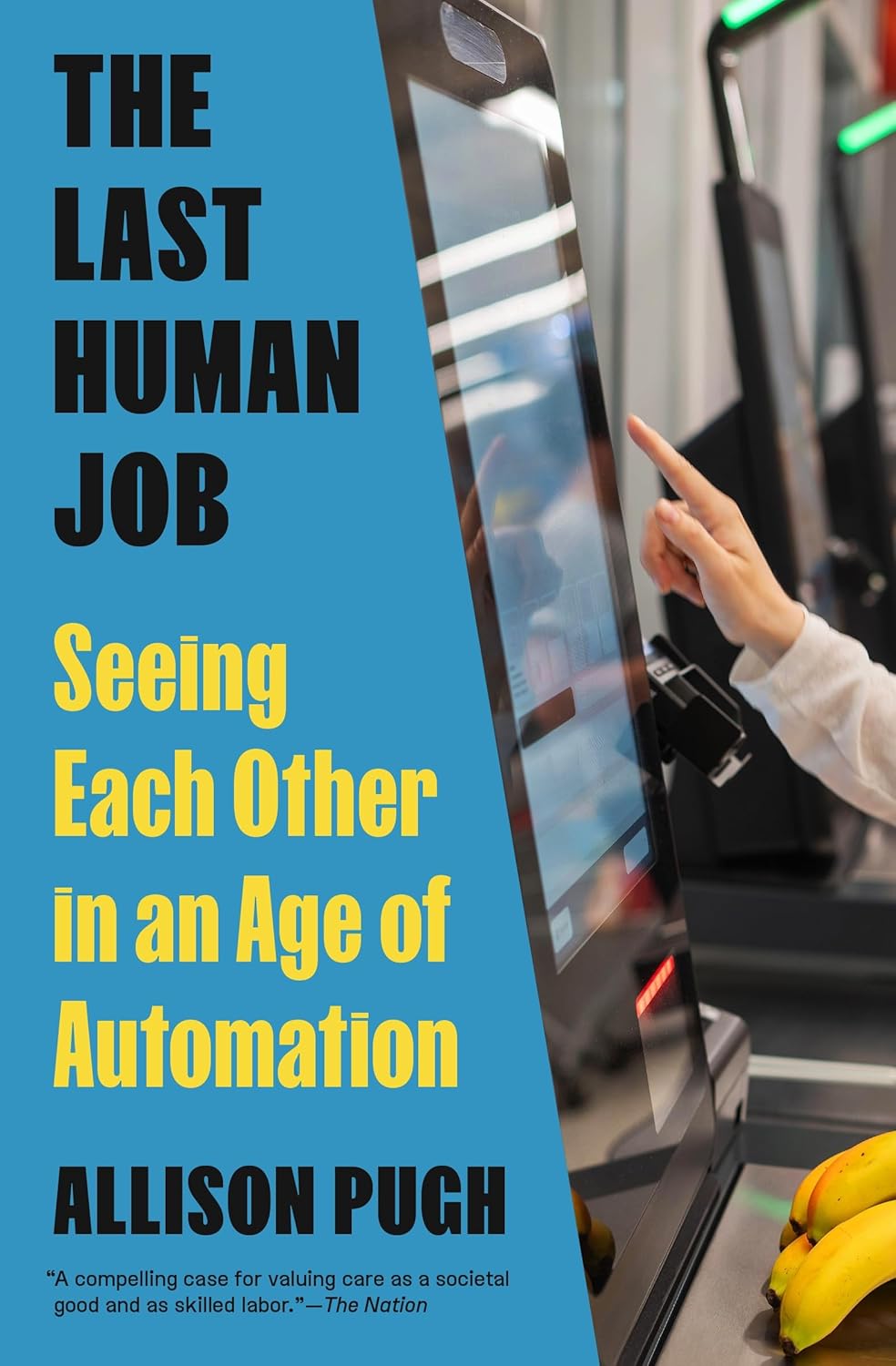
I was struck while reading this book on the plane as a flight attendant passed through the cabin with his trolley, asking, ‘Any waste, rubbish or trash?’ Three words to say the same thing, I thought, but a clear attempt to do exactly what this book was describing: connect with people who experience and express things in different ways.
The Last Human Job is premised on the concept of connective labour as an essential element of human relationship through work. ‘The crux of this labour,’ Pugh tells us, ‘involves “seeing” the other and reflecting that understanding back. … Yet it is work that is essentially invisible, only partially understood, and not usually recognised, reimbursed, or rewarded, despite its ubiquity and importance’ (page 2). It is also, Pugh argues, only doable by a human being.
Pugh endeavours to prove this by sharing the studies and interviews she has undertaken with people working across a range of professions whose success relies on connective labour. She shares the stories of chaplains, nurses, teaches, therapists, cashiers and sales staff, and argues that human beings and connective labour must be protected in an age where automation and artificial intelligence are trying to create shortcuts or replace them.
The book is in itself an attempt at connective labour as Pugh seeks to break down complex psychological and sociological concepts and terminology for the reader. Whether or not she achieves this depends also on the reader and their ability to understand the scientific analysis within the book, which is unavoidable and also gives this research its credibility. I would argue that for the non-scientific reader, of which, as a musicologist and ethicist, I am one, Pugh’s message resonates most when supported by the voices of her interviewees, which are quoted directly and conversationally: ‘I was just like, something was kind of off, like, it didn’t feel the same’ (page 117).
I would argue that this, too, lends the book credibility and is what makes it accessible to an audience which reaches well beyond the academic readership such research might traditionally attract. The anecdotal style might seem jarring at first, compared to the formal analytical prose which precedes these examples, but Pugh weaves these voices in throughout the book often making it feel more like a narrative with characters who the reader gradually gets to know over the course of its nine chapters. The result is that reading The Last Human Job does not feel like someone is explaining something to or at you, but rather that you are there in the room with them, learning and growing in understanding of each other as human beings, and equipping the reader with the skills to improve one’s own connective labour practices in work and daily life.
A lot of Pugh’s theory seems obvious: be a good listener, use your body language to make others comfortable, speak with authenticity. However, the reality described by those who do this work is much more complex: motivate a depressed stage four cancer patient to take their medication, inspire a truant pupil who is living in poverty and abusive parental relationships to come to school. There are challenges which humans face which a machine or automated sequence are simply unable to fix.
Pugh proposes that we are in a moment of ‘cultural reckoning of what it means to be human’ (page 60), and argues that as a result of increased automation and loneliness, we are ‘in the midst of a depersonalisation crisis’ (page 282). Discussion of artificial intelligence figures surprisingly little in the book, and Pugh does not reject or negate its positive uses and attributes. However, her focus on human relations and connection, and her thorough exploration of various and sometimes surprising professions and the connective labour they involve provide the critique in itself. For example, a lot of time is devoted to the work of chaplains in hospitals.
My ten years of working in social justice policy, research and programmes in the Catholic Church have given me, I will admit, a not entirely unfounded but certainly prejudiced expectation that religion or spirituality is somehow frowned upon by the more ‘logical’ fields. In addition to this, we are living in a cultural context in the UK where religious literacy seems to be increasingly non-evident. I therefore found it pleasantly surprising that a scientific book would consider such a profession as worth exploring at all.
‘The power of connective labour,’ Pugh concludes, ‘is in its capacity to knit together communities of disparate souls – in other words, to create belonging’ (page 280). Human beings crave recognition, not in terms of fame, but feeling understood and that they belong: ‘Through connective labour, we enact respect for the other; across our differences, witnessing conveys that someone is a fellow human being who deserves to be known’ (page 282). If this all seems a little too sugar-coated, we are brought back to reality a few pages later when Pugh gives us the stark choice: ‘the real question we face in an AI future is whether, as humans, we choose to be pets or livestock’ (page 282).
Pugh admits that the future she is proposing, one in which authentic human relationships rule supreme, seems ‘almost utopian’ (page 288); however, she also states, and I too was convinced, that the stories and cases she has recounted over these 365 pages prove that it is possible. In the same way that the readership of feminist literature is mostly women who often already know and agree with what they are reading, The Last Human Job is surely more likely to attract an audience which is already seeking to build the future for which Pugh is advocating.
Much like feminist literature, I hope that The Last Human Job will also fall into the hands of those who may not necessarily immediately agree with its argument. I would suggest that the people in the powerful position of shaping the future through AI and automation could do with receiving a copy as a matter of greater urgency.
The Last Human Job is more than a piece of sociological research, it is a masterpiece in the art of connective labour, at times technically challenging, other times deeply moving. Pugh tells us early on that ‘in German, the world Herzensbildung means “training one’s heart to see the humanity of another”’ (page 24). The Last Human Job is calling us to rise to this challenge.
Some airline companies now provide their flight attendants with a badge on which is printed their name and the flags of the countries whose languages they speak, evidently to help those passengers for whom the standard English announcements may not be easily understood. So, as I sat on the plane reading with this book with my empty plastic cup ready to throw into the rubbish cart, I looked up and saw a Spanish flag on the flight attendant’s badge. ‘Gracias,’ I said, and smiled to myself.

Last week we gathered people in policy, business, and public life together in Westminster to think about the current fiscal situation in the UK and specifically the relationship between taxation and enterprise.
We will be holding further events in the autumn. Please subscribe for details.
Tom Clougherty kicked us off by speaking about the rising level of tax needed to fund existing debt and continually increasing spending. For the purposes of this presentation he said he would take the required tax take as a given and focus instead on how it was raised. He pointed out that some taxes are much more efficient than others, because they raise revenue without impacting economic behaviour like investment in the future or decisions to take employment opportunities. He noted that the UK is ranked 32 out of 38 OECD members for tax competitiveness. He emphasised that the poor use of efficient taxes like VAT (where exceptions abound) and an almost uniquely poorly-designed property tax system mean than revenue comes from taxes that cause more economic damage.
Tom argued that while many experts disagree about the level and composition of government spending, they agree about improvements to the tax system and about the general design principles. Despite this, the practical politics is not clear cut and there are difficult questions about to how to get from the status quo to a better system.
Philip Krinks spoke about the broader determinants of a nation’s tax policy. He argued that there were at least six factors. The first was political vision and shared values, including the nation’s understanding of ‘fairness’ and of private property. The second factor was constitutional and legal, particularly which levels of government had tax-raising powers. The third was the chosen political economy, centring since the late 19th century in the UK on choices about state size, welfare provision and public ownership. The fourth was incentives for particular developments, such as the current focus on growth, where Philip agreed with Tom that the tax economics of growth enhancement are widely agreed, including predictability, low marginal rates, broad bases, neutrality, and favouring consumption taxes over levies on work, savings, and investment. A fifth issue, important to confront, was power dynamics, where certain constituencies are in a position to gain preferential treatment by forming electoral coalitions or otherwise influencing policy. The last was technical feasibility, since state capacity, while considerable in the UK, was still limited, not, for example, including a register of land values.
Philip concluded by suggesting a reset in the UK across all these dimensions: a political vision valuing work and enterprise over resentment, constitutional reforms restoring power to citizens and businesses over government bodies, a reduction in state size through welfare and pension reform, and tax reform to reward investment, innovation, and growth.
Naomi Wells spoke about the trends she was seeing in her work advising entrepreneurs impacted by UK taxes. These included those who had built up family businesses in the UK and were concerned by recent changes. In some cases, they were feeling compelled to leave the UK due to the liabilities which would be created when the business passed between generations, in addition to increasing payroll and other taxes and a worsening regulatory environment.
She also spoke about the successful entrepreneurs from overseas who had seriously considered relocating to the UK but been put off by a high and increasing tax burden. On a UK home, overseas buyers of premium property facing a 19 percent marginal stamp duty charge.
Taken together the risk is that policies discourage inbound entrepreneurs and encourage British entrepreneurs to move abroad weakening the economy and longer run fiscal situation.
The talks were followed by a lively group discussion, chaired by Joanna Moriarty, which continued over drinks.






We will be holding further events in the autumn. Please subscribe for details.

Developers of artificial intelligence and tech futurists are prone to foretelling the devastation of the labour market at the hands of AI. Predictions regarding the extent and speed of the decline in the demand for human labour vary, with some suggesting that half of white collar jobs will be lost to automation in a painful readjustment and others contending that almost all human labour will be replaced by technology in the next 20 years. Whether one views such developments as catastrophic or the beginning of an era of efficiency and abundance, there are clearly implications for public policy, such as the effects on governments’ ability to secure tax revenues.
It seems unlikely that all human labour could be replaced by machines. It is hard to imagine having a robot plumber visit to repair a leak or cut one’s hair, and indeed in the short run greater use of AI appears to be driving a spike in demand for blue collar labour, but beyond this, there are good economic arguments for questioning the idea that the human being is bound to go the way of the horse, as this interesting article by Brian Albrecht argues.
However, if we take seriously the claim that all, or almost all, or even most human labour is likely to vanish, then some proposal is needed for addressing the issue of how, with the demise of wages, human beings are to secure the means of subsistence. One suggestion is that our needs will be met by some kind of universal basic income provided by the state, funded in part by levies on the profits of AI and tech companies.
There would be very real practical considerations to deal with under such an arrangement: How would UBI be adjusted to take account of changes in the price level or inflationary pressures? If a tech firm had a ‘bad year’, what would this mean for people’s income? How could one fairly take account of differing standards of living in the distribution of universal basic income? Some would doubtless be better off than they currently are but others would most likely see a significant decline in their standard of living. Would their higher living costs be borne by the state – and would this be just?
Questions of Value, Questions of Dignity
There are important moral questions or questions of value to consider, too – questions which perhaps need to be answered before the more practical considerations can be addressed. A world without work (or largely divested of many kinds of human work at least) bears some comparison with the Roman latifundia or the vast plantations of the American south prior to the civil war, where a small number of vastly wealthy individuals owned huge estates while others existed in poverty or servitude.
It might be thought that these historical analogies could be developed to suggest that AI is not to be feared, but welcomed. Analysed over time, they are examples which illustrate the dynamism of socio-economic development: those who worked on those estates were first liberated from slavery and the work done by waged employees who enjoyed a degree of economic freedom. With the advent of technological development much of that work was automated, but the result was not massive, permanent unemployment; rather, new jobs were created in its place. However it could be argued – and indeed is being argued – that this time the latter mechanism will not apply, given the broad applicability of AI technologies across the economy.
If this prediction is accepted, then in a future scenario in which human labour has all but vanished, there remains of course a further, important difference: instead of large sections of society being enslaved by an aristocratic class, it is machines that are exploited for broader societal gain (and the much greater wealth of a few). Nevertheless, under a system in which millions depend for their basic income on a class of extremely wealthy elites whose operations are taxed by the state, we are obliged to ask questions about human dignity.
While a life of leisure funded by the functioning of AI bots might be appealing, many are likely to experience such an existence as stultifying or lacking in purpose. Some need to work, to feel that they are making their way in life, to thrive in a particular setting involving dynamism and pressure. Some require competition and the many social and individual goods that it brings, such as improved performance and personal excellence (as discussed in a recent post here by Ernie Graham). Without such a spur to action, many individuals are likely to feel their sense of purpose waning.
This might not be a consequence for all but it is related to a much wider point about human dignity and certain moral concepts that we take for granted. Where so many people are simply provided with their means of existence without the spur of economic necessity, what becomes of entrepreneurship, innovation and creativity? More widely, even for those that work in jobs they find tedious purely to earn a living, there are questions about freedom and responsibility. Where the individual works to secure her living, there is a greater degree of freedom than otherwise. Each pound or dollar secured by the individual is a mark of independence, of personal sovereignty – as that which the individual has and may by right keep as her own, removes her from the power of the state and dependence on it. The independence – whether from a feudal baron or a tech baron – won by securing property by one’s own endeavours confers liberty and with this comes responsibility. Will both be eroded in a world of greater dependence on the activity of tech companies and the largesse of government?
Being engaged in gainful activity – earning a living and making one’s way in life – brings a form of dignity. This is reflected in social thought of various kinds. According to Christian teaching, part of humanity’s purpose is to work: man is made in God’s image (Genesis 1:27) and God himself undertakes the work of creation (Genesis 1:1). Moreover, God instructs man to work (Genesis 2:15) – and Jesus himself worked (Mark 6:3). The idea that work constitutes part of the dignity of humanity is reflected in the papal encyclical Laborem Exercens, in which Pope John Paul II writes, ‘man, created in the image of God, shares by his work in the activity of the Creator’ and ‘man’s life is built up every day from work, from work it derives its specific dignity’. And if, relatedly, as he continues, ‘at the same time work contains the unceasing measure of human toil and suffering’, that still leaves work as part of the definition of the human conditon. In Laudato Si’ Pope Francis states, ‘Work is a necessity, part of the meaning of life on this earth, a path to growth, human development and personal fulfilment.’ Beyond Christian thought, the perspective of virtue ethics also lends itself to the idea that work is ennobling. Where virtues are taken to be excellences internal to specific types of activity, as in the thought of Alasdair MacIntyre, it is clear that work is a site of human fulfilment and flourishing. Socialist thinking also recognises the dignity of work. Indeed, part of Marx’s critique of capitalism was that in its dehumanising and exploitation of the worker, it alienates him from what renders work meaningful and strips work of its dignity.
Perhaps lives of near universal leisure funded via the taxation of the activities of AI companies will be abundant, meaningful and purposeful. After all, there is more to life than work and the world abounds with enriching activities, meaningful relationships and worthwhile experiences. Where work vanishes, however, that which provides a spur to much that is best in us is also at risk. Where the meeting of our needs by our own efforts goes into decline, there are important questions about our independence, our liberty, our sense of desert and self-worth, and above all our dignity. When receiving our basic income, will we still refer to ourselves as ‘getting paid’?
Image: Designed by vectorpocket: www.magnific.com
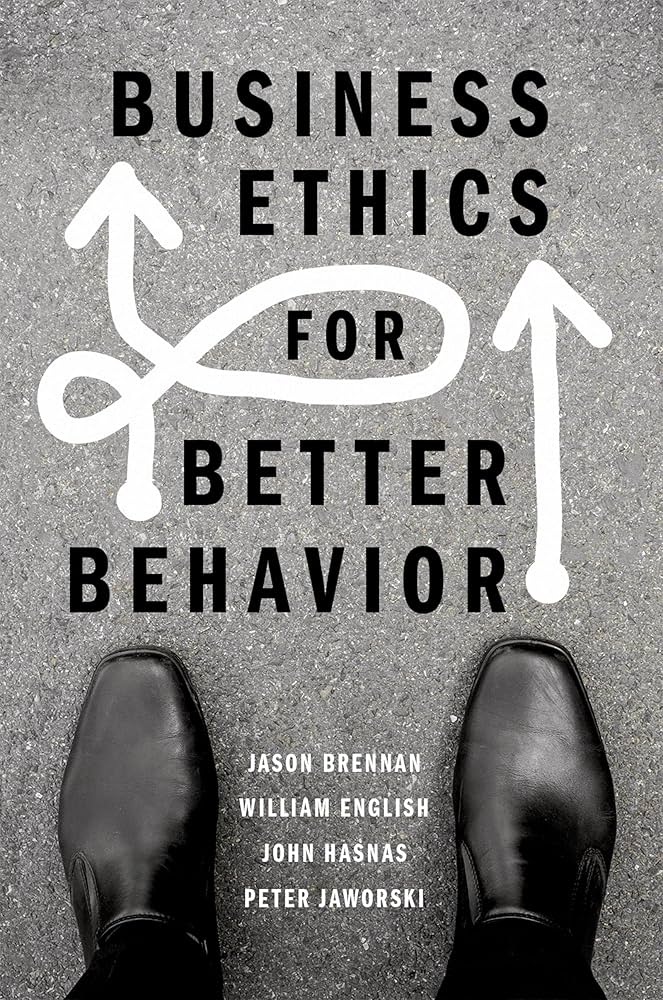
This is what an ethics textbook looks like when you actually care about helping people to be more ethical. It is profoundly refreshing in its appreciative treatment of business and of market institutions, whilst humbling the reader in demonstrating the vast scope for moral failure that is possible even within a fairly good institutional structure. The book avoids getting bogged down in the core philosophical questions of normative ethics, and rather concerns itself chiefly with how we can avoid non-controversial moral failures: cheating, lying, stealing, and shirking responsibility, and telling ourselves we did nothing wrong.
The authors are a group of moral and political philosophers and legal scholars working at the Georgetown University’s McDonagh School of Business. There, they have innovated in the teaching of business ethics and compiled a textbook informed by their overlapping vision of the field and their experience in the classroom. The book not only offers a refreshing new way of thinking about ethics in the world of business but philosophically justifies it in a way that is itself pedagogically valuable. This is a strong textbook around which to build an ethics course, or even program, in a vocational educational setting like a business school. But more than that, it is a manual for the morally conscientious. The book address itself to people who want to be good, to help others to be good, and work in or manage organisations that avoid bringing out the worst of human nature. Chapter 1, Why Do Good People Do Bad Things?, and Chapter 2, Why Are We Not All Saints?, synthesise the moral philosophy, moral psychology, and social psychology, on selfishness, moral confusion, cognitive biases, incentives, moral blind spots, and weakness of the will, to break down any preconception the reader might have that acting immorally is just what other people do, because they are simply bad people. There are universal features of our psychology and the institutional world in which we find ourselves that set even well-intentioned people up for moral failure in predictable aways. The purpose of the book is to prepare students for the stumbling blocks they will face as entrepreneurs, managers, employees, and citizens, so that these may be anticipated.
The authors argue that business ethics should not be an afterthought or a cherry-on-top of entrepreneurship, as if the only question of ethics that arises in the course of economic cooperation is what one should spend one’s profits on. Business ethics is often reduced to the mere study of ‘Corporate Social Responsibility’ (CSR). Morality is not limited to transient fashions of corporate governance and political ideologies. Ethics – like legal compliance – should be built into one’s business plans from the very foundation. What kind of person do I want to be? How do I want to achieve that? How will I treat my customers, partners, employees, and bystanders, in the process? How does my product or organisation make the world a better place? How will I know if I have succeeded or not? These are all questions one should ask before one engages in entrepreneurship, not after. (pages 13-16)
The CSR-based model of business ethics also sells business short. It implicitly assumes that businesses do nothing good for society until they decide to implement some scheme in which they donate profits to charitable causes, or what have you. But for a firm to even have profits for which this question arises presupposes that they already have in fact served society quite substantially: in providing something of value that other members of society deem worthy to part with their cash for. We often assume that because a business is profitable, the only motive its managers and owners have is producing income for themselves. This assumption is a case of extrinsic motivation bias, in which we imagine other people (but not ourselves) to be more extrinsically motivated than they are. The converse of this is the assumption that firms who practice CSR do so only for intrinsic reasons, and not because it often improves their bottom line (pages 203-207). However, even if this were true, the typical result of self-seeking economic behaviour in a well-governed marketplace is the provision of value for others. The more profit a firm makes tends to be indicative of the amount of value they have provided to their customers. Service to others, accounted for through profit and loss in a competitive marketplace, tends to be a more accountable mode of social beneficence than CSR (pages16-22).
The authors clearly echo the idea, most famously ascribed to Adam Smith, that economic agency in market conditions tends to economise on virtue and align our incentives with the good of others. In equally Smithian spirit, however, the authors clearly believe that this is far from the final word on the question of ethical conduct in business.
The book can be divided into three sections. The first (chapters 4-6) deal with moral confusions that might lead us into immoral conduct: chiefly moral relativism and the conflation of ethics with mere legality. The authors cut through these distinctions to show when, how, and why cultural variation is relevant from a moral perspective (for example, different rules and conventions that societies have for concluding contracts or of showing hospitality) and when it isn’t (for instance, when a society deprives foreign workers of their passports in order to de facto enslave them). The philosophical analysis and argumentation in these parts is accessible but robust. These chapters could and should supplement courses taught in philosophy departments.
The second section (chapters 7-10) deals with the question of incentives. Do normal people merely respond rationally to material incentives? In Smithian fashion, the authors argue that whilst we are significantly self-regarding, we not only desire material wellbeing but social esteem in society. We need to be able to think of ourselves as good people so that we can present ourselves as such to others (partially for its own sake, partially to secure their cooperation, which in turn benefits us materially). This presents an internal limit to our otherwise ‘rational utility maximization.’ We will often opportunistically cheat the rules of morality when it benefits us, but only to the extent that we can tell ourselves a plausible story that rationalises or minimises it. Limiting the scope for such rationalisations is therefore a crucial criterion for setting good rules – out in society and within the firm. This section gives a working account of game theory and how a concern for our own reputation is beneficial to us in strategic circumstances. The authors argue that if one were a psychopath who lacked any empathy for other people, it would be materially rational for one to wish this away since, actually having empathy for other people and being intrinsically motivated to be honest and trustworthy is a better way of doing well in life than merely pretending to for strategic reasons. The authors give a helpful and empirically informed overview of the varieties of collective action problems that can arise in societies and within organisations, both public and private. They demonstrate the different ways in which incentives can be aligned, and accountability baked in, so as to decrease bad behaviour, and show which ones are fitting for which scenarios, and how to identify them. They also detail attempts businesses have made to align incentives that have ended in disaster.
The third section (chapters 11-12) deals with our psychological limits. The authors reflect on the research on the depletion of will-power that finds the strength it takes to do the right thing in the face of temptation is a lot like physical strength. Taking this seriously means two things: that using will-power has opportunity cost and that will-power can be trained. We should avoid situations in which we will have to ‘spend’ our will-power if we know that we need to conserve it for something more important later. (If you are going to have a difficult meeting dealing with professional conflict, it would be good if you had not had to spend the whole day resisting the bowl of M&Ms sitting on the reception desk.) Taking steps to ensure avoidance of unnecessary exposure to temptation enables greater moral heroism in the face of the unavoidable challenges we have to address. However, it also means that repeated, manageable exposures can give one a greater capacity to do the right thing in the face of temptation. The authors also reflect on empirical research on ‘moral blind spots’. Just as we use decision-making heuristics to reduce the ‘transaction costs’ of executive functioning, and these heuristics often break down in predictable ways (e. g., in the face of novel circumstances), our moral heuristics can also break down such that we fail to notice what the moral stakes of a decision were – they are in our moral blind spot. This can occur due to the framing of a decision (for example, Is this a technical problem or a legal problem? Is this a competitive game or an economic transaction?), or of one’s role within the circumstances (for instance, Am I a friend or a manager? Am I a salesperson or a citizen?). Sometimes these frames and roles can direct our attention away from where the moral stakes really are, even if they work well as a rule of thumb the rest of the time. The authors, reflecting on the official Jesuit ethos of their own university, suggest that practices of self-accounting can help us to anticipate these mistakes by reflecting on cases in the past in which we have committed them.
I have used this book for teaching business ethics but it is essential reading for anyone who wants to become a better person and is willing to confront themselves with difficult questions. It is particularly crucial for leaders of organisations, both public and private.
The UK faces compounding fiscal pressures: a swelling adult social care budget, rising debt-servicing costs, and a persistent temptation to raise revenue in ways that erode the very economic activity on which public spending ultimately depends. How should the tax system be reformed to encourage enterprise rather than discourage it?
On 21 May, CEME welcomed Tom Clougherty — a leading authority on UK tax reform, formerly Executive Director of the Institute of Economic Affairs and Head of Tax at the Centre for Policy Studies — to Westminster to set out the case. Naomi Wells, Partner in the Tax practice at Azets, and CEME’s Director Philip Krinks responded.
Location: One Great George Street, Westminster, SW1P 3AA.
Time: The event begins at 6:45pm with the talks from 7:00pm, followed by a drinks reception.
Please RSVP to let us know whether you are able to join us by emailing office@theceme.org


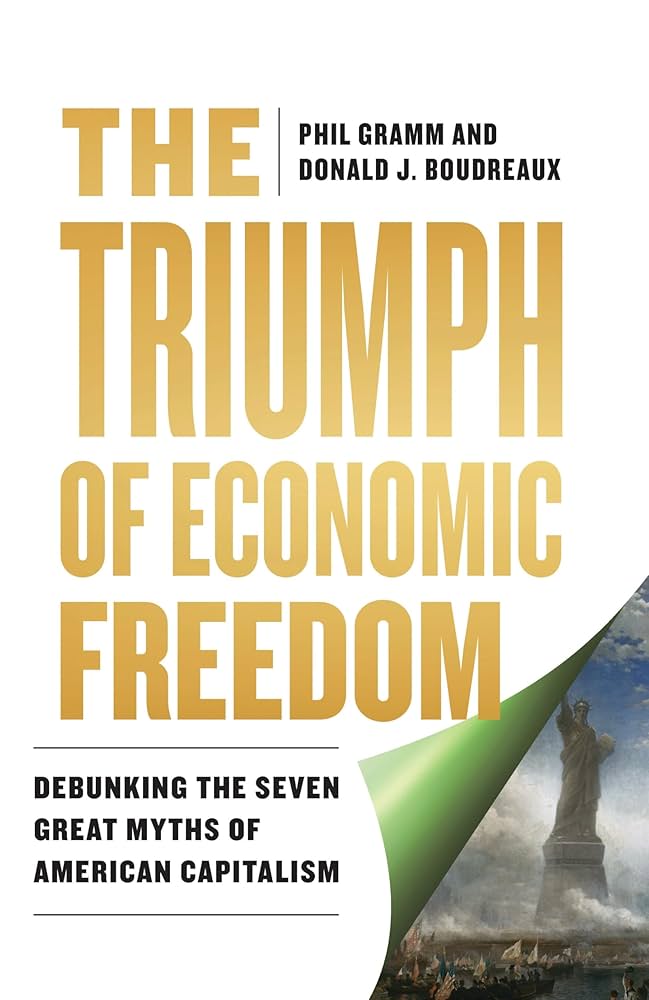
This fascinating book is well worth a read by anyone interested in economic history or contemporary policy debates. In it, Gramm (a former senator well-known as the moving force behind a number of important policies) and Boudreaux (an economist) take us through seven of what they call ‘myths’ about capitalism. These are five historical myths: that the industrial revolution impoverished workers; that in the decades after the American industrial revolution there was a strong tendency towards monopoly, only eventually limited and disciplined by regulation; that the Great Depression was a failure of Capitalism; that trade hollowed out American manufacturing; that deregulation caused the Global Financial Crisis; plus two myths about modern American inequality and poverty.
For each myth, the authors start off by setting out the case for the myth, drawing on certain key supporting statistics, academic commentary in favour and broader literature (frequently finding highly evocative quotes painting grim pictures embodying or expressing the myth). The authors state that their intention is to give each myth as fair and complete an airing as they can. And in most cases they have a decent shot at this, allowing the reader to understand what the myth is, why people believe it, and why it seems emotionally as well as intellectually attractive. I wasn’t wholly convinced they had summarised all the most important reasons to support the idea of the early industrial period’s tendency towards monopoly or the Great Depression’s natural resulting from Capitalism. But that is largely a matter of taste, for in all cases (including these) their painting of the case was vivid and should be seen as fair if not always complete.
With the myth and its basis painted, they move on to consider the facts in more detail, explaining why the idea in question is a myth. To a high degree, their case would have been made simply by the splendid additional facts they set out. But they go on to explain in detail why the facts that appear to the support the myth are as they are and to explain (frequently very interestingly and compellingly) the political context or motivations for the literature and commentary references that support the myth as well. At the end of each section, the myths lie in intellectual tatters, so savaged by Gramm and Boudreaux’s polite but forceful prose that one almost feels sorry for the battered victim.
Our courteous pitbulls begin with the industrial revolution and the notion that workers initially lost out because of it. Here perhaps the most decisive arguments offered were simply that purveyors of the myth had totally failed to understand the lot of the rural poor prior to industrialization, imagining that they lived a pleasant and comfortable life of high leisure in bounteous rural idylls. By contrast, Gramm and Boudreaux tell us a much more convincing tale of disease and accidents, early mortality, poor infrastructure, few if any available and accessible services, hunger or bland and monotonous diet, and living together in multi-family long-houses where a dozen slept together on a lice-ridden straw mattress and sexual relations were watched by skin-sores-ridden bedmates and rodents alike. In one fascinating section, the authors take us through nineteenth century interviews and autobiographical statements of the urban poor mocking and dismissing the ignorance and naivete of rich people expressing outrage at the lot of low-income urban living, whose only knowledge of the countryside came from their own or their rich friends’ stately homes.
Another interesting section in this opening myth concerned the motivation and timing of some of the key literature and commentary on bad conditions in factories. In the run-up to the abolition of the Corn Laws in 1846, opponents of free trade sought to paint manufacturers, who wanted tariffs taken off imported raw materials, as wicked bosses who harmed their workers by contrast with the pleasant lot workers had in the agricultural communities that food tariffs supposedly protected.
The chapter on the early industrial tendency towards monopoly told us of Standard Oil, as one would expect, but its longest section was about the Chicago meat-packers. Some of the most interesting material here was about how the key objections to alleged monopoly in this era were not, as one might suppose, that it resulted in prices that were too high – the authors offer extensive statistical evidence against that idea – but it appears that was not even claimed as a key concern at the time. Rather, opponents of monopoly worried that the power of large ‘trusts’ enabled them to secure prices that were too low, from their own suppliers (particularly of transport services) – and then pass these on to consumers.
This is also where we first encounter a recurring bipartisan theme – perhaps not unrelated to the fact that Gramm himself was first elected as a Democrat and then switched to the Republican Party. Time after time, through the economic history they set out, we see Republicans first to pursue foolish anti-market policies and rhetoric, followed by Democrats who push the anti-market agenda even further, before other Democrats finally see the light and set things in motion back along a pro-market line, in due course followed by the Republicans. As regards anti-trust rules, we are told that it is under President Carter that the key reversals of ‘Progressive era’ regulation start to be reversed, and Reagan carries forward Carter’s agenda. This pattern is repeated in other sections: Hoover starts the epic spending rises and deficits of the 1930s, and Hoover forbids firms from reducing wages despite 25 percent unemployment. Roosevelt carries that agenda forwards. Clinton enacts key (beneficial) financial deregulation measures and the most successful anti-poverty programmes (based on encouraging work). Trump impedes free trade and harms the WTO’s enforcement system, with Biden carrying forward Trump’s agenda. The authors clearly want readers to get the message that being pro-market is not a naturally Republican position and being anti-market not naturally Democrat.
Much of the material relating to the Great Depression will be familiar to students of the topic – the role of Britain’s rejoining of the Gold Standard leading to excessive US monetary growth in the 1920s and the failures of the Federal Reserve to prevent contraction of the money supply from the late 1920s onwards have been well-known since at least the work of Milton Friedman. Perhaps more novel is Gramm and Boudreaux’s analysis of the 1937-38 recession, along with their discussion of Roosevelt’s quasi-fascist anti-business rhetoric and how that was seen by investors aware of the international political context at the time. They present some interesting indicative statistics on how much more short-termist investment became as financiers worried that they might need to liquidate investments rapidly if the political situation turned further against them.
The section on trade and manufacturing is robust and persuasive, covering most of the bases one could want, explaining how US manufacturing dominated in the post-war period because much of the rest of the industrialised world lay in the ruins of war, but that that could not last indefinitely as other countries recovered. The authors cover the interesting question of whether software programming (which today constitutes up to half the value added of significant manufactured products such as cars) should be classified as ‘manufacturing’ in employment statistics. There was also a good discussion of the relationship between capital account inflows, as investors put money into America and then later invested into the rest of the world, and their natural counterpart in current account outflows (via trade deficits). The one thing I though could have been covered better here was the deeply erroneous arguments of Trump that the presence of a US trade deficit with a country shows that that countries must have been placing non-tariff barriers in the way of US exports.
The two final sections, on inequality and poverty, included material familiar to readers of Gramm’s 2022 book (along with Ekelund and Early) on The Myth of American Inequality (which I have reviewed here previously). These sections once again appeal extensively to the very strange situation created by US statistical authorities not deeming two thirds of the transfer payments made to lower-income American households as income (because they take non-cash forms such as food stamps) and how, once one corrects for this anomaly, the US actually has one of the highest proportions of GDP in the world transferred between income groups, very low poverty and very typical inequality by developed economy standards.
The one ‘myth’ topic about which I might claim to know more than the authors was the Global Financial Crisis. Here I found their discussion interesting and familiar, but incomplete in important ways that, though it did not threaten their key conclusion that the crisis was not a result of deregulation, it did mean their own alternative narrative was much less supported than they claimed. I found their discussion of financial diversification instruments (such as CDOs) a little too shallow, not really exploring whether these diversified away or added to systematic risk. I didn’t think they considered enough the role of an innovation boom-bust cycle in financial markets as a contributor to either the Great Depression or Global Financial Crisis. I also regretted their failure to discuss the way government bailouts of major banks since the mid-1980s had created implicit expectations of future bailouts, and how that encouraged banks to expand their balance sheets in multiple developed countries. I don’t dispute their criticisms of Clinton-era housing policies or of the failings of Fannie Mae and Freddy Mac. But I found their suggestion that flawed US housing policies by themselves caused a financial and sovereign debt crisis spanning the globe to be incomplete at best.
This is a small cavil regarding a book I enjoyed reading, found highly informative and whose overall message I both strongly endorse and believe this to be a robust ally in promoting. I liked it, and if this is your thing then you’ll like it too.
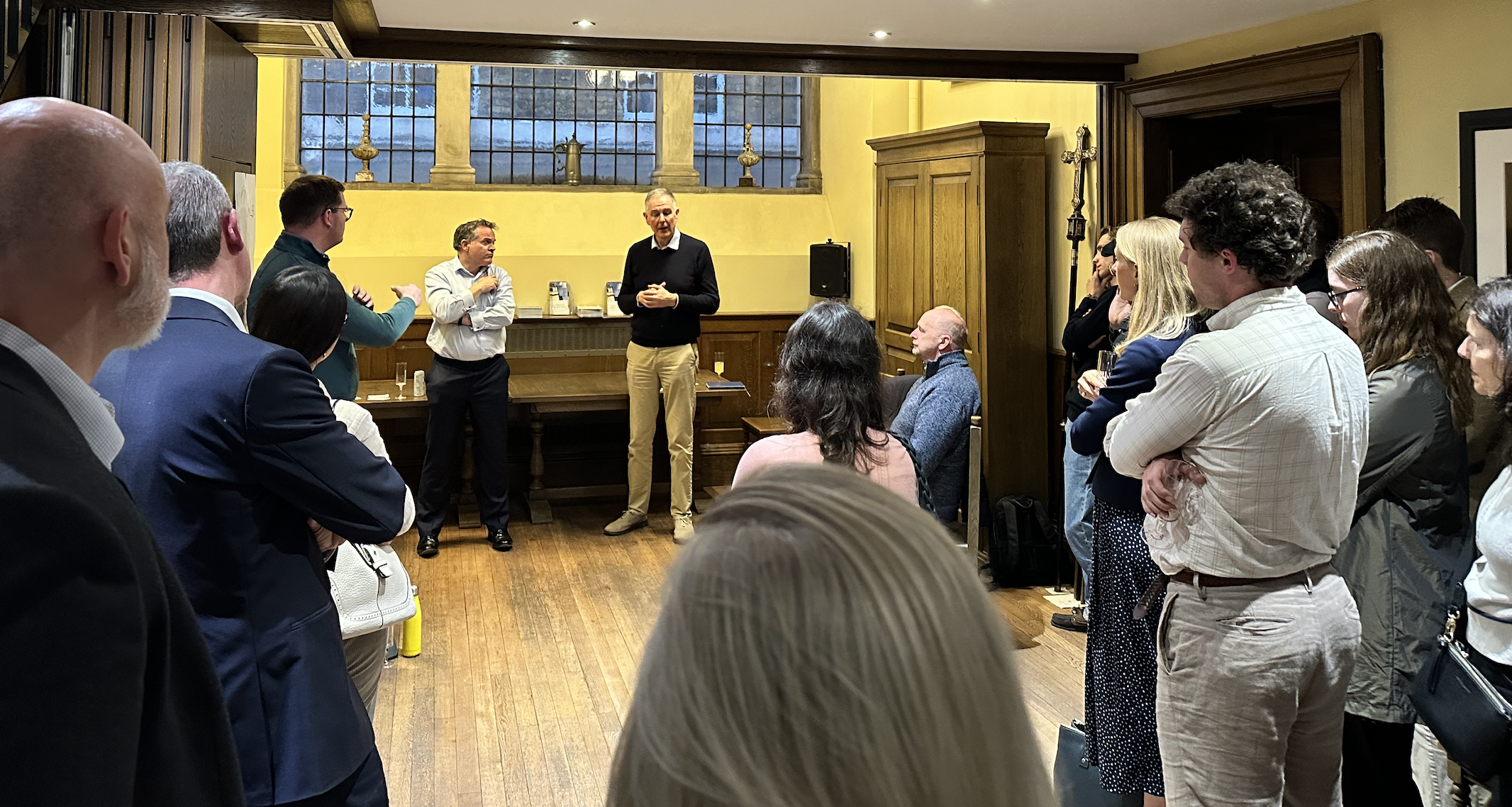
We are pleased to introduce an initiative designed to support those in the private sector and develop their thinking in matters related to faith, ethics, business and economics. We aim to provide a dedicated space to examine the moral underpinnings of business and how contemporary issues may affect practitioners. Most of our engagements will be through regular evening gatherings which will feature insights from one or two guest speakers followed by a drinks reception. We hope to offer participants the opportunity for both intellectual growth as well as fostering relationships with like minded peers.
The first of these took place on 6th May on the theme of “Ethics and Faith in a Competitive Market Economy” in the Vestry of St Mary-le-Bow Church in the City of London.
Our Director Philip Krinks spoke on the general topic first and was then followed by Ernie Graham who spoke on the topic of his previous blog post ‘Competition – Not only Ethically Positive, but Necessary’
To receive notice of forthcoming events join our mailing list.
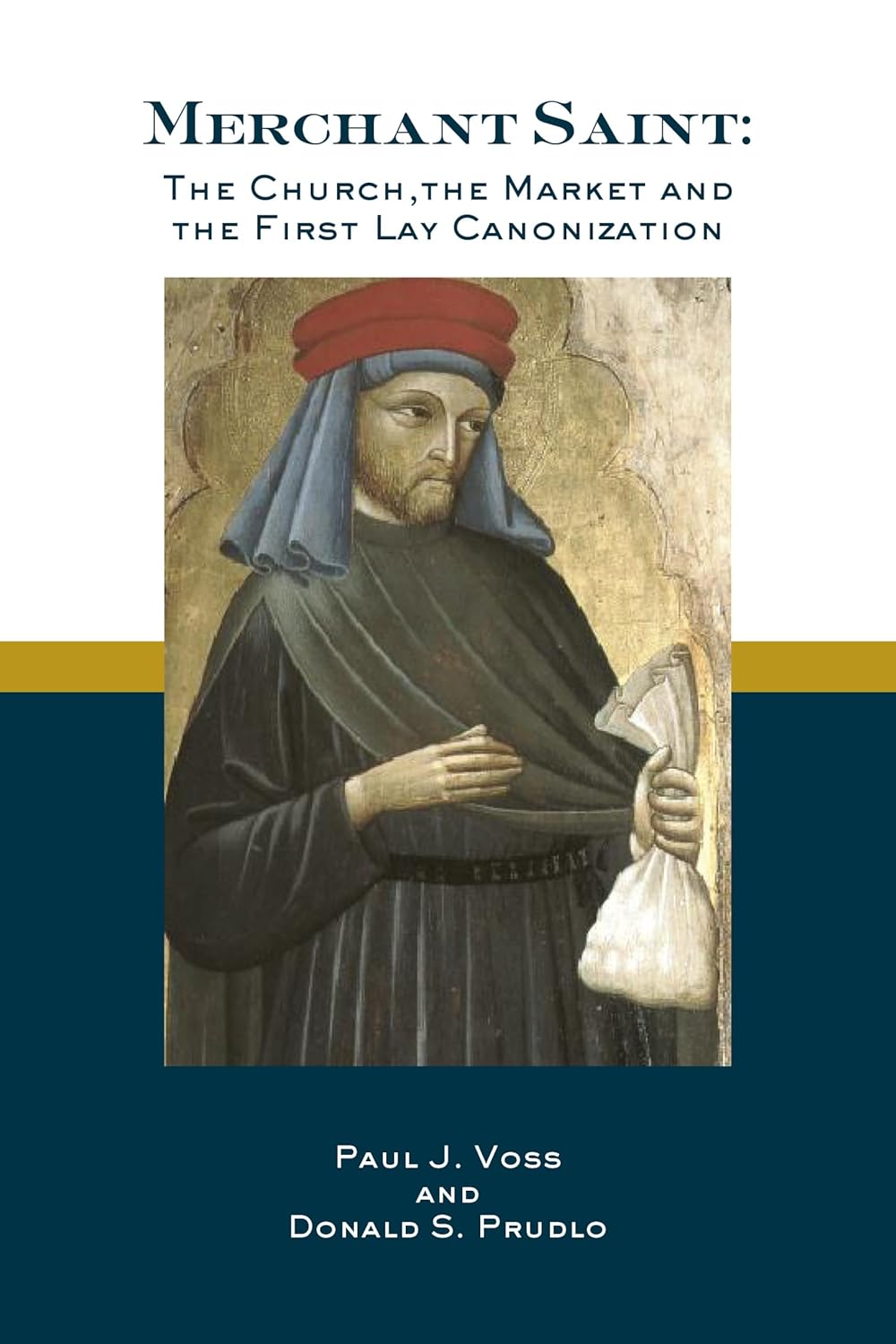
There are few figures who more directly challenge modern assumptions about the moral ambiguity of commerce than St. Omobono of Cremona. A merchant, husband, and citizen of a rising medieval city, he was also the first layman formally canonised by the Church. Paul Voss and Donald Prudlo’s Merchant Saint brings this largely forgotten figure back into view, and in doing so offers a striking meditation on whether economic life can itself be a genuine sphere of Christian virtue.
At first glance, the very idea of a ‘merchant saint’ appears paradoxical. The Christian tradition – especially in its early centuries – was often deeply suspicious of wealth, trade, and accumulation. The authors begin by carefully reconstructing this tension. Scriptural warnings against riches, patristic critiques of avarice, and the moral dangers of commerce form a powerful background against which Omobono’s life must be understood (pages 15–32). Wealth was not neutral; it was spiritually perilous. Yet, as the authors show, the tradition also developed a more nuanced account: riches could be redeemed through right use, particularly through almsgiving, which was increasingly understood in almost transactional terms – as a way of ‘storing treasure in heaven’ (pages 33–40).
It is precisely at this point of tension that Omobono emerges. Far from renouncing economic life, he inhabits it fully. A cloth merchant and artisan in the bustling commune of Cremona, he is neither monk nor ascetic outsider, but a man embedded in contracts, trade, and civic responsibility (pages 63–70). His sanctity does not consist in withdrawal from the market, but in a transformation of intention and practice within it. Prudlo and Voss are careful to stress that Omobono’s conversion did not abolish his economic activity; rather, it reoriented it. Property became the means of charity, profit the occasion for generosity, and work itself a field of moral discipline.
This is where the book makes its most significant contribution for contemporary readers. Omobono’s life suggests that commerce need not be morally neutral at best or corrupting at worst. Instead, it can become a site of virtue – provided it is governed by justice, honesty, and a recognition of the common good. The authors’ analysis of the early hagiographical sources is especially illuminating here. The evolution of Omobono’s vitae shows a gradual but decisive shift: from a model of piety centred on prayer and almsgiving to one that explicitly affirms the integrity of lay, economic life (pp. 120–135). The merchant is no longer merely tolerated; he is held up as exemplary.
The broader historical context reinforces this point. The twelfth and thirteenth centuries witnessed the rapid expansion of urban life, trade networks, and commercial practices. The Church could not simply condemn these developments without alienating the very fabric of emerging European society. Prudlo and Voss argue convincingly that figures like Omobono represent a kind of ‘medieval synthesis’ in which economic activity is neither sacralised nor rejected, but integrated into a wider moral and theological vision (pages 180–195). The market, as they memorably put it, begins to find its place on the ‘Christian map’ (pages 192).
For an audience concerned with the ethical foundations of markets, this is a crucial insight. Omobono does not anticipate modern capitalism, nor does he provide a blueprint for economic systems. But he does offer something arguably more fundamental: an account of the moral agent within economic life. The emphasis falls not on structures alone, but on character – on the virtues that shape how individuals engage in exchange, accumulation, and distribution.
The later chapters of the book extend this reflection by examining literary and cultural representations of merchants. Here the authors show that suspicion of commerce never fully disappears; the merchant often remains a morally ambiguous figure, associated with calculation, worldliness, and spiritual risk (pages 220–230). Against this backdrop, Omobono stands out all the more sharply. He embodies a counter-image: not the calculating trader, but the just and generous one; not the manipulator of value, but its steward.
If the book has a limitation, it lies in the fact that it stops just short of its own most important question. The authors offer a rich historical reconstruction and a compelling theological intuition – that economic life can be integrated into sanctity – but remains largely descriptive where a more explicitly normative account would be most fruitful. They show convincingly that such a reconciliation took place; they are less explicit about how it ought to guide economic life today. The internal norms of commerce – what distinguishes just profit from unjust gain, where the limits of accumulation lie, or how practices such as pricing, risk, and exchange are to be morally evaluated – are present only in outline. The reader is thus given a powerful figure, but not a fully articulated theory. One might say that Voss and Prudlo recover the merchant saint without quite developing a theology of the market adequate to his example. For a readership concerned with the moral foundations of economic life, this feels like a missed opportunity, especially since the material for such a development is clearly at hand.
Nevertheless, this is a minor reservation. The Merchant Saint succeeds admirably in recovering a figure who deserves far greater attention. More importantly, it reframes a question that remains urgent: whether economic life is merely a technical domain governed by efficiency and utility, or whether it can be ordered toward higher goods.
Omobono’s answer is quietly radical. Commerce, he suggests, need not be opposed to sanctity. Properly understood, it may even become one of its forms.
‘Merchant Saint: The Church, the Market, and the First Lay Canonization’ by Paul Voss and Donald Prudlo was published in 2025 by St. Augustine’s Press (ISBN 978-1-587-31513-8). 315 pp.

Entrepreneurship is a calling or vocation. It is, though, quite different from management. All aspects of business, whether one is in management, employment or an investor should be conducted ethically, but the characteristics and virtues demanded of entrepreneurs are quite specific – and rarely discussed.
Entrepreneurship requires alertness to opportunities, but it also involves a leap in the dark: a leap into the genuinely unknowable. Entrepreneurship also often involves radical uncertainty where, however much analysis we do, we cannot predict the outcome – or even quantify the risks that are faced.
Jack Cohen, the founder of Tesco, started as a market stallholder and even invested his wedding present in his then-micro business. He was an entrepreneur, and his actions gave rise to huge consequences that he could not have predicted.
Entrepreneurs also have to be prepared for failure: most businesses do fail. This requires a certain strength of character and detachment from material things. As the economists Alchian and Allen note:
Fortune does not hand down information and guidance to discover improved techniques of production and distribution of better products. It’s obtained by investing in risky exploration and experimentation with one’s own wealth. Some experiments fail, perhaps most fail. The failures disappear with little publicity.
Entrepreneurs, therefore, need a certain detachment from material things if they are going to take risks. Entrepreneurs could choose to do nothing, and many could choose not to start a new venture whilst carrying on living a life of considerable material comfort. The act of entrepreneurship requires people to move away from the familiar and risk their secure life and their material comforts. Thomas Aquinas comments that people would not carry out what he describes as works of magnificence (which could include, but is certainly not limited to, establishing a business) if they had not moderated their love for money. Otherwise, they would not have undertaken the financial risk – they would just have accumulated interest on their fortune.
The first Pope to use the word ‘entrepreneur’ in a public statement was probably Pope Pius XII. He did not write a social encyclical, but he produced broadcasts and speeches which demonstrated an advanced understanding of economics, and which were often related to business practice, including entrepreneurship. For example, he said in an address to the First National Congress of Small Industry in January 1956: ‘Among the motives that justified the holding of your convention, you have given the first place to “a vindication of the indispensable functions of the private entrepreneur”.’
And, in an address to the Third International Congress on the Distribution of Food Products in June of the same year, he noted some of the attributes and virtues that entrepreneurs needed: ‘they should rid themselves of prejudices that hinder the establishment of more economical methods and be open-minded with a taste for the calculated risk.’
As well as mentioning the characteristics of entrepreneurs, as discussed above, Pope Pius XII also mentioned, in his address to the Third International Congress on the Distribution of Food Products in June 1956, some of the virtues that entrepreneurs needed:
Men must [have]…solicitude for the common good, even if individual interests must suffer a little at first, and perfect honesty: all these qualities of a good merchant have now, more than ever, a rightful claim on you, and are clearly prime factors of success.
Adam Smith made a similar point, in fact. You may be able to make some quick money if you are dishonest. But, in general, if you are to build a lasting business, you need to develop trusted relationships with employees, suppliers, financiers, and so on.
Pope John Paul II certainly had a good understanding of the distinct role of the entrepreneur. In his encyclical, Centesimus annus, he wrote about entrepreneurship and the values and virtues of the entrepreneur. He mentioned the need for co-operation; a common goal; the need to organise properly; the willingness to take risks; discipline; diligence; industriousness; prudence in ensuring that the risks are reasonable; reliability and fidelity in personal relationships; courage in taking difficult decisions.
The Vatican document ‘The Vocation of the Business Leader’ goes further and, quoting Pope Pius XI’s social encyclical, Quadragesimo Anno, it is argued that an entrepreneur’s first aim should be to produce a good product or service and only secondly consider gain: the entrepreneur should produce true goods by good means (44).
We can go still further than this. The role of the entrepreneur is to produce goods or services by good means whilst making a return for the investors – which will include the entrepreneur himself.
If the entrepreneur does not make a return, he is running a charity, not a business. It is not intrinsically problematic for a business to make a return – after all, the profits from businesses pay pensions, payouts on insurance policies, allow people to save, and so on. But a business should make a profit through moral means.
Radich (2024), in his article, ‘Toward a Thomistic Account of the Virtues of the Entrepreneur: Moral, Intellectual, and Theological Strengths for Flourishing’, Journal of Markets and Morality 27(1) has, perhaps, the most comprehensive account of the virtues of the entrepreneur. He breaks down the cardinal virtues into constituent parts. He suggests that particular aspects of prudence are important for the entrepreneur. Entrepreneurs need docility (the ability to learn from others, which helps them make fewer mistakes and make more rapid judgements); they need providentia, by which the entrepreneur can see ahead; and they need circumspection, which requires them to be attentive to their surroundings.
These are all sub virtues of the virtue of prudence, and they can easily be related to the economic analysis above which emphasised the importance of, for example, alertness and being able to envisage the future as shaped by entrepreneurial activity.
The sub virtues of the virtue of fortitude involve overcoming challenges through effort and by taking financial risks in order to do great things.
Temperance is also important. Entrepreneurs may come across challenges that might endure over long periods of time, so patience is necessary. Entrepreneurs are not rash gamblers. If they are to be successful, they must restrain their impulses.
Interestingly, Radich also cites a study by researchers at Baylor university which suggested that entrepreneurs prayed more than the average. Radich speculated that this might be because they are aware of their dependence on others and, hence, upon the divine, and also that they are aware of their inability to control the circumstances that surround them.
Indeed, Pope Francis referenced the virtue of courage in entrepreneurship in an address at an audience for the Italian Family Business Association:
In your case, you are characterized by the delicate balance between family and work, which is expressed in entrepreneurial courage and responsibility. It is good, it is constructive when courage and responsibility go together. Action that comes from the heart is bold, it does not retreat into itself, but knows how to look far ahead; and responsibility, then, is the secret of business….
Indeed, there was a ‘Jubilee for Entrepreneurs’ in the Catholic Church’s 2025 jubilee year.
The concept of entrepreneurship – or certainly, its attributes – should not be thought of as being limited to the field of business. The characteristics of entrepreneurship apply in many other human activities. For example, we could imagine doing the following in a Church, civil society or public service context:
All these require the characteristics of entrepreneurs that we have described above such as:
This link between entrepreneurship and the mission of the Church is part of a longer research project that I am pursuing with CEME over the coming months.
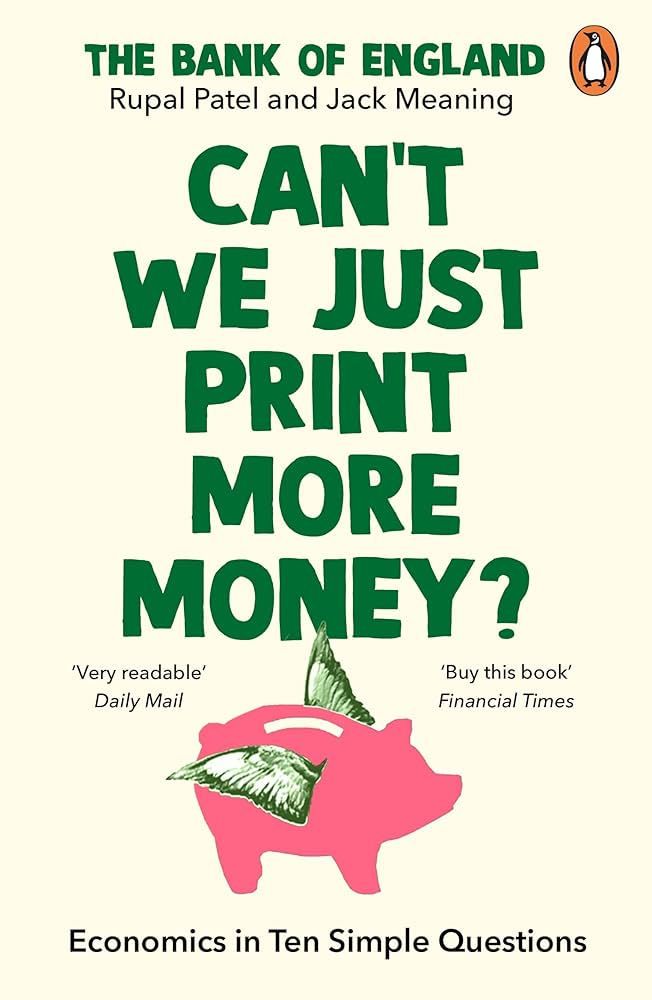
Written by economists at the Bank of England with a view to helping the public understand economics and economic matters, Can’t We Just Print More Money? represents an engaging and accessible contribution to the Bank’s purpose of contributing to the public good. As an exercise in explanation, there is no sustained argument to follow (or for a review to critique), which means that each chapter could be read in isolation – but considering how readable the prose is, there is no need to take such an approach.
Following an account of the reasons for writing the book, the introduction offers a series of illustrations to show the centrality of economics – as that which is concerned with decisions about how to use (scarce) resources – to many of our everyday experiences. The authors provide a brief history of the discipline and the tension between more ‘social scientific’ approaches and those more concerned to treat economics as a hard or mathematical science, and then explain the structure of the book: through a series of chapters, each raising one straightforward question, it will explore major issues of both micro- and macro-economics.
The first three chapters explore markets, with Chapter 1 focusing on the functioning of markets and discussing certain foundational concepts, such as ‘utility maximisation’, ‘monetary costs’, ‘opportunity costs’ and ‘marginal revenue’. In connection with these, it covers the importance of supply and demand and the factors that can influence each (such as pricing). The central point is that markets exist as the places where supply and demand (sellers and buyers) meet and prices are determined as the two are brought into equilibrium, with prices acting as signals to producers. In doing so, markets coordinate decisions made by countless individuals and bring about various outcomes that we find beneficial, without anyone managing the process or even in many cases directly intending those specific outcomes. Several useful examples illustrate these points perfectly, particularly in relation to pricing.
Subsequent chapters follow a similar pattern, the second covering the idea of market failure and the problems of externalities, imperfect knowledge and imperfect competition. These notions are brought to bear on the problem of climate change (or environmental damage more broadly) to illustrate not only the problems with markets, but also the reasons why some do not believe that market mechanisms can be employed to address the problem. Nevertheless, the authors consider the ways in which economic thinking can inform the alternatives and do discuss possible market solutions, such as carbon trading schemes. Chapter 3 turns to labour markets, framed in terms of the question of how to secure a pay rise.
From here, the book begins to shift towards macro-economic issues, considering (in Chapter 4) the question of growth by way of the question: Why am I richer than my great-great grandma? The authors discuss the concept of GDP and the ways in which it is measured, along with the factors affecting growth, its advantages and the negative outcomes of certain types of growth. Asking why so many clothes are made abroad, Chapter 5 focuses on trade, offering an explanation in terms of the specialisation brought about by the division of labour and the comparative advantage to each region or country of producing particular types of goods, components or services. The impact on trade of lower wage costs in some regions is considered, and the authors offer an interesting discussion of the controversies that arise from protectionist measures and competing interests – and the ways in which these can be (and have been addressed), reminding us that trade, and countries’ specialisms, are always shifting.
Chapter 6 addresses the issue of inflation, examining the factors that contribute to it and explaining the indices by which it is measured and the difficulties of doing so. The authors illustrate well the significance of the fact that inflation, by eroding the purchasing power of money, constitutes a major influence on our economic wellbeing. They also explain clearly why inflation constitutes a tax on savings and the reasons for which debt-laden governments are tempted to stoke inflation. This chapter also notes that moderate, controlled inflation tends to be favoured by economists as protection against the dangers of sustained deflation, and closes with a brief look at some of the major schools of thought on the causes of inflation. The discussion of a complex phenomenon that has been one of the major economic issues of recent years is very accessible. Opened (and closed) with the question of what was happening with the price of a Cadbury’s Freddo, it invites readers to look at the major causes of inflation, the reasons for which inflation is encouraged both responsibly and perhaps sometimes recklessly, who it tends to harm or benefit and its relationship with money. Missing perhaps, alongside the recognition that heavily indebted governments can be tempted to encourage inflation, is a short discussion of how the amassing of public debt can itself be inflationary.
Chapters 7 and 8 are also interesting and clear, focusing on the origin and functions of money and the role played by the banking system. With the recurring themes of the creation, storing, lending and circulation of money, these chapters cohere well and the authors emphasise the centrality of trust and confidence – though perhaps an opportunity was missed here to refer back to the discussion of inflation specifically in this regard.
The two final chapters look at economic crises. Chapter 9 addresses the question of why nobody saw the crisis of 2008 coming and considers the kinds of crisis that can occur, their causes and effects and the difficulties faced by economists in trying to foresee them. Chapter 10 raises the titular question of the book: Can’t we just print more money? It examines the measures that policy-makers can adopt to manage the economy. Some fairly difficult mechanisms connected with interest rates and their effects are handled well and there is a detailed discussion of how quantitative easing functions to affect the money supply and the reasons for which it affects rates of inflation. In addition to monetary policy, the chapter also looks at fiscal policy and the levers that governments have at their disposal in the form of taxation and spending to affect economic activity, closing with a discussion of government debt in relation to GDP and the debates surrounding the need to balance the books.
Following a summary conclusion that reiterates the importance and relevance of economics to our daily lives, a short appendix offers page references for answers to even simpler questions addressed in the course of responding to the major questions that form the basis of each chapter.
This is a lively volume that is richly illustrated with examples throughout, whether imagined for the purposes of explanation, or taken from history or current affairs. In consequence, it is easy to follow and material that could become abstruse is presented with clarity. The book’s stated aim is to enable readers to make more sense of the economic world they inhabit and in this, it is surely successful: all readers, including those with no grounding whatsoever in economics, ought to be able to understand the book without difficulty (and without becoming bored). It should therefore be read by anyone looking for an orientation in the major issues central to economics and clarity on the fundamental ideas and mechanisms that arise in public discourse on economic affairs.

Some years ago CEME published a fascinating report called God and Competition by Edward Carter. This notes that competition is often viewed with some suspicion in Christian thinking. It is typically treated as something to be restrained or carefully managed. While there is some truth in that, it does not go far enough. Competition is not merely permissible; when rightly ordered it is positively good and, in many areas of life, necessary for human flourishing.
At a basic level, competition reflects the reality that human abilities are not uniform. Across every sphere of life – intellectual, physical, creative, relational – people display different levels and types of ability. This is not simply the result of a fallen world but appears to be part of the intentional ordering of creation. Scripture itself assumes this pattern. In the Parable of the Talents, resources are given ‘each according to his ability’. Unequal gifts, therefore, are not a problem to be removed, but a reality to be recognised and worked with.
And here it is important to go a step deeper. If we are thinking in a properly Christian way, shaped by the doctrine of the Trinity, we should not confuse equality with uniformity. The Father, Son, and Spirit are fully equal in being, yet distinct in person. Equality does not mean sameness. In fact, the beauty of the Trinity lies precisely in unity without flattening difference.
That has profound implications for how we think about human life. The instinct to eliminate competition often comes from a deeper assumption – that fairness requires sameness, and that differences in ability are somehow problematic. But that instinct reflects a misunderstanding. A desire for uniformity may make sense in a worldview where persons are interchangeable, but it does not sit comfortably within a Trinitarian vision of reality. If difference is not only permitted but intrinsic to ultimate reality, then it should not surprise us that human life is marked by variety, distinction and differing levels of ability.
If that is right, then competition plays an important role in allowing those differences to be expressed and recognised. In any complex society, there needs to be a way of discovering who is best able to solve problems, lead organisations, innovate or create. Competition provides that framework. It allows people to strive for excellence and, in doing so, makes it clearer where real strengths lie.
This connects directly to stewardship. If individuals are entrusted with particular abilities, then they are called to develop and use them well. But stewardship is not just a private matter. Gifts need to be exercised in real situations, often alongside others pursuing similar goals. Competition creates the conditions in which those abilities are properly tested and sharpened. It pushes people beyond what they might otherwise settle for and helps prevent complacency.
You can see this very clearly in practice. In business, competition tends to lead to better products, better service and more innovation, because organisations are constantly being tested against one another. In the arts, whether music, writing or visual work, the presence of others producing high-quality work raises both ambition and output. And in sport, of course, without competition, performance simply would not reach the same level. In each case, the presence of others striving for the same goal raises the standard for everyone involved.
By contrast, attempts to minimise or remove competition often have unintended consequences. A system that tries to flatten differences or avoid comparison altogether can end up suppressing excellence rather than promoting fairness. When there is little incentive to strive, or when outstanding performance is neither recognised nor required, standards tend to drift downward. Exceptional ability can be discouraged, not deliberately, but because there is no clear place for it to be expressed.
Yet excellence, properly understood, is not just a private good; it benefits the wider community. When individuals or organisations perform at a high level, the effects extend well beyond themselves. In medicine, breakthroughs improve lives. In business, better services benefit customers. In the arts, exceptional creativity expands what others think is possible. And in sport, elite performance raises the standard for everyone coming through behind. Competition, by encouraging people to reach the limits of their ability, plays a key role in that process.
This also helps to reframe a common concern. The real moral danger here is not competition itself, but envy. Competition can expose unhealthy attitudes, but those attitudes are not caused by competition; they come from within. Envy resents the success of others and wants to diminish it. Healthy competition, by contrast, recognises and even delights in excellence. It allows one person’s success to become something that others can learn from and aspire to.
In that sense, competition can foster a culture of aspiration rather than rivalry in the negative sense. The success of others becomes something to build on rather than something to resist. Properly understood, competition does not undermine community; it can strengthen it, as each person’s contribution helps raise the level at which everyone operates.
Of course, competition does need to be rightly ordered. Like any powerful dynamic, it can be distorted. When detached from integrity, it can lead to dishonesty, exploitation, or an unhealthy focus on status. But these are not arguments against competition itself. They are arguments for ensuring that it operates within clear ethical boundaries – marked by fairness, honesty, and respect for others.
When those boundaries are in place, competition also plays a formative role in shaping character. It tests how people respond to success and failure, to pressure and comparison. It provides opportunities to grow in perseverance, humility, integrity and respect for others. In that sense, it contributes not just to what people achieve, but to who they become.
Competition, then, is not something to be apologised for or merely contained. When rightly understood and properly ordered, it reflects a deeper truth about reality itself: that difference is not a threat to equality, but part of its expression. And so, far from being a problem to solve, competition is one of the primary means by which human beings are stretched to use their gifts fully and through which both individual excellence and shared flourishing are brought into view.