
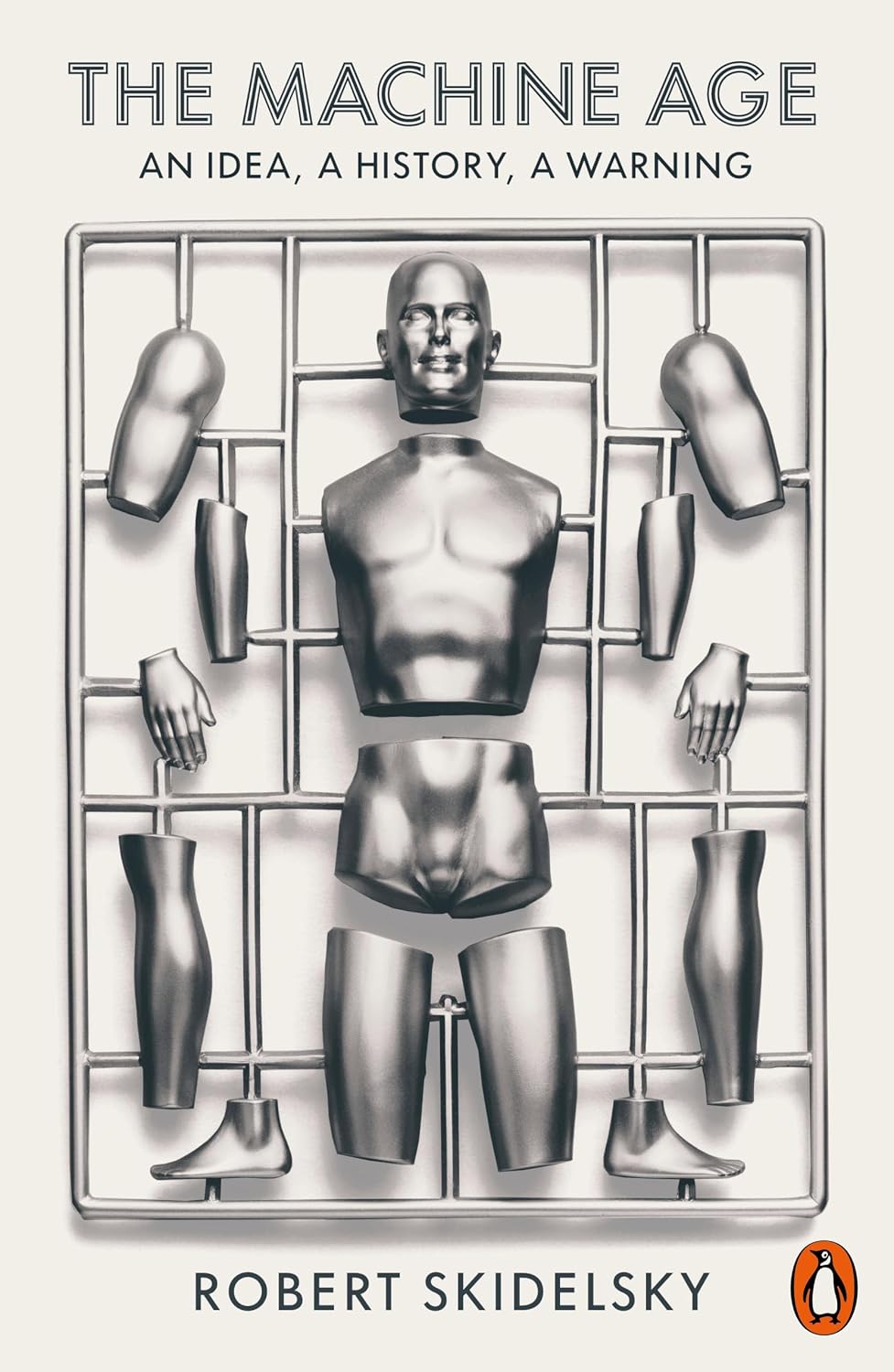
Robert Skidelsky, Baron Skidelsky, was Emeritus Professor of Political Economy at the University of Warwick. He is most well-known for his award-winning three-volume biography of John Maynard Keynes. The Machine Age: An Idea, a History, a Warning marks a departure from Skidelsky’s home domain of Keynesian macroeconomic thought into a comprehensive, interdisciplinary interrogation of humanity’s relationship with technology. The book is an ambitious, almost encyclopaedic project that touches upon everything from history and economics, to theology, philosophy and technological futurism. The core thesis serves as a cautionary call against the misguided overreliance on technology and indeed, the blindsighted surrender of human will in a technologically deterministic future.
Skidelsky’s prose is clear and the book is thoroughly researched, with a comprehensive bibliography for readers wishing to explore the subject further. Specialised terminology is used sparingly, making the text accessible to a broad audience of inquisitive readers. Yet the breadth and density of the material make it a demanding read, requiring sustained and uninterrupted attention. This challenge is heightened by the book’s frequent and sometimes abrupt shifts between disciplines.
The contents are comprised of three distinct thematic parts which chart the progressive encroachment of mechanisation from the Industrial Revolution to the contemporary frontier of artificial intelligence. Skidelsky notes at the outset, the text ‘tells three stories about the impact of machines on the human condition: on the way we work, on the way we live and on our possible future’ (page 1).
Chapters 1–7 consider ‘The Mechanisation of Work’ and establish the economic and historical foundations of technological proliferation. Skidelsky examines the onset of machines, the natural obstacles to early innovation and the structural alignment between technological progress and the rise of capitalism. In analysing modern labour dynamics Skidelsky offers a rather bleak outlook that dismisses the conventional economic reassurance that ‘with suitable education and training workers will be able to take on higher-level… tasks’ (page 94), landing instead on a systemic bifurcation of employment into ‘lovely and lousy’ jobs and increasing structural pressures towards downskilling (Chapter 6).
Chapters 8–13 look at ‘The Quest for Perfection’. Here, the text shifts from economic history to an intellectual and cultural critique. Skidelsky explores the Enlightenment ambition to ‘straighten the crooked timber’ of humanity through rationality and mechanisation. He investigates the cultural anxieties surrounding the ‘Devil in the Machine’ (Chapter 10) and the philosophical evolution of technology from a utopian vision of human liberation to a dystopian framework of surveillance and control (Chapter 13). Drawing a parallel with Jeremy Bentham’s Panopticon, Skidelsky warns that ‘we enter Bentham’s prison voluntarily, oblivious to its snares. But once inside, it is increasingly difficult to escape’ (page 184).
The third and final section, ‘Towards Apocalypse’, is covered in chapters 14–17 and as the title suggests, is mostly dedicated to confronting contemporary risks. It traces the advent of modern computation and AI from the 1950s, critically interrogates some of the salvific rhetoric surrounding AI and explores the clash between digital liberation and technological entrapment. An important and interesting discussion on conscience can be found in Chapter 15 where Skidelsky points out that AI succeeds in syntax but falters at semantics and experience: ‘Take for example, the tree outside my window […] I not only see the tree but I am aware that I am seeing it, and have beliefs and feelings about the tree; they signify an intentional relationship between the subject (me) and the object (the tree). A purely material account of the world runs into problems trying to explain this relationship’ (page 220). The book concludes in a sober evaluation of potential hazards of human obsolescence, where ‘the continuing threat of technological innovation is to rob ever-larger fractions of people of their employment, livelihood, status, skills, usefulness, and identity, and finally make them redundant’ (page 269).
Although historically a champion of the Keynesian macroeconomics, Skidelsky utilises Marxian concepts of alienation (Entfremdung) and the subordination of living labour to ‘dead capital’ to explain the trajectory of automation. He conceptualises technological advancement not as an autonomous, neutral byproduct of human curiosity and ingenuity, but as an instrument weaponised by capital to extract surplus value, control the workforce and lower production costs. Readers looking for an appreciation the free innovative and entrepreneurial spirit will not find it here – for Skidelsky capitalism is fuelling technological entrapment. Crucial to this dynamic is his critique of consumer capitalism’s manufactured needs, where he notes that ‘it is insatiability, natural and deliberately created, which keeps machines in business, by ensuring that the material requisites of happiness remain permanently scarce’ (page 112).
No doubt some readers will take issue with this approach. By framing the evolution of technology almost exclusively as a vector of capitalist exploitation and class subjection, Skidelsky underemphasises the adjacent positive outcomes such as market innovations, improvements in working conditions due to technology and even state-directed geopolitical initiatives (such as military R&D during the Cold War). All of these have historically led to technological advancements that do not fit neatly into a binary class-struggle paradigm.
Compounding this challenge is the immense, near encyclopaedic scope of the book. While the polymathic breadth is intellectually stimulating, it is likely to leave some readers overwhelmed and, at times, confused. The book functions more as a history of ideas about machines rather than a history of technology itself (which is what many might expect from the cover).
However, that is not to say there isn’t much to commend – there is. The Machine Age deserves significant praise because stands as a vital and sophisticated counterweight to the uncritical ‘techno-hype’ and hubristic boosterism propagated by many Silicon Valley CEOs with utopic promises or apocalyptic threats. Skidelsky’s triumphs in his ability to de-naturalise technology as foreign and offer a defence of human distinctiveness which is profoundly articulate and compelling. He ably reminds readers that economic efficiency and technological change should remain subordinate to human well-being and democratic values.
The Machine Age provides a sweeping and erudite critique of modern technological society. While the volume’s expansive breadth brings challenges and its rather unduly negative assessment of technology may alienate some readers, its foundational thesis remains robust. The book is best viewed as large warning sign held up against humanity’s somnambulation into a techno future driven primarily by the needs of software and hardware. It is a timely and valuable contribution to developing a contemporary philosophy of technology and serves as a powerful reminder that machines must ultimately serve human purposes – not dictate them.