In some economic theories we are told to trust the market: as a reliable arbitrator between supply and demand, and as a price-setter. Yet in their daily decisions Christians are encouraged to trust God. Are these the same kind of trust? If they are two different types of trust, are they in competition with each other?
It might be tempting to think that the two kinds of trust are at least similar: that proponents of the market economy call for trust in markets in the same way Christians are called to have faith in God. For Christians, however, believing in free markets cannot quite be the same as faith in God – and not only because market models inevitably contain oversimplifications, flattening particular aspects of reality to fit general economic theory.
Rather, Christians are called, first, to shift our trust to God rather than any human being, institution or other created thing, and, secondly, to relate to one another in a moral way. These two are commandments and are absolute: trust in God and loving our neighbour cannot be conditional.
This does not mean we cannot trust markets to do certain things well. But the two sentences I started with were not talking about the same kind of trust. What we mean by trust needs further differentiation. My argument is that how we trust, and whom we trust, is both the basis for economic decision-making and a profoundly moral choice.
The Meaning of Trust in Luke’s Gospel
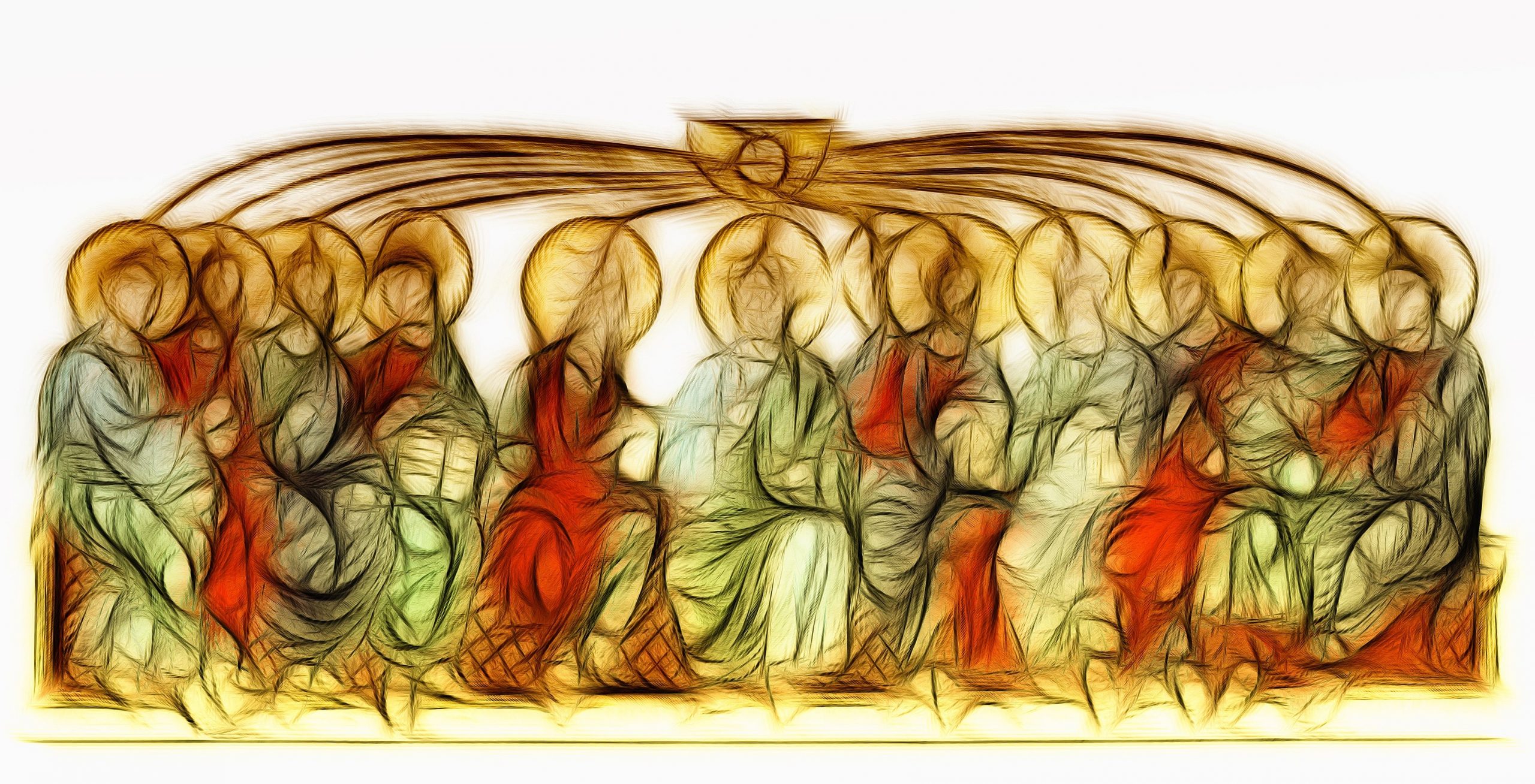
Luke the Evangelist offers radical teaching on faith and economics. Some have portrayed Luke as an early opponent of a market economy, misunderstanding his calls to all believers to hold goods in common and share resources in Acts 2 and Acts 4. Yet these are in fact best interpreted, not as a narrowly economic teaching, so much as a teaching about our relationship to God, and how it informs our economic decisions.
Luke’s focus is on the call to radically trust God, including in our economic choices. The Greek word Luke uses repeatedly, ‘pistis’, is arguably closer to ‘trust’ or ‘fidelity’, than to ‘faith’ or ‘belief’ in our contemporary understanding – although it is often translated with these terms. For example Luke’s description of the Early Church, often translated as the ‘Community of Believers’, or ‘Community of Faith’, could equally be translated literally as ‘the group of those who trusted’.
In an earlier blog post for both the LSE and the World Economic Forum, I argued that, ‘throughout Luke’s Gospel and the Acts of the Apostles, those who trust in God and his providence are able to be generous: Zacchaeus and the poor widow are examples given by Luke. That trust in God is so central to Luke’s message, that those who preferred to trust in their own investments rather than in God were chastised by the Early Church: Judas, who bought a field with the betrayal money, and Ananias and Sapphira, who kept part of the proceeds from the sale of their land.’
For Luke, trust in God, or a lack thereof, is what informs economic decisions and makes them intrinsically moral acts. There is a direct correlation, arguably a causal relationship, between the level of trust in God that the Community of Believers then, and the whole Body of Christ now, places in God, and the generosity they demonstrate.
What Luke invites us to see is more profound than simply teaching us not to put trust in idols, including any form of economic ideology. He is asking us to see that our economic actions go beyond material advantage, or rational calculations driven by our self-interest: in Acts 2, Luke describes how the newly baptised, who received the Holy Spirit, make certain economic choices as a direct result of trusting – having confidence – in a faithful God who has shown himself to be at work in this world. It is not that we know ex ante that this trust will necessarily be materially rewarded, either immediately or even long-term. Otherwise it would not be trust, but expectation with a high, if not absolute, degree of probability. The basis of Christian economic decision-making is therefore not rationality in the secular economic sense, but rather it is rational morally and spiritually, because it is doing the objectively right thing.
At the same time Luke’s teaching cannot be understood as encouraging us to be bad stewards of our money, or not to plan long term. Someone might look at the case of Ananias and Sapphira, and, assuming good intent on their part, ask what they did wrong. After all, all other things being equal, buying and keeping land whilst collecting rent from it, for example, to give it to the poor would be a perfectly rational thing to do. But in the context of the decision of that group of believers to engage in a practice of radical sharing, Luke’s point is to ask why they could not trust God sufficiently to join in with it.
This thought has the potential to create radical freedom for those who are fortunate enough to have assets to invest. They are not obliged to focus purely on financial return. Consider an entrepreneur who invests in a community project with a high risk of financial failure because it serves the vulnerable. A standard economic model might label this to be economically irrational, due to the likelihood that the return on investment will be low at best. Even if the decision to invest is construed as maximising a sense of doing the right thing, this still misses Luke’s point. For the believer, this is neither a miscalculation of risk, or nor a matter of optimising their feel-good factor: it is a deliberate act of ‘pistis’. In other words, an investor who commits to a morally worthwhile venture despite financial risk is not doing it to maximise ‘warm, fuzzy feelings’ or virtue signalling; they are investing because the act itself is a moral act, fully aware that the venture may fail.
It would not be going too far to say that Luke has no opinion to offer on whether markets are a good thing or not – only on how we ought to act within them. Ananias and Sapphira, and Judas, used a market exchange to invest and receive their proceeds, but it was not the mechanism which was at fault. It was their own lack of trust in God.
Beyond a Reductive Economics
Accounting for the role of trust in economic exchanges is a question relevant both for Christians and others. This is because markets must be understood as more than mechanical instruments to regulate supply and demand, even if that is their primary benefit. They are also social institutions, embedded in relationships, which inevitably have a moral dimension. Trust is key in enabling voluntary exchanges between participants. At a first order of analysis this is about trust between individuals, but that is related to shared values and to the belief systems in which they are grounded. For Christians, and those of other faiths, these include trust in God.
Critics might argue that if everyone acted on unconditional trust, the market would collapse, as free riders would exploit the virtuous. This is a valid concern, but it misses the point. Lukan trust is not naïve. Indeed it is explicitly viewed as a virtue that requires a community to sustain it. A market economy cannot create a community of believers, but it turns out to depend on multiple forms of trust and belief. This – and relatedly whether it is based on generosity or greed – will determine what its outcomes are.
When we conflate trust in market mechanisms with trust in human relationships, we miss the moral prerequisites that markets cannot generate themselves. As the Vatican’s 2018 economic teaching document ‘OPQ’ observes, ‘the market needs anthropological and ethical prerequisites that it is neither capable of giving for itself, nor producing on its own’ (s.23).
From Pius XI’s warning in Quadragesimo Anno that ‘the right ordering of economic life cannot be left to a free competition of forces’ (s.88), to Pope Francis’s rejection of ‘trickle-down theories’ in Evangelii Gaudium (s.54), the Catholic Church has consistently called for discernment rather than ideological adherence. Yet this is not a call to abandon markets, but to recognise their proper role. The question we are called to discern is how markets and our actions within them can serve the common good.
As Christians, we are called to recognise that we are moral agents as much as economic ones when engaging in exchanges; we bear the responsibility to ground economic activity within the realm of morality, acting through both personal choices and the creation of structures that empower good decisions without coercion. The challenge for secular economic thought is that such good choices are not easily reduced to utility-maximising functions.
Conclusion
Luke invites us to consider trust (‘pistis’) in God as a virtue with great salience for economics. Whereas some market logics may attempt to reduce trust to a calculation, the biblical tradition calls us to act on the basis of our trust in God. From that Biblical perspective the debate is not ‘pro-market versus anti-market’, but rather whether markets can be tools for human flourishing. If we determine that trust is a virtue to be pursued by moral agents in a market economy, the question then is not whether to trust markets, but rather how markets can enable virtuous behaviours. For the believer the market is not a god to be trusted, but a stage upon which the virtue of ‘pistis’ is tested and lived out.