S. L. Frank’s liberal philosophy is a hidden twentieth century gem which integrates Orthodox Christianity and spontaneous order. It offers a way to ground personalist freedom, limited government, and Christian realism against utopian tyranny and autocracy today.
Finding Frank
It was the end of a long day in London last July. My wife Kelly and I had seen Westminster Abbey and Westminster Cathedral that morning, and I spoke with the Catholic Bishops’ Conference of England and Wales that afternoon about my research and then-forthcoming book. Hendon Cemetery was only a mile or two north, though. How long could it take get there? As with anywhere in London traffic, the answer was about two hours.
As sundown approached, Kelly and I wandered lost in the graveyard. He was here somewhere, we knew that, but we hadn’t anticipated how large the cemetery would be. The London sky threatened rain, but it held off, and the happy chirps of rose-ringed parakeets kept us hopeful, even when we split up and I worried my phone battery might die before either of us found him. There among the graves, we passed many Greek Orthodox, Roman Catholics, and Muslims, all resting in peace together. My mind wandered to the great Scots novelist George MacDonald’s Lilith: ‘Of such as I could see, all were alike in the brotherhood of death, all unlike in the character and history recorded upon them.’ We’re all religiously tolerant in the end, whether we want to be or not. Then my phone buzzed. She had found him.
A tall, wooden, Russian cross, at least four feet high, with an engraved icon of the risen Christ over the top and middle, marks the final resting place of S.L. Frank. Kelly had to clear away a dense brush of vines just to read it. We must have been the first to visit in a long time. With the help of AI, we translated the epitaph. A plaque with a biblical quotation from the Wisdom of Solomon there reads, in Old Slavonic, ‘I loved wisdom and sought her from my youth … Knowing that I shall not otherwise obtain her unless the Lord gives her, I came to the Lord’ (Wisdom 8:2, 21). I couldn’t come all way to London and not pay my respects to Frank.
When people think of Russian civilization, ‘liberal’ isn’t their first descriptor. From Moscow’s tsars, to the Russian Empire, to the Soviet Union, to Vladimir Putin’s Russian Federation today – words like ‘autocratic,’ ‘totalitarian,’ ‘repressive,’ and other illiberal modifiers make more sense. Nevertheless, that is not the whole story, and the Russian Orthodox philosopher S.L. Frank puts the lie to the claim (often portrayed in positive terms by opponents of liberalism) that Russia and its dominant religious tradition, Orthodox Christianity, are fundamentally opposed to liberty.
Frank’s ‘Remarkable Life’
‘Quite apart from his philosophy,’ writes his biographer Philip Boobbyer, ‘[Frank] lived a remarkable life.’ Semyon Lyudvigovich Frank was born to a Jewish family in Moscow on January 19, 1877. His father died of leukemia when he was only five years-old. His maternal grandfather taught him Hebrew, instructed him in the Bible, and took him to synagogue. Frank’s grandfather died when he was fourteen, however, and his teen years were shaped more by his stepfather, who fostered in him a growing interest in revolutionary Marxism. This phase, however, did not last long. According to V. V. Zenkovsky, ‘In 1899 Frank was arrested and exiled from the university cities; he went abroad, working in Berlin and Munich on political economy and philosophy. His first published work (Marx’s Theory of Value) was devoted to a critique of Marxism (1900).’
Though Frank soon made philosophy his lifelong vocation, his years studying economics, as well as his longtime friendship with economist Petr Struve, another Russian liberal, made their mark on his later work. In particular, as we’ll see, Frank has a clear appreciation for spontaneous order. ‘All that is generally accepted in society,’ he writes in The Spiritual Foundations of Society,
e.g., mores, habits, fashions, even law (insofar as it is common law) and the price of goods (insofar as taxes and tariffs are neglected), exists without any special contract or agreement, appears ‘spontaneously’ in some manner and not as the consciously set goal of the general will. History shows that the state itself and state power arise and exist precisely in this manner: ‘spontaneously’ and not as the result of conscious social agreement. Only on the basis of this elementally and unconsciously formed common order and unity is it possible to have, in certain particular and limited domains and cases, the conscious agreement of individuals (e.g., rulers, national representatives, statesmen) and the conscious action of these individuals upon social life.
For Frank, however, this spontaneity represents more than historical, cultural evolution – as it does for F.A. Hayek, for example, who was working in parallel in London in the 1930s and 1940s and with whom Frank otherwise has a lot in common, although there is no evidence that he knew of Hayek’s work. ‘The forms of social relations,’ writes Frank, ‘are normalized by rules … that are not consciously instituted by anyone but are generated spontaneously and have a direct religious sanction; common law is conceived as the self-evident eternal expression … of the “obligatory” in human relations.’ In this, Frank is closer to Adam Smith, who wrote in his Theory of Moral Sentiments, ‘When by natural principles we are led to advance those ends which a refined and enlightened reason would recommend to us, we are very apt to impute to that reason, as to their efficient cause, the sentiments and actions by which we advance those ends, and to imagine that to be the wisdom of man, which in reality is the wisdom of God.’
Following a brief period of youthful atheism, Frank came back to religion like many of his friends and peers, including the philosopher Nikolai Berdaeyev and theologian (then economist) Fr. Sergei Bulgakov. After a decade of discernment, in 1912 Frank was baptized into the Orthodox Church. Together with them and other critics of the Bolsheviks, Frank was exiled from Soviet Russia in 1922, settling in Berlin. By 1937, he again fled for his life, this time from the Nazis, to Paris. After the Fall of Paris in 1940, he and his wife Tatiana sent their adult children to London while they hid out in the mountains near Grenoble. These years of exile were remarkably productive for Frank. Several of his major works date to this period, all marked by an unmovable faith in God who both transcends the turmoil of the world and yet grounds its very existence, suffering along with us in Jesus Christ. Frank was acutely aware of the reality of evil and the perils of political power. Many of his friends and relatives died in the Holocaust. In 1945, after the end of the war, the Franks reunited in London, where Semyon died of lung cancer on December 10, 1950, three-times-over a refugee – a ‘remarkable life,’ indeed.
Frank’s ‘Christian Realism’
Two Kinds of Order
Against the conceit of central planners, Hayek distinguished between two types of knowledge: (1) ‘scientific knowledge’ of ‘general rules’ and (2) ‘unorganized,’ local ‘knowledge of the particular circumstances of time and place.’ Frank makes a similar distinction: ‘We have not one but two kinds of knowledge: (1) abstract knowledge about the “object” expressed in judgments and concepts – knowledge which is always of a secondary order; and (2) immediate perception or intuition of the “object” in its metalogical wholeness and indivisibleness – primary knowledge upon which abstract knowledge is based and from which it originates.’ Both reject the scientistic claim that all that can be known, or at least all that matters to know, is empirical observation, measurement, and deduction.
But for Frank, as we’ve already seen, there is a deeper, ontological dimension to this. As he writes in another work, ‘reality in its living concreteness is wider and deeper than “the world of objective fact.” A philosophy adequate to the task of obtaining true knowledge of reality is therefore always based upon the living inner experience, in some sense akin to the experience that is called “mystical.”’ The unfathomable aspect of reality that we know through living experience is possible only through an ultimate, ontological connection between all existing things, or ‘all-unity,’ a common theme of Russian religious philosophy.
To Frank, this unknowable ‘other’ at the base of and uniting all things is the divine, which, consistent with Orthodox Christian theology, we can conceptually only gesture at through apophatic reasoning and metaphor: ‘Although no positive determinations in the usual sense are applicable to God,’ he writes, citing the ancient Christian mystic Dionysius the Areopagite, ‘they are applicable to Him in a different, metaphorical sense. It cannot be said, for instance, that God is “good” in the sense of possessing this quality as something that determines His nature, but at the same time it can and must be said that, being the source of goodness, He is “surpassing good” ….’ As such, evil constitutes the rejection of this mystical aspect of life, thus always entailing, if only subconsciously, the rejection of God. Conversely, all good, even that done by atheists, represents some expression of communion with the divine or ‘Godmanhood,’ a term Frank takes from the Russian Orthodox philosopher Vladimir Soloviev. On this generous ecumenical basis, Frank affirmed freedom of conscience and religious liberty.
For Frank, errors of knowledge come from either mistaking one of the two types of knowledge for the whole, or else from confusing one with the other, rather than seeing both as reflecting essential aspects of reality. Because this applies to all reality, it also applies to society, which rests on this same spiritual foundation. ‘On the one hand,’ writes Frank, ‘society is constructed through conscious planning; on the other hand, it is formed and grows “by itself.”’ Thus, Frank outlines an identical distinction to Hayek between spontaneous order and centrally-planned order. Hayek laments that English does not contain two different words for this, so he employs the Greek cosmos and taxis, respectively. Frank, however, is able to use the Russian terms sobornost’ and obshchestvennost’. Sobornost’ literally means ‘catholic,’ deriving from the phrase ‘one, holy, catholic, and apostolic Church’ in the Nicene Creed in Old Slavonic. It refers to the conciliar nature of authority in the Orthodox Church – as distinct from papal authority in Roman Catholicism and sola scriptura in Protestantism – but by Frank’s time had been expanded to a general social and philosophical principle.
How the Worst Get on Top
Failing to understand this twofold nature of social life generates errors of social theory, leading Frank to a Road to Serfdom-esque analysis of how the worst get on top. He writes in his political philosophy, The Light Shineth in Darkness,
All utopians transfer the function of salvation to the law, to measures of state compulsion or, at best, moral compulsion – a function that, in essence, only the free powers of God’s grace are capable of performing … Since the law in its essence is incapable of performing this task, it is necessary, in a vain attempt to perform this task, to immeasurably intensify the force of the law, to have recourse to tyrannically harsh and despotic forms of the law, normalizing all aspects of human life.
Just like Hayek, Frank notes how the impossibility of centrally planning all of social life leads to moral compromise – a Gresham’s Law of leadership. Bad leaders drive out good. He writes,
The bloody torture of living people, the crippling and repression of concrete life in the name of the attainment of absolute truth on earth, continues without end and without leading to the desired goal. But then, in the long process of this crippling of life, one more unexpected transformation occurs that is not part of the original plan of its initiators: the final goal itself, the kingdom of absolute good, begins to disappear from the consciousness, blocked by emotions that are necessary for this arduous path to its attainment. Power gradually passes into the hands of people whose character is adequate to the cruel, bloody work of the crippling of life, into the hands of villains and executioners, who naturally think of nothing but the protection – by all means of repression and falsehood – of their power. The radiant dream of salvation and the happiness of all people is transformed into the somber glorification of hate, cruelty, [and] inhumanity as normal motive forces of human life.
No doubt, Frank would agree with Acton (whose work he knew): ‘Power tends to corrupt and absolute power corrupts absolutely. Great men are almost always bad men, even when they exercise influence and not authority: still more when you superadd the tendency or the certainty of corruption by authority.’ The most noble ideal, combined with unchecked power, too often leads ‘great men’ to become ‘bad men.’
Personalism and Political Power
So if Frank rejects all such utopianism – and he lived through many tragic forms of it – what did he affirm? Boobbyer rightly refers to Frank as a ‘Christian liberal.’ ‘In practice, liberalism or Manchesterism contains a considerable amount of truth. But this truth usually receives an incorrect philosophical explanation,’ Frank explains. In particular, he takes issue with egoism, utilitarianism, and social atomism. He would not be a fan of Ayn Rand. Because Frank believes that all things are grounded and fulfilled in the ‘all-unity’ of ‘Godmanhood’ or sobornost’, he rejects atomistic individualism in favor of philosophical personalism. Or, Hayek might say, he rejects false individualism for true.
We could add to this by calling Frank a personalist liberal as well. There is a spiritual unity at the base of all human society that turns an external collection of individuals – ‘he,’ ‘she,’ and ‘they’ – into an inner unity of ‘I and thou’ or simply ‘we.’ All people come from ‘we’ as basic fact of biology, not to mention sociology. The family and religion thus represent the holiest of social spheres, but Frank insists that business and even the state can and must manifest this inner unity as well. Regarding the state, Frank insists that ‘state power is necessarily limited by the presence of civil society and the uneliminability of the latter.’ As we are not isolated individuals but rather persons embedded in various communities, the state must respect the autonomy of those communities. The state can impose rules that externally order collections of individuals, but it cannot create the inner unity necessary for healthy social life. Through civil law, solidarity and freedom – the planning of the state and the spontaneity of non-state social spheres (‘civil society,’ in Frank’s usage) – are harmonized into mutual service.
Thus, Frank insists, the law, which addresses impartial justice based upon natural law, must establish the necessary structure for free and personal mercy (or, Adam Smith would say, ‘beneficence’), by protecting rule of law, private property, religious liberty, economic freedom, freedom of speech, academic liberty, and democratic consent. At the same time, mores and common law must establish a moral culture that preserves the responsible use of freedom. For Frank, as for Edmund Burke, the extent of law will reflect the extent of a people’s moral character. Going beyond Burke from his Orthodox Christian perspective, Frank therefore insists on the importance of ascetic practices (e.g., prayer, fasting, almsgiving) for people to learn the self-restraint they need to be free and to encounter the unfathomable source of true freedom, God.
Like Reinhold Niebuhr (but independently of him), Frank accordingly refers to his own political position as ‘Christian realism.’ Acknowledging the imperfection of a world fallen into sin, from his Christian point of view, he does not expect utopian perfection, even while considering the task of saving or ‘perfecting the world,’ exercised within these constraints, to be a noble one. Understood in this context, Frank fondly quotes Vladimir Soloviev, who wrote, ‘The purpose of legal justice is not to transform the world which lies in evil into the kingdom of God, but only to prevent it from changing too soon into hell.’
Because, for Frank, a divinely-grounded freedom and unity lies at the basis of all society and, for that matter, all reality, he can only justify coercive force as a matter of the doctrine of double effect, i.e., when inaction or indifference would be a greater sin. ‘War is an evil and a sin,’ he said in a series of lectures, citing the most extreme example of state power, ‘and a monk and hermit is right when he abstains from participation in it. But he is right because he never uses the fruits of war, because he does not need the political state which is waging the war and all that the state gives to men.’ By contrast, ‘Those who are ready to use the fruits of war, those who still need a state, bear responsibility for the destiny of the state and, sinning together with the latter, they sin less than those who wash their hands of the matter and shift the sin to others.’ Thus, when coercive force is necessary to preserve the institutions of free and gracious spontaneity in social life, Frank supports it, but only as the less sinful option in an imperfect world.
Conclusion: A Road Once Travelled
Religious illiberalism is ascendent today with the surprising popularity of such books as Patrick Deneen’s Why Liberalism Failed, Adrian Vermeule’s Common Good Constitutionalism, Yoram Hazony’s The Virtue of Nationalism, and Stephen Wolfe’s The Case for Christian Nationalism – along with a Vice President and Secretary of War in the United States known to repeat their rhetoric. Yet what these authors still only hope for, Russia sadly has been doing in recent years. However, that is not the whole story. S.L. Frank, though an original thinker in his own right, nevertheless saw within his Russian Orthodox Christian tradition the foundations of a free society. Indeed, Russian history includes not only the despotism of its tsars and emperors, but also the more-than-three-centuries-long medieval republics of Pskov and Novgorod, and a century of Church-led liberalization in the Russian Empire before the tide turned following the Decemberists’ failed uprising in 1825. Even afterward, it was Metropolitan St. Filaret of Moscow who authored Emperor Alexander II’s 1861 Emancipation Manifesto, liberating the serfs.
Liberty is not just a ‘road untraveled’ in Russia and the Orthodox Church, it is a ‘road once travelled, but too briefly,’ a road on which, with S.L. Frank as a guide, others – of any nation or religion – could travel even farther today. It is high time to clear the brush away from this lost liberal’s grave and, in the words of the Orthodox memorial service, ensure that his ‘memory be eternal.’
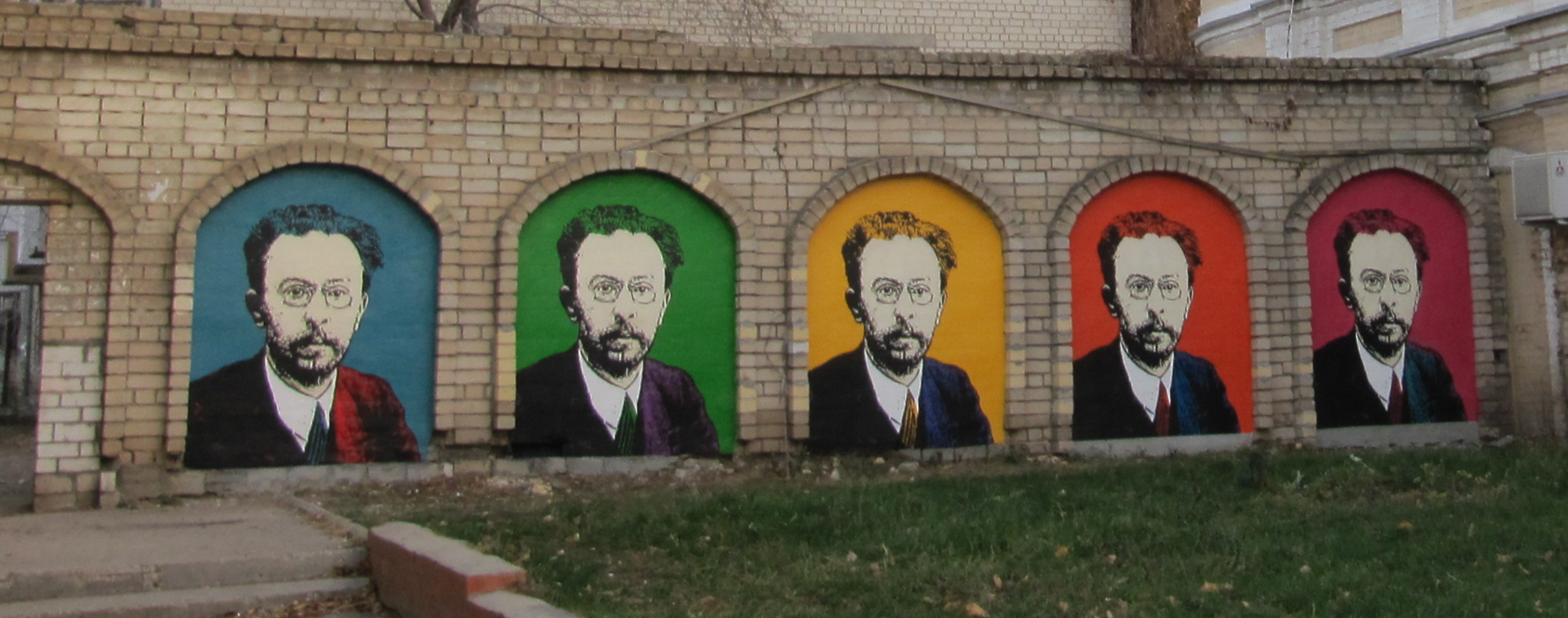
Image: S.L. Frank portraits on Radishchev Street, between buildings 16 and 18; Saratov. Sourced from Wikimedia Commons on a creative commons licence.