
Fredrik Albritton Jonsson and Carl Wennerlind set out a comparison of ideas about the use of natural resources and economic organisation. They term these as ‘Cornucopian’, being the active mastery of nature by mankind, and ‘Finitarianism’, which emphasises the limitations of humanity over nature and the importance of constraint and moderation. They trace these ideas from Aristotle to Marx and Keynes. Jonsson builds here on his work on the impact of Enlightenment ideas on the Scottish Highlands from which he developed ideas about cornucopian and pessimistic outlooks. Wennerlind’s previous work has centred on David Hume, while they have previously both contributed essays to a collection on mercantilism.
Their view is that cornucopian theories are inimical to sustainable life on the planet and that constraint on economic activities is needed if climate change is not to have an irreversible adverse impact. The way that ideas about the relationship between human needs and natural resources are summarised, with the tone set by the assurance that palaeolithic foragers ‘always had more than they needed’.
While there is much here of interest, it is unfortunately undermined by a lack of rigour when dealing with less familiar material, in places by unnecessary arrogance and is arguably overly simplistic. Jonsson and Wennerlind are historians of the Enlightenment, with a focus on political economy, and they are clearly most at home when writing about these subjects. It is unsurprising that they draw most of their examples from England but might perhaps exercise a little more caution when outside their area of expertise. They refer to the Poor Laws and Sumptuary Legislation as examples of finitarianism harnessing desire for ‘moral and spiritual ends’. They describe sumptuary legislation as being introduced ‘to regulate consumer desire’ and the poor laws as providing ‘parish welfare’. While broken windows at the Carlton Club were doubtless irritating, to cite the riots in the west end of London in 1886 as an attack on industrial capitalism alongside the Russian revolution of October 1917 is surprising. They are perhaps on their weakest ground in their understanding of how land tenure changed in England and exaggerate the nature and the impact of sixteenth century enclosures. They describe land as being transformed from the ‘existential and spiritual foundation of the community’ into ‘exclusionary and alienable pieces of property’. The active land market which has been extensively explored by medieval historians, the impact of the Black Death and the complexity of changing forms of tenure are ignored to suggest a transition from virtue to vice, which is not persuasive. While one could regard the frailty of their grasp of English history, outside their area of expertise, as not being fatal to their argument, there is a sense of material being mined at a superficial level and with a limited grasp of context.
Perhaps more serious is the tone of arrogance which characterises this work. The authors claim to have undertaken ‘historical detective work’ which has uncovered ‘this hidden history of scarcity’. This is difficult to reconcile with their having written for ‘students and other young people’. Given that they have summarised the work of More, Luther, Bacon, Locke, Swift, Hume, Adam Smith, Rousseau, Mill, Burke, Ricardo, Malthus, Marx and Keynes, one is tempted to compare this to an introductory course on political economy rather than anything obviously original. It is helpful to show how ideas have developed over time, but to claim that they have uncovered hidden material does not aid their credibility. It would have been much better to have recognised that people have debated the ways in which natural resources are exploited for an extended period and to use that debate to contribute to the current challenges. The impression is created of academics responding to the pressure to publish by placing readily available material in the context of climate change, to make it topical, and being tempted to claim more for their contribution than can be justified.
However, this should not detract from the fundamental weakness of this book. The central thesis is that unconstrained human demand, facilitated by the wickedness of capitalism, has brought the planet to the verge of disaster. There is no recognition of the extraordinary improvement in living standards since the industrial revolution. Many would accept that the unconstrained use of fossil fuels has had a serious and perhaps disastrous impact on the planet, but to characterise their use as reflecting greed and wickedness, without recognising the benefits to humanity, means that this book does little to advance the debate about the trade-offs between prosperity and sustainability. To suggest that capitalism ‘has brought about rapid and massive changes that threaten to overwhelm the earth system’, rather than recognising that, independent of the economic system, fossil fuels had the capacity to increase human productivity, is to advance a political agenda with shallow support. In a world of short life expectancy and widespread poverty, it is surely unreasonable to blame mankind for having made use of the fuels available. To conflate their use with criticism of the economic system which has arguably been most commonly found on the planet is unhelpful.
Their conclusion is, perhaps unsurprisingly, that we need to give up the idea of perpetual economic growth. They see this as the exorcising of cornucopianism from culture to be replaced by a focus on repair aiming at ‘universal flourishing within planetary constraints’. To be fair to the authors, they recognise both that ‘degrowth’, presumably in the West, to balance growth elsewhere, would require ‘immense effort and creativity’. However, they fail to engage with how this might be done.
The failure to engage with the challenge of an industrialising Asia being unsurprisingly unwilling to deny themselves the benefits of fossil fuels that facilitated the economic growth of Europe and North America undermines the value of this book. Not everyone will accept the authors’ analysis, but many will be interested in how a genuinely sustainable world might be achieved. Perhaps most surprising is their failure to include the contribution of Garrett Hardin in his well known, if contested, article from 1968 ‘The Tragedy of the Commons’. The challenge of how the sustainability of the planet is to be ensured, while individual nations seek to prosper, is arguably the key challenge for the next generation. This book is a missed opportunity to advance that debate. A little less grandstanding and a little more thought would have been welcome.
‘Scarcity: A History from the Origins of Capitalism to the Climate Crisis’ by Fredrik Albritton Jonsson and Carl Wennerlind was published in 2023 by Harvard University Press (ISBN: 978-0-67-498708-1). 304pp.
 Andrew spent his career with PricewaterhouseCoopers where he was a partner for more than 25 years. He led a variety of the firm’s businesses both in the UK and globally, with a focus on the pharmaceutical industry. He also led the firm’s work on explaining corporate taxation to civil society and the public. He is now studying for a masters in history which he combines with being a trustee at the London Handel Society.
I have read many books in my life, and reviewed quite a few. I can safely say I have never hated a book more than this one. That is probably not unrelated to the fact that I doubt I have ever read a book for which I was less the target audience. And one should bear that in mind in considering what I say about it. After all, if I were a Calvinist theologian and chose to review a movie entitled ‘A pornographic proof of atheism’, would I really be entitled to declare I found its arguments weak and its conclusions shocking? As someone with a PhD in economics, head of an economics consultancy, devising policy for many governments, perhaps it should be unsurprising that I am unimpressed by a book purporting to overthrow and replace economics as we have known it?
Yet even if I tried to place myself into the mindset of a sympathetic reader I would still have to feel this book was poor. It makes assertion after assertion about economics that is simply false, and even if the initial assertion were true, what is done with that assertion would still be wrong, raising a rickety homestead of Error on a stilt-bed of Falsehood.
This is not just an occasional problem. It is relentless throughout the book. We are told that economists regard firms as atomic units and do not seek to unpack them or look inside. Coase? Marginal costs? Theory of contracts? Economics of asymmetric information? Apparently none of these things exists. We are told that in an economics textbook the only mention of ‘power’ will be in relation to energy. Monopoly power, monopsony power, bargaining power, outside options — apparently none of these things is of any interest to economists. Perhaps most bizarrely, Raworth accuses economists of assuming and implicitly teaching that ‘a woman’s place is in the home’, a claim so frankly weird that I have no idea how to argue against it.
Her main theme is that economics teaches that maximising GDP is the sole or main goal. Well, that’s just blatantly false. Insofar as orthodox economic reasoning accepted any goal, it would be maximising ‘welfare’, and the paradigm form of utility functions includes consumption and leisure. In many advanced economies, average hours worked, for those working ‘full-time’, have fallen over many decades. Have you ever heard any economist declare this a Bad Thing? Doubtless you’ve heard economists suggest it was bad if unemployment rose or labour force participation fell, but does anyone think it’s bad if full-time hours fall, even though GDP would presumably be higher if full-time hours were longer. No. Because (inter alia) leisure is of value as well as consumption.
Now it may well have been the case that, at least for several decades from the 1930s onwards, governments sought to use economic policy to maximise GDP even if economists did not consider that their main goal. And it wasn’t merely that governments sought to grow GDP rapidly. All over the world, in major countries, they sought to grow not merely as fast as they could, but often specifically faster than the economies of their political enemies. Raworth does not ask herself the obvious question about that: why? If she had done so, she might have realised that the answer was that if you let your enemies grow faster than you for any length of time, then in an era of industrial wars you would be overtaken, militarily dominated, and then your populations would be taken as slaves by authoritarian rulers or (from the other side) exposed to the decadent immorality and depraved injustices of liberal capitalism. In Europe, if economies had failed to grow fast enough, producing mass unemployment (like the 1930s) and famine (like the 1940s), there would have been fascist coups or communist revolutions. And, oddly enough, politicians consider that kind of thing a Bad Idea.
Raworth condemns economics for seeking to produce technical methods for achieving goals independently of what those goals might be. She also condemns economists for assuming economic decision-makers are selfish. Again she’s wrong about that. Modern economics is expressed in terms of value functions where people can have whatever goals they want, and there is no assumption that those goals are solely self-interested. But as with many other issues, even if she were right about economics assuming that she’d still be wrong. She wants to say we should embed within economics goals that include reducing inequality and living sustainably on our planet. I disagree with both those. I don’t care about inequality at all and I believe humanity should seek to be a multi-planetary species within a currently economically relevant timescale, and we should be prepared to devote a non-trivial portion of the Earth’s resources to achieving that. Does the fact I don’t share her goals mean I’m not permitted to do economics and have to invent a subject of my own? Economics is, perhaps, based on the idea that we don’t all necessarily want the same things. The reason for that is: we actually don’t.
Maybe we should forgive the deep naivete and extensive errors of her discussions of the Global Financial Crisis, since her mistakes, though scarlet, are shared by so many other popular analyses of those events. But it all adds to the general sense that the reasoning is shallow and the author insufficiently informed about the subject matter to be as ambitious as she is in attempting to reinvent things she doesn’t understand.
One discussion she presented that I did find of genuine interest was where she explored the perils of seeking to price everything – e.g. if we pay children to read books, could that corrupt or replace the love of reading? Or if we charge fines for collecting children late do parents more willingly arrive late, seeing the fine as an overtime charge they’re content to pay? Her discussion of how this issue applies in Development Economics settings was quite valuable. But what made her discussion there more interesting was its more orthodox use of economic reasoning (understanding goals, collaboration and habit-formation) than her weak critiques of economics elsewhere.
This was a rare respite. Even the pictures are bad. As a project, she actually has quite a nice idea. She identifies a series of classic images she says make us inclined to think about economics a certain way and to subconsciously accept, unchallenged, assumptions about matters that are actually contentious. So she wants to replace those images with new ones. So far, so good. But what she actually does is to replace a series of elegant images that abstract away vast complexity to focus, beautifully and concisely, upon the nub of important issues with, instead, fantastically busy diagrams that create the illusion of being ‘more practical’ and ‘more realistic’ by using vast numbers of words (the ‘doughnut’ itself has 50 words on it!) and complex arrows that obscure rather than illuminating.
Economics is not in crisis and doesn’t need reinventing. It is in robust good health and producing extremely useful insights that are improving lives every day. Theoretical and applied economics grow and adapt all the time, including expanding to cover new topics such as industrial symbiosis, asteroid mining, the intellectual property implications of 3D printing, the insurance of autonomous vehicles and the pricing of publicly-available training information used by AI. Economists design auctions for carbon permits, devise progressive tax regimes that seek to address inequality, and incorporate endogenous behavioural responses into epidemiological models. Economics helps you achieve your goals whatever they are, progressive or liberal, authoritarian or communitarian, Earth-preserving or Martian-terraforming-focused.
We don’t need to reinvent economics. We just need to understand it properly and apply it correctly and with imagination. Unfortunately, reading this book will not help you to achieve any of that.
‘Doughnut Economics: Seven Ways to Think Like a 21st-Century Economist’ by Kate Raworth was published in 2018 by Penguin (ISBN: 9781847941398). 384p

Opening the newspaper or watching the news can lead one to think that the environment is doomed. A litany of isolated images (polar bears drowning or forests being cut down) are seared into many minds. People have a difficult time putting these isolated images into context and knowing whether the pervasive doomsday rhetoric is well founded. In her Not the End of the World: How to be the First Generation to Build a Sustainable Planet (2024), Hannah Ritchie deftly cuts through the informational fog surrounding much popular environmental thinking.
The overriding thesis of the book is that many misunderstand the basic pattern of environmental harms over time and that this misunderstanding leads to false trade-offs that risk both environmental and humanitarian harm. Environmental degradation is deeply troubling, but in nearly all areas the pace of harm is slowing; in some cases, things are improving dramatically.
Per capita carbon emissions have peaked (page 75); forests in Europe have rebounded since the 19th century (page 118); the air is less polluted in the developed world and even Beijing (page 38). Technical innovations and targeted solutions (often aided by well-informed policy decisions) have proven successes that shouldn’t be ignored. The author is at pains throughout to not appear as a climate change sceptic or Panglossian and roots her claims in simple empirical claims.
Subscribe to our Substack to receive blogs and reviews in your email
Ritchie was trained in the natural sciences and now works for Our World in Data, the indispensable Oxford organization that collects data on all sorts of things and gives users the ability to create their own custom charts. The data that she brings to bear on environmental questions will shock most readers.
The book is divided into eight chapters (and an introduction and conclusion) which range from the scene-setting chapter on sustainability to more focused chapters on biodiversity and plastics. There is a chapter on climate change, but this subject is also woven through most of the other chapters. The book is distinct from others on the topic by the clarity of its purpose and the breadth of information it brings to bear on the issues which are often discussed in alarming bits of isolated information. The breadth of information and nuanced argument on climate change both makes the book more interesting and makes the most important topic difficult to summarize in this review.
The clarity of purpose I mention is interesting because most of the broader argument of the book follows from the perhaps under-argued philosophical approach in the beginning of the book. The argument has to do with the focus of her first chapter: sustainability. On page 17, Ritchie writes:
In 1987, the UN defined sustainable development as ‘meeting the needs of the present without compromising the ability of future generations to meet their own needs’. That definition has two halves. The first is making sure that everyone in the world today – the present generations – can live a good and healthy life. The second half is about making sure that we live in a way that doesn’t degrade the environment for future generations.
She further adds that, ‘on a moral level, I cannot ignore the first half of the equation. A world full of avoidable human suffering does not meet our definition of sustainability’ (page 18).
It is also in the first chapter that Ritchie dismisses both depopulation (for obvious reasons) and degrowth as reasonable options. The argument for degrowth is first complicated by the fact that while growth increases environmental harms initially, the accompanying technological innovation and care about environmental harms increase beyond a certain point of wealth, lowering the impact per person (page 34).
Additionally– even ignoring dynamic effects– there is very clearly not enough to redistribute. With egalitarian redistribution the world economy would have to quintuple for every person on the planet to be as well off as the average Dane. For every person to reach the line of poverty in the developed world ($30 a day), the world economy would have to double (pages 34-35).
Most of the chapters begin with a shocking misleading headline that Ritchie contextualizes. For example, she begins the chapter on ocean plastics with a quote from the Washington Post claiming that ‘By 2050, there will be more plastic than fish in the world’s oceans, study says’ (page223). This statistic went viral in 2016 but is quickly undermined by Ritchie. The claim stems from a report from that year took two pieces of academic research and extrapolated their findings to the year 2050. Neither researcher endorsed this reading and the researcher on the number of fish in the sea even found different results when he revisited his own study. Similar stories abound for topics like deforestation and soil degradation.
In the introduction, Ritchie argues that these kind of headlines – and especially the more apocalyptic ones about climate change – manage to both undermine the credibility of scientists with the public and paralyze (or radicalize) those most concerned about the environment.
The book is organized in a way that sets the broader issues assessed in each chapter in the author’s own experiences and past mistaken beliefs. While sometimes annoying, this humanizes the issues. It is compelling to see that a motivated environmentalist trained in the natural sciences used to not just recite but believe and act according to the very notions she discredits now. It also leads readers to buy into her claims about the sorts of individual actions that can actually have a positive impact.
Seven of the eight chapters include a section detailing things to stress less about (the exception being the chapter on biodiversity that suggests that many worry too little about the topic). For instance, the chapter on plastics suggests that many worry too much about single use plastics like bags and especially plastic straws. Similarly, in the chapter on food production, she touts the benefits of plastic packaging on other serious environmental harms like the spoilage of carbon intense food. Approximately four percent of the carbon emissions of food comes from packaging (page 190). The real harm of plastics is when they enter our rivers and oceans. Of the 350 million tonnes of plastic waste generated per year, approximately one million tonnes of it enter oceans and virtually none of it is from countries like the UK (page 232). The solution to this in other countries is sealed landfills. Landfills are another thing we should worry less about. The idea that there isn’t enough space for landfills is hilarious when dealing with relevant numbers. All the plastic produced in history would fit in a landfill of normal depth covering 0.001 percent of the size of the world (page 253).
Ritchie argues that misunderstandings about environmental impacts lead people to do unintentional harm. For instance, in the chapter on food Ritchie relates the story of one her environmentalist lecturers at Edinburgh ordering lamb instead of chicken because it was raised locally (page 183). While its location means that fewer emissions were used between farm and table, the carbon impact of consuming lamb over chicken far exceeds the relatively small carbon impact of the transportation.
I was struck by the example of palm oil. While decried for being the driver of deforestation, palm oil is much less land intensive than nearly all relevant substitutes. Even focusing on tropical forests – for the reason that the land used to grow palm oil is often more biodiverse than other types of land – the most relevant substitute is coconut oil, which uses more tropical land for the same amount of oil. Ritchie estimates that the ecologically minded Ben & Jerry’s uses five to ten times the amount of land because of the switch from palm oils to coconut and soybean oils (page 130). While palm oil is viewed by the public as the least environmentally friendly oil, the boycott of it likely leads to a worse environmental impact.
More than just being rife with interesting facts, this book is an excellent and accessible introduction to the very broad topic. The author pulls together enlightening data and clear argumentation to put humane bounds on the types of environmental actions we should consider morally desirable.
‘Not the End of the World: How to be the First Generation to Build a Sustainable Planet’ by Hannah Ritchie was published in 2024 by Vintage (9781784745004). 352 pp.
 John Kroencke is a Senior Research Fellow at the Centre for Enterprise, Markets and Ethics. For more information about John please click here.
The sub-title of The World Made Otherwise is “Sustaining Humanity in a Threatened World” and climate change or other environmental issues form the book’s starting point and backdrop. Gorringe sees climate change as creating a burning platform that makes thorough-going political, economic and social change imperative.
His prognosis is dire. He opines that “civilisational collapse is likely” (page 19) and that, together, environmental issues and current socio-political trends “could suggest the ‘new dark ages’ of which MacIntyre spoke nearly 40 years ago” (page 153). He asserts that the resulting problems are primarily moral and political and that “neither technological fixes nor tweaking of the present economic system are sufficient to address them” (page 117). Instead, he thinks that the heart of the problem lies in false values.
Much of Gorringe’s discussion relating to values will be widely applauded: he rejects the post-modern relativism that reduces discussions of values to discussions of psychology or sociology, confusing values with either societal norms or preferences linked to self-realisation; he defends the idea of universal values against those who would deny their existence (including those on the left who suggest that the very idea of human rights is a form of Western cultural imperialism); he also rejects “the claim of the neoliberal market to provide the fundamental standard for everything whatsoever” (page 57) and instead seeks to establish a value system based on the ultimate end or object of human life, which he suggests is, in essence, the creative fulfilment of human potential, “a fulfilment that is both individual and social” (page 85).
His discussion of the problems within the existing political, economic and social order also contains much that will command wide acceptance, albeit not much that is new. In particular, the history of the twentieth century supports the wisdom of his call for “a critical watchfulness” with regards to our political practices and his warning that “all claims for absolute allegiance on the part of the state are idolatrous” (pages 133/134). Likewise, his warning about making an idol of the market will be accepted by all but the most extreme free marketeers and his criticisms of the workings of modern democracies (including the basis on which people cast their vote, the role of the media and lobbying) ring true.
Unfortunately, however, time and again Gorringe gravely overstates his case and, whilst some parts of the book are closely argued, much of what he asserts is not backed up by detailed analysis or engagement with different views. For example, he asserts that “equality must mean equality of outcome” (page 163) on the basis of five lines of argument and he makes no effort to comprehend the practical and moral arguments for the market economy or recognise the different conceptions of justice that underly much current socio-political debate (as to which, see Capitalism and Democracy by Thomas Spragens). Furthermore, the version of the market economy that he attacks is extreme and he fails to acknowledge that one can be in favour of a market economy yet at the same time recognise the need for guiding values outside it. Instead, he makes a number of unsupported ex cathedra assertions that, on occasions, descend into mere left-wing jibes (e.g. his side swipe at “austerity” measures, which he defines as “making sure the bankers do not have to pay for their mistakes”, page 198, and his distinction between “genuine science” and “the spurious corporate-financed variety”, page 290).
The least satisfactory part of the book is its suggestions for change: they are almost totally lacking in specificity and are absurdly Utopian. Gorringe says that he is putting forward what he calls “rights cosmopolitanism”, which he describes as “a vision of a cosmopolitan world of federated states where all people enjoy basic rights and freedoms simply in view of their humanity” (page 147). However, the vision is vague and Gorringe gives no clue as to how it might be realised. He envisages the break-up of current nation states and talks of “a world of small and devolved, but often federated states, where economic and environmental rules would be worked out together and held to be binding by the United Nations and its agencies” (page 152); he suggests that “local economies will have shorter supply chains and keep real wealth within the community” and that they “will not import products they can produce for themselves or export local products until local needs have been met”, citing apparently with approval, Molly Scott Cato’s suggestion that there might be perhaps 20 bioregions forming the basis for a reformed economy with each bioregion having “the task of provisioning its inhabitants” (pages 233/234); and he advocates monetary reform. Yet his political proposals amount to little more than a vague idea relating to the creation of local deliberative assemblies; leaving aside a few specific proposals (e.g. to mutualise utilities and provide a basic citizen’s income), his economic ideas are packed into a bewildering four page section in which he advocates the localisation of economic life; and, apart from discussing a few examples of what are, in essence, local or restricted use currencies, he gives us no clear idea of what monetary reforms he is seeking.
Gorringe defends himself against the charge of being Utopian by suggesting, first, “that nothing is so wildly Utopian as to try and build a sustainable world on the basis of greed and competition” and, secondly, that his proposals “are actually being modelled on the ground the world over” (page 236) but this defence fails. The first of these points has no bearing on the realism of his proposals and the second fails to recognise that the only examples he gives of anything remotely resembling the kind of localised system that he advocates are very small scale and, as he himself recognises, have many problems.
It is difficult to know precisely who the book is aimed at. It is not an academic work yet it is overloaded with quotations from and references to the views of different authors (e.g. the main text in the first five pages of the chapter relating to values includes references to the views of no less than 15 different authors). These come so thick and fast that parts of the book are heavy-going and they are likely to render it inaccessible to many potential readers. Furthermore, Gorringe is a liberal Christian who is heavily influenced by Marxist thinking and these starting points pervade The World Made Otherwise. Gorringe makes no attempt to justify them, with the result is that the book is unlikely to prove persuasive to those who do not share his assumptions. Thus, whilst most Christians will welcome his reminder that God ultimately owns all things (a fact which necessarily relativizes property rights), his approach to Scriptural interpretation will baffle and alarm many. For example, his suggestion that “The Eucharist (when not fetishized) adumbrates as a sign the view that the world is gifted to all creatures and is to be shared equally between them” (page 224) is, to put it mildly, difficult to extract from the biblical text, whilst his assertion that Hebrews 13:14 (“Here we have no abiding city”) “promises us that Rome (which for us is neoliberalism) will not last forever” (page 66) is extraordinary.
Gorringe has, for a long time, passionately believed in the need for radical, political, economic and social change and environmental issues have added to the imperative tone of his appeals for such change. However, passion and urgency do not of themselves make up a viable political programme. Gorringe’s theological villain is clearly St. Augustine of Hippo, who he feels is responsible for generations of Christians believing that “the possibility of a truly different society… belongs only to the next life” (page 67). On this basis, one might expect him to show us the way to an earthly paradise but, despite its title, The World Made Otherwise fails to provide one and, whatever one’s political views, Gorringe’s diagnosis and prognosis are simply depressing.
The World Made Otherwise by Timothy J. Gorringe was published in 2018 by Cascade Books (ISBN: 978-1-5326-4867-0). 348 pp

Richard Godden is a Lawyer and has been a Partner with Linklaters for over 25 years during which time he has advised on a wide range of transactions and issues in various parts of the world.
Richard’s experience includes his time as Secretary at the UK Takeover Panel and a secondment to Linklaters’ Hong Kong office. He also served as Global Head of Client Sectors, responsible for Linklaters’ industry sector groups, and was a member of the Global Executive Committee.
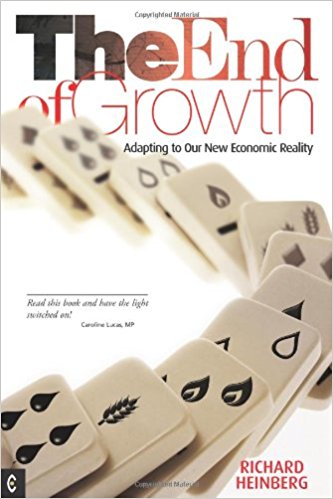
Richard Heinberg is an American journalist and author that has dedicated most of his writing career to environmental causes. His most notable works include publications such as, The Party’s Over: Oil, War, and the Fate of Industrial Societies (2003), and Powerdown: Options and Actions for a Post-Carbon World (2004).
Just from the book titles alone, an astute reader can gain a sense of Richard Heinberg’s environment angle. Indeed, there is a common thread that flows throughout his body of work and which is probably best exemplified in the book we are reviewing here: The End of Growth: Adapting to Our New Economic Reality (2011).
In a nutshell, Heinberg’s thesis is this: Global economic growth as we have become accustomed to over the past century or so is “…over and done with” (page 1). When talking about “growth”, Heinberg is referring here to the overall size and expansion of the economy, i.e. an increase in both consumption and production (ibid.).
So how come? Why will there be no more economic growth? Throughout the book Richard Heinberg builds his argument on three main assumptions. First, the depletion of natural resources (fossil fuels & minerals). Secondly, the negative environmental impact of exploiting resources (e.g. Deepwater Horizon, the BP oil spill disaster). And thirdly, the ‘financial disruptions’ caused by our defective banking and regulatory system and its inability to deal with both “resource scarcity and soaring environmental costs” (page 2). For these three main reasons, historical records of economic growth are no longer sustainable in the future.
Let’s turn slightly to the structure and content of the book. “The End of Growth” is well-written and thoroughly researched. From the onset, it becomes apparent that the author has a wealth of experience and knowledge of the subject. Indeed, Heinberg spent over two decades examining and writing about environmental issues and this clearly shows throughout the book.
The book is structured around seven main chapters. The first two open the discussion with a more generalised debate on historical economics and the influences of both Marxist and capitalist ideology in shaping the current state of global macroeconomics. Heinberg also talks about the financial crisis of 2007/8 and how the actions of the Federal Reserve (like Quantitative Easing) are akin to a “Ponzi Scheme” that could ultimately lead to rising interest costs and even currency failure (page 75).
Chapters three and four turn towards the environment and the limitations of earth’s natural resources. Economists and experts in the field have largely ignored the obvious: natural resources are finite. As they become increasingly scarce, the race and exploitation in finding them will have dire consequences on the environment. The BP Oil Spill is given as a clear example of how petroleum companies need to search in deeper and more dangerous areas to find oil. Heinberg goes through all the major natural resources and explains their limitations, including, Oil, water, food, and metals. In chapter four Heinberg remains sceptical that new technologies and innovations will be sufficient to promote growth and stop climate change. He asserts that, “Civilisations advance human knowledge and technical ability, but they also tend to generate levels of complexity they cannot support beyond a certain point. When that point is reached, civilisations decline or collapse” (page 187).
Chapters five and six move the discussion toward a more international dimension. Heinberg effectively sees China’s recent economic growth as a “bubble” (page 190). A bubble that is overwhelmingly dependent on favourable age demographics and a reliance on coal as a primary energy source. Chapter 6 talks about how ill-equipped our current geopolitical system is to both adapt and succeed in a post-growth, contracting economic climate.
Finally, chapter seven concludes with an explorative study in how society (especially civil society) can adapt and grow in a post-growth world. In short, Heinberg believes that organising and local community initiatives will have a crucial role to play. He speaks about “Transition Towns” and “Common Security Clubs” where “The work of local groups should include the sharing of practical skills such as food production and storage, home insulation, and the development and use of energy conserving technologies.” (page 270).
At the end of the day, Richard Heinberg’s “The End of Growth: Adapting to Our New Economic Reality” remains something of a paradox. On one hand, the core of his message rings true: we are consuming and in some cases, abusing resources that are by definition, finite. On the other hand, it feels like the book is too pessimistic and sceptical – it underestimates the power of new and innovative technologies and overemphasises the negative impact of consumerism. For instance, his analysis on electric cars in Chapter four (page 159) is superficial at best. Heinberg fails to consider the rapid advancement in battery technology and their ability to store power.
Readers in search of a gloomy, sceptical analysis on the future of the environment and economic growth should pick up this book. Those seeking a more balanced account should look elsewhere.
“The End of Growth: Adapting to Our New Economic Reality” was published in 2011 by Clairview Books (ISBN-10: 1905570333). 231pp.

Andrei Rogobete is a Research Fellow with the Centre for Enterprise, Markets & Ethics. For more information about Andrei please click here.