I first read this book shortly after it was published in 1994, at a time when I was starting to explore the interface between Christian ethics and economics. Re-reading it some twenty years later has been instructive, now that this field has been developed rather more and is taken seriously again by at least some of those involved in politics and public life.
The book is set out in four parts, preceded by a helpful introduction in which Tim Gorringe sets out his stall by explaining how he uses Karl Marx as a dialogue partner throughout. This gives a hint as to his own political leanings. Indeed, in his introduction he even locates Marx as standing within the tradition of prophecy (p. xi). This means that Gorringe works essentially with a structured view of society and of economics that draws on Marxist theories of power and domination, rather than something more dynamic or entrepreneurial, and this is the undergirding theme of Part One. However, the theme of ‘narrative’ and economic history is certainly also present here, as part of his general critique of a version of economics that is ‘at the mercy of abstract laws which only experts can fathom’ (p. 22).
Within Part One I enjoyed finding at least two sharp criticisms of Brian Griffiths, Chairman of CEME, and having heard Lord Griffiths’ more recent reflections my sense is that he might now yield a little ground to Gorringe when it comes to the place for Christianity within public policy (see p. 13), while holding fast against the Marxist view on equality and liberty (p. 54). In certain respects, the world that Gorringe describes has changed. I particularly noticed this in his discussion of a living wage, which has now been embraced across the political spectrum in the UK.
Part Two of the book has four chapters that address more focused subjects. The first of these, ‘Work, Leisure, and Human Fulfillment’, sets out a valuable survey of Christian thinking through history on this theme, with the conclusion that ‘true leisure is not utilitarian’ (p. 77), and that both work and leisure are about human realisation. As a stand-alone section this would make good reading for anyone wanting a critique of a self-contained neo-classical economic world-view. However, the other three chapters in Part Two resonate more strongly with Gorringe’s Marxist theme, as they tackle the subjects of alienation, solidarity, resistance, and social justice. Gorringe looks for a ‘rejection of the individualism which divides people and sets them against each other, affirmation that humanity consists in working together’ (p. 102). While this is indeed a hopeful broad vision to set forth, as I read these words I found myself wondering whether it takes seriously enough the way in which entrepreneurial energies operate within the economy.
Part Three is given the over-arching heading ‘The Common Treasury’, in which Gorringe explores the subjects of personal property, inequality, planning and ecology. His general approach is one that advocates a socialist ‘control’ of the economy, and at one point he states that ‘some kind of global planning is needed’ (p. 140). Part Four then consists of a single final chapter, entitled ‘Two Ways’, in which Gorringe mounts a strong attack on global capitalism. It was here that I was surprised but pleased to stumble across a reference to the economist Joseph Schumpeter. His work had been used as ammunition within a 1980s debate between the Roman Catholic bishops of the USA and some prominent Catholic lay people. Reading this section carefully, my impression was that Gorringe brackets Schumpeter with a more general neo-classical take on economic theory, and then summarily lambasts them both. However, I would argue that he has missed something here, and that a more careful look at the contrast between Schumpeterian economics and the neo-classical approach would have been fruitful. In fact, Schumpeter has been taken in a Marxist direction, notably by Paul Sweezy, and I wondered if Gorringe might have changed his line if he had been aware of this.
On almost the last page of the book I then found this sentence: ‘There is nothing intrinsically wrong with enterprise, initiative and ownership. What is wrong is when these are harnessed to profit, power, self-aggrandisement, and inequality.’ (p. 166) As a programmatic statement this felt promising to me, but I struggled to see how large parts of the book itself could be taken to support or develop it. Rather, for Gorringe any sense of enterprise or initiative seems essentially to be subsumed within a Marxist superstructure, and the need for human cooperation to be played out in a society marked by planning and control. In the end, therefore, I found this book to be a helpful foil against which I wanted to put forward different ideas connected to human enterprise. However, as a major contribution in the field of theological ethics and economic theory its importance cannot be doubted.
“Capital and the Kingdom: Theological Ethics and Economic Order” was published in 1994 by SPCK/Orbis Books (ISBN 10: 0-281-04773-1)

Edward Carter is Vicar of St Peter Mancroft Church in Norwich, having previously been the Canon Theologian at Chelmsford Cathedral, a parish priest in Oxfordshire, a Minor Canon at St George’s Windsor and a curate in Norwich. Prior to ordination he worked for small companies and ran his own business.
He chairs the Church Investors Group, an ecumenical body that represents over £10bn of church money, and which engages with a wide range of publicly listed companies on ethical issues. His research interests include the theology of enterprise and of competition, and his hobbies include board-games, volleyball and film-making. He is married to Sarah and they have two adult sons.
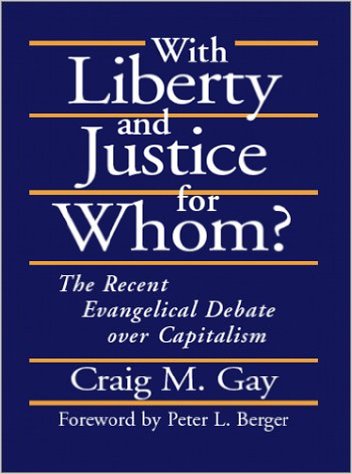
With Liberty & Justice for Whom? is an analysis of the views of conservative Protestants about capitalism. It was written a quarter of a century ago and its focus is on U.S. writers. It is thus dated in parts and, in any event, many outside the U.S.A. will feel that Gay’s analysis is not wholly applicable to their context. Some will also find tiresome its almost obsessive quoting of other scholars, which betrays its origin as a doctoral dissertation. Nonetheless, the issues raised by it are of long-term general significance and, whilst Anglo-Saxon evangelicals are likely to benefit most from reading it, it could be read with profit by other Christians, those of other faiths and, indeed, anyone who wishes to consider the reasons why people who apparently share a common religious or philosophical starting point disagree so vehemently about economic and societal issues.
Gay divides evangelical intellectuals into three groups: the left (which, he suggests, essentially regards capitalism as oppression); the right (which, he suggests, has primarily engaged in the defence of capitalism against the critics of the left); and the centre (comprising those “whose appraisals of capitalism are neither wholly negative nor entirely positive” but who regard capitalism as a “cause for concern”; page 116). He examines the views of many people within each group, considering the essentials of their economic and political views as well as the way in which they use the Bible to support these views.
The first two-thirds of the book is largely descriptive, albeit interwoven with comment and evaluation. Gay then moves on to analysis. He believes that it is “clear that capitalism as such is not the only thing at issue in this debate but that the various evangelical factions are contending for entirely different socio-cultural visions of American society” (page 161). However, he points out that the difference between the competing views “is not a matter of competing moral and ethical paradigms but of disagreement on the question of whether capitalism promotes or prevents the realisation of the norms and values they hold in common” (page 166).
Gay attempts to use the “new class” theory of the Austrian born American sociologist Peter Berger in his analysis. He argues that those on the evangelical left are reflecting their membership of this new class (broadly those engaged in what he calls the “knowledge industry”) whilst those on the right reflect the attitudes and interests of the old middle class (occupied in the production and distribution of goods and services). He suggests that both evangelical groups have engaged in a process of “cognitive bargaining” with the secular world and, in particular, in their analyses, have compromised the more transcendent, or “other worldly”, elements of evangelical faith. He also asserts that “Both the evangelical left and right have succumbed to an ideological abuse of Scripture and a de facto (and occasionally explicit) confession of the ultimacy of economic life” (page 203).
Many of Gay’s assertions and suggestions are contentious. For example, he admits that his use of the new class theory is “provocative, to say the least” (page 203). Furthermore, one may question whether his categorisation of evangelical views (which he admits is arbitrary) is helpful. Is the analysis assisted by lumping Theonomists and Christian Reconstructionists together with Brian Griffiths and Peter Hill? Do those in what Gay terms the “evangelical mainstream” (whose views are moderately right of centre) really have much in common with the views of what he terms “progressive evangelicals” (whose views fit much more comfortably with the left wing analysis)? Gay observes that the “evangelical centre” has no economic programme, which suggests that it is not a real category worth examining. It might have been better had he examined the extreme right, the moderate right and the left (which Gay recognises is a more coherent group than the others).
Gay was doubtless conscious of the danger of being accused of criticising everyone else’s views without offering a view of his own but he wisely avoids entering into the detail of the economic and theological debate. Instead, he offers suggestions as to a way forward in the debate, which are set out in a 33 page “Epilogue”. Unfortunately, this part of the book is disappointing There is little to object to in what he says but the language used, particularly in the first part of the Epilogue, is less clear than might be desired and, overall, his suggestions do not add much to the debate. Furthermore, although he seeks to avoid taking sides, those on the evangelical left are likely to feel that he is in fact laying the foundations of an essentially right of centre viewpoint without fully justifying his position.
These are significant failings but they should not put anyone off reading this book. It provides a wealth of food for thought and challenges: Why is it that evangelical economic debate so closely mirrors the corresponding secular debate, albeit with the addition of Biblical analysis? How much of the evangelical contributions to economic debate derives from the Bible, how much from secular assumptions and how much the compromise with the groups in which the relevant authors move or a reaction against these groups? To what extent are arguments caused by a disagreement as to whether criticism of the existing economic order is to be based on a comparison with an ideal or a comparison with practically available alternatives? Should the debate focus on the detail of capitalist economics or will progress only be made if the underlying assumptions and issues relating to our concept of society are addressed? Specifically, are those debating capitalism and other economic models guilty of a failure to examine whether terms like “liberty” and “justice” are being used by everyone in the same sense?
These questions are well worth considering and, by raising them in the context of a detailed analysis of the spectrum of evangelical opinion, Gay provided and, 25 years on from his book’s original publication, continues to provide an excellent foundation for further thinking.
“With Liberty and Justice for Whom?” was reprinted in 2000 by Regent College Publishing (ISBN 10 1573831328).

Richard Godden is a Lawyer and has been a Partner with Linklaters for over 25 years during which time he has advised on a wide range of transactions and issues in various parts of the world.
Richard’s experience includes his time as Secretary at the UK Takeover Panel and a secondment to Linklaters’ Hong Kong office. He also served as Global Head of Client Sectors, responsible for Linklaters’ industry sector groups, and was a member of the Global Executive Committee.