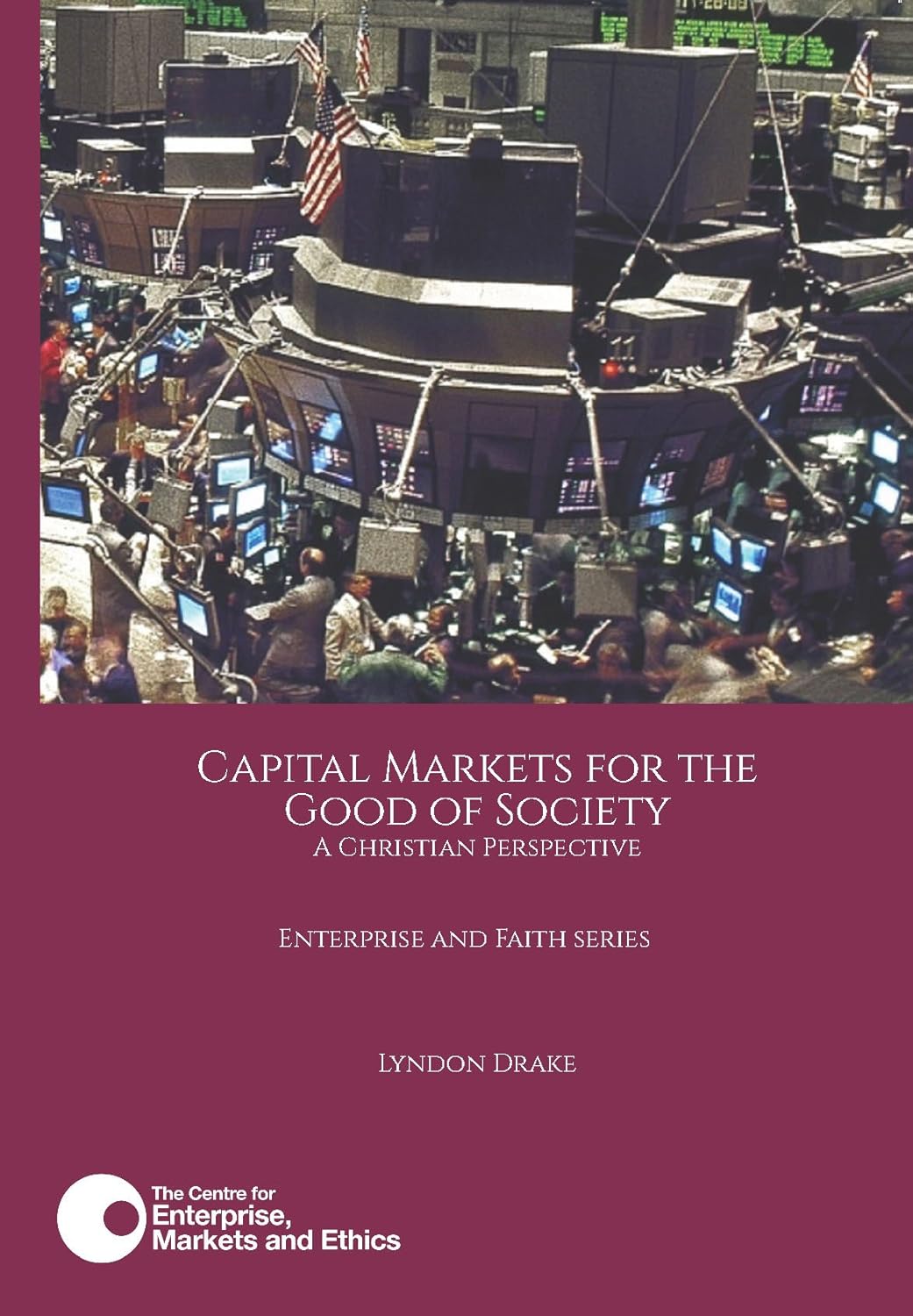
Capital Markets for the Good of Society discusses the ethical foundations and societal benefits of capital markets from a Christian perspective, emphasizing their role in promoting human flourishing and economic fairness.
It makes the case that capital markets — despite their terrible public image — provide genuine and often overlooked benefits to society, particularly to the poor. Drake argues that public discourse is dominated by highly visible failures like the 2008 financial crisis, while the gradual, dispersed benefits of capital markets go largely unnoticed.
To assess social utility, Drake develops a framework grounded in Christian theology, using ancient Israel as a paradigm. Drawing heavily on the book of Deuteronomy and early Church thinkers like Basil of Caesarea and Clement of Alexandria, he identifies key principles: that economic structures should promote human flourishing and creativity, that justice includes a redemptive dimension (not merely punishment of wrongdoing), and that no person or group has an absolute right over capital — ownership is contingent and comes with obligations.
From these theological foundations, Drake distils four practical norms for evaluating capital markets: they should provide harmless credit for the poor, support personal economic freedom, ensure visibly fair pricing, and enable broad participation in material blessings — not just aggregate GDP growth.
He then applies these norms to specific market types — bonds, equities, commodities, currencies, money markets, and derivatives — arguing that each provides measurable social utility. Government bond markets fund public infrastructure and welfare; equity markets democratise investment access; commodity markets protect weaker participants through transparent pricing; currency markets enable vast wealth transfers to developing countries through remittances; and even derivatives, despite their complexity and risks, lower borrowing costs in ways that disproportionately benefit poorer borrowers.
Drake also addresses the real problems: harmful products like NINJA mortgages, market scandals, information asymmetry, excessive compensation, and overleveraged speculation. However, he concludes that these are reasons for better regulation and cultural reform within the industry, not for dismantling capital markets themselves. The deeper challenge, he argues, is that the benefits of capital markets are gradual and invisible while their failures are dramatic and headline-grabbing — making it easy for society to undervalue what these markets actually contribute.