
At a time when much of the output of the publishing industry appears to cover ground which has already been well served, it is a real pleasure to read a book which combines originality with the analysis of an underused primary source. That pleasure is accentuated by the sense that Anne Hughes has been led by the archive and not sought to evidence an existing position.
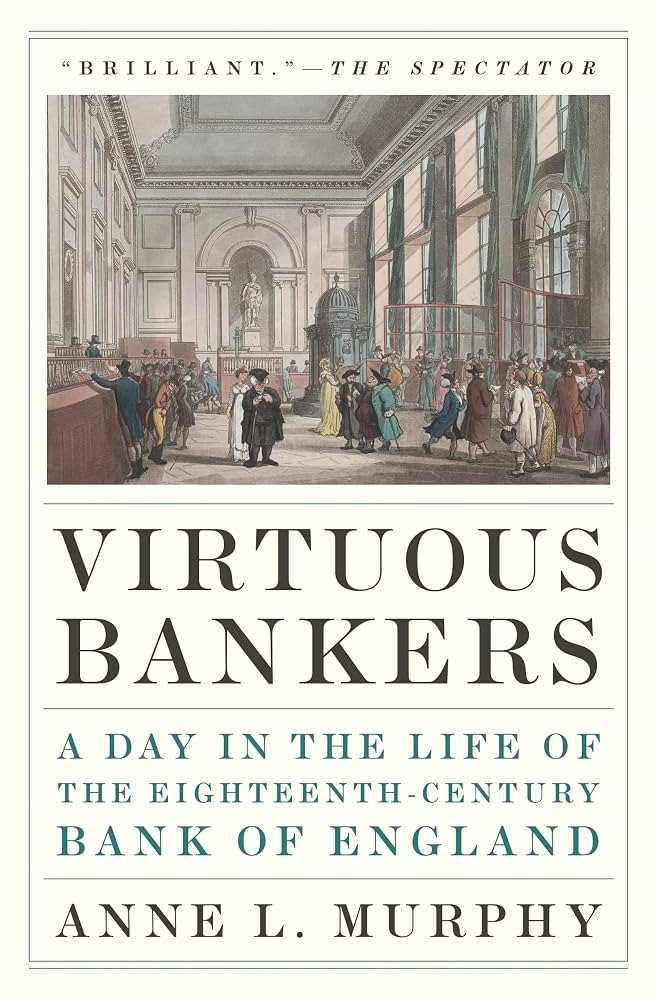
Murphy has mined the archives of the Bank of England (‘the Bank’) to produce a book which takes the reader through a typical day at the Bank in the 1780s. In doing so she not only explores the role that the Bank played in financing the expanding role of government, but also the practicalities of running an institution which lay at the heart of an increasingly complex financial system. The book makes impressive use of the records of an inquiry into the activities of the Bank which began in March 1783. This inquiry allows us to understand the daily routines of the institution in the context of the assessment of the risks which the Bank needed to manage.
Murphy explains how the Bank was successful in meeting its key objective of raising the funds needed to finance the government, which was to be a central part of national success in the Napoleonic wars. Without the Bank’s ability to lend astonishing amounts to finance the war effort, the country would have been unable to maintain the succession of ultimately successful Continental coalitions. This relied on a reputation for competence. The British people trusted the Bank and bought the securities it issued. In 1763 the total amount owed to the bank was £133 million which had grown to £844 million by 1819. At that time, the bank had 250,000 public creditors in a country with a population of 17.5 million.
The Bank was a private company, established by Royal Charter in 1694, until nationalisation in 1946. While it had some business in discounting bills, the large majority of its activity was the management of the public debt, issuing currency and making payments on behalf of government.
A strength of the book is the way it engages with a series of issues relevant to the operation of the Bank. Most prosaically was the environment of Threadneedle Street and the need for physical security. The Directors of the Bank had premises constructed, without windows on the street, with a focus on security and the need to impress the public. The site was steadily expanded as concerns were raised about fire risk in a crowded part of the City and as the daily movement of printing plates to allow the production of bank notes became unacceptable. An attempt to storm the Bank during the Gordon riots led to the nightly deployment of a company of Foot Guards which was to survive until 1973.
Physical security was one element of building and maintaining public confidence. Another key concern was the security of the Bank’s records. Fire was a constant risk leading to duplicate accounting records being maintained. The physical safety of the accounting records was important but so was their accuracy. The accounting records were maintained, at least in part, in the main banking hall and the public could observe the clerks at work. Depositors could inspect the ledgers, helping to build confidence in the robustness of the institution. The quality and accuracy of the records played a key role in investigating crime, particularly the forging of bank notes or drafts. The evidence from the inquiry suggests that the standard of record keeping was high; in a period when every transaction or calculation of interest went through the mind of a clerk, how was this achieved?
The Bank relied on the quality of the work of the approximately 300 men it employed. The evidence from the 1783 inspection is that the standard of their work was high. Recruitment included recommendation with an element of patronage, but men applying to join the Bank were subject to a series of tests. They included handwriting, accuracy, simple mathematics and double entry bookkeeping. Men joined a hierarchical organisation in which advancement, with markedly higher salaries, was possible, based on experience and ability. Long careers were normal and the Bank paid generous pensions, if not for long at a time when most employees died within five years of retirement. Richard Marston retired in 1835 after 53 years’ service on a pension of £350 which compared well to his final salary of £310.
These staff needed to be properly organised, and we are led through the various departments of the bank, each of which had a clear statement of their responsibilities. The organisation and staffing of the bank support the view that Britain enjoyed a significant number of skilled workers, in service activities as well as manufacturing, which was a key element in the economic growth of the late eighteenth and nineteenth centuries.
In its management of risk, its concern with the recruitment and training of staff, and its willingness to reward long service with generous pensions, Murphy presents a compelling picture of an impressive and well run institution. She concludes that ‘processes were generally sound and operated with a transparency that helped to engender trust in both the Bank and the state’. This work illustrates the development and management of a substantial institution with clear links to the subsequent development of successful commercial banks and financial institutions. This picture of competence, combined with a sustained focus on managing risk and the review of processes to identify opportunities for improvement, does not fit easily with the low opinion often expressed of eighteenth century institutions. Taken with recent revisionist work on the Poor Law, it serves as a useful corrective to the poor opinion of the competence and achievements of eighteenth century institutions.
While the insight into the management of a substantial institution is of real interest, Murphy’s work sheds light on the approach to managing their finances of a wide range of the population. In June 1784 three servants in the same household visited the bank to make purchases, two of £25 and the third of £50. Female buyers of three per cent consols in 1784 included186 spinsters and 137 widows. The security of principal and interest was doubtless attractive to those making often relatively small purchases of stock. This work provides evidence of women who were quite capable of independence in managing their money.
The Bank of England played a key role in the history of the United Kingdom in providing a means for capital to be lent by individual depositors to a government needing to finance a series of ruinously expensive wars. In achieving that objective it needed to identify and address risks and recruit and manage a substantial workforce. This led to growing trust and a reputation for competence and integrity which played a key role not just in the financing of government but in the financial wellbeing of a large section of the population. Anne Murphy has written a book which will interest both those with an interest in the history of our financial institutions and of the eighteenth century.