
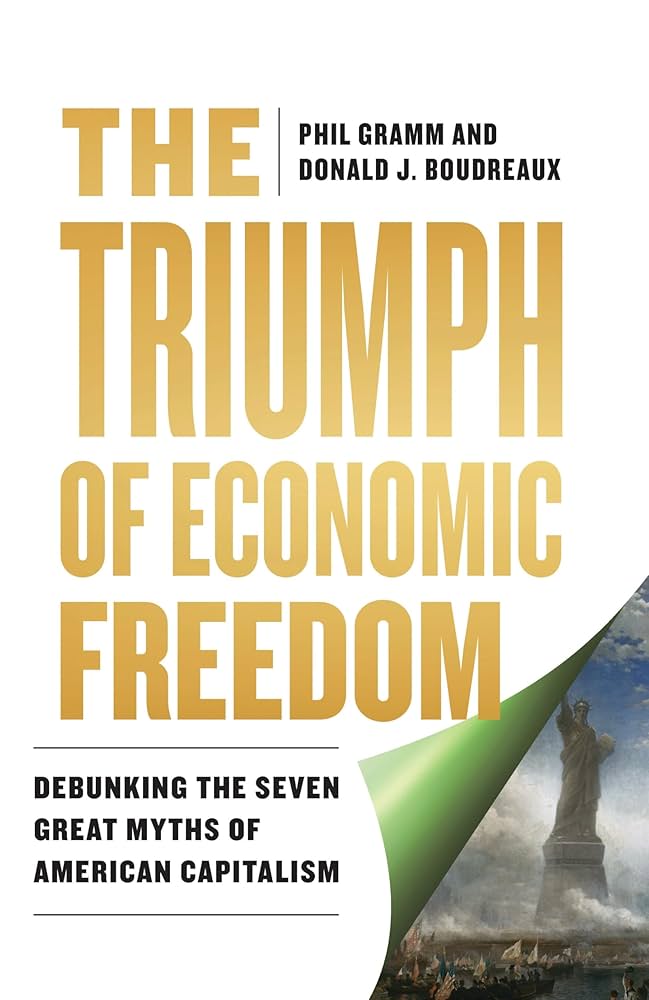
This fascinating book is well worth a read by anyone interested in economic history or contemporary policy debates. In it, Gramm (a former senator well-known as the moving force behind a number of important policies) and Boudreaux (an economist) take us through seven of what they call ‘myths’ about capitalism. These are five historical myths: that the industrial revolution impoverished workers; that in the decades after the American industrial revolution there was a strong tendency towards monopoly, only eventually limited and disciplined by regulation; that the Great Depression was a failure of Capitalism; that trade hollowed out American manufacturing; that deregulation caused the Global Financial Crisis; plus two myths about modern American inequality and poverty.
For each myth, the authors start off by setting out the case for the myth, drawing on certain key supporting statistics, academic commentary in favour and broader literature (frequently finding highly evocative quotes painting grim pictures embodying or expressing the myth). The authors state that their intention is to give each myth as fair and complete an airing as they can. And in most cases they have a decent shot at this, allowing the reader to understand what the myth is, why people believe it, and why it seems emotionally as well as intellectually attractive. I wasn’t wholly convinced they had summarised all the most important reasons to support the idea of the early industrial period’s tendency towards monopoly or the Great Depression’s natural resulting from Capitalism. But that is largely a matter of taste, for in all cases (including these) their painting of the case was vivid and should be seen as fair if not always complete.
With the myth and its basis painted, they move on to consider the facts in more detail, explaining why the idea in question is a myth. To a high degree, their case would have been made simply by the splendid additional facts they set out. But they go on to explain in detail why the facts that appear to the support the myth are as they are and to explain (frequently very interestingly and compellingly) the political context or motivations for the literature and commentary references that support the myth as well. At the end of each section, the myths lie in intellectual tatters, so savaged by Gramm and Boudreaux’s polite but forceful prose that one almost feels sorry for the battered victim.
Our courteous pitbulls begin with the industrial revolution and the notion that workers initially lost out because of it. Here perhaps the most decisive arguments offered were simply that purveyors of the myth had totally failed to understand the lot of the rural poor prior to industrialization, imagining that they lived a pleasant and comfortable life of high leisure in bounteous rural idylls. By contrast, Gramm and Boudreaux tell us a much more convincing tale of disease and accidents, early mortality, poor infrastructure, few if any available and accessible services, hunger or bland and monotonous diet, and living together in multi-family long-houses where a dozen slept together on a lice-ridden straw mattress and sexual relations were watched by skin-sores-ridden bedmates and rodents alike. In one fascinating section, the authors take us through nineteenth century interviews and autobiographical statements of the urban poor mocking and dismissing the ignorance and naivete of rich people expressing outrage at the lot of low-income urban living, whose only knowledge of the countryside came from their own or their rich friends’ stately homes.
Another interesting section in this opening myth concerned the motivation and timing of some of the key literature and commentary on bad conditions in factories. In the run-up to the abolition of the Corn Laws in 1846, opponents of free trade sought to paint manufacturers, who wanted tariffs taken off imported raw materials, as wicked bosses who harmed their workers by contrast with the pleasant lot workers had in the agricultural communities that food tariffs supposedly protected.
The chapter on the early industrial tendency towards monopoly told us of Standard Oil, as one would expect, but its longest section was about the Chicago meat-packers. Some of the most interesting material here was about how the key objections to alleged monopoly in this era were not, as one might suppose, that it resulted in prices that were too high – the authors offer extensive statistical evidence against that idea – but it appears that was not even claimed as a key concern at the time. Rather, opponents of monopoly worried that the power of large ‘trusts’ enabled them to secure prices that were too low, from their own suppliers (particularly of transport services) – and then pass these on to consumers.
This is also where we first encounter a recurring bipartisan theme – perhaps not unrelated to the fact that Gramm himself was first elected as a Democrat and then switched to the Republican Party. Time after time, through the economic history they set out, we see Republicans first to pursue foolish anti-market policies and rhetoric, followed by Democrats who push the anti-market agenda even further, before other Democrats finally see the light and set things in motion back along a pro-market line, in due course followed by the Republicans. As regards anti-trust rules, we are told that it is under President Carter that the key reversals of ‘Progressive era’ regulation start to be reversed, and Reagan carries forward Carter’s agenda. This pattern is repeated in other sections: Hoover starts the epic spending rises and deficits of the 1930s, and Hoover forbids firms from reducing wages despite 25 percent unemployment. Roosevelt carries that agenda forwards. Clinton enacts key (beneficial) financial deregulation measures and the most successful anti-poverty programmes (based on encouraging work). Trump impedes free trade and harms the WTO’s enforcement system, with Biden carrying forward Trump’s agenda. The authors clearly want readers to get the message that being pro-market is not a naturally Republican position and being anti-market not naturally Democrat.
Much of the material relating to the Great Depression will be familiar to students of the topic – the role of Britain’s rejoining of the Gold Standard leading to excessive US monetary growth in the 1920s and the failures of the Federal Reserve to prevent contraction of the money supply from the late 1920s onwards have been well-known since at least the work of Milton Friedman. Perhaps more novel is Gramm and Boudreaux’s analysis of the 1937-38 recession, along with their discussion of Roosevelt’s quasi-fascist anti-business rhetoric and how that was seen by investors aware of the international political context at the time. They present some interesting indicative statistics on how much more short-termist investment became as financiers worried that they might need to liquidate investments rapidly if the political situation turned further against them.
The section on trade and manufacturing is robust and persuasive, covering most of the bases one could want, explaining how US manufacturing dominated in the post-war period because much of the rest of the industrialised world lay in the ruins of war, but that that could not last indefinitely as other countries recovered. The authors cover the interesting question of whether software programming (which today constitutes up to half the value added of significant manufactured products such as cars) should be classified as ‘manufacturing’ in employment statistics. There was also a good discussion of the relationship between capital account inflows, as investors put money into America and then later invested into the rest of the world, and their natural counterpart in current account outflows (via trade deficits). The one thing I though could have been covered better here was the deeply erroneous arguments of Trump that the presence of a US trade deficit with a country shows that that countries must have been placing non-tariff barriers in the way of US exports.
The two final sections, on inequality and poverty, included material familiar to readers of Gramm’s 2022 book (along with Ekelund and Early) on The Myth of American Inequality (which I have reviewed here previously). These sections once again appeal extensively to the very strange situation created by US statistical authorities not deeming two thirds of the transfer payments made to lower-income American households as income (because they take non-cash forms such as food stamps) and how, once one corrects for this anomaly, the US actually has one of the highest proportions of GDP in the world transferred between income groups, very low poverty and very typical inequality by developed economy standards.
The one ‘myth’ topic about which I might claim to know more than the authors was the Global Financial Crisis. Here I found their discussion interesting and familiar, but incomplete in important ways that, though it did not threaten their key conclusion that the crisis was not a result of deregulation, it did mean their own alternative narrative was much less supported than they claimed. I found their discussion of financial diversification instruments (such as CDOs) a little too shallow, not really exploring whether these diversified away or added to systematic risk. I didn’t think they considered enough the role of an innovation boom-bust cycle in financial markets as a contributor to either the Great Depression or Global Financial Crisis. I also regretted their failure to discuss the way government bailouts of major banks since the mid-1980s had created implicit expectations of future bailouts, and how that encouraged banks to expand their balance sheets in multiple developed countries. I don’t dispute their criticisms of Clinton-era housing policies or of the failings of Fannie Mae and Freddy Mac. But I found their suggestion that flawed US housing policies by themselves caused a financial and sovereign debt crisis spanning the globe to be incomplete at best.
This is a small cavil regarding a book I enjoyed reading, found highly informative and whose overall message I both strongly endorse and believe this to be a robust ally in promoting. I liked it, and if this is your thing then you’ll like it too.