
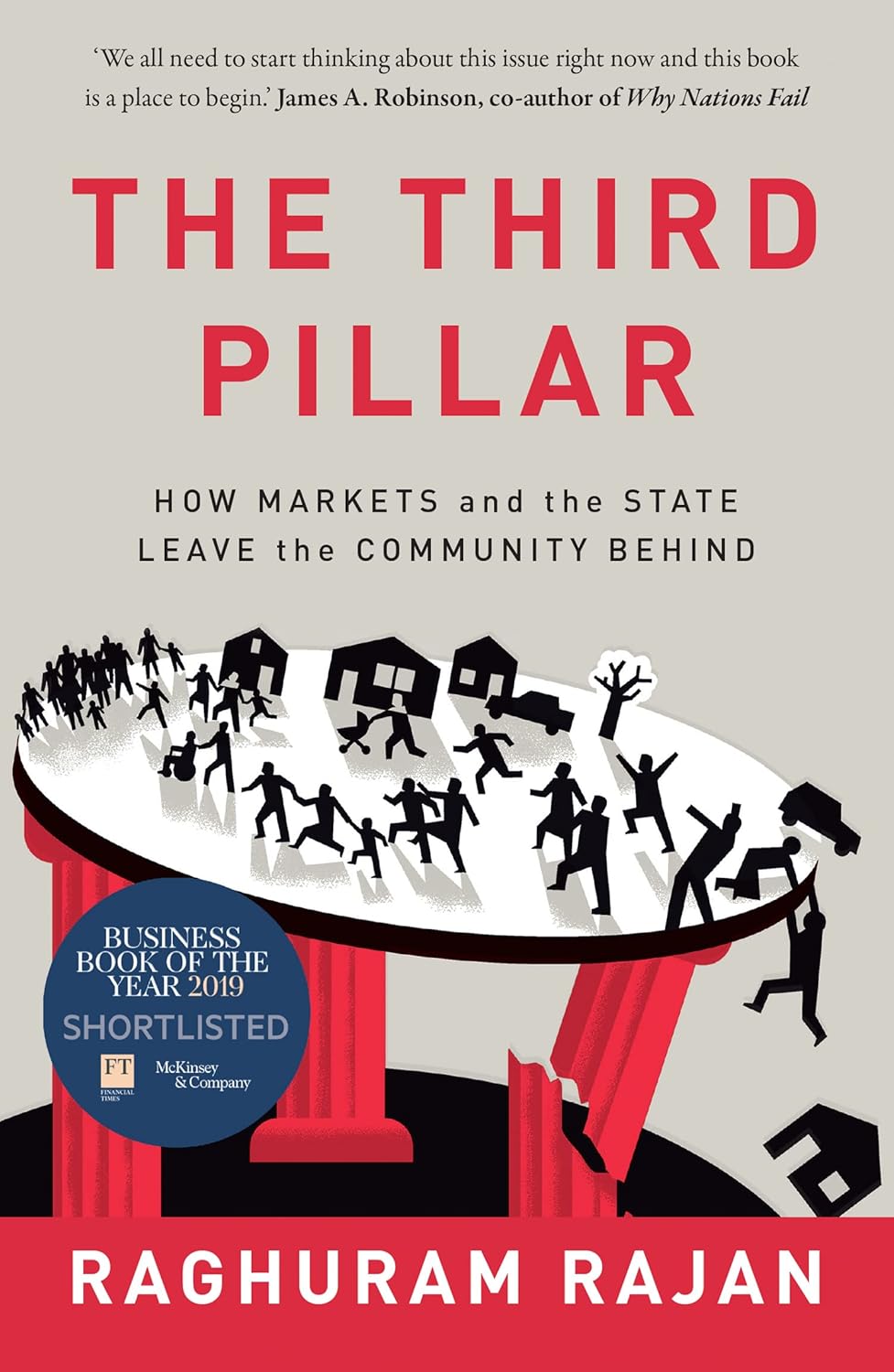
Raghuram Rajan’s central claim in his book The Third Pillar is that modern societies have allowed markets to globalize and states to centralize while neglecting what he calls the third pillar: community. The result of this neglect is economic imbalance, social and political fragmentation, loss of belonging and shared purpose, and a decline in social trust. The Third Pillar makes a thorough inventory of the decline of community. It documents the widespread dissatisfaction with institutions in the Western world and some of its unfortunate consequences, like the deaths of despair cataloged by Anne Case and Angus Deaton (Case and Deaton 2020). Rajan offers a strong diagnosis, but the strength of his diagnosis also exposes the limits of his framework. The book gestures towards a richer understanding of community, but never fully delivers on developing the conceptual or institutional foundations necessary to sustain it. As a result, Rajan’s proposal for a cure to the illness he identifies also falls short. He relies on state incentive programs to try to reinvigorate community and constraints imposed by the state on communities to keep them from becoming too exclusive.
One of the most valuable contributions of Rajan’s book is its insistence that community is more than a residual category. He goes to great lengths to retell the story of industrialization and globalization over the course of the 20th century as well as the Information and Communication Technology (ICT) revolution, but while his retelling gestures at the decline of community, the substance of his argument is limited to cataloguing the effects of these changes on the other two pillars: economy and government.
The examples of communal actions he does offer are only marginally communal: take for example the Indian city Indore, which went from one of the dirtiest towns in India to being celebrated as a zero-litter city. Rajan ostensibly tells the story of Indore to offer an example of a community that self-organized to solve a problem. But even in his account of the example, it becomes clear quickly that the city’s government was crucial in achieving the desired outcome. Just like in his description of the larger 20th century industrialization and communication trends, it is unclear that the example really speaks to the lack of community, because the central player in the clean-up effort seems to have been Indore’s city government. This is where Elinor and Vincent Ostrom’s work on self-governance could have been a natural complement to Rajan’s ideas. Over the course of their careers, the Ostroms accumulated empirical evidence as well as theoretical frameworks that can explain authentic communal self-governance ‘without the sword’ of state coercion in the background (E. Ostrom, Walker, and Gardner 1992).
This lack of a substantive discussion of community pervades Rajan’s entire book. He stops short of offering a more profound explanation of how community performs important functions in every chapter of the book. To make sense of his work, one must supply a conceptual framework that the book itself only hints at. The absence of an explanation haunts the book from beginning to end and leaves this reader chasing from chapter to chapter, hoping that what comes next may fill the void, only to be disappointed again. One example of this lack of explanation can be found in chapter 6, which discusses the information and communication technology (ICT) revolution. Rajan carefully analyzes its effects on production, inequality, employment, and educational stratification, but he doesn’t explain why stratification is a problem or exactly what it is about community that is weakened by the ICT revolution. While the weakening of community is central to Rajan’s argument, the mechanism remains underdeveloped. Without a better understanding of what exactly community does to provide meaning and belonging, it is impossible to tell what the cure may be.
The lack of a clear mechanism is also the missing element in Rajan’s proposed solution: inclusive localism. Rajan argues for greater communal autonomy to rebalance the pillars, insisting that this greater autonomy cannot come at the expense of inclusiveness. While his proposal is attractive in principle, it also reveals a deeper tension in Rajan’s thought. On the one hand, he recognizes that community must be thick enough to provide identity, belonging, and shared purpose. On the other hand, he insists that communities must not become exclusionary or restrict individual mobility. While he celebrates diversity among individuals, he views differentiation among communities with suspicion. The question of how communities can be thick enough to provide meaning yet not so thick as to exclude is left unanswered but is arguably the crux of the problem. Rajan argues for national governments to prevent the exclusionary tendencies of communities by requiring inclusiveness, but he does not explain how those same national governments refrain from crowding out community in the process, as his own account of the 20th century has shown they did. The Ostroms’ work could have again been helpful here. Throughout his work, Vincent Ostrom, in particular, emphasized the importance of overlapping and competing jurisdictions (V. Ostrom, Tiebout, and Warren 1961), which allow for both a strengthened community with shared meaning and a systemic check on exclusionary tendencies through competition among self-governing communities. Importantly, however, as Elinor Ostrom shows (E. Ostrom 1990), clearly defined boundaries between groups or effective exclusion of outsiders, are essential for self-governance communities to function.
On the whole, Rajan’s book diagnoses an important problem: community has been hollowed out as states and markets have expanded in scope and scale. His diagnosis is begging for a deeper assessment of the effects of the imbalance he diagnoses and the likely channels by which they affect individual feelings of belonging and meaning. In the end, The Third Pillar offers us an important diagnosis but only the beginning of a theory. What remains is to develop a theory that offers a more complete account of why community matters and how it can be sustained realistically in a complex, modern society.