
In many areas of our lives, we join associations or engage in activities where there are rules that impose limits on or direct our behaviour. To give one example, over 7 million people are members of 40,000 football clubs, all with their own rules which are, in turn, regulated by the Football Association (FA). The FA, in turn, is a member of UEFA and FIFA with their own rules systems. There is, in the jargon, polycentricity or nested rules systems.
However, over time, the role of the state in regulating our lives has increased and the role of other bodies has reduced. Even football is now regulated by a government regulator.
By way of another example, we often think of the 1980s as a period of deregulation of financial markets. In 1986, there was an episode called ‘big bang’. This is often wrongly described as ‘deregulation’. In reality, the regulatory powers of a private body, the stock exchange, were radically curtailed after 300 years of independence, and they were replaced with a bureaucracy accountable to the Treasury. The scope of bureaucratic rulemaking in financial markets has increased exponentially ever since.
Our lives are now dominated by regulation from one source – central government. Even local government effectively acts as a set of Whitehall branch offices. When institutions do have some form of independence from the state, instead of this being regarded as normative, it tends to be regarded as a privilege, as if the state has a natural right to order our social, civic, professional, economic and family life. And there is always a threat hanging over quasi-independent institutions that they will have their independence snuffed out by the state – for example, when it comes to teaching about sex and religion in Catholic schools. And the remaining independence that universities, schools, professions, sports associations, and so on, have is radically tempered by employment regulation, equalities regulation and regulation that purports to promote human rights but, in reality, curbs freedom of association.
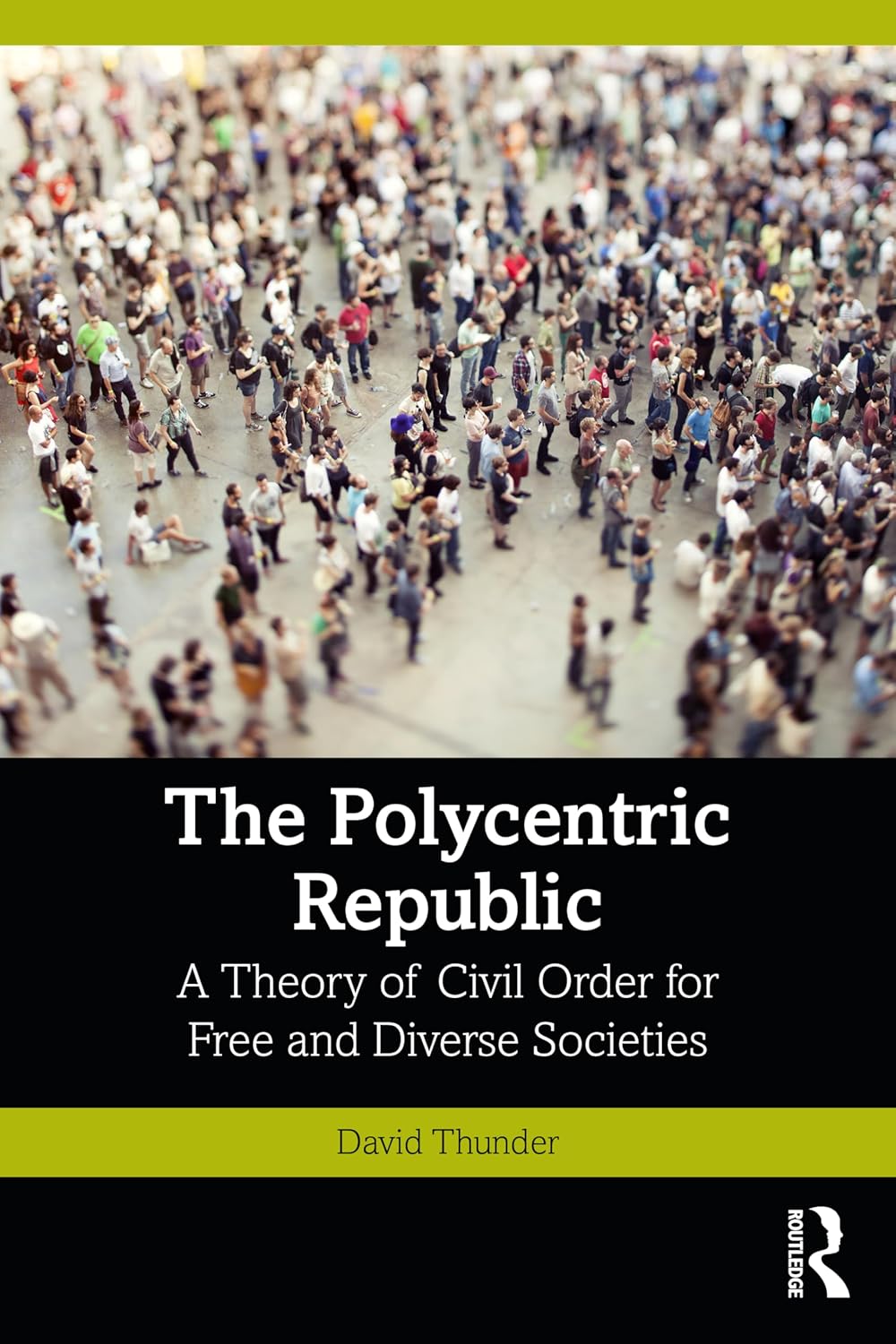
Pope Benedict produced a papal encyclical in 2009 in which he identified these problems, writing: ‘The exclusively binary model of market-plus-State is corrosive of society, while economic forms based on solidarity, which find their natural home in civil society without being restricted to it, build up society.’ This is surely true. And David Thunder’s excellent book, The Polycentric Republic: A Theory of Civil Order for Free and Diverse Societies, provides the antidote.
Thunder identifies the problem of the all-powerful centralised state as lying with classical theories of government in which the individual gives a monopoly of power (or coercion) to the state to keep order with the aim of promoting a peaceful society and preventing a ‘war of all against all’.
Thunder does not base his case for a system of decentralised governance on the principle of individual freedom but on the ability of such a system to promote flourishing and the practice of the virtues.
Thunder divides institutions of governance into two types: enterprise associations and civil associations. The former are not necessarily related to commerce and business, but they would be non-territorial. They would include professions, sports associations, universities, securities exchanges, and so on. Civil associations would be territorial in nature. Most powers in civil associations would be held at local level. The national political community would obtain its authority not just from a franchise of individual voters, but also from the lower-level civil associations and the enterprise associations: authority would flow upwards and not downwards. Interestingly, in some respects, the City of London operates on such a basis. Enterprise associations would be constrained by the right of exit. Civil associations would be constrained by the wide dispersion of authority.
In terms of philosophical outlook, the title of the book makes a clear nod towards Elinor Ostrom. Her Nobel Prize winning work showed how systems of governance which disperse authority with multiple layers and institutions adjusting to each other, evolved naturally in situations where economists and political scientists believed that centralised political control was often necessary.
There is an admirable chapter in the book which deals with possible objections to Thunder’s approach. But perhaps, there are a few other questions that could be considered. Firstly, reading this book from a UK perspective, one might be tempted to ask why he could not base his case on individual freedom and freedom of association. Until the growth of the centralised state from 1914, Britain had a huge network of self-governing institutions, many of which had developed over the previous 50 years. Local government was pretty autonomous too. Indeed, a Select Committee of inquiry into the stock exchange was able to conclude in 1878 that it was ‘capable of affording relief and exercising restraint far more prompt and often satisfactory than any within the read of the courts of law’. That is a pretty strong endorsement of forms of regulation that grow out of the market and civil society through enterprise associations.
Sporting associations also flourished. Indeed, it is worth noting that, in the case of football, three entirely autonomous rule-making bodies developed with very different organisational structures (association football, rugby football league and rugby football union). There was order, but also competition between rule-making bodies. A world of free, rule-making bodies in the context of a limited state is exactly what classical liberals would like, and it is what David Thunder wants too. So, the first challenge to Thunder is to ask why he does not join the queue of people who would simply like to go back to a smaller state.
The answer to that is that Thunder’s justification is different. His justification relies on creating a society in which we can all flourish and not one which simply maximises freedom, including freedom of association to form rule-making bodies. Pope Leo XIII, in 1891, published a strong defence of the family and private associations in Rerum novarum and argued that the state should protect the family and such associations and not interfere with them. His starting point was that of natural rights – we are born into a family, and society and the state should protect the family and society. But this perspective was also based on the need for society to flourish. Perhaps freedom and flourishing are best thought of as complementary arguments and so Thunder adds a new dimension to classical liberal arguments for a limited state.
And there is also the challenge, which Thunder does raise, that enterprise associations can be monopolistic and exclusive. I discuss this issue in a variety of papers, including, for example, an article ‘Private regulation versus government regulation: The example of financial markets’ Economic Affairs, 42(1), 30–49. In this respect, David Thunder refers to the Hanseatic league positively. But that organisation was extremely cartelistic. The Test and County Cricket Board (TCCB) was taken to court in 1977 for banning cricketers who played for an Australian entrepreneur, Kerry Packer. The TCCB lost. I disagree with the court decision, but we have to accept that a return to a world in which there is much greater diversity in rule-making institutions may lead to the restrictive practices that used to dominate economic life. That said, economic life today is dominated by state occupational licensing and government regulation of professions that restrict entry on arbitrary criteria.
I hope that David Thunder’s work will widen the constituency of people who believe in a limited state and dispersed competing forms of governance. Those of us who believe in a limited state but the maximum possibility for civil society structures of governance to emerge tend to be dismissed as ‘neo-liberal’ in a lazy misrepresentation of our views. But with his focus on creating a system of governance in which people can flourish and practise the virtues, David Thunder should avoid any such allegation, at least from interlocuters who exhibit a generosity of spirit and a genuine desire to engage with his arguments.
In the final chapter, David Thunder states that he hopes that the polycentric, federalist approach that he lays out provides a useful theoretical paradigm in which the future of our governance arrangements can be discussed. He has achieved that objective. His approach should be widely discussed and developed. It should be read by students on university politics and political economy programmes and by those who seek to influence the climate of opinion. It certainly should be of interest to Christians. Thunder states in the penultimate chapter that his purpose is to ‘stimulate our moral and political imagination with a view to stimulating institutional and cultural reform.’ This he does.
‘The Polycentric Republic: A Theory of Civil Order for Free and Diverse Societies’ by David Thunder was published by Routledge in 2024 (ISBN: 978-1-032-88889-7). 196pp.
Philip Booth is professor of Catholic Social Thought and Public Policy at St. Mary’s University, Twickenham (the U.K.’s largest Catholic university) and Director of Policy and Research at the Catholic Bishops’ Conference of England and Wales. He is also Senior Research Fellow and Academic Advisor to the Centre for Enterprise, Markets and Ethics.