
For the first three years of our marriage, my husband and I lived in a small apartment with our children and dog. The building sat in the middle of a booming city block, ringed on all sides by construction. I must have mentally recited Walt Whitman’s ‘I Hear America Singing’ hundreds of times as I walked the dog around the block, both of us surveying the steady transformation. There is something deeply satisfying about watching a structure rise at such close quarters, being privy to the immense effort of coordination, craft, and discipline it requires to manage something of that size.
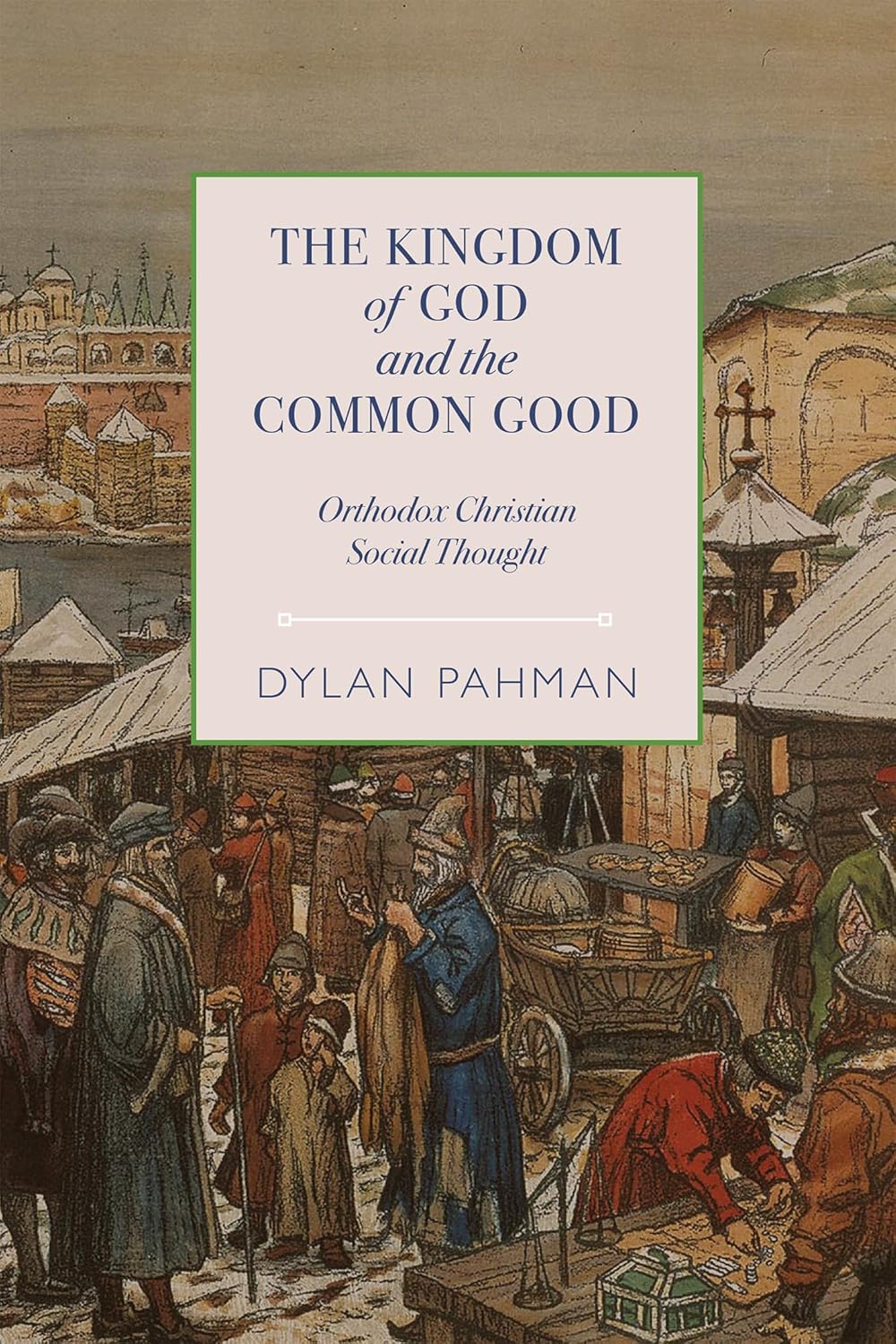
Reading The Kingdom of God and the Common Good produces a similar sensation. Rather than waiting for someone else to begin a broad, accessible conversation about Christian social thought — and the distinctive Orthodox contribution to it — Pahman simply started building. Like an experienced construction manager, he brings decades of preparation to the task: years as a Research Scholar at the Acton Institute, a PhD in Theological Studies from St. Mary’s University (Twickenham, London), and his work as the Executive Editor of the illustrious Journal of Markets and Morality. Unlike the typical book in this genre, his knowledge extends as comfortably to the economic contributions of Smith, Keynes, and Hayek as it does to Scripture and history.
The first section of this review will provide a summary of the book and explain four key terms – kenoticism, symphonia, Sophia, and sobornost’ – that play a special role in Pahman’s understanding of the Orthodox contribution to Christian Social Thought. The next section of the review will engage more with some strengths and shortcomings of the text. A third section will conclude, offering suggestions and encouragements for future research.
Summary and the Orthodox Contribution
The Kingdom of God and the Common Good is written for readers without prior background in Christian social thought. Each section opens with references to familiar cultural works and closes with discussion questions, making the book well suited for classroom or parish study. Pahman intentionally selects topics likely to interest Orthodox readers and highlights moments where insights from other Christian traditions or historical episodes might deepen Orthodox reflection.
The first part surveys modern Christian social thought, focusing on the Roman Catholic, Lutheran, Neo-Calvinist, and Social Gospel traditions. The second discusses related aspects of biblical theology, reminding us to read the Scriptures not alone but ‘with the church.’ A third part surveys Church history beginning with Pagan Rome and ending with the Russian Empire. A fourth part provides the reader with a primer on modern economics. Finally, the fifth part engages with contemporary Orthodox sources and argues for Pahman’s vision of a uniquely Orthodox social thought that draws from Scripture, Church history, liturgy, and the best of other Christian social thought traditions.
The most distinctive contribution of the book is the recurrence of four Orthodox terms—kenoticism, symphonia, Sophia, and sobornost’—to articulate this uniquely Orthodox social vision. While asceticism and liturgy also play especially important roles in the Orthodox approach to the world, these may be more familiar to Christian readers of other traditions and so I leave discussing them to the next section.
Kenoticism derives from the Greek kenosis, ‘self-emptying,’ used in Philippians 2:7 to describe Christ’s voluntary humility in the Incarnation. Orthodoxy insists this act did not diminish Christ’s divinity; rather, it reveals that God’s nature is self-giving love. Socially, kenoticism implies humbling ourselves before each person we encounter, especially the vulnerable. In a manner resonant with Catholic social teaching and thinkers in the social gospel tradition, it affirms human dignity while emphasizing the paradox that divine glory is revealed in meekness.
Symphonia describes the ideal harmony between the church and the world, especially when it comes to the state. While it is difficult in practice to protect the church from worldly interference, separate institutions remain necessary for securing the array of moral and material goods that humans require. The common good requires vigilance and prudence in this division of labor and trade. Pahman is fond of reminding the reader that Christ tells us that we do not live by bread alone, not that we do not live by bread.
Sophia, or Holy Wisdom, refers to the divine order manifested in creation and revealed in Christ. It underscores the contemplative dimension of social life and how human work can participate in God’s ongoing creative purpose. This theme echoes Protestant reflections on vocation, suggesting that our faithful attention to ordinary tasks is more beautiful and more consequential than we initially perceive as we cooperate with grace.
Lastly, sobornost’, a central concept in Russian Orthodox thought, describes freely chosen communal unity. To be sustained, this unity must be grounded in both truth and love. This term captures the Catholic social thought principles of solidarity, emphasizing that flourishing emerges from organic community and freedom within those communities, rather than various forms of social engineering.
Strengths and Weaknesses
The book has many strengths, making it a bookshelf essential for those interested in Christian social thought more broadly. Among the book’s strengths is its fair treatment of contentious issues such as usury, profit, and socialism. Pahman clearly identifies shared principles of Christian social thought, including private property and freedom of association. Most compelling is his recurring emphasis on asceticism. Orthodox ascetic practice, such as fasting from food or certain luxuries, reorders human desires toward higher goods and exposes how easily economic life becomes governed by disordered loves. Markets respond to preferences, but preferences themselves require moral formation. In this light, asceticism serves as a corrective not only to personal materialism but also to short-term economic thinking.
While reading The Kingdom of God and the Common Good, I was struck by how lopsided some strains of Christian social thought can and have become without this essential commitment to asceticism alongside beautiful liturgy. Ascetic practices force us to reorder our loves toward the highest goods, instead of idolizing things which cannot fulfill us. It is the liturgy, and our active participation in the liturgical calendar with our households, which reveals to each of us that which is truly valuable. It is how we store up treasure in heaven. This, in many ways, is the fundamental problem of the Christian in economic life. I would like to read many more books about the importance of asceticism and liturgy in modern economic life.
The book has few weaknesses. Readers new to Orthodoxy may wish for more historical and doctrinal background, which would help situate the social arguments. As an economist, I have a minor quibble with Pahman’s critique of modern economists as being too unwilling to engage explicitly in moral reasoning. While the earliest economists (such as the Late Scholastics or Adam Smith) often arrived at their economic analysis by way of contemplating specific moral questions, contemporary scholarship tends to separate analytic and ethical tasks for methodological clarity. This division does not eliminate moral reflection; it relocates it to different genres of writing, thus allowing scholars to specialize in their comparative advantage and trade insights with one another. Another Orthodox social thinker, Alex Salter, has a helpful piece on the matter, entitled ‘What, to a Christian, Is Economic Efficiency?’ (2024). Salter defends the positive economic analysis of efficiency as a means to limit the scope of the discipline and to allow normative analysis its own space to argue directly for moral goods rather than being constrained by the tools of economists or other social scientists.
Conclusion
Orthodox Christianity is often associated with mystery and paradox – liturgical beauty and disciplined asceticism. Pahman’s book brings these two dimensions into conversation with modern social questions, offering a vision in which sacrifice and beauty together illuminate Christian economic life. I hope that he, and many other Orthodox thinkers, will continue building this magnificent tradition.
‘The Kingdom of God and the Common Good: Orthodox Christian Social Thought’ by Dylan Pahman was published in 2025 by Ancient Faith Publishing (ISBN: 978-1-955-89080-9). 408pp.

Clara Piano is currently a Visiting Assistant Professor of Economics at the University of Mississippi, a position which will become tenure-track in Fall 2026. Her primary areas of research are family economics, law and economics, and public choice. She also serves as Managing Editor of the Journal of Markets & Morality and holds positions as an Affiliate Scholar at the Acton Institute, a Family Policy Fellow at the Archbridge Institute, a Senior Fellow in the Family Program at Cardus, and a Law & Economics Fellows Advisor for the International Center for Law & Economics.