
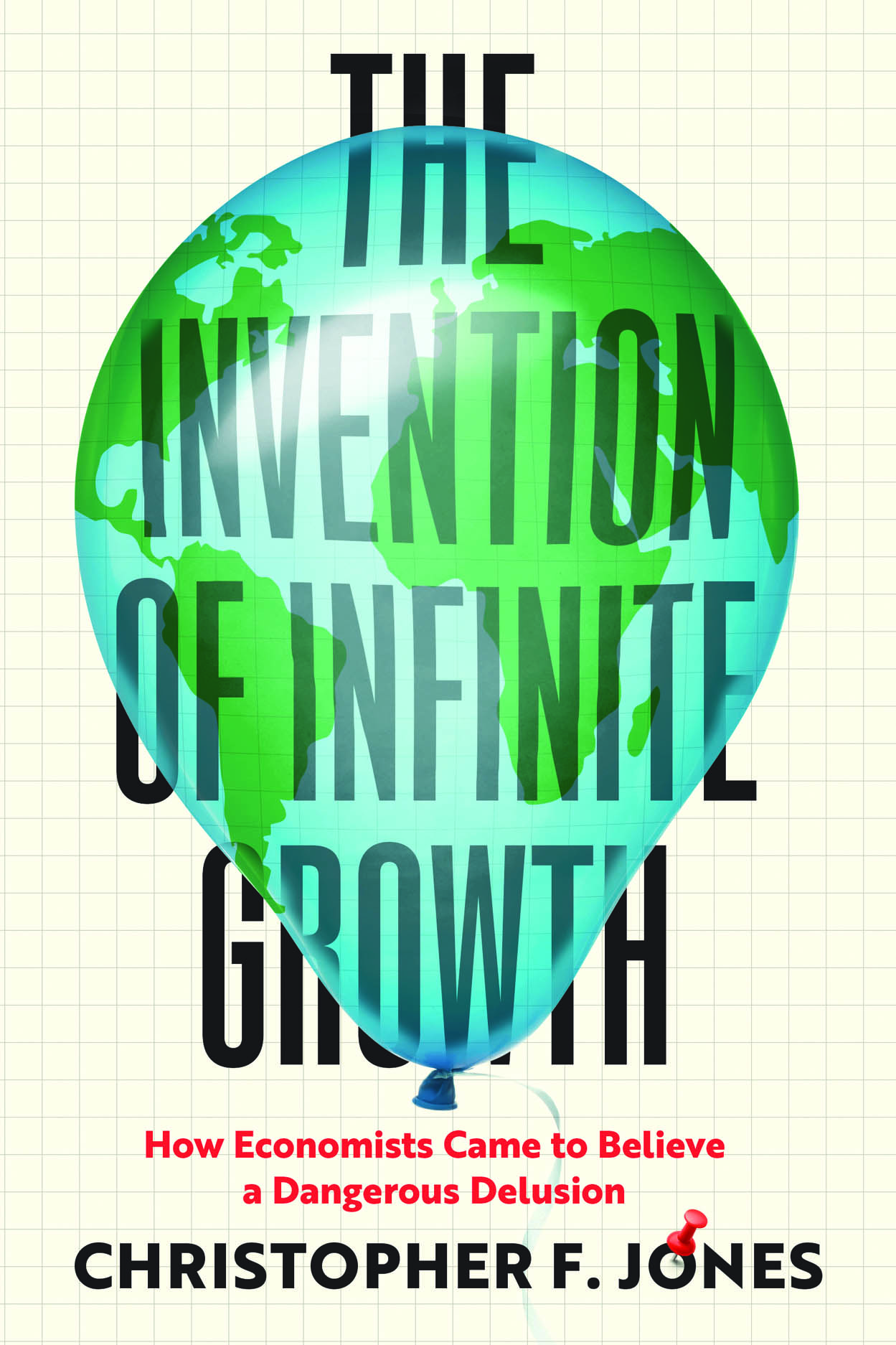
Christopher Jones has a straightforward thesis. Economists invented the concept of infinite economic growth which makes unsustainable demands on the natural world. As the global economy grows, so does the negative impact on the environment. More activity means more pollution and harmful climate changing emissions. The only way to live on the planet in a genuinely sustainable way is to accept limitations in economic growth. Few would dispute the idea that there is a real tension between the level of economic activity and the impact on the planet, although innovations have allowed greater consumption with less environmental impact. There is little merit in increasing wealth if the result is a planet which can’t support the current level of human life. John Stuart Mill’s hope that abundance would lead to better lives as focus moved to the good from the useful remains an attractive prospect.
The strengths of this work are also its limitations. Jones covers in detail the history of academic American economics. For those interested in how the ideas of Simon Kuznets, Paul Samuelson, Robert Solow, Joan Robinson, William Nordhaus, Paul Romer and many others relate to each other, this provides a useful guide. Jones explains clearly how the tension between the desire for economic growth and sustainability have been explored from Malthus and Mill to ecological economics and green growth. He is particularly strong in exploring the way that the school that developed around Robert Solow and Paul Samuelson at MIT, and their models which sought to analyse the factors which account for economic growth, came to dominate academic economics. He focuses on the development of GDP as the key metric for national economic activity and how it has come to be a key element in political discourse. Jones provides a useful reminder of the history of global attempts to reduce global warming from the enthusiasm of the Earth Summit in Rio de Janeiro in 1992 to the disappointments in the same city twenty years later. He concludes that the ‘fixation with growth instead of better lives and healthy ecosystems is apparent in sky-rocketing levels of inequality’ and that ‘growth must give way to degrowth’.
This analysis may be more persuasive to an American audience with high incomes. However, given that environmental concerns are global, his rather parochial approach is problematic. Narrowly, one may wonder if Jones is inclined to exaggerate the role of academic economists. Whether they ‘invented’ the idea of growth being infinite or rather sought to explain the evident step change in global economic performance after the industrial revolution is less important. More significant is the failure to engage substantively with the experience and perspective of the majority of the world’s population in Asia. While Jones bemoans increasing inequality in America, he gives no attention to the astonishing reduction in poverty in Asia, for instance.
He recognises that the arguments for ‘degrowth’ have received little support from mainstream economists but shows little interest in why this is the case or in how his ideas would be put into practice. He calls for growth to be ‘targeted to those who need it most, and away from those who do not’. That may be hard to disagree with in principle, but we hear nothing as to how this objective would be achieved apart from vague calls for more focus on how wealth is distributed. With egalitarian redistribution the world economy would have to quintuple for every person on the planet to be as well off as the average Dane. For every person to reach the line of poverty in the developed world ($30 a day), the world economy would have to double. [1]
Moreover, the author’s focus on America seems to blind him to the impact of economic growth elsewhere. Jones completely fails to engage with the crucial question of how an affluent global north can expect a relatively poorer global south to deny themselves the benefits of economic growth. It might be unrealistic to expect an answer, but to fail to recognise such a key challenge undermines the value of this work. It is particularly disappointing that Jones describes the argument for ‘degrowth’ as being straightforward. It may appear so from an American perspective, but perhaps much less so for those still emerging from poverty.
The economics of comparative advantage have been demonstrated on a global scale by the transfer of manufacturing activity from higher cost American and European economies to those with cheaper labour in Asia. This aspect of globalization has been an engine for significant improvements in living standards for those employed and cheaper goods for consumers (perhaps especially the poorest Americans). This has caused dislocation and distress in communities (comparatively wealthy communities in an international context) which have seen factories close, but Jones has little to say about these trade-offs.
By contrast, he is concerned about growing inequality in America, although unusually, he seems rather to assume this and does not provide a reference in support of his assertion. (Andrew Lilico’s review of The Myth of American Inequality by Phil Gramm, Robert Ekelund and John Early is interesting in this regard.)
This focus on America finds expression in a weakness in dealing with the rest of the world. Citing a 1988 article by Robert Lucas, Jones claims that India’s economy, from the perspective of 1980, ‘had grown only 1.4 per cent over the preceding two decades’. Lucas in fact suggests that ‘rates of growth of real per capita GNP’ had averaged 1.4% per year over that period. This may be no more than a lack of attention to detail, but it does not encourage confidence. The same is true of a suggestion that the elder Malthus was alive in the 1970s. For a work by an academic, this book is rather uneven in quality and perhaps not the ‘scholarly miracle’ claimed by J R McNeill in a blurb for the book.
The book is strong on the way that ideas around the tension between growth and the natural world have developed but disappointing in adding nothing useful to the debate on how our generation should approach these issues. There is arguably little merit in reducing economic activity and the related emissions in America and Europe if they are simply to be exported to Asia. To suggest that accepting the end of economic growth is straightforward, while not at least recognising that this is unlikely to be accepted by much of the world, reduces the value of the work. If the reader is interested in the history of the study of economics in America, and the way that thinking on the tension between economic growth and the environment has developed, this book contains much useful material. The suggestions for change are perhaps less compelling.
‘The Invention of Infinite Growth: How Economists Came to Believe a Dangerous Delusion‘ by Christopher F. Jones was published in 2025 by University of Chicago Press (ISBN: 978-0-226-72204-7). 376pp.
[1] See Ritchie, H. (2024) Not the End of the World: How We Can Be the First Generation to Build a Sustainable Planet. Chatto & Windus. Pages 34-5.

Andrew spent his career with PricewaterhouseCoopers where he was a partner for more than 25 years. He led a variety of the firm’s businesses both in the UK and globally, with a focus on the pharmaceutical industry. He also led the firm’s work on explaining corporate taxation to civil society and the public. Since retiring from PwC he has completed a master’s in history at Oxford and is hoping to undertake further research. He is also a trustee at the London Handel Society and the Open Spaces Society.