
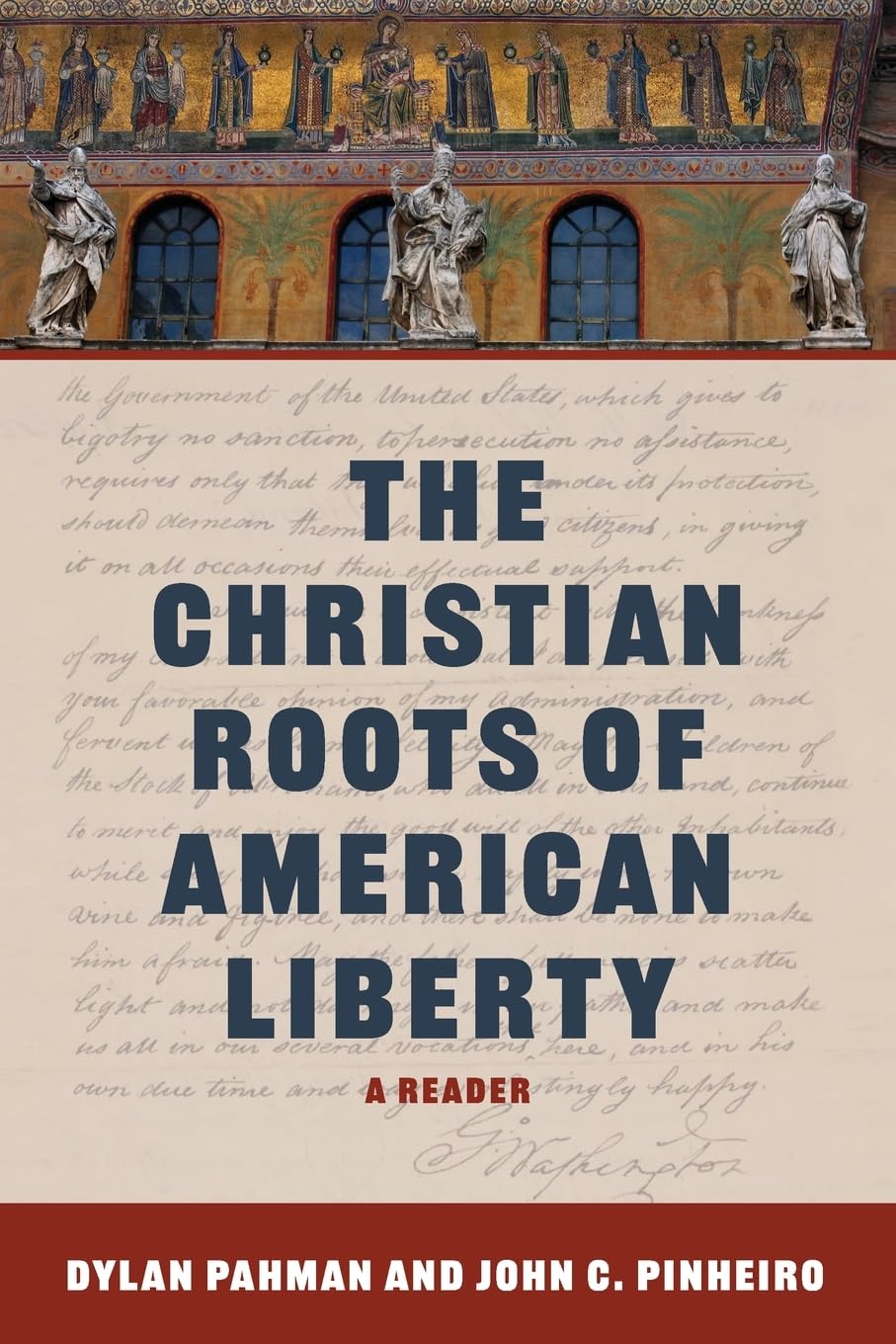
This collection of primary texts highlights liberal principles embedded in the history of Christian thought. Challenging efforts by Yoram Hazony, Patrick Deneen, and Adrian Vermeule to sever Christianity from liberalism, editors Dylan Pahman and John C. Pinheiro document the presence of liberal principles in the writings of church fathers, Christian edicts, and early modern philosophy. The editors also aim to show how liberal principles can be compatible with conservatism. Divided into five parts, with discussion questions at the end of each part, the book is organized to show Christian precedents for principles articulated in the founding documents of the United States.
While the title, The Christian Roots of American Liberty, may suggest otherwise, the book is not designed to show that American founders drew their ideas on liberty directly from Christian thought. Rather, the book culls excerpts on liberty from Christian history to highlight commonalities with liberal principles in America’s founding documents.
Part One: God, Natural Rights and the Rule of Law provides a strong case for this common bedrock. Thus, Justin Martyr claims that ‘every race of man’ shares in the Logos of creation and ‘those who lived reasonably are Christians,’ even if they lived before Jesus was born (page 21). Augustine of Hippo defines conscience is the principle of natural reason implanted in the human mind, with virtue the natural result, though often distorted by passion and dishonesty. Similarly for Aquinas, ‘to the natural law belongs those things to which a man is inclined naturally: and among these it is proper to man to be inclined to act according to reason’ (page 52). Thomas Jefferson develops the egalitarian implications of natural reason more fully, declaring ‘all men are created equal’ and ‘endowed by their Creator with certain inalienable Rights’ (page 64).
Part Two: Religious Liberty is less persuasive. Tertullian objects vigorously to punishing Christians for ‘the crime of treason’ (page 79). Constantine established religious toleration in 313, but it lasted only a few years before the Church began persecuting Arians, then Donatists, and eventually pagans. Protestant reformer Sebastian Castelllio pled with Catholics and evangelicals to stop condemning each other and in the seventeenth century, John Locke drew on natural reason to separate the reach of civil power from religion’s ‘inward persuasion of the mind’ (page 109). Jefferson also appealed to natural reason in his Statute for Religious Freedom written for the State of Virginia in 1779, which decreed any infringement of religious liberty to be a violation of natural rights (page 114). But Jefferson’s argument for religious liberty – not the same as religious toleration – is as much a break with Christian tradition as a continuation.
In Part Three: Private Property, the problems involved in culling sources become apparent. In the editors’ effort to join economic and political liberalism, medicant religious orders are brushed aside, and concerns about Christian displays of wealth and the monetization of penance are overlooked, along with connections between piety and vows of poverty. One of the most respected historians of early Christianity, Peter Brown, known for his interest in the tension between the teachings of Jesus and Christian management of wealth, is dismissed in a footnote (page 122 n. 4). Perhaps most telling, the rich history of Christian reflection on the acts and sayings of Jesus related to wealth receive no mention. The compromise struck in America between liberty and the right to slave property is not discussed.
Part Four: Limited Government highlights the Magna Carta as a precursor to Federalist No. 51, written by James Madison, which includes Madison’s famous but oblique reference to original sin: ‘If angels were to govern men, neither external nor internal controls on government could be necessary’ (page 149). But Madison’s leadership in conceptualizing a government based on checks and balances and the separation of powers goes unmentioned, as does his disagreement with Alexander Hamilton over limits on federal authority. In the footnote below the text from Federalist No. 51, the conservative Hamilton is mistakenly identified as the author.
Documenting the long history of episcopal elections, Part Five: Representation and Consent challenges anti-liberal writers who fail to recognize consent of the governed as a Christian principle. With the full text of Jefferson’s Summary View of the Rights of British America (1774) as the culmination of this section, and indeed of the book as a whole, the editors align the history of Christian thought with Jeffersonian liberalism. The problem with this alignment is that Jefferson and other American founders grounded their principles of liberty not in Christian writings but in pre-Christian Greek and Roman writings including Cicero, Tacitus, Homer, and in the case of Jefferson, Epicurus. While the editors acknowledge the contribution of ‘the Roman Republic and Athenian democracy’ on the American founders, they underplay its influence.
At the same time, the editors miss an opportunity to explore the Christian roots of Madison’s ideas about the separation of powers and the inevitability of factionalism. The influence of Presbyterian John Witherspoon on Madison, and the influence of Scottish Reformer John Knox on Witherspoon, are reflected in Madison’s recognition that contestations of wealth and power are part of human nature, consequences of what Witherspoon and Knox called natural depravity or original sin. This point is important for understanding Christian contributions to American liberty because Madison’s conceptualization of checks and balances and the need to account for factionalism may be the only elements reflected in the US Constitution ratified in 1789 that are rooted in Christianity but not in classical philosophy.