
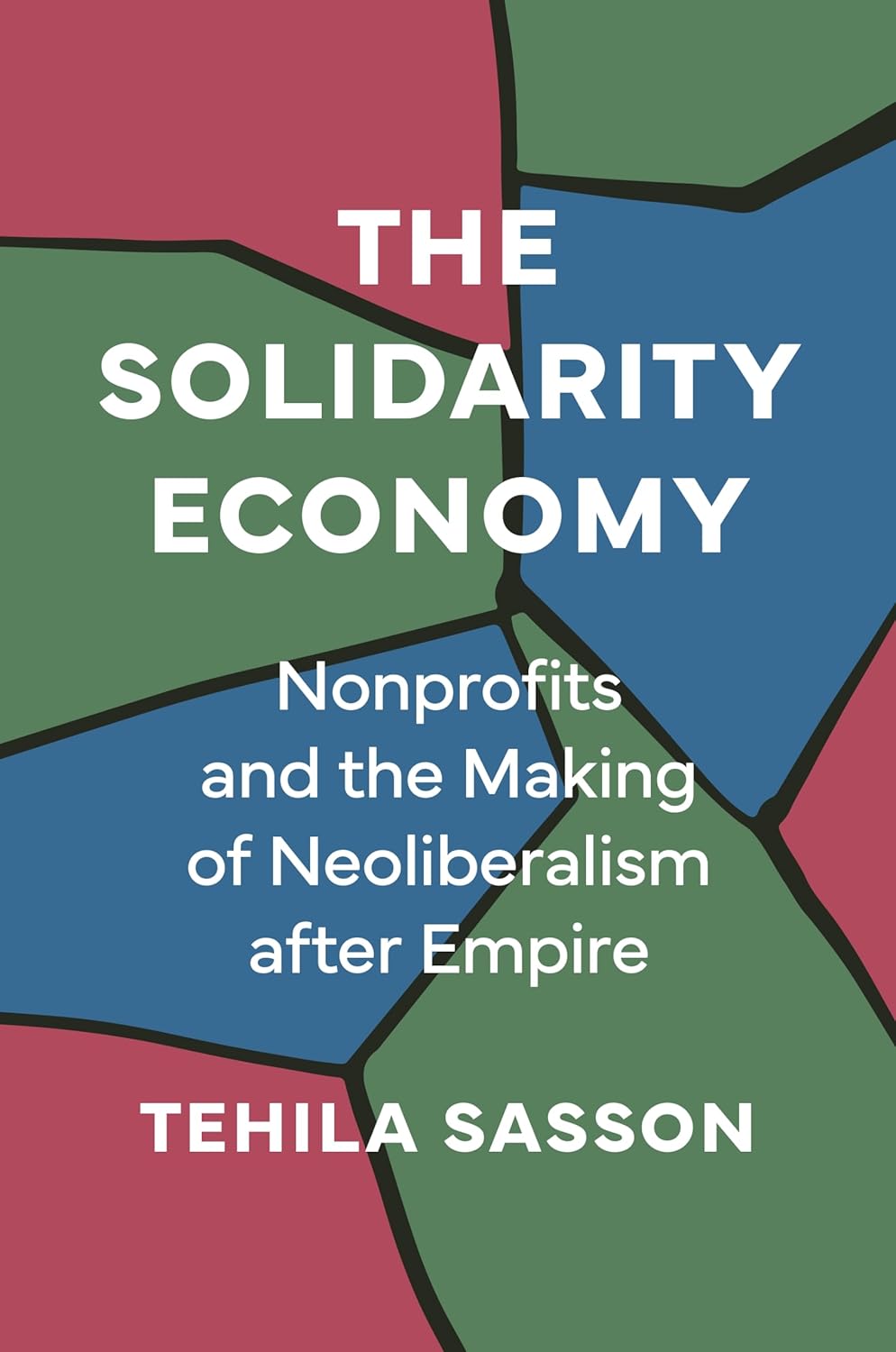
In this historical study with a contemporary perspective, Tehila Sasson details the efforts of the charitable and nonprofit sectors to promote economic development in the ‘Third World’ after 1945. Despite pejorative connotations, ‘Third World’ is appropriate terminology given the historical context. The book is based on copious research, evident from a 30-page bibliography, with six chapters ambitiously traversing a range of issues from international development, corporate social responsibility, fair trade, environmentalism, and neoliberalism. In recounting a typology of global activism linking environmental, economic, and social issues, thematically the book oscillates between development theory, organisational history, and microeconomic business models.
Sasson considers post-imperial Britain from the perspective of the nonprofit sector rather than elitist high politics or the industrial struggles of trade unions. She aims to demonstrate the ethical dimensions of Britain’s post-imperial role after 1945, a role predicated on the assumption that global underdevelopment and inequality owed something to imperial authority, with resource control and allocation serving the metropolitan core rather than the colonial periphery.
Sasson demonstrates how a moralistic view of capitalism drew on cross-currents in British socialism such as Christian Socialism, the anti-modernity of William Morris, and craft-based Guild Socialism. It was not mere antiquarianism, though revival of interest in these ideas after 1945 was undoubtedly eclipsed by the big battalions of trade unionism, State socialism, and Keynesian demand management.
The development theorist E. F. Schumacher is a prominent figure throughout. Through his experiences in Burma and India, Schumacher was converted to Gandhian ‘Village Economics’, encompassing promotion of cottage industries, indigenous manufacturing, and small-scale farming. Rejecting an expansive Statist, Keynesian path to economic growth, Schumacher, in his most famous work Small is Beautiful (1973), envisaged an incremental, environmental development strategy using intermediate technologies and close control of resources (pages 37-38).
The popularity of these ideas within the British Left was not readily apparent, with a reimagined capitalism based on humanised production and responsible consumption slow to emerge. While a general dissatisfaction with industrial capitalism was evident, the idea that ‘small is beautiful’ was influential is problematic. It is easy to mistake the shadow for the substance, for despite an ideological vibrancy spanning a spectrum from Gandhi to the Angry Brigade, such ideas were variable in their impact and influence. The Left, broadly defined, remained predominantly Statist in its economic thought and direction at least up until the 1970s, though the ‘New Left’ in the following decades absorbed some of these ideas.
Ethical socialism was also largely extra-parliamentary, sourced from intellectuals like R. H. Tawney and Richard Titmuss. Tony Crosland was one of the few leading politicians to advance the idea that foreign aid was vital to the internationalist conscience of the Wilson/Callaghan Labour Government of 1974-79. However, by the mid-1970s he faced a formidable alliance of a gatekeeping Treasury and a Chancellor and Prime Minister fully prepared to jettison Keynesian orthodoxy and high government spending. Domestically, business-minded ideas of industrial democracy, going beyond nationalisation to co-ownership and corporatism, were largely unsuccessful. The charitable sector enjoyed more success in lobbying for and achieving tax exemptions, and resisting the imposition of VAT arising from EEC membership in 1973.
While changing notions of foreign aid by respective governments would have been a fruitful line of inquiry, the focus of the book leans more towards charting the growth of consumer activism, through organisations such as War on Want and Oxfam. The counter-culture of the 1960s, notably incorporating women and the family, distinct from masculine trade unionism, created notions of the ‘Citizen-Consumer’. It was a concept that gained traction with the development of charity shops, where a closer connectivity between donors and recipients represented a departure from the rather disheveled and informal antecedents of jumble sales and church bazaars.
At least initially, there was something of a middle-class character to shop locations, volunteers, and clientele. Campaigns to raise awareness were complimented by a new vocabulary of ‘Consumer Sovereignty’ and ‘Global Citizenship’, with emotional appeal heightened by sophisticated marketing, branding, and advertising tools. Oxfam ‘Slimming Clubs’ offered a lifestyle focus, of dieting and fundraising, though global food scarcity and famine make this appear, in hindsight, an awkward, even crass, juxtaposition. The first Oxfam (Oxford Committee for Famine Relief) shop aimed at tackling domestic poverty, and incentivising Third World production and development. This was a business model which required work. Sasson recounts how Oxfam couldn’t locate native-made handicrafts, and ‘resorted to buying foreign goods from wholesalers’ in Britain, which were then designated as handicraft goods (page 78). These morally questionable actions appear to violate consumer transparency and trading standards, but more seriously, this strategy was vulnerable to the criticism of entrenching inequality and stifling development.
Sasson concedes that the business model of the charitable sector became more calibrated towards satisfying British consumers (page 84). The lines between means and ends, between business operations and ethical objectives, became somewhat blurred. Criticism of Oxfam’s Bridge Programme, connecting Third World producers with British consumers, anticipated later critiques of multinationals with accusations of low wages, piece-rates, child labour, and poor working conditions (page 107). With an emphasis on product quality and competitive pricing, the Bridge Programme was touted as an entrepreneurial training-ground but success in less-developed ‘informal’ economies often proved elusive (pages 104-105).
Indeed, the extent to which development could be achieved by a ‘bootstrap’ approach is debatable. Handicraft manufacturing and micro-financial projects were often difficult to scale, resulting in entrenched underdevelopment and solidified relative poverty and lower living standards. Development strategies that shunned national macroeconomic planning always ran the risk of an outcome whereby infant industries would remain infants!
Some might argue for a flaw in the development model, with sustained growth not merely a matter of possessing capital, knowledge, and resources, but also dependent on a myriad of financial, political, and cultural factors. It all seems a long way from Walt Rostow’s claims for an inexorable modernisation model in The Stages of Economic Growth: A Non-Communist Manifesto (1960). In a politically-charged Cold War text, Rostow had argued for the transformative power of Western capitalism, whereby aspirational countries could capture the magic formula of modernity by emulating Western economic development, innovation, and entrepreneurship. As traditional societies were not so easily transformed, by Keynesian or more incremental means, such a view was overly optimistic and simplistic. In any case, many Third World governments and charitable organisations were hostile to the imposition of Western patterns of development or economic thought, often viewing it in neocolonial terms. Hence, by the 1970s, development was conflated with the less ideologically-charged term ‘modernisation’ rather than Westernisation.
In that sense, it is unfortunate that Sasson doesn’t tackle the issue of the governance of less-developed countries. We don’t have to take the position of Peter Bauer (that foreign aid is money taken from poor people in wealthy countries and given to wealthy people in poor countries) to acknowledge the diversity of political and financial arrangements in less-developed countries. Examining political culture and financial incentives and initiatives would have provided an evidential acknowledgment of the ethical complexity of trade, aid, and development issues. Equally, while recounting widespread failures, the author might have considered post-1945 economic successes using market-based solutions.
Regrettably, there are a number of avoidable errors within the text. Some are typos: ‘Tori’ for ‘Tory’ (page 49), while Chris Patten, Minister for Overseas Development, 1986-1989 is misidentified as ‘Chris Patterson, Minister for Overseas Aid’ (page 187). Similarly, Ken Livingstone was not an MP and Mayor of London simultaneously, as implied by the text ‘London Labour MP mayor Ken Livingstone’ (page 174). The 1984 Band Aid record was not the ‘very first charity song’. George Harrison’s ‘Bangla Desh’ in 1971 claims that honour (page 141). More substantively, it is questionable whether Britain in the 1970s can accurately be described as ‘deindustrialized’ (page 80), or whether the Conservative Party can be described as ‘neoliberal’ given the struggles Margaret Thatcher faced throughout her leadership with the noblesse oblige section of the Party (page 187).
While unfortunate, these errors don’t undermine the positive attributes of the book. While at times the arguments are somewhat diffuse, Sasson presents a thought-provoking account of ideas coopted or diverted from their original high-minded, idealistic objectives. Her assertion that nonprofit activity has often provided a respectable imprimatur for continuing global inequality, poverty, and hunger is the leitmotif of the book. Hence, we’ve come full circle, with the continuing relevance of the term ‘Third World’ testimony to the relative absence of transformative change.
‘The Solidarity Economy: Nonprofits and the Making of Neoliberalism after Empire’ by Tehila Sasson was published in 2024 by Princeton University Press (ISBN: 978-0-691-25038-0). 289pp.

Gordon Bannerman is a professor teaching Business History at Wilfrid Laurier University, Canada. His primary research interests focus on modern British political and economic history.