
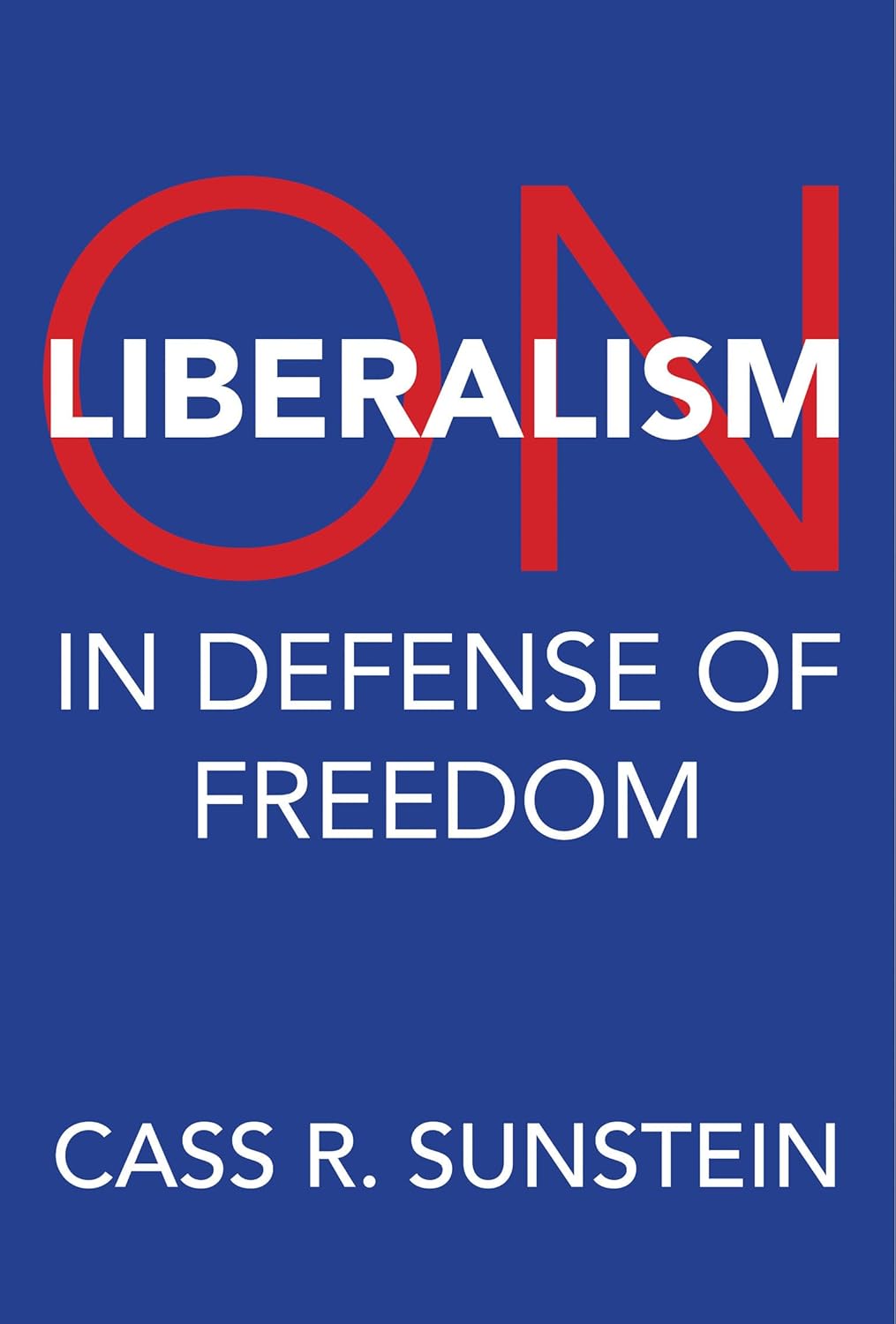
Cass Sunstein has written what may be the most lucid and unembarrassed defense of liberalism in recent memory. On Liberalism is at once a philosophical meditation, a political testament, and a quiet act of intellectual recovery. In an age when the word ‘liberal’ is either wielded as an accusation or whispered with apology, Sunstein offers something rare: a confident, humane, and historically informed affirmation that liberalism remains the best moral and political framework we have.
‘Festschrifts’ may be uneven, but manifestos rarely are—and this short, tightly reasoned book is nothing if not a manifesto. Sunstein begins from the premise that liberalism, properly understood, is not the ideology of any faction but a moral vision grounded in freedom, equality, and dignity. ‘Liberalism is a big tent,’ he writes, ‘but it is also a fighting faith.’ His is a creed of pluralism and restraint, of reasoned disagreement and institutional humility. Throughout, his tone is that of the patient teacher rather than the polemicist: confident without arrogance, passionate without bitterness.
A Catechism of Liberal Virtues
Sunstein structures his argument around six cardinal principles: freedom, pluralism, security, equality, the rule of law, and opportunity. Each principle receives a concise yet profound exploration, enriched with historical insight and contemporary resonance. This is no abstract taxonomy; it reads more like a meditation on civilization itself. Sunstein insists that these values were not conjured from ideology but forged through centuries of moral conflict and political experiment. They are, he reminds us, ‘the slow achievements of human decency.’
He returns repeatedly to his intellectual hero, John Stuart Mill, whose On Liberty becomes for him the liberal catechism. Sunstein’s Mill is not the sterile rationalist of caricature but a passionate moral romantic, convinced that individuality is the flame that sustains civilization. The passages on Mill’s courage—his insistence on defending free thought even when it scandalized his age—are among the most stirring in the book.
Hayek and Rawls also make appearances, not as combatants but as partners in conversation. Sunstein treats Hayek’s spontaneous order and Rawls’s distributive justice as complementary rather than contradictory. This capaciousness of spirit is one of Sunstein’s chief virtues. He refuses to reduce liberalism to a party platform. Like Mill’s, his liberalism is both moral and experimental: an ongoing inquiry into how human beings can live together without coercion and with dignity.
Freedom, with Seatbelts
What distinguishes On Liberalism from other recent defenses of the creed—Fukuyama’s or Pinker’s, for instance—is its realism. Sunstein’s liberalism is neither sentimental nor technocratic. It is, in his own phrase, ‘freedom with seatbelts’: confident in human agency but mindful of its limits. The author of Nudge remains attentive to the psychology of choice, arguing that freedom is not mere non-interference but the cultivated ability to make good decisions within a just and enabling framework. Markets, he insists, are indispensable to liberty, yet they must be tempered by law and animated by conscience.
This realism extends into his treatment of governance. The discussion of Franklin D. Roosevelt’s ‘Second Bill of Rights’ is exemplary. Sunstein interprets these social and economic rights not as a betrayal of classical liberalism but as its completion, a recognition that liberty without security can be a cruel illusion. Here his liberalism proves both moral and muscular, insisting that compassion and competence are not opposites but allies.
The Spirit of Generosity
What gives this book its particular charm is its tone: Sunstein writes as a moralist in the best sense—not to lecture, but to elevate. Quoting Germaine de Staël’s call for ‘a lever against egoism,’ he suggests that liberalism, rightly understood, is an ethic of generosity. Freedom requires self-restraint; tolerance is not indifference; civility, far from weakness, is a civic virtue.
He is at his most eloquent when he turns from theory to temperament. Liberalism, he argues, is not only a political creed but a psychological posture: a preference for conversation over coercion, persuasion over purity, humility over hysteria. He concludes one reflection with Rawls’s understated line from A Theory of Justice: ‘Purity of heart, if one could attain it, would be to see clearly and to act with grace’—a sentence he takes as the very essence of the liberal spirit.
A Liberalism for the Twenty-First Century
The later chapters engage the challenges of our present age: populism, nationalism, digital tribalism, and the collapse of trust in institutions. Sunstein does not scold; he reasons. Liberalism, he concedes, has sometimes seemed weary or complacent. Yet its promise remains the most humane path between authoritarian discipline and revolutionary fervor. What is needed, he suggests, is ‘freedom with fire’—a moral energy without moralism, conviction without cruelty.
In his closing ‘Epilogue: Fire and Hope,’ Sunstein sounds almost pastoral. Liberalism, he writes, ‘is not a creed of cold reason but of faith in improvement—faith that reason and decency can coexist.’ That faith may seem quaint today, but Sunstein wears it with sincerity and grace. His optimism is not naïve; it is hard-won.
The Trouble with Liberalism (and Why It’s Still Worth It)
And yet, the reader may feel a lingering unease. Liberalism’s problem has never been its ideals but its optimism—that freedom and equality, individuality and solidarity, can always be harmonized. Sunstein’s ‘big tent’ sometimes feels like a moral circus: everyone is welcome, provided they follow the rules. Liberalism’s greatest temptation is procedural perfection, the belief that decency can replace depth. When politics becomes mere management and conscience mere sentiment, something vital withers.
Still, this is not an external critique but a filial one. Sunstein himself acknowledges liberalism’s contradictions as inseparable from its vitality. On Liberalism is both defense and confession: an admission that the creed is perpetually unfinished, forever balancing liberty and order, reason and passion. The miracle, he suggests, is not that liberalism has survived its crises—but that it continues to offer a vocabulary of hope in an age of exhaustion.
On Liberalism is not a book for cynics or ideologues. It is a work of intellectual courage, written with clarity, warmth, and historical intelligence. Sunstein’s liberalism is moral without moralism, rational without reductionism, principled yet pragmatic. The book deserves to be read by anyone who believes that the center of civilization is still worth defending—not because it is safe, but because it is, however precariously, free.
In the end, Sunstein’s liberalism is less a political doctrine than a moral temperament: a quiet faith that humanity is improvable, that reason can temper rage, and that freedom, properly tended, can still burn bright—without burning down the house.
‘On Liberalism: In Defense of Freedom’ by Cass R. Sunstein was published in 2025 by The MIT Press (978-0-262-55018-4). 186 pp.