
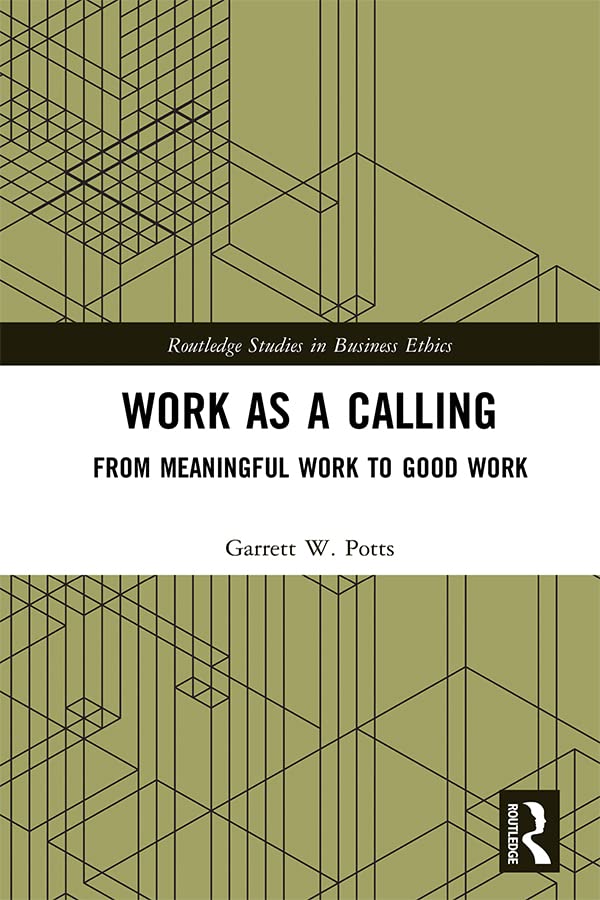
In Work as a Calling, Garret Potts (Professor in the Department of Religious Studies for Business & Healthcare Professionals at The University of South Florida) asks: ‘could it be the case that many modern people prevent themselves from experiencing the fulfillment that they hope for by focusing so much on themselves’ (page 16)? He answers this question by arguing for a return to the moral vision of work as a calling, whereby ‘meaningful work’ is ‘good work’ that pursues the common and individual good together. Influenced strongly by the work of Robert Bellah et al. in the sociological classic Habits of the Heart, the author contends that the view of the calling orientation found there has given way to a view of calling based on self-interested rewards and individualistic concerns about how workers feel about doing good work.
The first two chapters show how the major academic literature on ‘work as a calling’ can be seen to have departed from the vision of Bellah et al. The author points out that ‘Contemporary notions of work as a calling stress that work should provide individuals with a deep sense of meaning and personal fulfillment. Such notions demand that work ought to be a therapeutic source of individual happiness’ and that ‘notions of “meaningful work” are often divorced from moral considerations about (a) good work (i.e., the production of excellent products/services), (b) the good of individual lives (including one’s very own), and (c) the common good of communities that one’s organization reaches’ (page 14-15). Thus, much of the existing literature sees a calling as being bound to identity exploration, such that accounts are centred on subjective fulfilment as distinct from the pro-social dimensions and communal goods that characterised traditional understandings. Even those authors who are critical of this trend ultimately themselves lapse into the individualistic outlook, or end up using its vocabulary. All of the leading authors in this field, while acknowledging their debt to Bellah, ultimately adopt an individualist position that is incompatible with his approach – incompatible because such an outlook both reduces pro-social tendencies and over-emphasises personal autonomy, with the result that notions of the meaningful life, ‘often construed in a consumeristic way, have become divorced from considerations about goods that are necessary for individual and communal flourishing’ (page 51).
Chapter 3 is a dense, theoretically heavy chapter that shows how heavily influenced Bellah’s vision of the calling orientation was by the practice-based theory of the virtues propounded by the philosopher Alasdair MacIntyre. MacIntyre’s thought is complicated but in essence it sees virtues as excellences or dispositions of character that enable us to serve and achieve the internal goods of certain practices, sustaining those practices and helping us to flourish as individuals and communities. For example, architecture, as a practice, requires the achievement of certain types of excellence (professional and technical skill, the use of the right materials and so on) in order to bring about certain goods internal to the practice, such as excellent houses – rather than simply profit, which, though a good, is an external one. Where practitioners focus on external goods instead of the internal goods, they risk falling into certain kinds of vice (such as greed) and the practice suffers (with the construction of shoddy homes). As such, those genuine goods which enable us to flourish – as individuals, as communities of practitioners and as a society – lie outside of ourselves. Indeed, our preferences and desires need to be ‘tutored’, as it were; we have to learn, within a practice – a living tradition that is maintained and passed on with its own standards of excellence – and by deliberation with others over ends, what things are genuinely good, rather than focus on the fulfilment of those preferences that we do in fact happen to have. The author draws on this approach to distinguish between a true calling and a fake one: a true calling cannot ultimately be based on the individual’s un-schooled preferences, for ‘meaning emanates from one’s shared participation in good work that genuinely contributes to the flourishing of individuals and communities’ (page 60). A true calling cannot treat work as a means to personal fulfilment; rather, it must involve good work within a community of practice and sound judgement, which results in genuine goods, such that work has meaning and value in its own right.
The fourth chapter looks at the social implications of the fake, individualist calling. In the modern, Western world (particularly the U.S.) working as part of practice-based communities reflecting on genuine goods or ends that ought to be desired has given way to a focus on individual autonomy, and this has left the individual as the locus of value, with the preferences that he or she happens to have. This individualism – as expressed in fake callings which centre on maximising the satisfaction of preferences or expression of the self – is mirrored at the organisational level with a focus not on genuine goods to be pursued together, such as excellent products, but on ‘effectiveness’, by which is usually meant the maximisation of profit or production. In both individual and corporate life, ends are simply given, therefore, and all reflection is on the means of achieving them. In our Western society, these ends are shaped by consumerism, such that the meaning in life is not based on the development of virtues centred on individual and common goods, but on ‘achievement’, ‘self-realisation’, wealth, or making something of oneself at work. However, as the author points out, the individualist approach does not deliver what it promises, for it would appear that the more people pursue such forms of ‘fulfilment’, the less happy and meaningful they find their lives and work to be and the greater the incidence of problems such as anxiety, or the feeling of not being valued as a person by one’s employer (whose attempts to keep staff happy seem to consist of solutions that distract from dissatisfaction and restlessness at work, such as the provision of pinball machines or ping pong tables). Thus, there are various consequences of the ‘junk’ values on which contemporary fake callings are based, and the author connects them with the fragmentation of individual lives, for example, and the ‘burnout society’ described by the philosopher and cultural theorist Byung-Chul Han.
In the final chapter, in an effort to show how it is possible to reclaim the kind of life envisioned by Bellah et al., Potts gives several examples across various sectors (such as education, retail, food and drink and cybersecurity, among others) of what he, following Robert K. Greenleaf, calls ‘servant leaders’, who live in accordance with a true calling, focusing on the genuine goods of their work rather than their own untutored preferences. He outlines some of their characteristics – such as empathy, seeking to persuade rather than coerce, striving to build community, choosing service over self-interest, for instance – with a view to showing that a true calling orientation is possible. For each example, the author shows why the person is following a true calling, often referring to MacIntyrean notions – for example, reflecting on genuine goods, participating in a practice-based community, or providing an excellent service that benefits a community – or showing how that person embodies the characteristics of a servant leader.
The book is at its best in the two final chapters as the author turns to the ‘real-world’ effects of the misconceptions surrounding work as a calling and meaningful work. The discussion is very interesting and extends far beyond the very short and incomplete summary provided here. These chapters should be of interest to readers with general interests in such issues and could be read in isolation from the earlier chapters centred on understandings of Bellah and his reliance on MacIntyre’s thought, which themselves have a far more limited appeal. The analysis would suffer from such an approach, however, because it is in light of those earlier chapters that readers can see precisely why the individualist approach to work as a calling is mistaken and why it is associated with the societal problems identified by the author. Similarly, one can see why the servant leaders described by Potts are chosen as examples. While there is real value in chapters 4 and 5 for readers concerned with wider questions of business purpose and meaningful work, the book is clearly a scholarly volume, aimed at an academic readership. In its entirety, therefore, it can really only be recommended for those with academic interests in these areas, as well as some grounding in MacIntyre’s neo-Aristotelianism and Bellah’s sociology.
Work as a Calling: From Meaningful Work to Good Work by Garrett W. Potts was published in 2022 by Routledge (ISBN: 978-0-36-772441-2). 164pp.

Neil Jordan is Senior Editor at the Centre for Enterprise, Markets and Ethics. For more information about Neil please click here.