
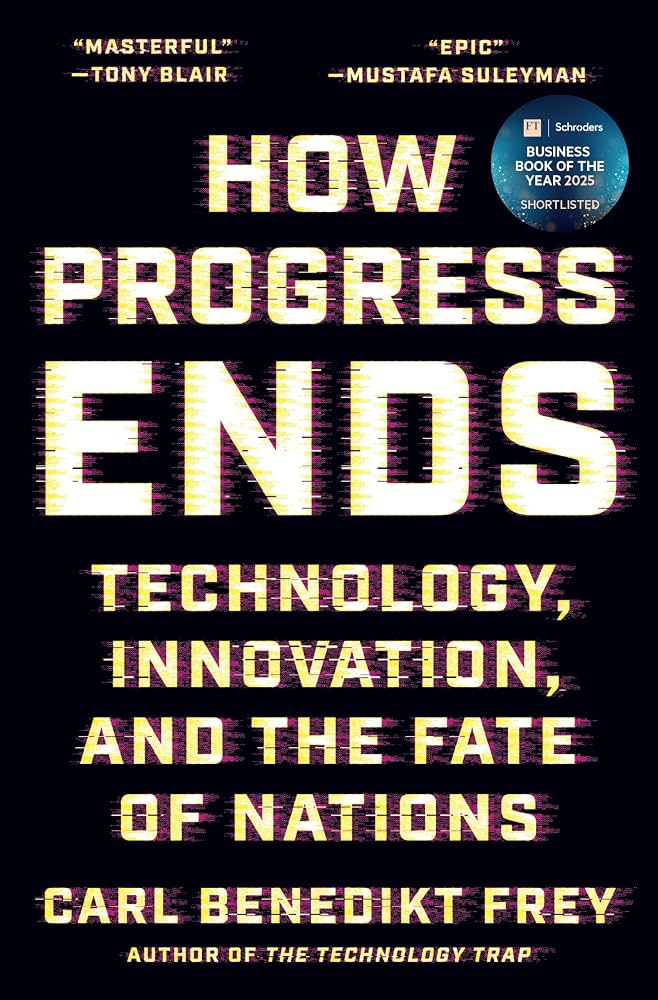
In How Progress Ends we are presented with a work whose ambition might best be described as monumental: Frey seeks to establish a thesis which holds good over the millennia of human experience – not only delving a thousand years into the past but projecting into the future of humankind. In this great endeavour he may have been emboldened by the global impact of a co-authored paper from 2013 in which he and fellow machine learning enthusiast Miake (then Michael) A. Osborne claimed a disturbingly precise 47% of US jobs were at risk of replacement through ‘computerisation’ as a result of growing cognitive AI capabilities. At the heart of these findings was the discovery that jobs with low cognitive requirements, attracting low wages and performed by those with low educational attainment, faced the highest vulnerability. While this prediction has not materialised (indeed, the US job market shows a net growth of twenty million since publication) the paper helped both fuel the fascination for AI investment and the author’s progress to the post of Associate Professor of AI & Work at the Oxford Internet Institute. This explains his interest in AI as a central component of this work: Frey stated in a lecture on the book delivered for the Oxford Martin School that ‘the key question, which is addressed in part here, is the role of AI’; that it is only addressed in part is perhaps forgivable given the challenging breadth of his chosen topic.
Societies and Progress
For Frey, it seems that progress is defined as innovation for economic growth and the book draws upon examples of technological advance and stagnation across a wide span of historical environments including Song China, the British Empire, Prussia, Japan and the Soviet Union, with innovation illustrated from the Industrial Revolution to the glory of US Silicon Valley triumphs. His argument is that, historically, nations have tended to choose between two political options: central or decentralised societies. The centralised systems are good for dissemination, while those which are decentralised are better at innovation. Perhaps not surprisingly, these two extremes only prove effective for a limited time as the original motivations of the innovators become encumbered with first corporate then state concerns arising from policy, scale or reach, and advantage is eroded wherever competition is allowed to exploit the opportunity. None of this is particularly groundbreaking.
We are invited into this debate through a single defining moment in the battle between the planned and the decentralised: when the USSR triumphed by getting the first man into space. Notwithstanding that both the US and the Soviet space programmes were based upon technology advances under the Nazi regime, it seems a somewhat shaky example on which to suggest the USSR placed societal progress (as understood in the West) as its priority.
To clarify this example we would be aided by some definition of progress but one is not forthcoming: instead, we deduce that ‘progress’ (however defined) is (or always should be) the ultimate end goal of states, nations and empires, and its end co-synchronous with theirs. Frey usefully previews the contents of the book in an early overview, and for many this should perhaps be more than enough. Yet sadly this overview still fails to set out any central framework or thesis; rather, the chapter structure begins by being roughly chronological, ranging through dynastic China, the rise of Europe, Prussia, Tsarist Russia, and America, then more thematic with aspects of the twentieth century, before finally focussing on the decline of wealth inequality following the millennium. It’s clearly a substantial ask for anyone to provide a satisfactory global narrative across a millennium in three hundred pages, and it cannot be said that Frey exemplifies the desirable clarity or skillset. Instead, we are presented with selected aspects of historic geopolitical entities in a manner that gradually (and not always subtly) nudges the reader towards the conclusion that we are here to learn a lesson from this central-decentralised discussion. The obvious danger with cherry-picking illustrations from such a bold sweep of history is always that individual narratives – even those which are entertaining or interesting – appear insufficient when used as pivot points for the overarching millennial narrative structure. Instead, what we are presented with is an object lesson in how economists can (ab)use history: as a bran tub of discrete historical eras to be deployed to illustrate a point, stripped of wider context and with superficial explanation. Indeed, there’s a worrying suspicion that the book may have been constructed backwards, from thoughts on how the USA and China will evolve over coming years, subsequently propped up on chapters of curated national experiences over the past one thousand years in an attempt to reverse-engineer an historic continuum upon which the narrative can sail. Overall, one gets the impression that the author is creating a constellation from a series of randomly chosen and at times not even particularly bright stars.
Not all the blame attaches to the author: one feels that If it had been edited with a firmer hand it could have been less tortuous read: the compilation of facts would have benefited from a structured attempt to correlate, while there is no real excuse for failing to ensure the book at least attempts to do what it says on the tin: sadly, the threat provoked by the title proves a chimera. A more honest title might have been ‘How different styles of state leadership have not always managed to sustain innovation over long periods of time.’
Overlooked Models of Progress
Instead, so keen is the author to find a place for his exemplars that the work sprawls to some four hundred overwritten pages, accompanied by a further one hundred pages of supporting material. Even so, the scale naturally fails to match the scope, and critically, exploration of counter arguments is largely absent. It might, for example, be posited that progress is somehow correlated with the age of any ’empire’ in question and fluctuates with its passage through the life-cycle with an initial phase characterised by conquest, followed by one of exploitation, then finally the more static challenge of bureaucratic management. Thus the martial conquers are replaced by innovative colonisers, who in turn give way to bureaucrats. The constant challenge of these latter is to address the threats from geopolitical rivals – and some further exploration of the importance of this distraction, might have replaced some of the extraneous stories from the history books. Frey does devote a useful chapter to re-evaluating the role of wartime rivalries in promoting technological advancement, and probably rightly tempers the claim of undoubted accelerated progress with the nuance that state demand was at the same time bureaucratic, inefficient, and relied on efforts from private individuals. Things, apparently, can often be more complicated than they seem at first glance.
Another aspect of these nation-empires which could have merited exploration is the role of the moral when assessing their contemporary ideas of progress. Frey begins his final chapter with the phrase ‘Our way to riches’ as a proxy for ‘progress’ – and yet the societies of the past saw many other ways of measuring progress than fiscal returns. If progress for Frey equates to wealth a great deal is missing from this already weighty tome. Progress in many societies has been evidenced in the form of universal suffrage, or the abolition of slavery or the introduction of state supported pensions – none of which innovations create wealth but all of which can without difficulty be badged as progress. By ignoring this moral dimension of social progress, the question of the importance the equitable in society appears not to concern the author.
Sources of Innovation – If Desired?
In the latter stages of the book there is perhaps a missed opportunity to look in detail at the contemporary effect of western governments’ strategic interventions in environmental policies – such as the UK’s Net Zero (which does not get a mention). Here we have seen both injections of cash and favourable tax regimes spawn innovative new enterprises across the multi-billion dollar green sector while simultaneously loading other businesses with compliance problems which erode profitability. We are aware these concerns are not being mirrored in China where there appear fewer environmental burdens to innovation alongside the unleashing of a dynamism associated with freedom of wealth creation. A parallel assessment would be useful considering how this has instigated moves by some western economies towards protectionism and the use of tariffs, which has rarely proved conducive to innovation.
Given the importance of AI to the author, there is a curious absence of reflection on developments in the US where enterprises have been seeking government engagement over recent years. These moves indicate what will happen when the innovators begin to feel unable to sustain the levels of debt required – and should the US financial system now require Federal assistance to sustain US AI’s progress to global dominance we are genuinely at an important inflexion point. And finally it would surely be valuable to establish without question the assumption implicit in this book that that nations themselves actually possess the will to innovate – or whether instead they find progress a fickle companion whose presence is merely courted?
A Study in Economics Rather Than History?
If not a history book, then perhaps this is intended for economists. Yet a further inescapable disappointment concerns the lamentable absence of data. Since economics is a science, it is obliged to provide some systematic approach which builds on observation and experiment. Instead, we have a small handful of sparsely populated graphs seeming scattered through the work as an afterthought. We are shown the collapse of Fiscal State capacity in China from 1100-1800 (page 43) which is immediately contradicted by the data on comparative capacity around the world (page 44) without acknowledgement or explanation. Much less controversial are a three-bar graph showing that the number of ‘knowledge societies’ across Europe increased from fifty to two hundred during the Age of Enlightenment (page 59) and a timeline of early-modern patents granted by the English and the Dutch (the former initially had more but later on did not). Later still, a US productivity histogram (measured over disparate time periods of 30, 50, 24, 10 and 17 years) demonstrates there were fluctuations over the past century (page 211). The inconsequential nature of the sum of the data evidenced contributes to a sense of unease similar to that encountered when following an inexperienced tour guide.
What ultimately hurts the book is that with a central question which reduces to ‘how might we balance innovation and bureaucracy?’ and an absence of quantitative analysis, we are left with illustrative examples which permit the most feeble of conclusions. The book ultimately fails to deliver on the hoped-for promise of predicting (or indeed explaining) ‘how progress ends’, and we’re left to ponder the potpourri of illustrations of success and failure in the hope that we might identify factors which have enabled the social changes which may loosely be identified as synonymous with ‘progress’.
It is hardly innovative to suggest that there is no single solution to creating an innovation-friendly regime. The question remains, are any of the exemplars cited real evidence of past attempts to do so? The answer would seem to be ‘not particularly’ – leaving us with the task of identifying what attributes (if any) to be found amongst these accidental successes and unintentional failures can be extracted to generate good practice when creating modern industrial policy.
How Progress Ends ultimately boils down to the notion that progress-oriented leadership will create an environment in which essentially decentralised innovation is simultaneously supported by some more or less centralised support mechanism to facilitate exploitation.
This, then, is neither a book for historians nor economists.
Tony Blair apparently read enough to describe it as ‘Masterful’: this may possibly help narrow down the nature of the reader to whom the text might appeal.