
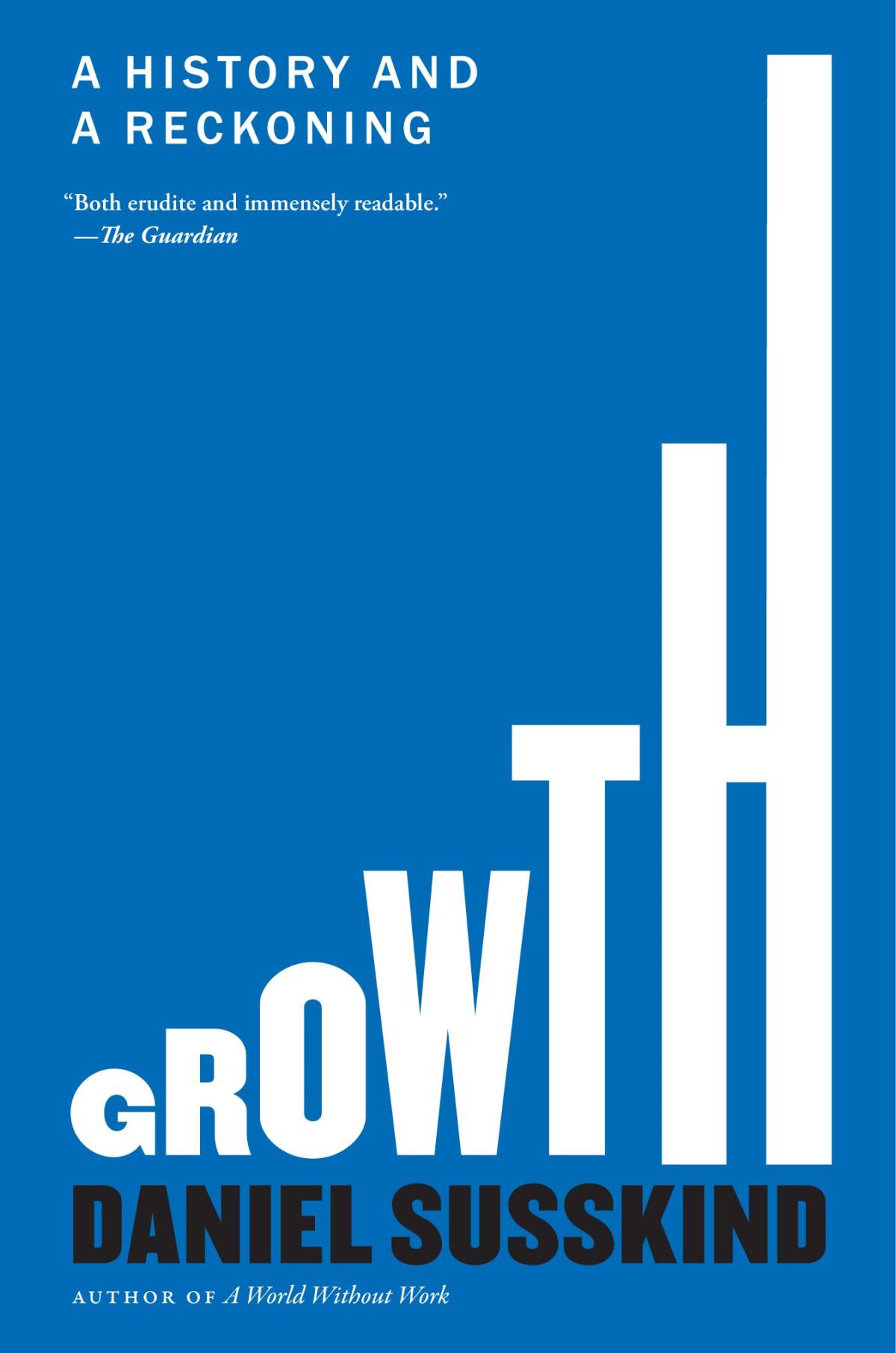
Anyone who follows the news in Britain, will have heard a lot about ‘growth’. Britain’s former Chancellor, Rachel Reeves, promised to turn the country into the fastest-growing economy in the developed world, while the last Prime Minister but three, Liz Truss, promised to take on the ‘anti-growth coalition’, even if she very quickly found that it was a lot more resilient than she could have imagined. Now that growth has largely disappeared, we spend more time discussing it than ever. And yet, in this timely and ambitious new book, Daniel Susskind, steps back from the debate, and asks some deeper questions. What is ‘growth’ anyway? Do we still need it? And if we do, how can we get it back on track?
At the start of his history of how output gradually started to expand, Susskind notes that ‘for most of the 300,000 years that human beings have been around, economic life was stagnant.’ Indeed, the standard of living of a Stone Age hunter-gathered and an 18th century labourer were remarkably similar. Over the last 200 years, something remarkable happened. Growth started to accelerate, and, once it started, it never really slowed down, even if there were inevitable bumps along the way. The result? We live in a world which, compared to any of our forebears, is marked by a material abundance that would have even relatively recently been unimaginable. There are lots of reasons for that, and in a comprehensive survey, Susskind identifies most of the factors that drove the sudden burst of prosperity. But what it really boils down to is this. It was driven by what he terms the ‘first industrial enlightenment – the first time that humankind engaged in the pursuit of useful ideas with a sustained intensity and moral seriousness.’
His conclusion is that it is basically knowledge and creativity that drives growth, and, as we embark on what may turn into the era of Artificial Intelligence, it is hard to dispute that. And yet, over the last few years, growth has been more contested than ever. In June, for example, the Global Justice Report led by the French economist Thomas Piketty proposed reducing the annual rise in GDP in the west to between zero percent to 0.5 percent to help create a fairer, more sustainable society, and that was just one example among many. In reality, the ‘degrowth’ movement is more powerful than ever. Championed by green activists such as Greta Thunberg, the ‘degrowthers’’ core point is that infinite growth is impossible on a finite planet. To Susskind, however, the argument is little more than failure of economic imagination. The ‘degrowthers’ treat the economy as a purely physical entity, ignoring the simple fact that growth is increasingly driven by intangible products. More seriously, ‘degrowth’ will quickly turn into a romantic euphemism for a deep global recession, and one that would permanently trap hundreds of millions of people in absolute poverty and require an authoritarian dismantling of western democracy to enforce. ‘There is no economic law which says growth promoting technologies must also ruin the environment, hollow out local communities, and rely on technologies we cannot properly control,’ he writes.
That is very true. Instead of condemning growth, the author is more interested in how we can revive it and give it greater moral purpose. There are, he argues, continual trade-offs that have to be made in any kind of economic policy, whether it is over the environment or the level of inequality we are willing to accept. Those decisions, he believes, are basically moral judgements, and can’t be left to the number crunchers calculating the quarterly GDP data, or technocratic officials. At one point, he suggests that discussion of the essential trade-offs could be made through ‘mini-publics’ or citizens’ assemblies, bodies where ordinary people work alongside the existing political system to make decisions that genuinely reflect broader society’s views about trade-offs. Well, perhaps. As it happens we already have a ‘citizens assembly’ – it is called a parliament – and we hardly need another one, especially as it could very easily be hijacked by special interest groups or hardcore activists. It would be far better if more politicians were willing to make a clear argument for growth, and why we need it, and what can be done to make sure it benefits everyone.
Those are minor quibbles, however. Susskind is writing for a global audience, and so, quite rightly does not trap himself in parochial arguments. A debate about ‘growth’ will be very different in Britain, or indeed most of the rest of Europe, where it has all but disappeared, than in the United States, or China, where economies are still expanding at a rapid rate. In the end, Susskind is a pro-growth optimist, firmly on the side of expansion and rising living standards. ‘For three hundred thousand years, humankind looked out on the future and saw what must have seemed inescapably bleak: a relentless, unforgiving struggle for subsistence,’ he concludes. ‘Modern economic growth has changed that.’ That is very true. We might be struggling to grow again, and many people have been questioning whether it is even worth trying. But as this excellent short guide makes clear, ‘growth’ is well worth having – and we will certainly miss it if it is gone for good.