
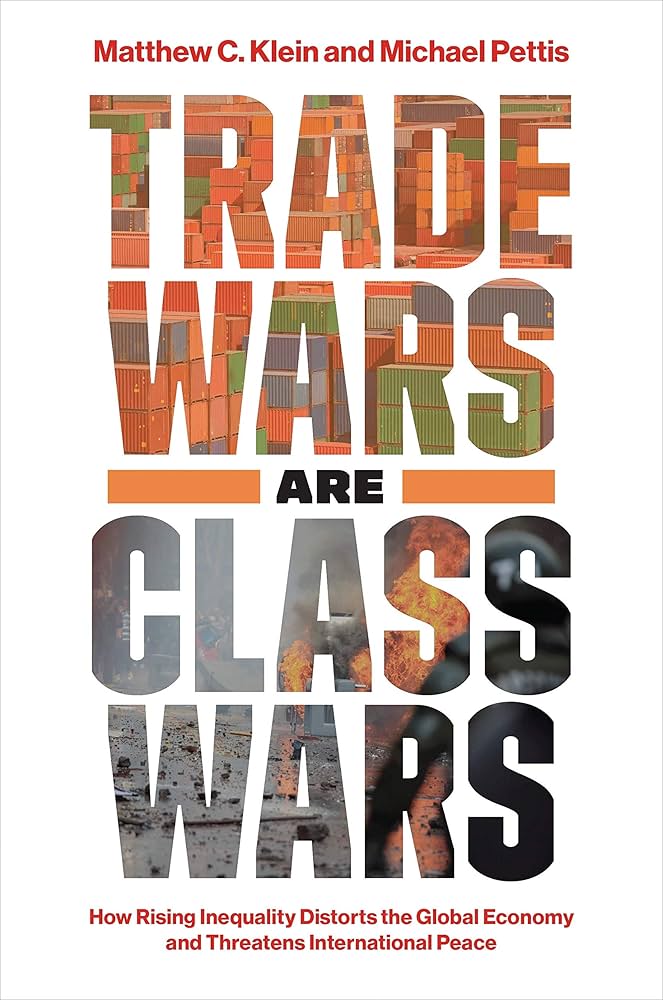
Matthew C. Klein and Michael Pettis’s Trade Wars Are Class Wars offers a bold reinterpretation of global trade tensions. Their central thesis is that trade wars are not the result of national rivalry, but of internal class conflict: rising inequality within countries suppresses domestic consumption, leading to excess production and savings that must be exported. This, they argue, creates trade surpluses and financial instability, which manifest as international conflict.
The authors draw heavily on the legacy of John A. Hobson, whose 1902 work Imperialism: A Study argued that inequality within nations leads to under-consumption and surplus capital, which must be deployed abroad—often violently. Klein and Pettis quote Hobson directly: ‘The struggle for markets… is the crowning proof of a false economy of distribution. Imperialism is the fruit of this false economy’ (page 6). They adapt Hobson’s insight to the modern global economy, replacing gunboats with financial flows and trade imbalances. As they put it, ‘The global concentration of income over the past several decades was responsible for slower growth in living standards in much of the rich world, worsening trade imbalances, and the global financial crisis’ (page xi).
The book’s strength lies in its detailed case studies of China, Germany, and the United States. In China, the authors argue, ‘systematic transfers of wealth from Chinese workers to Chinese elites distort the Chinese economy by strangling purchasing power and subsidizing production at the expense of consumption’ (page 3). They show how financial repression, the hukou system (the control of the labour force to keep rural workers away from high paying jobs in cities, to avoid slums), and underpaid migrant labour have created a surplus economy reliant on exports and overinvestment. In Germany, they trace the post-reunification wage suppression and fiscal austerity that shifted income from workers to capital owners, resulting in a massive current account surplus. ‘Germany’s leaders undermined what should have been one of the most positive transformations of modern times: the creation of a healthy, unified Europe’ (page 5).
The book’s framing—’class wars cause trade wars’—invites scrutiny. The authors lean heavily on a Marxian interpretation of capitalism’s internal contradictions, echoing Hobson’s critique of imperialism. But while Hobson’s theory was historically tied to colonial conquest, Klein and Pettis focus on financial flows and trade imbalances. The intellectual lineage is clear, but the mechanisms differ.
An alternative is that trade wars may stem more from regional inequality than class warfare. The rise of populism in the United States, particularly Donald Trump’s electoral success in economically distressed regions, points to a geography of grievance rather than a pure class divide. The authors acknowledge this dynamic in passing—’voters in congressional districts where many businesses made goods that competed with imports from China elected increasingly extreme representatives’ (page 2)—but they do not fully explore the spatial dimensions of inequality.
Moreover, the book’s thesis that capitalism is inherently unstable has not held up at the level of the nation-state. Advanced economies have experienced fewer recessions and more resilient growth than the Marxian tradition would predict. Nor has Hobson’s imperialism thesis endured: many developing countries, including China and South Korea, have achieved substantial economic development. Trade Wars Are Class Wars is thus another attempt to revive the instability thesis—this time through the lens of global trade.
The book’s weakness is thus attributing too much explanatory power to class conflict. Regional disparities, institutional choices, and political coalitions also play crucial roles. The authors’ framing may be rhetorically powerful, but it risks conflating correlation with causation.
The book is a valuable contribution to the conversation about global economic governance. It challenges the conventional wisdom that trade imbalances are entirely the result of national policy failures, currency manipulation or eccentric politicians, and instead points to deeper structural issues. For readers interested in the intersection of economics, politics, and international relations, it is a thought-provoking read.
Viewing the book from a biblical worldview is not straightforward, because states and economies are so different now compared with the ancient world. However, with respect to the ‘hook’ of finding another negative consequence of inequality, one comment can be made. The two-fold biblical denunciation of both poverty and wealth draw from their impact on people—material and spiritual—in a more direct way. The prayer of Agur in the book of Proverbs nicely nutshells a range of biblical material.
‘Two things I ask of you, Lord; do not refuse me before I die: Keep falsehood and lies far from me; give me neither poverty nor riches, but give me only my daily bread. Otherwise, I may have too much and disown you and say, “Who is the Lord?” Or I may become poor and steal, and so dishonour the name of my God.’ (Proverbs 30:7–9)
Thus, the God-dishonouring evils that arise from destitution and the God-forgetfulness of the rich are the more direct concerns from this passage. Trade wars in and of themselves are not very pressing evils, though of course their wide-ranging consequences may include them.
Klein and Pettis is a worthwhile read, but only with a few other books in the Jenga tower at the bedside. Those interested in economic affairs will want other books that emphasise causation running from trade to regional inequality and then onto inter-national struggles, together with a wider political economy alongside Klein and Pettis’s borrowings from Hobson. Those interested in the spiritual power of wealth, and the spiritual dangers of destitution could do with a Bible. Klein and Pettis offer a compelling narrative, but it is not the only one.
‘Trade Wars Are Class Wars: How Rising Inequality Distorts the Global Economy and Threatens International Peace’ by Matthew C. Klein and Michael Pettis was published in 2020 by Yale University Press (ISBN: 978-0-300-24417-5). 336pp.

Gordon Menzies is Associate Professor of Economics at the University of Technology Sydney and Chair of Economic Humanists – a group that brings Christian theology into conversation with mainstream economics.