
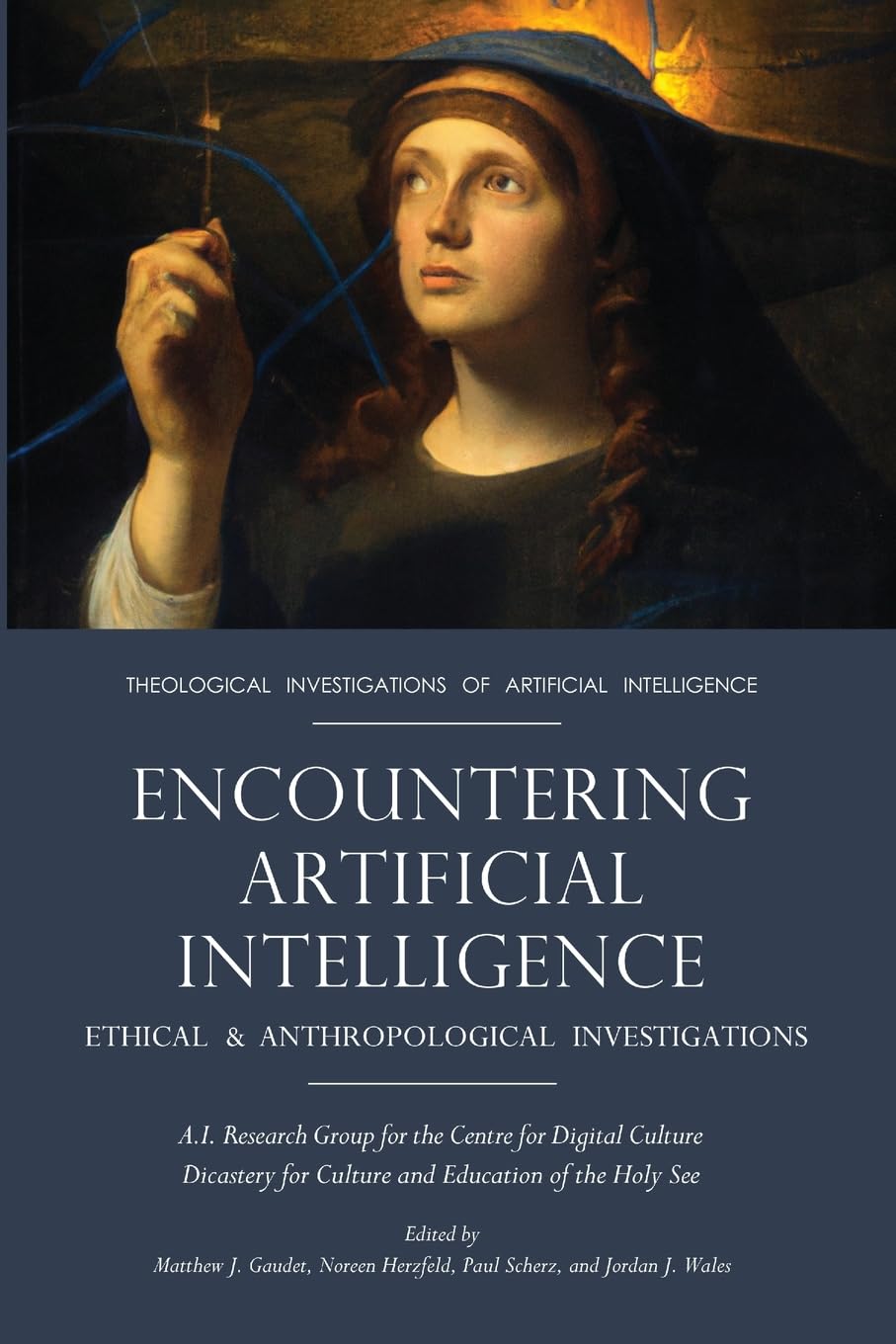
What has Silicon Valley to do with Rome? One moves quickly and breaks things; the other holds fast to timeless tradition. One seeks to maximise utility; the other seeks to preserve human dignity. One pursues technological salvation in this life; the other patiently waits for divine salvation in the next. Founded in disparate worldviews, motivated by different objectives and driven by divergent incentives, the Artificial Intelligence (AI) hubs of San Francisco Bay seem a world away from the ancient halls of the Vatican.
And yet, it is in this wide, surprisingly fertile, plain that Encountering Artificial Intelligence: Ethical and Anthropological Investigations clears the soil, plants the seeds and gently waters the green shoots of ethical and theological insight that have begun to bloom into a fruitful dialogue between Catholic social teaching and the development and use of AI.
Through a series of learned, thoughtful and perceptive reflections, the authors of Encountering Artificial Intelligence shine light on the possibility of positive-sum games between tradition and innovation, human dignity and prosperity, and right relationship with God alongside technological advancement. Neither naively credulous nor narrowly cynical, there is acknowledgement of both the great gift of technological advancement for human flourishing as well as the reality of human fragility and the attractive temptation towards an idolatrous worship of AI.
Why Should the Catholic Church Discuss AI?
Encountering Artificial Intelligence is the first fruit of multi-year collaboration between the AI Research Group for the Centre for Digital Culture, part of the Holy See’s Dicastery for Culture and Education, and the Journal of Moral Theology. Formed under the shadow of the COVID-19 pandemic in March 2020, the A.I. Research Group gathered a range of North American theologians, philosophers and ethicists for a series of discussions over three years on the promises and pitfalls of AI for our common life and society. Between the four lead authors and sixteen contributing authors, a valuable breadth and depth of insight permeate the writing. Pleasingly, Encountering Artificial Intelligence is only the first of three volumes in this new Theological Investigations of Artificial Intelligence book series.
The stated objective of the collaborators is to promote dialogue between the world of faith and the world of technology, between a culture of Christian humanism and a culture of positivism, to better discern the ways in which to be most fully human in our increasingly digital world. The volume is presented as akin to an ‘instrumentum laboris’ (working instrument), which communicates a general Catholic consensus on the emerging issue of AI while leaving space for further dialogue and discernment. It is an example of the Catholic social teaching principle of subsidiarity in action: the Church, alongside the rest of civil society, has a critical role to play in supporting state and market to understand and respond to the crucial cultural, legal and political issues of our time.
The open-hearted and open-minded approach of Encountering Artificial Intelligence is guided by the influence of Gaudium et Spes (1965), visible from the first footnotes of the introduction. Promulgated by Pope Paul VI in 1965 as a principal document of the Second Vatican Council, Gaudium et Spes (Joy and Hope) called on Christians to integrate ‘new sciences and theories […] with Christian morality and the teaching of Christian doctrine, so that religious culture and morality may keep pace with scientific knowledge and with the constantly progressing technology’ (Gaudium et Spes, 62). Through engagement with a variety of scriptural, traditional and intellectual authorities (from the Book of Genesis and St Benedict of Nursia, to the writings of British mathematician Alan Turing and the American sociologist Sherry Turkle), the volume responds to the call of Gaudium et Spes with a truly catholic, as in universal, appetite for knowledge and wisdom in its attempt to analyse AI in an authentically Christian fashion.
A helpful introduction sets the scene, establishing the longstanding Catholic embrace of the mutual benefit of faith and reason and firmly stating the compatibility of religious belief and scientific progress. For less tech-savvy readers, there is a succinct summary of the historical development of AI and a neat primer on the key concepts. Thereafter, a brief but significant chapter addresses the various ethical approaches being taken to AI, from human rights-based perspectives to more utilitarian calculus.
The book is divided into two main sections: Anthropological Investigations and Ethical Challenges with AI. These represent separate but connected lines of enquiry: what does it mean to be human in an age of AI, and how can we best respond to the threats, challenges and opportunities presented by AI across our personal and professional lives?
Anthropological Investigations
The emergence of AI has raised some fundamental philosophical questions about the similarities and differences between human nature and the nature of AI. What is AI? What is AI not? What does it mean to be human?
A chapter on ‘AI and the Human Person’ uncovers the deep Christian understanding of personhood and intelligence. Made in the image and likeness of God, the human person is deeply relational and intuitively intelligent in ways that imitate the divine life of the Trinity, and which transcend any of the impressive capabilities of AI.
A deep exploration of ‘Consciousness’ demonstrates its necessity for human relationality and rationality and the limitations of mechanistic arguments for AI consciousness based on physiology, behaviour or functionality. Consciousness, properly understood, involves a full grasp of reality, which allows for the authentic mutual encounter of another person and participation in the divine life of grace.
‘Encounters with Seemingly Personal AI’ offers fascinating analysis of the complex relational dynamics between humans and AI. While the prospect of employing AI models as a ‘good enough’ substitute for a friend or romantic partner can be attractive, any truly authentic mutual encounter between a human and an AI agent is impossible, not least because of the impossibility of mutual vulnerability. The authors caution against the use of AI in caring contexts, especially the risk of moral and relational deskilling through the loss of opportunities to grow in the capacity to care for others.
An intriguing section on ‘AI and Our Encounter with God’ reveals the limitations of AI as a tool in sacramental or spiritual mediation. Rather than succumbing to idolatry of AI as an omnipotent and omniscient source of spiritual truth, there is a call to reclaim a providential vision of human creation and salvation in which AI can only play a more minor assisting role.
In the face of significant philosophical challenges presented by our interactions with AI, the authors mount a strong defence of the irreplaceable magnificence of humanity. Formed in the imago Dei (image of God), intended for a life of relational self-gift with others, and empowered by grace to participate in divine life, human beings are uniquely different from any AI programmes.
Ethical Challenges with AI
Having provided greater clarity on the nature and purpose of AI, the authors turn to the practical ethical problems and possibilities posed by these new technologies.
A strong defence of the relevance of Catholic social teaching to the treatment of AI starts this section. Catholic understandings of human dignity, subsidiarity and the common good are highlighted as helpful resources for understanding and responding to the signs of these new times. Particular attention is paid to the late Pope Francis’ influential critique of the so-called ‘technocratic paradigm’, especially the modern-day temptation to exploit human beings as machines of efficiency and optimisation.
An expansive entry on ‘The Promises and Pitfalls of AI in Contemporary Life’ showcases the upsides and downsides of applying AI across different domains. From the prospect of AI-improved diagnostic and treatment applications to the potential for unequal access to AI to further entrench educational inequities, a realistic Catholic vision of both the limitations of human nature and the limitation of technology allows for an effective cost-benefit analysis of the adoption of AI across various fields.
In closing, an engaging reflection on ‘Recommendations for an AI Future’ proffers practical advice on living and working well alongside AI in new and changing contexts. Notable recommendations include the importance of offline creative activities, prudent regulation to limit the harms of AI programmes, and the need to incentivise better behaviour in our digital culture.
Legacy
Encountering Artificial Intelligence is an excellent start to this new Vatican-led, three-volume series of theological investigations into AI. It should surely serve as an essential textbook for Christian, and non-Christian, students of AI anthropological and ethical questions. The chapters themselves are worthy of standalone treatment, especially the rich anthropological reflections of ‘Encounters with Seemingly Personal AI’ and the extensive ethical coverage of ‘The Promises and Pitfalls of AI in Contemporary Life’. While these sorts of publications may typically tend to be of greater interest and importance to an internal Christian audience than an external secular audience, there is no reason why technologists, entrepreneurs and investors would not find some value in reflecting on these philosophical and ethical matters.
The impact of Encountering Artificial Intelligence has already been felt in the Catholic world, not least through its clear influence on the form and content of the landmark Vatican publication on AI, Antiqua et Nova: Note on the Relationship between Artificial Intelligence and Human Intelligence, which was published the following year in January 2025. Naturally, much more remains to be said in several areas of AI ethics. The emerging threats of AI hallucination and deception, the practical and economic effects of AI on the creative industries, and the ways in which our use of AI may reshape our methods and models of thinking, writing and communicating each merit closer attention.
Although Pope Leo XIV now carries the baton for the development of the Catholic Church’s engagement with AI, the influence of the late Pope Francis’s theology of encounter, which runs throughout this volume, is likely to loom large. As the late Pope Francis emphasised, there is a profound and persistent human desire for the ‘truly real’, which can ultimately only be experienced through authentic mutual encounter with another thinking, feeling and loving human being (Pope Francis, Fratelli Tutti, 33). Given that the phenomenon of ‘AI companionship’ seems to be growing from strength to strength, not least in its promise of risk-free relationships, there will be an equal and opposite need for the Church to communicate the enormous and irreplaceable value of risky but rewarding human-to-human relationships compared to the simulated substitutes supplied by AI models.
There is no shortage of AI coverage and commentary at present. Predictions, prognostications and prophecies of the future impact of AI abound in plentiful supply. Yet amid the heat of ever-evolving debate over job losses, regulatory options and corporate liabilities, there can sometimes be precious little light of insight. Here, through cohesive anthropology and coherent ethics, is where Encountering Artificial Intelligence bears fruit.
‘Encountering Artificial Intelligence: Ethical & Anthropological Investigations’ by the Dicastery for Culture and Education of the Holy See was published in 2024 by Pickwick Publications (979-8-385-21028-2). 274pp.

Naoise Grenham is a senior policy and research analyst for the Catholic Bishops’ Conference of England and Wales, where he advises Catholic bishops in areas of artificial intelligence, criminal justice reform and healthcare. He is one of the inaugural Edington Fellows of the Prosperity Institute in Mayfair, London, and serves as a Trustee for the national Catholic domestic charity, Caritas Social Action Network (CSAN).