
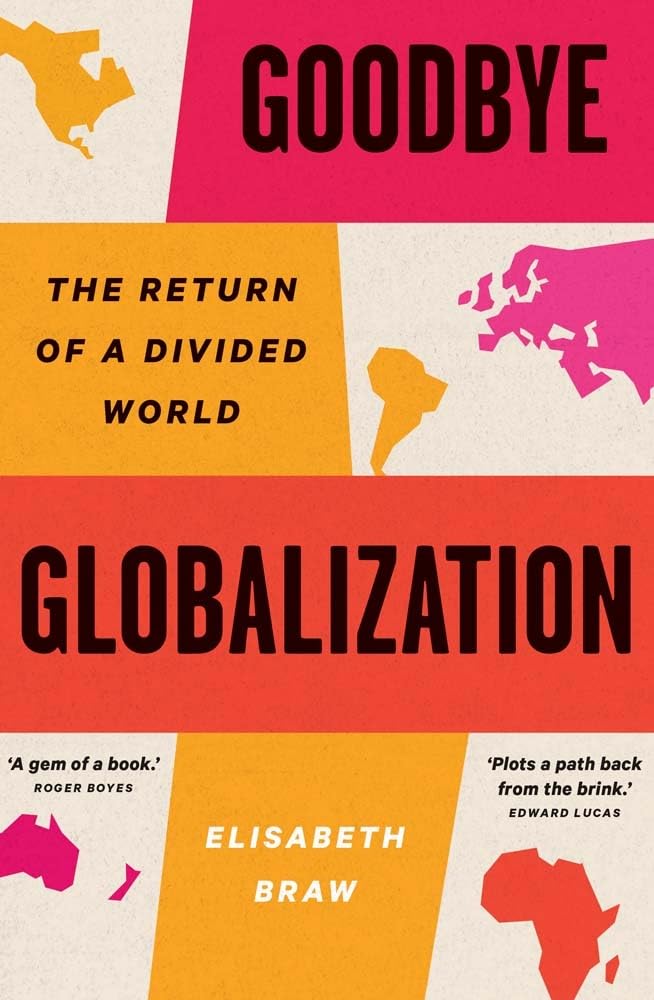
The timing could hardly be better. Elisabeth Braw’s Goodbye Globalization: The Return of a Divided World was published just as Donald Trump returned to the White House, and it has lost little of its pertinence in the year since then. And yet Braw, an Atlantic Council fellow delivers a deeper message. Trump isn’t the cause of deglobalization. He’s merely the symptom of a much deeper malaise that the Western establishment spent three decades pretending didn’t exist.
The book’s central thesis is brutally simple. The globalization project that dominated from the fall of the Berlin Wall until roughly the mid-2010s is already dead. Braw traces the story chronologically, from the giddy optimism of the 1990s through to today’s fractured world order. Back then, we were assured that opening up trade with China would inevitably lead to political liberalization. Beijing would discover the joys of democracy once its middle class got rich enough. Meanwhile, integrating Russia into the global economy would prevent any return to Cold War tensions. Financial deregulation would spread prosperity. Supply chains spanning multiple continents would deliver ever-cheaper goods to grateful consumers.
It all sounded fantastic in the economics faculties and corporate boardrooms. Out in the real world, however, it did not work out quite so well. Manufacturing workers in the West watched as their jobs vanished to China. Entire communities were hollowed out. The promised retraining programmes turned out to be worthless. The nineties offered plentiful opportunities, but there were plenty of people who were left behind.
What makes Braw’s account particularly valuable is her willingness to name names and tell human stories. This isn’t some dry academic treatise. She’s spoken to executives, policymakers, and ordinary workers across the globe. The result is a book that comes vividly to life with the full cast of characters who shaped this era.
The financial crisis of 2008 should have been the wake-up call that something was not working. Instead, the elites doubled down. Yes, there were problems with financial integration, but surely the answer was more regulation, not less interconnection? Then came Brexit. Then Trump’s first presidency. Then Covid, which revealed just how dangerously dependent Western nations had become on Chinese manufacturing for everything from pharmaceuticals to personal protective equipment. Russia’s invasion of Ukraine, with tacit Chinese support, delivered the final blow. Suddenly, all those smart people who’d been lecturing us about the virtues of economic interdependence had to confront an awkward reality: authoritarian regimes don’t share our values and will happily weaponize trade relationships when it suits them. Who could have guessed?
Braw documents how China has used its dominance of supply chains and critical materials to pursue strategic advantages. An increasingly authoritarian China’s control over products and materials needed for the energy transition has created dependencies that Western governments are only now scrambling to address. But it’s rather late in the day to suddenly discover that outsourcing your entire industrial base to a geopolitical rival might have downsides.
The book excels at explaining why plenty of leaders have concluded that globalization simply isn’t working anymore. Supply chains are vulnerable. National security has been compromised. Domestic social cohesion has frayed as entire regions were sacrificed on the altar of cheaper consumer goods and fatter corporate margins. So what comes next? For Braw, the answer is ‘friendshoring’. The idea is straightforward: trade should continue, but primarily with countries that share Western values of human rights, free markets, and the rule of law. Build supply chains through allied nations. Accept that this will mean higher costs, but gain security and resilience in return.
It’s a sensible enough prescription, though one can’t help wondering if it’s practical. Most countries quite sensibly want to trade with everyone. Consumers choose the best value products, which is precisely why Chinese electric vehicles are proving so popular despite Western politicians’ huffing and puffing. Raising tariffs to force friendshoring will increase costs for ordinary people and risk making Western industries permanently uncompetitive. Likewise, the Trump administration seems keener on battling with Europe than China. There is not much sign of ‘shared values’ in its tariff schedules.
Still, Braw deserves credit for facing up to uncomfortable truths. The West was naive and arrogant in assuming liberal democracy would inevitably spread alongside McDonald’s franchises. The assumption that economic integration would automatically produce political convergence was always wishful thinking dressed up as sophisticated analysis. The book won a gold medal at the 2024 Axiom Business Book Awards, and it’s easy to see why. This is sharp, well-researched work that cuts through decades of conventional wisdom to explain how we arrived at this fractured moment. Braw writes with authority but also wit, making complex geopolitical developments accessible without dumbing them down. As Trump imposes sweeping tariffs and the EU erects barriers against Chinese imports, we need clear-eyed analysis of what deglobalisation actually means for economies, businesses, and ordinary people. Braw provides exactly that.
Her conclusion is bracing: the world is dividing once again into competing blocs, but international cooperation remains possible if we’re more realistic about who we’re dealing with. The era of naive globalization is finished. What replaces it depends on whether Western nations can rebuild industrial capacity, strengthen alliances, and accept that cheap stuff from authoritarian regimes comes with a price tag that goes far beyond the sticker on the shelf. It’s going to be expensive, difficult, and politically fraught. But then, perhaps we should have thought of that before we outsourced our future to Beijing.
‘Goodbye Globalization: The Return of a Divided World’ by Elisabeth Braw was published in 2025 by Yale University Press (ISBN: 978-0-300-28263-4). 352pp.)

Matthew Lynn is an author, journalist and entrepreneur. He writes for The Daily Telegraph, The Spectator and Money Week, is the author of the Death Force thrillers, and is the founder of Lume Books.