
Introduction
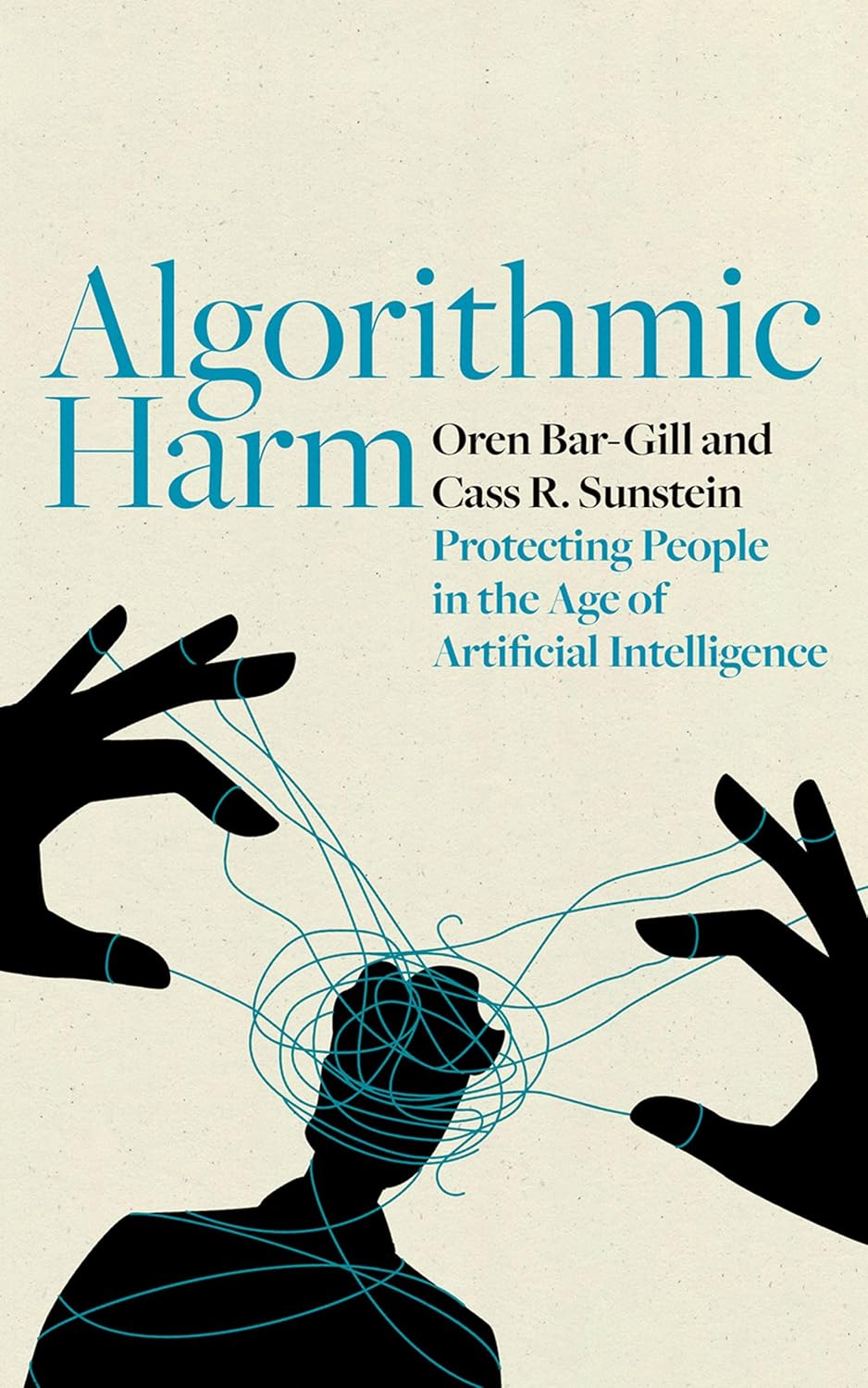
The question of whether artificial intelligence will help or harm ordinary people sits at the centre of some of the most consequential policy debates of our time. In Algorithmic Harm, the authors, Oren Bar-Gill and Cass R. Sunstein bring both rigour and accessibility to a subject that too often generates more heat than light. The book is neither a celebration of algorithmic innovation nor a counsel of despair. Its ambition is analytic: to identify precisely when and why algorithms cause harm, and to propose regulatory responses proportionate to those specific conditions. In that sense, it is a timely and disciplined intervention in a debate that is frequently distorted by ideological excess at both ends of the spectrum.
Summary of Argument and Content
The book’s organising framework is a distinction between two types of consumer markets. ‘S markets’ are populated by sophisticated consumers – those with sufficient information and the rational capacity to use it effectively. ‘U markets’, by contrast, are populated by unsophisticated consumers who either lack relevant information or are subject to behavioural biases such as unrealistic optimism, present bias, or availability bias. The authors are careful to note that this is a shorthand: when they speak of S and U consumers, they should be understood as referring to the likelihood of mistakes rather than fixed categories of persons. Nevertheless, dividing the analysis in this way allows them to advance a clear overarching conclusion: ‘algorithmic differentiation is generally beneficial in S markets but often harmful in U markets.’
The book is structured in three parts. Part I focuses on algorithmic harm in consumer markets and is the analytical core of the work, comprising seven chapters. These cover algorithmic price discrimination and its extensions, algorithmic targeting, algorithmically enhanced misperceptions, algorithmic coordination, race and sex discrimination and consumer-side algorithms. Part II turns to policy and law, addressing how regulators might intervene through disclosure mandates, algorithmic transparency requirements and a combination of ex post policing and ex ante regulation. Part III extends the analysis beyond consumer markets to labour markets and political markets, closing with a warning that democracy and self-government are also at risk and that the same framework of analysis applies.
The treatment of price discrimination is among the most sustained in the book. The authors demonstrate that where consumers are sophisticated, algorithmic price discrimination reduces consumer surplus while increasing overall efficiency. In U markets, however, the analysis shifts: the willingness to pay of unsophisticated consumers includes a misperception component, meaning that pricing algorithms trained on behavioural data may exploit distorted signals rather than genuine preferences. The Facebook example the authors cite is instructive here – a leaked internal document reportedly showed the platform identifying when young users felt stressed, defeated or anxious, and using those emotional states to micro-target advertising. This is algorithmic targeting at its most troubling: not merely personalisation, but the deliberate exploitation of psychological vulnerability.
The dynamic dimension of the argument is also significant. Over time, as sellers accumulate more data about consumers’ past behaviour, the degree of price discrimination increases. The authors flag the case of behaviour-based pricing (BBP), noting that consumers with lower willingness to pay – who are likely to be poorer – may, in some respects, benefit from BBP because lower prices allow them to enter markets they would otherwise be excluded from. The labour market chapter draws the parallel explicitly: employers, like sellers, are increasingly using AI to make or assist in hiring and wage-setting decisions, and the asymmetry of sophistication between employer and employee maps closely onto the seller-consumer dynamic explored in Part I.
On the regulatory side, the authors propose that policing algorithms – tools developed by regulators to monitor sellers’ pricing algorithms – could play an important role, noting that the actual number of commercially deployed algorithms is smaller than it might appear, with a handful of large technology firms and a small number of developers supplying the market. They also argue that regulatory approaches should be designed to remain relevant as technology evolves, rather than becoming obsolete with the next wave of innovation.
Critical Assessment
Bar-Gill and Sunstein’s analytical framework is genuinely valuable, and the S/U market distinction gives the book a clarity of argument that some of the writings I have read on AI and regulation lack. The progression from consumer markets through to labour and political markets is coherent, and the policy prescriptions – disclosure mandates, algorithmic transparency, and the development of regulatory policing algorithms – are grounded and reasonable.
Yet the framework has vulnerabilities that the authors do not fully reckon with. The binary of sophisticated and unsophisticated consumers, however carefully the authors caveat it, risks masking important gradations within the ‘sophisticated’ category itself. What an engineer understands about AI is not the same as what a product manager understands, which in turn differs from what a marketing executive understands. A consumer who is sophisticated about one domain of algorithmic activity may be significantly less so in another. The authors’ own observation that willingness to pay includes a misperception component is worth pressing further here: even informed consumers may suffer from confirmation bias or operate with bounded knowledge about rapidly shifting technologies. The disruption caused by DeepSeek’s emergence is one recent illustration of how quickly the landscape can shift beneath even technically literate observers. The ‘S consumer’ may be a more unstable category than the book seems to acknowledge.
There is also a structural assumption embedded in the analysis that deserves scrutiny. The behaviour-based pricing discussion largely treats consumer decisions as driven by willingness to pay and the presence or absence of misperception. But purchasing decisions are also shaped by circumstances entirely outside the algorithm’s model — emergencies, sudden changes in income or one-off windfalls. These exogenous shocks do not map neatly onto the S/U framework, and their exclusion risks overstating the predictive tidiness of algorithmic consumer profiling.
Questions and Observations
One question that lingers after reading this book is whether the regulatory architecture the authors propose is politically achievable within the currently flailing democracy systems, as it’s a generally known fact that governments play catch-up with technological advancements. The suggestion that policymakers develop policing algorithms to monitor sellers’ pricing behaviour is intellectually coherent, but it rests on assumptions about regulatory competence and political will that the current environment does not obviously support. In a context where major technology firms are significant funders of electoral campaigns and cultivate close relationships with elected officials, the appetite for robust algorithmic oversight may be structurally limited in ways the book does not confront directly. The authors recommend that regulatory approaches be designed to avoid obsolescence as technology evolves – a sound principle, but one that presupposes a regulatory body both technically capable and institutionally independent enough to keep pace with commercial AI development. In my opinion, that presupposition deserves to be stated and interrogated rather than assumed.
There is also a broader geopolitical dimension that sits largely outside the book’s frame. The framework is calibrated primarily to Western liberal market economies and the consumer protection traditions of the United States and European Union. How the analysis translates to emerging market contexts where regulatory capacity, data infrastructure, and levels of consumer digital literacy may differ is a question the book’s scope does not seem to address, but that a globally oriented reader will find pressing.
Recommendation
Algorithmic Harm is recommended reading for scholars of law, marketing, behavioural economics, business management/leadership and technology policy, as well as for policymakers and practitioners engaged with AI governance. Bar-Gill and Sunstein have produced a framework that is both analytically rigorous and practically oriented, and their extension of the consumer market analysis to labour and political markets gives the work a reach that elevates it above a mere academic work. Some readers will find the S/U binary simplistic, and the book’s engagement with the political economy of regulation could be deeper. But as a serious, evidence-based and accessible intervention in one of the defining debates of the present moment, this work appropriately contributes to contemporary discussions and deserves recognition within the field.

Akin Akinbusoye is a PMP-certified IT Project Manager at HAP Consulting LTD with over 12 years of experience specialising in digital transformation, IT sourcing, and technology investment optimisation. His professional interests lie at the intersection of technology implementation, business strategy, business ethics, and the policy implications of algorithmic systems in organisational contexts.