
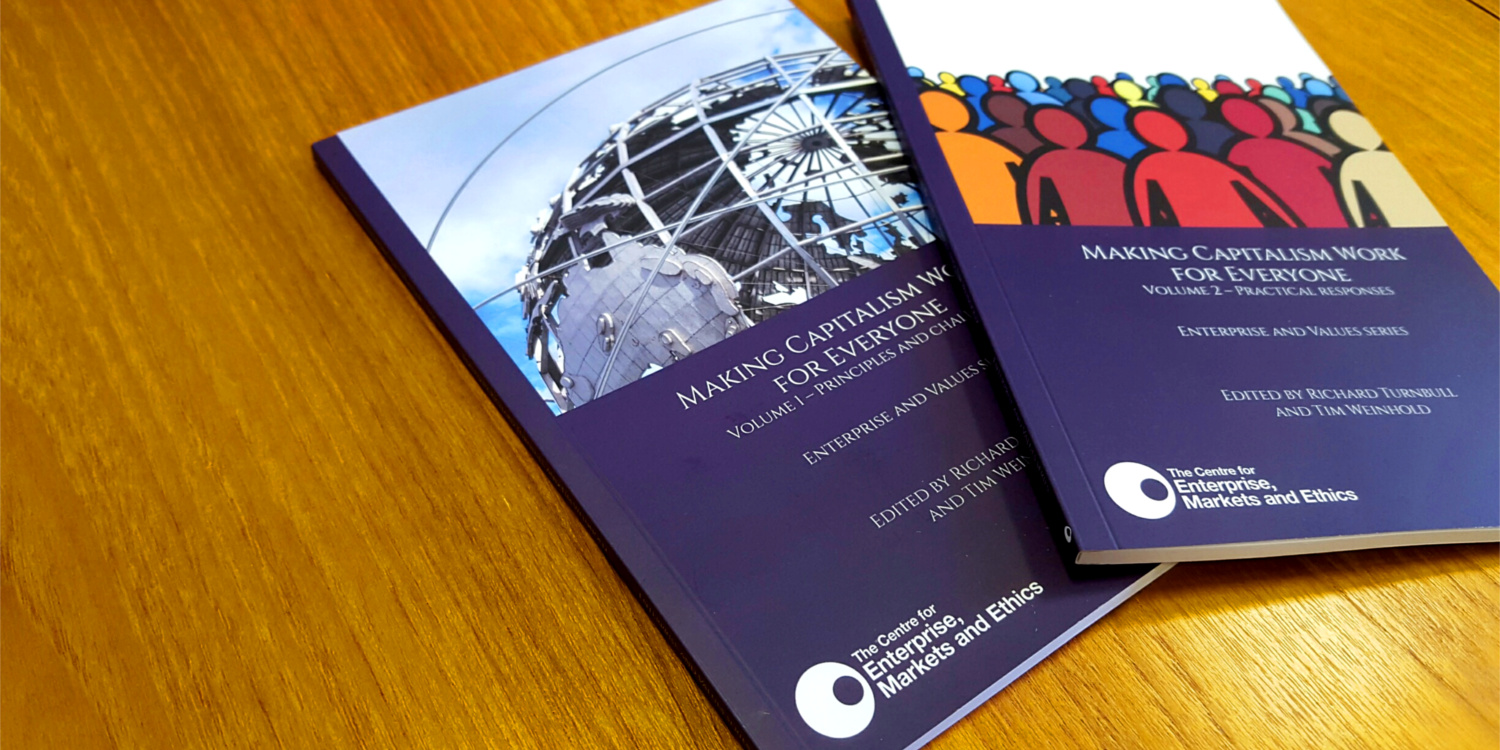
Chapter 3: Benefit Companies – A Pathway to the Future
The capital markets in the UK and many other countries are dominated by the doctrine of ‘shareholder primacy’. Under this concept, investors – including pension funds – seek to have each company in which they invest ‘maximise value’ by creating the greatest returns to shareholders. Unfortunately this narrow view of value can create great costs to society – what economists call ‘externalities’. Globally a tremendous amount of capital is subject to this system, encouraging the creation of systemic risks and costs. This phenomenon manifested itself in the recent financial crisis and is making it much more difficult to address climate change.
There is now a global movement to address this problem by passing ‘benefit company’ legislation. This corporate law reform gives companies the option to reject shareholder primacy and to be managed for the benefit of all stakeholders.
Problem identification illustrates the path to a solution
Business has become the most powerful force on the planet, and capitalism is the system under which we invest and steward business capital. The UK, to a substantial extent, invented the global system for allocating private capital. The community of institutional investors and their advisers wield as much power in allocating resources as any political system. Under shareholder primacy, this system of allocating financial capital ignores its effect on human and natural capital. Investors and businesses have not been asked to consider their effect on these essential elements of our economy. The investment and business community now have an opportunity to lead a reform of the principles that guide the investment channel, and to ensure that their beneficiaries’ assets are used to create a prosperous and resilient society for those beneficiaries.
Recent advances in industry, technology and finance have rescued hundreds of millions of human beings from poverty and created opportunities for broad prosperity and human fulfilment never before imaginable. But these advances are challenged by systemic threats that cannot be addressed without modifying the global investing chain. There is an urgent need to do so.
The investing chain channels hundreds of trillions of pounds of capital to businesses around the world. This capital is largely controlled by institutional owners, including mutual funds, pension funds, insurance companies, sovereign wealth funds, endowments and foundations. These asset owners rely on professional asset managers to direct this money into a variety of investments, including shares and bonds of public and private companies.
This chain is the circulatory system of the global economy, and serves vital functions:
1. It allows savings for the future – individuals can save to buy a home, retire and pass wealth on to the next generation.
2. It allocates savings to investments in manufacturing, intellectual property and technology, which drives growth and progress.
3. It should also provide stewardship through the governance rights of owners.
The companies at the bottom of the chain should work for the beneficiaries at the top of the chain – the workers, pensioners, insureds, students and others. In theory the allocation and stewardship performed by the institutions and managers in the middle should serve the savers’ interests. However, the system has become sclerotic, often working against the interests of those beneficiaries.
At the heart of our financial system there is a misalignment between the individual investor and society. What might be rational behaviour for an individual investor in his fiduciary context might be irrational behaviour for society. This misalignment arises from un-costed externalities. For example, executives recognise that there is no cost imposed on an individual company for emitting carbon. This creates an opportunity to increase returns by burning cheaper, dirtier fuel. While this may increase the individual company’s share price, increasing global temperatures increases risk to the portfolios of all diversified investors – including a worker whose savings are invested in that company through a pension fund. For savers, this externalisation of costs:
– increases the financial risks borne by a diversified portfolio;
– increases the risk that their lives will be disrupted by the effects of climate change.
Therefore the system works against the interests of the savers because it is focused on raising investment returns one company at a time, and thus encourages the externalisation of costs. Asset owners seek to maximise the value of each asset in their portfolio, and reward asset managers for doing so. Those managers expect companies to whom they direct capital to maximise the return on their shares, and support executive compensation packages that reward increasing share prices. As a result, corporate executives are encouraged to make decisions orientated towards maximising the return on their shares, even when those decisions add risk to the diversified portfolios of their owners and create instability in the world in which those owners live.
Two phrases encapsulate this paradox:
The first is ‘modern portfolio theory’, the investing paradigm that dominates portfolio management. MPT is a sound theory in many ways but its practical application has led institutional asset owners to focus on ‘alpha’ – returns that are higher than the return on a basket of similar assets – rather than on increasing (or at least not decreasing) the value of the basket.
The second principle – ‘shareholder primacy’ – posits that directors of companies must seek to deliver the best returns they can to their shareholders, without regard to the effect of their decisions on any other asset the shareholders might own or any other aspect of their lives.
MPT and shareholder primacy came to prominence in the latter half of the last century, the capstone being case law including the Revlon decision in Delaware (1985), and Harries v. The Church of England Commissioners in the UK (1992). Both had the effect of establishing that fiduciary duty governing trustees and directors was to maximise the financial interests of shareholders. This principle was codified in the 2006 Companies Act in the UK.
These principles lead to corporate behaviour that focuses on short-term share price and ignores the interests of critical stakeholders. In response there is a serious movement to require companies to act more sustainably. This movement, however, treats the symptom – irresponsible corporate behaviour – without addressing the root cause: the systemic focus on the financial performance of companies. Thus for the most part this movement to focus on corporate social responsibility (CSR) or environmental, social and governance concerns (ESG) is couched within the frame of shareholder primacy and MPT. A current focus of the ESG movement is that by acting responsibly, companies can avoid risks to their own reputations and improve their own long-term viability, and that asset managers can be stewards who encourage such long-term responsible strategies.
This is an important idea – there are many opportunities for companies to improve financial performance by treating the rest of the world decently and by taking a long-term view of their own business that incorporates environment and social factors. But ‘doing well by doing good’ is simply not enough. As long as asset owners and managers focus on improving the financial performance of individual companies, corporate executives will engage in less responsible strategies when available, and seek profit by imposing costs and risks on the rest of the market. And as long as asset managers are judged by their ‘alpha’, they will continue to be rewarded for finding the companies that beat the market by externalising costs and risks.
We must shift the focus of the investing chain to creating the real value, meaning that companies must be given the opportunity to act in the interests of all stakeholders rather than exclusively for shareholders.
The ESG movement has demonstrated that companies can act more responsibly, but authentic change in this area must be driven by asset owners. Only they have the power to create fundamental change, by requiring managers to focus on real value rather than naked financial gain. For fiduciaries, the ultimate beneficiaries of the capital they manage are entitled to have their assets used in a way that preserves their financial future and the future of society and the planet on which we live. The urgency of this task cannot be overstated: NGOs and governments simply do not have the resources to continue to repair the damage being done by an investing chain that encourages irresponsible and unsustainable capital deployment.
Benefit company: introducing stakeholder values into the investment chain
At the company level there is an emerging global alternative to shareholder primacy, known as the benefit company. This creates stakeholder-based corporate governance by requiring directors to pursue positive-sum opportunities. The model has three mandatory elements: a broadened purpose, director accountability and stakeholder transparency. Companies can opt in with a simple amendment to their articles. The statute requires that directors of benefit companies balance the interests of stakeholders with those of shareholders. It has now been adopted in 32 US jurisdictions (including Delaware), as well as Italy, and is being considered in other states and countries. Should current momentum be maintained, this legislation will de facto become the new global legal standard for businesses that are seeking to work for everyone.
Shareholders retain their rights – only they can enforce this obligation. Rather than undermining their rights, introducing director accountability for stakeholder interests gives shareholders and management a tool with which to engage cooperatively to address critical systemic issues without the obstacle of the ‘shareholder primacy’ mandate. Moreover, adopting benefit company governance helps a company to build more value for its own shareholders by allowing the company to make authentic commitments to its employees, customers and communities.
The legislation creates a voluntary regime. Business should not be forced to change. Stakeholder governance is rational and must demonstrate its superiority to shareholder primacy in a market environment.
The existing system is weighted against a stakeholder approach. Benefit company legislation simply offers stakeholder governance an equal opportunity. Culture and practice around shareholder primacy is a bar to investors using financial capital to build and preserve human and natural capital. The legal and accountancy professions are rooted in the orthodoxy of shareholder primacy. Understanding of the emerging alternative is sketchy and rudimentary at best. It is routinely seen as an improper route to pursue in light of modern understanding of ‘fiduciary duty’.
The UK has the opportunity to create market infrastructure to enable companies to pursue this alternative path – should they wish to do so. By doing so, the UK can take leadership in the urgently needed evolution of capitalism – just as it did in centuries gone by when it to a large degree created a global trading economy.
Key elements of benefit company legislation
Providing for benefit company governance clearly creates and illuminates two alternative pathways for business: the default shareholder route or the emerging stakeholder route. Without establishing this in the statute, shareholder primacy will remain as the only clear pathway for business, because the adoption of stakeholder governance without a statutory structure creates risk and uncertainty.
Under current law, companies can already change their charters to pursue impact, but the efficacy of such provisions is limited without a statutory structure. Benefit company legislation would create a simple turnkey solution for companies wanting to pursue and lock in commitment to stakeholders.
The protections built into the legislation allow companies to confidently adopt stakeholder governance without creating uncertainty or the risk of excessive litigation. By giving companies the confidence to pursue the interests of society and the environment, benefit company legislation reduces incentives to externalise costs, and consequently reduces the need for regulation. No company would be obliged to choose this legal form. The legislation would be an important tool for mainstream businesses pursuing commitment to stakeholders. And the reporting requirements ensure that a company reports annually on its stakeholder performance in addition to its financial performance.
Certified B Corporations: lighting the path towards a capitalism that works for everyone
Certified B Corporations are companies that have adopted the legal framework of the benefit company or a similar stakeholder-based governance model, and achieve a high level of performance for all stakeholders, as measured by the B Impact Assessment.
Certified B Corporations launched in 2007 in the USA, where arguably the problems associated with capitalism’s failure to work for everyone are most acute. However, because the problem of an overly narrow focus for business is a global one, the idea has attracted interest from business leaders all over the world. There are now 2,000 B Corporations in 50 countries, working in 130 industries. They include some of the world’s leading growth businesses, such as Etsy, Kickstarter, The Honest Company, Hootsuite and Warby Parker, as well as established brands such as Patagonia and Ben & Jerry’s, and industry leaders such as Laureate Education (one of the world’s largest providers of higher education), Roshan (Afghanistan’s largest mobile phone company) and Natura (Brazil’s largest cosmetics company).
In September 2015 the movement launched in the UK, where there are now over a hundred B Corporations, including leading growth businesses such as Ella’s Kitchen, Generation Investment Management, COOK, JoJo Maman Bébé, Escape the City and Ingeus.
Growth all across the world is accelerating as awareness of this alternative path for business grows, and as these B Corporations develop an evidence base that this path is value-creative for shareholders as well as for society.
The costs of moving to a stakeholder economy
Moving from shareholder values to stakeholder values will incur two types of costs: transitional costs and ‘trade-off’ costs. The former are the types of friction that would be expected with any significant public policy shift: the costs of creating new standards, of educating system participants and of implementation. These are hard to estimate but probably not large in comparison to the amount of capital currently allocated and the inefficiencies it seeks to address.
The trade-off costs are trickier but critical to the success of the stakeholder value movement. It is always tempting to argue that there are no trade-offs. This argument posits that because sustainable and responsible operations are inherently efficient and reputation-enhancing, they will always create long-term value for any firm. While it is often the case that responsible corporate behaviour does create long-term shareholder value, there will always be opportunities to create shareholder value irresponsibly. There are some important sustainability practices that just will not drop to a corporation’s financial bottom line. The distinction between sustainability practices that are financially material and those that are not were discussed in a recent piece on shareholder activism from Professor George Serafeim at Harvard Business School.[1]
Thus some individual companies may miss opportunities to create more profit, and this can certainly be a significant non-recoverable ‘cost’ from the individual company perspective. From a societal perspective, however, these foregone opportunities are negative sum, and the ultimate reason for encouraging a shift to stakeholder values in the capital markets is to create conditions in which we are applying our financial capital to positive-sum opportunities.
So the real challenge to implementing this shift will be avoiding the ‘tragedy of the commons’ that will always tempt both corporate and asset managers. Compensation will play a role, as will public perceptions and shareholder action at the level of ultimate beneficiaries.
The supply side
As a demand-side intervention, the benefit company creates a clear path for businesses and shareholders that wish to make their business work for everyone to follow. It is important to note that a range of complex supply-side interventions are required to provide the basis of a shift to enable capitalism to work for everyone. Many others, such as the Purposeful Company work of Big Innovation Centre in the UK, are seeking to illuminate how best to tackle the suite of interconnected issues that need to be resolved at both the investor level and in the real economy. While the benefit company can be a key lever to effect change at both levels, tackling the disconnection between the financial markets and the real economy will require a range of separate interventions.
Reasons to be hopeful
The growth in the number of businesses choosing to adopt the benefit company form is accelerating rapidly – in the USA there are now close to 4,500 benefit entities. More and more multinational companies are seeking to understand how they might adopt such purposes. In addition to this, over 50,000 companies worldwide are using the B Impact Assessment, the social and environmental performance management tool that offers one way for companies that adopt the benefit company status to fulfil their reporting requirements. Adoption of the legal form, and use of the B Impact Assessment, are both now experiencing exponential growth.
It is becoming increasingly clear to business leaders, governments and civil society that the current narrow role that business has been given is inadequate. Business can do more. There is growing consensus around the opportunity to address the design constraints of our current system of shareholder capitalism – to enable it to evolve into its more socially valuable and sustainable successor, stakeholder capitalism.
Notes to Chapter 3
[1] Jyothika Grewal, George Serafeim and Aaron S. Yoon, ‘Shareholder Activism on Sustainability Issues’, Harvard Business School Working Paper Number 17-003, 6 July 2016, https://papers.ssrn.com/sol3/papers.cfm?abstract_id=2805512.