James Perry
I started my career working for a great Quaker business, Cadbury Ltd. As a trainee I was fascinated by what made the business tick, and so I became friendly with the in-house librarians. Their role was to curate the organisational memory of a business that had been founded with social as well as financial goals, as part of the temperance movement. Chocolate as a weapon against gin, Cadbury as a social intervention, to tackle social distress and human indignity and to model community – while making money.
And then I watched as a new regime in London took over and undertook an internal change programme bluntly named ‘Managing for Shareholder Value’. The librarians lost their jobs and I watched the founding values being systematically extracted from the business, on the basis that they were getting in the way of ‘shareholder value’.
When my brother and I began our own business, we were naïve. Years before, our parents had started a craft baking business, which employed mostly recovering addicts. While this turned out to be a disastrous recruitment policy, it reinforced the idea to us that there was a choice about what sort of business one might create: on the one hand the early Cadbury business’s purpose-led approach; on the other the shareholder-value one latterly imposed on Cadburys. We didn’t even think about it; we opted for the former.
But we needed risk capital to grow the business, and it was only after numerous discussions with venture-fund managers that we realised that the choice we thought we had was an illusion. Fund mandates, operated quite properly by venture fund managers, could not accommodate a desire to create social or environmental value. Their mandate, and so their legal duty, was only to create financial value for their investors.
Inadvertently, a system was created where entrepreneurship in the UK was monocultured into profit. All of the broader, human goals that every entrepreneur starts out with were being systematically extracted by the financial markets, much as they were from Cadbury Ltd, ‘managing for shareholder value’. Thus King Midas was institutionalised into our society.
In the event, my brother and I went on a hair-raising journey to finance our business without surrendering our purpose, which is a cracking story but not one for today – suffice it to say, we entered the financial collapse ridiculously over-leveraged. Literally overnight we then watched our bank go bust, our sales plummet by 15 per cent; we breached every covenant with our now-broken bank; a terrifying, cavernous cash hole opened up beneath our feet.
In the subsequent two-year fight for our financial life we learnt a lot about the spirit behind the invisible hand and about who your friends are. It was these friends who enabled us to avoid a distressed equity sale and hence protect our ability to retain our social purpose.
Mercifully the business is now scaling, debt-free and cash generative, and employs around 700 people. In retrospect it was a terrific experience and one that left me fascinated by this question of the social purpose of business and of investment capital. I have spent the last eight years researching and experimenting in this field.
During the twentieth century an orthodoxy emerged in business schools that ‘the social responsibility of business is to maximise profits’. The rationale for this was based on evidence – business is the greatest source of wealth creation, innovation and employment known to humankind. The data suggested that as economies liberalised and developed, everyone benefited. Social responsibility was outsourced. Governments took responsibility for solving social problems and charities sought to clear up behind them. For a while it sort of, on the face of it, worked.
But the twenty-first century is starting to tell a different story. On the one hand, capital markets have become more sophisticated as information has experienced a revolution. As capital has become more mobile and intermediated we have seen it blown into great drifts, leaving the rest of the landscape sparsely covered. On the other hand, government is increasingly unable to honour the social contract and retain legitimacy. For many charities the scraps from the table become ever scarcer.
But all the hand-wringing over tax avoidance, executive remuneration, lobbying influence, zero-hour contracts, social immobility, widening inequality, predatory lenders and so on is to rage at the symptoms. Why are we demonising people for working the rules of the game? And what is the actual cause of these symptoms? I rather respected the Google CEO Eric Schmidt when he toured Europe a couple of years ago to make the point that it is his legal duty to legally avoid paying tax. He pays higher returns to investors – his fiduciary responsibility – when he mitigates tax liabilities. His point – that he would be happy to play by different rules but that it isn’t his job to set them – seemed a fair one to me.
So there is a big challenge here. The paradigm under which our society was conceived – where business’s role is to maximise profits; government’s is to get out of the way of this wealth creation and use tax revenues to solve social problems; charity’s is to mop up after the other two – is no longer fit for purpose.
The misalignment between business and society is acknowledged in its institutions. They are created to oppose each other and compete, locked in a zero-sum game: HMRC versus the tax accountancy industry; the CBI versus the TUC; environmentalists versus extractive industries; the financial services industry versus the FCA; big business versus the competition authorities; private versus public; labour versus capital.
That it is failing is obvious. But how do we respond in the face of such a systemic flaw? The core of it must be the concept of alignment – when we align interests, we are able to collaborate rather than only compete. Much like Hegel’s Geist, if you’re that way inclined.
Economists will tell you that there are three inputs: land, labour and capital. Well, Marx valued the labour at the cost of the others; the Greens value the land at the cost of the others; and our current economic system values capital at the cost of the others. It is becoming increasingly obvious that our economy needs instead to value all three, together, in harmony. But how do we do this? The frontier of this question is the place where government, civil society and business meet.
We have three million organisations in the UK. Of these, 2.7 million are companies limited by shares, focused on creating financial value. Some 300,000 are ‘civil society organisations’ such as registered charities, companies limited by guarantee, community interest companies, co-ops and industrial provident societies. They are focused on creating social and environmental value.
What distinguishes the 300,000 from the 2.7 million is the concept of an asset lock. All of those civil society organisations have some sort of asset lock, or bar on financial distributions. This is how we determine that they are, indeed, social – rather than a vehicle for private interest. The unintentional effect of this asset lock is to exclude social purpose organisations from the capital markets. Perhaps more significantly, it is to exclude the capital markets and business from explicit social purpose. This in turn has the effect of ensuring that any economic value created by social-purpose organisations is incidental and that any social value created by business is also incidental.
The future, therefore, lies in ending this Berlin Wall between civil society and the capital markets. It lies in expanding the concept of fiduciary responsibility to allow for the creation of social value, and in expanding the concept of social value to allow for the creation of economic value.
This future was elegantly illustrated by the first social impact bond in 2010, where private investors contracted with government through a social-purpose partnership to intervene with short-sentence male offenders. If the private investors could reduce recidivism, they would be paid out of the savings made by government. The private investors then contracted with charities to deliver a broad set of interventions with those offenders to help them put their lives back together. Because they had skin in the game, the private investors were focused on the outcomes in a way that government could not be. Why this first social impact bond has caught the imagination is because of the big idea at its heart: achieving alignment between the creation of social and financial value. Great things are possible when the incredible skills and talent in the financial markets and business are put to work to solve social problems in a way that creates value for both society and investors.
The social impact bond market and the social investment market as a whole continue to develop – the UK is seen as a world leader in this emerging field, with Big Society Capital, the new Access Foundation and so on. Over time this may well have a profound impact on government and how it operates. But an even bigger strategic transformation in the role of government and charity will come if the role of business is allowed to change.
A strategy director of a global business recently gave me his personal definition of business. He sees it simply as ‘a tool for the efficient organisation of tasks’. Business people, like everyone else, can see the increasingly obvious flaws in the system design, and for them it is personal – winning the game under its current rules often makes them a pariah. So there is a new breed of business leaders and investors whose response to all this is to use the profoundly powerful tool of business to create social and environmental – as well as shareholder – value; ultimately, to use business as a means to solve social problems.
This is not such an outlandish idea as it may at first appear. It is after all already the case that business meets social need when it delivers quality goods at reasonable prices and when it creates and distributes wealth – including wealth in the form of jobs – throughout society.
So these entrepreneurs are challenging the core bipolar principle of our system design: that they must either, on the one hand, be excluded from intentionally creating social value; or, on the other, be excluded from capital markets. The most tangible example of this is the global ‘B corp’ movement. Business leaders from around the world have come together to challenge and change the system. Thus far it has benefited from bipartisan political support. Launching such a movement in the UK was a core recommendation of the G8 Social Impact Investment Taskforce, established by the Prime Minister in 2013.
In September 2015, B corps will launch in the UK with a community of business leaders who are using their businesses to solve social and environmental problems. They range in industries from financial services and investment fund managers to consumer brands; from technology businesses to outsourced public service providers. By using the tool of business to solve social and environmental problems, they can scale. By having clear measurement and analytics tools, they create the possibility that all businesses can measure what matters and move beyond the ‘single bottom line’. Notably, one of the biggest companies considering certifying as a B corp in the UK is a global professional services firm, interested because they recognise the importance of measuring social and environmental – as well as financial – value.
The future for social welfare does not lie with government trying to do it all alone, with some help from cash-strapped charities. It lies in a new system where government, business and charities all play their part. Separately, pulling in opposite directions, none of them can respond to the challenges of our time. Aligned, pulling together, they can.
Maurice Glasman
First, it is always an honour to be invited by Lord Griffiths to anything and I always try to accept. He has been a true friend to me since I entered the House of Lords; that is a rare gift to be given and I treasure it.
It is all the more precious as we are of different religions, different parties, and if my younger self could glimpse me saying these words to the head of the policy unit under Margaret Thatcher and a vice president of Goldman Sachs, then there would be a scandalised disbelief. Life itself is the teacher and I am grateful for the lessons it has taught me. Not the least of these, which is important in the discussion of poverty, is the inheritance of Catholic Social Thought, with its stress on vocation and value, on a balance of interest and relationships; a tradition that also understands that we are fallen and capable of vice as well as virtue, a narrow selfishness as well as self-interest broadly conceived. It is also a tradition that does not think that the free market created the world. There is something inherited in that as well.
It also is fond of paradox, something that sounds wrong but is right, and not the least of these paradoxes is that while there is no alternative to the market, the market is no alternative. It creates unprecedented wealth but also an unprecedented poverty – a poverty of inheritance that leaves people without assets and in debt in a monetised economy. That is a more complex form of poverty in which access to common lands is forbidden through enclosure and there is little participation in a common life; a world in which you are on your own in a radically new way, in which it is your responsibility to find your way with no inheritance. Progress for many people is seen as a systematic dispossession. This is because capitalism poses a radical threat to the notion that human beings and nature, the substance of creation, are anything other than commodities. It tries to exploit both through creating factor markets in labour, land and food, in things that are obviously not created as commodities to be bought and sold. This, however, is what happens to you when you are in debt, as we see in Greece. Its inheritance is being privatised and it is very unclear out of what the value is to be created. The accompanying tragedy is that the state did not create the world either, and nor were people created as administrative units. Poverty is a problem of a lack of humanity, so we need to look to the restoration of human-scale solutions for its alleviation.
While there is a structural and material aspect to poverty, which is extensively researched, I work with a definition of poverty by enquiring as to whether the monetised essentials of life are affordable on a basic wage. While poverty is not caused by welfare, it is not eradicated by it either. The move towards a living-wage economy is a fundamental one in ensuring that people do not work for their poverty. Outside London, £9.40 an hour is a reasonable amount to live a dignified life. It creates incentives to virtue rather than vice, to work and to be able to fulfil fundamental responsibilities to others through your work. It is a foundation stone of a new consensus built around work rather than welfare, but if we consider poverty to be a discussion exclusively about material possessions or spending power at any given moment, then we will get stuck in static definitions and a tax-and-spend Gini coefficient conversation that has not changed the dynamics of polarisation and the increasing divisions of wealth.
A politics of the common good requires a different way of talking about inequality, welfare and the relationship between the market, state and society in the practice of mutual responsibility and the question of how we care for each other. In this, virtue and vocation, responsibility and reciprocity have to play an important role but the two key and primary concepts are those of inheritance and relationships. This is a way of looking at poverty that asks what we pass on to the next generation, in which the ideas contained within a social contract are changed into the notion of a covenant between the generations. This covenant is orientated towards the safeguarding of creation, a preservation of liberty and democracy within an orientation towards the good of a commonwealth and a common-good that is ultimately to pass on liberty, prosperity, civic peace and a sense of mutual responsibility to the next generation, undiminished and, if possible, enhanced a little bit.
I believe that there is a space to build that common good politics in place of the collectivist and exclusively individualist and materialist alternatives that have dominated politics over the last 60 years. In this a renewed body politic would lessen the administrative penetration of the state through a renewed role for the Church, for universities and vocational colleges, for city councils and business to craft a common good around the strengthening of family life, the place you live in and the ethics of work, with an emphasis on virtue, defined as ‘good doing’ rather than ‘do gooding’, the corporation itself rather than corporate social responsibility for example. In other words, a politics in which skilful work is honoured, recognised and rewarded within a system that gives incentives to virtue rather than to vice. A vocational economy if you like.
Marvin Gaye’s question of ‘What’s Going On?’ is logically prior to Lenin’s question of ‘What Is To Be Done?’ What’s going on is centralisation of financial and political power, an excluded and estranged population and widespread anxiety relating to how people can fulfil their obligations to their loved ones.
What remains elusive now in the debate around welfare reform is an understanding of relational poverty (how people find themselves isolated and powerless), institutional poverty (a dearth of belonging and participation within institutions that uphold a specific good and practice) and also knowledge poverty (where people are cut off from a tradition of understanding that is intergenerational and related to specific practices).
In terms of the changes that are required in the political economy, there are three essential ones that are required if poverty is to be addressed in practical terms. The first change concerns the establishment of a vocational economy within which apprenticeship and skill are taught, sustained and recognised through democratic institutions that regulate labour-market entry. Reciprocity requires having something to give as well as take, and if you have a vocation then that is a good relational start. One of the successes of the German economy is that vocation is given a central place in the organisation of its labour market. Vocation includes within itself a calling, or something that is appropriate for the person that comes from within, to work that is authentically your own and not defined exclusively by its external rewards or demands but characterised too by internal goods rooted in a tradition of practice. A vocation requires discipline and judgement, good doing, and constrains vice through the concept of good practice, institutionally enforced. Honour, skill, loyalty and dedication are necessary for the preservation and renewal of value, which is judged by other practitioners and not exclusively by the price system.[1] What academics call ‘peer group review’ is built into the vocational system. It allows for an inheritance to be received, renewed and passed on. It places work, not exclusively as the immediate fulfilment of a task but as something received from the past and orientated towards the future. Vocational institutions valorise labour and promote virtue. The internal goods preserved by vocational institutions are a direct threat to the domination of capital but necessary for its successful reproduction.
We need to address the failures of an exclusively academic framework for further and higher education in which there is tremendous working-class and immigrant failure as well as a lack of skills in the economy. The most important structural changes would be to close down half the universities and transform them into vocational colleges, jointly run by local business, the unions and local political representatives. Vocation would bring intergenerational relationships through the apprenticeship system, also bringing older and retired workers into a constructive relationship with the economy and with younger people. It would establish a tradition of good practice that would address knowledge poverty and bring a sense through which people can earn and belong, in the words of Jon Cruddas.
The second fundamental economic reform that would address the impoverishment of a local inheritance is the endowment of regional banks that are constrained to lend in their area through using part of the bailout. One of the fundamental causes of contemporary poverty is debt and the emergence of usurious financial institutions. Regional banks are a central part of the new institutional ecology in that they resist the centralising power of capital, allow a more stable access to credit for regional and smaller businesses and encourage relationships and reciprocity to constrain the demand for higher rates of return that have decimated the mutual bank sector in Britain. Ten per cent of the bailout should be used to endow these Banks of England through which local people could have access to credit, start businesses and a more humane and locally embedded form of banking could be established.
The third aspect would be corporate governance reform so that workers can exercise a balance of power with capital in the governance of firms. Corporate governance representation for labour addresses the necessity of a form of accountability that does not claim all advantage for one side and that can restrain cheating, greed and avarice in the working life. The specific technique developed within Catholic Social Thought was a form of relational accountability, in which the real physical presence of the workforce on boards required a sharing of information regarding the firm and the sector, a negotiation of modernising strategy that was not set exclusively on terms beneficial to capital.[2] The unilateral pay rises given to themselves by managers could possibly be constrained by the presence of a workforce that could question their legitimacy on the basis of a real internal knowledge of the firm.
It is the absence of relational accountability, the lack of internal constraint on capital and the absence of the labour interest that provide the fundamental explanation of the crash of 2008. The financial crisis was generated by the concentration of capital, a lack of accountability so that money managers could lie, cheat and exaggerate without any specialist interests with knowledge of the internal working of the firm that could challenge them. We learnt that accountability is too important to be left to accountants. It was a crisis of accountability, of a lack of virtue and of ‘incentives to vice’ in the form of bankers’ bonuses and unilateral self-remuneration. It was also a result of the relentless demands for higher rates of return. These turned out to be speculative and fantastical. There was no vocation or virtue in the governance of the financial sector, and the key to its remedy lies in the expertise and interests of labour, who through their representation in the firm could hold the unvirtuous elites to account and bring about the necessary cultural change required to break out of the present malaise. Responsibility and power need to be shared in order to be effectively exerted.
In terms of welfare reform a similar process of moving away from the unilateral domination of management and towards a balance of interests in the governance of institutions such as schools and hospitals is required, so that their corporate governance is based on a third funders, a third workforce and a third users. This would initiate the workforce and users into the complexity of running large institutions, create a greater sense of ownership, constrain the fantasies of relentless restructuring and create an ethos or common good within the organisation.
The second reform relates to what is sometimes called ‘relational welfare’. I have mentioned that human beings should be understood not as either selfish or altruistic but in terms of ‘self-interest broadly conceived’. This is based philosophically on a broadly Aristotelian reading of persons in which human flourishing is understood as bound up with the well-being of family, friends and colleagues and not opposed to that. David Brooks’s The Social Animal: The Hidden Sources of Love, Character, and Achievement gives a good account of the extent to which many different forms of academic research are clustering around the propensity of all things to move into a relationship with other things, and most particularly human beings.[3]
We are social beings who find meaning in relationships with others, and it is these relationships that are the source of our flourishing and power, rather than qualifications or formal status. One of the problems with the previous political economy was its tendency to individuate and collectivise, so that relationships were neglected. Relationships are a source of power in that they generate trust and a sense of a shared destiny between people who would otherwise be estranged. Relational welfare would give incentives for people to meet and do things together, rather than put the emphasis on individual care packages, career plans and CV skills.
A third area relates to the more political issue that there is a large defection from the existing means-tested benefit system among the working class. It is seen as unfair in that people who have not put into it are sometimes beneficiaries, and as inhibiting virtue by rewarding irresponsibility and indolence. With the impact of austerity, this is moving from an irritation to a central political concern. This is at a time when it is undoubtedly the case that there is going to have to be greater welfare provision for social care, the National Health Service and pensions. There is a loss of trust in unmediated state provision, which echoes a further loss of trust in politics and political leadership. A meaningful structural reform would be to generate four contributory mutuals within the National Insurance system that would be owned and administered by those who make a contribution in the areas of social care, pensions, health and social security. It is important that those who care for their parents and children would be viewed as giving, so that there would be incentives to strengthen relationships. This would also provide an incentive for participation and engagement, as interests would be involved.
What needs to be questioned is the reliance on the state and the market as the two essential instruments. There needs to be a stress on relationships and virtuous institutions, a balance of power in the corporate governance of public and private corporations and a common good forged through the reconciliation of estranged interests. Ugly politics leads to ugly governments. A politics in which the rich or the poor are demonised is a bad politics and can end badly for both sides. The stakes are high but the quality is low. It is up to us to build a common good and raise the level – maybe we could call it the spiritual level.
[1] See Papal Encyclicals, Centesimus Annus (1991), paragraph 32, and Laborem Exercens (1981), paragraph 18.
[2] See Papal Encyclical, Quadragesimo Anno (1931), paragraph 132.
[3] David Brooks, The Social Animal: The Hidden Sources of Love, Character, and Achievement, New York: Random House, 2012; see ch. 1.
Brian Griffiths
A market economy can be a harsh reality for those who work in it. A fall in the world price of a commodity can lead to the closure of a business. A new technology can make jobs redundant. A financial crisis in Asia can lead to rising unemployment in Europe. Economic cycles appear to be a lasting characteristic of market economies. When compounded by problems such as industrial injury, disability and physical and mental illness, a market economy can prove a challenging environment.
It is because of this that ever since the Industrial Revolution there have been moves to protect the vulnerable from the uncertainties of markets and compensate them for its worst effects. In the nineteenth century, voluntary organisations such as friendly societies, trade unions and savings institutions provided services to help families be self-supporting. They were not charities. These were clubs that people joined and to which they paid in contributions, which they could then draw out at a time of need. In the early twentieth century the UK government introduced a compulsory national insurance scheme for all working people, which provided retirement pensions. The government of Clement Attlee (1945–50) extended state provision and laid the foundations for the modern welfare state, which won general approval from the public.
Seventy years on the picture looks very different. The modern welfare state has lost public support and faces a crisis of legitimacy. The 2015 edition of the official government survey ‘British Social Attitudes’ reports that public support for welfare spending has been in long-term decline. Those supporting the statement ‘government should be spending more on welfare benefits for the poor’ fell from 61 per cent in 1989 to 30 per cent in 2014.[1] Within this, pensions and disabled people were a priority, unlike benefits for single parents and unemployed people.
One reason for the loss of public support is that welfare spending fails to reward hard-working people who have contributed to the system and subsidises a minority who have not. A few days after the summer budget of 2015, which aimed to move the UK from a high welfare society to a lower welfare economy, a national newspaper published a letter that expressed the sentiment of many:
Sir, I have worked hard and paid taxes for 45 years, and apart from child allowance, never qualified for tax credit. I have brought up three children, all of whom have been through university. I have paid off my mortgage and have no debts, as I live within my means. My gross pay is £26,000. Why should I pay for people to receive more through social security payments than I earn?
Some years before this, the journalist John Humphrys of BBC Radio 4’s Today programme spent 12 months travelling around the country researching the state of welfare in Britain. He claimed in the resulting late-2011 BBC Two television programme that a culture had grown up in which people had a sense of entitlement that the state owed them a living. His overall conclusion was that:
In my decades of reporting politics I have never before seen the sort of political consensus on the benefits system that we seem to be approaching now and our poll suggests the politicians are reflecting a changing public mood.[2]
The same sentiment was echoed in a controversial Channel Four television series, Benefits Street, which documented the lives of several residents in James Turner Street in Winson Green, Birmingham, in which it was alleged that 90 per cent of residents claimed benefits.
These views have been confirmed by opinion polls.[3] One that was conducted in 2004 for the centre-left think tank IPPR, and which is fairly representative, found that 78 per cent of people surveyed agreed with the proposition ‘the system does too little for people who have contributed’ while 76 per cent agreed with the statement ‘it is too soft on people who could work but don’t’. This was found to be not simply a right-wing view, because 75 per cent of Labour voters who were polled lined up for the first view and 65 per cent for the second.[4]
A second reason welfare has lost support is because of the dependency culture it has created. More than 20 million families in the UK are dependent on some kind of welfare benefit (two-thirds of all families), of which pensioners account for 8.7 million. For 9.6 million families, benefits account for more than half their income. Some people face little incentive to return to work because of the loss of benefits. For an unemployed person with several children, entitled to unemployment benefit, housing benefit, child tax credits and free prescriptions, net take-home pay from employment may not be much greater than income from benefits. Today there are 3.6 million households in the UK in which nobody of working age is in paid employment but dependent entirely on social security. In some housing estates three generations of families have never worked. One million people have been on incapacity benefit for over a decade. Housing benefit has increased from £9 billion in 1990 to roughly £25 billion at present. Christian Guy, formerly the director of the Centre for Social Justice, captured the spirit of William Beveridge and put it crisply: ‘the welfare state should be a life-boat not a cruise ship.’[5]
A third reason social welfare is a problem is cost. Expenditure on social security payments, including pensions, is running at £220 billion per year. Britain has 1 per cent of the world’s population, generates 4 per cent of the world’s income and pays 7 per cent of the world’s welfare spending. In 1980, welfare benefits paid to people of working age amounted to 8 per cent of all public spending. By 2014 that figure had run to 13 per cent. The original tax credit system, which was introduced in 2003, cost £1.1 billion in its first year. Today it costs £31 billion per year.[6]
The welfare bill has grown like topsy and proved a nightmare for politicians to get under control. In his 2015 summer budget speech the Chancellor of the Exchequer quoted Frank Field, a Labour MP and chairman of the House of Commons Work and Pensions Select Committee, as well as one of the great authorities on the subject, as saying that the present system was simply ‘not sustainable’. More surprising perhaps was that soon after, Harriet Harman, the interim leader of the Labour party, told leadership candidates not to oppose welfare cuts because the electorate had twice rejected a Labour manifesto that stated that welfare spending would not be cut.
A fourth problem is that the welfare budget is not perceived as addressing the real causes of poverty. This is partly because of the way poverty is defined and measured. The present official method of measuring poverty is closely connected to the original approach taken by Charles Booth and Joseph Rowntree at the beginning of the twentieth century. They were meticulous in their research and through it they wished to determine the income level that enabled families to achieve a minimum decent standard of living. Those families with incomes below that level were categorised as poor while those above were not. The Child Poverty Act 2010 defined poverty as households with income below 60 per cent of median income. According to this definition, one in five of the UK population today live in poverty.
This approach suffers from three weaknesses. First, it leads to some curious results. During the recession that followed the financial crisis, the number of children living in poverty fell, not because they were better off but because median incomes declined. Similarly a small rise in the state pension will increase average income and with it the number of children living in relative poverty. Second, it is a statistic that measures inequality not poverty. It says nothing about the percentage of children who have failed to meet standards of literacy and numeracy in schools, the percentage of children in workless households, the number of people who suffer from hunger and so on. Third, it fails to shed light on more searching questions regarding the causes of poverty. Why do certain children suffer from a lack of educational achievement? Why do some parents have poor parenting skills? What is the impact of family breakdown on poverty? What can be done to break the cycle of children living in poverty today growing up to be parents living in poverty tomorrow?
A fifth and final reason the present welfare system has lost public support is because of its impersonal nature. Welfare provision has become synonymous with a hugely centralised and complex system of cash payments from central government to individuals. In the friendly societies and trade unions of previous generations there was a personal element involved. Those who collected subscriptions from members and ensured they were paid when need arose had a personal relationship with them. They knew of their circumstances. They lived in their neighbourhoods. They were part of their communities. Welfare payments today have become just another transaction. As a result, the growth of a highly centralised welfare state has been at the expense of those mediating structures that involved personal participation in a local community and typically emphasised an ethos of work, self-support and saving.
The overall result of this is that the welfare state today has lost public support because it is centralised, impersonal, bureaucratic, complex and disjointed.
In many countries with a Christian tradition, such as Britain, the debate on welfare has deep roots in a Christian understanding of the dignity of the human person, responsibility of caring for the vulnerable and improving the lot of the excluded and poor, and the importance of work. Many friendly societies of the nineteenth century had a religious foundation. The first labour exchange was set up by the Salvation Army in Upper Thames Street in London in 1890. The term ‘welfare state’ was first used by William Temple, Archbishop of Canterbury, in the early 1940s.
The parable of the Good Samaritan (Luke 10.25–37) is one of the most compelling stories Jesus ever told and relates directly to helping people in need. The context was a question addressed to Jesus by a lawyer who was a recognised expert in interesting Jewish laws that Moses had set down in the Torah. ‘Teacher, what must I do to inherit eternal life?’ (v.25). In other words, how should we live now to qualify for life in a future world? Jesus responded with further questions, ‘What is written in the law? What do you read there?’, to which the lawyer answered with two quotations from the Torah, ‘You shall love the Lord your God with all your heart, and with all your soul, and with all your might’ (Deuteronomy 6.5) and ‘your neighbour as yourself’ (Leviticus 19.18). Jesus acknowledged this as the right answer and added ‘do this and you will live’. Quick to look for a loophole and to embarrass Jesus, the lawyer asked a further question, ‘And who is my neighbour?’, something that was a highly disputed issue at the time.
The story relates to a man travelling from Jerusalem to Jericho who was attacked by a gang of robbers who took his clothes, beat him and left him naked and apparently half dead. By accident a priest was travelling down the same road, saw him but consciously walked by on the other side. Similarly a Levite, one of the administrative staff employed at the Temple in Jerusalem, was also travelling along the same road; he saw the victim but again avoided contact with him. Finally a Samaritan, a foreigner, a heretic and a sworn enemy of the Jewish people saw him, had compassion on him, gave him first aid, disinfected and bandaged his wounds, lifted him on to his donkey and led him to an inn. The following day he gave the inn keeper two silver coins with the request ‘Take good care of him. If it costs any more, put it on my bill – I’ll pay you on my way back.’ Jesus then questioned the lawyer as to which of the three did he think was neighbour to the victim. The lawyer replied the one who treated him kindly, to which Jesus responded ‘go and do the same’.
This was a realistic story. The winding road down from Jerusalem to Jericho, roughly 17 miles and through rocky and barren countryside, was known to be dangerous because of frequent attacks. Any parable, however, leaves a great deal to the imagination, and this is no exception. The victim was most probably an Israelite. The priest and Levite might not have been bad people. They might have thought that because he looked as if he was half dead there was little they could do. Or they might have thought they had insufficient knowledge to be able to help him. Or they might have thought the robbers were still nearby and would pounce on them next. Or they might, as professional religious people, have had qualms about defiling themselves ritually because of contact with blood and a dead body. What is not left to the imagination is that they passed by on the other side of the road.
The Samaritan’s response was different. He saw him and went to his aid. His response was more than empathy, simply identifying with him mentally. The import of his response is not adequately conveyed by expressions such as ‘he took pity’, ‘he was moved’, ‘he had compassion’. The Greek verb suggests something much stronger. It was as if he was struck by a bolt of lightning that left him completely shaken. His response was visceral rather than rational. He felt compelled to act. He committed himself to helping the wounded man regardless of the danger involved, and in the way he did it was generous both with his time and his money. The point of the parable is that it turns the lawyer’s question on its head. The Samaritan did not ask ‘Who is my neighbour?’, hoping to be able to divide the world into neighbours and non-neighbours. He found himself asking a more searching question, ‘To whom am I a neighbour?’ For the lawyer the term ‘Good Samaritan’ was an oxymoron. To discover that the wounded man had been helped by a racial enemy, someone from outside of the community, was not just a surprise but a scandal.
We all in one way or another aspire to be a Good Samaritan. By asking the question ‘Who is my neighbour?’ we are seeking the timeless quest for a loophole to divide the world into neighbours and non-neighbours. The lawyer was searching for a clear definition that set a precise boundary. Thomas Walter Manson suggests that the question asked by the lawyer is unanswerable.
For love does not begin by defining its objects: it discovers them. And failure in the observance of the great commandment comes not from lack of precise information about the application of it, but from lack of love. The point of the parable is that if a man has love in his heart it will tell him who his neighbour is: and this is the only possible answer to the lawyer’s question.[7]
Can the parable of the Good Samaritan help us in thinking about welfare policy and the welfare society? Before we explore this we should remember that there was in Israel at the time of Jesus a system of social welfare: every three years one tenth (tithe) of that year’s annual produce was to be given and stored as a source of help for the poor. This was part of a much larger welfare society in which the laws relating to social and economic life were based on Jewish religion, ranging from weights and measures to social provision.
Social welfare provision in the political economy of ancient Israel was comprehensive, mandatory and personal. It was a duty of care charged to each member of the community for the welfare of the poor, the widow, the orphan, the homeless and the stranger. It was complementary to a social programme of welfare provision enabling all to share in the gleaning of the annual harvest, to call on the social fund created from the triennial tithe and to have on the Sabbatical year debts cancelled – though it is doubtful whether this system was ever implemented as such.
The spirit with which welfare was to be provided was generosity.
If there is among you anyone in need … do not be hard-hearted or tight-fisted towards your needy neighbour. You should rather open your hand, willingly lending enough to meet the need, whatever it may be. Be careful that you do not entertain a mean thought, thinking, ‘The seventh year, the year of remission is near’, and therefore view your needy neighbour with hostility and give nothing … Give liberally and be ungrudging when you do so. (Deuteronomy 15.7–10)
What lessons can we draw from our Judaeo-Christian heritage in thinking about welfare? First, we should start by stating the obvious, which is that we as individuals, and we as members of a society, have a moral responsibility to care for those in need. The primary reason for reforming social welfare is not to help HM Treasury to balance the books, tackle the estimated £1 billion benefit fraud or deal with ‘scroungers’ and ‘benefit tourists’. It is to shape a society in which those who are elderly, disabled and vulnerable are cared for and those who can work and are able to save are incentivised to do so. As a society we have responsibilities to those less fortunate than ourselves.
Second, we need to distinguish between a welfare state and a welfare society. A welfare state administers the provision of benefits provided by the state and paid for by taxpayers. By contrast, a welfare society has three components: welfare provided through the state; welfare provided through a range of voluntary and charitable organisations, including religious institutions; and neighbourliness, namely welfare provided by people caring for individuals or families suffering from loneliness, isolation and deprivation in the communities in which we live. Perhaps the most basic of all the elements of a welfare society is the family, in which children are shown love, cared for and taught the values that are important in life, which is why public policy aimed at strengthening family ties is so important.
Over recent decades the culture of our society has become more individualistic and less public spirited. The bonds that bind people together in civil society have loosened. The British Attitudes Survey has documented the reduction in the number of people who wish to be actively involved in their communities – whether as volunteers, school governors, members of a Neighbourhood Watch Scheme or leading Scouts and Guides. The great challenge in strengthening our welfare society today is how to revive the declining sense of mutual responsibility in life and reverse the general loss of ‘neighbourliness’. If the parable of the Good Samaritan has one overriding message it is that people become involved with others when they are moved to have genuine compassion for those in need. This is not something governments can easily effect. It may be prompted by a television news item, a chance meeting, a front-page newspaper photo or the plight of a friend.
There is a third leg important to the Christian understanding of social welfare, and that is the importance of work. The significance of work derives from each person bearing the divine image. The nature of God is to create and work, and in this we as creatures reflect the creator. A job well done is the satisfaction that derives from work, whether paid or unpaid. Work allows each person to express their talents and personality. It is natural for men and women and from it we derive not only satisfaction but a reservoir of self-worth and dignity. Work in itself is rewarding and a service to God. It is because of this that involuntary unemployment is an evil. It is something alien to our nature. We want to work and yet the jobs are not there. The same is true of benefit dependency, in which the state has created incentives that make work unattractive. Not working in this situation is not only a source of long-term poverty, it undermines self-worth and ambition and leads to depression and illness.
People have put forward many different principles as the basis for welfare reform: compassion, justice, reciprocity, contribution, contracts, mutualisation, participation, penalisation and localisation. Which should guide us?
One principle is that of contribution and reciprocity. With the exception of the elderly, disabled and vulnerable, social security should be a safety net in the way proposed by Beveridge in the 1940s, rather than some vast merry-go-round drawing increasing numbers of benefit recipients into its orbit while at the same time requiring them to pay indirectly for their additional benefits through general taxation.
The starting point of Beveridge’s proposals was that in a free society persons who could work had responsibility to earn an income with which to make provision for themselves and their dependants: ‘Management of one’s income is an essential element of a citizen’s freedom.’[8] He claimed that people had come to regard thrift as a ‘duty and pleasure’.[9] John Maynard Keynes had proposed a solution to the mass unemployment of the 1930s and Beveridge believed that a return to full employment was a realistic prospect in the post-war years, which turned out to be correct.
From time to time people would suffer a loss of earnings because of unemployment, injury and sickness, as well as having extra outgoings at times of birth, death and marriage. To deal with this Beveridge proposed a national or social insurance system in which risks were pooled and underwritten by the state. He rejected a system of voluntary private insurance much as we have today for cars, homes and travel. The system was compulsory for all working people. Each paid in flat-rate contributions and when occasion arose each was paid out flat-rate benefits. There was to be no means testing.
This structure rested on key judgements. First, benefits should be paid out in return for contributions, rather than free allowances from the state, which ‘is what the people of Britain desire’.[10] He made it abundantly clear that social security as envisaged in his report was not a plan ‘for giving to everybody something for nothing’.[11]
Next, payments were to be made into a national Fund. If the resources of the Fund proved inadequate, contributions should be increased. The reason for creating a Fund rather than paying for the scheme through general taxation was to make it clear that benefit payments did not come from a bottomless purse.
A future key judgement was that social insurance was intended to be a minimum:
The State in organising [social] security should not stifle incentive, opportunity, responsibility; in establishing a national minimum, it should leave room and encouragement for voluntary action by each individual to provide more than that minimum for himself and his family.[12]
Another principle of welfare reform should be to tackle the root cause of long-term poverty by focusing on the home environment and the early years in order to enhance the life chances of children. For the past one hundred years, by contrast, the focus of removing poverty has been providing more money to less well-off families. This is not unimportant. Soon after becoming Prime Minister in 2010, however, David Cameron commissioned the Labour MP Frank Field to undertake a major rethink of the causes of poverty in the UK, the case for reforming the way poverty is measured and the way a child’s home environment affects their life chances. Frank Field has spent a lifetime working in the field of welfare provision, both inside and outside of parliament and as a minister in the Treasury when Tony Blair became Prime Minister.
In his report he claimed that research suggested that a person’s success in adult life could be predicted by the level of cognitive and non-cognitive skills they possessed on the first day of school.[13] Children who arrived at school in the lower range of ability tended to remain there. More than money income, research emphasised that the factors that mattered for enhancing a person’s life chances were a healthy pregnancy, good maternal mental health, secure bonding with the child, love and responsiveness of parents along with clear boundaries, and opportunities for a child’s cognitive language and emotional development. Good-quality services such as healthcare, children’s centres and childcare also mattered. The key conclusion of this work was that good parenting was critical to improving the life chances of children when they reach adulthood.
The policy recommendation of this approach is to strengthen support for parents through the Foundation Years ‘from conception to age five’, by providing high-quality integrated services across the board, but especially for those from low-income families. As a result, a child from a low-income family but brought up in this environment has every chance of succeeding in life. Perhaps more surprisingly, focusing on the Foundation Years is a better way to achieve a reduction in income inequality.
Finally, it is important that the worlds of welfare (caring, community, neighbourliness) and enterprise (entrepreneurship, aspiration and reward) work together rather than against each other. That is why a growing economy that provides jobs is far better than a stagnant economy as the backdrop to welfare reform. It is also why reducing the government deficit and reining in public borrowing is a necessary step to achieve it.
[1] ‘British Social Attitudes 32: Key Findings’, London: NatCen Social Research, 2015, p. 3.
[2] John Humphrys, The Future State of Welfare, 2011, BBC Two.
[3] Ed Cox, ‘Between Priests and Levites: Putting Relationship into the Heart of the Welfare System’, in Nick Spencer (ed.), The Future of Welfare: A Theos Collection, London: Theos, 2014, p. 102.
[4] Cox, ‘Between Priests and Levites’, pp. 102–3.
[5] Christian Guy, ‘Welfare, But on What basis?’, in Spencer, Future of Welfare, pp. 43–51.
[6] Guy, ‘Welfare’.
[7] T. W. Manson, The Sayings of Jesus, Cambridge: Cambridge University Press, 1931, p. 308.
[8] The Beveridge Report, 1942, paragraph 21.
[9] Beveridge, paragraph 21.
[10] Beveridge, paragraph 21.
[11] Beveridge, paragraph 455.
[12] Beveridge, paragraph 9.
[13] Frank Field, The Foundation Years: Preventing Poor Children Becoming Poor Adults – The Report of the Independent Review on Poverty and Life Chances, December 2010.
Richard Turnbull
Poverty is a scar on humanity.
Samuel Johnson, a high Tory, claimed in 1770 that ‘decent provision for the poor is the true test of civilization.’[1] For R. H. Tawney, a socialist, there is nothing that ‘reveals the true character of a social philosophy more clearly than the spirit in which it regards the misfortunes of those of its members who fall by the way’.[2] Another Tory, Lord Shaftesbury, described the continued cruelty, oppression and indeed deaths of child sweeps as ‘a disgrace to England’.[3]
Today the same agreement on the unacceptability of poverty would cross party, think-tank, academic and faith divides. However, any accord is largely limited to the problem itself. This is a shift historically and potentially damaging to the quest for genuine solutions. The collapse of the consensus over poverty focuses around three questions, although the underlying problem is a deeper one.
First, the debate about measurement. How should poverty be measured? A concern about poverty in an absolute sense (adequacy of food, clothing, housing) may focus on safety nets and a richer role for voluntary societies, whereas an emphasis on relative poverty (the bottom 20 per cent) is more likely to see a greater role for government redistribution. Hence the debate moves from poverty to inequality. To this question we will return.
Second, the debate about the role and size of the state, specifically the welfare state. Tory utopianism in the nineteenth century masked the fact that voluntary charity provision was patchy. However, the provision of universal state benefits also has unintended negative consequences: the squeezing out of the voluntary sector as well as a loss of personal responsibility and moral compass. The state has become the answer to every question. Excessive emphasis on ‘relative poverty’ and ‘income inequality’ distorts the role of the state and leads to an ever-larger public sector, which becomes more concerned with redistribution than with the prevention of poverty.
The suggestion is sometimes made that for advocates of market capitalism the state has no role. However, ‘friends of capitalism do not argue that the state has almost no useful role to play.’[4] To suggest otherwise is potentially very damaging to the cause of poverty relief since creative partnerships between the state, the voluntary sector and the market can play an important role in social welfare. If we are, as a society, to have a sensible, well-informed debate around the common objective of ensuring that as few as possible of our citizens live in poverty, then it is imperative that the role of neither the market nor the state is stigmatised.
Third, the role of the voluntary sector. Intermediate institutions that lie between the individual and the state are the bulwark against extreme individualism and an excessively powerful state. Is it possible to harness the locality, dynamism and community spirit of the voluntary society to the efficient and effective elimination of poverty on a national scale and in a consistent way? Can ‘market-based’ solutions to social evil, with their strong historical precedents, assist today?
There is a long history of a dynamic voluntary sector in the provision of social welfare within the UK, alongside appropriate provision and protections provided by the state. The industrialisation of Victorian Britain exemplifies this approach. Large-scale movements of people, the accumulation of capital, the development of cities all contributed to both economic growth and the complexities of poverty, housing and employment conditions. The voluntary society provided a key response to the challenges of poverty. Leading campaigners such as the Earl of Shaftesbury encouraged the formation of a wide range of local voluntary societies to provide, inter alia, schools, hospitals, training and apprenticeships. The key features were local and voluntary – not a part of the machinery of state. Shaftesbury and other campaigners also understood that the market had a role to play, and they pioneered what we would call today micro-finance and impact investing. Shaftesbury himself was a Tory, a Christian, and passionate about the poor and vulnerable. Voluntary provision was, of course, sporadic and of variable standard, but was particularly successful in reaching the poorest sections of society, those who fell beneath the radar of other provision.[5]
Poverty is no longer a moral problem (around which people unite) but a political one (around which people divide). This prevents some questions from being asked and tends to militate against new and creative approaches. Gertrude Himmelfarb notes, ‘it became a moral principle to eschew moral distinctions and judgments.’[6] She suggests that this ‘de-moralisation’ came about due to the theory that ‘society was responsible for social problems and that therefore society (in the form of the state) had the moral responsibility to solve those problems.’[7]
In order to find and develop solutions to poverty, we need to restore the debate to a moral level. Hence judgements are required over personal responsibility, social policy, the role of the state and the voluntary sector. We need to remember that efficiency is not the preserve of the Right, nor compassion the preserve of the Left.
The confusion that has arisen between ‘poverty’ and ‘inequality’ potentially harms the generally desired outcome of relieving poverty. The poverty charities have bought into the concept of relative poverty. The consequence has been not only the politicisation of poverty but also the politicisation of charity. So, for example, the Joseph Rowntree Foundation defines poverty as follows:
When we talk about poverty in the UK today we rarely mean malnutrition or the levels of squalor of previous centuries or even the hardships of the 1930s before the advent of the welfare state. It is a relative concept. ‘Poor’ people are those who are considerably worse off than the majority of the population – a level of deprivation heavily out of line with the general living standards enjoyed by the majority of the population in one of the most affluent countries in the world.[8]
The usual definition is 60 per cent of median income. In other words, income inequality is the driving force.
If absolute poverty is a moral question, then relative poverty is a political one. The losers are the poorest in society. If the concern is entirely with the ‘bottom 20 per cent’, say, then there are three consequences. First, the emphasis on the relative may actually disguise real abject, soul-destroying absolute need at the bottom of the segment. Second, excessive concern with relative incomes will inevitably lead to an enhanced redistributive role for the state. Third, the greater the weight given to relative need the less focus there is on the reasons for poverty and the exercise of moral responsibility and judgement both in its cause and its solution.
Too much of the debate about poverty takes place out of context. It is impossible to reflect on poverty, its causes and solutions without an appreciation of the role of the market, the creation of wealth, economic growth and trade.
Economic growth is a contested area. Richard Heinberg asserts: ‘From now on, only relative growth is possible: the global economy is playing a zero-sum game, with an ever-shrinking pot to be divided among the winners.’[9] However, without the wealth creation generated by the market, which leads to economic growth, it is impossible to deal effectively with issues of poverty and social welfare irrespective of the policy prescriptions: ‘higher per capita income is strongly correlated with some undeniably important factors, such as longer life expectancy, lower incidence of disease, higher literacy and a healthier environment.’[10]
To turn to the United Kingdom by way of example, economic growth, measured as GDP per capita in international dollars – hence measuring comparative purchasing power – grew 19 times from 1700 to 2008.[11] Hence there ‘is much evidence that economic growth in recent decades has delivered substantial improvements in living standards’.[12] This pattern of economic growth, wealth creation, adding to the production of goods and services is an essential prerequisite for dealing with poverty.
The most effective mechanism for achieving such economic growth is the market economy. As Michael Novak notes:
Of all the systems of political economy which have shaped our history, none has so revolutionized ordinary expectations of human life – lengthened the life span, made the elimination of poverty and famine thinkable, enlarged the range of human choice – as democratic capitalism.[13]
He adds that his definition of democratic capitalism is ‘a predominantly market economy; a polity respectful of the rights of the individual to life, liberty and the pursuit of happiness; and a system of cultural institutions moved by ideals of liberty and justice for all’.[14] The evidence for the positive impact of the market on poverty reduction is insurmountable. Extreme poverty has fallen.[15]
Related to the argument concerning the market and growth is the principle of trade. The market brings buyer and seller together, who trade, to mutual advantage, at the agreed price. William Bernstein tells the extraordinary story and history of trade and the overwhelming mutual benefit humanity has gained from the principle of trade: ‘World trade has yielded not only a bounty of material goods, but also of intellectual and cultural capital.’[16] Hence a reasonable conclusion to draw is that the market system and economic growth are both necessary conditions for the relief of poverty, irrespective of decisions over specific policies. These basic points are lost all too frequently.
However, if the market and growth are necessary conditions for the relief of poverty, are they sufficient?
The market is an efficient mechanism, but it is not perfect. There are problems of monopoly, oligopoly, price fixing and the fact that the market is populated by individuals who are themselves not perfect, but flawed. In the same way that the benefits of the market cannot be ignored, neither can its imperfections. Similarly, economic growth may accrue unevenly. Thus the market may lead to inequalities. Does that matter?
There are wide disparities globally in income distribution. The Gini coefficient is the generally accepted standard measure of inequality. It uses a scale of between 0 (everybody has an identical amount of income) and 1 (all the income is owned by one person). In respect of the UK, the Gini coefficient increased through the 1980s (note that the very large reduction in the top rate of income tax inevitably contributed to this rise). From the 1990s onwards the co-efficient stabilised and has since declined slightly. So, for example, in 1979 the Gini coefficient in the UK was 0.274; in 1990, 0.368. However, from 1990 to 2013 we have seen a high of 0.362 in 2001/02, with a modest decline – albeit with fluctuations – to 0.332 in 2012/13.[17]
So in the aggregate, inequality has fallen in the UK over the last 25 years.
However, what the Institute of Fiscal Studies has shown by comparing ratios of different income percentiles is that whereas the ratio of the 90th to the 50th and the 50th to the 10th percentiles has remained largely stable, that of the 99th to the 90th percentile has, albeit with some quite dramatic fluctuations, increased significantly.[18] Hence whereas overall there is stability, the top 1 per cent have pulled away. The income level required to be in the top 1 per cent is £150,000 per annum.[19] More recent government policy has actually targeted the most wealthy – it will be interesting to see what impact, if any, this has on the Gini coefficient.
In any event, one can almost hear the clatter of hooves on the cobbles as familiar hobby horses from the Right and the Left canter out of the stable door.
The question is, does it matter?
In reality there is a tension. If too much emphasis is placed on inequality, and hence on relative poverty, there is the potential danger of loss of focus on those most seriously in need because of an unhealthy obsession with the top 1 per cent of income earners. This is particularly the case if the potential for an increased tax-take is limited – as suggested by the Laffer Curve, which measures tax rates against total tax-take (though politicians and economists will argue over the exact position on the curve). The encouragement of the middle class, of entrepreneurship and SMEs can and will play a significant part in spreading the aggregate economic growth.
There are, however, negative consequences to inequality, and in the case of extreme inequality these factors may be seriously damaging. Inequality may lead to a loss of opportunity as well as inequality of output. The ability to access justice, constitutional rights and indeed welfare services more generally can be seriously compromised by significant income inequalities.
There is, however, a level of dishonesty in debates around welfare. The assumption that the prime objective is to ‘reduce the gap’ or reduce inequalities is a political argument that misses the point about the essential purpose of welfare provision; that is, not to achieve equality but to ensure that poverty is defeated.
Poverty and moral responsibility are closely linked. Gertrude Himmelfarb’s argument is that since welfare and poverty were ‘de-moralised’, the responsibility for the resolution of the problem moved to society or the state. This issue of personal responsibility, its meaning, extent and consequences is essential to any coherent discussion of social welfare and the defeat of poverty.
Historically there was a very close correlation between local, voluntary provision, the exercise of judgement, and moral responsibility on behalf of both provider and recipient. The removal of notions of personal responsibility has been disastrous for an effective system of welfare. This is not just about ‘assessing the feckless’ – the issue of what to do with those who fall through the safety nets for any reason remains in a civilised society. The issue of personal responsibility goes much deeper and indeed wider. Thus Ruth Porter has commented: ‘We have stripped people of part of their dignity, forcing them to look first to the state before looking to those around them.’[20]
The move from a contributory to a means-tested approach was a further factor that encouraged dependency by reducing incentives either to work or to avoid welfare dependency. To avoid such undesirable consequences any effective welfare system:
requires participants to maintain necessary levels of personal diligence (i.e. work and saving) even though they know they will probably not benefit from them. It requires them not to exaggerate their level of need, even though they would probably benefit from doing so … In short, it requires sufficient and sustained virtues of diligence, honesty, and trust to nullify or overcome the free-rider problem.[21]
This encapsulates both the importance of personal responsibility and the levers within the present welfare system that push against it. Any debate on the future of welfare needs to engage with this inherent tension within the system. Indeed, for the critics of the market, that the market is flawed and subjected to greed, this is a salutary reminder that the welfare system suffers from the same problems.
Moral responsibility is both personal and communitarian. However, the acceptance of individual moral responsibility for work, for income and for welfare within families and communities is an essential starting point without which any form of state provision will become burdened by bureaucracy and failure.
The responsibility to work requires an understanding of work. For some, work is drudgery and wages are a reflection of subjection. In these circumstances the attraction of welfare will be significant. Deirdre McCloskey points out that work prevents poverty – ‘wages make people better off than the even more terrible alternatives.’[22] Indeed, she adds that the regulation of wages and excessively protective policies, by preserving old jobs and preventing the creation of new jobs, has the effect of preserving poverty.[23]
How then do we resolve the tensions between ‘protection’ (minimum wages), ‘subsidy’ (tax credits), personal responsibility and protection against poverty? There are, of course, a variety of answers that have been offered, but a move away from the rhetoric of inequality to one of relieving need and protecting the most vulnerable within a context of personal responsibility might at least allow for an honest debate.
How might the market be re-energised for the modern age in the quest against poverty?
Social entrepreneurship
Social entrepreneurship is not new. Indeed, the sector is not without its problems. Professor Alex Nicolls suggests that ‘social entrepreneurship is best understood as a multi-dimensional and dynamic construct moving across various intersection points between the public, private, and social sectors.’[24] So one consequence of this is a wide variety of organisational structures and funding models. However, the real opportunity comes from recognising that ‘what is new and most distinctive about social entrepreneurship is not the particular organizational forms that are used but the entrepreneur’s continual pursuit of greater social or environmental impact.’[25] The generation of social value, once accepted, generates its own questions of measurement and metrics. Indeed, the very meaning of ‘social’ is contested space.[26]
Social enterprises have become one of the new modes of business organisation for social purposes. The most effective social enterprises use a variety of means of capital, including venture capital and private equity. In addition there will be robust governance structures, highly skilled individuals, diverse partners and a clarity of social vision. In this way it is possible to harness significant funds to achieve social purposes through the application of business skill and commercial objectives. These enterprises will increasingly make use of commercial income streams and provide a return to investors. The larger the scale, the greater the opportunity for external finance. Smaller enterprises may also be very successful in local areas but carry the danger of an overdependence on grant finance and hence may display the characteristics of a traditional charity. The point is diversity, capital, scale and social objectives. Thus, ‘money and mission are intertwined like DNA in the social enterprise, yet they are not always equal partners.’[27] There are a variety of models, from the embedded model (the enterprise and social operations being interlinked) to the external (external profit-making enterprises service social programmes). The outcomes can be as dynamic in the contemporary market as they were historically.
Social impact investing
Social impact investing is effectively a new asset class in which investment funds are harnessed for capitalist return in investments with social objectives. This means of investing is a scaled-up version of the historic model, which was essentially small and local. Hence it enables larger-scale investment on a global scale for social objectives. So these funds take an enterprise approach to poverty alleviation by building commercially sustainable companies that create jobs and empower the poor to improve their livelihoods. They adopt the principles, discipline and accountability of venture capital investing but with a sub-venture capital rate of financial returns.[28]
The full story is told elsewhere, but one example is the Kuzuko Game Reserve in South Africa. Here, as well as the rehabilitation of land, conservation and eco-tourism, the game reserve provides employment, higher than average wages, proper contracts, training, participation in profits and investment in housing. So precisely like Lord Shaftesbury’s efforts, these ‘projects help the poor with both employment as well as capital building … either intellectual (through education and skills training) or asset (ownership of a taxi, a cow or share equity)’ and are ‘critical to poverty alleviation’.[29] They require investor confidence, expertise in both management and investment, long-term commitment and political stability. We should not underestimate the impact and the ability of such funds to harness capital for good on a global scale.
Corporate structures and objectives
The corporate social responsibility (CSR) reports of public companies seem, rather like audit reports, to get longer and longer in order to say less and less. That is not to argue that community involvement, philanthropy and social concern by companies large and small are other than good things. However, the traditional approaches to CSR emphasise the disconnection between a company’s core purposes and its ability to deliver wider social objectives. Section 172 of the Companies Act 2006 requires a director to promote the success of a company for the benefit of its members as a whole. This has given rise to the claim that directors must act to maximise shareholder value. Section 172 adds that directors must ‘have regard to’ various other matters including long-term decision-making, the interests of its stakeholders, ethical behaviour and the impact of its operations on the environment and community. It is doubtful whether section 172 requires shareholder value maximisation even without the sub-clauses. However, the use of ‘have regard to’ effectively lowers the priority given to the more inclusive vision.
This has led to other suggestions about how corporate structures can best serve wider social objectives. Business, social values and community do not necessarily stand in opposition to each other. The history of the Quaker businesses bears ample testimony to this.[30] The problem has occurred as ever greater distance has emerged between ownership and control. As Professor Colin Mayer has pointed out, the effect has been to weaken both governance and accountability.[31]
How, then, might the business community respond in terms of corporate structure? Two particular suggestions are worth noting in the space we have available. Colin Mayer advocates the ‘trust company’ in which a second board (the trustee board) exists to oversee and ensure the long-term stewardship of the company’s core values over time. This can be reinforced by differential voting rights for shareholders, such that those who have held investments in the company for more than ten years carry greater weight. Another recent approach has been that of the ‘B corp’ movement. A ‘C corp’ – in US law, but the point of principle remains – is a standard corporate structure in which the company has separate legal personality. A ‘B corp’ is a corporation that embodies specific social objectives into its articles of association or other constitutional documents. In the UK this involves adopting the general legal framework of section 172 of the Companies Act 2006 but specifically including societal and environmental benefits and a requirement that the interests of different stakeholders be treated equally.
Poverty is scandalous. The causes of poverty are complex and that in itself means that diverse solutions are likely to be the most effective.
Poverty is a moral issue. The compartmentalisation of life into different strata – family, business, society – has essentially privatised morality. This is the conceptual reason why solutions to the problem of poverty have proved so elusive. It is essential to reverse this trend, but to do so will challenge vested and political interests. We must recover the ability to debate in the public square the morality of poverty, to exercise moral and public judgements – about responsibility, work, incentives and welfare.
A new social contract is needed that recognises that business, welfare and government are all needed to collaborate together in order to enhance the values that underpin society. The challenge to the Right is to recognise that those values are not merely individual but social. The challenge to the Left is to recognise that government cannot be the sole answer and may even hinder the achievement of our shared values, and that the market rather than being inimical to social welfare can play a central role. So here are a few final thoughts:
Work and enterprise are essential to defeating poverty
We cannot, and indeed should not, escape from the conclusion that work and enterprise lie at the heart of combating poverty. Incentives to work are central; as are incentives to avoid dependency on welfare. There are, of course, debates to be had about the quality and nature of work and employment. However, the over-emphasis on relative poverty and inequality devalues the central role of paid employment as the essential means of reducing poverty. In the same way, policies that encourage business and enterprise lie at the heart of any response to poverty.
The tax system should incentivise social objectives in the market
The government has a role to play but its size, complexity and cost mean that government cannot be solely relied on, and nor should it be. Social objectives in private-sector philanthropy and investment should be incentivised through the tax system. In the same way that the Enterprise Investment Scheme provides tax incentives to start-up companies, so similarly should investment in social enterprises and social venture capital also be encouraged. The removal of corporation tax from SMEs with social objectives (so that trading income streams are not taxed), VAT relief, together with investment and employment incentives could be transformational in encouraging social entrepreneurship.
The protection of the vulnerable is essential in a civilised society
None of this should take us away from the proposition that the protection of the vulnerable is a basic moral value in a civilised society. This will require a clarity of public moral intent, the harnessing of resources, the collaboration of faith and other communities and a willingness to debate the real issues.
New asset classes and ownership structures should be encouraged
The development of new asset classes for social venture capital, of new and diverse models of social entrepreneurship and of new corporate structures for commercial companies should be advanced and encouraged. The maximisation of shareholder value should perhaps be replaced by the idea of the maximisation of stakeholder values. In the same way that the introduction of limited liability enabled the broadening of ownership and the raising of equity capital, so we must be willing to enable and develop new structures for the modern age that give reality to long-term value and to social and environmental concerns.
In short, the issues of social welfare are so important that they cannot be left either to government, to the market, to the community or to the individual. However, we cannot continue with the current unsustainable models and the lack of proper debate. The moral debate must be restored to the centre of the stage, and that means a moral debate about poverty, its causes, work, welfare, incentives, personal and family responsibility and both the role and limits of government. After all, the future reduction or elimination of poverty depends on the clarity of the moral debate.
[1] Quoted in Gertrude Himmelfarb, The Idea of Poverty: England in the Early Industrial Age, London and Boston: Faber & Faber, 1984, p. 3.
[2] R. H. Tawney, Religion and the Rise of Capitalism, New Brunswick, NJ and London: Transaction, 1998, p. 268.
[3] Richard Turnbull, Shaftesbury: The Great Reformer, Oxford: Lion Hudson, 2010, p. 197.
[4] Philip Booth and Ryan Bourne, Institute of Economic Affairs, ‘What the Market can Provide’, Institute of Economic Affairs, 2015.
[5] For the full story, see Turnbull, Shaftesbury.
[6] Gertrude Himmelfarb, Poverty and Compassion: The Moral Imagination of the Late Victorians, New York: Random House, 1991, p. 384.
[7] Himmelfarb, Poverty and Compassion, p. 384.
[8] See www.jrf.org.uk/sites/files/jrf/poverty-definitions.pdf.
[9] Richard Heinberg, The End of Growth: Adapting to Our New Economic Reality, Gabriola, BC, Canada: New Society Publishers, 2011, p. 2; emphasis in original.
[10] Wayne Grudem and Barry Asmus, The Poverty of Nations: A Sustainable Solution, Wheaton, IL: Crossway, 2013, p. 47.
[11] Angus Maddison, Maddison historical GDP data.
[12] European Environment Agency, ‘Continued Economic Growth? (GMT5)’, Copenhagen: European Environment Agency, 2015.
[13] Michael Novak, The Spirit of Democratic Capitalism, Lanham, MD: Madison Books, 1982, 1991, p. 13.
[14] Novak, Spirit of Democratic Capitalism, p. 14.
[15] United Nations, The Millennium Development Goals Report 2015, New York: United Nations, 2015.
[16] William J. Bernstein, A Splendid Exchange: How Trade Shaped the World, London: Atlantic Books, 2009, p. 384.
[17] Office for National Statistics, ‘Gini coefficients 1977–2012/13’ (equivalised disposable income).
[18] Jonathan Cribb, ‘Income Inequality in the UK’, London: Institute for Fiscal Studies, undated.
[19] HM Revenue and Customs, ‘Percentile Points from 1 to 99 for Total Income Before and After Tax’, 2012; updated March 2016.
[20] Ruth Porter, ‘The Case for Connection’, in Nick Spencer (ed.), The Future of Welfare: A Theos Collection, London: Theos, 2014, p. 26.
[21] Nick Spencer, ‘Welfare and Moral Community’, in Spencer (ed.), Future of Welfare, p. 114.
[22] Deirdre N. McCloskey, Bourgeois Dignity: Why Economics Can’t Explain the Modern World, Chicago, IL: University of Chicago Press, 2010, p. 424.
[23] McCloskey, Bourgeois Dignity, p. 425.
[24] McCloskey, Bourgeois Dignity, p. 425.
[25] Rowena Young, ‘For What It Is Worth: Social Value and the Future of Social Entrepreneurship’, in Alex Nicolls, Social Entrepreneurship: New Models of Sustainable Change, Oxford: Oxford University Press, 2006; repr. 2013, p. 59.
[26] Alex Nicholls and Albert Hyunbae Cho, ‘Social Entrepreneurship: The Structuration of a Field’, in Nicolls, Social Entrepreneurship, pp. 104–6.
[27] Sutia Kim Alter, ‘Social Enterprise Models and their Mission and Money Relationships’, in Nicholls, Social Entrepreneurship, p. 206.
[28] Brian Griffiths and Kim Tan, Fighting Poverty Through Enterprise: The Case for Social Venture Capital, Coventry: TBN, 2nd edn, 2009, p. 29.
[29] Griffiths and Tan, Fighting Poverty, p. 42.
[30] Richard Turnbull, Quaker Capitalism, Oxford: The Centre for Enterprise, Markets and Ethics, 2014.
[31] Colin Mayer, Firm Commitment: Why the Corporation is Failing Us and How to Restore Trust In It, Oxford: Oxford University Press, 2013, p. 153.
Today, insurance companies and pension funds manage more than 100 trillion dollars of savings. These flows are not directed to long-term investments in low-carbon infrastructure and other sustainable development projects, but are fuelling financial bubbles; shareholders who lack investment opportunities in the context of a deepening crisis of the real economy are collecting increasingly disproportionate dividends, becoming sources of economic instability and social inequality. It is important to find a strategy for training financial analysts, and more generally managers, to ensure that they are neither clones nor chameleons. This strategy needs to meet professional and deontological standards that are indispensable to the economy and finance, and must take into account the economic and societal changes to be made. There have been many dramatic events in financial markets since 2007. The subprime crisis was followed by successive bank failures and numerous scandals (Madoff, Kerviel, UBS, Offshore Leaks, China Leaks, Luxembourg Leaks etc.). More generally, collusion between public and private interests, as well as the public discredit of elites generated by different scandals worldwide, have underlined the necessity of looking at the type of training that needs to be promoted in order to fight against fraudulent practices that undermine social ties. Such training also needs to take into account today’s energy and ecological concerns.
The bankruptcy of Lehman Brothers was declared on 15 September 2008, and was linked to the subprime crisis. The bank was facing important write-downs of its real estate investments and because it was unable to find a buyer, had to file for bankruptcy. It was an emblematic bankruptcy, which the US authorities wanted. But it was not alone. The implosion of the US financial system began with the near collapse of New Century Financial (April 2007). It led among other things to the buyout of Bear Stearns by J. P. Morgan, with support from the authorities (in March 2008), the refinancing of Fannie Mae and Freddie Mac (during the summer of 2008), the purchase of Merrill Lynch by the Bank of America (September 2008), the bankruptcies of the insurance giant AIG, followed by that of the Japanese insurer Yamato Life (October 2008), the Royal Bank of Scotland (end 2008), the restructuring of UBS and the bankruptcy of the Irish State in the wake of Irish bank nationalisations, and so on.
This failure of financial institutions had both systemic causes but also very often resulted from the accumulation of risks that were not correctly controlled. The banks piled up commitments and investments, notably in the form of derivative products and securitised loans, which are little-regulated, ‘sensitive’ financial instruments. As a result they were carrying ever greater risks that could not be sufficiently ‘reinsured’ in the markets, even if the overall characteristics of such products did not stop them obtaining satisfactory assessments by the credit-rating agencies. It may therefore legitimately be asked whether risk control by such institutions really did seek to manage real commitments, rather than merely checking in a formal manner that banks’ activities respected standardised procedures: for example, not buying stocks with at least a minimal rating.
In January 2008, news broke out in France that a trader in the banking, finance and investment division of the Société Générale had lost the bank €5 billion by speculating in stock markets. As with any trader negotiating futures contracts on stock indexes, Kerviel was operating under strict limits concerning his risk exposure, responsible to an ad hoc team whose function was to alert traders and their superiors about any breaching of limits. The aim was to ensure that positions taken were covered by symmetrical positions at the least, in order to return to risk levels permitted by the bank.
Several points may be noted. At the time, operating in the derivative markets was of strategic importance to Société Générale. People operating in these products had a not inconsiderable influence within the bank. By definition such traders are exposed: their transactions involve large sums that have little relationship to reality (Kerviel had mobilised around €50 billion in his positions). Such traders live in a virtual world. Their pay is linked to profits. They are also subject to social pressures: a bank’s networks, the atmosphere in the trading room, competition between market floors and even within a bank’s trading room. Their egos are very strongly expressed. As a result, management of such traders is very important. However, the turnover that can be observed among ‘heads’ of teams of traders, who may switch from one bank to another, may lead to carelessness. This raises the issue of governance for each bank.
Do all these financial actors actually master technically the sophisticated products they use? Has their human formation prepared them for such situations? Do the departments of control and management of financial risks within banks have the natural authority and technical competence to control traders’ activities? How are those persons who use sophisticated products trained? What are the criteria for recruiting and selecting supervisors and traders? What criteria are used in organising their professional development?
It should be noted that the initial academic training of bank managers over 50 today, who are in positions of responsibility, did not include theoretical teaching of the most sophisticated market techniques used now, and implemented by teams that report to them. They have therefore to be surrounded by department or unit heads who are younger and correctly trained in banking and insurance. They must also ensure that their teams have sufficient cultural diversity.
It also needs to be noted that present training in finance, mathematics and econometrics involves very little questioning of the social effects of the techniques put into place. It is, however, legitimate to subject practices that have developed over the last 30 years to critical examination of their wider social role. Yet the references of our societies are clearly changing. The issue of compensation reflects the change in paradigm. Income spreads between top and bottom earners that used to be seen as indecent are now justified as compensation for specific talent, for mastery of business or simply as chance. But how is it possible to justify from any ethical point of view income spreads of 1 to 400, or even 1 to 1,000 and 2,000, spreads that are scarcely affected by taxation? For market-driven finance, these issues are aggravated by the complexity of instruments used and the speed with which financiers invent procedures to circumvent regulatory constraints, and hence raise their chances of rapid winnings. The examples concerning the pathologies of finance are quite clear. Since the work carried out in 2009 relating to abusive securitisation practices, and the destabilising role of over-the-counter markets, new practices have emerged, such as high-frequency trading, dark pools and shadow banking. These were all accepted by an EU MiFID (Markets in Financial Instruments) Directive of 2007, which reduces possibilities of controlling markets even more. For the person in the street, the concerned citizen who is not a specialist, all of this amounts to no more than a series of damaging inventions, and the discussion about the so-called benefits of these practices demonstrates very clearly their social harmfulness. The justification does indeed seem to be limited to greed and the unbounded search for personal wealth by some. Yet when it comes to criticising such financial innovations and simply banning them, the silence is deafening on the part of financial market experts, while politicians are very reticent in their declarations. From this point of view, the banning of naked credit default swaps (CDSs) by the European Parliament in the autumn of 2011 was a real, though isolated, step forward. And it was outdated, given the permanent inventiveness of operators. This raises the question of how to get experts, financial operators and politicians to enter into a dialogue. How can practitioners be trained to be incisively critical of the malfunctioning and pathologies of the system? The issue of how to regulate finance must be accompanied by a collective questioning of its basic soundness, and this has to be done in classrooms, within financial institutions themselves and in the public domain.
However, apart from training in finance, the whole direction of education in business professions needs to be re-examined. In general, actual training continues to be provided without systematically including any of the extra-financial concerns described in the previous proposals. A symptom of the gap between needs and dominant practices is the development in management schools of international associations (such as Net Impact or AIESEC), which seek to put strong emphasis on training in ethics and companies’ social responsibilities. Such training, which students who are members of these associations are calling for, is not simply an afterthought or marginal. Instead, it strives to design whole curricula from a social and ethical point of view.
Business ethics as it is taught in certain programmes is very insufficient and partial, for several reasons. First, such training tends to be optional, reflecting its marginal character. Thus there is every chance that it only gets through to the ‘converted’. Second, most theorists of business ethics are led to wanting to demonstrate the short- and long-term advantages of management that respects certain ethical practices, as well as the diverging interests of ‘stakeholders’. They draw on case studies of ethical behaviour, which show that companies have everything to gain from acting morally. Yet such an instrumental perspective is seriously limited. On the one hand, in the short term there seems to be no clear link between a company’s social and societal commitments and its financial performance.[1] Grounding the arguments for business ethics on its potential profitability is likely to lead only to limited mobilisation by companies and managers in favour of the unconditional respect of certain norms. It therefore seems necessary to present an applied ethics approach in companies from a different point of view. Different rationales and opposing, or even contradictory, interests exist in companies. An approach based on ethics involves highlighting these differences and seeking ways of moving to their resolution, subject to criteria that need to be specified, such as the social utility of an activity, the refusal to do harm and so on.[2]
The teaching of business ethics, as we have seen, is marginal in courses taken by students. To be sure, things have evolved a little. A recent attempt is based on getting all actors in a firm’s business activities to adopt a win–win perspective. The aim is to show how companies that target populations at the bottom of the social pyramid could increase both their market shares and be profitable, by allowing poor populations to have access to quality goods and services.[3] The ambiguities of such an approach are numerous and it is important to analyse case-by-case who really gains from a firm’s social innovations. The aim is not to deny the efforts of certain groups striving to make business activity more civic, but to stress the limits of these strategies. For example, when the quality of a product made by a multinational is not really superior to a local product, then to what extent is it legitimate for the multinational to penetrate the new market, if this leads to a weakening of small local producers? In many cases, students at business schools would benefit from extending their learning to the ethical and political issues linked to their practices. This is not done in most cases.
A further important fact to stress is the recurring difficulty that training in business and finance faces, in dealing with ethics, in both business schools and companies. Ethics tends to be associated with the compliance by individuals or organisations with existing standards and regulations. In the first instance, this means promoting respect for rules, and indeed many problems could have been avoided in certain banks had traders not taken positions that exceeded their authority. However, personal or even collective integrity in respecting the law should not be identified with morality. Actions that are legal are not necessarily legitimate. Many business and engineering schools and universities have a tendency to let themselves be trapped by what could be called ‘the good student syndrome’: the habit of obeying the rules of the game in education and then in work.[4] This may lead to a successful but conformist career, with little scope for thinking critically, for identifying and challenging factors that generate inequality and exclusion or for commitment to fairer and more humanising practices.
The instrumentalisation of ethics is also strongly sustained in companies themselves in order to promote adherence by employees. There is a growing public questioning about the supposed virtues of companies’ business, tax and civic practices and so on. In response, companies are seeking to develop stronger ethics internally, based on charters and codes of ethics. However, most of the time such an ethics-through-charters approach focuses on individual behaviour and not on the behaviour of companies as social organisations. In other words, this approach limits discussion of practices within companies to the issue of individual behaviour, as though legitimate questions could not be raised about the consequences of companies’ behaviour as a whole. From this point of view it is important to recognise that explicit references to the Universal Declaration of Human Rights, the Principles of the ILO and the OECD Principles represents significant progress.
Furthermore, the proliferation of ethics charters leads to what very much looks like a partitioning of analysis. Charters have a tendency to refer all substantive issues an employee may consider as their responsibility to a third party, an expert within the company on this question: ‘above all, our company must respect the law, and for any tax issue that you may face, any questions which you may be asked by representatives of government, you should first refer to the tax department, and so on’. The same is true about issues relating to communication, the environment and any other sensitive questions, so that ultimately the ability of individual employees to think about problems and discuss them with others is limited. To deal with this, some companies do set up ethics committees that allow certain issues to be discussed, at the behest of employees. This is more about transmitting information and appealing for arbitration, rather than reflecting on issues collectively.
The partitioning of analysis is also driven by the growing specialisation of profiles. In the name of the continual need to acquire high-level skills, there is a strong tendency among human resource personnel – such as recruiting firms – to select employees who have the identical profile to their future superior, and who have identical training and experience to the requirements of the jobs offered. Such HR policies lead to a partitioning of professions, as well as a partitioning of individuals and their views about their work. In other words, no one has legitimacy when expressing views on work that does not relate exactly to the core of their own activity.
Thus a sales manager, whose job is exclusively to sell, has no legitimacy in commenting, for example, on the ethics of a firm’s advertising, because views about this are the sole responsibility of the marketing and communication manager. To be sure, organisational efficiency means that not everyone can be involved in everything. However, it is argued here that concern for ethics is probably one of the subjects that could and should stand more at the crossroads of different functions within the company.
This partitioning of analysis and thinking is maintained by recruitment, which generally focuses on technical competencies at the expense of the ability to think more generally, and a general culture, as shown for instance by the limited recruitment of graduates in humanities (sociology, philosophy etc.). Moreover, it is often difficult to move from one function to another within the company. For all these reasons, though ‘vertical’ ambition is accepted, mobility from profession to profession is de facto complicated. Yet if all accountants do not necessarily have the temperament to work in sales, nothing prevents some of them from having relational qualities that could allow them to carry out jobs not strictly limited to financial techniques.
A greater permeability of professions to outsiders, as well as to non-specialist training, would surely help in promoting company consideration and analysis of ethics. Therefore there should be generalised training in ethics in higher education. To foster a critical perspective among students and professionals in the business and financial worlds, in order to make progress towards equitable and sustainable practices, there should be:
– a generalised and compulsory course in moral and political philosophy in each curriculum;
– systematic incorporation of work on codes of good conduct and professional ethics in all programmes;
– mandatory blue-collar traineeships and immersion in a developing country in all educational tracks;
– support for continuing training of managers in ethics and alternative experiences (solidarity leave etc.).
It must be stressed that if the training of financial operators and analysts is better organised, including training in economics and social ethics, as well as internships in a company, then this will only be beneficial if clear professional ethics are adopted in institutions that recruit employees and manage their careers.
Finally, to move to a sustainable economy it is important to favour technical training relating to the energy and climate transition, within generalist or specialist teaching tracks in economics, management and finance.
At present, training ethics is limited to a minimum: in France, students who prepare for entrance exams into grandes écoles in literature and business do indeed study some philosophy. However, this discipline is not taught subsequently, other than in exceptional cases (courses in ‘philosophy and commerce’ or ‘business ethics’ are usually optional and are only chosen by a small minority of students). Most other training courses, high-level technical training for engineers or education in universities do not include philosophy classes.
So what are the reasons for teaching ethics and politics? The behaviour described above in relation to recent scandals indicates that a rift separates the world of finance from the rest of society. At the same time, irresponsible individual behaviour is predominant, with insufficient control and little regard by professional practices for social questions in general. It is therefore important to promote the acquisition of a culture that allows the overall effects of the present form of capitalism to be analysed, that permits moral consideration, both individually and collectively, and that may then help shape criteria for action.
How should this training in ethics be undertaken? It could be argued that in response to the proposal of teaching moral and political philosophy systematically via courses, there is still the danger of formatting students according to the dominant libertarian view of the world. It is precisely this that makes it important to move beyond simply promoting codes of conduct relative to a particular discipline or professional activity, even if such an approach is important. The whole point of drawing on a philosophical approach is precisely to train students in the ability to reason critically, to recognise the presuppositions of any point of view, and to stand back and analyse any form of ‘turnkey’ evidence or argument – the doxa. The aim is to promote students’ freedom of thought and judgement, and to favour free and balanced intellectual choices. It is possible to put forward deeper study of the main thinkers in moral philosophy, including both classical (e.g. Plato, Aristotle, Aquinas, Kant) and contemporary thinkers (e.g. Weil, Ricoeur, Walzer,[5] Nussbaum[6]), along with philosophy that takes into consideration relations between human beings and the cosmos, as well as the consequences of human actions on ecosystems (e.g. John Baird Callicott, Hans Jonas, Simon Caney, Henry Shue). All of these ideas should be discussed specifically, as should the means of integrating the concerns of future generations into the policy-making process.[7] This list is obviously not exhaustive. Work by sociologists that looks at companies and the evolution of liberal societies could also be beneficial.[8] The idea is specifically not to give answers or put forward a single line of analysis, but to recognise that ethics can, and undoubtedly should, express itself in all human activity.[9] From this point of view, references to spiritual sources and different religious traditions are especially precious in supporting the ethical dimension of economic and financial activity. For example, the social thinking of the Catholic Church could lead to research into justice and the common good as the criteria for founding any entrepreneurial project.[10] For its part, Islamic banking provides material for examining criteria of justice relating to finance.
Is business ethics sufficient? We have seen how business ethics as taught in management programmes is limited in scope and is instrumental. To be sure, efforts to take into account different ‘stakeholders’ within a company, in order to offset the power granted to ‘shareholders’ (according to the economic theory of agency), does allow steps to be taken towards a form of economic activity that respects the just distribution of value added.[11] Similarly, recent calls by apologists of liberal management – such as Professor Michael Porter of Harvard Business School – for ‘shared value’ are significant in terms of the shift to more cooperative forms of governance and the distribution of profits.[12] However, it is important to go further, in order to look at the distribution of value throughout the production chain – value that is defined in economic, social, and environmental terms.
For these reasons, any analysis of ethics needs to be applied at a macro level and also at a micro, company level. It is important to look at the political weight of economic actors, and especially tax and accounting issues linked to the presence of multinationals in various legal environments (tax havens and other favourable areas). It is also important to set out ethical issues in all specialised curricula: for example, in the teaching of communication, advertising, negotiation and strategy as well as in training in finance, marketing, human resource management and management control. From this point of view the development of social entrepreneurship curricula and ‘alternative management’ teaching in business schools is a good thing. The aim here is to make such teaching available to all. It would be possible to have ‘company role-plays’, which are often provided to each new group of students in business schools as learning tools, that seek to identify other rationales for business than the dominant finance one.[13]
In engineering and advanced technical schools, the acquisition of theoretical tools for ethical considerations will directly affect both scientific and technical innovation as well as the economic and financial dimension of companies’ activities and their methods of management. These tools should be a priority. To accelerate the shift to a sustainable economy, it is also appropriate to favour generalist training as much as technical training with regard to the energy transition and climate change.
Theoretical consideration is vital, but it is improbable that it is enough to lead to clear awareness by students. If it is not accompanied by the integration of beliefs and values, how will it possibly lead to creating a desire to direct work and professional activity towards an economy that is embedded in society and in the cosmos, which are both clearly seen as meaningful? Students should be given experiences of situations that will help them view reality through different glasses and with different references from those they are used to. For this reason it is suggested here that students should undertake blue-collar training and immersion training in a developing country.
Finally, along with providing initial training to students in ethics and politics, the same interest should be shown in continuing education. Organisations and professional clubs already exist in which the extra-financial dimensions of business are stressed. Religious associations for managers could also be mentioned. Again, the question is how these places of analysis and discussion can contribute to debate in the public arena, thus favouring the formulation of standards and policies covering finance and the economy as a whole. In France, the Grenelle 2 Accords on the Environment marked the beginnings, albeit insufficient, of such an approach. At a global level, the Sustainable Development Goals (SDG), adopted in September 2015, express the willingness of the states to tackle development issues, together with the private sector and civil society. SDG 17 highlights the importance of redirecting private and public resources in order to promote long-term investments, particularly in developing countries.
As expressed by Pope Francis, the current economic and ecological crisis is first ethical and spiritual. Will we succeed in mobilising these ethical resources to promote an inclusive economy?
[1] David Vogel, The Market for Virtue: The Potential and Limits of Corporate Social Responsibility, Washington, DC: Brookings Institution, 2005.
[2] Cécile Renouard, La Responsabilité éthique des multinationales, Paris: Presses Universitaires de France, 2007; ‘The Private Sector and the Fight Against Poverty’, Field Actions Science Reports, Special Issue 4, 2012, http://factsreports.revues.org/1573.
[3] Erik Simanis, ‘Reality Check at the Bottom of the Pyramid’, Harvard Business Review, June 2012.
[4] Cécile Renouard, Éthique et Entreprise, Ivry-sur-Seine: Editions de l’Atelier, 2015.
[5] Michaël Walzer, Spheres of Justice: A Defense of Pluralism and Equality, New York: Basic Books, 1983; Thick and Thin: Moral Argument at Home and Abroad, Notre Dame, IN: University of Notre Dame Press, 1994.
[6] Martha C. Nussbaum, Women and Human Development: The Capabilities Approach, Cambridge and New York: Cambridge University Press, 2000. This American philosopher has formulated the capabilities approach in connection with Amartya Sen and social science researchers. This is a criticism of development focused on GDP growth. It is based on a holistic and pluralist conception of human development and insists on the political conditions of such development.
[7] See in particular the work of Dominique Bourg and Kerry Whiteside.
[8] For example, Luc Boltanski and Eve Chiapello, The New Spirit of Capitalism, London and New York: Verso, 2005.
[9] Cécile Renouard, ‘Corporate Social Responsibility, Utilitarianism, and the Capabilities Approach’, Journal of Business Ethics 98:1, 2011, pp. 85–97.
[10] Benedict XVI, Caritas in Veritate, 2009; Pope Francis, Laudato si’, 2015.
[11] R. Edward Freeman and David L. Reed, ‘Stockholders and Stakeholders: A New Perspective on Corporate Governance’, California Management Review 25:3, 1983, pp. 88–106.
[12] Michael E. Porter and Mark R. Kramer, ‘Creating Shared Value’, Harvard Business Review, January 2011.
[13] For example, Cécile Renouard, Pierre-Louis Corteel, Grégory Flipo and Ludovic Rouvier, ‘Grameen Danone in Bangladesh: Building, Rebuilding and Sustaining the Social Business’, ESSEC Business Case, ESSEC Business School Publishing, April 2011.
The capital markets in the UK and many other countries are dominated by the doctrine of ‘shareholder primacy’. Under this concept, investors – including pension funds – seek to have each company in which they invest ‘maximise value’ by creating the greatest returns to shareholders. Unfortunately this narrow view of value can create great costs to society – what economists call ‘externalities’. Globally a tremendous amount of capital is subject to this system, encouraging the creation of systemic risks and costs. This phenomenon manifested itself in the recent financial crisis and is making it much more difficult to address climate change.
There is now a global movement to address this problem by passing ‘benefit company’ legislation. This corporate law reform gives companies the option to reject shareholder primacy and to be managed for the benefit of all stakeholders.
Business has become the most powerful force on the planet, and capitalism is the system under which we invest and steward business capital. The UK, to a substantial extent, invented the global system for allocating private capital. The community of institutional investors and their advisers wield as much power in allocating resources as any political system. Under shareholder primacy, this system of allocating financial capital ignores its effect on human and natural capital. Investors and businesses have not been asked to consider their effect on these essential elements of our economy. The investment and business community now have an opportunity to lead a reform of the principles that guide the investment channel, and to ensure that their beneficiaries’ assets are used to create a prosperous and resilient society for those beneficiaries.
Recent advances in industry, technology and finance have rescued hundreds of millions of human beings from poverty and created opportunities for broad prosperity and human fulfilment never before imaginable. But these advances are challenged by systemic threats that cannot be addressed without modifying the global investing chain. There is an urgent need to do so.
The investing chain channels hundreds of trillions of pounds of capital to businesses around the world. This capital is largely controlled by institutional owners, including mutual funds, pension funds, insurance companies, sovereign wealth funds, endowments and foundations. These asset owners rely on professional asset managers to direct this money into a variety of investments, including shares and bonds of public and private companies.
This chain is the circulatory system of the global economy, and serves vital functions:
1. It allows savings for the future – individuals can save to buy a home, retire and pass wealth on to the next generation.
2. It allocates savings to investments in manufacturing, intellectual property and technology, which drives growth and progress.
3. It should also provide stewardship through the governance rights of owners.
The companies at the bottom of the chain should work for the beneficiaries at the top of the chain – the workers, pensioners, insureds, students and others. In theory the allocation and stewardship performed by the institutions and managers in the middle should serve the savers’ interests. However, the system has become sclerotic, often working against the interests of those beneficiaries.
At the heart of our financial system there is a misalignment between the individual investor and society. What might be rational behaviour for an individual investor in his fiduciary context might be irrational behaviour for society. This misalignment arises from un-costed externalities. For example, executives recognise that there is no cost imposed on an individual company for emitting carbon. This creates an opportunity to increase returns by burning cheaper, dirtier fuel. While this may increase the individual company’s share price, increasing global temperatures increases risk to the portfolios of all diversified investors – including a worker whose savings are invested in that company through a pension fund. For savers, this externalisation of costs:
– increases the financial risks borne by a diversified portfolio;
– increases the risk that their lives will be disrupted by the effects of climate change.
Therefore the system works against the interests of the savers because it is focused on raising investment returns one company at a time, and thus encourages the externalisation of costs. Asset owners seek to maximise the value of each asset in their portfolio, and reward asset managers for doing so. Those managers expect companies to whom they direct capital to maximise the return on their shares, and support executive compensation packages that reward increasing share prices. As a result, corporate executives are encouraged to make decisions orientated towards maximising the return on their shares, even when those decisions add risk to the diversified portfolios of their owners and create instability in the world in which those owners live.
Two phrases encapsulate this paradox:
The first is ‘modern portfolio theory’, the investing paradigm that dominates portfolio management. MPT is a sound theory in many ways but its practical application has led institutional asset owners to focus on ‘alpha’ – returns that are higher than the return on a basket of similar assets – rather than on increasing (or at least not decreasing) the value of the basket.
The second principle – ‘shareholder primacy’ – posits that directors of companies must seek to deliver the best returns they can to their shareholders, without regard to the effect of their decisions on any other asset the shareholders might own or any other aspect of their lives.
MPT and shareholder primacy came to prominence in the latter half of the last century, the capstone being case law including the Revlon decision in Delaware (1985), and Harries v. The Church of England Commissioners in the UK (1992). Both had the effect of establishing that fiduciary duty governing trustees and directors was to maximise the financial interests of shareholders. This principle was codified in the 2006 Companies Act in the UK.
These principles lead to corporate behaviour that focuses on short-term share price and ignores the interests of critical stakeholders. In response there is a serious movement to require companies to act more sustainably. This movement, however, treats the symptom – irresponsible corporate behaviour – without addressing the root cause: the systemic focus on the financial performance of companies. Thus for the most part this movement to focus on corporate social responsibility (CSR) or environmental, social and governance concerns (ESG) is couched within the frame of shareholder primacy and MPT. A current focus of the ESG movement is that by acting responsibly, companies can avoid risks to their own reputations and improve their own long-term viability, and that asset managers can be stewards who encourage such long-term responsible strategies.
This is an important idea – there are many opportunities for companies to improve financial performance by treating the rest of the world decently and by taking a long-term view of their own business that incorporates environment and social factors. But ‘doing well by doing good’ is simply not enough. As long as asset owners and managers focus on improving the financial performance of individual companies, corporate executives will engage in less responsible strategies when available, and seek profit by imposing costs and risks on the rest of the market. And as long as asset managers are judged by their ‘alpha’, they will continue to be rewarded for finding the companies that beat the market by externalising costs and risks.
We must shift the focus of the investing chain to creating the real value, meaning that companies must be given the opportunity to act in the interests of all stakeholders rather than exclusively for shareholders.
The ESG movement has demonstrated that companies can act more responsibly, but authentic change in this area must be driven by asset owners. Only they have the power to create fundamental change, by requiring managers to focus on real value rather than naked financial gain. For fiduciaries, the ultimate beneficiaries of the capital they manage are entitled to have their assets used in a way that preserves their financial future and the future of society and the planet on which we live. The urgency of this task cannot be overstated: NGOs and governments simply do not have the resources to continue to repair the damage being done by an investing chain that encourages irresponsible and unsustainable capital deployment.
At the company level there is an emerging global alternative to shareholder primacy, known as the benefit company. This creates stakeholder-based corporate governance by requiring directors to pursue positive-sum opportunities. The model has three mandatory elements: a broadened purpose, director accountability and stakeholder transparency. Companies can opt in with a simple amendment to their articles. The statute requires that directors of benefit companies balance the interests of stakeholders with those of shareholders. It has now been adopted in 32 US jurisdictions (including Delaware), as well as Italy, and is being considered in other states and countries. Should current momentum be maintained, this legislation will de facto become the new global legal standard for businesses that are seeking to work for everyone.
Shareholders retain their rights – only they can enforce this obligation. Rather than undermining their rights, introducing director accountability for stakeholder interests gives shareholders and management a tool with which to engage cooperatively to address critical systemic issues without the obstacle of the ‘shareholder primacy’ mandate. Moreover, adopting benefit company governance helps a company to build more value for its own shareholders by allowing the company to make authentic commitments to its employees, customers and communities.
The legislation creates a voluntary regime. Business should not be forced to change. Stakeholder governance is rational and must demonstrate its superiority to shareholder primacy in a market environment.
The existing system is weighted against a stakeholder approach. Benefit company legislation simply offers stakeholder governance an equal opportunity. Culture and practice around shareholder primacy is a bar to investors using financial capital to build and preserve human and natural capital. The legal and accountancy professions are rooted in the orthodoxy of shareholder primacy. Understanding of the emerging alternative is sketchy and rudimentary at best. It is routinely seen as an improper route to pursue in light of modern understanding of ‘fiduciary duty’.
The UK has the opportunity to create market infrastructure to enable companies to pursue this alternative path – should they wish to do so. By doing so, the UK can take leadership in the urgently needed evolution of capitalism – just as it did in centuries gone by when it to a large degree created a global trading economy.
Providing for benefit company governance clearly creates and illuminates two alternative pathways for business: the default shareholder route or the emerging stakeholder route. Without establishing this in the statute, shareholder primacy will remain as the only clear pathway for business, because the adoption of stakeholder governance without a statutory structure creates risk and uncertainty.
Under current law, companies can already change their charters to pursue impact, but the efficacy of such provisions is limited without a statutory structure. Benefit company legislation would create a simple turnkey solution for companies wanting to pursue and lock in commitment to stakeholders.
The protections built into the legislation allow companies to confidently adopt stakeholder governance without creating uncertainty or the risk of excessive litigation. By giving companies the confidence to pursue the interests of society and the environment, benefit company legislation reduces incentives to externalise costs, and consequently reduces the need for regulation. No company would be obliged to choose this legal form. The legislation would be an important tool for mainstream businesses pursuing commitment to stakeholders. And the reporting requirements ensure that a company reports annually on its stakeholder performance in addition to its financial performance.
Certified B Corporations are companies that have adopted the legal framework of the benefit company or a similar stakeholder-based governance model, and achieve a high level of performance for all stakeholders, as measured by the B Impact Assessment.
Certified B Corporations launched in 2007 in the USA, where arguably the problems associated with capitalism’s failure to work for everyone are most acute. However, because the problem of an overly narrow focus for business is a global one, the idea has attracted interest from business leaders all over the world. There are now 2,000 B Corporations in 50 countries, working in 130 industries. They include some of the world’s leading growth businesses, such as Etsy, Kickstarter, The Honest Company, Hootsuite and Warby Parker, as well as established brands such as Patagonia and Ben & Jerry’s, and industry leaders such as Laureate Education (one of the world’s largest providers of higher education), Roshan (Afghanistan’s largest mobile phone company) and Natura (Brazil’s largest cosmetics company).
In September 2015 the movement launched in the UK, where there are now over a hundred B Corporations, including leading growth businesses such as Ella’s Kitchen, Generation Investment Management, COOK, JoJo Maman Bébé, Escape the City and Ingeus.
Growth all across the world is accelerating as awareness of this alternative path for business grows, and as these B Corporations develop an evidence base that this path is value-creative for shareholders as well as for society.
Moving from shareholder values to stakeholder values will incur two types of costs: transitional costs and ‘trade-off’ costs. The former are the types of friction that would be expected with any significant public policy shift: the costs of creating new standards, of educating system participants and of implementation. These are hard to estimate but probably not large in comparison to the amount of capital currently allocated and the inefficiencies it seeks to address.
The trade-off costs are trickier but critical to the success of the stakeholder value movement. It is always tempting to argue that there are no trade-offs. This argument posits that because sustainable and responsible operations are inherently efficient and reputation-enhancing, they will always create long-term value for any firm. While it is often the case that responsible corporate behaviour does create long-term shareholder value, there will always be opportunities to create shareholder value irresponsibly. There are some important sustainability practices that just will not drop to a corporation’s financial bottom line. The distinction between sustainability practices that are financially material and those that are not were discussed in a recent piece on shareholder activism from Professor George Serafeim at Harvard Business School.[1]
Thus some individual companies may miss opportunities to create more profit, and this can certainly be a significant non-recoverable ‘cost’ from the individual company perspective. From a societal perspective, however, these foregone opportunities are negative sum, and the ultimate reason for encouraging a shift to stakeholder values in the capital markets is to create conditions in which we are applying our financial capital to positive-sum opportunities.
So the real challenge to implementing this shift will be avoiding the ‘tragedy of the commons’ that will always tempt both corporate and asset managers. Compensation will play a role, as will public perceptions and shareholder action at the level of ultimate beneficiaries.
As a demand-side intervention, the benefit company creates a clear path for businesses and shareholders that wish to make their business work for everyone to follow. It is important to note that a range of complex supply-side interventions are required to provide the basis of a shift to enable capitalism to work for everyone. Many others, such as the Purposeful Company work of Big Innovation Centre in the UK, are seeking to illuminate how best to tackle the suite of interconnected issues that need to be resolved at both the investor level and in the real economy. While the benefit company can be a key lever to effect change at both levels, tackling the disconnection between the financial markets and the real economy will require a range of separate interventions.
The growth in the number of businesses choosing to adopt the benefit company form is accelerating rapidly – in the USA there are now close to 4,500 benefit entities. More and more multinational companies are seeking to understand how they might adopt such purposes. In addition to this, over 50,000 companies worldwide are using the B Impact Assessment, the social and environmental performance management tool that offers one way for companies that adopt the benefit company status to fulfil their reporting requirements. Adoption of the legal form, and use of the B Impact Assessment, are both now experiencing exponential growth.
It is becoming increasingly clear to business leaders, governments and civil society that the current narrow role that business has been given is inadequate. Business can do more. There is growing consensus around the opportunity to address the design constraints of our current system of shareholder capitalism – to enable it to evolve into its more socially valuable and sustainable successor, stakeholder capitalism.
[1] Jyothika Grewal, George Serafeim and Aaron S. Yoon, ‘Shareholder Activism on Sustainability Issues’, Harvard Business School Working Paper Number 17-003, 6 July 2016, https://papers.ssrn.com/sol3/papers.cfm?abstract_id=2805512.
With apologies to Winston Churchill, it might be said that ‘Capitalism is the worst form of an economic system, except for all the others.’ Or putting it more positively, it seems beyond dispute that capitalism is the most efficient economic system for aligning the means of production with the desires of consumers (measured on a one-dollar-one-vote basis), but that this outcome is only one aspect of human flourishing.
The trouble comes when we forget this caveat. Often our idolatry of the free market leads us to conflate an efficient allocation system with an optimal overall societal outcome. Dazzled by the market’s many positive and amazing features, we quickly go blind to competing values. In the midst of our ecstatic worship of all the good that the market has done it becomes too easy to ignore the human and environmental damage it has inflicted along the way.
Indeed, it is the very success of the market that tempts us to idolatry. An increased reliance on market economics has led to rising standards of living in most places around the globe. Extreme poverty has been radically reduced. The world attained the first Millennium Development Goal target – to cut the 1990 poverty rate in half by 2015 – five years ahead of schedule largely through the introduction of market-based economies in Asia.[1] Reductions in the poverty rate continue in all regions. Huge gains have been made in reducing infant mortality and extending life spans. The number of neonatal deaths around the globe declined from 5.1 million in 1990 to 2.7 million in 2015.[2] Market forces have spurred on substantial growth in food production, in most cases sufficient to accommodate huge growth in the overall world population.
In addition there is credible evidence to support the assertion that respect for the ‘rule of law’ goes up as businesses operating in a capitalist environment are established.[3] The market has accomplished much good.
Yet it has also done much harm. It can fairly be held responsible for multiple instances of environmental degradation and cultural commodification. It has nurtured a temptation towards greed and created a corporate environment in which leaders are confronted with enormous temptations to ‘cross the line’ in pursuit of profits. In many cases it has turned a blind eye to slavery, forced labour and sex trafficking. Moreover it has aggravated the gap between the rich and the poor. According to Oxfam, from 1980 through 2012 the percentage of income held by the richest 1 per cent in the USA has grown nearly 150 per cent. That small elite has received 95 per cent of wealth created since 2009, after the financial crisis, while the bottom 90 per cent of Americans have become poorer.[4]
For at least the last 15 years, the School of Business and Economics (now the School of Business, Government and Economics) at Seattle Pacific University has been wrestling with questions of business and economics from a Christian perspective. Generally, the focus of these discussions has been from the perspective of the business leader; that is, what advice would the School offer a Christian in business who seeks to align his or her behaviour with God’s plans for the world? Under the broad heading of a ‘theology of business’, the School has been considering macro-level questions such as ‘How might God think about the appropriate purpose of business?’; ‘How might God want business as one institution in society to interact with other institutions?’; ‘How might God think about the free market system?’
Our conclusion is that business leaders need to attend to questions of purpose, practice and partnership. In so doing they can participate in God’s work in the world and help make capitalism work for everyone.
In 2014, Miguel Padró, Senior Program Manager of the Business & Society Program for the Aspen Institute, released a paper entitled ‘Unrealized Potential: Misconceptions about Corporate Purpose and New Opportunities for Business Education’, which emerged from a series of Business & Society Program roundtables, meetings and private conversations with more than one hundred law and business scholars, corporate leaders and investors over the preceding three years. He wrote as follows:
While corporations are arguably the world’s most influential institutions, this influence is accompanied by deep public scepticism about the nature of the corporation, the motivations of its leadership, and its ability to advance the public good …
Such findings are sobering given the potential for our largest corporations to help solve the great challenges of our day, from developing and scaling clean energy to curing disease. Throughout history, the corporate form has been used for constructive and remarkably diverse purposes … However, an equally powerful narrative of the corporation views it as an engine of income inequality and a threat to the sustainability of our natural environment and the civic institutions charged with protecting society’s interests. Both of these narratives hold a fair share of truth and are deeply rooted in historical experience. And yet both assessments are incomplete on their own.
Conventional wisdom unnecessarily constrains thinking about the role of corporations in the long-term health of society …
The dominant conception today is that corporations exist to maximize value for shareholders. Unfortunately, a particularly narrow understanding of this paradigm leaves many MBAs believing that they are legally and morally obligated to maximize stock price for their investors. Over three years of dialogue among and with scholars, business practitioners, and investors, we have observed deep concern that such a view is not only untrue as a matter of law, but unwise as a practical business matter. Unfortunately, the narrow paradigm persists strongly throughout business education and surprisingly little new thinking about corporate purpose has emerged from the business academy for some time.[5]
Against this backdrop, an alternative understanding of business purpose is desperately needed if we are to make capitalism work for more than just investors. Indeed, I would argue that the good corporations can accomplish in our world will be substantially enhanced if the dominant paradigm is turned upside down.
At this point, most corporations would affirm the importance of offering employees opportunities to engage in meaningful and creative work and of developing products and services that will enable their communities to flourish. These ‘goals’, however, are really understood as strategies designed to help achieve the higher end of maximising returns on shareholder investment. Providing good jobs reduces turnover and keeps expenses down. Providing good products builds brand loyalty and increases sales. In each case, these strategies serve the higher purpose of greater profitability.
However, in the light of the biblical narrative, this model is indeed upside down. Instead of adopting maximising return on investment (ROI) as the ultimate corporate purpose, we concluded that businesses’ ultimate purpose would be better understood in terms of the following two goals:
1. Business exists to provide opportunities for individuals to express aspects of their identities in creative and meaningful work.
2. Business exists to provide goods and services that will enable the community to flourish.
I would argue that these are the proper first-order purposes of a business. Good profits – or ROI – is not the ultimate end of a business, rather it is the means of attracting the capital that the business needs in order to allow it to pursue its legitimate first-order purposes. Stated succinctly, profit is the means rather than the end of business operations.
Consider this metaphor: imagine that profit is like blood in our bodies. If you do not have blood circulating in your body we do not need to have a long discussion as to your purpose in life. You’re dead. Similarly if profit is not circulating in a business we don’t need to consider its purpose in society. It’s bankrupt. But which of us gets up in the morning and decides to dedicate our day to the ultimate purpose of pumping blood? No. Blood is critically important but it’s not the purpose of our lives. And the same is true of profit in business.[6]
The blood metaphor does highlight one other critical characteristic of profit, however. In addition to serving as a means to a higher end, it also operates as a constraint. When a business leader sets out to achieve the twin goals of good jobs and good products, he or she cannot choose from any option that might advance these ends. Rather he or she must limit the options under consideration to those that can be pursued profitably. And in many contexts, this can be very limiting indeed.
Still under this proposed upside-down paradigm, the question to be pursued when making a strategic business decision is fundamentally different. Instead of asking which of the available options will most likely maximise ROI, the first question should be ‘Which option can I pursue that will go the farthest towards creating opportunities for meaningful and creative work and providing the products and services most likely to enable my community to flourish?’ These are fundamentally different questions and over time they will lead in different directions.
To understand a game one needs to have a clear understanding of both the object of the game (i.e. what it takes to win) and the rules (the limits of what you can do as you pursue the object). In the same fashion, reflecting on the discipline of business from a biblical perspective, if we are to understand God’s design we will need a clear understanding of both the object – the purpose of the work – and an understanding of the ‘rules’ that a business leader should respect even as he or she pursues the purpose.
Put differently, the question is one of limits and boundary conditions. What limits should a business respect as it pursues the twin first-order purposes of good jobs and good products/services?
Just as there currently is a dominant understanding of business purpose – that is, maximising returns on shareholders’ investments – there is also a conventional understanding of business limits. Put simply, under at least one school of thought, a business leader has a fiduciary duty to do everything possible to optimise ROI so long as it does not involve breaking the law.
But does that mean it’s all right for CEOs to maximise profits by following perfectly legal business practices that cross the line into unethical waters? Some business executives would say ‘yes’. Their stance is that a CEO’s main responsibility is to maximise profits and shareholder value within legal parameters – even if that means having low ethical standards:
… just because a decision may be viewed as ruthless, doesn’t mean it’s the wrong choice for the long-term viability of the organization. When it comes to the game of business, my rule is to know the rules and then play the game at the very edge.[7]
A competing view requires that business decisions be limited by both legal and ethical constraints. But even here, the understanding of ethics is often impoverished. For some, the two are conflated. For example, ‘”If it’s legal, it’s ethical” is a frequently heard slogan.’[8] For others, ethics may go beyond the law – but not too far. The patron saint of the ‘maximise ROI’ understanding of purpose, Dr Milton Friedman, explains the limitation this way in his seminal article, ‘The Social Responsibility of a Business is to Increase its Profits’:
The responsibility is to conduct the business … to make as much money as possible while conforming to the basic rules of society, both those embodied in law and those embodied in ethical custom.[9]
While this seems to open the door to some restraints beyond just legal requirements, the balance of Friedman’s article reveals how narrow this ‘expansion’ really is:
There is one and only one social responsibility of business – to use its resources and engage in activities designed to increase its profits so long as it stays within the rules of the game, which is to say, engages in open and free competition without deception or fraud.[10]
In short, for many, the dominant view holds that business choices are limited to law with perhaps a dash of ethics thrown in. From a Christian perspective, however, this is unsatisfactory. Christians are to aspire to be like God ‘in true righteousness and holiness’ (Ephesians 4.24), and while compliance with laws may, in most instances, serve as a floor for righteous behaviour it is certainly not the ceiling. So beyond mere compliance with laws, what additional ethical limits or boundary conditions should a business respect?
Of course, there are a number of sources for authority that one might refer to in answering this question. Biblically, however, I would suggest that there are two overarching principles that together capture God’s higher standards for ethical limits. Both are derived from the biblical Creation account. As originally designed by God, human beings were made in the image of God (Genesis 1.27) and were called to function as God’s stewards who would guard or take care of their environment (Genesis 2.15). Consequently, Christians in business have a duty to respect each individual as God’s image bearer and a duty to operate their businesses in a sustainable fashion.
A duty to respect each individual’s dignity in business dealings is relatively easy to understand, albeit sometimes difficult to put into practice. It involves encounters with individuals in every dimension of the business, such as customers, employees, colleagues and vendors. It implicates, among others, issues of integrity, privacy, freedom of expression, sexual harassment, racism, sexism, fair working conditions and reasonable pay. In each case the question to be asked is whether a contemplated business decision will honour the image of God in each individual who will be impacted by the decision.
Sustainability takes a little more explanation. Although this isn’t perfect (for example, it doesn’t work particularly well for businesses in extractive industries), ‘sustainability’ might be assessed by asking the following question: ‘If nothing changed in the external surroundings of a business, could it continue to practise business in this way for ever or, alternatively, is it using something up such that when it is gone, the business will have to change?’
In the USA, references to ‘sustainability’ are typically understood in terms of the natural environment, and certainly this is included. However, the concept has applicability across all dimensions of the business. Will the practice in question be sustainable in reference to shareholders? Employees? Vendors? Customers? And so on. For each of these stakeholders, principles of sustainability can be developed. For example, this is why a business must pay a risk-adjusted rate of return on invested shareholder’s capital – not because doing so is the purpose of the business but because to do otherwise would be unsustainable. The business would burn through the invested capital with no opportunity to replenish.
Similarly, with respect to employees the principle of sustainability suggests that Christians should be at the leading edge of the ‘living-wage’ movement in the USA. For a business to use up the entire productive capacity of an individual but to fail to pay him or her an amount sufficient to survive on is fundamentally not sustainable. Comparable principles could be developed for the other categories of stakeholders.
The first-order purpose of business is to serve in two key dimensions: by providing goods and services that will enable the community to flourish and by providing opportunities for individuals to express aspects of their identities in meaningful and creative work. As businesses pursue these goals, however, they must select from the universe of possible choices only those that can be pursued in a manner that respects the dignity of each individual involved and is sustainable across all dimensions of the business.
The institution of business was never intended to function in a vacuum. In God’s design, business was intended to work in partnership with other institutions to enhance ‘the common good’. Business and other institutions were to be allies working for a common purpose rather than adversaries pursuing competing interests. While this applies to many different institutions, the relationship between business and government deserves special attention.
Notwithstanding a handful of public–private initiatives, most people in business and government experience the relationship between these institutions in adversarial terms. Government often approaches business as a wild animal that desperately needs to be controlled. To tame the beast it passes more and more laws and regulates business activities more and more closely. In its preoccupation with avoiding harm it frequently tramples on the important work of businesses as wealth creators. At its worst, it can substitute the judgement of politically motivated decision-makers in situations where attending to market signals would yield decisions more likely to nurture human flourishing.
At the same time, however, business frequently disrespects the role of government. Government involvement is characterised as a costly nuisance and distortion. Government bureaucracies are mocked as cesspools of inefficiency and its intrusions into the marketplace are to be resisted, subverted and avoided if at all possible.
Of course, neither of these positions honours the God-given purpose for government and for business. Neither was intended to function alone. Each needs the other. Government needs business. By itself it can never improve the overall financial health of its constituents. It needs business to create wealth and provide jobs. Moreover, government funds its operations from tax revenues – revenues only produced directly or indirectly by businesses.
However, business desperately needs government if it is to function in a manner that enhances the common good. In some ways this is obvious. Business needs laws and courts to enforce contracts. Businesses need police and firefighters to protect their facilities. They depend on government to provide the physical infrastructure, such as roads, needed to facilitate commerce, and to fund the basic research that is often the wellspring of new innovation but too risky and costly for any one business to undertake.
Business also needs government to help ensure that the market functions appropriately. It is the government that enforces antitrust laws to prevent monopoly power from distorting the market. Government regulations capture externalities that individual businesses have incentives to avoid but which, once captured, allow the market to function more accurately. Governments require businesses to provide information that allows customers and investors to make better market decisions.
Government can help level the playing field between businesses by ensuring that they abide by a common set of ground rules. In some ways, the more ethical the business, the greater its appreciation for government regulation that forces its less ethical competitors to operate within a comparable cost structure.
When Alan Greenspan was questioned in the wake of the subprime mortgage meltdown about his previous opposition to government regulation of the financial industry, he noted: ‘I made a mistake in presuming that the self-interest of organisations, specifically banks, is such that they were best capable of protecting shareholders and equity in the firms.’[11] It seems that government regulation is necessary, at times, just to preserve the health of the business.
Society’s common good requires that goods and resources be fairly distributed. Fair distribution invokes two values that coexist in tension: distributing goods in respect of merit; and distributing goods equally. Merit-based distributions reward individuals for their ingenuity. They provide incentives for risk-taking and hard work. By and large, the market is a merit-based distribution mechanism. Government, by contrast, tends to function within a framework of equality.
Both are needed. Business creates wealth but, left to its own devices, will tend to distribute the wealth unevenly. Much of the growing income inequality that exists in our world today can be traced to this phenomenon. Government, on the other hand, does not create wealth but facilitates its redistribution in a way that is designed to enhance equality. It does so through a variety of mechanisms including enforcement of labour laws, setting a minimum wage and enacting progressive taxation structures. Society flourishes best when there is a healthy balance between merit-based and equality-based distributions, and neither government nor business acting alone can achieve this balance.
So what might this mean for a Christian in business?
In general the business person should interact with government as an ally in pursuit of the common goal of human flourishing rather than as an adversary. This change in perspective alone will open up significant opportunities for partnership.
Business leaders should resist evaluating government in reference to business metrics. Efficiency is a central value of business. The capacity to produce more with less directly contributes to the business goal of wealth creation – providing goods and services that will enable the community to flourish. And, of course, there is no inherent value in an inefficient government. But government operates on a different ethic. Its goals and purposes are advanced through a political process of broad inclusion and compromise. These processes are inherently inefficient and yet central to government’s vocation. It undercuts government’s purpose when its output is critiqued against business standards.
In some cases, Christians in business should support the enactment of regulations that would require all competitors to comply with a certain set of ethical standards. For the Christian in business who would be complying with these ethical standards in any event, regulation may help level the playing field. Of course, the desire to level the playing field must be weighed against the inevitable transaction costs of enforcement, reporting and monitoring compliance with new regulations, the reality that all regulations are inherently both over- and under-inclusive, and the risk of unintended consequences. It also must take into account the very real possibility that in the context of globalisation, a competitor may simply move to another jurisdiction.
Christians in business should avoid using government to secure a competitive advantage in the marketplace. In his book Supercapitalism, Robert Reich describes a number of ways businesses have leveraged their political contributions to secure regulations that afford them an advantage over others in their industry.[12] In effect, these are cases where regulations are not being used to level the playing field but rather to tilt it in favour of the politically well-connected. This thwarts government’s purpose of looking out for the welfare of all and undermines its capacity to partner for the common good.
Business leaders operating within a regulatory structure will occasionally find gaps in the legal scaffolding. Conventional wisdom suggests that these are opportunities to be taken advantage of. But where the gap is clearly unintended or, as is sometimes the case in developing world countries, a function of a weak government, the business should work to strengthen the underlying regulatory scheme rather than take advantage of it in a way that would undermine the government’s intentions.
In short, business needs government and government needs business. And society needs both of them to function as allies if they are to pursue the common good.
If business is to seek the common good – indeed if it is to work for everyone – it must redirect its efforts away from a narrow focus on maximising ROI towards business choices that will seek to profitably create meaningful jobs and good products. It must conduct its operations in ways that respect the fundamental dignity of each individual it touches and are sustainable across all of its stakeholders. And it must be willing to partner with government and other institutions in society, recognising that the common good depends on a set of institutions, serving different but complementary goals, working in tandem.
[1] United Nations, ‘The Millennium Development Goals Report 2012’, New York: United Nations, 2012, p. 7.
[2] ‘Children: Reducing Mortality – Fact Sheet’, World Health Organization, last modified September 2016; www.who.int/mediacentre/factsheets/fs178/en.
[3] Ann Bernstein, The Case for Business in Developing Economies, Johannesburg: Penguin Global, 2010, pp. 190–209.
[4] Ricardo Fuentes-Nieva and Nick Galasso, ‘Working for the Few, Political Capture and Economic Inequality’, Oxfam International; www.oxfam.org/sites/www.oxfam.org/files/bp-working-for-few-political-capture-economic-inequality-200114-summ-en.pdf.
[5] Miguel Padró, ‘Unrealized Potential: Misconceptions About Corporate Purpose and New Opportunities for Business Education’, working paper of the Aspen Institute Business & Society Program, 2014, pp. 2–3.
[6] Don Flow, interview by Al Erisman, Ethix, 1 April 2004; http://ethix.org/2004/04/01/ethics-at-flow-automotive.
[7] Raquel Baldelomar, ‘Where is the Line between Ethical and Legal?’, Forbes, 21 July 2016, emphasis added; www.forbes.com/sites/raquelbaldelomar/2016/07/21/where-is-the-line-between-what-is-ethical-and-legal/.
[8] Lynn S. Paine, ‘Managing for Organizational Integrity’, Harvard Business Review, March–April 1994, p. 106.
[9] Milton Friedman, ‘The Social Responsibility of Business is to Increase Its Profits’, The New York Times Magazine, September 1970, pp. 122–6, at p. 122.
[10] Friedman, ‘Social Responsibility’, p. 126.
[11] Alan Beattie and James Politi, ‘”I made a mistake,” admits Greenspan’, Financial Times, 23 October 2008; www.ft.com/content/aee9e3a2-a11f-11dd-82fd-000077b07658.
[12] Robert B. Reich, Supercapitalism: The Transformation of Business, Democracy and Everyday Life, New York: Vintage Books, 2007, pp. 131–67.
Christian religious leaders are not known for their sympathy towards a market economy. They frequently complain about injustices and inequalities that they argue are caused by markets. Sometimes supporters of a market economy respond by conceding ground; at other times, however, by arguing that we have not got a real market economy, and need less state intervention, not more. Such a response was common, for example, when critics of markets blamed the banking crisis on a lack of government regulation of banks. It was to point out that the government regulation of banks that did exist, together with safety nets for banks that behaved recklessly, were among the causes of the crisis. This kind of response often seems inadequate and rather like the responses of die-hard communists after the fall of the Berlin Wall, who argued that real communism had not been tried and that they just wanted another go.
Such arguments are difficult to settle. We have theoretical and some empirical evidence, but often it is context-specific and hard to interpret unequivocally. A lack of counterfactuals – that is, evidence that something would not occur – is always a problem in making economic evaluations. However, there are many economic problems – especially those that cause dire poverty – that are demonstrably not the result of markets but of their absence. It is not that markets have been found wanting, it is that injustices have prevented access to markets. Those injustices might be in the form of deliberate policies that lead to the exclusion of people from markets, or governments not undertaking their proper functions of maintaining the rule of law, operating efficient and incorrupt court systems and ensuring that property rights are legally recognised and enforced. In such cases, surely it is not appropriate to criticise markets, rather the political forces that perpetuate the exclusion of people from them.
Pope Francis’ statements on economics have often suggested that he believes people are excluded by markets. For example, in his Apostolic exhortation Evangelii Gaudium, he wrote: ‘Just as the commandment “Thou shalt not kill” sets a clear limit in order to safeguard the value of human life, today we also have to say “thou shalt not” to an economy of exclusion.’[1] In the following paragraphs (53–60), the Pope seemed to blame market economies for the ‘economy of exclusion’, listing consumerism, debt, financialisation, ‘trickle-down’ theories and the profit motive among other reasons for the desperate poverty and inequality that exists in some places. The question did not seem to be raised as to whether the problem was a somewhat different one. Is it perhaps possible that various interests have conspired to ensure that people are not so much excluded by markets as excluded from markets?
This might happen as a result of malfunctional and dysfunctional government, possibly working in collaboration with business interests to promote monopolies, prevent land rights being established or collude in perpetuating corrupt processes that lie at the heart of much economic exclusion and the concentration of economic power.
These problems are common in Central and South America, the home continent, of course, of Pope Francis. Indeed, one of the right-hand men of Pope Francis, Cardinal Rodríguez of Honduras, illustrates the opposing points of view well. He has made statements that are similar to those of the Pope. For example, he has written: ‘In this time the free market has produced one sector which is booming: social exclusion.’[2] As it happens, in 2008–14, the period to which he was referring, there had been a continuation of the very rapid decline in world poverty and a continued narrowing of the world’s income distribution. Poverty has fallen because countries have become more open to trade and adopted systems of governance that are somewhat more supportive of the rule of law, private property, the proper administration of justice and so on. Putting that aside, however, this statement again raises the question of whether people are excluded by markets or excluded from markets.
The Cardinal’s own home country helps illuminate this particular point. Those who are ‘excluded’ in Honduras – one of the continent’s poorest countries – do not suffer because of free markets but because of the cronyism, corruption and absence of the basic conditions for markets to function. Indeed, if one were to look for an absence of social exclusion in the continent, one would probably look to Chile, which is the most economically free country in Central and South America and has a tiny percentage of people living in absolute poverty. Honduras, on the other hand, is the 112th freest country in the world and has a quarter of its people living in absolute poverty. According to the World Bank’s ease of doing business report, Honduras is the 162nd (out of 189) easiest place in the world to start a business. In Honduras, as in many other places in the world, people are most certainly excluded from markets and not by them. They may well be excluded by business interest groups and governments working together, but such places are not the type of market economy Pope John Paul II had in mind when he wrote in Centesimus Annus: ‘Is this [capitalism] the model which ought to be proposed to the countries of the Third World which are searching for the path to true economic and civil progress?’[3]
The answer is obviously complex. If by ‘capitalism’ is meant an economic system that recognises the fundamental and positive role of business, the market, private property and the resulting responsibility for the means of production, as well as free human creativity in the economic sector, then the answer is certainly in the affirmative, even though it would perhaps be more appropriate to speak of a ‘business economy’, ‘market economy’ or simply ‘free economy’.
Pope John Paul also made a reference to the importance of a free economy being supported by appropriate structures of governance when he said:
But if by ‘capitalism’ is meant a system in which freedom in the economic sector is not circumscribed within a strong juridical framework which places it at the service of human freedom in its totality, and which sees it as a particular aspect of that freedom, the core of which is ethical and religious, then the reply is certainly negative. (42)
This does not mean that a market economy should be wrapped up in government regulation. But if an economy is not to be an economy that excludes, then people need to be able to obtain redress in law when contracts are not adhered to, property rights need to be respected and so on. A free economy should also be reasonably free from corruption. Without that, the strong will dominate the weak and there will indeed be an economy of exclusion.
A situation in which there is an absence of secure property rights and without a straightforward means for businesses to legally register prevents proper business contracts developing, leads to reduced opportunities for entrepreneurship, prevents capital secured on property from being invested within businesses, leads to corrupt legal and governmental systems and can lead to ‘mafia gangs’ dominating a business economy. New businesses cannot develop, expand and advertise in case they come to the attention of the authorities. Employment relationships often remain informal because legally enforceable contracts cannot develop, and so on. Such an economy is one in which established and powerful interests and those with connections have an in-built advantage.
As the World Bank puts it in relation to the legal barriers to establishing businesses:
A growing body of empirical research has explored the links between business entry regulation and social and economic outcomes. Where formal entrepreneurship is higher, job creation and economic growth also tend to be higher … Conversely, excessively cumbersome regulation of start-up is associated with higher levels of corruption and informality.[4]
Perhaps unsurprisingly, there is a strong relationship between government institutions and economic growth. James Gwartney and Robert Lawson have studied data relating to the legal systems of 100 countries between 1980 and 2000.[5] They were rated according to the criteria established by the Fraser Institute’s Economic Freedom of the World index. This includes factors such as the rule of law, protection of property rights and the enforcement of contracts. The top 24 countries had an average GDP per capita of $25,716 at the end of the period, and average economic growth of 2.5 per cent. The bottom 21 countries had an average income of $3,094 per capita and average economic growth of 0.33 per cent.
An economy of inclusion needs good institutions to allow markets to flourish. Generally, though not in all circumstances, governments have an important role in supporting such institutions. Their very purpose is to protect the weak from the strong. A market cannot be thought of as ‘free’ unless the institutions exist to ensure that agreed contracts are adhered to, property rights are respected, the administration of justice is upheld and so on.
It is easy to point to institutional factors in poor countries that indicate why an ‘economy of exclusion’ may exist. We might assume that such an economy of exclusion would not exist in the West where it is perceived that structures of governance are much more effective. This may be so in general, though there are some Western countries that do have poor institutions.
While the problems discussed below are less likely to be a matter of life and death, in many Western countries the actions of government can create an economy of exclusion. In continental Europe, the most obvious way this arises is from labour market regulation that has a tendency to create what economists call ‘insider–outsider’ labour markets, whereby some have secure jobs but others – the long-term unemployed, the young and older workers – are trapped outside with little prospect of obtaining a job.[6] In Spain, for example, only 17 per cent of young people have a permanent, full-time job. While this figure has varied with the strength of Spain’s economy, extremely poor employment levels among vulnerable groups has been a permanent feature of an economy in which the risks of employment decisions are raised by various forms of regulation.
While there are tangible forms of exclusion in labour markets in the UK, and while many people may feel insecure in their employment,[7] we do not experience anything on the scale of youth or long-term unemployment prevalent in southern Europe. What is common, though, are low income levels among households with at least one adult in work.[8] There are certainly problems with the way the statistics used to illustrate this problem are compiled and exploited, and especially with the way in-work poverty and out-of-work poverty are compared.[9] However, that there are some groups who have suffered from low income growth and have very little financial resilience at times of misfortune is difficult to deny. This is one of many reasons why the use of food banks has increased in recent years.
Proposals to deal with such problems almost always focus on welfare systems. However, Pope Francis has said that welfare is not a long-term solution to poverty. The question we face is why so many people in a prosperous country struggle to earn sufficient to meet basic needs while having enough left over to put money aside to save for retirement and for a rainy day.
Kristian Niemietz suggests a wide-ranging process of economic reform that could address such problems.[10] This would include reform of the Common Agricultural Policy, reform of energy policy and the liberalisation of land-use planning laws. These reforms, together with reform in one or two other areas, could add around £750 a month to the household incomes of the least well off.
Of course, all governments use policies that reduce household real incomes in the pursuit of other goals. For example, the regulation of energy markets could be justified on the ground that it reduces carbon emissions and that such reduction brings about long-term benefits that more than justify the costs. However, one area in which the costs of policy are almost certainly overwhelmingly greater than any benefits is land-use planning controls. By a big margin these are the most significant cause of additional costs on households that arise from government regulation in the UK. Also, such controls have the characteristic of specifically excluding people from markets. They are part of the ‘economy of exclusion’ in many parts of the developed world, but especially the UK.
There are many statistics that illustrate the impact of the problem. For example, according to Countrywide, the average 20–29 year old will spend about half their post-tax income on rent for a one-bedroomed property.[11] According to UK government (ONS) figures published in 2015, the ratio of median monthly rent to median monthly salaries in Westminster – the most expensive area of the country – was over 78 per cent. Also, 18 London boroughs were among 25 areas in which the rent to income ratio was over 50 per cent.[12] The ratio of house prices to average earnings in the UK is 5.89.[13] This does, of course, disguise huge regional variations, with much higher figures in the south-east of England and London. The UK also has among the smallest dwellings in Europe.[14] Furthermore, the housing stock is of poor quality, with many people living in accommodation that is inadequate by modern standards.
The UK is an outlier when it comes to the problem of housing costs, and it is a problem driven entirely by a policy that prevents the building of houses. The issue is not lack of social housing – the UK has the third-highest level of social housing in Europe. In other words, the problem is not lack of government activity. Rather, the government has created an ‘economy of exclusion’ by adopting a policy that prevents houses from being built and therefore raises the cost of housing dramatically. This situation, it should be noted, is not a natural consequence of the UK’s relatively high population density. If the regions of Switzerland, Belgium, Germany, Holland and the UK are ranked by their density (excluding single conurbations), no UK region appears in the top ten. Indeed, less than 5 per cent of the south-east of England comprises buildings or transport infrastructure.[15]
People are literally excluded from the housing market by prohibitions on building; they are prevented by the cost of housing from moving from areas of high unemployment to areas of low unemployment or from areas of low wages to areas of high wages; high land prices lead to higher business costs and less business competition, thus raising other household costs; and the least well off are prevented from having dignified housing and attaining a level of disposable income, after housing costs, that allows them to buy other necessities and have some money left over to save for times of greater need.
The effect of land-use planning policies on the least well off has been enormous. Between 1971 and 2011, median house prices rose more than threefold relative to inflation. During this time, the ratio of house prices at the bottom end of the market (i.e. house prices in the lowest quartile) to incomes in the lowest quartile has risen from 3.2 to 5.7 in the East Midlands; 3.9 to 9.0 in London; 4.2 to 8.2 in the south-east. Bottom quartile house prices relative to bottom quartile incomes in the region with the lowest ratio today (the north-east) are higher than bottom quartile house prices relative to bottom quartile incomes in the region with the highest ratio (the south-east) in 1997. In other words, it was easier for somebody on a low income to buy a house in London in 1997 than it is for somebody on a low income to buy a house in the north-east today. Of course, house prices directly affect rents charged to those who choose not or are not able to own their own house.
The effect of high house prices on the disposable incomes of the poor is dramatic. Real incomes before housing costs for those at the tenth percentile of the income distribution grew by 80 per cent between 1965 and 2009. However, incomes after housing costs grew by only 45 per cent over the same period. In other words, had housing costs grown only at the same rate as incomes between 1965 and 2009, low income families would now have a level of real income 26 per cent higher. It is not only the least well off, of course, who have suffered from this rise in housing costs, but they feel the problem most acutely.
An economy of inclusion that allowed more housing to be built would not involve ‘paving over the countryside’. As has been noted above, only a relatively small proportion of the country is used for housing or infrastructure. Housebuilding is at very low levels in the UK because of the difficulty of obtaining planning permissions. It is at especially low levels in places where demand is greatest. In the UK, new dwelling starts have ranged from 331,000 in 1970 to 119,000 in 2008, with a strong long-term decline; that is, peaks generally being lower than earlier peaks and troughs being lower than earlier troughs. In Germany, new housing starts have ranged from 810,000 to 179,000 in the same period. Only 8 per cent of all housing finance in Germany comes from government sources: the grant of planning permission for a piece of land raises its value to such an extent that government funding is not necessary.
When Pope Francis and others criticise a market economy, there is little doubt about the power of the points they are making in the eyes of opinion formers. However, it is possible that, in analysing these problems, we are holding the telescope to our eyes the wrong way round. In the last 20–30 years the ‘economy that kills’ – to use Pope Francis’ words – marked by the increasing globalisation of trade, of which he is critical, has led more or less directly to the most rapid reduction in poverty in the history of the planet. But there is a problem. Still many hundreds of millions are desperately poor. In the West, many people are poor relative to the level of prosperity to which they might aspire. But what is the problem? Are they excluded by markets or from markets? Of course, it is true that some people have to be – and should be – supported because they cannot meet their own needs by working in a market economy alone. Such people need support, whether from family, civil society, charity or government. They should be treated with compassion and justice. However, there are also huge numbers of people who are excluded from the market economy as a result of the failure of government to provide its basic functions in an incorrupt way. In the West there are many more people who experience less prosperity than they should because governments place obstacles in their way.
We can argue about the appropriate role for government in the lives of such people and whether it needs to provide healthcare, education, training, basic health and safety regulation, welfare and so on. However, the most rapid way to successfully lift many more people out of absolute poverty in poor countries and relative poverty in rich countries would be to remove the obstacles to their participation in markets.
It should not be thought that business – or the private sector in other respects – is necessarily a benign actor here. The crony capitalism that Pope Francis knows so well from South America is often responsible for problems in poorer countries. Businesses can use the levers of government to pursue their own interests, acting alongside governments to create an ‘economy of exclusion’. Nevertheless, the problem is exclusion from markets and not exclusion by markets. In the West it is often private-sector trades-union interests that favour the labour market regulation that causes problems for ‘outsiders’ in labour markets, and often large firms accept such regulation because it reduces competition. Certainly it is private interests in the UK – normally well-off householders – who support strict land-use planning regulation.
This exclusion from markets does not help promote the common good and it leaves many people struggling on the margins of society. Governments should, through rooting out corruption and performing their basic functions properly, as well as by removing impediments to economic development, promote a climate that leads to a more inclusive economy. However, this also relies on private interests that operate through the political process – whether by lobbying or choosing which factors motivate their voting – putting their own interests aside and supporting policies that nurture an economy that promotes human dignity and the common good.
[1] Francis (2013), Evangelii Gaudium, paragraph 53.
[2] See www.caritas.org/2014/09/family-time-economic-crisis.
[3] John Paul II (1991), Centesimus Annus, paragraph 42.
[4] See www.doingbusiness.org/data/exploretopics/starting-a-business/why-matters.
[5] James Gwartney and Robert Lawson, ‘What have we Learned from the Measurement Of Economic Freedom?’, in Mark A. Wynne, Harvey Rosenblum and Robert L. Formaini (eds), The Legacy of Milton and Rose Friedman’s Free to Choose: Economic Liberalism at the Turn of the 21st Century, Dallas, TX: Federal Reserve Bank of Dallas, 2004.
[6] Indeed, it is interesting that economists use similar language (‘outsider’ labour markets) to Pope Francis’ (‘economy of exclusion’). However, they conclude differently. Most economists argue that labour-market regulation is a major cause of the problem, whereas Pope Francis has blamed unemployment – in Italy at least – on globalisation and people putting ‘money’ at the centre of economic activity.
[7] This is often equated with zero-hours contracts, but in fact those on zero-hours contracts on average are as happy with their situation as those who are not.
[8] See for example www.jrf.org.uk/data/work-poverty-levels.
[9] See for example https://iea.org.uk/blog/how-the-poverty-figures-stack.
[10] Kristian Niemietz, Redefining the Poverty Debate: Why a War on Markets is no Substitute for a War on Poverty, Research Monograph 67, London: Institute of Economic Affairs, 2012.
[11] See www.countrywide.co.uk/news/countrywide-lettings-index-june-2016.
[12] See www.ons.gov.uk/peoplepopulationandcommunity/housing/articles/housingsummarymeasuresanalysis/2015-08-05.
[13] www.nationwide.co.uk/~/media/MainSite/documents/about/house-price-index/2016/Nov_2016.pdf.
[14] See Malcolm Morgan and Heather Cruickshank, ‘Quantifying the Extent of Space Shortages: English Dwellings’, Building Research and Information 42:6, 2014, pp. 710–24.
[15] The problem of housing costs is greatest in the south-east. However, the south-east is less densely built on than the West Midlands; and in Surrey (one of the most expensive areas for housing), more land is used for golf courses than housing.
Barbara Ridpath
Globalisation has gone from praised to pilloried. Throughout most of the post-war era, international trade has been seen largely as a ‘good’. The advantage to both parties of trading was based largely on Adam Smith’s description of comparative advantage in the pin factory. In his example, specialisation enables an economy to be more productive. However, today the lifting of millions from poverty around the world is often measured against the expense of job losses to workers closer to home, a reduction in the bargaining power of labour and an unhealthy interdependence among countries. Externalities such as pollution have been shifted to countries least able either to protest or rectify them.
At the heart of the anti-globalisation movement lies an argument against the inappropriate distribution of the fruits of globalisation, rather than one against its benefits. Nonetheless, this subject will remain a political minefield for years to come. This chapter argues that the benefits of trading, operating and investing cross-border exceed the harm, and that advances in technology make it easier for smaller firms and individuals to take advantage of their benefits. It will explore what is at the heart of the anti-globalisation issue and how to limit the nefarious effects. It will acknowledge the need to consider issues beyond pure economic efficiency, including quality of life and the common good. The intention is to give the reader the analytic tools to arrive at his or her own position on the subject, in order to improve debate and decision-making.
From the age of exploration, we traded commodities and raw materials for finished goods. Then we began to move production closer to the source of the raw materials. After that, manufacturing moved to where the lowest production costs could be found. In the recent past, computing and communication improvements have enabled firms from Apple to Airbus to source materials, produce components and provide assembly in multiple locations. ‘Country of origin’ has become rather more difficult to define as a result. In the near future we may be able to 3D-print objects wherever we choose, completely delocalising design from manufacture. Already services can be outsourced through the internet from labour thousands of miles away, providing anything from secretarial services to engineering design. Looking further ahead, jobs taken by artificial intelligence may make moot the whole issue of delocalisation of labour.
We have come a very long way from when trade and globalisation initially benefited those most able to take advantage of economies of scale; those who could build car plants, steel plants and aluminium smelters where labour, energy or transport was cheapest. Now, in what is being called the fourth industrial revolution, thanks to the internet, almost any work can be ‘outsourced’ to the cheapest supplier anywhere in the globe; almost any small firm or individual can participate as a buyer or seller. Preparation and presentations for an investment banking client meeting, first drafts of company audits, website designs and copy-editing have all been delocalised. Courses can be taught and taken online. As a result, an analyst in Chicago might lose his or her job to a firm in Mumbai, but it also enables a parent in Falmouth to work from home in order to spend more time with small children. Those affected today are no longer just unskilled staff but white-collar professionals at all levels.
The world as a whole is richer for trade. One billion fewer people live on less than $1.90 a day than in the early 1980s.[1] Hundreds of millions of people have been pulled from poverty. The percentage of the world’s population whose basic human needs – food, water and shelter – are now being met continues to rise. In wealthy countries the costs of basic items of clothing, food and electronics continue to decline as a result of global production possibilities.
Trade and exchange are not at the heart of the issue. Rather, the perception that globalisation is to blame is the result of three clear factors. The first is power; specifically, unequal bargaining power. The second is differential labour, tax and regulatory conditions in different markets. The third set of issues includes education, training and culture.
The unequal bargaining power of some economic actors tilts the playing field to their advantage. The ability to shift, or even to threaten to shift jobs from one place to another limits the bargaining power of local labour. Historically, this was easier for big companies to do than small companies. Over time, this restricted union negotiating power in much of the northern hemisphere. These days, when almost anything can be outsourced, even the smallest companies can source work where it can be done most efficiently, whether ‘efficient’ is defined by costs, quality or a combination of the two.
Successfully manoeuvring in global markets has exacerbated income and particularly wealth differentials between the best off and the worst off. Stagnating real incomes have given many people the impression they are effectively falling behind. It has also concentrated the power that comes with wealth. Commanding large labour forces and highly profitable corporations affects influence with governments and policymakers who pass legislation and write regulations that determine tax rates, tariffs, regulations and employment law. Differences in these factors can have dramatic bottom-line effects on corporate costs and profits. Some jurisdictions intentionally draft legislation as a means of attracting overseas investment. This can become a race to the bottom among countries that compete to provide the most hospitable investment environment. Their intention is to create employment, generate tax revenue and increase economic growth. However, companies and their advisors have become extremely adept at finding the most attractive locations in which to base production, patents and legal entities to maximise the benefits of favourable tax and regulation, sometimes with little value-added in the jurisdiction.
Abilities to tilt the regulatory playing field or reap the tax benefits of jurisdiction-shopping can have significant implications not only for protecting profits but also for protecting market share and ensuring competitors stay small. Smaller organisations often do not have the influence or the scale to take advantage of global comparisons on such a wide range of issues. While advisors who have cut their teeth on large corporations are well placed to advise smaller companies how to take all the advantages they can, these producers are less able to influence policy unless they work through trade organisations.
Differential levels of economic development and lower costs of living and labour were once the biggest differentiators for a company searching to minimise costs. They remain important, but as the benefits of globalisation spread, these differentials tend to decrease, as evidenced by the erosion of competitiveness as wages rise in China. Over time, incremental differences tend to have more to do with the policy, tax and regulatory environment discussed above, and the pool of appropriately skilled talent available.
As production of goods and services requires ever more technical skills, the softer issues such as skill levels, education and training become more important. Successful countries have raised skill levels among their citizens to protect against the risk of joblessness due to globalisation. Some nations use strong industrial policies that attract the companies of tomorrow or offer government-sponsored innovation grants,[2] or strong research universities that help spur innovation and talent. All of these techniques encourage clusters of highly skilled workers that attract investment. Another strategy is to focus on service jobs that used to be more difficult to delocalise. Over time, both outsourcing and automation mean such tactics may provide only temporary respite. Few governments or countries have actively and successfully addressed necessary workforce education and retraining to prepare for future workforce needs, perhaps presuming that the market would force the adjustment. This has inadvertently created much of the current backlash against globalisation.
The hardest and most sensitive issue to address is often the ‘willingness to work hard’ argument. The incentives to work hard for those without social safety nets, or those of the first generation with the possibility of escaping poverty, can contrast markedly with those for workers from wealthy countries unaccustomed to facing competition for their skills from elsewhere. However, economic prosperity is only one element in overall prosperity. A concept of prosperity that includes community, health, leisure, culture, meaningful work and a sustainable environment would go some way to balance current emphasis on consumption and economic growth. Both France and Bhutan have tried to measure gross national happiness. For the moment, however, there is little that encourages businesses to consider the implications of their actions beyond the financial outcome.
It is clear that not everyone wins from this game of globalisation. Finding oneself in a global marketplace without strong skills or bargaining power is a disheartening and destabilising position for many workers, and indeed many companies. And it is not just the displaced steel worker in the American Rust Belt. The textile worker in Asia working unacceptable hours in dangerous conditions may be materially better off, but may risk his or her life to be so.
Are these forces genuinely beyond our control? Is it possible for employees, consumers and small companies to improve their bargaining position? These questions can be addressed at two levels. At the ‘macro’ level there are issues that can only be resolved across boundaries by coalitions of the interested and willing. These are issues such as tax policy coordination, labour bargaining and raising conditions among the lowest paid. Issues at the ‘micro’ level are those for which individuals can take responsibility as investors, entrepreneurs, employers, employees or consumers.
At the macro level: International action on tax and labour conditions needs to be coordinated. The International Labour Organization (ILO) was formed in 1919 specifically to bring together governments, employers and workers, to set labour standards, develop policies and devise programmes promoting decent work for all women and men. While these are noble standards, workers’ rights have been largely eroded by diminishing labour-union membership; the move to using contract or freelance workers (sometimes called the ‘gig’ economy); the technological ability to outsource around the world through the internet. New means must be found to seek any kind of level playing field. Reinvigorating the ILO to stop a race to the bottom in regulation on health and safety and work protections would be a start. Creation and protection of social safety networks around the world would diminish a race to the bottom on pay and working conditions. In each case it is important that such changes do not so diminish competitiveness that whole populations are re-impoverished. Corporations do not necessarily see this as something that is in their interest, so it is important to find coalitions of politicians, policymakers and non-governmental organisations that can speak for those with insufficient voice or power to represent themselves.
Corporate tax rates are set by sovereign governments, often with an eye to competitive levels to attract investment. International attention to tax minimisation since the financial crisis has led to work by the OECD to coordinate comparisons and try to stop egregious ‘tax shopping’, notably by offshore financial centres, but there is still work to do. Here too politicians need to understand how important this is to their constituents if change is to occur.
On both of these issues, concerned individuals can engage by raising a concerted voice on the importance of these issues to their elected officials and through non-governmental organisations. In order to do that, individuals need to consider what they believe to be in the common good, and whether that common good is defined as local, national or international.
For example, narrow, selfish agendas of global pharmaceutical companies have pushed tougher patent rules, while banks have lobbied for unfettered access to foreign markets. It is not clear that in either of these areas the corporations have a greater regard for public interest than the protectionists do.[3] Both as companies and individuals, we need to look beyond our narrow self-interest to what we want the world we live in to look like, how we want to treat our fellow citizens on the planet and how our actions affect others.
At the micro level: The fact that the macro is a collection of micro decisions is why the behaviour of the individual is so important in determining the future of globalisation. As we have all seen in recent years, our ability to make our voices heard has been amplified by the magic of social media. The Bangladeshi Primark subcontractor factory collapse in 2013 created serious reputational damage for Primark and changed the buying habits of many of their young customers. The garment industry has changed for the better as a result, but consumers and investors cannot afford to be complacent. Individuals as consumers, investors and employers need to vote with their wallets to make their voices heard.
Consumers have never had so much choice nor have they ever had so much product information at their fingertips. We can choose to buy Fairtrade goods if that is important to us. We can choose to avoid imported, non-seasonal produce or flowers that take away precious water from subsistence farmers. Consumers can choose to support local production or companies with low carbon footprints if that matters to them. We need to learn that every choice about consumption is also a moral choice about the sourcing of the inputs and the labour. At the very least we can choose to buy from companies that share our values, in whom we have confidence that they will check the treatment of subcontracted workers and the quality of their supply chain.
More of us are investors than we realise. Anyone with a private pension is an investor. As investors, we need to consider not just the short-term return of our investments but how the companies we invest in operate, their values and their social purpose. Anyone with a private pension can voice their views on these subjects to the trustees of the plan or the manager of the investments. Increasingly there are funds that take ethical considerations into account, which range from the type of products sold to environmental issues and increasingly labour issues. While in its early stages, some companies are beginning to use triple-bottom-line reporting. This refers to how a corporation deals with and reports on its impact and behaviour with respect to people, planet and profit. The intention of such reporting is to improve transparency and accountability in public disclosure regarding environmental, social and economic dimensions of corporate performance. To ask these questions before investing helps ensure that your money is working in a way that is consistent with your values.
Regarding labour, for those of us who employ people, wherever in the world they might be, we need to consider whether we treat them as we would wish to be treated. We need to think of them as human beings, not just ‘human resources’. Do we pay our employees a wage that permits them to live, or are they required to take a second job to make ends meet? The employment contract should benefit both employers and employees. Employers should develop staff to move up within the business rather than using them up until they are worn out.
Not everyone will be in a position to drive change as readily as others, but each of us can have an impact by using both our money and our voice in accordance with our values. It is often difficult to see the impact of such small movements, but they encourage others to consider their own behaviours. It does not take a majority to create change; a significant and vocal minority can often provide the tipping point for action. The impact of many small voices on child labour, sourcing and environmental issues is becoming significant, as it is also in investment policies and ethical investment funds.
Many businesses anxious to retain the best talent who understand their customers’ demands have already embraced a value proposition for their company that considers ‘What is the right thing to do?’ and the reputational cost of not doing it. It is important to beware, however, of companies that talk a good line but whose actions may not be aligned with their purported policies. Caution is warranted to ensure that fine words are consistent with a company’s actions.
Dani Rodrik suggested 20 years ago that ‘too much globalisation would deepen societal cleavages, exacerbate distributional problems and undermine domestic social bargains.’ He also suggested that economists had a lot to answer for by not being clearer about the costs as well as benefits of free trade.[4] Insofar as it is difficult for any single consumer or investor to have much power to effect change, he was correct. However, as with most things, trade and globalisation are neither all good nor all bad. The arguments are far more nuanced than people with vested interests on either side of the debate want you to believe.
Companies and consumers would be well served to consider the common good in their own decision-making and not just their own self-interest. The Archbishop of Canterbury’s new book recommends dethroning Mammon.[5] This may take some time. Nonetheless, positive engagement would go a long way to redressing the balance of negotiating power in the global marketplace. After all, businesses know just how important consumers are to their success. Look at how much money they spend trying to influence our decisions and desires through marketing and advertising. The consumer needs to learn how to use that influence effectively.
[1] Mark Carney, ‘The Spectre of Monetarism’, Roscoe Lecture, Liverpool John Moores University, 5 December 2016, www.bankofengland.co.uk/publications/Documents/speeches/2016/speech946.pdf.
[2] Numerous product developments originating in NASA grants, or technology developments that grew out of the Defense Department in the USA, are often cited as indirect innovation investment by government.
[3] Dani Rodrik, ‘Straight Talk on Trade’, Project Syndicate, 15 November 2016, www.project-syndicate.org/commentary/trump-win-economists-responsible-by-dani-rodrik-2016-11.
[4] Rodrik, ‘Straight Talk on Trade’.
[5] Justin Welby, Dethroning Mammon: Making Money Serve Grace, London: Bloomsbury, 2016.
Tim Weinhold
Adam Smith probably tops history’s list of influential teachers with the most followers who largely misunderstood their teacher’s message. As we all know, Smith is widely viewed as the father of capitalism, based on his 1776 book, The Wealth of Nations. Smith and his book remain hugely influential to this day.
His principal thesis was that individuals – and enterprises and countries – should focus their productive activities on that which they do best, and then, via a free market, trade their specialised outputs for the goods and services produced by others. He argued that this combination of specialised production, with supply-and-demand-based free-market trading, most efficiently allocates productive resources and, as a result, maximises overall wealth creation. As well, it (generally) maximises utility for all participants; that is, everyone is better off.
Smith’s core contention, therefore, is that the market’s ‘invisible hand’ transforms self-interested production and trading behaviours into outcomes of maximum economic and social benefit. This has provided the foundational rationale for business and free markets – in other words for capitalism itself – ever since. Much of this is summed up in the book’s most famous sentence: ‘It is not from the benevolence of the butcher, the brewer or the baker that we expect our dinner, but from their regard to their own self-interest.’
Arguably no other single sentence has ever been so thoroughly misunderstood, by so many people, to such disastrous effect. In fact this misunderstanding goes to the heart of why so many are now so critical of contemporary capitalism. More specifically, it explains why the rewards of late-twentieth and twenty-first-century capitalism have flowed increasingly to the wealthy, while the fortunes of much of the (Western) middle class, working class and poor have deteriorated.
The misunderstanding arises from a failure to recognise that, morally and practically, there are two very different kinds of self-interested behaviour. One occurs when an individual – or enterprise – acts for their own benefit at the expense of someone else. We generally describe such behaviour as selfish and predatory. Fortunately, there is a quite different sort of self-interested behaviour – where someone achieves a favourable outcome for themselves and for the other individual(s) affected by their action.
Though both behaviours are self-interested, their effects are poles apart. The first unilaterally imposes costs on someone else, making them worse off; that is, they are harmed. The second, by contrast, benefits not only the one taking action but the other party as well.
It is not surprising, then, that from our toddler years on we experience being on the receiving end of these two behaviours very differently. Reflect back, for example, on your own toddlerhood. Suppose you had been playing with a favourite toy and your older sibling came by and snatched it away saying, ‘I want to play with this now!’ Not very hard to recall how you felt, right? A terrible injustice has been perpetrated! Call in the authorities (Mom or Dad)! Such a grave wrong, such a violation of all that is just and proper, must be put right – NOW!
Suppose, though, that your sibling had said, ‘I’d like to play with your toy now, so how about if I let you play with my super-duper new toy?’ Provided that the new toy in question really was super-duper, you probably would have been quite happy to accede. In both cases, the result for your sibling was the same – they got to play with the toy they wanted. But the respective outcomes for you are quite distinct: in one scenario you were disadvantaged (harmed); in the other you were made better off (helped).
If even a toddler instinctively understands the watershed difference between these two versions of self-interest, why, we might ask, has it proved so difficult for adults – specifically economists, business people, business academics, political commentators and the like – similarly to understand that difference when it comes to the way business, and capitalism, are meant to work?
Yet a great many of Adam Smith’s devotees find themselves unable to grasp that distinction. Over and over they evidence a belief that, effectively, Smith’s most famous sentence reads, ‘It is not from the benevolence of the butcher, the brewer or the baker that we expect our dinner, but from their selfishness.’ They believe that Smith was claiming for free markets and capitalism something quite extraordinary: that they magically transmute the lead of selfishness and exploitation into the gold of maximised benefit for individuals and society. This is nonsense and delusion.
And yet we find the Harvard economist Edward L. Glaeser declaring in The New York Times:
Two hundred and thirty years ago, Adam Smith made the case for selfishness when he wrote that ‘it is not from the benevolence of the butcher, the brewer, or the baker, that we expect our dinner, but from their regard to their own self-interest.’[1]
Or we read comments like this one, attributed to one of the two most influential economists of the twentieth century, John Maynard Keynes: ‘Capitalism is the extraordinary belief that the nastiest of men for the nastiest of motives will somehow work for the benefit of all.’[2] Keynes may simply have been paraphrasing an earlier quotation from a close colleague, E. A. G. Robinson, who wrote in his book Monopoly: ‘The great merit of the capitalist system, it has been said, is that it succeeds in using the nastiest motives of nasty people for the ultimate benefit of society.’[3]
Of course, no one has done more to associate capitalism with selfishness – and its close corollary, greed – than Ayn Rand. Then again, in her full-on defence of selfishness and greed, maybe she meant something different from what we imagine. Rand acknowledged, for instance, in the introduction to her book The Virtue of Selfishness, that she was using the term ‘selfishness’ to mean, more precisely, ‘concern with one’s own interests’.[4] Hmmm.
Along similar lines, consider this defence of greed from the other most influential economist of the twentieth century, Milton Friedman:
Well first of all, tell me: Is there some society you know that doesn’t run on greed? You think Russia doesn’t run on greed? You think China doesn’t run on greed? What is greed? Of course, none of us are greedy, it’s only the other fellow who’s greedy. The world runs on individuals pursuing their separate interests … there is no alternative way so far discovered of improving the lot of the ordinary people that can hold a candle to the productive activities that are unleashed by the free-enterprise system.[5]
If smart, prominent commentators like these are going to treat ‘selfishness’ and ‘greed’ as synonyms for ‘self-interest’, no wonder so many devotees imagine Adam Smith claimed the market’s beneficent hand turns selfishness and greed into social and economic blessing. This has done great harm. In particular it has caused a great many business people to believe that selfish, exploitative behaviour, though toxic in every other arena of life, is somehow magically beneficial when practised in business.
But failing to distinguish the words ‘selfishness’ and ‘greed’ from ‘self-interest’, as sloppy and unhelpful as that may be, is not our real problem. Rather, the words themselves focus our attention in the wrong direction – towards the character and motivation of the actor. As a result, they keep us from recognising what truly differentiates good from bad and moral from immoral behaviour.
Let’s revisit for a moment our hypothetical scenario from your toddlerhood. When your sibling wanted your toy, your response had nothing to do with his or her motivations or character. If your sibling’s behaviour injured you – made you worse off – then you knew you had been mistreated and a wrong perpetrated. Period. If, instead, their action left you better off, you were happy to approve their behaviour – whether or not they were motivated by self-interest, selfishness or greed.
You knew your sibling’s conduct was wrong, or not, entirely based on the effect it imposed on you. Which means that, even as a toddler, you were thinking clearly as to what actually differentiates behaviours that are good from bad, right from wrong, moral from immoral; and that you were already thinking clearly about how we should assess good versus bad business conduct, and the difference between moral versus immoral versions of capitalism.
Of course, there’s more here than the justice instincts of toddlers. Throughout human history – across religions, across civilisations, even now in our post-religious Western secularism – one principle has always provided the bedrock foundation for human morality: the golden rule – ‘Treat others as you yourself wish to be treated’; or in its alternative rendering – ‘Love your neighbour as yourself.’ Notably, this cornerstone moral principle zeroes in on our actions – how we actually treat others – not our motivations.
Just as notably, the golden rule envisages a behavioural landscape comprised of not two but three impact categories – two of which meet the golden rule test. One such behaviour/outcome occurs when an individual – or enterprise – chooses to do good for someone else to their own detriment. We typically refer to such behaviour as altruism or selflessness. More precisely, though, we can label this ‘lose–win’ behaviour. The one taking action is disadvantaged for the sake of benefiting another.
Most of us have a tenuous relationship with selflessness. We acknowledge its moral attractiveness yet practise it infrequently. There are exceptions, of course. Many parents exhibit a great deal of lose–win behaviour towards their children. Good soldiers in combat may do so as well. And good spouses. Nevertheless, selflessness seems more the province of saints like Mother Teresa than us ordinary mortals. Across the landscape of human behaviour it is decidedly more the exception than the rule.
Fortunately there is another behaviour/outcome that also fulfils the golden rule. Win–win behaviour, as noted earlier, occurs when someone’s conduct brings about a beneficial outcome for themselves and for the other individual(s) affected by their action. Such behaviour is almost always motivated by self-interest. Yet it entirely meets the ‘Love your neighbour as yourself’ moral test.
Selflessness, therefore, is not the only way to keep the golden rule. Self-interested actions also meet the test for good and moral behaviour — provided they don’t come at the expense of others. It’s only when self-interest crosses over from win–win behaviour into win–lose territory that it violates the golden rule and becomes what most of us call selfishness (Ayn Rand and certain economists notwithstanding). A simple summary diagram should prove helpful (see Figure 1).

A great deal of what passes for moral commentary, at least as it relates to business and economics, assumes the important moral watershed is between selflessness and selfishness (or self-interest) – as if the foundational injunction is to ‘Love others rather (or more) than yourself.’ This both misunderstands the golden rule and misses the moral divide of real consequence.[6]
In fact the line of first-order significance is that between win–win mutuality and win–lose selfishness. It is here that we find the precise divide between what is moral and immoral, the exact boundary between right and wrong. It is also the difference between good and bad outcomes or, more broadly, between blessing and blight. More prosaically it is the difference between the merchant who makes money by providing a beneficial product and the mugger who takes money at knifepoint – or the loan shark (or payday loan company) who does so via extortionate interest. One practises a morally commendable self-interest, while the others’ behaviour is morally reprehensible.
As a moral philosopher, Adam Smith understood this distinction clearly, even if many of his followers do not. In his book The Big Three in Economics: Adam Smith, Karl Marx, and John Maynard Keynes, the prolific economics author Mark Skousen describes Smith’s fundamentally moral understanding of self-interest:
Smith recognized that people are motivated by self-interest. It is natural to look out for one’s self and one’s family above all interests, and to reject this would be to deny human nature. Yet at the same time, Smith did not condone greed or selfishness. For Adam Smith, greed and selfishness are vices.[7]
Skousen elaborates Smith’s morally circumscribed view of self-interest in a piece for the Foundation for Economic Education:
[Smith] wrote eloquently of the public benefits of pursuing one’s private self-interest, but he was no apologist for unbridled greed. Smith disapproved of private gain if it meant defrauding or deceiving someone in business. To quote Smith: ‘But man has almost constant occasion for the help of his brethren … He will be more likely to prevail if he can interest their self-love in his favour … Give me that which I want, and you shall have this which you want, is the meaning of every such offer.’ In other words, all legitimate exchanges must benefit both the buyer and the seller, not one at the expense of the other.
Smith’s model of natural liberty reflects this essential attribute: ‘Every man, as long as he does not violate the laws of justice, is left perfectly free to pursue his own interest his own way, and to bring both his industry and capital into competition with those of any other man, or order of men.’[8]
All of which makes especially compelling Smith’s pithy, emphatic statement of what we might call the ‘foundational justice dictate’ in his earlier (1759) masterwork, The Theory of Moral Sentiments: ‘There can be no proper motive for hurting our neighbour.’[9] It would be hard to misinterpret that.
The bottom line is this: Adam Smith, the father and foremost apologist for self-interested capitalism, nevertheless saw a bold bright line between actions that benefit both us and our neighbour versus those that help us but harm our neighbour. He recognised that a self-interested win–win mutuality was essential to business success and the creation of wealth, yet never countenanced win–lose selfishness and predation. He knew that taking advantage of others for one’s own benefit is both deplorable and dangerous. Smith understood clearly (along with virtually every other moral thinker throughout history) that such predatory behaviour undermines the very foundation of human society – and deserves to be roundly condemned by all.
This is consequential for three key reasons:
During the middle portion of the twentieth century, American business was the envy of the world. American corporations were the pre-eminent global leaders in virtually every industry. And the prevailing view among CEOs and business academics was that the purpose of a corporation was to create value for several different constituencies, more or less in this rank order: customers, employees, host communities, society and shareholders. In practice this meant companies generally aimed at win–win outcomes vis-à-vis their various stakeholders.
But starting in the 1970s, American business embraced an entirely different conception, a view that the pre-eminent purpose of a corporation is to maximise the wealth of its owners.[10] This view, labelled ‘shareholder value maximisation’ (SVM), has been the prevailing consensus ever since.
This watershed reconception of business purpose was first advanced by Milton Friedman in his famous 1970 opinion piece in The New York Times Magazine entitled, ‘The Social Responsibility of Business is to Increase its Profits’.[11] Then in 1976 two business academics, Michael Jensen and William Meckling, published ‘Theory of the Firm: Managerial Behavior, Agency Costs and Ownership Structure’.[12] This hugely influential article argued for giving CEOs substantial grants of stock, or stock options, to better ensure their energies were pointedly focused on behalf of shareholders.
But it was in the 1980s when business people themselves embraced in a big way this new understanding of corporate purpose. They were especially influenced by Jack Welch’s 1981 speech, ‘Growing Fast in a Slow Economy’, in which he made clear that, henceforth, General Electric’s primary objective would be to return maximum value to shareholders.[13] This conception of corporate purpose has reigned supreme in America ever since. (It got considerable, but less, traction in other English-speaking countries, and relatively little in Europe.)
In practice, SVM has translated into a rigorous focus on maximising short-term profits. But maximising one outcome necessarily means sacrificing others. So when profits conflict with creating value for customers (or with the good of employees, suppliers, host communities or even society as a whole), SVM dictates that profits prevail.
In fact this understates the distorting effect of SVM. Once corporate purpose is defined in terms of immediate maximised wealth for shareholders, the priority job of senior management becomes channelling every dollar possible away from employees, suppliers, communities, society, even away from research and development for future growth – all for the sake of a fattened bottom line this quarter or next. SVM represents, therefore, a giant turn towards selfishness, towards advantaging business owners – senior management owners in particular – at the expense of everyone else.[14] Consequently a great many businesses have moved squarely into the win–lose, plunder and predation end of the moral landscape.
The effects have been severe. Rather than a last resort, layoffs are now a go-to choice to boost near-term profits. Pension plans have all but disappeared. For many retail workers, so too have predictable hours and incomes. More and more health care cost has been pushed from employers to employees. At a more foundational level, the ‘gig economy’ threatens to undo the entire landscape of worker protections, blithely turning employees into contractors with virtually no rights or security. And maybe most significantly, the share of economic output flowing to profits (shareholders) is at an all-time high, while the proportion flowing to workers has never been smaller (see Figure 2).[15]

Of course, corporate win–lose predations are hardly restricted to employees. Anti-customer corporate scandals – GM’s ignition switch, VW’s emissions cheating, Wells Fargo’s bogus accounts, Wall Street’s seemingly endless stream of malfeasance – have become commonplace. So has corporate tax avoidance, including through domicile inversions and aggressive use of tax havens.
And what about unilaterally pushing business costs onto taxpayers? As a rather notable instance, American taxpayers spend in the vicinity of $8 billion a year providing poverty assistance benefits to Walmart workers[16] – despite the company topping the 2016 Fortune Global 500 with revenues of $482 billion. And, of course, there’s this egregious example of misbehaviour: less than a decade ago the greed and recklessness of our largest financial institutions came within a hairsbreadth of taking the entire global economy over the cliff.
No wonder the ranks of capitalism’s critics continue to swell, as does the vehemence of their critiques. No wonder more young people now say they prefer socialism to capitalism (43 per cent to 32 per cent).[17] No wonder the communications group Edelman reported recently that the credibility of corporate CEOs has fallen ‘off a cliff’, dropping 12 points in just the past year.[18]
There is a better way. Business, practised wisely and well, is an extraordinarily powerful means for human betterment. Business fulfils this high calling by creating value for its stakeholders in two particular and important ways. First and foremost, business solves human problems. In fact it solves an especially large and important set of human problems: the material challenges of human existence.
Virtually every product and service offered by business is meant to meet a material human need.[19] In some cases business products may represent novel and dramatic new solutions to those needs (breakthroughs), as happened with the invention of automobiles, personal computers and mobile phones. In other cases the solutions may be more modest: a less expensive option for air travel, a more comfortable mattress or a non-polluting laundry detergent. All of which makes business, quite literally, a solutions machine targeted at humankind’s material welfare.
But business creates an entirely different type of value as well. When a business sells its products for more than their cost of production, it creates profit – and thereby enlarges human wealth. Provided this wealth is broadly deployed rather than narrowly hoarded, business both solves human problems and creates the economic provision that makes those solutions affordable and accessible.
Both forms of value creation are extraordinarily important. As Eric Beinhocker and Nick Hanauer note in their compelling article, ‘Capitalism Redefined’: ‘Ultimately, the measure of a society’s wealth is the range of human problems that it has found a way to solve and how available it has made those solutions to its citizens.’[20] It is no overstatement, therefore, to say that business provides the material foundation for human flourishing.
Or, more precisely, business is capable of providing the material foundation for human flourishing. It delivers these great benefits when, and to the degree that, it engages in win–win behaviour. Period. But win–lose behaviour is an entirely different matter. When business selfishly and narrow-mindedly pursues profits at the expense of stakeholders, then it becomes something altogether disparate. Rather than a means of value creation, it becomes a mechanism for value extraction – in other words, for plunder and stealing. That version of business – based on the intrinsically selfish ideology of shareholder value maximisation – rightly deserves the ire and condemnation increasingly directed against it.
The Business 360 Framework[21] provides a helpful analytical tool by which to understand and apply all this in practice, as shown in Figure 3. The top-left part of this figure identifies the crucial difference between win–win behaviour that creates value for stakeholders, versus win–lose behaviour that extracts value, and provides a +100 to -100 reference scale. The top-right part lays the basis for applying this create-versus-extract value assessment to each of a company’s primary stakeholders. The bottom-left and bottom-right parts show, in turn, two sample 360 Impact Maps that might result from such an analysis. We might label these particular assessments ‘Business for blessing’ (bottom-left) and ‘Profits by plunder’ (bottom-right). More simply, let’s just call them examples of good business versus bad business.
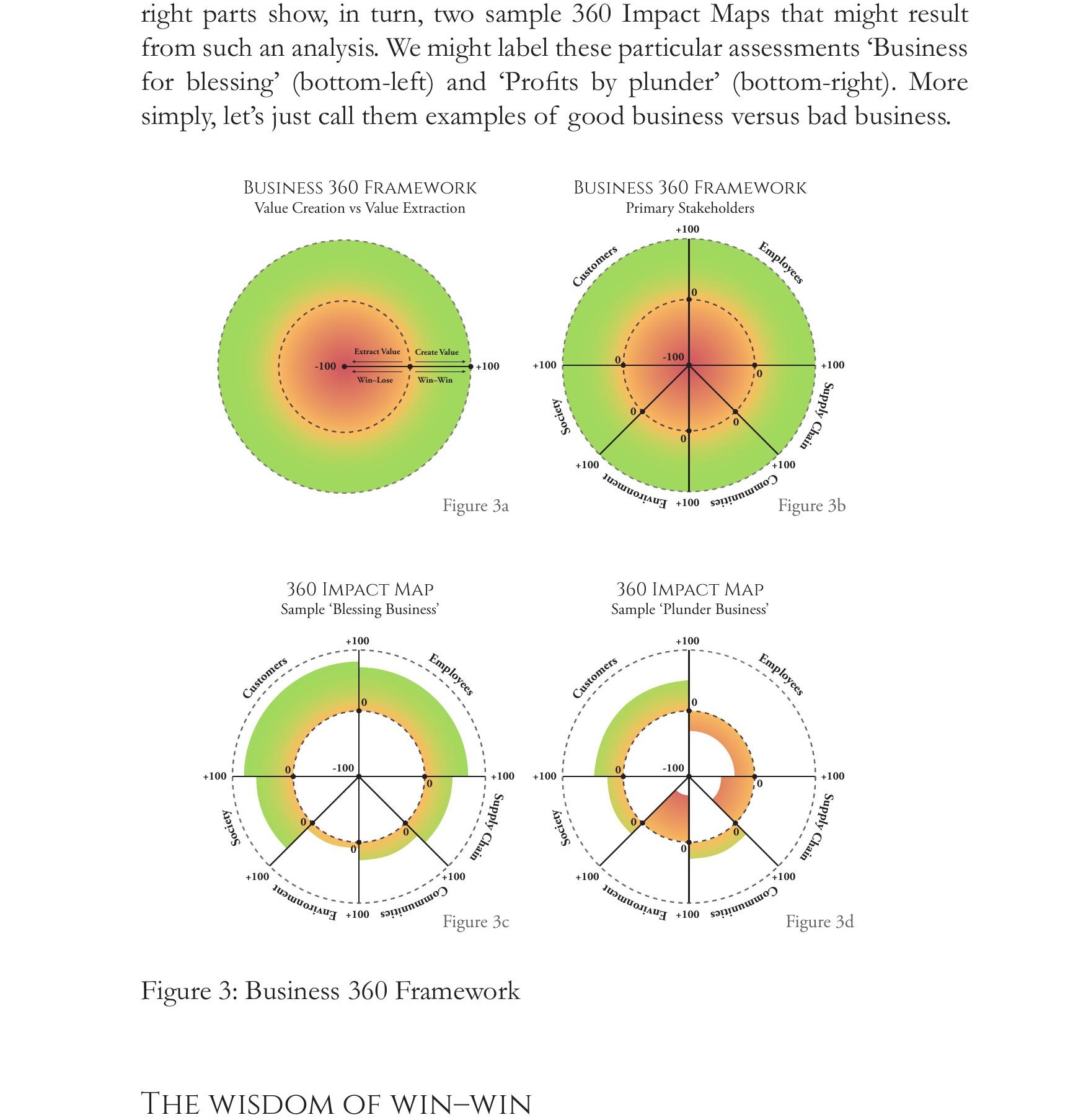
Is good business too much to ask? Hardly. First off, it’s the way business was characteristically practised until recently, including during its (American) mid-twentieth-century heyday. Second, it asks business to forsake neither self-interest nor the pursuit of profit. It simply requires that business not pursue self-interest and profit in ways that harm others. How is that unreasonable? (And what argument would business make as to why it should be allowed to inflict harm on others?)
More importantly, win–win behaviour is in the best interest of business. Treating others the way we want to be treated is the only behaviour that really works. It’s the behaviour that creates trust and fosters relationship. These are the essential building blocks of sustainable business success – trust and relationship with customers, with employees, with suppliers and so on. In fact without trust and relationship, business grinds to a halt.
It’s not surprising, then, that the empirical evidence for golden-rule behaviour in business is compelling. In The Ultimate Question, first published in 2006, Fred Reichheld introduced the powerful new business metric Net Promoter Score (NPS). Superficially, NPS measures how well or poorly a company satisfies its customers. But according to Reichheld, what NPS really measures is golden-rule behaviour. In turn, Reichheld marshals compelling data demonstrating that companies with superior NPS scores have substantially higher rates of profitability and growth than their competitors.
Similarly, in her 2013 book The Good Jobs Strategy, Zeynep Ton, one of the foremost retail operations experts, makes a powerful empirical case that – even in the extremely price-sensitive arena of low-cost retail – the most successful companies are the ones that pay and treat their workers well. Specifically, she found that these ‘good jobs’ companies were anywhere from 50 to 300 per cent better than their competitors at bottom-line performance metrics such as inventory turns, sales per employee and sales per square foot.
Let’s complement this with some anecdotal evidence:
Isadore Sharp, founder and chairman of the Four Seasons hotel group: ‘Our success all boils down to following the golden rule.’
Colleen Barrett, retired president of Southwest Airlines: ‘Practising the golden rule is integral to everything we do.’
Andy Taylor, CEO of Enterprise: ‘golden rule behaviour is the basis for loyalty. And loyalty is the key to profitable growth.’[22]
John Bogle, founder and former CEO, Vanguard Group: ‘You [only need] one rule … “Do unto others as you would have them do unto you.”‘[23]
The ‘golden rule’ is called that for a reason. Throughout human history it has been the gold standard for good behaviour. And for prudent behaviour. Profiting at the expense of others may work in the short term but not in the long. The merchant who delivers good value can expect to operate indefinitely; not so the knife-wielding mugger. Or as Jim Collins says in his seminal book Built to Last: ‘You can cheat your way to seeming greatness for five or ten years, but not for fifty or one hundred years.’[24]
It’s high time, therefore, for American public company CEOs to give up their profits-by-plunder myopia; high time to forsake win–lose value extraction and recommit to win–win value creation for all stakeholders. It’s how capitalism was always meant to work – for everyone.
[1] Edward L. Glaeser, ‘Can Business Do Well and Do Good?’, The New York Times, 6 January 2009; emphasis added.
[2] From Quote Investigator: Exploring the Origins of Quotations, http://quoteinvestigator.com/2011/02/23/capitalism-motives.
[3] From Quote Investigator: Exploring the Origins of Quotations, http://quoteinvestigator.com/2011/02/23/capitalism-motives.
[4] https://en.wikipedia.org/wiki/The_Virtue_of_Selfishness.
[5] Transcript of Milton Friedman interview quoted in ‘Donald Trump Says Greed Is Good’, by Aaron Sandler, The Daily Wire website.
[6] Which is not to say the divide between selflessness and self-interest is unimportant. It has considerable significance related to one’s character growth and spiritual development. But as regards outcomes, and the difference between right and wrong, moral and immoral, the dividing line of real consequence is between win–win mutuality and win–lose selfishness and predation.
[7] Mark Skousen, The Big Three in Economics: Adam Smith, Karl Marx, and John Maynard Keynes, Armonk, NY and London: M. E. Sharpe, 2007, p. 29.
[8] Mark Skousen, ‘Is Greed Good?’, Foundation for Economic Education, 1 May 2001; emphases in first paragraph added; emphasis in second paragraph original.
[9] Adam Smith, The Theory of Moral Sentiments, II.ii.2.
[10] In her excellent book The Shareholder Value Myth, the respected Cornell Law School professor Lynn Stout makes a convincing case that neither shareholders nor anyone else are the legal owners of corporations. That said, whatever their precise legal status, in the shareholder-centric version of business embraced in the USA since the 1980s, shareholders are clearly the effective and beneficial owners of public corporations – Lynn Stout, The Shareholder Value Myth: How Putting Shareholders First Harms Investors, Corporations, and the Public, San Francisco, CA: Berrett-Koehler, 2012.
[11] Reprinted in Walther Ch. Zimmerli, Markus Holzinger and Klaus Richter (eds), Corporate Ethics and Corporate Governance, Heidelberg: Springer, 2010, pp. 173–8.
[12] Michael C. Jensen and William H. Meckling, ‘Theory of the Firm: Managerial Behavior, Agency Costs and Ownership Structure’, Journal of Financial Economics 3:4, 1976, pp. 305–60.
[13] John F. Welch, ‘Growing Fast in a Slow Economy’, speech to financial community representatives, Hotel Pierre, New York, 8 December 1981.
[14] In fact it disadvantages long-term shareholders as well. A major study from the Harvard Business School, ‘Competitiveness at a Crossroads’, February 2013, comes to the blunt assessment that American business is losing the ability to compete in the global marketplace. Much of this is driven by companies’ squeezing research and development budgets to maximise short-term profits and fund dividend payments and stock buybacks.
[15] This chart comes from Andrew Smithers, economist and founder of Smithers & Co. Until recently he also wrote a recurring column for the Financial Times. The chart can be found at www.pbs.org/newshour/making-sense/merle-hazard. To be clear, SVM has not been the only driver of the disproportionate flow of business rewards towards owners and away from workers during the last few decades. Globalisation and automation have also had significant effect. Without the embrace of SVM, however, business would have looked for ways to mitigate the anti-worker effects of these other factors. Instead, SVM justified a wholesale embrace of any measures that fattened profits at the expense of workers and/or other stakeholders.
[16] ‘The Low-Wage Drag on Our Economy: Wal-Mart’s Low Wages and their Effect on Taxpayers and Economic Growth’, a report from the Democratic Staff of the US House Committee on Education and the Workforce, May 2013.
[17] Catherine Rampell, ‘Millennials Have a Higher Opinion of Socialism than of Capitalism’, The Washington Post, 5 February 2016.
[18] 2017 Edelman Trust Barometer: Global Annual Survey, 15 January 2017, www.edelman.com/trust2017.
[19] That said, it should be acknowledged that some businesses meet ‘needs’ that many may judge to be illegitimate – such as pornography or gambling.
[20] Nick Hanauer and Eric Beinhocker, ‘Capitalism Redefined’, Evonomics, 30 September 2015 – http://evonomics.com/redefining-capitalism-eric-beinhocker-nick-hanauer; originally published in Democracy: A Journal of Ideas, 31, Winter 2014 – http://democracyjournal.org/magazine/31/capitalism-redefined/?page=all.
[21] Developed by Eventide Asset Management, LLC as a guiding framework for ‘better investing for a better world’.
[22] All three quotations are from Fred Reichheld with Rob Markey, The Ultimate Question 2.0: How Net Promoter Companies Thrive in a Customer-Driven World, Boston, MA: Harvard Business School Publishing, 2011.
[23] John C. Bogle, ‘What I’ve Learned in a Half Century in Business – Twelve Rules For Building A Great Work Force’, 23 April 2003, www.vanguard.com/bogle_site/sp20030423.html.
[24] James C. Collins and Jerry I. Portas, Built to Last: Successful Habits of Visionary Companies, New York: HarperBusiness, 1994, p. xi.
Richard Turnbull
Capitalism is a complex word, even inadequate. Marxism uses the term in contrast to ‘labour’ (with the assumption that the accumulation of capital can only be at the expense of labour, a zero-sum game). Economic theory holds capital to be one of the ‘factors of production’, land, capital, labour and entrepreneurship, which at least allows for economic growth. Capitalism, at least in the public mind, may be linked with the opportunities, personal responsibility and individual freedom that lead to wealth creation, or with greed, lack of opportunity and inequalities that may lead to poverty – sometimes even in the same survey.[1] The Ipsos Mori Veracity Index 2016 lists ‘bankers’ and ‘business leaders’ in 19th and 20th places out of 24 professions in terms of being ‘trusted to tell the truth’.[2]
There are many dilemmas. The globalisation of world trade has extended the benefits of growth, not least reductions in global poverty, but not only is the growth shared unevenly, the exclusion of many from the benefits leads to alienation. Corporate structures have tended to reinforce rather than resolve the problem. Oligopolistic markets that lack real competition are not really capitalism at all. Neither are public bailouts for failed businesses – even banks; more like socialism for the already wealthy. Corporate values and ethics as expressed in a firm’s statement of purpose, mission or values have not prevented scandal.
So for some, the recovery of moral purpose in capitalism is an oxymoron. Nevertheless, the fact remains that it is the capitalist economic system that, for all its failings, delivers goods and services, well-being of individuals and communities, provides employment and opportunity and encourages enterprise and entrepreneurship. The recovery of moral purpose for capitalism, rather than being a contradiction, is the essential prerequisite for its effectiveness.
Therefore perhaps capitalism is the wrong word to describe an enterprise, market-based economy built on values of purpose, service and integrity. In other words, an economy with values shaped historically by the Judaeo-Christian ethic, encompassing growth, reward, incentive and opportunity, but also fairness, responsibility and compassion as integral elements. Yet capitalism is here to stay. Adjectives such as inclusive, conscious, restorative, relational have all failed to capture the imagination. What capitalism needs is not a new definition but the restoration of moral purpose in markets, in business purpose, conduct and structure and, indeed, in the character of market participants.
However, we should begin by setting out the contours of capitalism or enterprise. The debate too often begins in the wrong place – a rogue trader in a bank, a corporate scandal or issues of executive pay. From the problems, solutions are debated. The issues may indeed be very important, but if there is to be a holistic approach to creating an enterprise economy, then it is essential to begin with a vision for the market economy itself.
At the heart of the moral case for enterprise and capitalism is, first, the necessity of wealth creation for the economic and moral well-being of society. The most effective mechanism for achieving the economic growth necessary for the common good is the market economy. This is the means for the provision of goods and services, the management of savings and investment, the encouragement of the propensity to save, the provision of employment and a tax base. The market economy brings inestimable benefits to society. As the late Michael Novak (1933–2017) notes:
Of all the systems of political economy which have shaped our history, none has so revolutionized ordinary expectations of human life – lengthened the life span, made the elimination of poverty and famine thinkable, enlarged the range of human choice – as democratic capitalism.[3]
This, he argues, means ‘a predominantly market economy; a polity respectful of the rights of the individual to life, liberty and the pursuit of happiness; and a system of cultural institutions moved by ideals of liberty and justice for all’.[4] The evidence for the positive impact of the market on poverty reduction is insurmountable. Extreme poverty has fallen.[5]
A second crucial element to capitalism is freedom to trade and undertake economic activity. The market brings buyer and seller together, who trade, to mutual advantage, at the agreed price. William Bernstein tells the extraordinary story and history of trade and the overwhelming mutual benefit humanity has gained from the principle of trade: ‘World trade has yielded not only a bounty of material goods, but also of intellectual and cultural capital.’[6]
Both these points, which are all too frequently lost in debate, are reinforced by Milton Friedman’s observation that he knew of ‘no example in time or place of a society that has been marked by a large measure of political freedom, and that has not also used something comparable to a free market to organise the bulk of economic activity’.[7]
Economic growth, of course, is a contested area. For some, ‘only relative growth is possible: the global economy is playing a zero-sum game, with an ever-shrinking pot to be divided among the winners.’[8] However, without the wealth creation generated by the market, which leads to economic growth, it is impossible to deal effectively with issues of poverty and social welfare; to suggest otherwise is illusory.[9] Indeed, ‘higher per capita income is strongly correlated with some undeniably important factors, such as longer life expectancy, lower incidence of disease, higher literacy and a healthier environment.’[10]
Third, the propensity to save. The importance of savings – deposits, investment funds, life and pension funds – is often overlooked. The efficient pooling and investment of this capital in high-quality, innovative companies, technological advance and product development is an essential driver of growth and employment in an enterprise economy.
The market is an efficient mechanism but it is not perfect. There are problems of monopoly, oligopoly, price fixing and the fact that the market is populated by individuals who are themselves not perfect but flawed. In the same way that the benefits of the market cannot be ignored, neither can its imperfections. Similarly, economic growth may accrue unevenly. Thus the market may lead to inequalities. Equality is not a goal per se – but extreme inequalities reinforce the loss of opportunity in an economy, significantly dampen aspiration and may result in lack of access to justice or the other basic institutions of civil society.
The first problem lies then in the failure of competitive markets. So, for example, in both banking and energy sectors in the UK, the market is dominated by a small number of large players. The consequence of this is that price competition is reduced, consumer choice may be limited and there are significant barriers to entry and the potential for restrictive practices. Reduced choice and high prices disproportionately affect the poor. In the early 1800s there were some 800 country banks, outside London. With the advent of joint-stock companies there were, by 1866, some 154 joint-stock banks that were members of the clearing house system; now there are just five.[11]
The second problem is the painful consequences of reallocating capital. The impact of the movement of capital from a dying or declining industry into new areas of growth has significant and negative structural impact. This may be true in terms of unemployment, the knock-on effect on consumer spending, issues of poverty and structural decline of communities. The market may indeed bring about long-term recovery but the impact of the decline and its effects cannot be denied. For example, in 1971 there were, in the UK, 320,000 people employed in the steel industry. By 2015 this had fallen to 21,000 (with a further 10,000 in steel processing). From 1975 to 2015, employment in the steel industry in Wales fell from over 60,000 to 8,500.[12] The brunt of this impact has fallen on particular communities, such as, for example, Port Talbot in South Wales.[13]
The third issue is the exploitation of power often seen in examples of corporate and personal greed. This perception of corporate greed is further reinforced by apparent rewards for failure, excessive remuneration and failings in corporate governance. All of these things underline the sense of ‘crony capitalism’, the accumulation of capital by the few, and greed.[14]
The point is that a combination of capital accumulation, globalisation of production, structural decline in industries and failings of corporate governance, combined with greed and malpractice, produces effects that cannot be ignored.
The market economy has always attracted people of faith. The reasons are, of course, varied. Sociologists will point to the ‘Protestant work ethic’ and the formation of what Max Weber referred to as ‘the spirit of capitalism’.[15] In other words, Protestants worked hard for the Lord in the world, their faith of individual discipline shaping a work ethic. For others, such as the Quakers, persecution and exclusion from the universities and from public office meant that many turned not only to business per se but also to technological research and development. Quaker involvement in manufacturing and banking went considerably beyond their numerical influence. It is quite extraordinary how many of our companies – Cadbury, Barclays, Huntley & Palmer, Clarks – had Quaker origins. The Quakers produced ‘advices on trade’ over many decades, warning against everything from overtrading to indebtedness and advocating the priority of good accounting. They made provision for the welfare of their employees – from sick pay to pensions; from savings banks to model housing.[16]
However, these explanations are only partial. Two other factors have formed and shaped how people of faith have influenced business. First, the development of culture. People of faith have often formed networks of families, contacts, even schools and so on. These factors led to a culture of trust and integrity in business dealings. Trade networks, credit finance, apprenticeships all developed through these culturally shaped groupings. In addition to that, most religiously minded people had clearly developed moral codes – for the Christian most usually the Bible – and as a consequence, habits of moral behaviour (honesty) also translated into business practice: fair pricing, resistance to bribes, weights and measures and indeed concern for employees and wider society.
Faith provided, for some though not all, a framework of culture and conduct. Both of those aspects of a moral, purposeful, inclusive business ethic are today often sadly lacking.
In 1987 one of the leading chemical conglomerates at the time, ICI, described its purpose as follows:
ICI aims to be the world’s leading chemical company serving customers internationally through the innovative and responsible application of chemistry and related science. Through the achievement of our aim we will enhance the wealth and well-being of shareholders, employees, customers, and communities which we serve and in which we operate.
In 1994 the company objective had changed to:
Our objective is to maximise value for our shareholders by focusing on businesses where we have market leadership, a technological edge, and a world competitive cost base.[17]
So what changed? What changed so that ICI no longer aimed to be ‘the world’s leading chemical company’? What changed such that ICI’s application of science was no longer to be ‘the innovative and responsible application of chemistry and related science’ but only that in which they had ‘a technological edge’? What happened to the ’employees, customers, and communities which we serve’, to be replaced by ‘to maximise value for our shareholders’?
The case of ICI is illustrative of the way business has become separated from ethics, values and a truly holistic purpose that serves the economy and society well.[18]
The problem lies in the way ‘shareholder value maximisation’ has become the single measure of business return. Continued adherence to this mantra imperils the future of the enterprise economy.
Profit – the surplus of revenues over costs, the value added to goods in the process of manufacture and sale – is a deeply moral concept. Profit is essential to the proper, effective and long-term functioning of a business. However, profit is essentially a by-product of purpose.
The objective of profit does not stand alone but is set in the context of a business’s wider purposes. It is one that brings value to our ever globalised, ever competitive marketplace, in a manner that continually strives for a goal that is greater than itself. Profit becomes a by-product of this purpose-driven business model.[19]
Shareholder value maximisation is one of several factors that encourage short-term decision-making over long-term values. Others would include the tenure of CEOs, the expectations of quarterly reporting and executive remuneration based on short-term performance. Current shareholders benefit at the expense of future shareholders. The conclusion might be that all that matters is the current share price and hence company valuation. Not so.
Bill Drayton, founder and chairman of Ashoka: Innovators for the Public, and named in 2005 as one of the 25 best leaders in the USA by US News and World Report, observes: ‘For three centuries the social and business halves of society drifted apart. So far apart that they developed different languages, styles, legal structures, and mutually negative stereotypes of one another.’[20] This separation goes to the heart of why business has become compartmentalised from the communities and societies whose fundamental consent and licence is essential for enterprise to operate effectively. The social contract is breaking down.
This separation is not one that can be simply bridged by corporate social responsibility, which is more a symptom of the divide than a solution.
Historically the business world has been more connected to communities and society in both direct and indirect ways. In the nineteenth century many factory owners developed ‘model villages’.[21] The idea that industrialists, entrepreneurs and business owners might build such model villages is, to many, surprising if not somewhat baffling. These villages remain today as monuments to a bygone age. However, their development reminds us that in the period of the great Quaker firms, business magnates had a real vision for the relationship of business, family, workforce, locality and wider society.
The model villages were an expression of this integrated vision. In Bournville the houses had gardens; there was planned open space, a village green, cricket ground; and provision was made for schools, worship, shops, adult education facilities, libraries, schools, baths and so on. Both Cadbury and Rowntree decided against ‘out and out sale of housing at cost price’[22] or anything that had the ‘stamp of charity’,[23] preferring long leases with mortgages and deposits on a sliding scale.
There were wider housing examples in London. The Artizans’, Labourers’ and General Dwellings Company, a for-profit joint stock company whose President was the Christian social reformer Lord Shaftesbury, built 6,400 residences for working people by 1900, accommodating 42,000 people. Other examples included the Four Per Cent Industrial Dwellings Company – the clue being in the name – and the Metropolitan Association for Improving the Dwellings of the Industrious Classes, which adopted business principles for social purposes. Business principles and capital return for social good.
The nineteenth century also saw the beginnings of micro-finance and local banking. The Emily Loan Funds were established in memory of Lord Shaftesbury’s wife, who died in 1872. They were aimed especially at flower sellers who could not operate in winter. The Fund would loan an amount to enable these women to purchase stocks of goods suitable for sale in winter or else the hire of a potato oven. Other similar ‘finance societies’ funded the purchase of barrows or donkeys with low-cost loans. We also see banking at work among the poor, pertinent today in our debates about credit unions and so on. Penny Banks and Provident Societies were effectively savings banks, taking small deposits on a weekly basis.
Today this application of business skills to social problems is called ‘social entrepreneurship’ and ‘social impact investing’. The Organisation for Economic Co-operation and Development (OECD) defines social impact investment as investment made ‘with the intention of generating a measurable, beneficial social and environmental impact alongside a financial return’.[24] There are other ways of approaching the issue of definition but the essence is that social impact investing involves both financial returns and measurable social impact.
Social enterprises have become one of the new modes of business organisation for social purposes. The most effective social enterprises use a variety of means of capital, including venture capital and private equity. In addition, there will be robust governance structures, highly skilled individuals, diverse partners and a clarity of social vision. In this way it is possible to harness significant funds to achieve social purposes through the application of business skill and commercial objectives.
How then are we to respond to these changing features of capitalism and restore moral purpose to the heart of an enterprise economy?
Purpose needs to be restored to business. This restoration of purpose cannot be reduced to either legislative or corporate social responsibility. However, as a starting point, the repeal of section 172 of the Companies Act 2006 would signal intent. Section 172 requires directors to act for the success of the company for the benefit of members (effectively shareholder value maximisation), while having regard for employees, customers, suppliers and environmental impact. The effect of the section is to establish a hierarchy of priorities. As Professor Andrew Keay has said, the bottom line is: ‘Did the action promote the success of the company for the benefit of the members?’[25]
However, purpose cannot simply be legislated for. Purpose and values can only be implemented in a culture. Both the history and academic study tells us, as Professor Mark Casson has argued, that ‘the quality of entrepreneurship depends on the quality of business culture.’[26] So one further step is to emphasise that business success cannot be measured by a single numerical value. A second step is to think about how culture is determined. There may, in this regard, be considerable differences between the culture of a small- or medium-sized enterprise (SMEs) and that of a large corporate entity. A small, family-run company is likely to have a very strong culture, which may be benevolent or otherwise; a large corporate may have more defined processes and perhaps a very open culture, but face significant pressures on culture from middle management in particular.
A business culture can be defined as the attitudes, expectations and processes that shape the behaviour of a company and its employees in the conduct of business. Culture therefore includes both formal and informal aspects, personal characteristics and example, as well as good-quality processes. The key challenge is how to implement these expectations throughout a company.
The complexity is this: to argue that, for example, a culture should be transparent is easy to write but less so to implement. However, there are some questions that might help in forming and shaping an appropriate corporate culture:
The idea of the joint-stock company – that is, a company with external shareholders who share fully in the profits but are limited in their losses – has been a vehicle for raising capital for investment for over 150 years. While the structure has many advantages, its ambiguity is shown by the simple fact that prior to 1855 (the introduction of the Limited Liability Act), the establishment of a joint-stock company required an Act of Parliament. Even The Economist recognised the complexity: in 1856 the magazine regarded limited liability as overrated; by 1929 as indispensable.[27]
The answers to the problems of capitalism do not in themselves depend on corporate structure. However, structure can provide a framework from which other matters flow. Indeed, society is increasingly recognising the importance of corporate governance.
There are two aspects to consider. The first is formal structure. There are those, such as the B Corporation movement, who advocate formal changes to corporate structure, such as through the Memorandum and Articles of Association and an accreditation process. Professor Colin Mayer advocates a ‘trust company’ with a ‘board of trustees’ responsible for the stewardship of corporate values and voting rights dependent on the length of time equity shares are held.[28] More detailed reflection on the relative merits of such approaches is beyond the scope of this chapter. However, in essence the more company law allows for a wider and greater variety of structures, the greater the opportunities for exploring new ways of inculcating purpose and values within a corporate structure.
The second aspect is new approaches within the current structures. The idea of the non-executive director is a powerful one in terms of checks and balances within the system. The problem is that many non-executives fail to maintain the vigorous independence the role requires. Similarly, for some the non-executive role becomes a career in itself. Thus the professions and the professional bodies should be encouraged to widen the pool of potential non-executive directors through identification, mentoring and training. Similarly, some consideration should be given to restricting the number of non-executive roles that may be held by one individual simultaneously, so that full attention can be given to the discharge of the responsibilities.
There is also the question of the handling of certain ‘hot potato’ topics. Executive remuneration is probably the most significant of these but there may also be supply-chain, environmental or employee-related issues. In essence these are reputational matters. A healthy capitalism does not mean that executives should not be well remunerated or that credit should not be taken from suppliers. However, companies with good ethics and values will want to ensure that pay reflects merit and long-term performance; that smaller suppliers are not exploited in respect of payment terms; that the contractual arrangements of employees are not abnormal, unreasonable or exploitative; and that firms take seriously their environmental impacts. In essence, clear and transparent policies are the key here, although some would argue, for example, that a company’s annual remuneration report (if applicable) should be formally voted on by shareholders or the ratio of pay within the company published. These suggestions may indeed warrant adoption, but a more radical approach would be for an annual report from the independent non-executive directors covering all the key areas of risk or contention, such a report requiring to be approved at the AGM, published on the website and circulated to all employees, key customers and suppliers.
We are, in our current age of diversity and tolerance, very wary of enjoining moral codes on others. Ultimately the question is one of character. No amount of legislation, structural organisation or regulation can force good behaviour. However, society needs, for the good of business, the economy and civil society to draw a distinction between the moral and moralising. The former is a state of mind, an attitude of heart, a recognition of responsibility and an appreciation of the impact of values on behaviour. The latter is more of the nature of ‘injunctions’ concerning particular behaviours. The consequences of a failure to appreciate the central importance of moral character was clearly espoused by a quote, which although unsourced, is famously attributed to Theodore Roosevelt: ‘To educate a person in the mind but not in morals is to educate a menace to society.’
Among the consequences of moral character are a responsible attitude to wealth and also to society. The steely discipline that shapes an entrepreneur – the patient wait for return – is likely to enhance a view of wealth that recognises that such wealth was hard earned, is transient and carries responsibility. Equally, the apparent rugged individualism of the entrepreneur usually belies the reality of a team and a culture. Values shaped in such a setting are more likely to recognise a wider responsibility to civil society – or as was illustrated in the original corporate objectives of ICI: ‘to serve … the communities in which we are set’. Just like Cadbury at Bournville.
The future of capitalism, its nature, shape and organisational features, is essential to a healthy society and indeed an inclusive economy. Capitalism carries innumerable advantages for everyone. However, all is not well. This is partly due to structural problems within the market economy but much more so because capitalism as practised today has, regrettably, rather lost its way. A breadth of purpose, responsibility towards wealth, recognition of the impact on our communities and civil society, and above all the restoration of moral character and discipline, would go a long way towards repairing the tear. We need not call this ‘moral capitalism’ or ‘inclusive capitalism’; better just ‘capitalism’. Yet the word is problematic. An ‘enterprise economy’ sounds so much better.
[1] Public Religion Research Institute, Economic Values Survey 2013.
[2] Ipsos Mori Veracity Index 2016, www.ipsos-mori.com/researchpublications/publications/1896/Enough-of-Experts-Ipsos-MORI-Veracity-Index-2016.aspx.
[3] Michael Novak, The Spirit of Democratic Capitalism, Lanham, MD: Madison Books, 1982, 1991, p. 13.
[4] Novak, Spirit of Democratic Capitalism, p. 14.
[5] United Nations, The Millennium Development Goals Report 2015, New York: United Nations, 2015.
[6] William J. Bernstein, A Splendid Exchange: How Trade Shaped the World, London: Atlantic Books, 2009, p. 384.
[7] Milton Friedman, Capitalism and Freedom (40th anniversary edn), Chicago: University of Chicago Press, 2002, p. 9.
[8] Richard Heinberg, The End of Growth: Adapting to Our New Economic Reality, Gabriola, BC, Canada: New Society Publishers, 2011, p. 2; emphasis in original.
[9] Daniel Pinto, Capital Wars, London: Bloomsbury, 2014, ch. 2.
[10] Wayne Grudem and Barry Asmus, The Poverty of Nations: A Sustainable Solution, Wheaton, IL: Crossway, 2013, p. 47.
[11] A Report on the Culture of British Retail Banking, Cass Business School/New City Agenda, November 2014. See also British Banking History Society, www.banking-history.co.uk/history.html.
[12] House of Commons Library Briefing Paper, October 2016, ‘UK Steel Industry: Statistics and Policy’, p. 6.
[13] National Assembly for Wales, Research Briefing, ‘The Steel Industry: An In-depth Look’, May 2016.
[14] Examples include the original ‘rogue trader’, Nick Leeson, who brought down Barings in 1995, the recent accounting scandal around overstated profits at Tesco in 2014 and the controversy over Philip Green’s sale of BHS and its pension fund deficit in 2015.
[15] Max Weber, The Protestant Ethic and the Spirit of Capitalism, first published in German in 1905. Multiple modern translations and editions are available.
[16] For a full analysis see Richard Turnbull, Quaker Capitalism, Oxford: Centre for Enterprise, Markets and Ethics, 2014.
[17] www.theguardian.com/business/2007/jun/24/manufacturing.observerbusiness.
[18] See analysis by John Kay, Obliquity: Why our Goals are Best Achieved Indirectly, London: Profile Books, 2011.
[19] Andrei Rogobete, Ethics in Global Business: Building Moral Capitalism, Oxford: Centre for Enterprise, Markets and Ethics, 2016.
[20] Bill Drayton, ‘The Citizen Sector Transformed’, in Alex Nicholls (ed.), Social Entrepreneurship: New Models of Sustainable Social Change, Oxford: Oxford University Press, 2006, p. 51.
[21] Examples include Bournville, Saltaire, New Earswick, Port Sunlight.
[22] P. Henslowe, Ninety Years On: An Account of the Bournville Village Trust, Birmingham: Bournville Village Trust, 1984, p. 3.
[23] Joseph Rowntree Village Trust, One Man’s Vision: The Story of the Joseph Rowntree Village Trust, London: Allen & Unwin, 1954, p. 4.
[24] OECD, ‘Social Impact Investment: Building the Evidence Base’, Paris: OECD, 2015, pp. 58–9.
[25] Professor Andrew Keay, presentation at Guildhall Chambers on ‘Promotion of the Success of the Company – Section 172’.
[26] Quoted in A. Prior and M. Kirby, ‘The Society of Friends and Business Culture 1700–1830’, in D. J. Jeremy (ed.), Religion, Business and Wealth in Modern Britain, London and New York: Routledge, 1998, p. 115.
[27] Quoted in B. C. Hunt, The Development of the Business Corporation in England 1800–1867, Cambridge, MA: Harvard University Press, 1936, p. 116.
[28] Colin Mayer, Firm Commitment: Why the Corporation is Failing us and How to Restore Trust in it, Oxford: Oxford University Press, 2013.