This is a transcript of a speech given as part of a debate on the EU Referendum. The event was organised by James Cowper Kreston and held at the Oxford Union.
The EU Referendum – some moral and economic perspectives
Thank you for the invitation to speak this evening, and thank you also for putting on this event.
How, then, will we decide between the competing visions for Europe, for the future of the United Kingdom and our relationship, not only with Europe, but with the world? Will we decide on the arguments about economics, borders or sovereignty? Will we make our decision on the basis of statistics? And if so, which particular statistics will we rely upon? Or maybe we will decide on the basis of propaganda – but who’s propaganda would we trust; the government’s, the Brexit campaign or some other vested interest?
My initial observation is that larger businesses, especially those with a significant export market to Europe, tend to be more swayed by the economic arguments for remaining (that is, primarily the argument of access to markets) than smaller businesses that tend to be more exercised by the impact of regulation (that is, the control of markets)
So, this evening, I want to open up a different kind of question, to try and bring a moral economic perspective into the debate, or perhaps two questions, one about the nature of markets, access to markets, trade and employment and another about regulation, control, business development, entrepreneurship, innovation and creativity.
The most depressing argument in this debate is….the EU costs us £55m per day (gross amount, no account of rebate or EU payments to the UK) or £35m a day (net of the rebate and closer to the amount actually paid over) or £23m a day (net of EU payments for farming and poorer areas support – but not counting the payments to universities for research). Cash and economic costs and benefits are not the same thing. We must go deeper in our analysis. And we should ask questions about purpose, the long-term economic costs and benefits, not just cash payments.
The most significant economic argument is concerned with access to markets. The reason it is the most important question is that economic growth is a necessary condition for individual, family, community and national welfare. This is a moral question. Without economic growth we damage employment prospects, reduce the tax base and stifle innovation. Economic growth is not a zero-sum game and is also a prerequisite for the political debates around wealth and income creation and distribution. In other words, unless we bake the cake in the first place, we cannot debate how the cake should be divided.
So, we should ask how best, then, to bake the cake. Access to markets means trade and exchange, import and export, competition and so on. The freedom to trade has shaped and transformed the world we live in. So, we know the EU represents the largest single market in the world (with the US being second). The UK is the largest market for exports from the EU (though only at around 16% of total EU exports), but for the UK around 44% of our total exports go to the single European market, though that percentage has been falling.
Does this mean that the UK couldn’t negotiate its own free-trade agreements with other countries, or that either new or even traditional markets could not be opened up or expanded? No, it does not mean that, but it does mean that we need to take very seriously indeed, the opportunity for access to the world’s largest single market and surrender that only after very careful thought. To lose that access is not irreplaceable, but would certainly damage short and medium term growth prospects, and there would be a cost to the negotiation of multiple trade agreements which may, or, more likely, may not, obtain equally favourable trade terms.
And we certainly need to be wary of naivety; the oft-quoted Norway model is illusory; Norway pays 90% of the UK per capita payments, they have to observe the single market regulations, and, indeed, it is worth quoting The Economist reporting a Norwegian minister as follows, ‘if you want to run Europe, you must be in Europe. If you want to be run by Europe, feel free to join Norway’ (Economist, 4th March, 2016, p20).
So, let me turn to the second question, that of regulation. The impact of the EU on the regulation of the market is undeniable. Part of the problem stems from the fact that what we read about in the newspapers is the silly stuff – the size of a vegetable, bendiness of bananas and cucumbers, regulations on washing-up gloves and so on. In reality the regulative impact of the EU extends far and wide into employment, market regulation, discrimination, health and safety, and into industry sectors from investment management to transport and shipping.
How are we to assess the nature and impact of this regulatory regime? Let’s start with the negative impact. There is little doubt that there is a ‘regulatory bureaucracy’ about the EU which rather reinforces the observation of Andrew Bailey, formerly the deputy-governor of the Bank of England, that ‘the main consequence of an increase in regulation is an increase in the number of regulators.’ Similarly, I think there is a cogent argument that EU regulation is an easier burden to bear for larger firms than smaller and medium-sized enterprises; and, in my view, it is SMEs who are the powerhouses of innovation, entrepreneurship and growth, indeed, collectively also of employment. Perhaps the Working Time Directive is an example of that. The directive, with the laudable aim of protection, is, however, an example of the different cultural mind-set between the UK and a Europe that sees the control of working hours as a governmental responsibility. You can see how, with a regulation like the Working Time Directive, a larger organisation with the resources of an HR department, would find those rules easier to manage and implement than an SME. Some of the industry-specific regulation is of a similar outlook – so, a significant number of effective, focussed, co-owned and co-invested small investment management firms find the burden of the regulatory regime focussed and geared towards the larger investment management firms, with their resources and capacity – all investment management firms with funds under management of more than £100m are treated the same, subject to the same requirements, reporting and regulations. So, I am persuaded that there is a negative impact of EU regulation.
However, there is a ‘but.’ First, I believe, morally, that the freest access possible to markets should be encouraged, but as we know, the free market is never quite as free as we think or might like. So, the single market itself is surrounded by a tariff wall; free Europe or fortress Europe? And in addition to tariff walls around the single market, because a free market is never entirely free, and indeed is populated by participants and players who do not possess perfect information, and, I might add, are not perfect and flawless characters, a degree of regulation is necessary. Second, therefore, the idea that leaving the EU means we can simply sweep away all of this regulatory regime is neither right nor appropriate. Even if we left the EU, and abandoned the more bizarre or restrictive regulations, the reality is that any independent UK government is going to impose the overwhelming majority of the current regulatory regime. So, although, I too would like changes, I too find the bureaucracy and extent of EU regulation irksome, it is naïve in the extreme, to think that leaving the EU would enable all of this regulation to be simply abandoned.
So, where have we got to? We have, I think, established the importance for economic well-being of the single market; with the challenge that we might lose other opportunities, but with much uncertainty. We have also argued that there is a negative impact of a regulatory regime bearing heavily on SMEs; yet with the reality that it would not all be swept away by leaving.
How to decide? I remain sceptical of the campaigns and the propaganda from both directions! Rather, ask this question, what will best enable the maximum flourishing of the economy which in turn will enable the flourishing of individuals, families, communities and the nation? Is access to the single market and its benefits too significant to surrender? Is the regulatory regime of the EU sufficiently oppressive and burdensome that it prevents SMEs from flourishing? Of course, there are other considerations, non-economic arguments about borders and sovereignty, but as business people, we need to assess fairly the moral imperative of ensuring a successful business environment for the country. The answer to that question might vary from person to person, but let us at least ask the right questions.
Photo Gallery:
Dr Richard Turnbull is the Director of the Centre for Enterprise, Markets & Ethics (CEME). For more information about Richard please click here.

This is a transcript from a speech given at Clare College, Cambridge on Friday 11th of March, 2016.
It is a great pleasure and honour to be invited to address you today at this service to commemorate the benefactors of the College, and in particular its founder, Elizabeth de Burgh, Lady of Clare.
When the Master, Lord Grabiner, invited me to speak I was delighted to accept not least because of my own involvement in higher education. For the first 20 years of my career I first taught and did research in the field of monetary economics at the London School of Economics (LSE) and then moved to a chair at The City University where I was appointed Dean of the Business School.
One interesting aspect of this Commemoration is that we are celebrating it in a College chapel, using Christian liturgy, readings from Solomon’s Book of Wisdom, in the Apocrypha and the Gospel of Saint Mark and with prayers being said. Not all of us here today may be believers but the place we are in and the form of this service recognises that there is a mystery to be explored which goes beyond our academic pursuits. We recognise it in music, in paintings, in poetry, in the beauty of nature and we see it today in the readings we have heard. This is in complete contrast to the environment in which I studied and then later taught, namely the LSE. We had no chapel and in the whole of my sixteen years as a student and then member of staff I never attended a religious service in the School simply because to the best of my knowledge there were none to attend.
So I am delighted that this service provides an opportunity for us to recognise that in this country our understanding of benefaction is deeply rooted in our Judaeo-Christian heritage. Ever since I was an undergraduate I have been interested in the relevance of Christian social ethics to economic life and over the years one thing which has struck me is the Jewishness of Jesus. A question I have often found myself asking is whether there is any aspect of Christian-social ethics which is not found and rooted in Judaism?
Over the centuries the Judaeo-Christian understanding of human dignity, the rule of law, social justice, rights to the ownership of private property, the importance of the family and care for the disadvantaged have shaped our society. So it is with benefaction. Our heritage has placed great emphasis on charitable giving to help others in need and to promote the common good. And In this respect Jewish and Christian communities have over the centuries set an outstanding example.
Today we are remembering the former and current benefactors of this College and in this context I would like to explore three aspects of benefaction which I hope, given our common heritage, will resonate with people of all faiths and none.
Gratitude
One of these is the importance of gratitude.
Gratitude is recognised as a virtue in all major religions. Even for a humanist such as Cicero, gratitude was “not only the greatest of the virtues but the parent of all others”.
For myself I owe a great debt to those who provided the means for my own education, first at a primary and then at a grammar school in Wales and later as an undergraduate and post-graduate student at the London School of Economics. I am sure that everyone attending this service today will have certain individuals and institutions to whom they will forever be grateful.
I should add that I am grateful not just for the financial support I received as a student but also for the encouragement of teachers who took a personal interest in my development. In this respect the benefaction of time can be just as important and demanding as the benefaction of money.
Incidentally gratitude has more recently been shown to have unintended benefits. Over the last fifteen years or so psychologists have undertaken research to explore the impact of gratitude. The evidence suggests that a correlation exists between gratitude and increased well-being. Gratitude is positively related to life satisfaction, hope, optimism, empathy and the willingness to provide support to other people. In the field of behavioural economics research has found that gratitude is correlated with generosity and increased monetary giving. In addition the evidence also suggests that grateful people are more likely to sacrifice individual gains for community well-being.
In the ‘me-centered’ spirit of modern society a life of gratitude does not come easily. A culture of consumerism alongside the relentless striving to be the best and win, in highly competitive global markets can so easily foster a constant state of dissatisfaction with our material well-being, with the result that we neglect to recognise gratitude as a virtue.
Generosity
Gratitude is a great virtue. So is generosity.
Elizabeth de Burgh was an outstanding example of generosity. In the Commemoration address we heard how at a difficult time in the life of this county, following the Black Death, when I feel sure there would have been many requests for charitable giving she was generous and took a long term view. She gave money to ensure that the College would provide for the education of poor Scholars of ability. Not only that but in her will of 1335 she singled out that money be left to a number of other good causes: the poor religious, women who had fallen on hard times, poor householders and merchants, poor parish churches and poor prisoners.
A gift does not have to be large however to be worthy of being a genuine benefaction, because each gift however small is itself an expression of generosity.
Generosity was highlighted for us in the story from Mark’s gospel, which is an account of an occasion when Jesus and his disciples were in the Temple at Jerusalem sitting opposite the treasury and watching people making their donations. The rich put in a great deal of money. The poor widow puts in just two small copper coins worth very little. Yet she is praised by Jesus for contributing more than the wealthy, “this poor widow has put more money into the treasury than all the others. They gave of their wealth; but she, out of her poverty, put in everything – all she had to live on”.
For me the greatest argument for generosity in the New Testament is that of St. Paul in his second letter to the church at Corinth, which extends to two whole chapters. Paul was highly intelligent, well educated, restless, argumentative but also a great campaigner for the cause of the poor. The first century church at Jerusalem had fallen on hard times and it is clear from his letters that wherever he went he not only proclaimed the Good News but encouraged generosity in giving in order to help the poor in Jerusalem. In doing so in his second letter to the Corinthian church he held up as an example the Macedonian church, which although extremely poor gave generously – in fact the words he used were that they gave “even beyond their ability”.
His clinching argument was “for you know the grace of our Lord Jesus Christ, that though he was rich, yet for your sakes he became poor so that you through his poverty might become rich” (2 Cor. 8:9)
Wisdom
Gratitude, generosity and finally wisdom.
Before Elizabeth, Lady Clare, gave generously to establish this College she first showed very clearly in the Preface to the Statutes of the Foundation of 1359 the value she attached to learning: “experience plainly shows”, she wrote that “learning is no mean advantage in every rank of life”: she made it clear that she was concerned to “further the public good by promoting learning”: her purpose in founding the college was that “students should discover and acquire the precious pearl of learning”.
Learning in the Abrahamic faiths is invariably associated with a book, a body of sacred texts. We read this evening from The Book of Wisdom by Solomon. From this and more generally from the Wisdom Literature of the Old Testament (Job, Psalms, Proverbs, Ecclesiasties and the Songs of Songs), it is clear that wisdom is about more than acquiring knowledge and information.
Canon David Atkinson, former Canon, Chancellor and Missioner, Southwark Cathedral expresses it succinctly in his Commentary on Proverbs;
“wisdom is no abstract concept; wisdom is personified: she is described as a woman…This personification of wisdom is not a (mere) literary device; it reflects the essential nature of biblical wisdom. Wisdom is embodied. Wisdom is for living”
Wisdom is something practical. It relies on knowledge but is more than learning. It is based on experience and common sense. The lady Wisdom possesses widely respected qualities: honesty, fidelity, integrity, love, justice, modesty. Taken together they might well be regarded as the marks of a ‘person of character’. Wisdom is a manual for living.
Wisdom begins with awe, the recognition that there exists something greater than ourselves. However awe is also the beginning of wisdom, in that it is not acquired in a moment but grows throughout a lifetime.
In today’s highly competitive market place in higher education and certainly something I found as Dean of a Business School, is that it is far easier to provide knowledge and information than to grapple with fostering the development of those qualities which together characterise a wise person.
In the opening stanzas of his poem, Choruses from the Rock, T.E.Elliot after noting the constant innovation and unending 24/7 activity of an industrialised society poses challenging questions,
Where is the life we have lost in living?
Where is the wisdom we have lost in knowledge?
Where is the knowledge we have lost in information?
Let me conclude on a personal note.
When I was made a life Peer I was invited to put forward a design for a Coat of Arms and a motto, something I did some years later. I choose a pair of ospreys the symbol of Swansea where I was born and grew up, a brewin (a play on Brian) holding in his forepaw a leek and two red gryphons not unlike dragons to signify Wales, a stack of books because of my interest and commitment to learning, three trees representing my three children and a motto which read in Welsh:
Ofn yr Arglwydd yw dechrau doethineb
The fear of the Lord is the beginning of wisdom
I chose it because I believe it and I commend it to you.
Lord Griffiths is the Chairman of CEME. For more information please click here.


(This is a transcript from a speech given at Exeter University, 2016)
Introduction: The moral challenge of the market
Thank you very much indeed for the invitation to lecture this morning on a Christian view on the market economy. I am myself qualified in economics and spent just under 10 years in the City of London as a Chartered Accountant. I am also ordained and have spent most of the last 20 years as a Vicar and then the Principal of a theological college in Oxford before becoming the Director of the Centre for Enterprise, Markets and Ethics in 2012.
The financial crisis of 2007 onwards was not the first such crisis, or even the first time a bank has collapsed, but the resulting recession and crisis was deep not least because it was seen that some combination of greed, abuse of power and trust as well as the development of increasingly complex financial instruments all contributed to the collapse. The outcome was not just a financial crisis, but a crisis for capitalism itself. How then might Christians respond? What can Christians say about the market economy and what about the role of government and the quest for social justice?
So, Irving Kristol:
‘Capitalism survives because it still satisfies the basic, simple impulses of ordinary men and women. It will not continue to satisfy them however, without the bedrock provided by the Judeo-Christian tradition….It gives certain answers to ultimate questions that modern philosophy or modern thought of any kind cannot provide..’[i]
Michael Novak, in his 1991 book, The Spirit of Democratic Capitalism, wrote the following:
‘’Of all the systems of political economy which have shaped our history, none has so revolutionized ordinary expectations of human life – lengthened the life span, made the elimination of poverty and famine thinkable, enlarged the range of human choice – as democratic capitalism.’[ii]
He goes on to define democratic capitalism as one essential defined by a market economy and a free society. It is difficult to contest that without the market economy we would have made significantly less progress in the fight against poverty (UN Millennium Goals) and we would be living in societies that were substantially less free. However, there is a problem. Perhaps the problems could be summarised as follows:
In the USA, the Public Religion Research Institute conducted the 2013 Economic Values Survey, with the following findings:
Reasons cited as to why capitalism is working:
Encourages Personal Responsibility – 33%
Provides Equal Opportunities – 29%
Promotes Individual Freedom – 24%
Creates Wealth – 11%
Other – 3%
Reasons cited as to why capitalism is not working:
Encourages Greed – 34%
Does not provide Equal Opportunities – 28%
Creates Poverty – 14%
Creates Inequalities – 11%
Other – 13%
So, 48% of Americans cited just two reasons why capitalism was not working, that it generated greed and created poverty. Perhaps it is not surprising then that Pope Benedict, in Caritas in Veritate argued that ‘in terms of the resolution of the current crisis, the State’s role seems destined to grow.’[iii] This in itself raises all sorts of questions about freedom, taxation, the family and so on.
So, there is the dilemma for us. Does the market economy create wealth or poverty, does it generate opportunity or greed? What I want to show is that for the Christian, wealth creation is actually a spiritual imperative, but that it carries awesome responsibilities and consequences. Only when we have had this discussion can we effectively debate how social justice is to be met, the role of government and so on.
Wealth creation as biblical imperative
The basic reason why wealth creation is a biblical imperative is that it is a creation mandate. What we mean by a creation mandate is something which is set out by God as part of the principles of creation for all people for all time. So let me illustrate and explain.
In Genesis chapter 2 , verse 15, we are told the following; ‘The Lord God took the man and put him in the Garden of Eden to work it and take care of it.’ This short verse has enormous implications. The command to work precedes the entry into the world of sin and the fall. In other words part of God’s intention for every person is that they work, they harness the resources of the world in producing goods and adding value. This basic requirement also has implications for any government programmes that encourage dependency rather than work.
Reinforcing this verse, there is a remarkable description of what God has provided for those who work the land. In describing the Garden of Eden and its setting in vv8-14 of Genesis 2, we read that God had provided trees and water but that also between the head waters of the rivers which flowed out from Eden God provided three precious materials – gold, aromatic resin and onyx. So, in other words, alongside the command to work is the provision of precious stones, metals and resins all of which can be used in the production of bowls and plates, jewellery and medicines. In the creation narratives God provides the command and the materials. Hence the creation of wealth is a spiritual imperative.
Entrepreneurship as call and gift
The second area to explore is that of recognising that economic creativity and innovation (or entrepreneurship) is in fact both a gift and a call from God. We see this illustrated first of all in Exodus, especially, chapter 35. After the people of Israel had escaped from Egypt, Moses received instructions for the construction of a tabernacle to provide the focal point of worship. In Exodus 35:30, he points to one individual, Bezalel, and asserts that God has filled him, ‘with the Spirit of God, with skill, ability and knowledge in all kinds of crafts,’ referring to his ability of working with gold, silver and wood in order to prepare the tabernacle. It is interesting that the materials mentioned are so similar to those referred to earlier in Genesis. Moses adds, in verse 34, that the Lord had also given him ‘the ability to teach others’.
We see here the coming together of crucial theological and economic concepts. Notice the centrality of the flourishing of the human person, who has been endowed with skill, but note also two other crucial economic concepts, growth (that is, adding value through the combined use of resources and skill), and human capital, that is education and the training for the acquisition of such skills.
The divine economy is an enterprise economy and an entrepreneurial one. We would do well to honour, rather than disparage, those that create wealth and take entrepreneurial risk. Not only is the divine economy an entrepreneurial economy, it is also a place of call. In other words Christian men and women do not work in this part of the Lord’s vineyard either by accident or simply as a means to an end. Rather they are called by God to work in commerce, law, banking, manufacturing, service industries, IT and so on. It is a basic, but fundamental concept. If we understand that our business and commercial life is part of our call from God to work in his economy for the common good of all then we at once begin to deal with the ethical issues which arise. Recognising that our call is from God will help us make good business decisions, good ethical decisions, and act responsibly and well. This of course goes right back to Luther, but also note this from the Roman Catholic Pontifical Council for Justice and Peace.
‘The vocation of the businessperson is a genuine human and Christian calling. Its importance in the life of the Church and in the world economy can hardly be overstated. Business leaders are called to conceive of and develop goods and services for customers and communities through a form of market economy. For such economies to achieve their goal, that is, the promotion of the common good, they should be structured on ideas based on truth, fidelity to commitments, freedom, and creativity.’[iv]
The market and its morality
So, we have seen that wealth creation is a spiritual imperative but that it carries spiritual responsibility. Let me now turn to the market itself, its strengths and weaknesses from a Christian perspective.
A market is essentially a place where buyers and sellers come together to exchange. The market through its pricing mechanism allocates resources. The origins of the understanding of the modern market economy lie with Adam Smith and his publication of the Wealth of Nations in 1776. Smith viewed the market as the best place to achieve the allocation of scarce resources mainly through the division and specialisation of labour. Importantly, Smith built upon a prior work, The Theory of Moral Sentiments (1759). He assumed a natural propensity to barter together with an essential selfishness in humanity. Crucially the effect of the economic mechanism is to bring about, not only the satisfaction of others, but indeed the welfare of all, by each serving their own interests. In this way a greater public good is achieved. This was the essence of the ‘invisible hand.’ The question was, if the hand existed, to whom did it belong?
The paradox in the classical model between the pursuit of self-interest on the part of individuals and the overall achievement of the public good could only be explained by the providential design of those laws of economics which brought this about.
Historically, evangelicals have, generally, held a positive view of wealth creation and enterprise and then adopted the voluntary principle, which we will come to, in how they have sought to deal with poverty and disadvantage. Market principles and virtuous compassion have defined this approach. Indeed because the market is part of God’s provision, behaviour, compassion and responsibility are crucial components of a Christian vision for society. The evangelical thus views the market not simply as a system of resource allocation, but also as a place where discipleship is exercised or even learned. From this comes ethics and behaviour. When the creativity, innovation and dynamism of the market are combined with the voluntary principle the result is a radical conservative approach to the challenges of poverty.
So, the leading evangelical, Thomas Chalmers, in the second volume of his Natural Theology, said that the market ‘strongly bespeaks a higher agent, by whose transcendental wisdom it is that all is made to conspire so harmoniously and to terminate so beneficially.’[v]
Two particular problems arose from this model, namely, the impact of sin and the possibility of inequality. Sin, as we have noted, distorted the market, through the sinful acts of the market’s participants – unethical behaviour. In economic terms this led to disequilibrium; in Christian terms to poverty and suffering.
The Christian idea of the market is built on:
The quest for social justice
How then did these early evangelicals respond to poverty?
The answer lies in the acceptance of the classic economic model alongside the voluntary principle, which involved both the rejection of state intervention and the development of voluntary organisations, which in turn provided an appropriate setting for the exercise of philanthropy – the market plus the voluntary principle.
For Chalmers government intervention was not only unnecessary but also arrogant as it sought to usurp the Creator from his rightful position. In addition any extensive role for the state had the effect of taking over those things which truly belonged in the heart – the moral sentiments. As he put it, ‘we cannot translate beneficence into the statute-book of law, without expunging it from the statute-book of the heart.’[vi] Compulsion would lead to the ‘extinction of goodwill in the hearts of the affluent and of gratitude in the hearts of the poor.’[vii] Chalmers shows great Christian insight at this point. He understood that the nature of the human person not as a depository of ‘rights’ but as an individual with a will, a conscience, indeed, a moral personality. The intervention of the state had led to duties being replaced by rights, to dependency rather than freedom.
In the changing industrial landscape of nineteenth-century Britain a wide spectrum of voluntary societies developed, ranging from visiting societies, savings clubs, loan societies (an early example of micro-finance) and poor relief societies to schools and both social and evangelistic missionary societies. The seventh Earl of Shaftesbury was one of the great pioneers of the voluntary society. These organisations were neither new nor exclusive to the nineteenth century but there was then a significant expansion. They were characterised by local control and independence from state aid. The attraction of the voluntary society for the advocates of political economy (‘the market’) was that it enabled the proper provision of social welfare to be kept separate from state intervention. It also allowed a distinction to be drawn between deserving and undeserving poverty. The voluntary visitor operating in a local area was quickly able to ascertain the degree to which applicants themselves were at fault. This more easily enabled relief to be temporary rather than becoming enshrined as a legal right; state aid depersonalised poverty relief.
Conclusion
The market economy is not perfect. All Christians will share a concern about the reduction of poverty. The evangelical response to poverty depends upon a dynamic understanding of God’s providential provision of the market together with the practical application of the moral sentiments to compassion implanted in the heart. The need for compassion and care is a result of sin which leads to behaviour which distorts the market. So evangelicalism’s embrace of the ‘invisible hand’ is neither an unthinking nor an unlimited adoption of the free market. Rather it is an acceptance of the nature of divine provision with the application of Christian moral values. The voluntary principle lies at the heart of the thesis because without it government becomes all powerful, the opportunity for Christian morality and discipleship in the market place is lost and, hence, God’s good and gracious provision is denied. What is more, government fails on account of locality and relationships, both of which evangelicals have viewed as essential. Indeed government may induce poverty and increase dependency rather than reduce it; hence self-help is also an evangelical principle. In addition to that, government, or perhaps we should say, excessive government and centralisation are in fact dangerous not only to economic freedom but also to the very Christian voluntary societies which lie at the heart of the response to poverty. This has been well articulated by Professor Roger Scruton:
‘The first act of totalitarian governments is to abolish the charities through which people help themselves, and which are the main obstacle to creating the total dependence of the citizen on the State.’[viii]
Thus, the threat is not only to economic and religious freedom, but in essence to freedom itself. So, for the evangelical, there will be a real emphasis on the market, on self-help, and on incentives to work; but alongside that lies compassion on the ground through the voluntary principle. In this way innovation flourishes, philanthropy is encouraged, compassion is exercised and the gospel maintained.
[i] Irving Kristol, in ‘The Disaffection from Capitalism and Socialism,’ quoted in Griffiths, Morality and the Market Place.’
[ii] M. Novak, The Spirit of Democratic Capitalism, p13
[iii] Pope Benedict XVI, Caritas in Veritate, p49
[iv] Vocation of the Business Leader, Pontifical Council on Justice and Peace, paragraph 6
[v] Ibid., page 137
[vi] Chalmers, Natural Theology, volume 2.4.4.6, in Works, page 128
[vii] Ibid., page 130
[viii] Professor Roger Scruton, Charity, Conservative Home Thinkers Corner, 11th February 2012

Dr Richard Turnbull is the Director of the Centre for Enterprise, Markets & Ethics (CEME). For more information about Richard please click here.
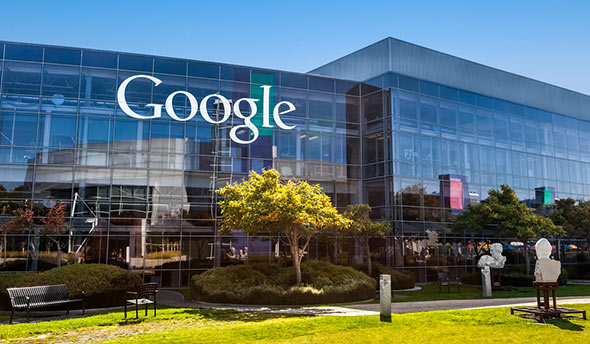
Poor old Google. Well, not so poor actually. According to their SEC 10-K filing group profits amounted, in 2014, to $17.26bn. Google’s UK sales (mainly internet advertising), based upon the billing address of customers, were around $6.5bn in 2014. Lots of sales, but, apparently no profits. Google themselves told the Public Accounts Committee in 2012 that they don’t actually make UK sales. Of course, that is true. To suggest otherwise, might imply a permanent residence for tax purposes and trigger all sorts of consequences – such as paying more Corporation Tax. There are, though, sales from a Dublin registered company to people in the UK. The basic corporate tax rate in Ireland is 12.5%, in the UK 20% and in the US, 35%! So, Ireland get the business. If I buy a product from an American company or an Irish company then the sales and profits are generally accounted for in the country of origin. A British company selling in the US would account for and pay tax on the transaction in the UK. Well, that’s the easy bit. It gets much more complicated when subsidiaries are involved and there are transactions between them…as we will see.
So, what’s the problem?
Mind you, for a Professor of Accounting, Prem Sikka, seems rather naïve. He estimated that rather than the £130m settlement Google reached with HMRC the figure should have been nearer £1.8bn. I have no idea if he has the right figure. And neither does he. HMRC said that they collect the full amount of tax due on profits and no less.
Why the discrepancy?
Before, rushing to judgement (John McDonnell described the payments as ‘derisory’), let’s try and be objective.
Most of its corporate taxes are paid in the US (approximately $2.5bn in 2014). The company also pays corporate tax – at a lower level ($0.8bn) – in Ireland. Google also pays a lot of tax in the UK and collects even more on behalf of the government. Google has around 2,400 employees in the UK (though I cannot confirm the exact figure). Let’s assume that the average salary approximates to that of the Top 100 companies in the UK, namely, £31,929. So that is an annual tax bill of, say, £7.9m per annum in National Insurance Contributions (NIC for employers is 13.8% for all remuneration above £8,160). Not to mention business rates and all the taxes on consumption and irrecoverable VAT the company incurred. It might be that the tax burden on Google and other companies should be higher. Or not. But we must remember the total tax bill that companies face, not just Corporation Tax.
It’s odd how tax campaigners always seem to know how much tax companies should pay. It is a very strange morality. Google can be forgiven for, perhaps wrongly believing that the taxes they are due to pay should be determined by the rule of law, the tax provisions set in Parliament. We do not know what Google’s UK profits are, should be, or should not be, unless there are some rules to determine the calculations.
George Osbourne introduced the Diverted Profits Tax in order to deal with large multi-nationals potentially diverting profits. Google, we are told, would not have been caught. I read the Diverted Profits Tax legislation. Like the rest of the tax code it is not straightforward, complex and requires interpretation to determine whether a company is caught by its provisions or not. This was a simple reminder of the complexity of the tax code, a point quite simply overlooked by many campaigners. Elections, claims and, indeed, judgements are invariably required.
Parliament has the ultimate responsibility to legislate. There are ways in which the tax provisions could be simplified. However, we are naïve in the extreme if we think it is straightforward to enact a national tax regime for multi-national companies. Even multi-nationals need to be protected from double taxation (the same income taxed twice in different places) and there are many provisions to prevent cost and value shifting. Indeed, there are moral issues about depriving Ireland (say) of its tax revenue from Google, when they have been attracted there by a transparent and public lower rate of tax. If a UK subsidiary pays a US parent (or a Bermudan subsidiary) for the use of the brand, what is a fair price?
We do not know the actual, precise amount of tax liability, if any, in dispute between Google and HMRC. It is possible that Google and their advisors believe this to be Y and HMRC believe it to be 4Y. So, HMRC could seek to impose 4Y. And Google could stand firm on the grounds that their interpretation of the law produces Y. HMRC could go to court. They might win. They might lose. It will cost millions of pounds in direct costs and even more in opportunity cost. So, a deal is done at 2Y. Except it is not a deal, but an agreement that 2Y is the amount of tax that is due.
So, we should not join with the so-called tax justice campaigners who display a false morality about tax. The campaigners seem to think that they should be the arbiters of Google’s and other companies tax liabilities. I prefer the law to determine the liability.
And yet, my sympathy for Google is limited.
First, let’s spell out the roots of the accounting problem.
The core of the issue lies in what sales and what costs should be booked in the UK. Only then can the level of profits be determined and appropriately taxed.
If I buy a product from the US, the income and costs will be recorded by that company in the US. If that US company sells so much in the UK that they set up a subsidiary to sell those products here then the sales and costs will be accounted for and taxed in the UK (with relief given in the US for double taxation).
Problem 1. Google (and others similarly) do not officially ‘reside’ in the UK, but Dublin, or Bermuda, the Netherlands or Switzerland, where depending on the precise corporate structure corporate tax rates are lower.
Problem 2. Google sell internet advertising, but almost certainly there will be payments between subsidiaries which have the effect of transferring costs and revenues. So for example, London may charge Dublin for, say, ‘sales and marketing services’ so that the income in Google UK more closely matches it costs (employees, rent etc), and hence reducing the profits in Dublin which are then subjected to the (lower) rate of corporate tax. It also seems likely that a subsidiary in Bermuda (even lower tax) makes charges to Ireland for the use of intellectual property. There are existing rules about ‘transfer pricing’ (effectively it must be an ‘arms-length’ transaction) but what precisely would be a fair or reasonable price?.
Other issues might involve inter-company loans, charges for use of the brand and (probably not in Google’s case) payment for raw materials. The pricing of these transactions is complex and can generate very different outcomes.
In essence a low corporate tax regime should encourage investment, employment and transparency. Google should not be targeted or demonised for meeting its obligations, nor HMRC for agreeing past and (more importantly) future arrangements.
Yet, at the same time, Google is being disingenuous. There is, without doubt, substantial economic activity in the UK by Google and it is not unreasonable for a corporate tax liability to arise. The OECD is encouraging national governments to change the tax arrangements of multi-nationals so as to reflect this economic activity. In reality this cannot be achieved by individual nations.
So, the deal with HMRC is central. Confidentiality in taxpayer affairs quite reasonably prevents disclosure of the arrangements for the past. However, assuming HMRC will seek to apply consistent principles to others for the future payment of tax, it is not unreasonable to disclose those principles. It is not good enough for Google to say they will book more sales to the UK (perhaps more costs too, so there will still be no profits) nor for HMRC to hide behind confidentiality when what is needed is not details about an individual company, but details of the principles which will be adopted going forward.
Google should not be demonised. They pay a lot of tax and arrange their affairs accordingly and legally. However, it is reasonable for there to be a tax regime which does bear some relationship to economic activity. What that regime is to be, we should be told.
And, maybe, just maybe, what is at fault is the whole approach to corporate taxation. To introduce a new tax allowance or restriction is easier than to remove one – long-term consequence, less certainty and more complexity in the tax code. If a company employs more people due to it competitive advantage there are tax gains for government, economic growth, more employment and so on. Maybe we should abolish Corporation Tax and all its associated reliefs and allowances. Make the profits, invest the profits, remove the profits (duly taxed as income in the hands of the recipient), improve employment, pay and so on. Just a thought.
Dr Richard Turnbull is the Director of the Centre for Enterprise, Markets & Ethics (CEME). For more information about Richard please click here.
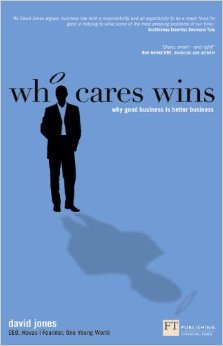
“Who cares wins – why good business is better business” by David Jones is a welcome addition to the emerging cohort of literature on the impact of Social Media on 21st Century contemporary life. The book seeks to address one the most pressing questions of our time: how is the internet and more specifically, Social Media, shaping the future of business activity?
David Jones speaks from a wealth of experience in digital marketing, being the CEO of both Hanvas and Euro RSCG Worldwide – two prominent marketing agencies. He also helped in driving Kofi Annan’s ‘tck tck tck’ Campaign for Climate Justice and is also a Co-founder of One Young World, a non-profit organisation that gives a voice to up-and-coming leaders around the globe.
The book starts from the premise that today’s consumers are no longer just consumers, but prosumers – empowered by the vast amount of publicly found online information to make informed, moral decisions about their purchasing intentions. Decisions that are in line with each ‘prosumers’ set of values and beliefs. In this respect David Jones argues that businesses have to change their behaviour if they are to build long-term success in the digitalised marketplace, “Today, consumers, employees and now shareholders expect business to be more socially responsible. They are frustrated with how things are. They want change…Social media is creating what I believe will be a bigger transformation for business than the arrival of television”.
The book is written clearly and concisely, using a straightforward vocabulary that makes it accessible to a wide audience of readers – even those for whom English may not be the first language. Chapters 1 to 3 lay the groundwork in building the case for the advancement socially responsible business. Here David Jones argues that in our ever-changing, globalised marketplace, companies should strive to out-behave the competition, ‘transparency, authenticity and speed are the rules of modern business’. In this environment, a global company that pursues profit for profit’s sake is running a very risky business model. The consequences of unethical practices being exposed online may cause significant financial damage and in some cases, unrepairable reputational damage. Therefore, the most successful businesses in the future will be those that are most socially responsible.
The author continues to build the argument for ‘good business’ throughout the remainder of the book. Chapters 4 through 6 he discusses the idea of the rise of a new breed of entrepreneur, the social entrepreneur. A ‘social entrepreneur’ is an entrepreneur that puts social responsibility at the core of their business model. Yvon Chouinard, founder of Patagonia clothing or Anita Roddick of the Body Shop fall into this category. In this sense the author rightly argues that the key to making social responsibility mainstream is to ensure that it is both sustainable and financially profitable.
David Jones concludes in pressing the idea that today’s social media, data-driven digital world, access to new information is just a few clicks away. Therefore, it is increasingly likely that the most profitable and successful companies will be ones that operate and add value to their business ecosystem in a socially responsible way.
All being said, “Who cares wins – why good business is better business” by David Jones, builds a compelling empirical argument for good business. Critics might argue that it lacks any significant academic or theoretical analysis. However, the highly relevant case studies and practical examples make up for what it may lack in other departments.
A highly recommended read for anyone interested in understanding how the digital age is changing our world – hopefully for the better.
“Who cares wins – why good business is better business” by David Jones was first published in 2013 by Pearson (ISBN, 0273762974, 9780273762973).
Andrei Rogobete is the Associate Director of the Centre for Enterprise, Markets & Ethics. For more information about Andrei please click here.

(This is an adaptation of a speech given at the Institute of Economic Affairs – For more information about the event please click here)
Christianity, politics the poor and the planet – what should the Christian attitude and response to these issues be?
I want to reflect on two things; the Christian responsibility for the environment and the role of the market in proving a mechanism for an appropriate response.
First, then, an appropriate Christian framework for dealing with environmental issues. It is an area where there is frequent muddled thinking. The Papal encyclical Laudato Si exemplifies both the basic principles and the muddle.
The doctrine of creation is paramount. It is the doctrine of creation which endows the human person with dignity. However, this same doctrine, drawn from Genesis 1 and 2, also establishes the principle of wealth creation. Man was placed in the Garden of Eden, we are told, to both work it (with the raw materials provided) – the principle of wealth creation, and to care for it – the principle of stewardship. To understand a Christian response to the environment you need both of those aspects, not just one.
Now, at the risk of getting too theological; since we live between the fall (hence not a perfect world) and the ultimate end (when all will be restored) there are trade-offs; we are to live, to work, to produce, to educate, to enjoy, to worship and we are to care, steward, oversee and act responsibly. We are not called to asceticism; Lydia is an example of a wealthy Christian businesswoman in the Bible; we are called to innovation, creativity and enterprise; and to steward and care for the world created by God.
The muddled thinking comes about because the language of ‘common good’ sometimes subverts the idea of ‘mutual flourishing.’ The latter bakes the cake; the former reflects upon its distribution. This also leads to the unhelpful presumption that government or global authorities provide the solution to every problem and there is frequently a misunderstanding of the market, which fails to give proper perspective to the role of business and enterprise
Second, then, how can the market help in the environmental debates? Four points:
The market is best at pricing and allocation. Certainly the market needs moral boundaries and moral people as participants and players. However, the market mechanism can be harnessed in support of the environment in ways that governments cannot achieve; governments invariably misallocate resources and hence excessive expectations of government are likely to harm rather than assist the environment.
Any Christian viewpoint that fails to give proper weight to wealth creation, to enterprise and to the market is, in my view, misrepresenting God.
Dr Richard Turnbull is the Director of the Centre for Enterprise, Markets & Ethics (CEME). For more information about Richard please click here.
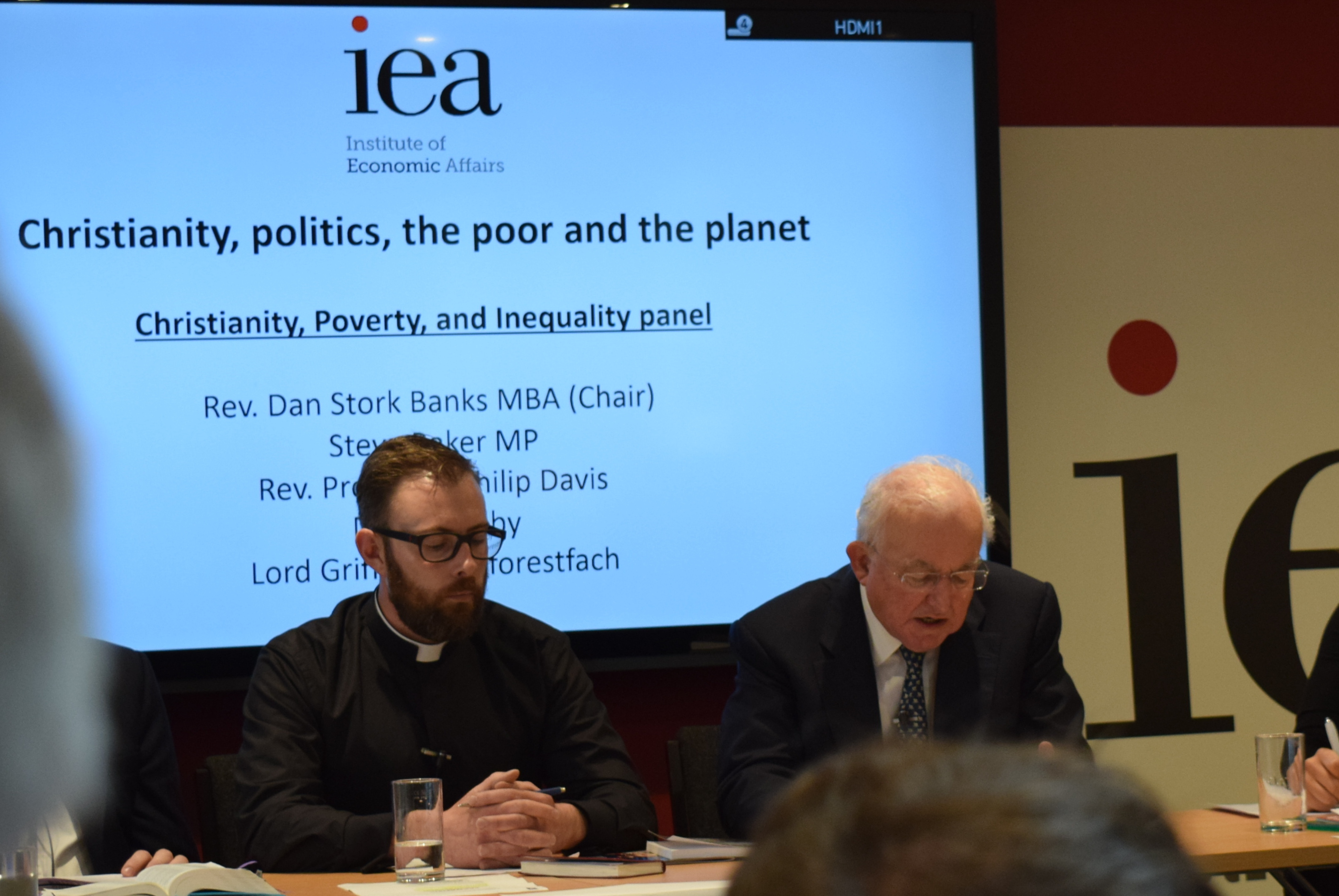
On Wednesday the 21st of October, CEME Chairman Lord Brian Griffiths and Dr. Richard Turnbull (Director), took part in a conference held at the Institute of Economic Affairs (IEA) in London. The focus of the event was to challenge and debate concepts within “Christianity, politics, the poor and the planet“.
The event was formed of two panels, one on poverty and inequality, and one on the environment.
Poverty and Inequality panel speakers:
Environment panel speakers:
About the panels:
Christianity and inequality
Churches have always been concerned about the problem of poverty even if there are differences in views about how it should be tackled. However, in recent years, despite inequality in the world falling, there have been an increasing number of critics of the “rich” and of the level of inequality.
This panel discussed the approaches Christians should take to reducing poverty and whether we should be concerned about inequality as such or simply the position of the poor. The focus was on the poor in richer countries.
Christianity and the environment
The pope recently published an encyclical letter on the environment whilst most Christians would agree that we should “care for the common home” there was little acknowledgement in the encyclical of trade-offs, the way in which globalisation and free trade has lifted many out of poverty, or the possibility that adaptation might be better than trying to stop global warming.
This panel discussed the appropriate Christian attitude towards the environment and the policies that should be adopted to continue the exceptional recent history of poverty reduction.

First coined in 1984 by R. Edward Freeman in his book, Strategic Management: A Stakeholder Approach, Stakeholder Theory brought a new and somewhat radical approach to the study of organizational management and business ethics. Radical in the sense that it became the first theoretical framework to secure a prominent position for the interplay of values, responsibilities, and ethical decision-making in managing a business.
In contrast to the traditional shareholder view, stakeholder theory promotes a way of business conduct that takes into account all the parties that come into contact with a company’s ecosystem . From shareholders and employees, to customers, suppliers and the local community. A ‘stakeholder’ is a person or group that can affect or be affected by the business in question.
Here are three key lessons that we can learn from Freeman’s Stakeholder Theory:
- – Businesses that effectively manage all stakeholder relationships are more likely to succeed in the long-run.
- – Stakeholders must be considered together and not in isolation, working together in the same direction.
- – In the long-run, all stakeholders are equally important for the future of a business.
At the end of the day, both internal stakeholders (such as employees, management, shareholders) as well as external stakeholders (customers, the local community and even governmental or non-governmental organizations) – all have the power to significantly damage, and in extreme cases, bring down a business that mistreats them.
Wise companies must recognize the value in a stakeholder-driven management approach.

Andrei Rogobete is a Research Fellow with the Centre for Enterprise, Markets & Ethics. For more information about Andrei please click here.

CEME will be publishing a ‘theology of work’ in late 2015 so it was particularly helpful to listen to Yves de Talhouet, senior Vice-President of Hewlett-Packard on the subject.
Work is essential to human flourishing. All sorts of implications flow from that including for government welfare policies. However, work is not necessarily in the state it should be in. Gallup have shown that 16% of workers are actively disengaged from their work which has enormous cost in terms of productivity, community and the collective intelligence within a workplace.
Yves described work as under attack from two sources, both of which need to be resisted. The first is the classic ‘work is a necessary evil,’ or simply viewed as a prison to escape from. Actually work delivers well-being, defeats poverty and dependence and so needs to be encouraged. More interesting was Yves second point about work being under attack. In this case work was under attack from management systems driven only by numbers, productivity, targets etc, key performance indicators – all of which had the effect of disguising real work.
Work has three aspects:
A proper understanding of work involves all three of these aspects to be properly recognised. The problem is that the objective side (measurement, targets) has grown to the extent that nothing else seems to matter. Work is reduced to process and the consequence is disengagement. More value needs to be put into the subjective side (recognition, encouraging self-esteem) and the collective (team work, solidarity, community).
It seems to be me that we either over-emphasise the objective as Yves suggests so that we become obsessed by outputs and targets, or we ignore that productive side altogether in pursuit of some vague collective ideal. Work both dignifies humanity and is essential for producing goods and services. Work enables us to flourish and provide for our families. Work, for the Christian, reflects God’s purpose for us. Work is important.
If work is conveys both dignity and economic productivity then its lack destroys both. So unemployment is not a good thing and we should encourage policies which encourage enterprise, growth and hence employment. At least part of the purpose of a firm is to provide employment in the process of producing economic surplus. However, discouraging work also damages human dignity and purpose. CEME is strictly independent and works with people across the political spectrum. Nevertheless, if minimum wages are imposed at too high a level for all jobs, or welfare benefits set at too high a level, the consequence could be to discourage work. Equally, in order to encourage work there is surely a case for a degree of wage subsidy at the lowest points of the wage scale to encourage people into work. However, if tax credits potentially subsidise the proper wages employers should be paying then there is an even stronger case for a lower introductory rate of income tax which would encourage work, avoid subsidies and indeed the impact on take-home pay as income rises.
Whatever the policy prescriptions work not only must pay, but work must also be valued and invested with true worth, value and dignity in all its fullness.
Dr Richard Turnbull is the Director of the Centre for Enterprise, Markets & Ethics (CEME). For more information about Richard please click here.

The inspiring session of the day came from Daniel Servitje, Chairman and CEO of the Bimbo Group, Mexico.
Bimbo is one of the world’s largest baking goods industry firms with a capitalisation of US$12bn and around 129,000 employees.
The company was described as ‘rooted in long-standing values,’ shaped by strong corporate governance and a determination that businesses and society must work together for human dignity and the common good. The company, he said, was both highly productive and deeply humane.
The aims of the company where shaped by a matrix:
| Economic | Social | |
| External | Providing valuable goods and services to society | Contributing to the development of society in a sustainable way |
| Internal | Compensating employees, members, investors | Contributing to personal and professional development of employees |
This was a powerful reminder that profitability and sustainability are not incompatible. However, it is entirely reasonable for a company to have aims and objectives that are not simply defined by shareholder value maximisation. Of course, a successful and sustainable company may well do just that.
Daniel pointed out that his company was involved in sectors of the economy which attracted criticism – baked goods and health. The companies social responsibility platform was built on four areas:
All employees were encouraged to take part in the 3-day company sponsored off-site development event, covering person, family, work, society, culture and spirituality.
The fascinating thing about the presentation was the holistic and integrated nature of the approach to sustainability. Social responsibility was not an add-on, but fully part of the company and its objectives – and not as an alternative to profitability. At the heart of the company’s purpose was providing goods and services at profit. Alongside that came creating jobs, investment, promoting a formal economy (in a country, Mexico, where much of the economy is ‘informal’ which denies extensive tax revenue to the government), developing and sharing knowledge and skills. The outcome was better people, companies and countries.
It would be great if more companies, large and small, thought about their aims and objectives, the role of profit and sustainability, with the same degree of intent.
Dr Richard Turnbull is the Director of the Centre for Enterprise, Markets & Ethics (CEME). For more information about Richard please click here.