Skip to content

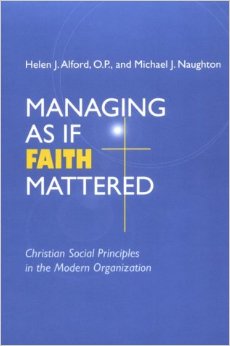
Richard Godden: “Managing as if Faith Mattered” by Helen Alford & Michael Naughton


Managing as if Faith Mattered” is the first volume in the Catholic Social Tradition Series, published by the University of Notre Dame Press in response to Pope John Paul II questioning how many Christians really know and put into practice the principles of the Catholic Church’s social doctrine. Its target audience is thus, first and foremost, Catholics in business, although the authors say that they are directing their book towards Christians as a whole and that its content will be worth considering by all people (page xvii).

At the time the book was published, in 2001, Helen Alford was Dean of the Faculty of Social Sciences at the Pontifical University of St Thomas Aquinas in Rome and Michael Naughton was Director of the John A. Ryan Institute for Catholic Social Thought at the University of St Thomas, St Paul, Minnesota. Unsurprisingly, they adopt a precise analytical approach to their subject and, as the 73 pages of end notes illustrate, seek academic rigour. None-the-less, the two questions that they pose in order to frame their discussion are profoundly practical: “What kind of person should I as a manager or employee strive to become?” and “What kind of organisational community should I as a manager or employee strive to build and maintain?” (page 8).

They suggest that two unhelpful paradigms foster a divided life in present day Western culture: first, the paradigm of the “secularisers” (typified by Tom Peters, co-author of “In Search of Excellence”), who suggest that religion and spirituality have nothing to say to business since religion is by its nature a private affair; secondly, the paradigm of the “spiritualisers” (typified by Andrew Carnegie), who may have strong personal faith and seek to live out this faith in personal virtue but who “avoid judging business policies in light of their faith” and who “fail to be true to a faith that does justice” (page 15). Alford and Naughton, asserting the relevance of faith to business, take issue with both paradigms, before analysing three models of linking faith and work: what they call the “natural law approach” (which seeks to find common ground in order to mould secular organisations); the faith-based approach (which is manifested by organisations founded explicitly on faith inspired values); and the prophetic model (which seeks to challenge organisations). They recognise weaknesses in all of these models but urge that they all be kept in mind.

Alford and Naughton then address the purpose of business. They severely criticise the suggestion that this is merely to make money or, indeed, merely to enhance shareholder value; they draw attention to the limitations of a stakeholder model of organisational purpose; and they conclude that the purpose of business is “working together for the common good” (the title of Chapter 2), defining “the common good” as “the promotion of all the goods necessary for integral human development in the organisation, in a way that respects the proper ordering of those goods” (page 70). This definition then leads naturally into the consideration of the concept of human development in a corporate community and, at the core of this, is a discussion of “virtue” and, in particular, the four Catholic Cardinal Virtues.

The book then moves from the theoretical to the practical in four chapters that are collectively entitled “Making the Engagement”. These consider, in turn, job design, just wages, ownership and marketing and, whilst continuing to analyse and develop theoretical concepts, seek to consider practical solutions to business problems. Thus, for example, the discussion of pay suggests that three basic tests need to be applied: whether something is a living wage; whether it is an equitable wage; and whether it is a sustainable wage (page 130). This theory is then applied to remuneration concepts such as ESOPs (Employee Share Option Plans).

Finally, the book turns to spirituality at work, considering the use of prayer, scripture, daily reflection and, perhaps more surprisingly, liturgy.

All of this provides much food for thought. The critique of modern professional education for its failure to address the “ends of business” (page 16) and its recommendation by default of a “privatised professional ethic” (page 18) is particularly telling and its fresh look at the objectives of job design and remuneration is challenging. Unfortunately, however, the book is heavy going in places and some of it could have been more simply expressed. For example, the book would have been more accessible to its lay readers had the authors expressed more pithily their points relating to the distinctions between “foundational goods” and “excellent goods” (page 42) and between “common goods” and “particular goods” (page 49). Similarly, the discussion of virtue would have been more accessible to modern businessmen had the authors not felt it necessary to tie it back to Aquinas’s teaching. More generally, there is a grave danger that the key points made by the authors become lost in a sea of detailed analysis.

It is also disappointing that, for all the care in the analysis, unsupported contentious statements from time to time leap off the page. For example, the quotation (with apparent approval) of Peter Maurin’s statement that “when everyone tries to become better off, nobody is better off” (page 92) suggests a naïve “zero sum gain” view of global economics and the quotation (again with apparent approval) of the assertion that “a manager’s first obligation is maintaining the company as a going concern for the benefit of the stakeholders” (page 149) seems contrary even to the purpose of business as contemplated by the authors. Furthermore, many Christians will raise eyebrows at various theological statements such as the statements that we are meant “through virtuous living to attain the possession of God” (page 64) and the quotation of Pierre Teilhard de Chardin’s statement that “God is inexhaustibly attainable in the totality of our action” (page 207).

Those who are not used to Catholic academic analysis may also find the frequent quotation of Thomas Aquinas, Pope John Paul II and other Catholic authorities a distraction rather than a help and the authors’ use of the terms “Christian Social Tradition” and “Christian Social Teaching” to refer to what is specifically Catholic teaching is irritating even though, as the authors point out, in recent years there has been some ecumenical convergence in relation to social teaching (page 247).

This book is worth reading but it requires time, determination and a degree of patience.


“Managing as if Faith Mattered” was first published in 2001 by University of Notre Dame Press (ISBN 0268034613, 9780268034610)


Richard Godden is a Lawyer and has been a Partner with Linklaters for over 25 years during which time he has advised on a wide range of transactions and issues in various parts of the world. 

Richard’s experience includes his time as Secretary at the UK Takeover Panel and a secondment to Linklaters’ Hong Kong office. He also served as Global Head of Client Sectors, responsible for Linklaters’ industry sector groups, and was a member of the Global Executive Committee.

Ben Cooper: “The Spirit of Democratic Capitalism” by Michael Novak

Revd Dr Ben Cooper is Minister for Training at Christ Church Fulwood in Sheffield. He holds doctoral degrees in both Theology and Economics. Before training for ordained ministry, he was a post-doctoral research fellow in economic theory at Nuffield College, Oxford. He is married to Catherine and has three children.

Martin Novak is an American Catholic author, philosopher, and theologian. Born in 1933, he tells of how he took seriously Aristotle’s advice that a man cannot write well on ethics until he is at least fifty, and so waited until the late 1970s before starting work on what has become his most influential book, The Spirit of Democratic Capitalism. In the intervening years, he had become increasingly convinced that the actual practice of what he calls “democratic capitalism” is more consistent with the high ideals of Judaism and Christianity than the practice of any other system. This was a radical conclusion to reach. As he notes (page 242), it was generally assumed at the time that prominent thinkers like Paul Tillich were right to say, “Any serious Christian must be a socialist”. The term “capitalism” was used in many Christian circles, as it was by many in the academy, with contempt.

The Spirit of Democratic Capitalism was published in 1982 — just before Novak’s fiftieth year, as it happens, but it is nonetheless ethical writing on political economy of the highest quality. The book is divided into three parts, beginning with an enquiry into “the ideal of democratic capitalism”. The term “democratic capitalism” was not in wide usage at the time, and Novak appropriates it to describe a three-fold dynamic system: “a democratic polity, an economy based on markets and incentives, and a moral-cultural system which is pluralistic and, in the largest sense, liberal” (page 14). Novak challenges the negative stereotypes: “The spirit of democratic capitalism is the spirit of development, risk, experiment, adventure” (page 48). It is pluralistic: power and control is dispersed, countering any tendency to tyranny. It is relatively resilient to errors of unintended consequence. It doesn’t make the mistake of thinking economic decisions constitute a zero-sum game. It’s more conducive to community than you might think, especially in relation to the family. All this, Novak contrasts with socialism in the second part of the book, “The twilight of socialism”.  In the light of its practical failures, socialist thinkers have retreated into idealism and claims of moral vision, mostly centred around questions of equality and justice (page 207). Novak critiques these claims both at the level of ideals and, in one of the rare empirical sections of the book, in terms of real outcomes. In the final section, he then attempts “A theology of economics”, critiquing a number of approaches before outlining his own, rather limited, account of the theological doctrines underpinning democratic capitalism.

This is a lengthy book, requiring some perseverance to work through its 460 pages. I found myself on occasion yearning for a more orderly and concise argument. Other times, I felt in need of some more formal analysis or hard evidence. Nonetheless, The Spirit of Democratic Capitalism is essential reading for anyone interested in the ethics of political economy. The basic argument is, on the whole, satisfying and persuasive. Socialism claims, in part, that capitalism institutionalizes greed and selfishness (page 92), and positions itself as an antidote. But socialism cannot do away with greed and selfishness. Rather, these negative impulses survive to inflict enormous damage, because the rigidity of a centralised system means there are relatively few checks and balances to constrain them. Under capitalism, the constraints on the damaging social effects of greed and selfishness turn out to be superior, because success typically depends on doing something that will be of benefit to other people (although, as Novak and others have noted, this requires a democratic polity and strong moral cultural foundations to function well). Moreover, capitalism provides a setting within which some of the more positive aspects of human nature, such as creativity and invention, can flourish. In such a setting, many kinds of failure are actually part of the learning process through which innovations develop and improve, and cause economies to grow. Importantly, in none of this does Novak claim perfection for democratic capitalism. It “does not promise to eliminate sin” (page 85). His claim is a relative one: “all other known systems of political economy are worse” (page 28). It’s in democratic capitalism, he goes on to say, that our best chances lie: “Such hope as we have for alleviating poverty and removing oppressive tyranny — perhaps our last, best hope — lies in this much despised system”.

So successful is Novak’s basic argument that the question now is not so much whether one should be “for” democratic capitalism or “against”; rather, the question becomes what kind of democratic capitalism should we favour and promote? Given that “the democratic capitalist revolution is moral, or not at all” (page 439), Christian thinkers should have plenty to contribute on this question. Novak’s own attempt to do so in the final section of the book is perhaps its weakest and most undeveloped part. There is only the faintest glimpse of how democratic capitalism might fit with the wider plans and purposes of God in history across the nations. On such things Novak was very clear even as he wrote that there is much more to say.


 “The Spirit of Democratic Capitalism” was first published in 1982 by Simon & Schuster. This is a review of the revised edition, published in 1991 by Madison Books (ISBN-10: 0819178233), 460pp.


Revd Dr Ben Cooper is Minister for Training at Christ Church Fulwood in Sheffield. He holds doctoral degrees in both Theology and Economics. Before training for ordained ministry, he was a post-doctoral research fellow in economic theory at Nuffield College, Oxford. He is married to Catherine and has three children.


Richard Turnbull: “Good News for the Poor” by Theodore W. Jennings


John Wesley’s influence in the history of Christianity is indisputable. His movement for ‘scriptural holiness,’ his foundation of Methodism as both movement and denomination, his organisational prowess, his spiritual passion for the established church, all form part of his legacy. His Journals, letters and sermons are a goldmine of information and insight. Naturally this wealth of primary resources has also generated a history of interpretation. The fire in his parents’ Rectory at Epworth (‘a brand plucked from the flames’) came to form part of the providential history of Methodism, as indeed did his ‘conversion’ experience at a meeting of the Moravians in Aldersgate Street in London in May 1738. Wesley also was a political conservative, a supporter of the monarch, willing to pray against the French and resistant to the rebellion of the north American colonies.

So, a quest for Wesley’s economic and social ethic is an attractive possibility. Surely if there is an ‘evangelical economics,’ we will find Wesley an able exponent? The enormous strength of this book is that it gathers into one place Wesley’s writings and teachings on economic and social matters. The weakness lies in the interpretation in which we learn more about the author than we do the subject.

Professor Theodore Jennings is currently an affiliated Faculty member of Chicago Theological Seminary as Professor of Biblical and Constructive Theology. He has been a local pastor and also taught at the Methodist Seminary in Mexico City. He clearly stated aim is to re-interpret Wesley through the lens of liberation theology. So his starting point is a ‘demystification of wealth and power’ and a ‘preferential option for the poor’ (pp24-25). By ‘evangelical economics’ the author means ‘the criticism of wealth, the forms of solidarity with the poor, the notion of stewardship, and the vision of an economic practice based on the example of the Pentecostal community’ (p24). Intriguing though these themes are, they hardly form an adequate definition for ‘evangelical economics.’

The book is constructed around these key themes together with chapters on ‘The Theological Basis of Wesley’s Ethic,’ ‘Why did Wesley Fail?’ and ‘The Relevance of Wesley,’ together with an appendix on ‘Wesley on Politics.’ These chapters, forming the second half of the book, are essential to Jennings interpretative exercise – because he has, by his own admission, to deal with Wesley’s well-known conservatism, his swift abandonment of the Pentecostal ideal, Wesley’s own contra-writings to the liberation theology theme and the unwillingness of Methodism to embrace the apparent ideals of their founder.

Jennings powerfully brings out Wesley’s critique of wealth and excess. Wealth was a temptation and increasing riches increase the temptation and conformity to the world. Luxury leads to laziness and contempt for the poor. Jennings here draws upon Wesley’s Journal and his sermons, On Riches, The Danger of Riches, On the Danger of Increasing Riches. Wesley expounds the theme that all our riches and wealth are held on stewardship from God and with a purpose:

Do you not know that God entrusted you with that money (all above what buys necessaries for your families) to feed the hungry, to clothe the naked, to help the stranger, the widow, the fatherless; and, indeed, as far as it will go, to relieve the wants of all mankind (p102, quoting the sermon on ‘The Danger of Increasing Riches’).

Wesley’s most famous treatise on the matter was his well-known sermon on ‘The Use of Money,’ and the famous three-fold injunctions of ‘Earn all you can, save all you can, give all you can.’ Jennings does recognise the complexity of this sermon but we see also his own forced interpretation here by his description of this sermon as ‘the source of most of Wesley’s problems with the Methodists’ (p167). This is wholly inadequate by way of interpretation. Wesley refers to money as ‘an excellent gift of God’ and being of ‘unspeakable service to all civilised nations,’ whilst also arguing for ‘honest industry’ and for the avoidance of sinful trade or the undercutting of competitors. In reality there is little economics (evangelical or otherwise); the feel is very much that of a preacher.

There is also the vexed question of Wesley’s advocacy of the ‘community of goods,’ upon which Jennings places great store but about which two things are clear. First, that Wesley experimented intellectually (and hoped to do so practically) with the idea in the 1740s and, secondly, that he subsequently abandoned it either because he considered it to be unrealistic or because his thought had moved on, perhaps as he preached his sermon on “The Use of Money” (which he delivered on 23 occasions according to the sermon register, starting in 1744, and which was printed in 1760).

Despite his occasional radical thoughts Wesley stood in the mainstream tradition; he accepts the basic role of the market, offers strictures against excess and looks to the voluntary principle as a response to social need. However, for all that, we should not underestimate the power of his critique of wealth and money.

Ultimately, Jennings forces the material to his theme. He makes far too many pejorative interjections in his interpretation for the contemporary age.  That is not to say that there is nothing powerful about gathering together from their disparate sources Wesley’s economic and social thought. However, he does so partially. By separating those writings of Wesley which operate in the opposite direction we are left with two halves of a theological tradition without the necessary interpretation of the complexity. Wesley was not an economist and his writings on economics – claimed indeed by both ‘free-marketers’ and ‘socialists’ (which merely illustrates the complexity) –  simply cannot be garnered into some overarching economic strategy. As a preacher he certainly knew the challenges wealth brought; about business and market itself (the use of the word capitalism would be an anachronism) he was unquestionably equivocal.


“Good News to the Poor: John Wesley’s Evangelical Economics” was first published in 1990 by Abingdon Press (ISBN-10: 0687155282)


Richard%20Turnbullweb#1# (2)

Dr Richard Turnbull is the Director of the Centre for Enterprise, Markets & Ethics (CEME). For more information about Richard please click here.

Edward Carter: “Capital and the Kingdom – Theological Ethics and Economic Order” by Tim Gorringe

I first read this book shortly after it was published in 1994, at a time when I was starting to explore the interface between Christian ethics and economics. Re-reading it some twenty years later has been instructive, now that this field has been developed rather more and is taken seriously again by at least some of those involved in politics and public life.

The book is set out in four parts, preceded by a helpful introduction in which Tim Gorringe sets out his stall by explaining how he uses Karl Marx as a dialogue partner throughout. This gives a hint as to his own political leanings. Indeed, in his introduction he even locates Marx as standing within the tradition of prophecy (p. xi). This means that Gorringe works essentially with a structured view of society and of economics that draws on Marxist theories of power and domination, rather than something more dynamic or entrepreneurial, and this is the undergirding theme of Part One. However, the theme of ‘narrative’ and economic history is certainly also present here, as part of his general critique of a version of economics that is ‘at the mercy of abstract laws which only experts can fathom’ (p. 22).

Within Part One I enjoyed finding at least two sharp criticisms of Brian Griffiths, Chairman of CEME, and having heard Lord Griffiths’ more recent reflections my sense is that he might now yield a little ground to Gorringe when it comes to the place for Christianity within public policy (see p. 13), while holding fast against the Marxist view on equality and liberty (p. 54). In certain respects, the world that Gorringe describes has changed. I particularly noticed this in his discussion of a living wage, which has now been embraced across the political spectrum in the UK.

Part Two of the book has four chapters that address more focused subjects. The first of these, ‘Work, Leisure, and Human Fulfillment’, sets out a valuable survey of Christian thinking through history on this theme, with the conclusion that ‘true leisure is not utilitarian’ (p. 77), and that both work and leisure are about human realisation. As a stand-alone section this would make good reading for anyone wanting a critique of a self-contained neo-classical economic world-view. However, the other three chapters in Part Two resonate more strongly with Gorringe’s Marxist theme, as they tackle the subjects of alienation, solidarity, resistance, and social justice. Gorringe looks for a ‘rejection of the individualism which divides people and sets them against each other, affirmation that humanity consists in working together’ (p. 102). While this is indeed a hopeful broad vision to set forth, as I read these words I found myself wondering whether it takes seriously enough the way in which entrepreneurial energies operate within the economy.

Part Three is given the over-arching heading ‘The Common Treasury’, in which Gorringe explores the subjects of personal property, inequality, planning and ecology. His general approach is one that advocates a socialist ‘control’ of the economy, and at one point he states that ‘some kind of global planning is needed’ (p. 140). Part Four then consists of a single final chapter, entitled ‘Two Ways’, in which Gorringe mounts a strong attack on global capitalism. It was here that I was surprised but pleased to stumble across a reference to the economist Joseph Schumpeter. His work had been used as ammunition within a 1980s debate between the Roman Catholic bishops of the USA and some prominent Catholic lay people. Reading this section carefully, my impression was that Gorringe brackets Schumpeter with a more general neo-classical take on economic theory, and then summarily lambasts them both. However, I would argue that he has missed something here, and that a more careful look at the contrast between Schumpeterian economics and the neo-classical approach would have been fruitful. In fact, Schumpeter has been taken in a Marxist direction, notably by Paul Sweezy, and I wondered if Gorringe might have changed his line if he had been aware of this.

On almost the last page of the book I then found this sentence: ‘There is nothing intrinsically wrong with enterprise, initiative and ownership. What is wrong is when these are harnessed to profit, power, self-aggrandisement, and inequality.’ (p. 166) As a programmatic statement this felt promising to me, but I struggled to see how large parts of the book itself could be taken to support or develop it. Rather, for Gorringe any sense of enterprise or initiative seems essentially to be subsumed within a Marxist superstructure, and the need for human cooperation to be played out in a society marked by planning and control. In the end, therefore, I found this book to be a helpful foil against which I wanted to put forward different ideas connected to human enterprise. However, as a major contribution in the field of theological ethics and economic theory its importance cannot be doubted.


“Capital and the Kingdom: Theological Ethics and Economic Order” was published in 1994 by SPCK/Orbis Books (ISBN 10: 0-281-04773-1)


Edward Carter is Vicar of St Peter Mancroft Church in Norwich, having previously been the Canon Theologian at Chelmsford Cathedral, a parish priest in Oxfordshire, a Minor Canon at St George’s Windsor and a curate in Norwich. Prior to ordination he worked for small companies and ran his own business.

He chairs the Church Investors Group, an ecumenical body that represents over £10bn of church money, and which engages with a wide range of publicly listed companies on ethical issues. His research interests include the theology of enterprise and of competition, and his hobbies include board-games, volleyball and film-making. He is married to Sarah and they have two adult sons.

Andrei Rogobete: “The Shareholder Value Myth” by Lynn Stout


They often say ‘never to judge a book by its cover’, that initial external appearances can distort or even deceive the audience from the content that lies within. Well, the principle doesn’t apply here. Lynn Stout’s The Shareholder Value Myth attempts to achieve exactly what the title entails: a pure and straight forward critique of the belief that the ultimate purpose of business is to maximise shareholder value, which often dominates the field of business management.

Author Lynn Stout is Professor of Corporate & Business Law at the Cornell Law School where her main areas of research include corporate law, securities and derivatives regulation, economics, and organisational behaviour.  Stout argues that the Shareholder Value ideology is ultimately just an ideology, not a legal requirement or a ‘practical necessity of modern-day business life’ (p3). In this sense, Shareholder Value thinking is a mistake for most companies because it indirectly forces corporate managers and executives to ‘myopically’ focus on short-term earnings at the expense of long-term stability and performance. It also ‘discourages investment and innovation, harms employees, customers, and communities; and causes companies to indulge in reckless, sociopathic, and socially irresponsible behaviours’ (p10).

The book is written clearly and concisely, predominantly using direct rhetoric and short sentences. In terms of structure, the book is broadly divided in two comprising parts: Part 1 is a direct attempt in ‘Debunking the Shareholder Value Myth’ while Part 2 is mostly an investigative endeavour into who the ‘shareholders’ are and what they actually value. Each part is made up of five shorter Chapters so let’s take a closer look into some of the main points and arguments made throughout the book.

The first half can be seen as a systematic critique of the means and (even disastrous) consequences of ‘shareholder value thinking’. Corporate scandals such as the 2010 BP Oil Spill and cases of serious fraud in large companies such as Enron, HealthSouth and Worldcom throughout the 2000s are all cited as consequences of shareholder value thinking. Professor Stout makes a compelling case that the ‘narrow’ focus on share price alone can result in ruthless management behaviour. The drive for extreme cost-cutting in the hope of increasing short term profit doesn’t just hurt the employees and the company, but the shareholders themselves.

The book provides a brief historical account of how shareholder value thinking came to dominate teaching in business schools as well as becoming the norm within the private sector itself. If in the 1800s most privately held companies were of single ownership (or a tight shared ownership), by the 1990s publicly held companies have tens of thousands of shareholders. Stout rightly argues that this replacement of the ‘single’ ownership model with an executive Board to represent the vast number of shareholders causes the Board (as well as the senior management) to assume that all the shareholders want is ‘to make as much money as possible, as quickly as possible’. It rather quickly trickles down to the lowest common moral denominator, ignoring the fact that shareholders are real human beings with different investment timeframes, different priorities and different attitudes toward the well-being of others. In this sense Lynn Stout rightly argues that ‘recognising these differences reveals that the idea of a single objectively measurable “shareholder value” [i.e. solely based of share price] is not only quixotic, but intellectually incoherent’ (p60).

The second half of the book turns its attention toward the shareholders themselves: who are they? And what do they want to get out of their investment? These questions in turn give rise to a clear dichotomy within a company’s pool of shareholders: ‘short-term speculators versus long-term investors’. Again, Lynn Stout rightly points out that ‘long-term shareholders fear corporate myopia. Short-term investors embrace it – and many powerful shareholders today are short-term’ (p65). The conflict of interest generated by short vs. long-term investors indirectly forces a company’s management to take the default position and assume that every shareholder is a ‘platonic investor’ – i.e. an investor that only owns shares in company ‘X’ and the share price increase is all that they are interested in. Lynn Stout argues that in reality however, this ‘platonic investor’ does not exist. The overwhelming majority of investors today own more than just shares in company ‘X’, they are invested in the marketplace as a whole and want to protect the value of their other investments also. In this sense, the short-term focus generated by shareholder value thinking can actually work against the interests of the shareholders themselves.

The book as a whole presents a compelling critique of shareholder value thinking. Yet it’s strength is also its greatest weakness: it is just that, a critique –nothing more and nothing less. What are the solutions? The final pages of the book only tentatively touch on a possible way forward in arguing that what is needed is a more ‘complex and subtle understanding of what shareholders really want from corporations’ (p115). This all sounds great and very necessary but how do companies get there? Even if executives come to acknowledge the variations in their shareholder’s desires – is this a guarantee that the company’s approach to corporate governance will change?

I have written on this topic in the past  where I highlighted the importance of first establishing a concrete set of internal ethical values and practices. Only then does it become possible to accommodate the desires of a larger pool of shareholders and indeed, stakeholders.

A great deal remains to be written on this topic and The Shareholder Value Myth by Lynn Stout is an excellent addition to the growing body of literature that forces us to re-think the role and purpose of business in society.

A recommended read.


“The Shareholder Value Myth” was published in 2012 by Berrett-Koehler Publishers (ISBN 10: 1605098132). 134pp.


Andrei Rogobete

Andrei Rogobete is Associate Director of the Centre for Enterprise, Markets & Ethics. For more information about Andrei please click here.


Richard Godden: “Why Business Matters to God” by Jeff Van Duzer

Why Business Matters to God” is addressed to Christians. Jeff Van Duzer, now Provost of Seattle Pacific University and formerly Dean of its School of Business and Economics, suggests that Christians in business “have often been made to feel like second-class citizens in God’s kingdom” (page 9). His aim is to counter the attitudes that underlie this by affirming the intrinsic value of business work “as work full of meaning and importance to God”, whilst at the same time challenging what he describes as the “dominant business paradigm of the day” (page 9). The result is an excellent, well-argued and thought provoking book that should be read by all Christians engaged in business.

Van Duzer undertakes his task by using a theological framework, considering in successive chapters the implications for business of the biblical accounts of creation, fall, redemption and consummation.

From the creation story, he concludes that the material world matters to God, that human beings are called to steward God’s creation and that we are made to work (i.e. that work is not a punishment or a necessary evil). He notes that society has many institutions (e.g. families, churches and governmental bodies) and asks “which aspects of the creation mandate are best suited for business to handle?” (page 41). He points to the role of business in the creation of wealth and concludes that the intrinsic purposes of business are “to provide the community with goods and services that will enable it to flourish, and … to provide opportunities for meaningful work that will allow employees to express their God-given creativity” (page 42).

At this point, the reader may feel that the account of business is too rosy but this issue is squarely addressed in the next chapter, which considers the implications of the fall. Here Van Duzer parts company with the more extreme free market enthusiasts (both Christian and non-Christian) by stressing that “the market will not usher in the kingdom of God” (page 75) and suggesting that the market mechanism is an aspect of common grace that mitigates some of the consequences of the fall. He stresses that we cannot “equate market forces with God’s perfect will” (page 79).

Having done this, Van Duzer reverses the logical theological order and leaps on to consider what the biblical account of ultimate salvation (“consummation”) can teach us that is of relevance to business. In doing so, he heads into stormy theological waters as he assesses the relative merits of adoptionism and annihilationism as an explanation of how God’s new heaven and new earth will be inaugurated. He sides with the “cautious adopters” (page 94) but those who don’t take this view will be pleased to hear that it is not central to his argument and he acknowledges that “any conclusions we may reach must be held lightly” (page 83). This result is that this part of his analysis is less fruitful than other parts of it.

He next considers redemption and suggests that business must “concern itself with redemptive as well as creative work” (page 114), whilst accepting that it is operating within the “messy middle” (page 118). In this context, he rejects both the cynicism of those who suggest that “Business ethics is an oxymoron” and the optimism of those who argue that “Good ethics is good business” in the sense that there will always be a bottom line benefit for those practicing good ethics.

Van Duzer recognises that our attitude to business will turn to a considerable extent on our view of how Christians should engage with the world (what he calls our “posture of engagement”) and also upon our attitude to institutions of all kinds in the modern world. He devotes an “excursus” to each of these issues, of which the first is particularly helpful. It adopts Niebuhr’s typology (“Christ against culture”, “Christ of culture”, “Christ above culture”, “Christ and culture in paradox” and “Christ the transformer of culture”) and demonstrates how our answers to several key theological questions are likely to determine which type of cultural engagement we adopt and, specifically, our view of the role of business.

The final quarter of the book is less well structured than it might have been and parts of it would have better merged with the earlier chapters. None-the-less, it contains some worthwhile discussions of important issues such as business sustainability (in the broad sense) and, most importantly, the role of profit and enhancing shareholder value. Van Druzer recognises the essential instrumental role of profit but denies it any greater significance, specifically rejects the notion that the maximisation of profit or shareholder value is a primary goal of a business.

Although published under the IVP Academic banner, this is not an academic work. It does not interact extensively with other literature and it has no bibliography, although it makes good use of footnotes that may suggest further reading.

It is a short book and could not possible consider all of the angles on its subject. None-the-less, it would have been helpful had Van Duzer considered questions that arise from his dethroning of profit and shareholder value: Might this result in a loss of focus on efficiency and thus reduce wealth creation? How can managers be rendered accountable for the delivery of goals that cannot be quantified or otherwise clearly measured? If shareholders in a public company appoint and remove them, will the directors not always focus on the maximisation of shareholder value? Who might enforce any broader directors’ duties? Van Duzer is a lawyer by background and his views on these issues would be interesting.

Despite the final chapter’s focus on “making it real”, many readers may be left wondering how it is possible to translate Van Duzer’s vision of business into practice in a secular Western business context. This is a significant issue. However, the purpose of this book is to provide a Christian conceptual framework for business not to analyse in detail its implications in relation to day to day management. Addressing these implications would require another book and perhaps the only significant criticism that can be levelled at Van Duzer is that he hasn’t yet written it!


“Why Business Matters to God” was published in 2010 by InterVarsity Press (ISBN 10: 0830838880). 201pp.


Richard Godden is a Lawyer and has been a Partner with Linklaters for over 25 years during which time he has advised on a wide range of transactions and issues in various parts of the world. 

Richard’s experience includes his time as Secretary at the UK Takeover Panel and a secondment to Linklaters’ Hong Kong office. He also served as Global Head of Client Sectors, responsible for Linklaters’ industry sector groups, and was a member of the Global Executive Committee.

Richard Godden: “Business for the Common Good” by Scott Rae and Kenman Wong


The concept of “the common good” dates back at least to Aristotle and has been used by political theorists, moral philosophers and economists down the ages, including people as diverse as Thomas Aquinas, John Locke and Adam Smith. It is a basic concept in Catholic social teaching and is easily understandable by all. However, it is not familiar today in discourse about the purpose and role of business.

Wong and Rae want to change this. They suggest that, “it is an important time to reconsider what business, and our current or future participation in it, is all about” (page 28) and they undertake this reconsideration by first considering the purpose of those engaged in business. They suggest that, “The idea that business can be a calling is becoming more widely appreciated and accepted” but that “what exactly business is a calling to needs much more exploration” (page 33; the emphasis is theirs). They then launch into the required exploration. The first part of this leads to the conclusion that business is a calling “to transformational service for the common good” (page 76) and the implications of this are then worked through.

Business for the Common Good forms part of the InterVarsity Press “Christian Worldview Integration Series” and is, thus, written primarily for Christians. However, Prabhu Guptara observes in his endorsement that “Nothing in this book prevents it enriching the lives of Hindus such as myself – or, as far as I can see, those of Buddhists, Muslims, agnostics or atheists!” He is right.  The book’s conclusions do not depend upon any theological propositions other than a general view of God and the World that will be shared, at least in its more important features, by millions of people of various faiths and, at least in relation to its view of the World, by many of no faith. Furthermore, although the Series Preface suggests that college students may be a primary target audience, the book is likely to assist a far wider audience, including those who have been in business for many years. Some readers will find its lack of interaction with other literature a downside but others will welcome the fact that it does not assume any prior reading and deals with issues from first principles.

After an over long Series Preface and their (shorter) Introduction, Wong and Rae helpfully examine the purpose of work, addressing the question whether work has merely an instrumental purpose or whether it also has an intrinsic purpose. Put simply, do we work merely to live or do we live to work? Many, perhaps most, people today would say that they work to live and for the poor this may seem obviously true but Wong and Rae seek to re-establish the idea that, as Martin Luther said, “The entire World is full of service to God, not only in the Churches but also the home, the kitchen, the cellar, the workshop and the field of the townsfolk and farmers” (page 60). As Wong and Rae put it, “Our work can serve as an altar” (i.e. an act of worship; page 46).

On this basis, they ask whose interests business should serve. It is their analysis of this that leads to what they describe as their “Christian vision for business” (page 76) and hence to their basic proposition that the calling to business is a calling to transformational service for the common good.

Having laid these foundations, they then turn to a series of specific issues: how involvement in business can result in negative effects on our character but how it can also transform us for good (which they rightly describe as a “rarely examined question”; page 37); what our attitude towards wealth, success and ambition should be; how we should respond to globalisation; ethics in the work place; business leadership and management; marketing; and stewardship and sustainability. Finally, they turn to what they describe as “several exciting (and very inspiring) ways that emerging practices and organisations are moving business towards becoming proactive and intentional partners in solving social problems” (page 38).

This is a huge amount to cover in a relatively short book and some parts of the book may leave the reader feeling a little short changed. However, this is not a superficial book or one that deals in generalities. It is closely argued and it is careful to explain both its starting points and its logic. It is also good to see issues such as the ethics of marketing addressed head on rather than in passing and, more generally, to have work place ethics placed in the broader context of the purpose of business rather than considered in isolation.

More seriously, many may question whether it is realistic to expect society as a whole to adopt Wong and Rae’s view of the purpose of business and whether it is even worth attempting to persuade society to do so. Wong and Rae are ethicists not business people and on occasions this is revealed in a lack of sophistication in the examples of business situations that they give. Furthermore, their view of the world leans towards the optimistic end of the theological spectrum (being in Niebuhr’s “Christ the Transformer of Culture” category and, in some respects, leaning towards his “Christ of Culture” category) and many will wish to question this optimism.

Wong and Rae recognise these issues and seek to address them. Not all of what they say is wholly convincing and they leave many unexamined issues (e.g. with regard to the role of competition). However, the points that they make should at least cause those who are more pessimistic, whether from experience or theological conviction, to analyse their views and perhaps conclude that, even if they are right to be pessimistic, Wong and Rae’s basic suggestions are worth pursuing.

Business for the Common Good provides an overview of its subject matter and, if it leaves readers with many questions requiring further exploration, that is for the good. Wong and Rae state that their intention is “to plant seeds, deepen conversations and enable changed outlooks, purposes, values and practices” (page 285). Their book should achieve this goal.


“Business for the Common Good” was published in 2011 by InterVarsity Press (ISBN 10: 0830828168). 288pp.


Richard Godden is a Lawyer and has been a Partner with Linklaters for over 25 years during which time he has advised on a wide range of transactions and issues in various parts of the world. 

Richard’s experience includes his time as Secretary at the UK Takeover Panel and a secondment to Linklaters’ Hong Kong office. He also served as Global Head of Client Sectors, responsible for Linklaters’ industry sector groups, and was a member of the Global Executive Committee.

Ethics in Global Business

The Centre for Enterprise, Markets and Ethics (CEME) is pleased to announce the publication of Ethics in Global Business: Building Moral Capitalism by Andrei Rogobete.

The publication can be downloaded here. Alternatively, hardcopies can be ordered by contacting CEME’s offices via email at: office@theceme.org


Richard Godden: “With Liberty & Justice for Whom?” by Craig M Gay


With Liberty & Justice for Whom? is an analysis of the views of conservative Protestants about capitalism. It was written a quarter of a century ago and its focus is on U.S. writers. It is thus dated in parts and, in any event, many outside the U.S.A. will feel that Gay’s analysis is not wholly applicable to their context. Some will also find tiresome its almost obsessive quoting of other scholars, which betrays its origin as a doctoral dissertation. Nonetheless, the issues raised by it are of long-term general significance and, whilst Anglo-Saxon evangelicals are likely to benefit most from reading it, it could be read with profit by other Christians, those of other faiths and, indeed, anyone who wishes to consider the reasons why people who apparently share a common religious or philosophical starting point disagree so vehemently about economic and societal issues.

Gay divides evangelical intellectuals into three groups: the left (which, he suggests, essentially regards capitalism as oppression); the right (which, he suggests, has primarily engaged in the defence of capitalism against the critics of the left); and the centre (comprising those “whose appraisals of capitalism are neither wholly negative nor entirely positive” but who regard capitalism as a “cause for concern”; page 116). He examines the views of many people within each group, considering the essentials of their economic and political views as well as the way in which they use the Bible to support these views.

The first two-thirds of the book is largely descriptive, albeit interwoven with comment and evaluation. Gay then moves on to analysis. He believes that it is “clear that capitalism as such is not the only thing at issue in this debate but that the various evangelical factions are contending for entirely different socio-cultural visions of American society” (page 161). However, he points out that the difference between the competing views “is not a matter of competing moral and ethical paradigms but of disagreement on the question of whether capitalism promotes or prevents the realisation of the norms and values they hold in common” (page 166).

Gay attempts to use the “new class” theory of the Austrian born American sociologist Peter Berger in his analysis. He argues that those on the evangelical left are reflecting their membership of this new class (broadly those engaged in what he calls the “knowledge industry”) whilst those on the right reflect the attitudes and interests of the old middle class (occupied in the production and distribution of goods and services). He suggests that both evangelical groups have engaged in a process of “cognitive bargaining” with the secular world and, in particular, in their analyses, have compromised the more transcendent, or “other worldly”, elements of evangelical faith. He also asserts that “Both the evangelical left and right have succumbed to an ideological abuse of Scripture and a de facto (and occasionally explicit) confession of the ultimacy of economic life” (page 203).

Many of Gay’s assertions and suggestions are contentious. For example, he admits that his use of the new class theory is “provocative, to say the least” (page 203). Furthermore, one may question whether his categorisation of evangelical views (which he admits is arbitrary) is helpful. Is the analysis assisted by lumping Theonomists and Christian Reconstructionists together with Brian Griffiths and Peter Hill? Do those in what Gay terms the “evangelical mainstream” (whose views are moderately right of centre) really have much in common with the views of what he terms “progressive evangelicals” (whose views fit much more comfortably with the left wing analysis)? Gay observes that the “evangelical centre” has no economic programme, which suggests that it is not a real category worth examining. It might have been better had he examined the extreme right, the moderate right and the left (which Gay recognises is a more coherent group than the others).

Gay was doubtless conscious of the danger of being accused of criticising everyone else’s views without offering a view of his own but he wisely avoids entering into the detail of the economic and theological debate. Instead, he offers suggestions as to a way forward in the debate, which are set out in a 33 page “Epilogue”. Unfortunately, this part of the book is disappointing There is little to object to in what he says but the language used, particularly in the first part of the Epilogue, is less clear than might be desired and, overall, his suggestions do not add much to the debate. Furthermore, although he seeks to avoid taking sides, those on the evangelical left are likely to feel that he is in fact laying the foundations of an essentially right of centre viewpoint without fully justifying his position.

These are significant failings but they should not put anyone off reading this book. It provides a wealth of food for thought and challenges: Why is it that evangelical economic debate so closely mirrors the corresponding secular debate, albeit with the addition of Biblical analysis? How much of the evangelical contributions to economic debate derives from the Bible, how much from secular assumptions and how much the compromise with the groups in which the relevant authors move or a reaction against these groups? To what extent are arguments caused by a disagreement as to whether criticism of the existing economic order is to be based on a comparison with an ideal or a comparison with practically available alternatives? Should the debate focus on the detail of capitalist economics or will progress only be made if the underlying assumptions and issues relating to our concept of society are addressed? Specifically, are those debating capitalism and other economic models guilty of a failure to examine whether terms like “liberty” and “justice” are being used by everyone in the same sense?

These questions are well worth considering and, by raising them in the context of a detailed analysis of the spectrum of evangelical opinion, Gay provided and, 25 years on from his book’s original publication, continues to provide an excellent foundation for further thinking.

“With Liberty and Justice for Whom?” was reprinted in 2000 by Regent College Publishing (ISBN 10 1573831328).


Richard Godden is a Lawyer and has been a Partner with Linklaters for over 25 years during which time he has advised on a wide range of transactions and issues in various parts of the world. 

Richard’s experience includes his time as Secretary at the UK Takeover Panel and a secondment to Linklaters’ Hong Kong office. He also served as Global Head of Client Sectors, responsible for Linklaters’ industry sector groups, and was a member of the Global Executive Committee.

God and Enterprise: Towards a Theology of the Entrepreneur – November, 2016


CCLA Investment Management and the Centre for Enterprise, Markets and Ethics held a book launch, lecture, panel discussion and reception.  Author Revd Canon Edward Carter spoke about his new book, published by The Centre for Enterprise, Markets and Ethics as part of its series on Enterprise and Faith.

A distinguished panel included Joanna Moriarty, Lord Glasman, Lord Griffiths and the Bishop of Dover, the Rt Revd Trevor Willmott.


What is the “Common Good”? – October, 2016

The Center for Enterprise, Markets and Ethics, in conjunction with Campion Hall (University of Oxford),  held a roundtable discussion on the “Common Good”.


We were delighted to have, among others:

Brian Griffiths (Lord Griffiths) – Chairman, Centre for Enterprise, Markets and Ethics

Revd Dr James Hanvey – Master, Campion Hall

Professor Philip Booth – St Mary’s University, Twickenham

Dr Adrian Pabst – University of Kent

Dr Samuel Gregg – Director of Research, Acton Institute

Revd Dr Patrick Riordan – Heythrop College

Professor John Barton – emeritus Professor, University of Oxford

Revd Dr Richard Finn – Director, Las Casas Institute, Blackfriars Hall

Rt Revd Dr Peter Selby – former Bishop of Worcester

Revd Dr Malcolm Brown – Director, Archbishops’ Council Mission

Revd Canon Dr Edmund Newell – Principal, Cumberland Lodge, Canon of Windsor


The debate took place on the 4th – 5th of October, 2016 at Campion Hall. A publication of the discussion is due to be released shortly.

Picture Gallery: