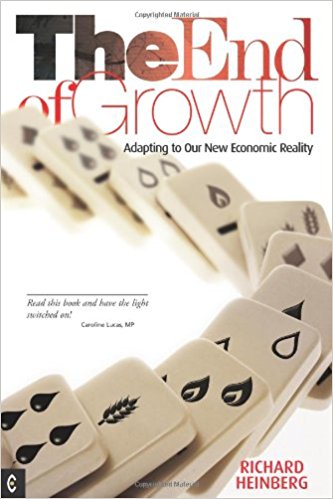
Richard Heinberg is an American journalist and author that has dedicated most of his writing career to environmental causes. His most notable works include publications such as, The Party’s Over: Oil, War, and the Fate of Industrial Societies (2003), and Powerdown: Options and Actions for a Post-Carbon World (2004).
Just from the book titles alone, an astute reader can gain a sense of Richard Heinberg’s environment angle. Indeed, there is a common thread that flows throughout his body of work and which is probably best exemplified in the book we are reviewing here: The End of Growth: Adapting to Our New Economic Reality (2011).
In a nutshell, Heinberg’s thesis is this: Global economic growth as we have become accustomed to over the past century or so is “…over and done with” (page 1). When talking about “growth”, Heinberg is referring here to the overall size and expansion of the economy, i.e. an increase in both consumption and production (ibid.).
So how come? Why will there be no more economic growth? Throughout the book Richard Heinberg builds his argument on three main assumptions. First, the depletion of natural resources (fossil fuels & minerals). Secondly, the negative environmental impact of exploiting resources (e.g. Deepwater Horizon, the BP oil spill disaster). And thirdly, the ‘financial disruptions’ caused by our defective banking and regulatory system and its inability to deal with both “resource scarcity and soaring environmental costs” (page 2). For these three main reasons, historical records of economic growth are no longer sustainable in the future.
Let’s turn slightly to the structure and content of the book. “The End of Growth” is well-written and thoroughly researched. From the onset, it becomes apparent that the author has a wealth of experience and knowledge of the subject. Indeed, Heinberg spent over two decades examining and writing about environmental issues and this clearly shows throughout the book.
The book is structured around seven main chapters. The first two open the discussion with a more generalised debate on historical economics and the influences of both Marxist and capitalist ideology in shaping the current state of global macroeconomics. Heinberg also talks about the financial crisis of 2007/8 and how the actions of the Federal Reserve (like Quantitative Easing) are akin to a “Ponzi Scheme” that could ultimately lead to rising interest costs and even currency failure (page 75).
Chapters three and four turn towards the environment and the limitations of earth’s natural resources. Economists and experts in the field have largely ignored the obvious: natural resources are finite. As they become increasingly scarce, the race and exploitation in finding them will have dire consequences on the environment. The BP Oil Spill is given as a clear example of how petroleum companies need to search in deeper and more dangerous areas to find oil. Heinberg goes through all the major natural resources and explains their limitations, including, Oil, water, food, and metals. In chapter four Heinberg remains sceptical that new technologies and innovations will be sufficient to promote growth and stop climate change. He asserts that, “Civilisations advance human knowledge and technical ability, but they also tend to generate levels of complexity they cannot support beyond a certain point. When that point is reached, civilisations decline or collapse” (page 187).
Chapters five and six move the discussion toward a more international dimension. Heinberg effectively sees China’s recent economic growth as a “bubble” (page 190). A bubble that is overwhelmingly dependent on favourable age demographics and a reliance on coal as a primary energy source. Chapter 6 talks about how ill-equipped our current geopolitical system is to both adapt and succeed in a post-growth, contracting economic climate.
Finally, chapter seven concludes with an explorative study in how society (especially civil society) can adapt and grow in a post-growth world. In short, Heinberg believes that organising and local community initiatives will have a crucial role to play. He speaks about “Transition Towns” and “Common Security Clubs” where “The work of local groups should include the sharing of practical skills such as food production and storage, home insulation, and the development and use of energy conserving technologies.” (page 270).
At the end of the day, Richard Heinberg’s “The End of Growth: Adapting to Our New Economic Reality” remains something of a paradox. On one hand, the core of his message rings true: we are consuming and in some cases, abusing resources that are by definition, finite. On the other hand, it feels like the book is too pessimistic and sceptical – it underestimates the power of new and innovative technologies and overemphasises the negative impact of consumerism. For instance, his analysis on electric cars in Chapter four (page 159) is superficial at best. Heinberg fails to consider the rapid advancement in battery technology and their ability to store power.
Readers in search of a gloomy, sceptical analysis on the future of the environment and economic growth should pick up this book. Those seeking a more balanced account should look elsewhere.
“The End of Growth: Adapting to Our New Economic Reality” was published in 2011 by Clairview Books (ISBN-10: 1905570333). 231pp.

Andrei Rogobete is a Research Fellow with the Centre for Enterprise, Markets & Ethics. For more information about Andrei please click here.
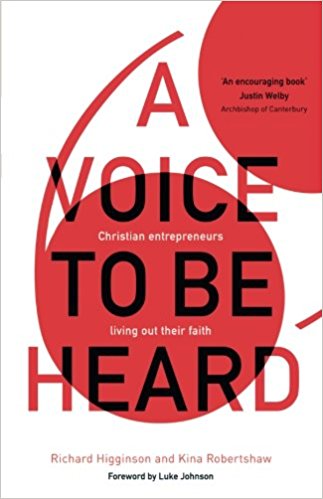
A Voice To Be Heard is not a systematic economic, theological or historical analysis of Christian entrepreneurship, although it contains a number of economic, theological and historical observations. Instead, it comprises ordered reflections on Christian entrepreneurship based around the stories and thoughts of 50 contemporary Christian entrepreneurs interviewed by the authors.
The authors are the well-known Director of Faith in Business at Ridley Hall, Cambridge, Richard Higginson, and the rather less well-known Zambian entrepreneur, Kina Robertshaw. They say that the book is “for actual entrepreneurs, aspiring entrepreneurs and anyone who wants to know more about them” (page xvi) but they are being unduly modest in their expectation: the book provides food for thought for all Christians and, since it is readable, interesting and important, it deserves to widely read.
It begins with pen portraits of five Christians involved in business and uses their stories to clarify what the authors mean by the term “Christian entrepreneur”. They are not referring to “entrepreneurs who happen to be Christian” but rather to “Christians who see their companies as an outworking of their faith” (page 13).
The authors then provide some brief comments on what the Bible has to say about entrepreneurship, attitudes to entrepreneurship in the UK today and the history of Christian entrepreneurship in the UK. This part of the book comprises less than 50 pages, so it is not an in-depth study. However, it is useful in framing the discussion that follows.
The heart of the book comprises an examination of a series of issues that are of particular relevance to entrepreneurs the idea of a calling to business; the question whether business may contribute to the advance of God’s Kingdom; vision and purpose; risk taking; relationships; stewardship; integrity; prayer; and perseverance. Each section combines the stories and views of those who have been interviewed with the reflections of the authors.
Fortunately, the authors have resisted the temptation to provide statistical analysis of the answers to their interview questions or to include the answers of all of their respondents to every question. They have been selective in their quotes and used them to set up a dialogue on particular issues in which they have then inserted their own thoughts. The result is that business issues are brought to life by means of stories and the related theological and ethical issues are clearly laid out.
The authors are clearly reluctant overtly to criticise those they interviewed. However, the methodology used invites the reader to evaluate what is said and the authors gently correct some views and challenge others, perhaps recognising that they should not expect those they have interviewed to be as successful as theologians as they obviously are as business people!
The most interesting part of the book is that which considers the answers that the authors received to the question “Do you see your working business as contributing to the advance of God’s Kingdom?” They tell us that the answer “was a resounding yes” (page 77) but that the answers to the follow-up question – “If so, how?”, varied hugely. Some of the entrepreneurs focussed on their belief that they are contributing to making the world a better place, some on the way in which their companies are run (i.e. the embodying of Christian values), others on the opportunities to witness provided by their businesses and still others on the opportunity to give to charitable and Christian causes. The authors suggest that the Kingdom of God is being advanced in each of these four ways and urge entrepreneurs to have “a broad view of God’s Kingdom rather than a narrow one” and “to embrace all these different categories in a holistic understanding rather than limit themselves to only one” (page 89). This is surely right: we are called on to serve God not in spite of our work or even simply in addition to it but in it and through it (see Colossians 3:23).
The authors issue an equally big challenge to the Church as a whole. This arises from the answers to the question “How do you view the attitude of the church towards you? Negative or positive?” (page 189). A mere 20% of the answers were positive and a further 30% were broadly neutral. The rest of the answers were negative, a result that demonstrates that, despite progress in recent years, Christians who have been called into business are often “made to feel like second-class citizens in God’s Kingdom” (to quote Jeff Van Duzer, in Why Business Matters to God). Many of the entrepreneurs interviewed “often feel appreciated only for the financial support they are potentially able to provide” (page 194) and there is very little evidence of positive support being provided to Christians in business.
Of course, some of the apparent problems may be a matter of perception and it may also be that people in churches naturally offer support to those who appear obviously in need of it (perhaps even emotionally fragile), overlooking entrepreneurs since they are the kind of people who appear self-sufficient. However, the Church needs to do better and the authors suggest that there are six things that the local Church ought to do: to listen; to give entrepreneurs a voice in the Church; to pray; to make biblical teaching more relevant; to be open to the fact that God might seriously be calling people beyond the confines of the Church and to recognise that entrepreneurs may have a significant role to play in Church leadership. These are all points that deserve proper consideration and action.
Overall, the book is broad rather than deep in its analysis: there are many books that examine the relevant history and underlying theology and ethical issues in greater detail and libraries could be filled with weighty tomes examining the economics relevant to entrepreneurship. Furthermore, the book does not have incisive new insights for those who have already looked at the theory in detail. However, these comments are not criticisms: they merely indicate the nature of the book. It focusses on the practicalities and real-life issues faced by Christian entrepreneurs and it does not merely look at the easy bits: bankruptcy and difficult issues relating to integrity are addressed in an honest manner. Of course, there are things that many would take issue with (e.g. the suggestion that God resembles an entrepreneur in having “a willingness to take risks”, page 28) and some parts of the book are weaker than than others (e.g. the chapter on prayer is of a very general nature and has little that is specific to entrepreneurs). However, these points are minor quibbles: the book is well worth reading.
“A Voice To Be Heard Christian Entrepreneurs Living Out Their Faith” was published in 2017 by Inter-Varsity Press (ISBN: 10: 1783595655); 208 pp.
 Richard Godden is a Lawyer and has been a Partner with Linklaters for over 25 years during which time he has advised on a wide range of transactions and issues in various parts of the world.
Richard’s experience includes his time as Secretary at the UK Takeover Panel and a secondment to Linklaters’ Hong Kong office. He also served as Global Head of Client Sectors, responsible for Linklaters’ industry sector groups, and was a member of the Global Executive Committee.
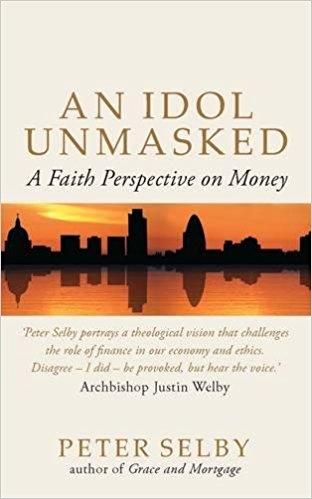
Peter Selby’s polemic against modern money, An Idol Unmasked, was published a few years ago now, in 2014, but captures an attitude to money and modern finance that remains widely prevalent. It is, as he says, a book ‘about money, what it has become, and what it represents in our lives’ (page 3). His key claim, expressed repeatedly throughout the book, is that money has acquired the characteristics of an idol. It now rules peoples’ lives in a way it never quite did before. ‘The quite widely held view,’ he says, ‘that money is not in itself harmful, only the love of it or greed for it, is turning out to be out of date’ (page 3). Over two of the main chapters, Selby links this claim to the decreasing sovereignty of nation states over money, and the increasing role of global financial institutions in the creation and movement of money. More than that: ‘money has long since passed from the control of the public authorities and has become itself the major controlling force behind the organisation of society’ (page 30). Having identified the idol of money and its power over us, he then turns in the final chapters of the book to some theological reflection.
One immediately obvious flaw with Peter Selby’s claim to have unmasked the idol of money (expressed, for example, in the title of the book) is the inconvenient truth that associating money with idolatry is hardly a new idea. Identifying money as an idol or potential idol has deep roots in Judeo-Christian thought. It’s there in the Hebrew Prophets, in Jesus’ teaching about ‘Mammon’, in the apostolic teaching about greed (‘which is idolatry’, Col 3:5), and plays in important role in Christian ethical discourse thereafter. Selby clearly knows this, and even makes reference to some of this material, but seems strangely slow to acknowledge or engage with what others have said.
To be saying something new, Selby needs to demonstrate that money has changed somehow – that it has become ‘more of’ and idol, with a more powerful role over peoples’ lives than it has ever had before. But the argument here is unclear. One problem is that he never quite defines what he means by ‘money’, and seems to use the word in a number of different ways — sometimes referring to currency, sometimes wealth, sometimes ‘a set of ideas’ or even a ‘controlling force’. Another problem is the absence of any evidence or data beyond the anecdotal to back up the claims being made. These are basic issues of method. There also seems to be an insufficient grasp of some of the issues. For example, Selby argues that the globalization of money creation – removing some of the sovereign power once possessed by individual nation states over their currencies – has given money a destructive, anarchic life of its own, ‘acting only on its uncontrolled instinct to produce more of itself’ (page 53). It doesn’t seem to occur to him that the decentralization of money creation might have some good features – taking away too much power from any one player in the system, for example. No doubt there’s much more to say on this, and these are complex issues. The problem is: the issues and counter-arguments are hardly raised at all. Selby generates considerable heat as he develops his polemic – but not much confidence in his depth of understanding.
What then of the theological reflection towards the end of the book? This begins well enough with some reflections on the nature of idolatry. But we then get some very strained readings of Jesus’ parables as anti-market polemics (pages 98–110) – a classic case, if ever there was one, of someone reading into a text precisely what they want to hear. Weaker still is the proposed solution to the problems Peter Selby finds in modern money – what he calls ‘the mercy economy’ (pages 111–126). Given everything he’s said earlier in the book, this rather surprisingly doesn’t seem to involve getting rid of money altogether. It is in fact quite hard to work out quite what it is or might involve, beyond perhaps some debt forgiveness and maybe, perhaps, some kind of universal basic income (page 124). Whatever the ‘mercy economy’ is in detail, Selby seems to be suggesting that the solutions to the problems of money-idolatry lie in structural change or intervening to reform ‘the system’. For a theological reflection, there is precious little on the battle in the human heart behind our tendency to idolatry – and what can be done about that – which is where a deeper reflection on the Scriptures might have taken him.
Reviews of bad restaurants can be fun to read and I suspect they are quite fun to write (which then compensates, somewhat, for the critic’s experience of the meal itself). Every failed dish or example of poor service is described and unpicked with a darkly humorous glee and relish. One could probably do the same with the claims and arguments of An Idol Unmasked, picking over them one by one. But the practical purpose of a bad restaurant review is to advise readers to find a meal elsewhere. Likewise with this book. Anyone in search of a balanced and insightful analysis of contemporary monetary systems and markets, coupled with some deep theological reflection, is not going to find it here.
“An Idol Unmasked: A Faith Perspective on Money” was published in 2014 by Darton, Longman and Todd Ltd (ISBN 978-0-232-53111-4), 140pp.
 Revd Dr Ben Cooper is Minister for Training at Christ Church Fulwood in Sheffield. He holds doctoral degrees in both Theology and Economics. Before training for ordained ministry, he was a post-doctoral research fellow in economic theory at Nuffield College, Oxford. He is married to Catherine and has three children.

The Centre for Enterprise, Markets & Ethics (CEME) was delighted to hold a lecture and roundtable discussion on the topic of “Capital Markets for the Good of Society”. Our distinguished speaker was Dr Lyndon Drake who recently published on that topic with CEME.
“Capital Markets for the Good of Society” is available to order as a publication here.
Tuesday 14th November 2017 – London Stock Exchange
Welcome from Lord Griffiths of Fforestfach:
A divide exists between theologians and academic economists, as well as financial practitioners. Lyndon Drake has known both worlds, having worked formerly as a trader in bonds and derivatives, and now studying for a PhD in Theology.
Presentation from Dr Lyndon Drake:
The financial sector has a very poor reputation, accused of ‘appropriating wealth created elsewhere in the economy’. Financial investors are treated with ‘widespread suspicion’, with many believing that their work carries ‘little benefit to the population as a whole’. How then can we improve this reputation and build socially-useful banking?
The issue is that we must restore trust with the public, the trust which was lost during the [2008] financial crisis. Moreover, increasing numbers of people today favour a move away from a market economy; there is a deepening mistrust of capitalism and growing interest in socialism. In light of this change in public opinion, how can we motivate those in a dominant position within the financial markets to behave well and so benefit the general public?
The main caveats presented by capital markets are that the products are complex; they lie beyond personal experience, implicating clients, companies and governments rather than small businesses or individuals. There is a widening gap between diurnal experience and financial rhetoric; the benefits of a capital market seem irrelevant and ephemeral to an everyday consumer.
The issue is that the benefits of a capital market, and the reasons for which we have it, are not communicated clearly enough in the public sphere; in the place of any compelling narrative, we present only abstract and disconnected ideas. We must move away from talking about the aggregate benefits of a capital market, for such an argument bears no weight when ‘my part’ of the economy is ostensibly stagnant.
Moreover, the existing Biblical theology of capital markets is technical and incidental. Most theologians have a regrettably limited background to economics (the public comments that they make are enough to demonstrate their ignorance on the subject!).
This needn’t be a ‘zero-sum game’; rather, it is possible for us to show that finance can form a part of public ‘flourishing’ which benefits most people, giving the clear majority of individual’s economic freedom and dignity.
For example, it is possible to affirm property rights with the understanding that those with rights over property should ‘give back’ by using their capital for the common good.
The aim is to assess different types of capital markets and provide a moral metric against which to judge them. One central principle is that of the historical memory which exists around helping the marginalised. Why do we have this instinct for creativity and historical memory? Christian principles are persuasive and resonate with popular, contemporary understanding.
So how do we restore public trust in and engagement with capital markets? Firstly, we must showcase the positive ways in which capital markets contribute to the common good, countering the ‘stink of scandal’ which hangs over markets as a result of all the bad news that emerges in the media. Bond markets, for example, lend to governments through pension funds and hedge funds; those who benefit from government spending are not predominantly the higher earners. Another example is how derivatives lead to more visible pricing, allowing for fairer and more transparent trading. We must do more to communicate with the public the precise value that traders provide to society, and to explain why those in dominant positions earn the salaries that they do.
Another important step is to improve company culture within the financial sector and create fair, healthy praxis. This new culture should revolve around the concept of ‘stewardship’, which removes any inherent ownership from the broker who deals in finance. Increasingly digital trading lends traders anonymity and can create the illusion that they have no ethical obligation toward a client. Instead, they should look to trade with a stranger as though trading with a family member – ‘fictive kinship’. These paired principles of ‘stewardship’ and ‘fictive kinship’ would enable financial companies to maintain a just practice and build companies which are able to benefit the economically powerless. In this way would capital markets be restored to their proper role of ensuring the flourishing of individuals from all economic and social strata.
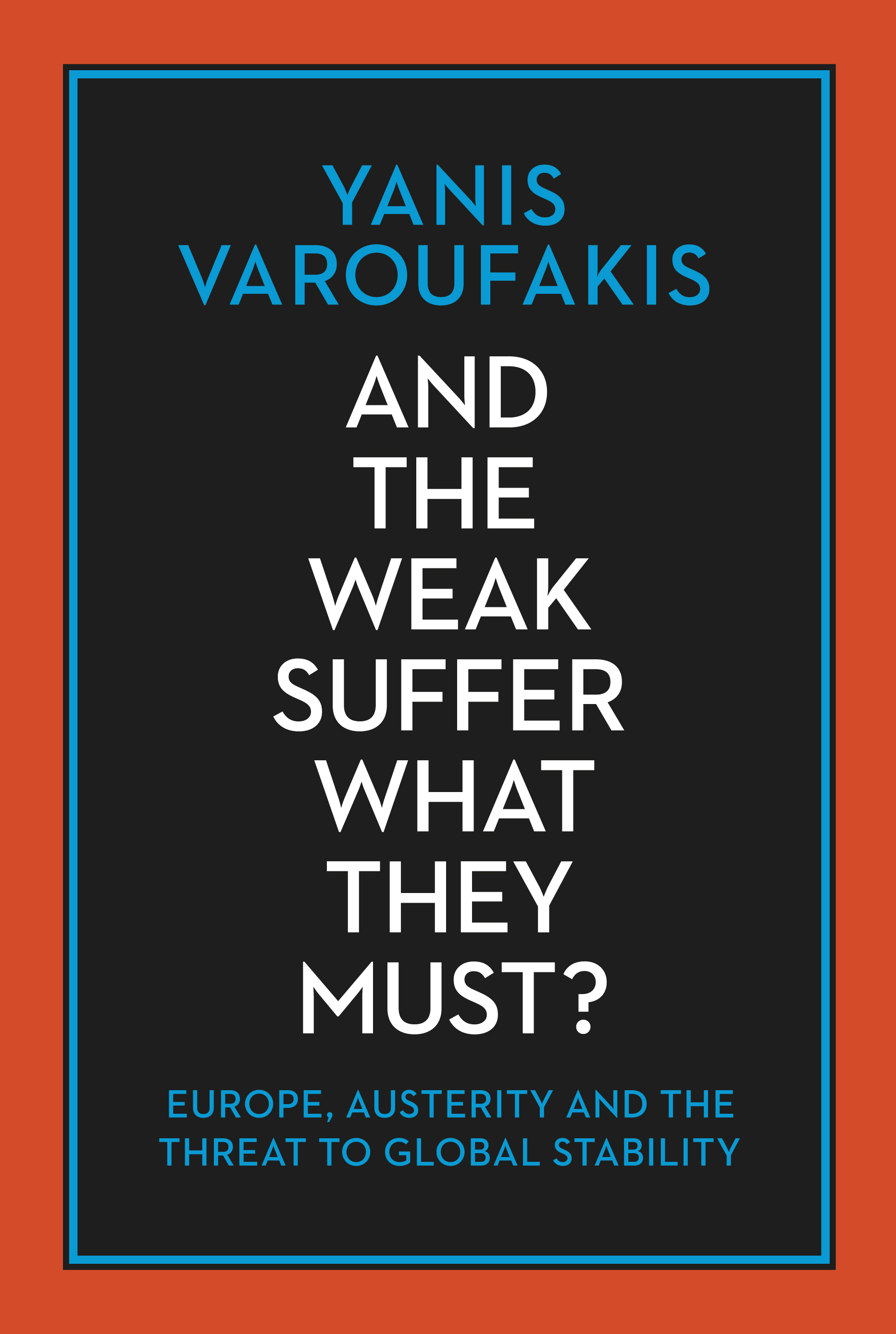
In this book, Yanis Varoufakis (Professor of Economics at the University of Athens) gives a highly informative and very well-informed account of the austerity measures enforced by the institutions of the European Union (EU) since the financial crisis which began in 2007-2008. He also sets these events and policies in the wider context and history of the EU, and especially of the economic relationship between the EU and the USA. As the title shows, Professor Varoufakis is deeply concerned about the impact of these policy measures on the people who are weakest in a society: most plainly, the weak in Greece (his own country), but also in other EU countries. This is a concern which Christians must of course share, given the many biblical injunctions to uphold the cause of the poor and needy.
Varoufakis’ account is especially well-informed because of his (short-lived) role as Greece’s Finance Minister between January and July 2015: he was directly involved in many lengthy meetings between the Greek government and the major EU bodies. These negotiations were focused on the debt crisis which hit the Eurozone in 2010 (a direct consequence of the 2007-8 crisis in London and Wall Street), and in which the desperate finances of the Greek banks were a central part. Prof Varoufakis was already well underway with writing this book when he chose to stand for election in Greece – motivated by precisely the concerns and arguments about which he was already writing.
More than half of the book is taken up with an account of the economic relationship between the USA and the EU and its predecessors: the European Coal and Steel Community, which evolved into the European Economic Community [Common Market]. The key aspects here centre on macroeconomic policy and the nature of global capitalism: and these are, as Varoufakis shows, central to the contemporary challenges for policymakers, for capitalism and indeed for democracy.
This material (chapters 1 to 5) often takes a fair amount of wading through (although it is thoroughly researched). But the case he presents is a strong one. In his own words (pp137-8): ‘The reason Europe seemed to be prospering in the late 1990s and until 2008, despite having introduced an unsustainable gold standard [i.e. permanent monetary union in the form of the Euro], had little if anything to do with the design of its single currency and everything to do with the fact that there was no need for political surplus recycling [emphasis added], as the world of private finance was doing plenty of fair-weather recycling’. What Varoufakis means here by ‘recycling’ is nothing to do households with putting plastics and paper into bins of various colours (!). Instead he is talking about macroeconomic and monetary flows between and within countries. In essence, during the 1950s and 1960s, the ‘Bretton Woods’ economic institutions helped to ensure that no developed economy slumped into permanent recession or depression; and, even after the collapse of those arrangements in 1971, the large and growing ‘twin deficits’ of the USA (i.e. both a Balance of Payments current account deficit, with imports exceeding exports, and a public sector deficit, with government expenditure exceeding tax receipts) helped to enable economic growth to continue in the EU and the Eurozone. There was no need for the countervailing current account surplus in countries such as Germany to be recycled by the hand of politicians, since the macroeconomic ‘weather’ continued to be fair – until 2008. However, the 2007-8 crisis brought all of this crashing down; and the poor design of the Euro, Varoufakis argues, meant that the Eurozone countries had no defence against the ensuing crisis.
Varoufakis also makes a strong argument for what is many ways is a very depressing proposition. The argument is that – in the light of the above history – the EU’s political, economic and monetary institutions do not have it in their DNA to provide a suitably flexible response to a crisis such as that of 2007-8 and its aftermath. In essence the EU’s structures centralize power (e.g. in the hands of ‘bureaucrats’) and are incapable of being made democratically accountable.
On that basis, in the remaining chapters Varoufakis proceeds to explain the interconnections between the post-2008 debts of private (commercial) banks, the perceived need to bail out these banks, and the EU’s requirement that governments must introduce austerity measures as the price for the EU agreeing to complex packages to try to resolve the severe difficulties. Crucially, argues Varoufakis, the ‘no bailouts of EU countries’ rule was at the heart of why the follies of bankers led to the price being paid by the weakest citizens (in the form of austerity measures), most especially in Greece. ‘A clueless political elite, in denial of the nature and history of a crisis whose roots go back to at least 1971, is pursuing policies akin to carpet-bombing the economies of proud European nations in order to save them’ (p192).
Varoufakis makes no secret of his left-wing convictions, and his atheism is also evident. He writes with passion and intelligence about some very serious challenges facing European and global capitalism, and the book is well worth reading.
Let me conclude with some questions that are raised by this book, especially from a Christian perspective. First, are we sufficiently concerned for how macroeconomic and political forces impact on the weakest in our societies? The title of the book, as Varoufakis explains on p19, is drawn from Thucydides’ Peloponnesian War: at one point the powerful Athenian generals explained to the helpless Melians that ‘the strong actually do what they can and the weak suffer what they must’ [translation by Varoufakis]. Substitute ‘politicians and bankers’ in place of ‘the strong’, and it is hard not to find this very chilling.
Secondly, what is the future for the EU? This is evidently a question not only for the UK (whatever one’s views about Brexit). Varoufakis is an internationalist, and sees nationalism as a great problem; yet he is deeply pessimistic about the EU.
Thirdly, how can global capitalism be better managed, so that the power of money and finance (we might even say ‘Mammon’) is circumscribed and a more truly democratic political economy is shaped?
“And the Weak Suffer What They Must? Europe, Austerity and the Threat to Global Stability” was published in 2016 by Nation Books (ISBN – 10: 1568585047), 368pp.
 Revd Dr Andy Hartropp is an economist, theologian and church minister. He has two PhDs, one in Economics and one in Christian Ethics. He lectured in financial economics for 5 years at Brunel University, west London. He also worked for a year with the Jubilee Centre in Cambridge, primarily leading a team doing research on families in debt. He trained at Oak Hill College, London, for ordained ministry in the Church of England. His (second) PhD was published as: What is Economic Justice? Biblical and secular perspectives contrasted (Carlisle: Paternoster, 2007). He has spent 13 years in parish ministry. He worked for eight years with the Oxford Centre for Mission Studies, where he was the Sundo Kim Research Tutor in Mission and Economics. In March 2016 he joined Waverley Abbey College as Director of Higher Education. He chairs the Ethics and Social Theology Group of the Tyndale Fellowship. He is married to Claire, and they live in Bicester, near Oxford.
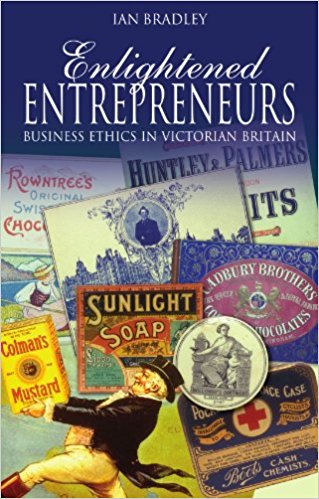
This book’s subtitle is deceptive; it is not a volume about business ethics so much as a fascinating piece of social history. Ten great Victorian entrepreneurs are described in turn, with very little attempt to add any interpretation. The names of the ten speak for themselves: Thomas Holloway, Titus Salt, Samuel Morley, George Palmer, Jeremiah James Colman, Andrew Carnegie, George Cadbury, Joseph Rowntree, Jesse Boot, and William Hesketh Lever. Each chapter takes an essentially chronological view, with many delightful details set alongside a sweeping narrative of business-building, all within the context of the major social and economic changes that the Victorian era brought.
I was struck by how deeply these ten particular accounts of enterprise intersected with my own life history. For example, Thomas Holloway founded Holloway College in Egham, Surrey, which is very near where I grew up; the Colman factory site in Norwich, Nofolk, included nearby some purpose-built housing, one of which made a fine (albeit small) home for me and my wife when we were first married; and the Joseph Rowntree Charitable Trust (JRCT) is now a member of the Church Investors Group (CIG), which I chair, and one of the CIG Trustees is a JRCT nominee. More generally, many of the household products made or retailed by these companies are still to be found on our larder shelves. This is the kind of history that really does overlap with our lives in an ordinary, down-to-earth way.
While Bradley himself does not offer much interpretation or synthesis, I found plenty of themes that emerged. First, each story included accounts of what I call ‘attentiveness’: the ability to spot an opportunity and to be persistent in following it up. The entrepreneur is not someone who will carefully construct a five-year strategic plan for the future. Rather, she or he will be alive to opportunities. For example, we read of Titus Salt: ‘One day in 1834, while on a buying visit to Liverpool docks, he noticed a pile of 300 or so dirty-looking bales lying in a corner of a warehouse. They turned out to be fleeces of the alpaca…’ (p.28). As the account unfolds we discover how an attentive entrepreneur made the most of an opportunity that started a new industry. The technological advances needed came from someone else (the inventor), while the entrepreneur had eyes on changes in society, on ways in which resources could be mobilized, and how people’s imaginations could be caught and aspirations met.
Secondly, the connection to a certain kind of Christianity is very striking. Quakerism and Congregationalism, with their focus on temperate living, self-help, lack of privilege and simple hard work had a tremendously formative influence on all these ten men. Although they were restless in seeking out profitable business opportunities and in being competitive, they were never personally greedy for riches. Their lifestyles were in many ways frugal, and they all showed extraordinary generosity as benefactors.
Thirdly, all of them were to a greater or lesser extent paternalistic. In nearly all of the businesses described there is a ‘family’ feel, whether through care of employees who fell ill or through the well-known model villages such as Saltaire, Bournville, Earswick and Port Sunlight. One of the significant things about this is the way it anchors a business in a locality, and gives depth to its history. Although Bradley does not discuss this aspect, it seems to me that this ‘rootedness’ of enterprises is one of the hallmarks of the Victorian era. These were companies that had a good sense of where they belonged, both in time and in place, something that is generally much weaker now, when production facilities are relocated because of marginal cost advantages. It is simply inconceivable that George Cadbury would have moved his Bournville factory to Eastern Europe or the Far East to reduce costs.
Fourthly, each of these ten men was involved to some extent in public life. They wanted to make a difference to society, often in local or national politics. They saw business as an integrated part of how society works, rather than an ‘external’ source of tax revenue or some kind of threat to government or the people.
I enjoyed this book, but would have valued some kind of attempt to interpret these themes. Even more interesting would have been a discussion about how entrepreneurs today might help society rediscover its roots in time and place, but without the paternalistic baggage that belongs to a different era. Although it is tempting to describe the Victorian period as a golden age for enterprise, the truth is that businesses such as Facebook and Google have stories that are just as fascinating. However, such analysis doubtless belongs in a different book.
The writing style is clear and easy to read. Most of the book was written in 1987, with additional material added in 2007. It is therefore occasionally out of date, for example when describing the Cadbury business of today.
“Enlightened Entrepreneurs: business ethics in Victorian Britain” was published in 2007 (Revised Ed.) by Lion Books (ISBN-10: 0745952712).

Edward Carter is Vicar of St Peter Mancroft Church in Norwich, having previously been the Canon Theologian at Chelmsford Cathedral, a parish priest in Oxfordshire, a Minor Canon at St George’s Windsor and a curate in Norwich. Prior to ordination he worked for small companies and ran his own business.
He chairs the Church Investors Group, an ecumenical body that represents over £10bn of church money, and which engages with a wide range of publicly listed companies on ethical issues. His research interests include the theology of enterprise and of competition, and his hobbies include board-games, volleyball and film-making. He is married to Sarah and they have two adult sons.
American essayist and novelist William Styron once said that “A great book should leave you with many experiences, and slightly exhausted at the end.” If we judge the late David Landes’ ‘Wealth and Poverty of Nations’ by this criterion, it most certainly fits the bill of a ‘great book’. It is a majestic display of his deep insight and vast knowledge of global economic history. It comes as no surprise, therefore, that the book has been all but universally acclaimed by literary critics.
David Landes was Professor of History and Emeritus Professor of Economics at Harvard University. His other works include Bankers and Pashas, Revolution in Time, The Unbound Prometheus and Dynasties. As one might expect, therefore, ‘Wealth and Poverty of Nations’ is no short and easy read: half a millennia of global economic history are covered in over 600 pages and 29 chapters.
Landes’ primary aim in the book is to better understand how nations have evolved to reach their current state. Landes’ main thesis of the book is that cultural traits and cultural values play a key role in determining whether a country fails or succeeds economically. As he points out in the Preface, the analysis is not one of a “multicultural, anthropological sense of intrinsic parity: all peoples are equal and the historian tries to attend to them all. Rather, [to]…understand how we have come to where we are, …[through] making, getting, and spending” (page xi).
In this sense, ‘The Wealth and Poverty of Nations’ provides a fascinating and distinctive historical angle that considers the cultural circumstances, as well as the economic trends of the time – thus, viewing economic history through a cultural lens.
Landes opens up the discussion with the premise that the old dichotomy of the West vs. the East, or better said, West vs. the ‘Rest’ has largely dissolved (page xx). The more pertinent split in today’s ‘globalised’ world is between ‘Rich’ vs ‘Poor’ countries. The common thread of questioning that is present throughout the entirety of the book is this: why have some countries come to be so poor and some so rich?
In the opening chapters Landes presses the idea that the technological and cultural advancements enabled the (relatively small) nations of western Europe to significantly punch above their weight (page 137). The Industrial Revolution in Europe brought technological innovations that had tremendous long-term impact on economic development. Basic advancements cotton manufacturing for instance, enabled the creation ‘washable’ clothes. This in turn led to better personal hygiene and therefore, better health and an increase in life expectancy. The technological advancements improved all areas of life in the Continent
Landes also points out that throughout the late 17th Century and 18th Century, England’s relative open society enabled it to flourish at a faster pace than its European counterparts, many of whom were deeply embattled with religious persecution (page 223). As a result, England managed to ‘profit from other nation’s self-inflicted wounds’ (ibid).
Yet arguably one of the most powerful and convincing arguments of the book is raised in Chapter 12 (page 175 – 181). Here David Landes reinstates Max Weber’s thesis on the Protestant work ethic. The core argument here is that the Protestant revolution in Europe brought with in a change in the role and responsibility of work. The influence of Protestant thinking encouraged people to value, creativity, hard work, timeliness, and free-thinking. This in turn acted as a catalyst for economic growth not only in Europe, but also in the early development of America (CEME’s Director, Richard Turnbull, wrote on the impact of Quakers in Quaker Capitalsim: Lessons for Today)
The latter half of the book bring the discussion back to the impact of culture on economic performance and how the two are intrinsically linked. In Thailand for example, young men are encouraged to spend a few years in religious (Buddhist) monasteries before entering the world of work. Landes argues that this sets their priorities right – and makes them more effective once the do enter the ‘materialistic’ world of work, where money plays a major role (page 517).
Landes concludes the book with a discussion on the current tensions between globalisation and the nation-state, but also the merits of free-trade and some of the benefits and dangers of international aid (Page 519-521). In a nutshell (and without giving too much away), the book argues that free trade between nations is disproportionately beneficial and foreign aid can do as much damage as it does good. Landes overarching conclusion is that the adoption of a free market economy (especially by poor countries) is the surest and safest way to long-term economic development and wealth creation.
‘The Wealth and Poverty of Nations’ leaves its reader with a completely new, and unique understanding of the role that culture plays in the historic economic development of countries. Finding criticism for this book is a challenge in itself, I have found myself nit-picking at best. One possible observation is that, even in 600+ pages, it remains difficult to comprehensively capture half a millennia of world history.
Some may say that it is too Eurocentric. Yet the book’s apparent Eurocentrism is part of the presentation and hypothesis that is put fourth – it is the angle that the author adopts rather than an inherit bias. In response to this perceived ‘Eurocentrism’ and being a ‘Westerner’, Landes himself acknowledges that, “I feel surer of my ground” (page xxi). Nonetheless, one could argue that the cultural intricacies of each geographical region can, and deserve to be explored in greater depth.
‘The Wealth and Poverty of Nations’ has become a staple in the field of economic history.
A definite read.
“The Wealth and Poverty of Nations” was published in 1999 by Abacus, ISBN-10: 0349111669, 672pp.
Andrei Rogobete is a Research Fellow with the Centre for Enterprise, Markets & Ethics. For more information about Andrei please click here.
Craig Blomberg (Distinguished Professor of New Testament at Denver Seminary, Colorado, USA) is a prolific author and his books are generally worth reading. Neither Poverty nor Riches is no exception. It is, to quote from Don Carson’s preface, “an extraordinary achievement” (page 9) and, having been published in 1999, it is well on the way to passing the test of time. However, this does not mean that it is an easy read. It is not. Parts of it need to be read in short chunks with the relevant bible passages being considered alongside them and its real value may be as a work of reference to which readers can return as they grapple with the issues that it discusses.
Blomberg says that he set out “to write a ‘biblical theology’ of material possessions” (page 28). His focus is on how Christians in the West should view their own possessions in the light of the existence of widespread poverty in the world. As Blomberg puts it, “this is a book by the rich for the rich” (page 11).
He begins his task with a brief overview of the problem of global poverty before, also briefly, outlining the range of Christian responses that have been seen over the past half century. These include Catholic “liberation theology”, left of centre Evangelical thinking typified by the work of Ronald Sider (e.g. Rich Christians in an Age of Hunger) and conservative responses to these approaches.
Someone reading only this introductory part of the book could be forgiven for believing that Blomberg is firmly aligning himself with Sider, since he has some harsh words for a number of Sider’s critics, but the rest of the book proves that this impression is misleading. It may be the result of Blomberg’s recognition that his readers are likely to be on the conservative end of the theological (and, possibly, political) spectrum and his desire to challenge them and distance himself from those who come dangerously close to seeking to justify materialism.
The core of the book comprises a detailed survey of the relevant biblical material. The survey of the Old Testament is broadly thematic. It contains some useful contributions to well-known debates (e.g. those relating to the charging of interest and debt cancellation) and, more fundamentally, an analysis of the Old Testament’s attitude to the ownership and use of property. Blomberg concludes that “Neither the amassing of riches nor their lack is seen as a necessary good (or evil)” (page 82) and he disagrees with both those who denigrate riches as such and those who (to use Gossai’s phrase) “place the poor on a pedestal and proclaim the advantages of being poor” (page 74). He particularly takes issue with those who assert that “God has a preferential option for the poor” (page 49) but also warns that “one can hardly claim that God’s [Old Testament] people were free to enjoy unbridled prosperity from their material resources” (page 47).
Following an interesting, if brief and marginal, examination of the inter-testamental historical background, Blomberg turns to the New Testament and, in particular, considers his subject from the point of view of redemption. He concludes that “A necessary sign of life in the process of being redeemed is that of transformation in the area of stewardship” (page 244).
Most of this part of the book comprises a detailed examination of passages in the New Testament relating to wealth and poverty. In essence, it is a biblical commentary with a difference: it is examining passages relating to a particular theme rather than commentating on a particular book of the bible. It is thorough, thought provoking and contains a number of helpful insights (e.g. the suggestion that, in the parable of the rich man and Lazarus, Jesus intended Lazarus to be understood as the prototype of the pious poor in Israel; page 123).
Unfortunately, however, it is at this point that the book becomes heavy going. Blomberg wishes to examine every single relevant New Testament passage and the result is a lack of a clear sense of direction in the analysis. Indeed, readers may feel exhausted by the end of it. The desire to conduct an exhaustive analysis is also probably the reason for the author’s final conclusions being squeezed into a dozen pages, which is a pity since the book cries out for a more detailed thematic statement of these conclusions.
Space limitations may also account for some of the book’s other deficiencies. Blomberg states that “the appropriate role of Christian involvement in the state or in the international systems of economics” is almost entirely outside the scope of the book (page 247). In reality, the same is true of the role of the state and economic systems in general. However, Blomberg has a tendency to make brief statements relating to these issues that are at best contentious and in some cases naïve (e.g. he appears to assume the effectiveness of foreign aid and, on one occasion, appears to endorse the view that the poor are poor because the rich are rich, although elsewhere he appears to contradict this; pages 158 and 68, respectively).
Blomberg also has a tendency to make assertions of fact without producing adequate supporting evidence. For example, it would be good to understand the basis for his conclusion that, at the times when the Old Testament prophets were writing, “Rent capitalism (the paying of rent to one or several owners of various factors of production) had led to upper-class exploitation of the peasants” (page 73) and his assertion that many of the Christians to whom the apostle James was writing were “day labourers on the large farms owned by rich absentee landlords” (page 152).
Some of his biblical interpretations are also surprising. The most extraordinary is his attempt to draw a point relating to social justice from Romans 3:22 (page 199). Other examples include his suggestion that the parable of the sower would have reminded a Palestinian farmer “of how much of his produce was ‘unfruitful’, going off to pay rent, tax and the like” (page 114/5) and his tentative endorsement of the suggestion that Jesus’s comments about the widow’s mites “at a secondary level may reflect an ironic lament about a system that allowed the woman potentially to divest herself of any further resources” (page 144/5). The best that can be said about such views is that they are speculative.
These deficiencies are frustrating since this is an important book. It contains a challenge to all Christians. Those who may be attracted to “liberation theology” or Ronald Sider’s approach should consider whether they have truly absorbed the biblical material or merely over reacted to Christian complacency; those who reject “liberation theology” and Sider’s approach and have a more positive assessment of property and wealth should consider whether they have in practice forgotten biblical teaching about the obligation to help the poor, the purpose of wealth and the obligations it brings with it. Blomberg is keen to avoid false senses of guilt but it is doubtful that anyone who reads this book carefully will end up comfortable and that is probably for the good.
In short, although it is hard unconditionally to recommend this book, it is so important that Christians should read it.
“Neither Poverty nor Riches” was published in 1999 by InterVarsity Press (ISBN-978-0-85111-516-0); 253 pages (excluding bibliography).
Richard Godden is a Lawyer and has been a Partner with Linklaters for over 25 years during which time he has advised on a wide range of transactions and issues in various parts of the world.
Richard’s experience includes his time as Secretary at the UK Takeover Panel and a secondment to Linklaters’ Hong Kong office. He also served as Global Head of Client Sectors, responsible for Linklaters’ industry sector groups, and was a member of the Global Executive Committee.

The Centre for Enterprise, Markets & Ethics (CEME) was delighted to hold a public lecture on “Poverty, Life Chances, and Destitution”. Our distinguished guest speaker was the Rt. Hon. Frank Field MP.
Frank Field has been the Labour Member of Parliament for Birkenhead since 1979. He is a long-time campaigner on poverty, low-pay, and welfare, often seeking radical solutions to complex problems. He has served in government and chaired numerous reviews and Select Committees. In 2010 Frank chaired an Independent Review on Poverty and Life Chances and now chairs the Foundation Years Trust to implement the Review’s main findings on how to prevent poor children becoming poor adults.
The event was hosted by Blackfriars Hall (University of Oxford) on Thursday, 19th October 2017. It was co-sponsored by CEME and the Las Casas Institute for Social Justice.
Rhodri Davies is the head of “Giving Thought”, the in-house think tank of Charities Aid Foundation. He believes that, “Although philanthropy is growing in prominence, there is still a real lack of clarity about its overall role in our society” (page 7) and in Public Good by Private Means he seeks to affirm its continuing role and clarify what that role is. The result is an interesting, though provoking and readable book that could assist people who wish to provide material support for charity or wish to influence public policy. Unfortunately, however, the book suffers from a number of deficiencies, which diminish its overall impact.
The most fundamental of these deficiencies relates to the thing that Davies is analysing. He expressly declines to give a precise definition of “philanthropy” (page 8). Instead, he says that he considers “the characteristics that typify philanthropy in its modern form” (page 8) and he leaves us to absorb his understanding as we read on. He distinguishes medieval religious alms giving “where the focus was primarily on what it meant for the donor and their immortal soul” from modern philanthropy, which he regards as giving “focussed on addressing the problems of society” (page 8) and it is clear that he does not have religious motivation or giving to religious causes in mind. Furthermore, although there is some discussion of support for the arts and education (e.g. page 99ff), it is clear that he is thinking mainly of the alleviation of poverty in much of his discussion. Indeed, his focus appears to be primarily on poverty in the UK (and, to some extent, the USA) rather than in the world as a whole.
Of course, an author may define his subject as he pleases. However, it is questionable whether Davies’ restricted focus is helpful and, more seriously, his lack of precision leads to conclusions that, on their face, appear to apply to a broader range of charitable activity than is justified by his arguments.
Parts of the book are tightly argued but Davies has a tendency to make sweeping assertions that lack support. For example, he asserts that “Philanthropy, properly understood, is about trying to improve society by tackling the root causes of problems, rather than just addressing their symptoms” (page 12) and thereby, dismisses disaster relief from its ambit. Likewise, a few lines later, he asserts that “tolerance for risk is one of philanthropy’s greatest assets” and later rhetorically asks “If philanthropy is unwilling to break the bounds of convention or afraid to think beyond the status quo, then what is the point of it?” (page 173). Whilst few would deny that there is a place for risk taking and “breaking the bounds”, this dismissal of other forms of philanthropy is surprising.
More seriously, important assumptions that underlie some of the book’s statements and conclusions are never properly examined or even, in some cases, stated. The most pervasive of these is the acceptance of what might be called the “post war consensus” regarding the role of the state. Davies appears to believe that the only theoretical alternative to the state doing those things that it does at the moment is for charity to do them and he rightly regards this as being impractical. However, he never considers the possibility that some of the things that are done ought not to be done at all, since they do more harm than good.
Davies also appears to accept the view that poverty is, at least largely, “something stemming from the wider failings of society” (page 35) and to regard the view that it may result in part from the failings of an individual as being hopelessly out of date. Indeed, he appears to believe that the poor are poor because the rich are rich since he states that “While the rich might not be entirely to blame for society’s failure to distribute wealth more evenly, the very fact that they are rich while others are poor is the root of the problem” (page 158). This is a disappointingly naïve approach.
The book suffers from a disturbing schizophrenia when it comes to individual choice. Davies asserts that, “The freedom for individuals to choose where they direct their gifts lies at the heart of philanthropy and gives it much of its strength” (page 11). Yet elsewhere he suggests that “what constitutes and acceptable charitable purpose is an ongoing source of debate” (page 192) and he states that “Philanthropy poses a fundamental challenge to democracy: by offering individuals a way of furthering their own priorities outside the normal democratic process, it potentially subverts the authority of elected officials and allows a small minority of those with significant wealth to exert a disproportionate influence on the direction in which society is travelling” (page 85). This implies that society should only allow philanthropic giving in line with some centrally determined priorities, which would require authoritarian governmental interference.
In relation to this and a number of other matters, it is unclear precisely what Davies’ views are since it is unclear whether he is merely reciting the arguments of others or endorsing these arguments. Overall, however, the book has a decidedly left-wing flavour. For example, the adoption of Finlayson’s view that levels of trust in charity fell following the 1926 general strike because of the efforts of volunteers (including Oxbridge students) in “strike breaking” (page 64) is contentious. Likewise, the suggestion that “the empowerment of women through charitable activities” is something that was seen in “the experience of women during the British miners’ strike of the 1980s” (page 90) is, to say the least, a strange choice of example.
These deficiencies may leave some wondering whether the book has any value but this would be an unduly severe judgement. It places modern philanthropy firmly within an historical context and the short “case studies” inserted in the text bring the history to life. By describing approaches in past centuries and views and arguments expressed in the past, it allows the reader to consider possibilities that might be ruled out by the prevailing twenty-first century consensus. Furthermore, whatever one may think about the arguments that have been and continue to be made against philanthropy, it is essential that we understand and address these arguments.
The book also contains valuable discussions of some important policy issues. These include the perennial hot potato of the involvement of charities in political activity, the justification for tax breaks for charities and giving to charities and the question whether charities should accept money from tainted sources. As regards the first of these, Davies states that “one of the main points of this book is to argue that involvement in the ‘political’ arena through campaigning and advocacy has always been one of the most important aspects of philanthropy organisations” (page 95). However, he later criticises some Victorian philanthropists on the grounds that they “brought ideological baggage with them” and he refers to “The necessity to look beyond ideology in picking philanthropic approaches” (page 188). It is unclear how these statements are to be reconciled and one is left with the impression that Davies supports an ideological approach provided that he agrees with the ideology! Nonetheless, by laying out the issues, he has assisted the debate.
Much the same could be said for many aspects of Public Good by Private Means. One does not have to agree with Davies’ assumptions, statements or conclusions to benefit from reading it. Provided that it is read in a critical manner, it should stimulate valuable thought and discussion. That is why it deserves to be read.
“Public Good by Private Means” was published in 2015 by Alliance Publishing Trust (ISBN 978-1-907376-24-5). 207 pages (excluding bibliography and references).
Richard Godden is a Lawyer and has been a Partner with Linklaters for over 25 years during which time he has advised on a wide range of transactions and issues in various parts of the world.
Richard’s experience includes his time as Secretary at the UK Takeover Panel and a secondment to Linklaters’ Hong Kong office. He also served as Global Head of Client Sectors, responsible for Linklaters’ industry sector groups, and was a member of the Global Executive Committee.
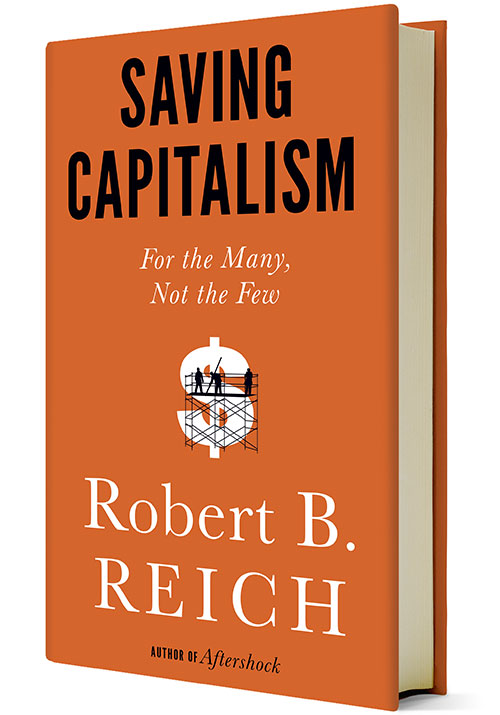
Saving Capitalism – For the Many not the Few is the latest addition to Robert Reich’s cohort of publications. He is perhaps best known for his previous work, The Work of Nations (1992) which raised the issue of growing inequality to the public sphere. Alongside his writing, Robert Reich is also a Professor at the University of California, Berkeley, and has served in various positions under the administrations of Gerald Ford and Jimmy Carter. Most notably, he was US Secretary of Labour under the Presidency of Bill Clinton between 1993 – 1997.
At the age of 71, Reich brings a lifetime of experience in both academia and politics to the table. As a true social-democrat, Reich’s Saving Capitalism is a continuation of the themes he discusses in previous publications – some of which include: rising inequality, the not so ‘free’ marketplace, the over-concentration of political and economic power in the hands of a few, the disenchantment of the masses, and others.
As the title may suggest, Saving Capitalism is a critique of the free market structures and modern-day capitalism. Reich argues that decision-making power is increasingly concentrated in the hands of a few, at the expense of the ‘many’. The very rich get richer and more powerful, while the middle and lower classes get weaker and poorer. The entire system is rigged against the majority in favour of a concentrated few. The solution to this injustice, Reich suggests, is an “…activist government that raises taxes on the wealthy, invests the proceeds in excellent schools and other means people need to get ahead, and redistributes wealth to the needy” (page xvii).
Does this narrative sound familiar? To many it certainly will. Robert Reich’s Saving Capitalism is therefore one among numerous publications that champion the social inequality-class warfare thesis. In that sense, the book brings little to nothing new to the debate. Nonetheless, it is well-written and its use of colloquial language grapples the reader. This does however make the book read like more of a socio-political novel rather than a macroeconomic or political account. One cannot help but feel that Reich’s desire to push his own personal narrative has come at the expense of rigorous analysis.
But before jumping to any conclusions, let’s briefly touch upon the structure and content.
Saving Capitalism is comprised of three main parts. The first chapter, entitled “The Free Market” aims to show how in fact ‘free markets’, are not ‘free’ (page 85).
As you may have already guessed, Reich argues that this is due to them being controlled by a select, powerful few that both establish and control rules in which a ‘free market’ operates. He argues that there are five ‘building blocks’ of a free market: property, monopoly, contracts, bankruptcy and enforcement. Each of these require human governance and can be used to either, promote a fair and decent society or can be manipulated to benefit a select few (page 9). This first part of the book argues that the latter has occurred. The stronghold on patent laws by pharmaceutical companies, the large lobby budgets of corporations to maintain dominant market positions, the abuse of bankruptcy laws, are all cited as evidence that the entire system is rigged in favour of on elite few.
The second part of the book is dedicated to showcasing the consequences of such a rigged system. Here Reich argues that free market meritocracy is in fact, a myth. Those at the top increase their own wages whilst those at the middle and bottom see their wages stagnant and in many cases, decline (pages 134-167).
In the third and final chapter, Reich argues for a restoration of countervailing power, or in layman’s terms, bringing power back to the people. The means by which he believes this can be achieved are certainly not new: an increase in the minimum wage, amending labour laws to favour unions, and changing contract laws as to encourage employees and workers to take action against unjust employers (pages 153 – 217).
So while Robert Reich’s latest work presents a compelling critique of the challenges facing 21st century capitalism, it brings little new to the table. Moreover, any truly impartial reader that has some basic understanding of economics would be quick to observe that Saving Capitalism is unabashedly lopsided. There is no doubt that western capitalism is at a crossroads, and the aftermath of the financial crisis has left millions feeling disenfranchised. However, Robert Reich portrays injustices within the free market (as real as they may be), as characteristic of the entire economy. It’s a bit like saying, we can’t play football anymore because one of the players faked an injury.
He also seems to portray an over-the-top form of class warfare: the elite vs. the rest. As if the classes are statutory and unitary groups with no movement or change between. The rich and powerful only stay rich and powerful while the rest suffer the consequences of their actions. We know this is simply not the case – a free market economy does indeed reward creativity and work. Whether, intentional or unintentional, Reich left out any deeper economic discussions, such as aggregate supply/demand and its impact on market meritocracy. This brings us to what is perhaps the most significant pitfall of the book, it is far to rooted in empirical storytelling rather than political or economic analysis. No matter how broad Robert Reich’s experience may be, personal examples should always be an addition to the argument and not its foundation.
Having said that, Saving Capitalism offers some captivating thoughts on the current state of free market. Provided that its rather superficial and politicised arguments are viewed through a critical lens, the book is certainly a worthwhile read.
“Saving Capitalism: For the Many, not the Few” was published in 2016 by Icon Books Ltd. (ISBN: 9781-78578-0677). 279pp.
Andrei Rogobete is a Research Fellow with the Centre for Enterprise, Markets & Ethics. For more information about Andrei please click here.