
It is bound to raise eyebrows from analysts and investors when a long-term value investor like Warren Buffet unloads Berkshire Hathaway’s entire stake in the five largest US airlines (Delta, Southwest, United, and American Airlines). It signals an all but total loss of confidence in the airline industry. Airbus chief executive, Guillaume Faury, said that “We are now in the midst of the gravest crisis the aerospace industry has ever known” and estimates that it will take at least 3-5 years for passenger travel to return to pre-crisis levels. There is no doubt that the Covid-19 lockdown has resulted in a dire predicament for the airline industry:
– International flights are down 87% since January, with most major airlines receiving bailouts and/or suffering job losses.
– The German government has agreed to a 9 bn Euro bailout of Lufthansa, acquiring a 20% stake in the company.
– British Airways has put 23,000 of its 42,000 staff on furlough with a risk of cutting the workforce by 12,000.
– Budget airlines like EasyJet and Ryanair are set to cut staff by 4,500 and 3,000 respectively.
– Rolls Royce is cutting 9,000 jobs and Air France said it will immediately phase out its entire Airbus A380 fleet.
– The International Air Transport Association’s (IATA) latest analysis shows that globally COVID-19 could cost airlines $314 billion in 2020, a 55% decline compared with 2019.
The bleak outlook begs the question of whether air travel will indeed ever return to a pre-crisis form and if so, how? There are several issues here that need to be addressed and we will start with the immediate and move toward the long-term.
The first and most pressing issue is safety. Mass air travel is unlikely to resume until there is widespread perception among the public that it is safe to do so. The European Aviation Safety Agency (EASA) and the European Centre for Disease Prevention and Control (ECDC) issued guidance for air passenger travel (the document can be found here). It includes detailed measures on airport screening, pre-travel checks, enhanced cleaning and disinfection, passenger management on-board, and the use of PPE equipment.
However, the reality is that social distancing simply cannot take place within the confinement of an aircraft. While there have been various proposals of empty seats and in-flight distancing measures – they are likely to fall flat from a financial standpoint. Ryanair Chief Executive, Michael O’Leary characteristically commented on the idea of an empty middle row as “mad” and added that 45cm of distancing would be “hopelessly ineffective” – a statement I would reluctantly have to agree with.
Therefore, safety and social distancing remain an urgent issue for the airlines. One which will likely continue until either the virus trickles down to negligible levels or a cure is found. This means that only those willing to take a risk or those with urgent needs will be more inclined to travel, resulting in an overall reduction in passenger travel for the airlines. Yet it is true that the same can be applied for any confined spaces or public modes of transport – they cannot guarantee 100% safety regardless of the measures in place.
This leads to the second core issue for the airline industry which is adapting to a changing environment. A discussed predicament is that leisure travel is likely to recover faster than business travel. Covid-19 brought videoconferencing to a new level of prominence, with many businesses likely to see this change as permanent. The financial gains and ease of use may very well cut all but essential business travel. This spells more trouble for the airlines for whom business travellers rank in double the amount of revenue compared to everyone else. Ben Baldanza, former Spirit Airlines CEO said that, “I actually worry more about business travel long-term than leisure travel… You’re not going to take your vacation through Zoom or Skype.” Airlines will have to adapt to this new reality. They may have to go through a period of downsizing to stay competitive or reinvent their marketing campaigns and loyalty plans for frequent flyers.
Another option that is being explored is an increased focus on air cargo. Some airlines may find that it would make more financial sense to reallocate their assets to the freight side of the business. Industry specialist Mark Diamond argues that from now on, “Airlines should treat air cargo as a core business. Cargo contribution should no longer be an afterthought in airline network and fleet planning, but rather a critical part of route decision making, alliance planning, aircraft selection and overall strategic plans and investment decisions.”
The third key issue facing airlines is sustainability and environmental impact. The trend is already well-established: there is an increasing awareness amongst the public on how travel choices directly impact their CO2 footprint. This has (and will) inevitably lead many to think twice before booking their next flight, leading some to fly less or even not fly at all.
Air travel has an image problem that can only be resolved by taking active steps in increasing sustainability and reducing the CO2 emissions. Newer and more efficient aircraft, less use of plastics on-board, and a more ethical and transparent supply chain are all welcome steps in the right direction. A Publicis Sapient survey found that “66% of respondents said they would be more likely to purchase from an airline that has increased its sustainability efforts, and 73% said they are paying attention to brands that are making a positive impact during the pandemic.”
While any significant change in sustainability will no doubt pose its own challenges, it is an opportune moment for airlines to use the lockdown and thoroughly re-think and re-integrate sustainability throughout their business model. It is not an issue to be taken lightly. Done successfully and it can remedy some of the public’s perception. Conversely, done unsuccessfully (i.e. by paying lip service), and it will further cement the industry’s tarnished environmental credentials.

Andrei E. Rogobete is the Associate Director of the Centre for Enterprise, Markets & Ethics. For more information about Andrei please click here.
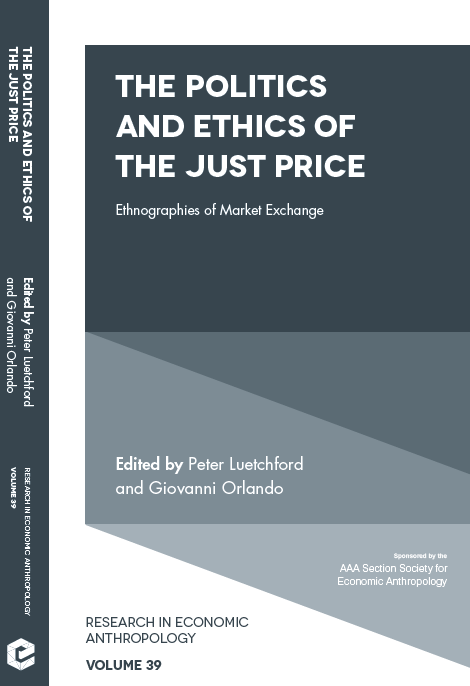
The Politics and Ethics of the Just Price is a collection of essays in economic anthropology. The volume, which is academic orientated, consists of an introduction to the theme and then eight case studies in different anthropological settings. The core issue at stake is the idea of what constitutes a just price, the relationship of price to value and hence to justice, the manner in which this then interacts with the market price and how this relates to real life activity in individual settings. Many of the individual stories and scenarios are fascinating and bring out some genuine tensions and complexities. Those anthropological settings ranger from waste pickers in Turkey, fruit growers in southern Spain, corn and bean trading in Nicaragua to small holders in Tuscany.
The first chapter is a scene-setting introduction. Four approaches to the idea of a just price are noted. The first of these is the classic model in which the interaction of supply and demand in a clearing market reflects consumer utility and hence represents a just price. The other approaches are labour value, the idea that commensuration – the comparison of use value and exchange value – is socially mediated in different historical and geographical circumstances (that is, social value) and, finally, a denial of the possibility of a just price or the possibility of reconciling exchange value and use value. The other key definition is that of “moral economy”, a term derived from the Marxist historian, E.P. Thompson. Unsurprisingly, the term is defined as “a critique of the laissez-faire economic model” (page 14), which really fails to give proper weight to the potential richness of the term, not least since the authors acknowledge that Adam Smith’s argument “resembles a notion of the just price” (page 8). More work is required in this area and the book is over-dependent on Thompson.
There are two aspects in particular that are worthy of further reflection in a review. The first is, notwithstanding the complexities and indeed alternative approaches, how many of the detailed anthropological settings which are analysed still give considerable, if not unlimited, weight to the classic determination of the just price. To give just one example from the volume. The actors in the Turkish scrap metal waste recycling industry include the waste-pickers who sell to warehouses and then sell on to recycling companies who in turn sell the recycled materials into the manufacturing process. Consequently, there are numerous opportunities for collusion, state intervention and global market dominance (London Metal Exchange) not to mention other contested areas. Perhaps surprisingly, or perhaps not, when “the state intervenes to alter the price at which waste-pickers and traders sell, either by direct imposition or through legal regulations, waste-pickers and traders perceive this as unfair and defend the average market price as the just price” (page 28). The study even concluded that “contestations over price in the Turkish recycling sector did not generate claims for justice against the abstract market price.” Adam Smith lives on.
The second area of fruitful reflection which is reflected in several of the studies is the relationship of exchange value and use value as mediated through social relationships. Thus, fruit and vegetable growers in southern Spain, small holders in Tuscany and corn traders in Nicaragua all proceed on the economic anthropological assumption that whilst accepting “important aspects of market exchanges, a substantive frame suggests a just price must also consider social and political relations” (page 92). These examples also proceed on emphasising the distinction between exchange value and use value. Hence, the vegetable growers will supply food to their own town at a different price at which surplus is sold into the market (page 95). The Tuscan small-holders hold to an ideal for a household “to own sufficient land to meet the bulk of their subsistence needs with a small surplus for sale” (page 141). Numerous familial and local exchanges would take place none of which were monetarised. In the Nicaraguan context the authors tells us that “peasants consciously oppose use values to exchange values through their moral ideologies” (page 116). Essentially all of these examples operate with two prices in two separate markets – a global, distant and anonymous exchange value based on supply and demand and a localised market based on face-to-face transactions grounded in personal and social relationships.
The strength of the volume is two-fold. First, that the role of a market price as a just price is recognised and accepted in a wide variety of anthropological settings. Secondly, that there are political, but in particular social factors that impact and form and shape prices in the local setting. In a sense this should be no surprise – differential pricing in different markets in accordance with then varying aims and objectives of sellers in alternative markets. There is nothing incompatible here with a market economy, but it is a valuable and helpful reminder as to how various communities respond locally in the context of wider and global markets.
The somewhat disappointing chapter was the essay on the compensation scheme following the Rana Plaza garment factory collapse. Although fascinating and incisive in its own right, and in a truly horrific context, the chapter seemed out of place in a discussion of just pricing.
Each individual chapter is self-contained and relatively concise and quite a fascinating read. Some real insights, extraordinary contexts, complex history and genuine engagement with the relationship of economic and social considerations in markets and pricing.
The weakness of the essays is that much of the language is simply turgid, and unnecessarily so. The academic foundations of the volume are both its strength and weakness; some interesting questions but shrouded in a mystical academic language of a rather obscure discipline. The book is very expensive and you would need a specific interest in the academic subject matter to justify purchase (at the market price one might add!).
The Politics and Ethics of the Just Price, edited by Peter Luetchford and Giovanni Orlando was published 2019 by Emerald Publishing (ISBN: 978-1-78743-574-2) as volume 39 in the series Research in Economic Anthropology. 245pp.
 Dr Richard Turnbull is the Director of the Centre for Enterprise, Markets & Ethics (CEME). For more information about Richard please click here.
For the more libertarian among us, not least economic libertarians, the lifting of the lockdown cannot come quickly enough. Others are either fearful of the consequences of moving too rapidly or perhaps enjoying the restrictions rather too much. Yet again there are those fearful of the economic consequences of the state’s intervention and others suggesting it offers a model for the future.
How are we to makes sense of these differing perspectives and can we bring a moral voice to the discussion?
Even if individuals have differing perspectives are there ways in which we can reconcile the necessary trade-offs?
Indeed, perhaps the first point is that there are indeed trade-offs and in a fallen world there will always be so. The choices that we face are not between ‘health of the nation fully restored, no Covid’ and ‘economic prosperity as quickly as possible even if there are significant deaths.’ In reality there is a trade-off and too much shrill commentary fails to recognise this basic fact. In a world where we need economic prosperity in order to ensure the well-being of all people we have to find a pathway between the two poles which manages risk and ensures maximum return to economic activity within a responsible environment for the management of the pandemic.
Let’s start with some philosophy and theology. The reason for this is that we have to establish some base points for working out how to move forward.
Jeremy Bentham (1748-1832) is generally regarded as the founder of what is known as utilitarianism. There are different ways of characterising this approach; perhaps the ‘greatest happiness of the greatest number’ is the most common. Essentially utilitarianism requires all human life and activity to have purpose, or utility. That is why Bentham left his body to medical research; even in death there must be some use for the body.
Younger people appear less likely to suffer the more serious symptoms of Covid-19 and are, at least compared to, say, residents in care homes, more economically active. Well, you can probably work out where that leads….
Utilitarianism is antithetical to any concept of natural rights. Consequently, for those such as Gertrude Himmelfarb utilitarianism does not extend liberty but in reality restricts it. The source of our natural rights is God and as a result all people are regarded as being equally valuable in the eyes of God, with inherent rights, values and purpose, even if in a care home at the end of their lives.
So then, as all are equally valuable we clearly should stay in lockdown until no-one might die of Covid-19?
On the contrary. The same God-given natural rights also convey the rights of property, liberty, commerce and wealth creation. These are essential prerequisites for the well-being of all people in this imperfect world. They are necessary principles to ensure goods and services, employment, a tax base, the right to enjoy and to trade.
These principles should leave us very wary of those who think, for example, that government schemes which support 80% of a company’s wage bill (even if up to certain limits) are sustainable in anything other than a temporary way. The implications for the well-being of all, intergenerational sovereign debt and so on are inimical to any idea of natural rights. For the same reason the proper action of government in the short-term gives no mandate for some grand expansion of government activity.
This piece is not about what aspects of lockdown one personally does or does not support. Rather it is an exploration of methodology and then applying that methodology to some of the current policy prescriptions. We need, in conclusion, then to remember the following:
No doubt a great deal more could be said! However, the ideas of creation or natural rights remind us of both our social responsibility to all and our economic responsibility to all. We would do well to recognise more explicitly the trade-offs we all face but to base those trade-offs on a properly articulated philosophy or theology in which both social and economic responsibilities are properly related to each other.
Dr Richard Turnbull is the Director of the Centre for Enterprise, Markets & Ethics (CEME). For more information about Richard please click here.

The World Bank issued a warning recently claiming that the impact of COVID19 will have a disproportionate impact on the most vulnerable in lower-income countries throughout South America and the Caribbean. Martín Rama, World Bank Chief Economist for the Latin America said that, “Governments across Latin America and the Caribbean face the enormous challenge of both protecting lives and limiting the impact of the economic fallout. This will require coherent, targeted policies on a scale rarely seen before.”
Yet what exactly would these ‘coherent and targeted’ policies look like? Here are a few proposals that aim to be discussion starters rather than definitive answers:
It only makes rational sense that one priority in terms of financial relief should be aimed at small businesses and the self-employed, many of whom have limited financial reserves and cannot afford to sustain themselves or their employees. This would be particularly worsened if the period of inactivity is prolonged (as it seems to be the case in the majority of countries). The IMF recommends that the best vehicle to offer this type of fiscal support are public banks, given their ability to reach firms of all sizes as well as households and local authorities. According to the IMF they can achieve this through “(subsidised) loans and loan guarantees”. Small and medium enterprises will be crucial to the economic recovery so short-term, temporary assistance seems sensible.
Another key area is protecting essential supply chains in delivering food and healthcare. The World Bank warns that fragile supply chains may lead to widespread food shortages. Another issue is the displacement of workers due to a lack of activity in urban areas. Again, the World Bank points out that “…sudden and large-scale loss of low paid work has driven a mass exodus of migrant workers from cities to rural areas, spiking fear that many of them will fall back into poverty.” National governments must do everything to ensure the protection of key supply chains and ensure that those in remote areas have access to basic supplies.
A third measure would be ensuring that the respective national healthcare systems broaden their sources of equipment to accept both public and private contributors. We have seen initiatives to produce innovative ventilators from companies like Tesla in the US and Dyson in the UK. National healthcare systems from around the world will have to be quick in adapting to the crisis by increasing their flexibility (indeed, as many are already doing). It is key that national healthcare systems in low-income countries are as well stocked as possible. Despite the controversies over sourcing and supply of protective equipment it is perfectly reasonable for such contracts to be on a commercial basis and to involve trade between countries. This means supply and demand are met to the benefit of all rather than a narrow protectionism.
From a broader outlook, prospects of a COVID-19 cure seem to be gaining traction. Current trials range from antivirals to antibodies such as: remdesivir, lopinavir/ritonavir (currently authorised as an anti-HIV medicine) chloroquine and hydroxychloroquine (currently authorised against malaria), monoclonal antibodies and others. The challenge of course, remains to ensure the safety and efficacy of any medicinal cure. Greater cooperation must be made at a national and international level to test and develop these drugs. The New York Times reports that “never before, have so many experts in so many countries focused simultaneously on a single topic and with such urgency. Nearly all other research has ground to a halt.”
The process of developing a cure must be streamlined and streamlined quickly. Yet this needn’t be a top-heavy approach – scientists will find the cure, not politicians. Indeed, it may be private companies in the biomedical sector that are at the forefront with a responsiveness and nimbleness that is often not present in the public sector. Partnership is needed. Our representatives in power must ensure that they facilitate this exchange of information and work towards a feasible solution. Failure to do so may result in grimmer outcomes than the pundits suggest. The World Economic Forum argues that “…only by ditching nationalist rhetoric and policies, and embracing stronger international cooperation, can governments protect the people they claim to represent.” Nationalistic or not, governments and the scientific community must act fast.
We face a global problem and solutions will be found only through innovation, creativity and collaboration between the public and private sectors.
Andrei E. Rogobete is the Associate Director of the Centre for Enterprise, Markets & Ethics. For more information about Andrei please click here.
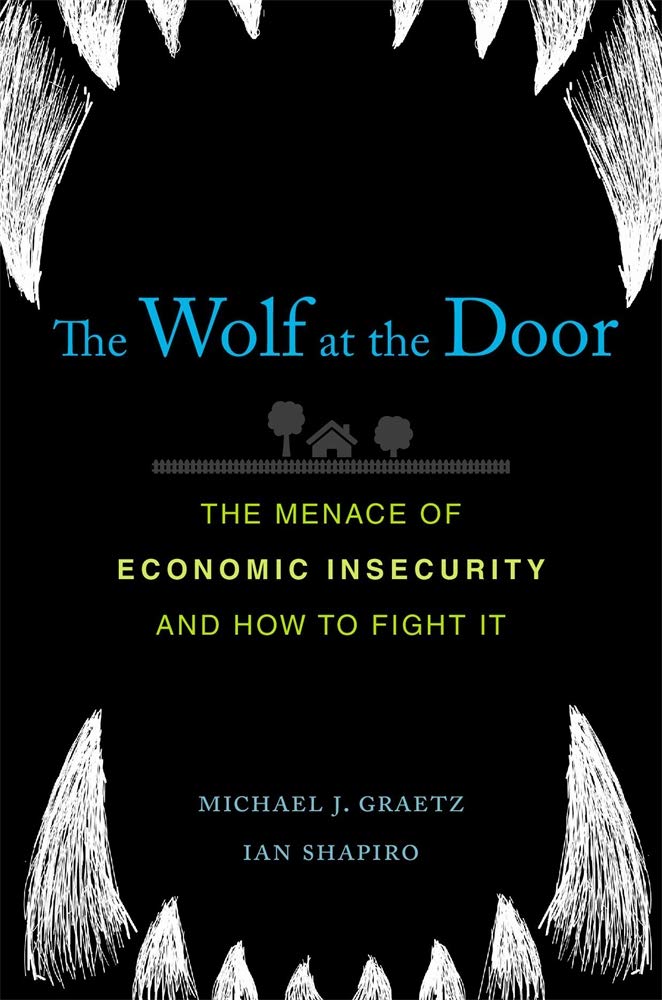
The publication of yet another left of centre book asking “What has gone wrong with American capitalism and what should be done to fix it?” may provoke a sigh or a yawn. However, in the case of The Wolf at the Door such a reaction would be misplaced. It is a constructive and engaging book that has things to say that are worth considering.
Its starting point is that there is a serious economic and consequent social problem in the USA that is giving rise to dangerous populism both of the right (Donald Trump) and of the left (Bernie Sanders). Those on the right of American politics are denying that there is a problem whilst those on the left are focusing on the wrong issue: taking their cue from Thomas Piketty, they focus on inequality and, in particular, the wealth of the top one per cent. This, Graetz and Shapiro suggest, is a serious mistake since “Obsessing about the very top is a distraction from the more pressing problems of economic stagnation and insecurity among increasing numbers of the middle class as well as the poor” (page 28). They acknowledge that “fighting insecurity might involve attending to some aspects of the growth of inequality” but insist that “the primary focus must be on mitigating the sources of economic insecurity” (page 7). They are surely right about this and their book thus gets off on a sound footing.
The authors aim to identify the various elements of economic insecurity and come up with a feasible agenda for addressing these. This result in a basket of proposals: a substantial expansion of the US Earned Income Tax Credit system (which provides a refundable tax credit for low to moderate income workers); the merger of the US Trade Adjustment Assistance and Unemployment Insurance programmes into one national programme (which the authors call “Universal Adjustment Assistance); major investment in infrastructure; the progressive expansion of Medicare starting by extending it to the youngest working age people, such that, over a generation, it becomes available to all; and the establishment of a system of universally available “pre-K” child care for young children under the age of five.
The authors recognise that many on the left will regard their proposed programme as unambitious, but they defend it on the basis that it addresses the right issue (i.e. economic insecurity) and is politically, economically and socially feasible. They are realists and pragmatists: they recognise that many on the left wish to return to what is seen as the utopia of the decades following the Second World War but, in the context of comments about the steel industry, warn that “this nostalgic yearning ignores the realities of lower-cost production abroad and of the technological transformations that now enable steel to be produced with a fraction of the workers once required” (page 18); they bluntly assert that the “unavoidable fact is that the good old days of well-paying, long-lasting employment are behind us, and they are not coming back” (page 115); they recognise that US politics is dysfunctional but seek to identify ways of achieving their goals despite this, in particular, by identifying “six features of successful distributive politics” (page 35) including building coalitions and pragmatically pursuing proximate goals; and on this basis they dismiss many policies favoured by the left both in the US and elsewhere including the establishment of universal basis income and a dramatic increase in the minimum wage.
This pragmatism results in a commendable absence of ideological shibboleths and the recognition of fundamental economic realities. Graetz and Shapiro are prepared to contemplate privatisation, they strongly favour free trade and they recognise the essential role of business both in the creation of prosperity and in the building of the coalitions that they recognise are essential for the implementation of their reform programme. They also refuse to take positions on a number of economic issues that divide left from right including the impact of statutory minimum wages and, perhaps most significantly, whether or not Piketty’s analysis and predictions are right. They dismiss Piketty’s suggestions of a global wealth tax and a trans-national European assembly with taxing and re-distributive powers as “so utterly deaf to anything that is feasible politically that it is hard to take them seriously” (page 261).
The book is wholly focused on the USA and non-Americans may fear that it will not be of interest to them. However, it is addressing issues that exist in many developed nations and, whilst much of the detail is likely to be relevant only to the USA, the analysis of the problems, the core elements of the proposals for solving them and the authors’ reflections on what is necessary to effect change should be of wide applicability. Furthermore, the insight that the book provides into the Byzantine complexities of the US legislative and governmental processes is of considerable interest in itself.
Of course, the biggest question to which the book gives rise is whether its proposals would work. Would they have the dramatic net positive effect that the authors’ hope for, even in the longer term? Unfortunately, this is open to serious doubt.
Graetz and Shapiro draw their inspiration from Roosevelt’s New Deal, which they mention on numerous occasions and which they credit with significant achievements. However, whilst unquestionably, there was much to applaud in the New Deal, it is far from clear that it dealt with economic insecurity. As Graetz and Shapiro admit, US unemployment remained above 20 per cent. through the 1930s and it was the Second World War that paradoxically transformed the US economy.
Some of the proposals are also vulnerable to other, more specific, criticism. In particular the authors never adequately deal with the economic issues associated with the subsidisation of wages that has been recognised ever since the Speenhamland magistrates tried this in late eighteenth century Britain. More fundamentally, they do not address issues associated with the control of mushrooming costs that have bedevilled social security systems around the world.
Leaving aside the economics, there must also be doubt over the US political feasibility of some of the proposals. In some cases, the authors give good reasons for believing that the coalitions necessary to secure the enactment of appropriate legislation could be assembled (e.g. in relation to the expansion of earned income tax credits). In other cases, however, they do not. Indeed, in relation to their proposed establishment of Universal Adjustment Assistance, they admit that “there is no obvious coalition to step in to the breach” (page 168) and their emphasis on infrastructure investment is somewhat undermined by their frank recognition that the apparent support for investment from across the US political spectrum has not prevented the visible decay of US infrastructure over a long period of time.
Those on the right of the political spectrum will also wonder how the proposals are to be paid for. Graetz and Shapiro are not classic “tax and spend” liberals. Indeed, they fear that left-wing populism could lead to “pressure for tax regimes that hamper competitiveness” (page 273). Furthermore, they acknowledge that the level of US government debt is already unsustainable yet raising income tax is politically impossible, having been rejected by both major parties in the US, and they dismiss wealth taxes as a solution on the basis that experience in other countries shows that their promise has been “oversold” (page 246). Hence they fall back on a basket of proposals that they suggest would, collectively, raise the necessary funds. Of these, the most dramatic would be the introduction of value added tax in the USA. Less dramatic proposals include the introduction of a gifts tax and the elimination of tax breaks for specific industries (although they do not generally favour raising business taxes.
British readers will probably recognise echoes of Tony Blair’s approach to taxation in these proposals. Indeed, the whole of Graetz and Shapiro’s programme has overtones of New Labour (which, it will be remembered, drew inspiration from the centre-left in the USA). This should give pause for thought. Some may argue that the rejection of New Labour by both the left and the right following the Global Financial Crisis resulted in us being unable to evaluate the long-term impact of Blairite policies. However, it is clearly arguable that those policies only worked because the economy was expanding at the time and they ultimately failed to address the underlying issues that Graetz and Shapiro identify and also stored up both economic and political problems for the future.
There are thus many challenges that can fairly be addressed to Graetz and Shapiro. However, this does not diminish the importance of what they have written. The Wolf at the Door represents a challenge to those on the left to reconsider priorities and to focus on policies that are both capable of implementation and will make a real difference to people’s lives. It is also a challenge to those on the right to recognise the reality of economic insecurity and, if Graetz and Shapiro’s proposals are considered unacceptable, to come up with an alternative. Whatever one’s political starting point, The Wolf at the Door is worth reading.
“The Wolf at the Door” by Michael J. Graetz and Ian Shapiro was published in 2020 by Harvard University Press (ISBN 9780674980884). 285pp including glossary.
 Richard Godden is a Lawyer and has been a Partner with Linklaters for over 25 years during which time he has advised on a wide range of transactions and issues in various parts of the world.
Richard’s experience includes his time as Secretary at the UK Takeover Panel and a secondment to Linklaters’ Hong Kong office. He also served as Global Head of Client Sectors, responsible for Linklaters’ industry sector groups, and was a member of the Global Executive Committee.
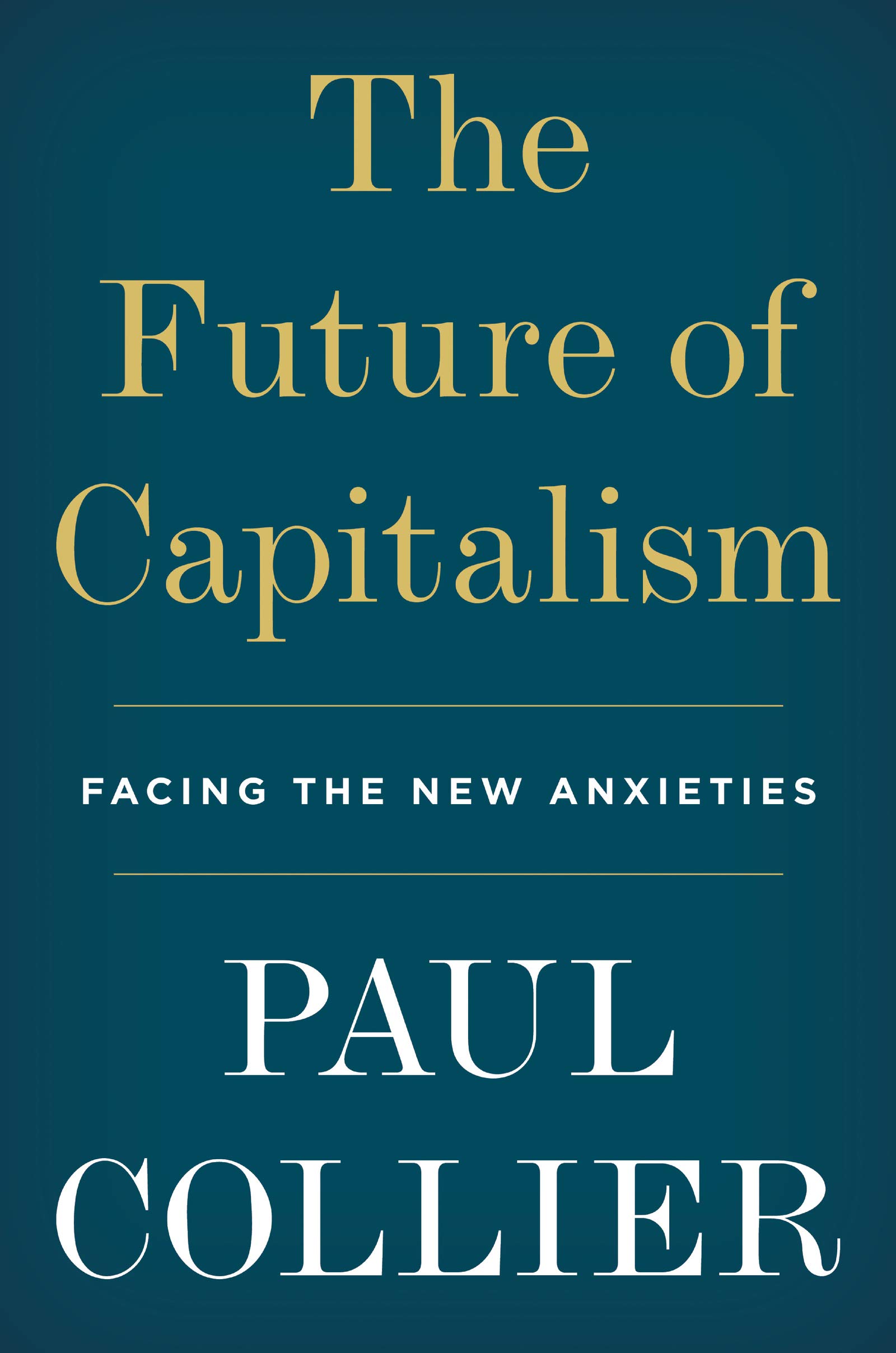
The Future of Capitalism tackles one of the big issues of our time. Its impressive author, Sir Paul Collier, CBE, FBA is a distinguished member of the Blavatnik School of Government at the University of Oxford and a seasoned practitioner in development economics for which he received a knighthood. He is convinced that capitalism is the only economic system which can generate mass prosperity. Regrettably it has also divided societies, created dysfunctional democracies and posed risks to the planet. More than that he claims it is morally bankrupt. The challenge he set himself in this book is how to restore ethics within capitalism to prevent it drifting into either a totalitarian state (China) or populist nationalism (East European countries). In doing so, he eschews ideology claiming that all his policy prescriptions are based on evidence, analysis and pragmatism.
The inspiration for the book was Anthony Crosland’s The Future of Socialism, published in the 1950s, which set an agenda for the social democracy of the post war years in the UK. (To some readers Anthony Crosland might seem a minor figure out of a history book, but in his heyday he was the leading UK intellectual of the centre left and a Cabinet minister in the Wilson and Callaghan Labour Governments attempting to put his ideas into practice). Collier claims that the Crosland agenda worked well between 1945-70, even at one point describing it as the “miracle period”. It failed however because it neglected its roots in the ethical foundations of the nineteenth century cooperative movement.
It was replaced by a combination of Utilitarian technocrats (mainly economists) intent on redistributing income to those below the poverty line (however defined) and lawyers committed to John Rawls philosophy which promoted the rights of disadvantaged groups based on race, gender, sexual preference and so on, which has become the basis for identity politics.
Both of these philosophical approaches emphasise the individual not the collective and differences between groups based on either income or disadvantage rather than the needs of persons and families. Each elevates a single moral prescription, “the greatest happiness of the greatest number” and “laws in a society must be designed for the most disadvantaged groups”. However, they neglect the normal moral instincts and values of people such as loyalty, fairness, obligation and desert which were central to the cooperative movement.
The philosophical foundation which Collier builds on is found in the writings of David Hume and Adam Smith (especially The Theory of Modern Sentiments) and the Pragmatism of nineteenth century American philosophers such as William James and Charles Peirce. After laying this down he devotes four chapters to restoring ethics within the state, firm, family and world. Then, in the final section he presents a plethora of ideas for restoring an inclusive society.
To tackle the geographical divide, he proposes taxing the metropolis and regenerating broken cities and regions through establishing local banks, local universities and business zones. Families can be strengthened by preventing them from falling apart in the first place, supporting children in the early years, from pregnancy to the first day of school, raising standards of teaching in schools, offering improved post-school vocational education and extending home ownership. Tackling the negative effects of globalisation requires redistribution of resources to those areas which have lost out through free trade and technology.
In putting forward all these proposals he is not afraid to be controversial. He is scathing about the greed of investment banks. He argues for taxes on financial transactions and raise taxes on the incomes of highly skilled workers especially in finance and law. He wishes to see a new criminal law comparable to manslaughter which he calls bankslaughter. He backs immigration controls, strengthening traditional two parent families from whom they are genetically descended and having less state intervention through social policy dealing with the needs of children.
Although it is not fundamental to the main theme of the book I question Collier’s judgement that the period 1945-70 was as successful as he claims. It is certainly true that the new social contract devised by Beveridge, Temple and others which produced the post war Welfare State and mixed economy lasted the course. However, by the 1960s inflation was back accompanied by rising unemployment, prices and incomes policy were a failure and the nationalised industries were mired in the red, while by the end of the 50s the social infrastructure began to show signs of fraying through increased violent crime, illegitimacy and addiction. Meanwhile, some of Crosland’s policies were proving destructive; “If it’s the last thing I do, I’m going destroy every fucking grammar school in England. And Wales. And Northern Ireland”. By the time of his early death (58 years old) he became so disillusioned with the crisis of capitalism that he thought the creation of a ‘serious revolutionary socialist party’ was worth thinking about.
One question which needs to be asked is whether he has succeeded in the task he set himself, namely restoring ethics to firms, families and states. In the case of firms he devotes an interesting chapter to the way in which ethical firms of the past which he mentions – Imperial Chemical Industries (ICI), Cadbury, The Halifax Building Society – have given way to the vampire squids of today which are held in contempt as greedy, selfish and corrupt.
In order to achieve change he believes competition is an important discipline on business but increasingly limited because of the power of networks (electricity, water, railways) and the role of technology in creating unregulated natural private monopolies (Facebook, Amazon, Google, eBay and Uber). The conventional responses to these problems are regulation and public ownership, but both have severe limitations. As an alternative he suggests taxing economic rent, which by definition does not discourage productive activity or risk taking; reforming corporate law so that concern for the public interest should be mandatory for all board members, such as Public Interest Companies in the US; and introducing the new criminal offence of bankslaughter.
The problem with all these, which he recognises is that regulations can be got around by talented management, taxes reduced by clever accounting and laws fudged by legal argument. After acknowledging that the cupboard is fairly bare he puts forward the novel suggestion that society needs to build a critical mass of ethical citizens who can judge the behaviour of companies, favourably or not. This is less than a specialised sub-police force and more a form of neighbourhood watch strengthened to have teeth. This may seem fanciful but the achievement of the women’s movement and climate change protests, based on evidence of discrimination or degradation show that great oaks grow from acorns. Post COVID-19 many questions will be asked about the future of our society, so his proposals may not be so fanciful.
To restore ethics to the state he rejects ethnicity, religion and shared values as a way to create shared identity because they are incompatible with modernity, despite the showing of how popular Judeo-Christian based ethics still remain. He plumps for a sense of belonging to place, something which is hard-wired in our psyche, especially the place in which we grew up and which we call home. Unlike Nationalism, Patriotism is an inspiring concept and he claims a good example of it is found in the politics of President Macron. A major raison d’etre of politicians should be to create narratives of shared belonging. To restore the ethical family, he suggests a greater acceptance of mutual obligations by parents in raising children rather than one focused on their own individual, personal success in work.
The one surprising weakness of the book is its treatment of religion. The book contains four references to religion and six to religious fundamentalism. All are wholly negative: religion leads to cultural separation, marriage is tainted by its religious association, it is the basis of a new nationalism, heir to fascism. Religion is almost always qualified by the adjective “extreme”. Jihad pogroms and other cultic, barbaric practices deserve the treatment he delivers and the Christian religion has many shameful episodes in its history. However, if restoring ethical behaviour in business, politics and society requires ethical citizens, ethical politicians and ethical family members, a rejection of self-aggrandisement, ‘freedom is not bound in servitude to the self but in escape from the self’ (p. 108), and strengthening a sense of obligation, surely a religion based on transcendence and true humanism must be a help to the cause.
On the evidence of nineteenth century history in the work of Gertrude Himmelfarb and Christie Davies, the irony is that ICI, Cadbury and The Halifax Building Society were deeply rooted in a late nineteenth century Christian culture, especially non-conformist, which was also an inspiration for the cooperative movement, friendly societies and the social reforms of the period. Non-conformity would also at this time have been a major force in Collier’s beloved Sheffield.
I enjoyed book but at the end it left me with a nagging question. It certainly respects the evidence, applies analysis to good effect and makes a number of interesting practical proposals. However, its conclusion is that religion has no place in the future of capitalism. In its neglect of the positive contribution of the Christian faith on British life and culture I fear it has strayed across the boundary of social science into ideology.
“The Future of Capitalism: Facing the New Anxieties” by Sir Paul Collier was published in 2018 by Harper Collins (ISBN 978-0062748652). 256pp.

Lord Griffiths is the Chairman of CEME. For more information please click here.

Lord Adonis has called for the chief executive of Tesco to resign. He argues that Tesco is using £585m of state aid in business rates relief to pay its shareholders a dividend of £635m.
This is exactly the sort of false linkage that damages the case for ethical business.
There is an absolute moral obligation on Tesco to pay a reasonable and responsible dividend to its shareholders. There is a similar moral obligation on the company to protect its workforce, ensure its supply chain is in robust shape, to continue to sell goods for profit and, of course, to comply with government directives and play its part in responding to the national crisis. The two belong together. You cannot argue morally that the providers of capital to the business have a lesser claim to a return than other stakeholders. This is a common error of advocates of stakeholder theory. I have much sympathy for the principle that there are a variety of stakeholders in a business and all have proper claims. However, many advocates of ‘moral business’ seem to think that all other stakeholders have a prior claim over that of capital. That rather invalidates any claim to moral and ethical approaches to business.
Here are 5 reasons why Tesco’s payment of a dividend to its shareholders is a moral claim.
But what about the company taking the business rates relief at the same time as paying last year’s dividend?
The first point here is the false linkage. The argument is that same as that Tesco should not accept £585m of state aid while it continues to charge the full price for a toilet roll. The two matters (state aid and dividends, state aid and product pricing) are simply not connected and it is not a moral argument to do so.
The second point is that Tesco have stepped up to the mark in this crisis in a number of ways including:
Tesco may have a good or a bad year ahead. They probably don’t know. There have been extremely high increases in demand but there has also been a significant increase in costs to meet those demands and government expectations.
To take the business rates relief can only be properly assessed against the matched additional costs incurred and the savings to the exchequer in providing temporary work to those who might otherwise have a claim against the state. The shareholders’ entitlement to dividend and its level for the next year can only be assessed once results are known. At that point, as now, any dividend payable would need to be responsible and proportionate.
Advocates for moral business behaviour, and I am one, need to understand that making false links damages the wider case. There are a wide range of responsibilities on business. Exploitation of the workforce or disregard for the communities in which business is set or extreme examples of reward for poor performance or, yes, excessive dividends unsupported by the company’s performance are all examples of behaviour’s deserving of criticism.
However, this is simply not the case in this situation. In fact, rather to the contrary.
Tesco should not only pay the dividend, they should do so with enthusiasm and not be rolled over by self-important commentators. Taking the state aid is irrelevant to the payment, or otherwise, of the dividend.
The nation should thank Tesco (among others) for their moral and ethical response to the national crisis. A fine example of moral responsibility in the market economy.
Dr Richard Turnbull is the Director of the Centre for Enterprise, Markets & Ethics (CEME). For more information about Richard please click here.
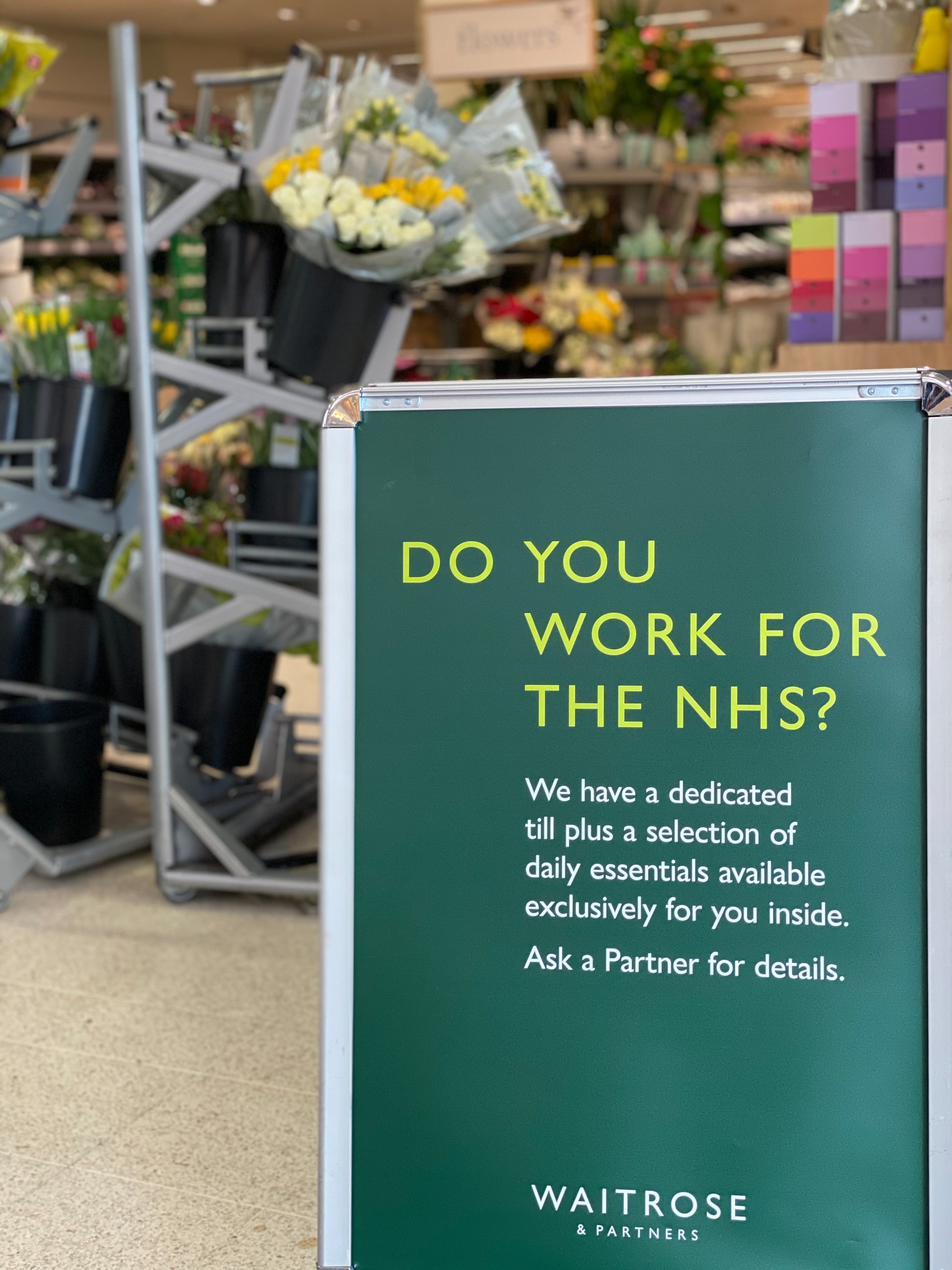
There are beacons of light in this otherwise barren landscape that the West is going through. Yet they’re coming from places you might have not initially expected. Business has mobilised on an unprecedented scale to alleviate the fallout from the COVID-19 crisis – and it has done so voluntarily. It’s worth pointing out a few examples:
– Virtually all major supermarket retailers are offering some form of discount and/or purchasing benefits to keyworkers. Stores like Tesco, Sainsbury’s, Aldi and Lidl are all opening their doors early for keyworkers. Aldi is giving its employees a 10% bonus for their effort during the crisis.
– The vast majority of UK telecoms providers are offering unlimited access to the NHS website. Id Mobile are also providing the over 70s with free unlimited calls to any UK destination.
– The main pharmaceutical networks like Boots, Superdrug, Pharmacy2U, and LloydsPharmacy are all prioritising key supplies and restricting the sale non-essential items. Boots is starting to offer COVID-19 testing for NHS staff.
– Delivery and haulage companies such as Royal Mail, TNT, UPS and others are prioritising critical goods used to help alleviate the the crisis. Major online retailers like Amazon are doing the same
– Even car repair garages like KwikFit and F1 Autocentres are providing discounts and reduced waiting times for keyworkers, particularly NHS staff.
– In the US, Bank of America has allowed over 50,000 mortgage borrowers skip their payments.
The emphasis here as to be on the ‘voluntary’. These measures are voluntary: there was no governmental requirement or regulatory framework enforcing them. Yes, we have also seen some bad apples – Mike Ashely’s blunder for instance, for which he has since apologised. But the overwhelming mobilisation and initiatives taken by business must be commended.
Yet the impact of COVID-19 on business goes deeper. It has instinctively awoken in a realisation that has been present all along: no company operates or indeed, survives in a vacuum. Profit is linked to purpose; stakeholders matter just as much as shareholders – if not more so in certain cases.
Since its inception CEME has been arguing for a free-market economy that is built upon a foundation of ethical and moral values. One that is driven by businesses themselves, not a regulatory framework driven by government. It is the fundamental realisation that long-term business success lies in a form of governance that actively considers all stakeholders, internal as well as external. CEME Director, Richard Turnbull, has recently written a more elaborate piece on this topic.
The long-term macroeconomic recovery is vital
The short-term economic disruption may appear difficult, but guidance for long-term recovery will dictate the trajectory of macroeconomic growth. Unfortunately, this is where the major risks lie. Get the policy response right, and the economic growth curve will be more akin to a ‘V-shape’ recovery – as many hopeful economists would point out. Get it wrong, and we are in for a prolonged “L-shaped” economic struggle. One that will have a profound impact on businesses both large and small.
Governments in the US and UK have pledged an unprecedented level of financial stimulus to dampen the economic impact of the crisis. President Trump announced the $2tn stimulus package while the UK’s Chancellor Rishi Sunak committed over £330bn to business and the self-employed. The Federal Reserve has also reduced interest rates to low of 0.25% and the Bank of England to 0.1%.
Admittedly these were necessary measures. Much like the crisis of 2007-2008 politicians have little choice but to pump the economy with liquidity to quite literally, keep things moving. The rationale behind lowering the interest rates is also understandable but perhaps less convincing – make lending cheaper, promote liquidity and breath some confidence into the markets. Unfortunately for the policymakers, the markets have reacted negatively. The S&P 500, DOW and FTSE 100 have all experienced drops of more than a third from their total market cap. Unemployment rates are going up and the national deficit is likely to skyrocket.
The problem is that measures like lowering the interest rates caused panic among investors and furthered uncertainty surrounding the overall gravity of the COVID-19 crisis. Investors saw the measures not as a stimulus, but rather a form of life-support for an economy that is likely to be critically ill. It created panic rather than confidence.
Again, the stimulus package for business and the self-employed is a necessity, the needs of those hardest hit by the pandemic must be met. Small businesses like barbershops, independent restaurants, bars and other cannot be held to account for circumstances that are out of their control. Equally for the self-employed, many of whom may desire to work but are unable given the current restrictions. Temporary financial support must be delivered quickly and effectively in these cases.
However, it is the course of macroeconomic recovery that remains a challenge – one that will likely affect all of us to varying degrees. Ian Stewart, Chief Economist at Deloitte warns that, “In the coming months, government spending will be the prop holding up economies across the West. Tax revenues will plummet. Levels of public debt seem likely to rise above the peaks seen during the financial crisis.”
The challenge we are faced with is two-fold: First, ensuring that the COVID19 virus is contained, or an adequate cure is found. And second, implementing a fiscal policy that is focused on medium to long-term growth. One that promotes spending but protects savers and the principle of saving. Therefore, low interest rates should only be kept in place for the absolute minimum that is necessary to return the economy to its pre-crisis state, no longer.
On a final note the impact on lives is disheartening. Sadly, too many will go before their time. Yet the challenge that COVID-19 poses should also prompt us to change. It should mobilise us to develop far greater international coordination on disease control and prevention.
COVID-19 has stopped the world in its tracks, yet a crisis is also a chance for new opportunities. To redeem this current predicament, the UK should start by promoting a renewed socio-economic model. One where the natural functions of the marketplace work (as they were originally intended), in tandem with a moral conscience for the development of a free and virtuous society.
Andrei E. Rogobete is the Associate Director of the Centre for Enterprise, Markets & Ethics. For more information about Andrei please click here.

This is a transcript of a lecture given at Hope College (MI. USA) in March 2020.
Introduction
Well, good evening and thank you very much indeed for the invitation to speak this evening at Hope College. It is a privilege to do so. I come to you with a varied background and training, including economics and theology. I have both worked in the City of London and been the President of a Christian seminary at Oxford University. I have also written a biography of a leading Christian social reformer, Lord Shaftesbury. I am currently the Director of a think-tank called the Centre for Enterprise, Markets and Ethics and a visiting Professor at St Mary’s University, London. I take it as read that there is a solemn moral obligation for people of faith to care for the less fortunate, to demonstrate a compassionate generosity towards the poor. We have an indisputable responsibility.
Jesus’ statement, then, in Matthew 26:11, that ‘the poor you will always have with you’ is rather disconcerting. This saying of Jesus seems to have become either a launchpad for utopian schemes of poverty eradication usually involving redistributive taxation and government intervention or a mood of thankful resignation that because Christ uttered these words we have no responsibility.
What I want to explore with you this evening is the moral case for the market. To what extent does the market provide the means and mechanism for achieving the common good, contributing to human flourishing and creativity and at the same time providing the means for the relief of poverty? What are the moral limits of the market and how have Christians responded to this challenge?
The role of markets
The role of the market is contested territory.
Jeffrey Tucker describes the market as generating order and achieving the common good and goes on to describe the market as:
‘…the greatest force for achieving the common good: it is a moral teacher, it is humane, it is socially directed and future orientated in a way that no political institution, socialist or democratic, can ever be.’[1]
A bold claim. Similarly, Michael Novak has argued as follows:
‘Of all the systems of political economy which have shaped our history, none has so revolutionized ordinary expectations of human life – lengthened the life span, made the elimination of poverty and famine thinkable, enlarged the range of human choice – as democratic capitalism.’[2]
He goes on to define democratic capitalism as one essential defined by a market economy and a free society. Economic liberty and political liberty are closely related.
According to the United Nations, in their 2015 report on the Millennium Development Goals, between 1990 and 2015 the number of people in the developing world living on less than $1.25 per day fell from 47% to 14%. That is a startling change. In the period 2000 to 2015 the percentage of those gaining access to primary education in those regions rose from 83% to 91%.
To give a further example closer to home. I understand that Michigan, or at least registered Democratic Party electors, voted yesterday to choose between a 78 year-old Senator and a 77 year-old former Vice President, having seen off a 78 year-old former Mayor of New York and a mere 70 year-old Senator from Massachusetts in order to take on a 73 year-old incumbent President. According to the US Center for Disease Control and Prevention (CDC), life expectancy in the US rose from 68.2 years in 1950 to 78.7 years in 2018. Over a similar period GDP per head in constant dollars has risen nealy 2.5 times.[3] Rising wealth leads to improved health care and increased life expectancy.
It is difficult to contest that without the market economy we would have made significantly less progress in the fight against poverty, made less progress in terms of health, education and life expectancy and we would be living in societies that were substantially less free.
However, not all are persuaded. The British academic and former Labour Party politician, David Marquand, in his book, Mammon’s Kingdom: An Essay on Britain Now (2015) comments:
‘Today’s markets are constituted by States, sustained by states, protected by states and sometimes imposed by states…without the state’s laws, police officers, courts, prisons, patents, Fraud Offices, food and drug regulations, air safety controls and rules forbidding insider trading there would be no markets…the doctrines that legitimize untamed capitalism tell us virtually nothing about the way in which it works.’[4]
There are plenty of others who see the market as the problem, rather than the solution. And of course, we recognise that there is a proper debate to be had about the distribution of the benefits of the market.
What about public opinion? In the USA, the Public Religion Research Institute conducted the 2013 Economic Values Survey, with the following findings:
Reasons cited as to why capitalism is working:
Encourages Personal Responsibility – 33%
Provides Equal Opportunities – 29%
Promotes Individual Freedom – 24%
Creates Wealth – 11%
Other – 3%
Reasons cited as to why capitalism is not working:
Encourages Greed – 34%
Does not provide Equal Opportunities – 28%
Creates Poverty – 14%
Creates Inequalities – 11%
Other – 13%
So, 44% of Americans agreed that capitalism encouraged personal responsibility and generated wealth, whilst 48% cited just two reasons why capitalism was, in their view, not working, that it generated greed and created poverty. Perhaps it is not surprising then that Pope Benedict, in Caritas in Veritate, argued that ‘in terms of the resolution of the current crisis, the State’s role seems destined to grow.’[5] This in itself raises all sorts of questions about freedom, taxation, the family and so on.
So, there is the dilemma for us. Does the market economy create wealth or poverty, does it generate opportunity or greed? What I want to show is that there is a clear moral case for the market, but that the creation of wealth also carries awesome responsibilities. Only when we have had this discussion can we effectively debate how social justice is to be met, the appropriate role of government and, of course, of the intermediate institutions of civil society.
How markets contribute to the common good
From a Christian perspective the idea of the common good is an intuitively appealing concept. It resonates with the teaching of Jesus (“love your neighbour as yourself”, Mark 12:31), St Paul (“let us do good to everyone”, Gal 6:10) and the Old Testament (“seek the welfare of the city”, Jer 29:7). Yet the idea is also tantalizingly elusive. The definitions of common good from within Roman Catholic social thought emphasise fulfilment and flourishing. If the common good is at all about human flourishing, then the economy has a central role to play.
Adam Smith and the common good
Before spelling out in more detail the moral benefits of the market we need to deal first of all with the paradox of Adam Smith. Understanding Adam Smith is an essential building block and he is very often misunderstood.
Adam Smith was born in a town called Kirkcaldy, 10 miles north of Edinburgh in 1723 and died in 1790. He mother was deeply religious, his father a customs officer, who died shortly before his birth. By 1750 Smith was lecturing in philosophy. Adam Smith is most well-known for his publication in 1776, entitled, An Inquiry into the Nature and Causes of the Wealth of Nations. Smith viewed the market as an ‘obvious and simple system of liberty’ (WN IV.ix.51) and that the creation of a prosperous civil society depended upon economic liberty and viewed government interventions as unnatural and oppressive. Smith offers us three lessons. First, he distinguished self-interest from selfishness. The Smithian argument is that the pursuit of an enlightened self-interest brings about not only the satisfaction of one’s own needs but also those of others and indeed the welfare of all. In this way a greater public good is achieved. That is very different from selfishness. Second, in his prior work to the Wealth of Nations, The Theory of Moral Sentiments published in 1759, Smith sets out a moral framework which sees sympathy as a moral principle and implants compassion for others in the human heart. The third lesson is that Smith viewed the role of government as necessary but limited and viewed excessive regulation and the existence of monopoly, whether public or private, as detrimental to the very economic activity necessary for the public good.
In Smithian thought then there is no paradox; the pursuit of self-interest alongside a natural propensity to barter does indeed lead to the common good. Social welfare is dealt with primarily through the moral sentiments implanted in the heart rather than by government. We will turn to that subsequently.
How then might we articulate a moral argument for the market.
First moral argument: enables human creativity
The first moral argument is that markets enable human qualities such as creativity, innovation, enterprise and risk-taking to flourish. The case for the market is not purely economic. Markets are part of a political and social order in which liberty is valued. It is essential to any idea of human dignity that human creativity and innovation can be enabled to flourish. That is precisely what a market mechanism achieves for the good of all. Smith’s natural propensity to barter, ‘the propensity to truck, barter and exchange one thing for another’ (WN 1.ii) such, as he put it, ‘that every man… becomes in some measure a merchant,’ (WN 1.iv), the desire for improvement, the place of enterprise and work all point to an imperative for wealth creation.
Consequently, freedom in economic life is an essential condition for the common good. Within the Judaeo-Christian tradition the human person is created imagio dei, possessed of infinite dignity, with the capacity to be creative, enterprising and innovative but at the same time responsible and accountable. We read in the book of Genesis of the imperative of enterprise and work, reflecting that essential divine dignity in the human person. People cannot realise their full development in a political and economic order which deprives them of freedom including economic freedom. When people are denied freedom human flourishing will wither. So will economic prosperity. We see that in command economics and socialist states.
Second moral argument: brings diverse interests together
The second moral argument for the market is that markets bring together the diverse interests of buyers and sellers, in a voluntary way, and to the benefit of all. Brian Griffiths, an economist and Christian commentator who worked in Margaret Thatcher’s government, takes as an example, a Farmers’ Market. Let me read his description. ‘Each participant in the market will have their own personal interests. Some may be shopping for the best price. Others will be prepared to pay a premium for a quality product. Some may value local convenience more than greater choice. Certain stalls may be promoting new products, others selling old favourites. Some products may be home grown, others imported from different continents. Some may be of the finest quality, others the essential basics. The important point is that markets are successful not because those who buy and sell have common objectives but because they are able to coordinate the different preferences of all concerned without central direction. A farmers market may be a simple structure but the basic principle of coordination is something which applies to all markets.’[6]
Third moral argument: responsive to changing needs
The third moral argument is that markets promote the common good by encouraging suppliers to anticipate, respond and adapt to changing needs. Clothes shops respond to changing seasons. Food shops respond to new dietary standards and also consumer preferences. Financial markets developed derivative products to hedge uncertainty. Technology firms anticipated the demand for tablets, iphones and smart phones. The market and its pricing ensures consumers are served and suppliers are flexible and responsive. Firms which fail to respond in this way will invariably decline, fail or be acquired by others.
Fourth moral argument: result in lower prices and stimulate innovation
The fourth moral argument for the market is that competitive markets are favourable to the common good because they result in the lowest prices and stimulate innovation. The common perception is that competition produces aggression, rivalry, conflict, cheating and discrimination all of which are anathema to a Christian conscience. However, in a competititve market firms have to set prices and respond to market movements and the actions of other firms. Entrepreneurs innovate and compete for customers. Hence the fewer the barriers to entry, the greater the benefits of competition. Applying this to an historical example in England. Around 1845 there was, in the light of a potato famine and issues of poverty, a debate around tariffs on corn (which protected the incomes of the farmer) or removal such tariffs (which resulted in cheaper bread). The abolition of the Corn Laws is an example of a market responding to human need.
When markets fail?
So four moral arguments in support of the market as part of the divine provision to create wealth, produce goods and services, generate work, and dignify human beings. The case is a strong one but that does not disguise either the reality of market failure or the complexities of the challenge of poverty. Markets fail of course for may reasons, ranging from uncosted externalities (eg environmental pollution; how to price and who pays) to the growth of monopoly or at least oligopolistic power. There is also a moral argument about the limits of markets. Michael Sandell refers to an era of market triumphalism where everything is for sale, and markets expanding into areas of life they do not belong.[7] Society makes certain political and moral choices that certain things should not be bought and sold on markets; human organs, human beings, drugs of one type of another and so on. This discussion is probably beyond what we can cover this evening.
The response to poverty: government intervention or the voluntary principle
How then should the market and, indeed, society, respond to the continued existence of poverty? Jesus’ statement about the poor always being with us is a reminder of our responsibility. A moral view of the market and its response to poverty will have a healthy scepticism of the role of government – there is government failure as well as market failure. Mostly, and certainly historically, it is what is known as the voluntary principle which has shaped the response to poverty. Market failure, government failure and the impact of sin all point to the problem of poverty. Let me conclude this lecture with two examples of the voluntary principle.
The first is that of Thomas Chalmers (1780-1847). Chalmers invested Smith’s invisible hand with divinity.The market, Chalmers said, ‘strongly bespeaks a higher agent, by whose transcendental wisdom it is that all is made to conspire so harmoniously and to terminate so beneficially.’[8] And, the ‘greatest economic good…is obtained by the spontaneous play and busy competition of a thousand wills.’ He also developed the law of relative affection, following Smith’s moral sentiments, that a natural seed was implanted in humanity that gave the individual compassion for the distress and destitution of others.
Chalmers too was sceptical of government. Any extensive role for the state had the effect of taking over those things which truly belonged in the heart – the moral sentiments. As he put it ‘we cannot translate beneficence into the statute-book of law, without expunging it from the statute-book of the heart.’[9] Compulsion would remove goodwill from the heart. The intervention of the state led to duties being replaced by rights, to dependency rather than freedom.
The response to poverty then was put into practice through the idea of the voluntary society, an intermediate institution sitting between the individual and governemt. In the changing industrial landscape of nineteenth-century Britain a wide spectrum of voluntary societies developed, ranging from visiting societies, savings clubs, loan societies (an early example of micro-finance) and poor relief societies to schools and both social and evangelistic missionary societies. These organisations were neither new nor exclusive to the nineteenth century but there was then a significant expansion. They were characterised by local control and independence from state aid. Social welfare was kept separate from the state. The local voluntary visitor would understand when people needed and deserved help which has always intended to be temporary rather than enshrined in law.
Although Chalmers himself sought to implement a voluntary welfare system when he was the minister of St John’s parish in Glasgow in the period 1819-1823 the example we will look at comes from the following century.
The seventh Earl of Shaftesbury (1801-1885) is the example par excellence of a Christian social reformer, who certainly did not exclude a role for government in legislating against the extremes of social evil but was high sceptical of government’s role to really effect social change and social welfare on the ground. Rather Christian people coming together in societies and associations was the answer – the voluntary principle in action. The whole story is in the book; we will look at just one example, education.
Shaftesbury led a Christian initiative in London to bring education to the poorest in London through the founding and staffing of what were known as ‘ragged schools.’ The aim of the Ragged School Union, founded in 1844, with Shaftesbury as President, was ‘removing every ragged, destitute child from our streets, and to the placing of that child in the path of industry and virtue.’[10] Note the emphasis on ‘industry and virtue’ – the aim was economic, moral and social transformation. One example of how this was put into practice was for these schools to employ tailors, shoemakers or other craftsmen as teachers of their trade to the children of the poor. The development of the Shoeblacks Brigade was another example; older children employed to clean shoes. The income was divided three ways, a third to cover expenses, a third as wages, a third banked as savings. Note the encouragement of responsibility and thrift. Many voluntary societies were linked to these schools, Penny Banks to encourage saving, Barrow Clubs to provide cheap loans for small businesses. Learning, discipline and thrift would equip them for a better life; a life he always hoped would be dependant in a personal way upon God. Given this you will not be surprised at Shaftesbury’s opposition to the introduction of compulsory state education in 1870. He viewed the prospects of state intervention as disastrous and would be highly destructive to the voluntary Christian school, as indeed, it was. For Shaftesbury and others like him, however, the voluntary society was essentially local and relational, neither of which could be said of government interventions.
Conclusion
The case we have sought to argue is that markets make a contribution to the common good. They have a moral purpose. Not least in the light of Jesus’ words that the poor you will always have with you. In the Christian worldview a competitive market economy can be seen as part of the divine provision for wealth creation and a view of the human person as enterprising, creative, innovative and purposeful, but also possessing the moral sentiments of sympathy and compassion. That is the driving force behind the voluntary principle in social welfare. Markets succeed because they co-ordinate the diverse interests and demands of people, something no command economy could do. Markets though depend upon trust and integrity. Is there a role for government? Of course, but we should maintain a healthy scepticism about its efficacy. Perhaps we should rebalance the approach.
Revd Dr Richard Turnbull
March 2020
[1] Jeffrey Tucker, Markets as Extended Communities, in Samuel Gregg (ed), Theologian and Philosopher of Liberty: Essays of Evaluation and Criticism in Honor of Michael Novak, Grand Rapids, MI: Acton Institute, 2014, p21
[2] M. Novak, The Spirit of Democratic Capitalism, p13
[3] Humanprogress.org
[4] David Marquand, Mammon’s Kingdom: An Essay on Britain Now, p81
[5] Pope Benedict XVI, Caritas in Veritate, p49
[6] Brian Griffiths, Markets and the Common Good, in N. Sagovsky & P. McGrail (eds), Together for the Common Good, London, SCM, 2015, p144
[7] Michael Sandell, What Money Can’t Buy
[8] Ibid., page 137
[9] Chalmers, Natural Theology, volume 2.4.4.6, in Works, page 128
[10] RSU, Second Annual Report, 1846, page 35

Steve Morris FRSA grew up in a family business. He argues that the model could provide some answers as we look at the future of capitalism.
The experience of growing up in a family business shaped my life, although I didn’t realise it at the time. I learned so much about values from my parents; in our little shop we had time to listen to people and everyone was welcome. We treated people fairly and our reputation for honesty mattered to us. My parents weren’t in debt; they paid tax and we were at the heart of our community. Our business was about much more than making a profit and we were in it for the long term.
Having just finished writing a book about this, I realise that these hallmarks of my family’s business, actually run through all the best family enterprises. Indeed, it strikes me that the template of family business might be an answer to capitalism in the raw.
Much has been written about the perils of neoliberalism and the idea that a deal can be down between business and society at large, where markets are unfettered and the casualties are picked up by the state. This is of course a caricature but I know many are uneasy about businesses that are all about short-termism and profit. As our high streets collapse under the weight of corporate debt and other bad choices, we need to ask deeper questions about the future shape of our businesses and communities. Many businesses that started out as family enterprise with clear values have become just like any other. If a business becomes detached from that original benevolent family ethos then it can be all at sea very quickly.
But does an increase in scale inevitably lead to a distance from original values? Perhaps it is because family businesses don’t have shareholders – who on the whole are looking for quicker returns – that they can take their time and continue to be who they are.
In recent decades executive pay has spiralled and there is much disquiet about the way corporations behave and do or don’t pay tax. But there is little discussion of the powerful contribution that the ethos and actuality of the family firm might add. It is a gap that surely needs filling. At the very least the family perspective might give us a way of seeing how to do trade and how to do capitalism in its advanced form.
The contribution of family enterprise to UK Plc is truly astounding. According to the Institute for Family Business, two-thirds of UK businesses are family-owned, that’s 4.8 million in total. Overall, they employ 12.2 million people. And yet despite this, we rarely hear spokespeople from this sector in the media and we don’t get much of the flavour they add to national life. Why is this?
My book is both an exploration of the verities of family business and a wondering about what we can learn from them. I am a vicar, but before I was a vicar, I was an entrepreneur. I began to realise that the very best churches had an odd way of mirroring the very best family businesses. They were places of welcome, where people could enjoy and foster their talents and where the aim was usually to stay in it for the long-term.
Family businesses are not all plain-sailing. Succession is an issue. Nepotism is a constant worry. But despite all the problems they do offer an alternative. It has sometimes been suggested that we emulate the German model of family enterprise (known as Mittelstand). As Germany rebuilt after the second world war small and medium-sized, mainly manufacturing family business, dominated the economy, supported by favourable tax regimes. But this model has proved hard to export. Perhaps it might just be better to celebrate the benefits of our home-grown ways. My temptation is to be optimistic about what family business has to offer. As high street chains collapse could innovative family business – helped by a business rates amnesty – reclaim the high street? Families are creative and the power of the family business might just add fresh colour where drab and dead zombie chains once roamed.
I guess that very few vicars worked in a family business. Probably very few politicians did either. For me, the family business helped me to listen to people and see the heroism of everyday life. I saw the amazing dedication and sacrifices my parents made to keep the thing going and I learned how creative business can be, especially without red-tape.
Eventually we were put out of business by a superstore that opened just down the road. As I drive past our old shop it still makes me sad.
This article was first published on the Royal Society of Arts website. Lessons from Family Business by Steven Morris can purchased from www.theceme.org

Steve Morris is the parish priest at St Cuthbert’s North Wembley. In earlier days he ran a brand agency, worked as a journalist and wrote books about management.
What constitutes a good business and what is the purpose of business are longer-term questions of interest that generate a great deal of debate and observation and upon which CEME will be publishing a fuller reflection later in the year.
The COVID-19 crisis has brought to the fore multiple examples of business acting responsibly and for the common good as well as numerous cases of what seems to be unseemly, unhelpful or perhaps even immoral behaviour. I am not in this piece going to ‘name names’ though it has to be said that there are some regular entrants into the rogues’ gallery. Rather I want to reflect on how a business decides to act in a certain way and what this tells us about the long-term understanding of business purpose.
The sorts of behaviours which have been reported include the following. First, the negative:
Second, the positive:
Many things could be said in respect of both the positives and the negatives. For example (and please don’t misunderstand me, I am no more in favour of exploitative pricing on the needy than anyone else) panic buying of toilet rolls in the market can be controlled by increasing the price. Similarly, no amount of government intervention can save every small business or every job. Even with wage support there is still rent, utility, distribution and other administrative costs to bear.
Most of us would prefer to support and be associated with companies in the second list rather than the first.
What I really want to explore is why a company might respond in one way or another.
First, a company that recognises that its purpose is to provide goods and services into the economy, at profit, but to satisfy needs and wants will find itself in the second, positive list. This is so because when a crisis hits the natural instincts of a business enterprise with this outlook is to deploy the maximum imagination, ingenuity, creativity and innovation to deliver the necessary goods to its customers. If its customers no longer want tractors but ventilators, then production will be changed. Now, of course, this switch and the need for it is heightened during a time of national emergency and concentrated into a much more restricted timescale. In order for this natural instinct to produce what is wanted to be most effective it needs to be combined with a second.
Second, a company whose leadership and management are explicitly aware of the naturally implanted instincts in the heart of compassion for the welfare of others will also find themselves in this second group. Adam Smith referred to this as ‘the moral sentiments’ Company leadership will thus be acutely aware of human dignity, social need and the welfare of others in the community. Consequently, these firms will wish to give a priority to the welfare of both those that work for them and the communities of which they are part.
What leads to a company finding itself in the first group, the negative characteristics? Of course, on one level it is the converse of what we have talked about above. Perhaps a motivation driven by ‘rent extraction’ rather than producing goods and services? Maybe such a lack of awareness and, indeed, self-awareness that a care for other people does not feature in the same way. To be more explicit, some combination of greed and selfishness.
Some small businesses may find themselves displaying certain of the negative characteristics through no fault of their own; they may simply not be able to carry on. That might mean wages cuts, lay-offs or even closure. This is tragic, of course, but we should be discerning before condemning. However, the customer is indeed king. We can choose where to buy our consumer goods, essential items, leisure activities and business supplies. Surely many of us would want to support local business, respond to the innovative and creative, and buy our goods and services from those who have the same compassion for their workforce and indeed their fellow citizens as I hope we all do.
The point is not the market economy is perfect in every respect or that there is no role for government action and intervention in the circumstances of a national emergency. Rather the observation is that by and large the resources of the market economy will be deployed for good in these circumstances but that the true motives of business leaders will also be exposed, for good or ill, and we can respond accordingly.
For the longer-term discussions about business purpose we should at least reflect that the good moral behaviours of business in this crisis (the second group of characteristics) did not need names like ‘inclusive capitalism’ or ‘conscious capitalism’ rather simply the market economy operating as it should accompanied by the moral sentiments of compassion in the hearts of all.
Dr Richard Turnbull is the Director of the Centre for Enterprise, Markets & Ethics (CEME). For more information about Richard please click here.