
 Dr Richard Turnbull is the Director of the Centre for Enterprise, Markets & Ethics (CEME). For more information about Richard please click here.

On the surface, one of the few bright spots of the second quarter of this year was a sharp rise in the UK’s savings ratio. But though an increase of 29% sounds like good news, in reality it’s quite the opposite.
More than anything, the surge in saving signals an economy in deadlock. Rather than a welcome form of organic growth, lockdown has resulted in ‘forced’ savings, where discretionary spending (for both individuals and households) has been restricted by compulsion, not choice.
The UK’s savings ratio hit a record 29.1% in the second quarter of 2020 according to the latest data from the Office for National Statistics (2020). The ratio is based on how much households are able to save in proportion to their disposable income. According to research conducted by Aviva more than £80bn has been deposited in the six months since lockdown began in March. That is the equivalent to about £3,000 per household. The graph below illustrates this (rather dramatic) increase from the pre-lockdown levels of 5-6% to over 29%.
 What does this all mean?
A first observation is that an increase in the savings ratio may come as no surprise to many analysts. This is largely due to the economic impact of Covid-19, spending on non-essential items and activities (e.g. eating out, leisure, and travel) fell by some 35% while “stay-at-home” products such as online subscriptions, household goods, and DIY improvements rose by 6%. This at least in part explains the 29% savings ratio.
A second observation is that people are more reluctant to spend and more likely to save during times of economic uncertainty – particularly when many sectors of the economy are faced with mounting job losses. We have seen this before in the aftermath of the 2007-08 financial crisis when the savings ratio increased from 6.5% to 12.2%.
A third observation to make is that while the savings ratio has gone up, interest rates across the board have gone down – with some moving worryingly close to 0%. The National Savings and Investments (NS&I) made headlines recently when they issued “devastating” cuts to their interest rates on savings accounts, with Income Bonds reaching a low of 0.01% and impacting 25 million people. Yet the problem is even more widespread with retail savings accounts seeing their interest rates slashed across the board. This all makes for a very difficult environment for savings.
For many the outlook is bleak
Despite encouraging news about a 29% savings ratio, the outlook for many whose jobs are at risk is permeated with financial instability and the emotional toll that it brings. The UK’s economy contracted by 19.8% in the second quarter of 2020 and one third of UK employers are expected to make redundancies over the winter season. This points to a dichotomy of outcome: we are not all in the same boat. There is a stark difference in savings between those who have maintained a steady stream of income throughout this period and those that have not. The latter will unfortunately bear the economic brunt and see their savings diminish or even fall into debt. The Bank of England estimates that even with a source of income, households earning less than £35,000 per annum have seen their savings decrease, while those earning above that figure have seen them increase.
The big picture requires balancing
Every crisis has a silver lining, and the 29% savings ratio can be a good opportunity to set the pace and tone in post-Covid Britain. One where a significant proportion of households are able to prudently spend from a much healthier financial position.
Yet this will likely be met with strong opposition from those in power who will do everything they can to encourage spending. We are likely to see “Eat out to help out” all over again even negative interest rates in 2021 should the pandemic worsen, and Brexit talks fail. These would be devastating for savings.
AJ Bell analyst Tom Selby said that, “From the government’s perspective, the higher savings ratio presents a short-term problem as it partly reflects the parlous state of the wider UK economy […] It also perhaps explains why Bailey is toying with introducing negative interest rates for the first time in a desperate bid to get people to spend more of their spare cash”.
This raises further questions for discussion: First, how do we keep the economy afloat without effectively placing a tax on savings? Second, how can those that are now (or will be) out of employment receive the support they need? Particularly, since certain sectors of the economy (e.g. hospitality) are closed on a temporary basis. Third, how can the current savings ratio be used to promote a more widespread culture of saving in the long run?
For policymakers and those in government, the tension between re-starting the economy and not penalising people for saving is a fine balancing act that will require careful attention and thought.

Andrei E. Rogobete is the Associate Director of the Centre for Enterprise, Markets & Ethics. For more information about Andrei please click here.
Steve Morris continues his series on lost management gurus
There is something infinitely sad that the great classic books of the late John Harvey-Jones are now available for one penny on Amazon. Indeed, every book Harvey-Jones ever wrote is out of print. Harvey Jones has been written out of history and a voice that was once so vital has been quietened. I’m not sure they quite make them like JHJ anymore and that’s why rediscovering his books is something of a thrill. I call it the lost wisdom of the old management gurus.
I have to declare an interest in JHJ. I was rather sniffy about business by the time I left University. I had decided not to go into the family business and wanted to pursue something ‘creative’. I think I may have become something of a snob. It was watching JHJ’s extraordinary BBC primetime television programme, Troubleshooter, that changed my mind. In the programme Jones parks himself in various organisations with a brief to sort things out. But that’s just part of the charm. His real goal is to change our minds about business and especially manufacturing.
Of course, on the one hand the books and TV shows were about fixing businesses that were in trouble. But JHJ’s real purpose was to introduce to the nation the drama, love and creativity of business. He wants us to know with all certainty that there would be no health service, no social infrastructure, without the heroes of business generating wealth. That was true then and it is true now. He was also alive to both the threats and opportunities to the UK economy posed by globalization. Compete or die, was a watchword.
Sign up to receive our blogs and book reviews via email
Troubleshooter was written and produced at a particular moment in time, 1990, and it was a trailblazer. In many ways it was one of the early reality TV shows but it’s much different from today’s variety. The reason is that nothing was set up beforehand, nothing was contrived. Jones simply went into a business, did his thing, they filmed it and edited it for screen. If it went wrong, then so be it. It felt risky and it was.
Reading the book version of Troubleshooter now, Jones’s bluntness is breathtaking. These days he might be cautious about naming names. But it’s always done with a kindly heart and so even the hard things he has to say to the businesses he visits seem to get home. I’ve heard Jones described as a one trick pony. It’s certainly true that whatever business he went into he tended to view it through the same lens. His focus was very much on getting the management right and understanding what the customer wanted. Behind that was a real desire that British industry should compete on a worldwide stage and not rest on a rather faded past glory. It could certainly be said that Jones didn’t really read the future very well (more Charles Handy’s area). I’m sure he had no idea that our economy would move so comprehensively to the service sector and away from making things and I think he would have been very sad about this.
Jones explains that business is more than just about numbers. It is about people and their dreams. He spends much time in each business listening to people and wondering why they’re doing why they’re doing it. He spends a lot of time speaking and taking on the views of shopfloor workers and has a hunch that they often understand the business better than their bosses. He knows that many problems experienced by business are the ones that we can’t see rather like a doctor realizing that the presenting problem is not the real illness.
In Troubleshooter Jones visited mainly small businesses that had reached a crossroads. He aims to take a clear-eyed view of what comes next and how the past has influenced how the business got into its current state. Jones, at heart, loves manufacturing and admires those involved in it. He is a romantic. He hates the growth of asset-stripping and venture capitalism and profiteering. Entrepreneurs are like folklore heroes, he tells us, and the country needs to appreciate them for all their creativity and sacrifice. Growing up in a family business and running one myself I believe him to be correct.
In that first series of Troubleshooter Jones visited some national names. His dissection of Tri-ang is brilliant. He realizes that the dreams the owners have will never happen and at the end he walks away feeling sad that this business may well be (in fact was) doomed. They are not prepared to do the hard work, the clear thinking, the restructuring and the investment to really make things go well. That’s what makes the book and series so interesting – Jones doesn’t always win and he doesn’t always get things right.
Perhaps the most affecting of all of the case studies is his time with Churchill tableware. He quickly realizes what the issue is. The firm is run by three brothers all of whom want different things, all of whom are more hobbyist than businessman. What’s more they seem incapable of delegating and although things are going well now, Jones realizes there may be trouble ahead. Towards the end of the case study he is feeling rather downcast and that nothing will happen. That isn’t quite the case though.
This surely is the whole thing about Jones. He may not always be right but he certainly worth listening to. Reading Troubleshooter feels like going back in time to a very different world. I’m not particularly surprised that it is of print, but I am sad about it because in this lost classic there is much to be learned about the joy of business and how taking time to understand why we’re doing things and what we’re doing is always time well spent
Jones’s books sold tens of thousands of copies and he was a household name. He was someone we listened to. It is hard to believe that anything like that could happen these days. When Jones was writing, business books publishing was booming but these days it is something of a backwater. We get our wisdom elsewhere.
We’ve lost something with the death of John Harvey-Jones in 2008 and we’ve lost something when we no longer have his salty and pertinent comments about our great country and how we might see the future differently. Jones clashed with Margaret Thatcher (and she knew what she was talking about) and there were many sceptics about his work. But I’d love to see JHJ go to work again today.
A friend of mine was speaking at a large and important business conference. He was looking forward to it until he saw who was on the podium before him – John Harvey-Jones. I asked my mate how it went.
‘Steve, he blew me away,’ he told me. I’m not surprised.
Thank God for John Harvey-Jones.
 Steve Morris is the Vicar of St Cuthbert’s, North Wembley, an entrepreneur, and the author of several publications for CEME and beyond including Enterprise and Entrepreneurship, and Lessons from Family Business, both available from the CEME office. He is married, with two children and has three cats. His latest writing, Our Precious Lives, dealing with the power of story-telling is available here.

Last August, in The Spectre of Inflation, I argued that the remarkable stability of prices in the past 25 years was due to central banks having operational independence and conducting monetary policy with a fixed inflation target of two per cent. While respondents and others put forward a variety of views, all recognised that a surprise increase in inflation would carry a real economic cost, create an arbitrary redistribution of income and be socially disruptive. In other words, inflation which takes off is bad and should be avoided.
For the immediate future, there is little prospect of serious inflation in the UK. Inflation is a dead issue. The implied inflation rate in financial markets in the UK, US and Euro area in 10 years time is less than two per cent. The policy priority is preventing a rise in unemployment.
While inflation may be dead in the short term, the prices of hedges against inflation, such as gold, silver, commodities, bitcoin, houses and art are high, some close to all-time highs. Despite recent setbacks, stockmarkets have risen remarkably throughout 2019. House prices in many countries have been rising. In Britain, partly aided by the stamp duty “holiday”, they are near an all-time high, in the US they are up by 5 per cent, in Germany 11 per cent.
This raises the question “Will Covid-19 kickstart inflation?” This is based on three concerns.
First, governments will find it challenging to finance their staggering deficits through a combination of greater borrowing and higher taxes.
Second, central banks will be under great pressure to keep interest rates low and continue with aggressive monetary easing, so allowing the monetary aggregates to expand excessively.
Third, there is concern that the institutional framework in which monetary policy is conducted may not be strong enough to weather the coming storms.
Balancing the books
For the past decade the coalition and Conservative governments have been severely criticised for pursuing a policy of austerity. They have targeted and succeeded in reducing the public sector deficit, as well as the borrowing requirement as a percent of GDP, year on year. Following the December 2019 election, austerity was discarded and the government committed to increase public expenditure on infrastructure, the NHS, schools, training and levelling up the North of England. As a result, in March the forecast for annual borrowing increased to £55 billion.
Covid has completely changed the story. During the first lockdown businesses were forced to close, output fell rapidly and with it tax revenue. The expensive furlough scheme to protect jobs was launched. According to the Office for Budget Responsibility, borrowing is expected to rise to a staggering £372 billion for the year, seven times greater than expected and way above the peak of £160 billion following the 2008 financial crisis. Far from being criticised for this, the Chancellor of the Exchequer, Rishi Sunak, has been applauded for an emergency, wartime and successful response to prevent mass unemployment.
The options now facing the government to balance the books and pay for extra spending are limited. It could rely on future growth providing increased tax revenue, but this is something over which it has little control. It could cut existing expenditure programmes, which it is unlikely to want to do because most are manifesto commitments. The options then left are raising taxes, borrowing more on the capital markets or allowing inflation to rise. The one unthinkable option would be to default on existing borrowing.
We know from history that serious inflations arise from the inability of governments to raise taxes or borrow to finance extra expenditure. This was true during the French Revolution, Germany in 1923, Hungary in 1946, Chile under Allende in 1973, Zimbabwe in 2008-9. We are nowhere near this and the chances of it happening are remote.
We also know that while a fiscal deficit is neither a necessary nor a sufficient condition for inflation to take off, the fiscal position is not irrelevant to a government’s ability to control inflation.
It is instructive to look at the evidence the last time that inflation took off in the UK in the early 1970s. A study by the Institute for Fiscal Studies shows that public sector net borrowing increased each year over the period, so that by 1973 the deficit was back to 1967 levels. In spite of the economic boom and the increased tax revenues it provided, public sector borrowing reached a post-war high in 1975 of 7.3 per cent of GDP (Figure 1).
Figure 1: Public sector net borrowing

The intention of the Heath government (1970-74) was to keep interest rates low in order to encourage business investment, extend home ownership and strengthen the economic recovery. While the government allowed public borrowing to increase year by year from minus 1.5 per cent to plus 6 per cent of GDP, the fact that interest rates were not raised was one significant factor accounting for the Bank of England’s failure to control money supply growth.
Because of the scale of the deficit the danger is that the public finances will spin out of control. Despite the operational independence of the Bank of England, including independent members of the Monetary Policy Committee (MPC), the money supply grew in the 12 months to August 2020 by £297 billion (12.5 per cent) of which the net contribution of the public sector was £244 per cent, namely 82 per cent. The leading independent economist, Peter Warburton’s conclusion is that this is monetary finance. “The convention has been to issue debt to the equivalent extent of the budget deficit but because this debt is being absorbed substantially by the Bank it has a monetary effect.” As a consequence I cannot see any fundamental difference between primary financing of government deficits, where the central bank prints money directly, and quantitative easing (QE), where it does it indirectly.
To get public spending under control is a formidable political challenge at a time when public expenditure will rise because of rising unemployment benefits, the uprating of pensions, further expenditure on health, social care and support for businesses to stave off insolvencies.
In addition, the Bank of England and the Office of Budget Responsibility have recognised that interest rates may not remain at this ultra low level indefinitely. When interest rates start to rise, servicing the debt will become a significant item of public expenditure. Already this is £40 billion, greater than the defence budget.
The good news on the fiscal front is the commitment of the Chancellor of the Exchequer that the government has “a sacred responsibility to future generations” to leave the public finances strong and that through careful management the government “will always balance the books”.
Aggressive monetary easing
At present the world’s leading central banks – the Bank of England, US Federal Reserve (the Fed), European Central Bank (ECB), Bank of Japan – are all in the process of what they officially term “aggressive monetary easing”.
Official central bank interest rates have been reduced to an all-time low, in order to reduce the cost of borrowing, stimulate household spending and business expenditure on new capital investment. Having reached the lower limit through conventional open-market operations, central banks have implemented unorthodox monetary policies. All have bought government bonds through launching a QE programme, as well as purchasing corporate debt. The Bank of England’s Asset Purchase Facility, the vehicle through which QE is conducted, now owns about 40 per cent of the stock of conventional gilts. In the US, the Fed has extended such support to credit markets.
The Bank of England has relaxed capital requirements to allow banks to increase lending while the ECB has gone further and set negative interest rates. Central bankers have also made it very clear that the toolbox of unorthodox monetary policies is far from empty.
These policies have resulted in an increase in monetary aggregates. In the UK, the growth of the M4 money stock was 12 per cent to August 2020. In the US, the growth of M3 was 7.8 per cent in the month of April alone and, according to Tim Congdon, in the year ending June 2020 more than 26 per cent, greater than the highest numbers recorded in the inflationary 1970s.
Alongside imposing unorthodox monetary policies, central banks are giving themselves greater room to increase their inflation targets. Recently the Fed moved from a specific two per cent target to an average two per cent target, which would allow inflation to rise above two per cent for an unspecified period of time. The ECB, which has undershot its two per cent inflation ceiling for the past seven years, is conducting a review of monetary policy, with the prospect of targeting a more flexible rate of inflation, most probably similar to the Fed. The Bank of England has always made it clear that it reserves the right to allow inflation to rise temporarily above the two per cent target so as to prevent a sudden fall in GDP and employment. Andrew Bailey has now indicated his support for a more flexible approach to the Bank’s inflation target in order to cope with a world of much bigger shocks.
The real danger facing the UK is not rapidly rising prices of 20-30 per cent, as in the 1970s, but of inflation creep. If a two per cent inflation target is considered too restrictive, maybe four per cent could be tolerated. Then if the MPC misjudges the slack in the economy — which, following the accelerated pace of digitisation, decarbonisation and the scarring left by Covid, may be tricky to figure out — inflation could creep up to six, eight or even ten per cent. At the same time the velocity of circulation of money will increase, as its purchasing power is perceived as likely to fall. Expectations of future inflation will have no anchor and interest rates will have to be raised to whatever level is necessary as the brakes are slammed on to bring it under control.
Independence of the monetary regime
This third area of concern that inflation might take off is that central banks will not be sufficiently independent to resist politicians’ (and the public’s?) demand for greater public expenditure, leading to monetary finance and inflation.
Ben Broadbent, deputy governor (monetary policy) of the Bank of England, in a scholarly speech devoted to government debt and inflation (September 2, Bank of England) claimed that, regardless of the fiscal position, the most important factor guaranteeing low and stable inflation is a consistent monetary policy regime, which targets a nominal objective (such as inflation or money income), is operationally independent of political control, and is publicly accountable. When the Bank of England was granted operational independence in 1997 it was not given the right, as a body of unelected officials, to set the inflation target. This was reserved for the Treasury, whose ministers are accountable to the electorate.
In the last 200 years, the UK has had three significant periods of inflation: during the French Revolutionary and Napoleonic Wars (1792 –1815), in which prices increased by nearly 50 per cent leading to the UK suspending convertibility of the currency in 1797, leaving the gold standard and not returning until 1821; during the First World War, when in 1914 it moved off the gold standard again, inflation averaged 16 per cent annually during the war years but it did not return to the gold standard until 1925; and in the 1970s, following the collapse of the Bretton Woods international monetary system based on a gold-dollar exchange rate standard.
The lesson Broadbent draws from this evidence is that, regardless of fiscal excesses, the inherent strengths of the monetary regime will provide price stability. Certainly a monetary regime which limits the ability of governments to pursue discretionary monetary and credit policies is of value. However, the lesson I would draw from our history is that when the going gets really tough elected politicians might well produce reasons for dispensing with the monetary regime, as happened in each of these periods.
Monetary policy and the zombie economy
The great success story of monetary policy for the past few decades is that inflation has been under control. However, over recent years there has also been serious collateral damage.
One effect of aggressive monetary easing driving down interest rates to zero has been to create asset price inflation. Asset prices, by contrast to those of goods and services, have risen and have been a major factor increasing inequality in wealth between those who own physical assets, such as houses, or shares in them (equities), and those who either rent rather than own property and have few investments. Since Covid the wealth of billionaires has increased in all major economies (source UBS). The more asset prices increase, the greater will be the demand for wealth taxes or their effective equivalent.
Another effect of this policy has been to create a zombie economy. Ultra low interest rates enable zombie companies to survive. These are companies which have sufficient revenue to pay interest on their debt but are unable to pay down the debt itself. It makes sense for the Treasury to support firms which have a long-term future but are shackled because demand is temporarily weak due to lockdown. However, identifying those companies at a time of rapidly changing consumer behaviour and digitisation is far from straightforward.
Ultra low and negative interest rates discourage zombie companies from restructuring and becoming profitable, thereby tying up capital and labour which could be used to support growing firms. For certain companies direct financial support is justified, but keeping interest rates across the board at ultra low levels is not the appropriate way to proceed. Even in difficult economic circumstances, the government accepts that not every job can be saved and not every business can be rescued. Hence it must simultaneously prepare the ground for future growth through providing incentives for enterprise, growth and higher productivity.
I believe it would be a tragedy for the UK to embark on negative interest rates. I am sceptical that negative (by contrast to ultra-low) interest rates have any impact on increasing aggregate demand. For central banks to introduce negative rates is a sign of desperation, not confidence in the future. The key to confidence is an overall government policy of how we live in a sustainable way with Covid, a public expenditure programme which can be financed without inflation and incentives for new and growing companies. The Bank for International Settlements (the central bankers’ bank) has said that the main purpose of negative rates has been to drive down the exchange rate, as in the case of Denmark, Switzerland and Japan.
In countries in which negative rates have been introduced, they have had an adverse impact on commercial bank profitability, with UK commercial bankers making it clear that even if it was desirable they are not yet prepared for such a move. In addition, a move to negative interest rates will be a psychological shock to retail bank customers, who will view it as the end of “free” banking. According to Sir Dave Ramsden, deputy governor (markets and banking) of the Bank of England, the experience of other countries is that cutting interest rates below zero may be passed on to corporate depositors, but interest rates on household deposits are unlikely to fall below zero. Negative interest rates will also hit companies that have final salary pension schemes, which will be forced to increase their cash contribution to their schemes rather than use it for productive purposes.
The experience of the Swedish central bank, the Riksbank, is also instructive. Negative interest rates were introduced in 2015 and abandoned in 2019. The bank governor subsequently described it as an “experiment”. It was successful at first: demand increased, inflation rose, the exchange rate weakened but then inflation fell. Although inflation rose at first, because Sweden is closely integrated with the Euro area, its inflation rate is highly correlated with Euro-area unemployment. As Euro-area unemployment fell over this period, isolating the impact of negative rates is difficult. However, when first implemented they also led to a rapid increase in house prices and household debt. The public struggled to understand the policy, and savers and companies began to hoard cash. It was finally abandoned because of the distortions it created in credit markets, the failure of prices to act as signalling devices thereby misallocating resources and the collateral damage to banks, pension funds and insurance companies.
Current monetary policy has the unintended consequence of not only driving inequality in the distribution of wealth and creating a zombie economy, but low interest rates are also a disincentive to save. The irony is that in the very short term since Covid, saving has been at an all time high of 29 per cent and funds have poured into National Savings and Investments (NSI), mainly from older people, to such an extent that NSI have cut the interest paid and may even close the fund. Although people will have very different reasons to save and in what form, the expected rate of return is certainly one of them. Ultra low interest rates create a huge disincentive to save. In TheArticle Andrei Rogobete (20 August 2020) has pointed to the bleak picture presented by Legal & General’s estimates that more than 30 per cent of people in Britain have less than £1500 in savings, while 15 per cent have no savings at all, a number which rises to over one half of those aged between 22-29.
Since the 1970s the real return on saving has fallen. Currently the kind of monetary and credit policy we are pursuing is the least attractive aspect of 21st-century neo-Keynesianism. At its root it has a very short-term perspective. We live in retirement off accumulated savings, unless we are forced to become wholly dependent on the state, which is clearly not the intention of policy. As a result, alongside rock bottom interest rates, governments have had to provide special tax incentives to encourage saving, such as tax relief of pension contributions, ISAs and Help to Save. A free society and a vibrant democracy requires households with a secure economic base and in that context savings are important, as is the incentive to save.
The Chancellor has said he cannot save every job and every business and clearly the present is not the time to allow swathes of firms across the board to fail. Given the impact of the Covid-19 crisis, fiscal support for business is justified. What is not justified is moving to negative interest rates. This is a blanket approach which undermines confidence, kneecaps the banks and is unable to distinguish between those firms that deserve help and those which do not.
The way forward
To sum up so far, inflation is unlikely to take off in the immediate future but is a serious concern beyond that. Public spending is now growing at such a pace that it poses a serious challenge of how it can be financed without inflation. The ratio of public debt to GDP is over 100 per cent, the highest for 60 years. Interest rates are at their lowest level ever and a monetary policy of aggressive easing is accommodating a growing fiscal imbalance. Central banks are actively seeking to have a more flexible (i.e. higher) inflation target. Output has fallen dramatically, largely because of lockdown but also social distancing, broken supply chains in international trade and in the future some possible disruption following Brexit. The recovery is decidedly not V-shaped.
Because of these factors and the second wave of the Covid pandemic, the government is in an extremely difficult position and will be criticised whichever way it moves. I believe there are three priorities.
One is the need for an overall fiscal and monetary plan, which is underpinned by a sustainable policy for everyday living with Covid, so that business can thrive in a “new normal”. Fighting Covid is like fighting a war in which the Treasury is on the economic front line. The Treasury has cancelled the Autumn Budget and the three year spending review, announced three job packages in the last six weeks, and that the expensive furlough programme will be continued during November. Last week it was extended to the end of March. The reason given is “100 per cent Covid”, mainly because of the difficulty of forecasting future GDP growth, tax revenue and uprating benefit payments.
We can sympathise with the Treasury’s predicament. Nevertheless, the decision to move house or spend money on housing improvements requires some indication of future tax liability. Similarly business capital investment on restructuring and adapting to new technology requires some assurance of the government’s future commitments. This is particularly true for those businesses directly affected by government capital spending, such as defence and construction. The Treasury may not be able to set out a budget for more than one year ahead, but it still needs to provide greater guidance to business on its aspirations and best estimates for the longer term.
A second area which needs a major reset is monetary policy and in this I have been greatly influenced by a former academic colleague, Peter Warburton. Warburton is an economist and the author of Debt and Delusion: Central Banks Follies that Threaten Economic Disaster (Penguin, 1999), which argued with great prescience that there was an unexploded bomb in the financial system — which indeed blew up in 2008.
There is no justification at present for increasing QE yet again by £150 billion to a new total of £875 billion. Keeping interest rates at 0.1 per cent, or even signalling through extra QE the possibility of negative interest, does not begin to address the reasons for a lack of investment by households and business. UK business is facing the digitalisation and decarbonisation of the global economy. Covid has accelerated these changes, so increasing the different outcomes between winners and losers. For a business to adjust is to decide that its existing business model is not sustainable and needs restructuring. This requires confidence in government strategy and probably a tax incentive as well, not simply keeping interest rates low.
To move to negative interest rates would damage commercial banks, extend the zombie economy, penalise savings and increase asset price inflation creating greater inequality in the distribution of wealth. Increased investment depends on confidence in the government’s management of the economy. Moving to negative interest rates will not inspire confidence, just the opposite.
Current monetary, credit and regulatory policy is drifting into creating a state-regulated monetary, banking and financial system. It is already clear that commercial banks are too important to fail, so they need strong capital controls. Because the government deficit must be financed, banks, money market funds, hedge funds, pension funds and insurance companies will need to be made to hold increasing quantities of government debt. Hence the prospect of new prescribed ratios of public sector debt for these institutions.
The one area on which there is common ground is the importance of training, with more short courses responding to digitalisation and upgrading the content and status of jobs where there is increasing demand, such as social care. Not that long ago nursing provided limited training. Today nursing has developed with undergraduate courses and post-graduate qualifications. Similar changes are needed in social care as people live longer, require assisted accommodation and professionally trained carers. This is just one area, but many others have similar potential.
Conclusion
Inflation is dead in the very short term, but beyond that it is far from dead. The government’s humane, if stuttered and erratic, response to Covid has meant that excessive public expenditure and the public finances are arguably of greater concern than at any other period in peacetime. Aggressive monetary easing, coupled with a more flexible interpretation of the two per cent inflation target, is enabling a growth of monetary aggregates inconsistent with low and stable inflation. By keeping interest rates ultra-low and considering negative rates central banks are damaging commercial banks, penalising savings, creating zombie economies and fuelling asset price inflation, while having little impact in creating the confidence necessary to increase aggregate demand.
The next move for interest rates should be up, accompanied by the removal of unnecessary credit restrictions imposed on the banking system. The Treasury is justifiably reluctant to present a Budget for more than one year ahead, but restoring confidence in fiscal policy requires it to set out indicative medium term expenditure intentions, especially regarding investment.
This was first published in The Article.

Lord Griffiths is the Chairman of CEME. For more information please click here.
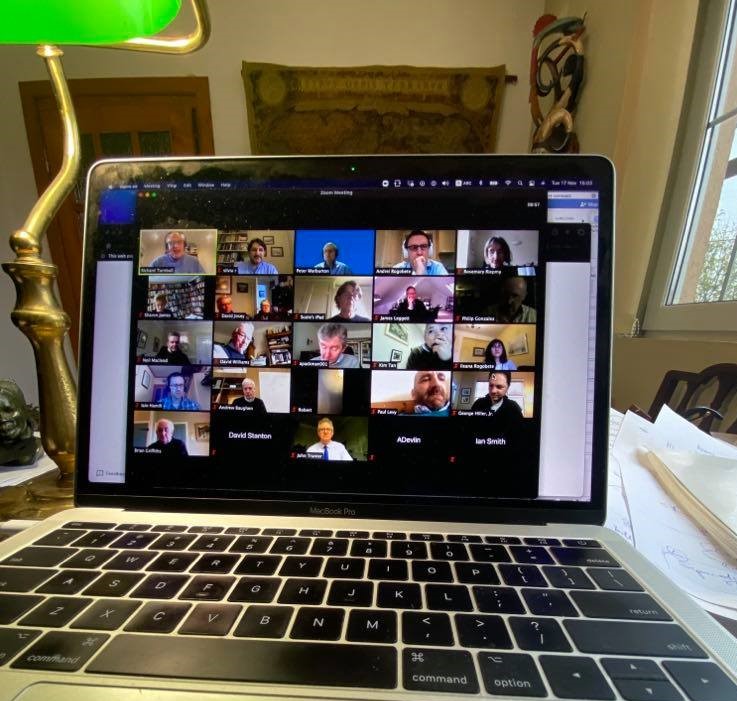
On Tuesday 17th November 2020, CEME was delighted to host an online event and publication launch on the topic of ‘The UK Savings Crisis – Rediscovering the Principle and Practice’. Lord Griffiths of Fforestfach acted as chair and contributor to the discussion alongside Peter Warburton (economics consultant and founder of Economic Perspectives), and Andrei Rogobete (report author and Associate Director, CEME).

This was first published as part of the “Personal Reflections” series for Christian Responsibility in Public Affairs (CRPA).
As we approach a second possible lockdown to deal with the coronavirus crisis – but this time with different local, regional and national characteristics – it reminds me of my experience of the first lockdown last March. Back then, the UK government advised the over-70s to self-isolate and Rachel and I did so in a hamlet of four houses just outside the city of St David’s (population 1800) on the coast of Pembrokeshire in Wales.
Even when the sun was shining the days following lockdown had an eerie quality. Shops were closed. No cars on the roads. Empty streets. Most shocking was the fact that the 11th century cathedral had been closed. This was the place where St David established a Christian community fifty years before St Augustine came to Canterbury (AD 597) and the place from which St Patrick left to go back to Ireland as a missionary in the 7th century. It has been a centre of pilgrimage for centuries. The cathedral is our parish church when we are in Pembrokeshire and the service sheet always reminds us, ‘Prayers have been said in this place every day for over 1,000 years.’ Not any longer; the doors were locked.
On the financial markets asset prices were tumbling, businesses were scrambling to obtain cash, the US Federal Reserve was pumping billions of dollars into the world economy to create liquidity and UK national output was plummeting, the worst recorded for 300 years.
For the days immediately following the lockdown I felt disorientated, confused and adrift. In an interview in The New Statesman, Grayson Perry said that everything in his world felt a bit irrelevant, which was exactly how I felt. A completely empty diary added to the strange feeling. Would we ever return to normal? What relevance would the FTSE, the Nasdaq and the Vix have now?
What value were the skills I had built up over a lifetime? Might we live in a stationary state agricultural economy? I was humbled, forced to listen and not in control.
As it happened when lockdown occurred, I was writing a review of Sir Paul Collier’s book, The Future of Capitalism. It is well-written, with policy recommendations based on evidence, analysis and pragmatism. It is worth reading but for me it had one great weakness. It was at best indifferent and at worst hostile to religion. Alongside his proposals for reform, there was no mention of how a Judeo-Christian ethic might influence the spirit of capitalism, as it had done historically (Weber and Wesley). Similarly, while not hostile to religion, Nick Timothy’s acclaimed book, Rebuilding the Nation, also had little place for religion because for him the dramatic decline in the number of those professing and practising the Christian faith made it irrelevant. The closed doors of the Cathedral seemed to show that the church itself lacked confidence in what its message could contribute at this time of crisis.
Then I received a letter from a good friend, checking on how we were coping. He had been responsible for building up a highly successful UK business in the second half of the twentieth century, which had become a household name. He recognised we were at greater risk of serious illness because of our age but said that the lockdown gave us time for reflection in a period when faith (he is Jewish) and old values were daily challenged. He recommended Jonathan Sacks’ new book “Morality”, which argues that our future depends on being guided by a philosophy of “We” not “I”, and insisted that it was “a must-read for bankers and tycoons”.
And then came the hammer-blow in his letter: “With God on another of his extended holidays we will have to prove we can live without him”. The idea of God being on an extended holiday took me back to the first time I went into my friend’s office and my shock at being confronted by a large black and white painting which dominated the room. It is of a railway junction in Continental Europe, a signal box and level crossing, but with no people, trains or any sign of activity, just railway tracks disappearing into the unknown.
To believe that God exists, that He is in control and that He cares for His world – “He who watches over Israel will neither slumber nor sleep” – goes against the grain of an enlightened, scientific world view. The default view of our society is a soft atheism, a moral relativism and unending confusion over class, gender and language. Without God, is there any ultimate framework or meaning to our existence or any purpose in living?
I started to read Ecclesiastes, one of the books of the Wisdom Literature of the Hebrew Bible. The author, Qoheleth (in Greek Ecclesiastes), is commonly translated as ‘The Preacher’ but could equally be translated as the ‘President’, the ‘Official Spokesman’, the ‘Philosopher’. It reads as if it were an autobiography and has certainly been influenced by, if not written by, King Solomon. An old man is writing to a young man, reflecting on his philosophical and theological insights. The book has the character of a complicated sermon with the bold opening statement:
“Meaningless! Meaningless! Utterly meaningless! Everything is meaningless”
If we search for the meaning of life within the boundaries of the natural world, the world we can observe, the world we experience in living, the world against which scientific hypotheses are tested, Qoheleth says life will ultimately turn out to be meaningless, pointless, empty, inconclusive, ‘a vanity’. He explores this theme relentlessly, first in connection with the pursuit of knowledge and wisdom, then pleasures from the sensual to the aesthetic, then the toil of work and wealth creation, and finally to the achievements which recognition and fame have brought. In each case the pursuit brought him no closer to understanding the meaning of life. Nine times he describes it as “chasing after the wind”. Life is an enigma. The only certainty we have in life is death.
James Packer, an influential academic and theologian, who died this summer, wrote:
“The God who rules the world hides Himself. Rarely does this world look as if a beneficent Providence were running it. Rarely does it appear that there is a rational power behind it all. Often and often what is worthless survives, while what is valuable perishes. Be realistic, says ‘The Preacher’; face the facts; see life as it is. You will never have true wisdom till you do.”
(J. I. Packer: Knowing God)
Solomon was proud of his achievements. He had created a great public works programme constructing houses, vineyards, gardens, parks, orchards, reservoirs, had bred herds and tended flocks of sheep and organised choirs, orchestras and music. Yet, as he reflects, he concludes it was simply ‘chasing after the wind’!
I have always enjoyed my work, whether as a teacher, researcher, adviser, board member, creating an enterprise, leading a team or being a member of the House of Lords. Yet I read this at a time when it seemed that the world had stopped and I was forced to ask myself the question, how much of my work has simply been ‘chasing after the wind’?
Qoheleth argues that in all areas of life a purely secular perspective on the world, a belief that God does not exist, cannot answer our deepest questions.
For the first six weeks of lockdown, the whole of the UK enjoyed a memorable Spring: the sun shone daily, flowers opened, birds sang. At the same time, traffic was minimal and pollution was noticeably down; the clarity of the night skies without planes on their flight paths revealed myriads of stars. Locked down for weeks on end, unable to use the car to travel more than two kilometres, I paid attention to the natural world on my doorstep as never before. With time to think and reflect I asked myself the question: what if I did not have faith, would I be satisfied that the beauty and wonder of the natural world were simply an accident? Or would I rather endorse Gerard Manley Hopkins’ sonnet: The world is charged with the grandeur of God.
It will flame out, like shining from shook foil; For many people, lockdown will be remembered for the way people reached out to each other, the unexpected acts of kindness, the renewed sense of community and a restored faith in the goodness of people. Technology meant that despite lockdown, families could keep in contact and spent more time with each other. This was certainly our experience both with our family and with our local community in the countryside. The owner of the local petrol began delivering newspapers to us without being asked, a local farmer would leave half a dozen fresh eggs on our doorstep from time to time, a neighbour, driving into our nearest town fifteen miles away, phoned to ask if there was anything we needed from the supermarket, the local post master invited gifts of food which he would personally deliver to those shielding. We heard of similar experiences from friends and family in urban settings. We had weekly reports from our granddaughters of new (socially distanced) friendships made and a community brought together now that their usually busy road did not divide them.
Qoheleth’s answer to understanding life is to the point: “Fear God: keep his commandments”. The use of the word ‘fear’ here does not have the sense in which we use it today, with the idea of being afraid of some impending disaster. A better word in today’s context would be ‘revere’. To revere Jesus as God is to have faith in him as our Creator, Redeemer and resurrected Lord.
Nearly a thousand years after Qoheleth, a legal expert quoted the commandments to Jesus: “Love the Lord your God with all your heart and with all your mind” and “Love your neighbour as yourself”. Jesus responded to him, “Do this and you will live”.
Reading Qoheleth during lockdown raised questions for me which needed to be confronted. I can never know the mind and purposes of God. I did, however, see the mystery and beauty of the natural world, the importance of family, friendships, community and work and I devoted greater effort to reading the Word itself. It was through these that my faith grew as I began to understand more profoundly that through the encounter with Jesus, I worship a triune God who, even during a pandemic, desires good for the world He created and has a purpose for each of us which gives meaning to our lives.
This was first published as part of the “Personal Reflections” series for Christian Responsibility in Public Affairs (CRPA).
Lord Griffiths is the Chairman of CEME. For more information please click here.
Steve Morris recalls interviewing Charles Handy and reflects on one of his books
I once spent a very pleasant day with Charles Handy at his home in Wimbledon, London. In fact, the day just flew past as we talked about organizations and life and goodness knows what else. I was interviewing him for one of the early incarnations of Amazon. The aim was to come up with a profile of perhaps the greatest living management thinker we had. I suppose Peter Drucker might be another candidate, but there was something almost indescribably attractive about both Handy’s persona and method. But there was something odd about the whole affair, and it may just have been my poor concentration levels. When I got home with the tapes and notes assembled, I found I didn’t have a great deal to write about. Or maybe, more to the point, I had too much to write about and didn’t know where to start or what to include. Maybe that’s the point about Charles Handy, there is a helter-skelter flow of ideas and observations and prophecies.
Handy is an Irish academic who has spent most of his life living in the UK. He has sold more than a million books and has shaped the thinking of many managers and other academics. His books are very approachable and full of stories and observations and words of wisdom. I think it no coincidence that he is a Christian because he uses that storytelling way of doing narratives that’s at the heart of The Christian faith.
The Age of Unreason is one of Handy’s greatest books. It’s interesting because it is a prediction about what the future may and will hold. Handy himself gives it a risk warning. He writes that, ‘we are entering an age of unreason, a time when the future, in so many areas, is to be shaped by us and for us; a time when the only prediction that will hold true is that no prediction will hold true; a time therefore for bold imagining in private life as well as public; for thinking the unlikely and doing the unreasonable.’ It is seductive isn’t it. A license to be creative and think oddly because we live in odd times. And how true and relevant for an age of the entrepreneur.
Handy tells us to ditch the Whig theory of progress and history. We are not on a gentle upward curve where the future is substantially the same as the past, each step representing measurable progress on the previous one. Instead, we need to strap ourselves in major and unpredictable times due to demographics and technology.
Of course, Handy is right on the money but the thing is that he was writing 25 years too early. The world he described and the crazy unreason that seems to go with it are much more the case now than they were then. Who would have believed that there would be a full-scale assault on the idea of truth and who would have thought that reason would be seen as a poor substitute for feelings and experience? We are in the new Romantic Age.
Handy dissects a moment in history, 1989. He says that we’re about to go into a period of unprecedented nonlinear change. His argument is that not only that society will need to be different but so will we. All the old rules have been torn up, rules about what makes a career, a place of work and an education. We’re in the age of portfolio life where we mix and match different skills. We are entering an age where what seemed impossible becomes possible. Think of the speed of technological processing and change.
To make predictions, as Handy does, is a very dangerous business and some of them look rather funny. But then we have the advantage of having lived through the period Handy could only dream about. He pictures a world where there are expert GPs working online, where smart cards replace cash, where new drugs will be developed to fight AIDS and what he calls cordless telephones will give everyone the chance to work away from the office!
Reading all these years later the Age of Unreason is both brilliant and odd. I think that strangeness comes from the different tones at work in the book. In one moment, we are hearing about a conversation with a colleague and the next we have something much more academic. It creates a narrative tension. Yet, he is full of ideas and prophecies. Just one example showing how he was ahead of his time – he develops the idea of the Shamrock organisation (made up of full-time core people, hired specialists and freelancers (outsourcing non-core elements) and other seasonal temporary workers). Handy also makes the valuable observation that the person we should invest in most is ourselves – in our own education for life – and that we shouldn’t rely on anyone else to open doors or make things happen for us. He really is full of insight.
In this age of post-truth and shaky foundations – in the age of unreason, I find myself no longer able to believe in the persona of the management guru and I am not alone. Could we, would we, ever be able to construct a persona like Handy’s again? Is there any room for the sage? Who would listen? Why is his truth any better than another person’s? We have left the age of the patricians. Maybe we are entering the world where poets and film makers and novelists might be able to give us wisdom about the way of the world and the human condition? However you look at it, creativity and innovation lie at the heart of thinking about the future.
Back in the day when I read The Age of Unreason for the first time, I felt that Handy had all the answers. These days I don’t think that’s true, but I do miss thinkers like this helping me to wonder and dream about what the future may hold. In our post-Covid world where will we find our wisdom? Where will we find our wisdom?
Thank God for Charles Handy.
Steve Morris is the Vicar of St Cuthbert’s, North Wembly, an entrepreneur, and the author of several publications for CEME and beyond including Enterprise and Entrepreneurship, and Lessons from Family Business, both available from the CEME office. He is married, with two children and has three cats. His latest writing, Our Precious Lives, dealing with the power of story-telling is available here.
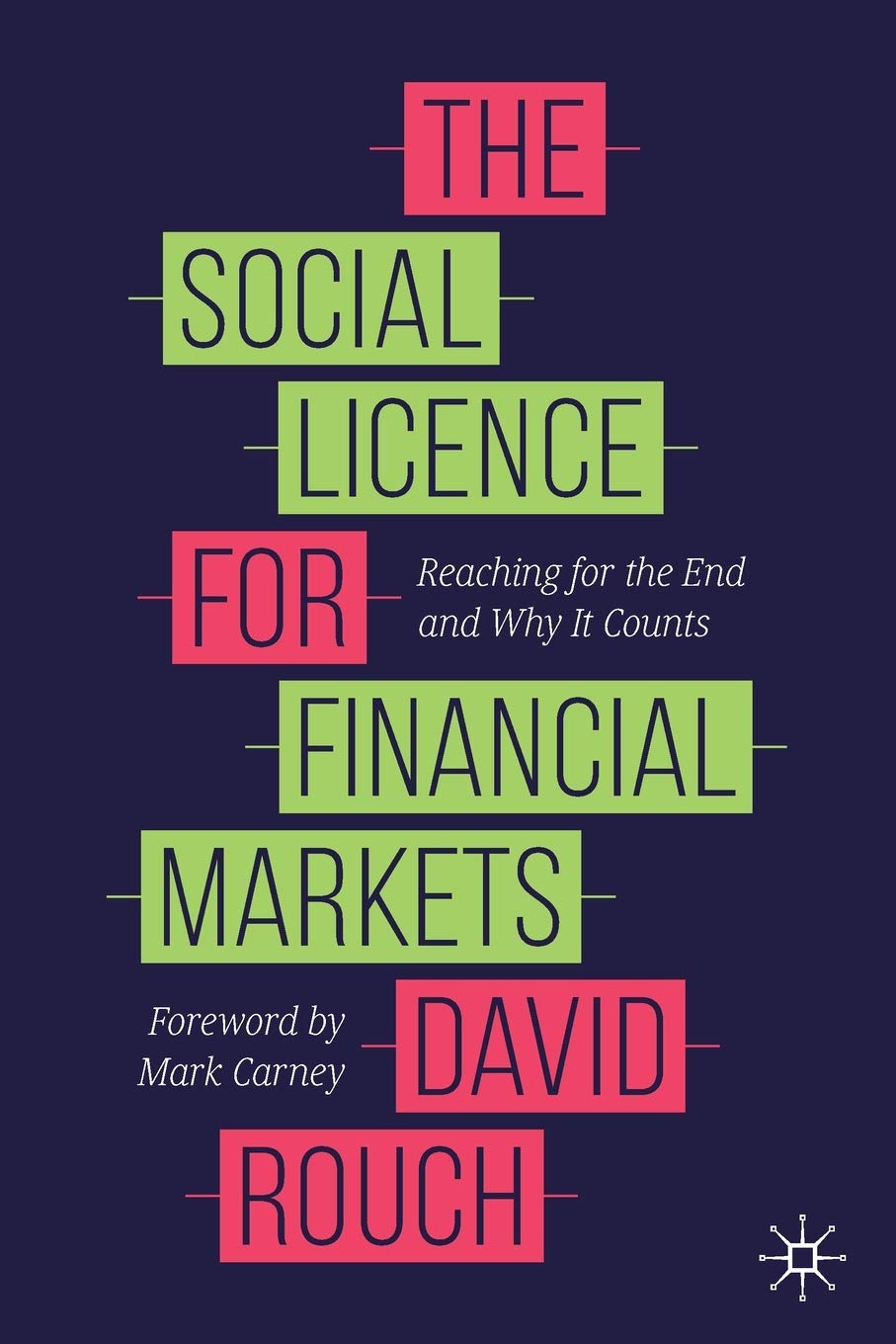
In the aftermath of the Global Financial Crisis, Mark Carney, the former Governor of the Bank of England, coined the concept of a “social licence” for financial markets and, in the Forward to David Rouch’s book, he commends Rouch for the progress he has made in defining a framework for this social licence.
Rouch’s basic thesis is concisely summarised in a six-page overview at the start of the book. He acknowledges that “Capitalism in one form or another is the only realistic option for meeting a host of human needs” (page xx). However, he also recognises that there has been a breakdown of trust of the kind that Mark Carney has identified and that “the usual toolkit of laws and regulations has been powerless to heal the fracture between the financial sector and surrounding society” (page xx). He suggests that the view that financial markets are really only about money-making is wrong and that recognition of a social licence is “both an observation about the relationship between finance and society and an expression of aspiration about how it could be at its best” (page xxii). Rouch wants to ensure that this recognition becomes universal and argues that paying attention to it “has the potential to help reorientate the individual relationships that comprise the wider relationship between finance and society, by strengthening positive reciprocity” (page xxiii). This, in turn, leads to various policy proposals designed to bring an overarching “social licence” narrative to financial market practice and regulation.
The resulting book is not an easy read. Rouch expresses the hope that traders, directors, lawyers, campaigners, regulators, academics, politicians and policy makers will approach finance differently as a result of what they read in it but even many of them will find it heavy going. Some parts are highly specialist (the 22 page “Written Standards Map” at the end of Chapter 5 being an extreme example of this), the language throughout is complex and a lot of the book is devoted to discussions of psychological, sociological and philosophical issues (e.g. theories of group behaviour and human motivation and concepts of human dignity and justice).
Rouch appears to be conscious of this issue and provides what he describes as a “Fast Track” summary at the start of each chapter, which sets out the key messages of the chapter and its main implications. He also frequently reminds the reader of what has been said earlier in the book and points to the direction of travel of his argument. Unfortunately, however, these devices do not completely solve the problem and they result in both a significant amount of repetition and an over self-conscious stress on the structure of the book.
Those who persevere will, however, find much food for thought and, probably, plenty to applaud in what Rouch says. Most fundamentally, he is surely right in asserting that markets are in fact, and should be, about more than simply making money. The knee jerk reaction of people (including market participants) to the effect that they care about nothing other than money can be proved to be wrong not only by reference to modern behavioural psychology but very simply through questions and answers posed to market participants. Moreover, the suggestion that markets should have a broader purpose is consistent with most major ethical systems, whether religious or secular.
Rouch is also surely right in recognising the power of ideas, or “narratives” as he calls them. If people believe that they are operating in a dog-eats-dog world constrained only by a jumble of complex regulations, they will behave differently and they would if they believed that they were working in an environment having a broad social purpose in which the relevant rules are, however imperfectly, reflections of that purpose. Furthermore, market and corporate culture exerts its own pressure for good or for ill. In part, these things explain why good people do bad things or, conversely, why even bad people may be constrained by the culture in which they find themselves.
In this connection, it is good to see Rouch acknowledge “the idea that legally enforceable regulatory rules that overlap with aspirational standards may diminish the force of the latter” (page 189) as well as the fact that “you cannot ultimately legislate for a sense of urgency. Nor can you force people to have a healthy relationship or to be trustworthy” (page 9). It is also encouraging to see his repeated references to issues of trust, which recognise that market behaviour comes down to the actions of individuals and groups of people and that relationships are key to the achievement of desired outcomes.
That said, there is a serious problem at the heart of the book: Rouch’s definition of “the social licence for financial markets” is vague. Indeed, he himself recognises that “Defining the substance of the social licence is … challenging” (page 133). He frequently says what it is not: It is “not a ‘mere’ metaphor” (page 113), it is not a “social contract” (page 115) and it is not to be identified with the “social licence to operate” that has been perceived in relation to other industries, particularly extractive industries (page 117). Furthermore, it is not to be identified with the legal authorisations which are required in order to be a market participant. It is, on the contrary, something that is granted by society as a whole and it “can be treated as granted to the extent that those in society have given their justified trust to financial operators, trust based on solid reasons for believing that those in financial markets will carry on business in a way that is consistent with the licence” (page xxii). It comprises “a freedom to pursue just ends by just means in financial markets, where justice is a situation in which the human dignity of market participants and those affected by their activities can be experienced most fully” (page xxii, italics in the original).
Almost every element of these statements gives rise to serious issues. For example, since most members of society (including many who are well educated) will have little idea of what the financial markets do let alone how they operate, in what sense can they be said to give “their justified trust … based on solid reasons”? In any event, what society are we talking about? Rouch appears to be having regard to nation states (or, perhaps, some super-national entities like the European Union) but is that realistic in a modern globalised world? Equally seriously, since there is no common understanding of the concept of “just” behaviour in society (see, for example, “What is Economic Justice?” by Andrew Hartropp), how can this form the basis of an adequate definition of the social licence?
Rouch acknowledges some of these difficulties, including the lack of consensus in relation to some key concepts such as the nature of “justice”, (page 135) but he believes that there is sufficient high-level consensus to render the concept of the social licence itself viable. Unfortunately, however, one may legitimately doubt whether this is true and ask whether the vague language of “social licence” has the effect of generating the appearance of agreement among those who use the term, without its reality. For example, as Hartropp demonstrates, an approach to justice that is based upon rights or needs will necessarily arrive at completely different conclusions from an approach that is based on due rewards or deserts and concepts based on justice in production will talk of completely different things from a concept based on justice in distribution (which, incidentally, Rouch appears to adopt).
There also seem to be problems in evaluating the role of laws and regulations in relation to the “social licence”. Rouch regards these laws and regulations as both evidence for such a licence and, to some extent, indicative of the terms and conditions of the licence. However, it is surely arguable that ever increasing regulation is indicative of the withdrawal or, at least, restriction of the terms of the “licence” rather than evidence of its grant. Furthermore, Rouch relies heavily on written materials produced by a variety of sources as the evidence of the terms of the licence and one is left with the impression that he has simply included “soft law” and related matters within his concept without really altering the regulation-based framework which he has previously recognised to be inadequate.
Some other questionable aspects of Rouch’s underlying analysis are less fundamental but nonetheless important in relation to the impact of his proposals. In particular, he places great stress upon the need to promote “other regarding behaviour” in contrast to “self-interest”. This is obviously morally right but, as Adam Smith long ago famously demonstrated, the two categories are not completely discreet. The building of trust may involve “other regarding behaviour” but, as Rouch recognises, it is absolutely necessary in business relationships and even the most self-interested person will need to have regard to this in order to advance their own interests. Similarly, most people have a desire for the approbation of others and this too may involve behaviours that, from one perspective, are other regarding but, from another perspective, are self-interested. In places, Rouch appears to acknowledge this and he clearly does not believe that the pursuit of profit is wrong in itself but, if his goal of widespread recognition of the “social licence” is to be realised, it would be desirable to avoid an undue bifurcation of motivations and instead to ensure that the narrative recognises that self-interested and other regarding behaviour are not in opposition as often as may sometimes be thought.
As one reaches the end of the book, one is left with a nagging feeling that the concept of a “social licence” is too vague and hard to get hold of for it to be capable of comprising the compelling narrative that Rouch rightly believes to be necessary to replace the distorted narrative of unbridled self-interest that is often wheeled out even by those within the financial markets. Might it not be better to focus on a simpler narrative?
Such a narrative might commence by focussing (as the book does) on the clearly evidenced positive role of financial markets within society, thus addressing both self-esteem of those within the markets who desire to be doing something worthwhile and the misplaced hostility of some outside; it might demonstrate how the aspirations of organisations operating in the financial sector and the personal aspirations of those who work for them (including financial aspirations) are advanced rather than held back by “other regarding behaviour”, which (as Rouch also agrees) is thus not code for abandoning the pursuit of profit let alone a demand that financial institutions turn themselves into quasi-charities; and it might stress some simple ethical values that are neither obscure nor disputed among reasonable people.
In doing this, the narrative could build on concepts that are well understood, widely accepted and of proven worth such as the hard monetary value of trust and brand reputation, the role of client/customer focus in developing this, the need for long term business sustainability and the motivational impact on staff of being an organisation that is known for its high standards, including ethical standards.
Such an approach would focus on the culture of financial services organisations rather than metaphysical concepts. It would avoid the obscure language of the “social licence” with the negative over-tones of constraint and implicit threat that may be perceived in it and replace it with a simpler and more positive narrative which invites participants in the financial markets to take pride in what they are doing and recognise that they will best prosper, both financially and otherwise, in an environment that is ultimately beneficial to society as a whole.
“The Social Licence for Financial Markets” by David Rouch was published in 2020 by Palgrave Macmillan (ISBN 978-3-0-30-40219-8) 327pp excluding bibliography.
 Richard Godden is a Lawyer and has been a Partner with Linklaters for over 25 years during which time he has advised on a wide range of transactions and issues in various parts of the world.
Richard’s experience includes his time as Secretary at the UK Takeover Panel and a secondment to Linklaters’ Hong Kong office. He also served as Global Head of Client Sectors, responsible for Linklaters’ industry sector groups, and was a member of the Global Executive Committee.
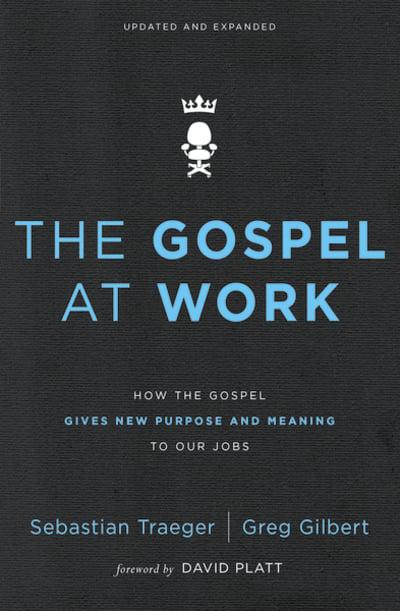
“The Gospel at Work” by Sebastian Traeger & Greg Gilbert is a relatively recent addition (published 2018) to the cohort of literature that aims to focus on faith within the workplace. This is a topic that likely stirs interest from secular and religious audiences alike. What role does a person’s faith have at work? How should work be understood by Christians? How can we develop a biblical understanding of work? These are just a few of the main questions addressed in the book.
The authors bring together relevant and varied knowledge on the issue. Sebastian Traeger is a former technology entrepreneur and current Vice President of the International Mission Board for the Southern Baptist Convention. Greg Gilbert is the author of several books and currently serves as the senior pastor of Third Avenue Baptist Church in Louisville, Kentucky.
The central message or ‘thesis’ of the book is that, regardless of your job, you are ultimately working it for God, “Who you work for is more important than what you do” (page 17). This is, as the book points out, contrary to what “the world” considers successful and important.
The premise is based on the words of the apostle Paul in Ephesians 6:7 where he calls to “Serve wholeheartedly, as if you were serving the Lord, not people”. Yet the focus is not just on the action itself, but also the attitude of heart. In Colossians 3:22 Paul calls people to work with “…sincerity of heart and reverence for the Lord” (page 16).
“The Gospel at Work” is devised into eleven main chapters and here we will touch upon some of the main points that arise.
Chapters I and II start with a dichotomy that sets the tone for the rest of the book: “The Idolatry of Work” versus “Idleness in Work” (pages 13 & 23). Traeger and Gilbert capture well the two extremes that many Christians risk falling into: making work their idol on one end, or rejecting it as anathema to God’s purpose for their lives on the other end.
There is nothing wrong with ambition or determination in our careers. However, the authors rightly point out that “trouble starts when our pursuit of enjoyment or influence or status in our work begins to make our work the source of ultimate satisfaction or meaning for us” (page 25).
Equally damaging on the other end of the spectrum is ‘idleness’ at work. Idleness here does not necessarily mean to be idle per se (while others provide for you), but rather a more subtle expression “that has less to do with productivity of our hands and everything to do with the motives and desires of our hearts” (page 35).
Chapters III to V take the discussion further and develop guidance on issues such as the gospel in work, God’s purpose for us, and choosing a job or career path. An interesting point is made on the correct order of priorities when making career choices expressed in the form of a pyramid. God sits at the foundation, serving others is in the middle, and loving the ‘self’ is the tip of the pyramid coming third (page 75). The book recognises that in reality, these priorities are often reversed: the self comes first, pleasing others is second, and serving God is third (page 79). The authors propose that as a remedy Christians must keep the right perspective: work is temporary, God is eternal (page 81).
Chapters VI to VIII continue with practical applications such as balancing work with faith and family, managing work relationships, and what it means to be a ‘Christian boss’. A useful discussion can be found on the nature of competitiveness in the workplace where the authors (rightly) argue that, “It’s not competition the Bible forbids, but rather the world’s playbook for competition. […] Win by running faster not by tripping all your competitors” (page 106).
The final chapters IX to XI take a more outward look and consider topics such as sharing the gospel in a secular space, the value of full-time ministry, calling, and defining success. On the latter the book makes the point in not defining ‘success’ by what the world considers ‘success’ but rather in the ability to one day stand before Jesus and say “Lord, where you deployed me, I served well. I gave it my all. I worked at it with all my heart because I was working for you, not for human masters” (page 158).
In concluding, “The Gospel at Work” is an excellent resource for anyone interested in the topic of faith within the workplace. It combines practice and theory well, using clear examples and principles that are backed by scripture. One point of contention could be that the authors write with great certainty. On one level this is perhaps not bad thing but on another it does, at times, make the book read like a ‘self-help’ piece of literature – one that was made to hit bestselling charts. Problem A is solved by doing X, Y, Z. I am sure, however, that this was not the author’s intent.
It is perhaps more of an observation than a direct critique. Yet one cannot help but feel that God’s “…ways are above [our] ways…” (Isaiah 55:9). There is an element of God’s mystery in life that often cannot be solved by simply following a clear set of instructions (good and correct though they may be). This perhaps an aspect that could have been developed more in the book. Nonetheless, it is a recommended read for anyone with an interest in the subject.
“The Gospel at Work” by Sebastian Traeger & Greg Gilbert was published in 2018 by Zondervan, 160pp.

Andrei E. Rogobete is the Associate Director of the Centre for Enterprise, Markets & Ethics. For more information about Andrei please click here.
JP Taylor wrote in his Oxford History of England:
“Until August 1914 a sensible, law-abiding Englishman could pass through life and hardly notice the existence of the state beyond the post office and the policeman…He could travel abroad or leave his country forever without a passport or any sort of official permission. He could exchange his money without restriction or limit. He could buy goods from any country in the world on the same terms as he bought goods at home. For that matter a foreigner could spend his life in the country without permit and without informing the police…All this was changed by the impact of the Great War…The state established a hold over its citizens which though relaxed in peace time, was never to be removed and which the Second World War was again to increase. The history of the English people and the English State merged for the first time.”
How things have changed.
As Taylor notes, freedoms are often eroded in wartime. Does covid 19 justify the same kinds of erosion of freedom?
If you think about these issues from the perspective of an economist you end up in roughly the same place as that to which the standard account of Catholic social teaching would take you. The language and thought process would be different, of course.
Let’s start with the economics. The classic public health case for intervention arises from the fact that the benefits of public health interventions are, in the jargon, non-excludable and not diminished in consumption. You therefore cannot easily charge for those benefits. If I have a vaccination for an infectious disease, this benefits large numbers of people other than me. Given this, we might want to use policy measures to encourage actions that have public health benefits.
In a free society the chosen intervention would normally involve taxing the general population to provide the intervention, such as a vaccination programme, for free. An out and out libertarian might object to this, but most economists and most people who broadly support a market economy would support such an intervention.
If you approached this problem from the perspective of Catholic social teaching, you might reason as follows. Broadly, families should have responsibility for making choices in relation to health and healthcare. Other institutions in society would, in various ways, support families in those choices. However, if the common good of society as a whole is under attack, the government may intervene just as it would intervene by raising an army or, occasionally, through conscription when society was under attack by a hostile power. Normally, we allow families the maximum freedom but, sometimes (only rarely), we have to suppress that freedom for the greater good of the protection of society as a whole. Catholic social teaching would think about this in a less utilitarian way than standard economics, but you end up in a similar place.
Just as we sometimes have to put people’s lives at risk or even conscript armies in wartime, sometimes Catholic social teaching would accept quite draconian measures if the survival of society were at stake. We might have to accept isolation for people with infectious diseases and possible separation from their families or even a lockdown. It is rarely desirable to stop people working to support their families but it might be justified if there were a legitimate fear that people may not be able to live without unacceptable fear of death or serious ill health.
But, what about track and trace?
A track and trace system requires us to go through certain procedures and give information to private companies and the government if we partake in certain activities. Again, this may be a proportionate and appropriate intervention for the protection of the common good. We might be concerned that the poor and those who do not have access to adequate technology might be excluded from participating in wider society in a track and trace system. The virtue of solidarity would warn us that we should take steps to avoid this.
Given what we know about humanity, we might be wary of such schemes in practice. Human persons can use their reason to behave and respond to the conditions that face us in all sorts of ways that might be difficult to predict and monitor using track and trace schemes. As Adam Smith put it in The Theory of Modern Sentiments:
“The man of system…is apt to be very wise in his own conceit; and is often so enamoured with the supposed beauty of his own ideal plan of government, that he cannot suffer the smallest deviation from any part of it…He seems to imagine that he can arrange the different members of a great society with as much ease as the hand arranges the different pieces upon a chess-board. He does not consider that in the great chess-board of human society, every single piece has a principle of motion of its own, altogether different from that which the legislature might choose to impress upon it.”
When considering all interventions, we should bear in mind that, although the common good, requires that all persons have access to basic healthcare and are not put at unacceptable risk of death, it also requires that we are able to have dignified work, social relationships and education too. So, when we see what seems to be policy chaos around us with division of opinion within and between the government, parliamentarians, the civil service and scientists, perhaps we should be sympathetic. Although any one of us might have very firm opinions about what government should be doing in this pandemic, a wide variety of different opinions can easily be derived from same basic ethical stance. In addition, as the quotation from Adam Smith suggests, the practical consequences of an intervention can be impossible to evaluate with any certainty.
However, we can say with certainty that interventions that are put in place in emergencies should be brought to an end at the soonest possible moment. This tends not to happen when liberties are taken away in war time. Those on the left might be relaxed about the moves towards economic socialism after each world war. However, experience has also shown that “emergencies” have led to the erosion of civil liberties that those on the left tend to value – the aftermath of 9/11 being one good example. So we should not be complacent. As the Compendium of the Social Doctrine of the Church puts it: ‘state action in the economic sphere should also be withdrawn when the special circumstances that necessitate it end’.
This article was first published on the Catholic Social Thought blog.
Philip Booth is Senior Academic Fellow at the Institute of Economic Affairs and Professor of Finance, Public Policy and Ethics at St. Mary’s University, Twickenham. He also holds the position of (interim) Director of Catholic Mission at St. Mary’s having previously been Director of Research and Public Engagement. He is a Senior Research Fellow in the Centre for Federal Studies at the University of Kent and Adjunct Professor in the School of Law, University of Notre Dame, Australia. He is also an Associate Fellow with the Centre for Enterprise, Markets and Ethics (CEME).

The Centre for Enterprise, Markets and Ethics (CEME) is pleased to announce the publication of The Social & Economic Teaching of the Hebrew Scriptures, edited by Richard Turnbull.
A PDF copy can be found here. The publication can also be purchased in paperback by contacting CEME’s offices via email at: office@theceme.org

One of the consequences of the Covid-19 pandemic is a shift in attitudes and practices of remote working at least some of which are likely to be permanent.
A survey undertaken by the Institute of Directors of around 1,000 firms found that 74% plan on maintaining or increasing the amount of home working and more than 50% intended to put into effect a long-term reduction of office space.
These moves have a number of implications from an ethical point of view, both from the perspective of the individual and also corporately and more widely. Working from home is not new in itself. Many individuals operate from home, either as individual professionals (eg the clergy) or as self-employed, running a business. Others, maybe more senior executives will operate home offices or simply be able on occasion to work from home. All of these examples have had to figure out issues of boundaries, ethics and so on. There are both gains and losses. What is perhaps different now is the scale and the permanence.
What then are the key issues?
The question of moral character
Ethics can be rule based or virtue orientated. Both are probably needed to some degree but a lot of arguments around ethical issues in business revolve around the relative emphasis placed on rules or moral character. Home working increases the negative aspects of rules (specific timings for being signed on; monitoring software) and hence also increases the importance of moral character; the employee recognising their professional responsibilities and acting accordingly. In the long term, greater weight given to the development of moral character can only be beneficial for business ethics.
Increased flexibility for both employer and employee
There are gains in flexibility for both employer. The individual can manage the boundaries between work and home in real time, flexibility increased by the reduction in commuting. Employers can manage their office space more flexibly and efficiently. Nevertheless, there cannot be total flexibility (an employee choosing to work from 1am to 9am) as there are corporate, commercial objectives that involve more than the individual.
Financial and environmental savings and gains
The financial savings for both employee and employer could be considerable. For the individual employee this is not simply less commuting cost and time, but, rather, if a physical presence in the office or elsewhere is required say once or twice a week, the individual can reside further away and hence, potentially, open up less expensive housing and further potential improvements to lifestyle. For the employer less city centre office space will be needed; or, indeed, no office space at all in the traditional business districts – which, of course, has knock-on effects on employment.
Clearly, there are also environmental gains to be made from home working; less commuting, pollution, emissions, gains replicated in a move to smaller office spaces. Clearly this is not all on one direction, but the gains should not be overlooked.
The complexities of remote management
There are, however, a number of clearly negative factors in this move to home working. One of these is the increased complexity of remote team management. The resources required for managers to oversee a wide range of employees all working from home are considerable, time-consuming, and not necessarily efficient.
Loss of professional engagement and team efficiency
Indeed, to follow on from the last point, there is a major loss in home working from the point of view of both individual and the employer in terms of the profession gains from face-to-face engagement. For the individual home working can be incredibly lonely (only partially mitigated by Zoom or its equivalent) and there is a considerable loss of professional engagement. A significant amount of job satisfaction derives from the daily engagement with those similarly engaged, either simply the social interactions of work, or, in professional environments, the intellectual stimulation and debate. For the employer, there is also the matter that these issues may have direct negative impact on team efficiency and commercial outcomes. An individual may or may not be more efficient working from home, but it is certainly the case that lack of teams meeting, working, planning and engaging together will reduce efficiency and have commercial consequences.
Varied capacity for home working
Both employers and employees face difficulties generated by different employees having varied capacities to work from home. Issues ranging from space, children, mental well-being will mean that one size will not fit all. How is space to be allocated in offices? Will this varied capacity mean first and second-class employees? Savings may accrue disproportionately.
Home working is almost certainly here to stay, at least in a significantly increased way for the next period of time.
There are many advantages, but it is not a panacea. Both employers and employees will need to work through new ways of operating and working. In addition, the tax system is not really geared for home working and changes may also be needed there. The development of virtue in moral character is essential. The losses, however, from the loss of personal human engagement are considerable and this, I think, will act as a counter to the move towards home working.
Finally, spare a thought for commercial property funds, or those parts of mixed funds!
Dr Richard Turnbull is the Director of the Centre for Enterprise, Markets & Ethics (CEME). For more information about Richard please click here.